Search the Site with 
General Characteristics Crew List Memorabilia Cruise Books History About the Ship's Name Image Gallery to end of page
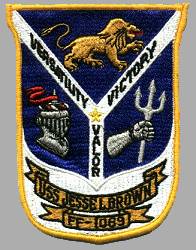
USS Jesse L. Brown (FF 1089)

- formerly DE 1089 -
- decommissioned -


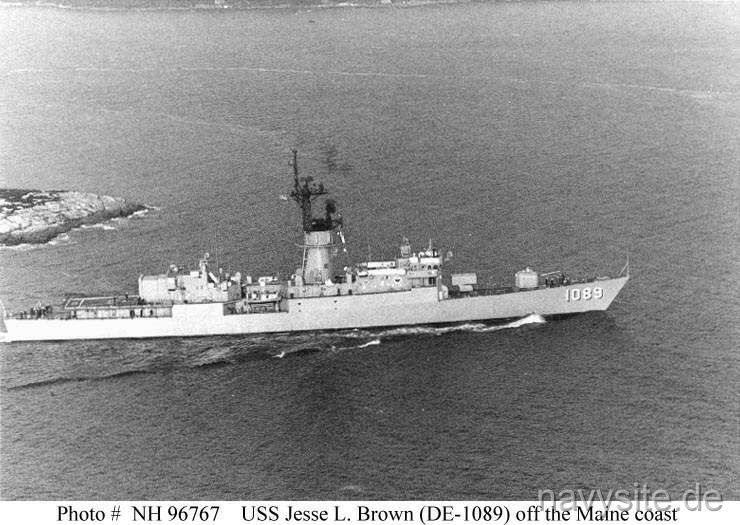
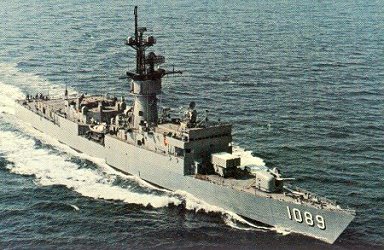
USS JESSE L. BROWN was the 38th ship in the KNOX - class of frigates and the first ship in the Navy to bear the name. Commissioned as a destroyer escort (DE), the ship was reclassified as frigate (FF) on June 30, 1975. Decommissioned on June 27, 1994, the JESSE L. BROWN was transfered to Egypt the same day. There she was recommissioned as DAMIYAT.

General Characteristics:Awarded: August 25, 1966
Keel laid: April 8, 1971
Launched: March 18, 1972
Commissioned: February 17, 1973
Decommissioned: June 27, 1994
Builder: Avondale Shipyards, New Orleans, La.
Propulsion system: 2 - 1200 psi boilers; 1 geared turbine, 1 shaft; 35,000 shaft horsepower
Length: 438 feet (133.5 meters)
Beam: 47 feet (14.4 meters)
Draft: 25 feet (7.6 meters)
Displacement: approx. 4,200 tons full load
Speed: 27 knots
Armament: one Mk-16 missile launcher for ASROC and Harpoon missiles, one Mk-42 5-inch/54 caliber gun, Mk-46 torpedoes from single tube launchers, one 20mm Phalanx CIWS
Aircraft: one SH-2F (LAMPS I) helicopter
Crew: 18 officers, 267 enlisted


Back to topback to top  go to endgo to the end of the page


Back to topback to top  go to endgo to the end of the page

Crew List:

This section contains the names of sailors who served aboard USS JESSE L. BROWN. It is no official listing but contains the names of sailors who submitted their information.


back to top  go to the end of the page


Back to topback to top  go to endgo to the end of the page

USS JESSE L. BROWN Cruise Books:


Back to topback to top  go to endgo to the end of the page

USS JESSE L. BROWN History:

USS JESSE L. BROWN was a KNOX-class ocean escort, later reclassified as a frigate and finally as a naval reserve training frigate, whose United States Navy career ran from 1973 to 1994. USS JESSE L. BROWN was laid down on April 8, 1971, at Westwego, Louisiana, by Avondale Shipyards, Inc. She was launched on March 18, 1972, sponsored by Daisy P. Thorne, the widow of Ensign Jesse L. Brown, while Pamela Elise Knight, Brown's daughter, served as matron of honor. The ship was commissioned at Boston Naval Shipyard on February 17, 1973, with Commander William M. Fogarty in command. After sea trials and fitting out, she reached her first homeport, Newport, Rhode Island, on March 8, 1973, and almost immediately began the normal sequence of weapons loading, trials, shakedown training, acoustic testing, and refresher work that would make her operational.

USS JESSE L. BROWN left Newport on March 13, 1973, to load ammunition at Naval Weapons Station Yorktown, Virginia. On April 2, 1973, she departed Newport again and carried out antisubmarine exercises with the submarine USS JALLAO (SS 368) while transiting to Port Everglades, Florida, between April 3 and April 5. She then conducted weapons-system accuracy trials at Port Everglades and on the Andros Island range in the Bahamas from April 7 to April 17. From there she proceeded to Guantanamo Bay, Cuba, for refresher training, the standard Atlantic Fleet proving ground where a newly commissioned ship's crew was evaluated in damage control, engineering, weapons, seamanship, and combat readiness. The ship made a short visit to Port-au-Prince, Haiti, from May 12 to May 13, completed her Guantanamo training one week ahead of schedule on May 16, and then conducted naval gunfire support training at Culebra Island, Puerto Rico, from May 17 to May 19 before returning to Newport.

During the summer of 1973, USS JESSE L. BROWN combined training with public and ceremonial duties. On June 30, she carried family members on a dependents' cruise from Newport to Gloucester, Massachusetts, by way of the Cape Cod Canal. From July 1 to July 5, she represented the Atlantic Fleet during Gloucester's 350th anniversary celebration. On July 13, she returned to Yorktown to load ammunition, then proceeded to Port Everglades for sonar-dome cleaning and completed acoustic trials at Andros Island from July 18 to July 20. From August 6 to August 23, she conducted at-sea training for naval midshipmen. Rear Admiral Samuel L. Gravely Jr., Commander Cruiser-Destroyer Group Two and the first African American naval officer to attain flag rank, embarked on August 14 to observe the training. On August 30, 1973, USS JESSE L. BROWN reached her new homeport of Charleston, South Carolina, as a member of Destroyer Squadron Four, and on September 1 she began a post-shakedown availability at Charleston Naval Shipyard. That availability continued into the new year and ended on January 15, 1974.

In early 1974, USS JESSE L. BROWN moved into the workup cycle for her first overseas deployment. She steamed to Norfolk, Virginia, on February 6 and February 7 for deperming, a magnetic-signature reduction procedure intended to lessen vulnerability to mines. On February 14, she received her first embarked helicopter detachment and began deployment preparation with a month of refresher training. On March 18, she sailed for Puerto Rico, completing readiness and accuracy checks at Roosevelt Roads and Vieques, as well as naval gunfire support at Culebra Island, before returning to Charleston on March 23. From April 29 to May 7, she participated in LantReadEx 3-74 and received the LantReadEx Top Operator Award for strong performance across operational areas. After loading ammunition at Naval Weapons Station Charleston on June 3 and holding a dependents' cruise in the Charleston operating area on June 6, she was ready for her first extended overseas assignment.

On June 14, 1974, USS JESSE L. BROWN departed Charleston for her first Mediterranean deployment. She reached Rota, Spain, on June 24 for turnover and held her first change-of-command ceremony there. During this period, she also received the Battle Efficiency "E" and several departmental excellence awards for the previous year. After visiting Sete, France, from June 30 to July 4, she operated off Cyprus through August 4 during a serious regional crisis. In July 1974, a coup d'etat by Greek Cypriot elements and the subsequent Turkish military intervention on Cyprus created a dangerous environment for foreign nationals. USS JESSE L. BROWN supported American amphibious forces engaged in the evacuation of United States citizens from the island. In the months that followed, she conducted the broader pattern of Sixth Fleet operations in the Mediterranean, combining surveillance, antisubmarine training, allied exercises, and port visits. Her itinerary included Genoa, Italy, from August 4 to August 11; Sousse, Tunisia, from August 14 to August 15; Augusta Bay, Sicily, from August 17 to August 30; Palma de Mallorca, Spain, from September 4 to September 8; Barcelona, Spain, from September 9 to September 18; Alicante, Spain, from September 20 to September 23; Cagliari, Sardinia, from September 27 to September 30; Malaga, Spain, from October 4 to October 9; and Naples, Italy, from October 16 to October 24 and again from October 30 to November 5. During the first Naples call, the crew participated in the activation ceremonies for the Naval On-Call Force, Mediterranean, a multinational North Atlantic Treaty Organization arrangement in which allied ships trained together to improve communications, tactics, and interoperability.

On November 7, 1974, Admiral Harold E. Shear, Commander in Chief, United States Naval Forces Europe, visited USS JESSE L. BROWN to observe antisubmarine operations. Two days later, the ship's helicopter rescued two crewmen from a downed United States H-3 helicopter. After additional port calls at Civitavecchia, Italy, from November 12 to November 19 and Gibraltar from November 23 to November 24, the ship departed the Mediterranean and returned to Charleston on December 6, 1974. The return closed a demanding first deployment that had combined Cold War naval presence, an evacuation contingency off Cyprus, allied operations, and routine Sixth Fleet work in the central and western Mediterranean.

After a holiday standdown and maintenance period in January 1975, USS JESSE L. BROWN prepared for and passed her Operational Propulsion Plant Examination in late January and early February. She then joined Operation Springboard 1975 in the Caribbean, completed naval gunfire support training at Vieques, visited St. Thomas, United States Virgin Islands, from February 15 to February 18, refueled at Roosevelt Roads on February 19, and conducted several days of antisubmarine exercises off Puerto Rico. After visiting San Juan from February 22 to February 24, she resumed antisubmarine work and returned to Charleston on February 28. On March 10, with Commander Destroyer Squadron Four embarked, she rendezvoused with USS GARCIA (DE 1040) and drilled with USS SUNFISH (SSN 649) in antisubmarine warfare, communications, and division tactics in the Virginia Capes operating area through March 13. On April 15, she sailed from Charleston with USS PAUL (DE 1080) and again exercised with USS SUNFISH. From April 17 to April 27, she took part in exercise Agate Punch in the Cherry Point operating area with Task Force 26, led by the aircraft carrier USS JOHN F. KENNEDY (CVA 67). Returning to Charleston on April 28, she entered a three-month maintenance availability. On July 1, 1975, as part of the Navy-wide June 30/July 1 reclassification of ships, she was reclassified from destroyer escort DE 1089 to frigate FF 1089. She loaded weapons at Naval Weapons Station Charleston on July 22, held sea trials on July 23 and July 24, conducted a dependents' cruise on July 25, and completed final deployment preparations.

On August 19, 1975, USS JESSE L. BROWN sailed from Charleston in company with USS VALDEZ (FF 1096) for a deployment that took her beyond the Mediterranean into the Red Sea, Persian Gulf, Arabian Sea, and Indian Ocean at a time when the United States was maintaining presence in a region shaped by Cold War competition, the strategic importance of Gulf oil, and American security ties with Iran, Saudi Arabia, Pakistan, and other regional states. The two frigates called at Rota from August 29 to August 30 and reached Port Said, Egypt, on September 4. They transited the Suez Canal on September 5 and steamed through the Red Sea to Djibouti, then still the French Territory of the Afars and the Issas, where USS JESSE L. BROWN completed turnover with USS NEW (DD 818) on September 9. On September 12, the American frigates departed Djibouti and exercised with French naval units. USS JESSE L. BROWN then detached and headed for Iran. From September 21 to September 28, she was at Bandar Abbas, where she participated in a three-day exercise with USS VALDEZ and Royal Iranian Navy ships FARAMARZ, PALANG, and MILANIAN. She then visited Manama, Bahrain, from October 2 to October 13 before leaving the Persian Gulf. On October 19, while en route to Mombasa, Kenya, she crossed the equator and held a traditional crossing-the-line ceremony. She visited Mombasa from October 21 to October 25, refueled at Djibouti on October 30, called at Karachi, Pakistan, from November 5 to November 10, and then exercised with the Pakistani Navy from November 10 to November 14. From November 15 to November 29 she participated in Exercise Midlink 75, then returned to Manama from November 30 to December 8. She operated in the Persian Gulf until December 17 and spent the Christmas period at Manama.

USS JESSE L. BROWN resumed operations on January 3, 1976, with members of the Royal Saudi Navy embarked. After refueling at Bandar Abbas on January 12, she visited Muscat, Oman, from January 14 to January 17, exchanged 21-gun salutes with the Omani Navy, and conducted an exercise with Omani forces after departure. She then returned to Djibouti from January 21 to January 23, refueled at Port Sudan on January 27, and stopped at Jidda, Saudi Arabia, from January 28 to January 29 to disembark the Royal Saudi Navy party and complete turnover with USS GARCIA. Reaching Port Suez on January 30, she transited the Suez Canal on January 31 and returned westward across the Mediterranean to Rota, where she remained from February 5 to February 8. On February 11, 1976, she arrived at Brest, France, for a special United States Bicentennial visit. The visit recalled the February 14, 1778, salute given by French Admiral Toussaint-Guillaume Picquet de la Motte to the Continental Navy sloop RANGER under Captain John Paul Jones, one of the early foreign recognitions of the American flag during the War of Independence. At the close of the port call on February 14, USS JESSE L. BROWN exchanged gun salutes with the French destroyer DUPETIT-THOUARS. She then crossed the Atlantic with fuel stops at Ponta Delgada in the Azores on February 17 and Port Royal Bay, Bermuda, on February 23, and reached Charleston on February 25.

After post-deployment leave and upkeep, USS JESSE L. BROWN returned to sea on June 4, 1976, for midshipman training at Newport. On June 16, she entered Boston to take part in the city's Bicentennial celebration and returned to Charleston on June 28. She prepared for and underwent a Board of Inspection and Survey inspection in mid-July. Ten midshipmen embarked for training on July 26, and over the next two months the ship conducted helicopter exercises, naval gunfire support, and ammunition loading. On October 4, 1976, she began another Mediterranean deployment. During the first month, she visited Tangier, Morocco; Gaeta, Italy; and La Spezia, Italy. On October 25 the Naval On-Call Force, Mediterranean was activated again, and on October 29, USS JESSE L. BROWN got underway with allied units including the British ships MOHAWK and TIDEREACH, the Turkish ship BERK, and the Italian ship INDOMITO. Over the next month, the force visited Marseille, France; Catania and Taranto, Italy; and Izmit, Turkey, before the force was deactivated. USS JESSE L. BROWN arrived at Athens, Greece, on November 25. During the first two weeks of December, she trained at Augusta Bay and Souda Bay, called at Izmir, Turkey, and entered upkeep at Elefsis Shipyard near Athens on December 20.

Returning to Sixth Fleet operations on January 10, 1977, USS JESSE L. BROWN proceeded to Kithira anchorage off Greece to rendezvous with Task Group 60. On January 20, she participated in missile and gunnery exercises at the North Atlantic Treaty Organization missile-firing installation near Souda Bay. After tender availability at Naples at the end of January, she conducted plane-guard duties, antisubmarine exercises, and port calls at San Remo, Italy, and Palma de Mallorca in February. After a four-day visit to Gaeta in early March, she completed coordinated submarine operations with USS SUNFISH. She spent March 11 to March 17 at Livorno, Italy, and from March 19 to March 25 took part in National Week XXII as part of the Blue Force Amphibious Group with USS GUAM (LPH 9), USS MOUNT BAKER (AE 34), USS HARLAN COUNTY (LST 1196), USS FORT SNELLING (LSD 30), and USS VALDEZ. The post-exercise critique took place at Augusta Bay on March 26. USS JESSE L. BROWN then visited Valencia, Spain, from March 28 to April 5 and steamed to Lisbon, Portugal, where she arrived on April 8. On April 12 she conducted turnover with USS TATTNALL (DDG 19) and departed for Charleston, arriving on April 21.

The ship returned to European waters only weeks later. On June 13, 1977, USS JESSE L. BROWN crossed the Atlantic again as part of the American naval participation in the Silver Jubilee of Queen Elizabeth II, marking the twenty-fifth anniversary of her reign. Other United States ships in the delegation included USS CALIFORNIA (CGN 36), USS CONYNGHAM (DDG 17), USS JULIUS A. FURER (FFG 6), USS BILLFISH (SSN 676), USS MILWAUKEE (AOR 2), and USS FRANCIS MARION (LPA 249). While USS CALIFORNIA and USS BILLFISH took part in the official review off Portsmouth before the Queen aboard the royal yacht BRITANNIA on June 28, USS JESSE L. BROWN and other units conducted goodwill visits to northern European ports. She visited Brest from June 23 to June 26, Liverpool from June 27 to June 29, Glasgow from June 30 to July 3, and Dublin from July 4 to July 7. She then participated in the British exercise Highwood Blue from July 7 to July 9 and a sinking exercise off Brest on July 10 before returning to Charleston on July 21.

After leave and upkeep, the ship relocated to Bath, Maine, for her first major overhaul. She departed Charleston on September 9, 1977, arrived at Bath, and began overhaul on September 12. She was in dry dock from November 22, 1977, to March 11, 1978. The modernization included installation of the AN/SQR-18 tactical towed-array sonar and the RGM-84 Harpoon anti-ship missile system, giving the ship improved long-range submarine detection and an over-the-horizon anti-surface capability. During sea trials on September 26, 1978, she rescued the crew of the sailboat LIBERTY in heavy seas. The overhaul ended on October 6, and she returned to Charleston on October 10. During the overhaul period, she received her second Battle Efficiency "E" and several departmental excellence awards. She operated locally until November 15, then sailed to Fort Lauderdale for helicopter workups, spent three days on the Atlantic Undersea Test and Evaluation Center range off Andros Island, and returned to Charleston on November 27, remaining there through the end of the year.

On January 4, 1979, USS JESSE L. BROWN steamed to Guantanamo Bay for refresher training, which continued until February 12. She then proceeded to Puerto Rico for an Operational Propulsion Plant Examination at Roosevelt Roads and naval gunfire support training at Vieques, returning to Charleston on February 27. After a maintenance availability through April 1, she sailed on April 2 to the Puerto Rico operating area for Composite Training Unit Exercise 2-79, held from April 2 to April 13. During that exercise, she fired a Harpoon missile and scored a direct hit on a target at a range of more than fifty nautical miles. At the end of April, she conducted antisubmarine exercises and a "mini-war" with USS GREENLING (SSN 614) and air units on the Andros Island range from April 24 to April 27, visited Fort Lauderdale from April 28 to April 30, and supported Helicopter Antisubmarine Squadron Light 36 with deck-landing qualifications off Jacksonville. She returned to Charleston on May 4 and entered final preparations for a major South American deployment.

On June 16, 1979, USS JESSE L. BROWN began her deployment for Unitas XX as flagship for Captain Donald L. Howard, Commander Destroyer Squadron Twenty. Unitas was the annual circumnavigation of South America by a United States task group conducting exercises with Latin American navies, and it served both training and diplomatic purposes during the Cold War. USS JESSE L. BROWN sailed with the guided missile destroyer USS DEWEY (DDG 45) and the frigate USS TRIPPE (FF 1075). The group first stopped at Roosevelt Roads, where it rendezvoused with the submarine USS BONEFISH (SS 582), then departed on June 20, exercised with the navy of Trinidad and Tobago, and visited Port of Spain, Trinidad, from June 24 to June 25. The ships refueled at Puerto de Hierro, Venezuela, and then operated with the Venezuelan Navy in antisubmarine, gunnery, and electronic-warfare exercises. They visited La Guaira, Venezuela, from July 2 to July 5, continued operations with Venezuelan and Colombian units, and called at Cartagena, Colombia, from July 13 to July 16. The Dutch frigate GRONINGEN joined the American and Colombian ships for antisubmarine and gunnery exercises en route to the Netherlands Antilles. USS JESSE L. BROWN visited Aruba from July 20 to July 22, then conducted additional operations with the task group and GRONINGEN before the American ships transited the Panama Canal and stopped at Naval Station Rodman.

Departing Rodman on July 28, 1979, the Unitas force headed down the Pacific coast of South America, crossed the equator on July 29, and arrived at Manta, Ecuador, on July 30. The next day, the warships joined Ecuadorian units for several days of exercises, then visited Guayaquil from August 4 to August 7. Over the following week, they trained with Peruvian warships in antisubmarine, antiair, and surface-warfare tasks, visited Callao from August 16 to August 19, resumed operations with the Peruvians on August 20, stopped for fuel at Ilo on August 23, and continued to Chile. The American ships visited Iquique on August 25, arrived at Puerto Aldea on August 28, refueled, and conducted free-play exercises with the Chilean Navy. After anchoring at Robinson Crusoe Island on August 31, the American and Chilean units held gunnery exercises on the way to Valparaiso, where the Americans stayed from September 3 to September 6. USS JESSE L. BROWN and her companions then visited Talcahuano from September 8 to September 13 for maintenance and repairs. USS BONEFISH detached on September 15, and USS JESSE L. BROWN, USS DEWEY, and USS TRIPPE began the passage around the southern end of South America by way of the Chilean Inland Waterway and the Strait of Magellan, making their final Chilean stop at Punta Arenas from September 19 to September 20.

Now in the South Atlantic, the Unitas ships reached Puerto Madryn, Argentina, on September 24, where USS GREENLING joined the group. The Americans departed the next day and trained with Argentine naval vessels in antisurface and antisubmarine warfare. They spent September 29 and September 30 at Puerto Belgrano, Argentina, before continuing to Montevideo, Uruguay. Because Uruguayan naval ships were unable to sortie, the planned training there took place in port. The Americans departed on October 9 for Rio de Janeiro, Brazil, visited Rio from October 12 to October 16, exercised for a week with the Brazilian Navy en route to Salvador, Brazil, and called there from October 23 to October 25. Underway again on October 26, they conducted free-play exercises with Brazilian aircraft, submarines, and surface units and concluded Unitas XX with a visit to Recife, Brazil, from October 30 to October 31.

On November 1, 1979, USS JESSE L. BROWN, USS DEWEY, and USS TRIPPE departed Recife for a West Africa Training Cruise intended to extend naval training, goodwill, and American presence along the West African coast. After the transatlantic passage, the ships separated, and USS JESSE L. BROWN called first at Freetown, Sierra Leone, from November 6 to November 7. While en route to Lome, Togo, where she was scheduled to visit from November 10 to November 12, the frigate participated in an unsuccessful attempt to rescue divers trapped in a diving bell that had fallen to the seabed off the Ivory Coast after a cable parted while the bell was being recovered aboard the motor vessel WODECO V. After the divers' bodies were recovered, the ship resumed her cruise, visiting Libreville, Gabon, from November 15 to November 16; Malabo, Equatorial Guinea, from November 18 to November 19; Accra, Ghana, from November 22 to November 23; and Mindelo, Cape Verde Islands, from November 29 to November 30. On December 1, she rendezvoused with USS TRIPPE, and the two frigates steamed for Charleston, arriving on December 10. The ship spent the rest of the year in leave and upkeep.

USS JESSE L. BROWN began 1980 with training in the Bahamas and Caribbean. On January 28 she sailed to the Andros Island range for a "mini-war" and helicopter training from January 30 to February 1, then stopped at Port Everglades from February 2 to February 5. She proceeded to Puerto Rico, called briefly at Roosevelt Roads, completed naval gunfire support at Vieques, and returned to Charleston on February 14. At the end of February, she completed a Board of Inspection and Survey inspection, followed by a nine-week selected restricted availability that lasted until April 30. After sea trials and weapons onload in early May, she conducted helicopter deck-landing qualifications in the Virginia Capes area from May 13 to May 15. On June 3, 1980, she departed Charleston for the Jacksonville operating area to provide submarine target services and participate in Composite Training Unit Exercise 4-80, but on June 5, she suffered a high-pressure turbine casualty and had to be towed back to Charleston by the destroyer USS DEYO (DD 989). After emergency repairs, she spent the remainder of the summer preparing for deployment, took part in Readiness Exercise 2-80 from July 22 to August 4, held a dependents' cruise on August 28, and loaded ammunition at Naval Weapons Station Charleston on August 29.

On September 19, 1980, USS JESSE L. BROWN departed on deployment in company with the destroyer USS PETERSON (DD 969). During the Atlantic crossing, she refueled at Bermuda on September 21 and Ponta Delgada on September 27, reaching Rota on September 30. She resumed eastward transit on October 2, refueled at Souda Bay on October 6 and Port Said on October 7, passed through the Suez Canal and Red Sea, and stopped for fuel at Djibouti on October 11. She then operated in the Indian Ocean with Combined Task Force 70. This was during the period after the 1979 Iranian Revolution and during the Iran hostage crisis, when American naval forces maintained a sustained presence in the Indian Ocean and Arabian Sea. USS JESSE L. BROWN earned a Navy Expeditionary Medal for this service. From October 11 to November 18, she completed a month-long tender availability at Diego Garcia, the British Indian Ocean territory that had become a major support point for American operations. In December she received her third Battle Efficiency "E" and six departmental awards. On December 25, she headed to Port Louis, Mauritius, for a New Year visit.

The ship returned to Charleston by way of Bermuda, stopping there on March 1, 1981, and arriving home on March 3. She remained in restricted availability through April 10, then resumed training. On April 20, she departed for the Caribbean, visited St. Thomas from April 24 to April 26, and conducted naval gunfire support at Vieques from April 28 to April 29. On May 11 she got underway again to provide submarine services while proceeding to Composite Training Unit Exercise 2-81 from May 14 to May 22. From June 8 to July 4 she was in selected restricted availability. From July 3 to July 7 she hosted the visiting French warship PROTET. On July 27, she sailed to Florida for helicopter workups with Helicopter Antisubmarine Squadron Light 36 Detachment 2 and an operational readiness inspection, followed by a visit to Port Everglades from July 31 to August 1. During the return voyage, she provided services for USS STURGEON (SSN 637) and reached Charleston on August 6, immediately entering maintenance availability for her next deployment.

With Helicopter Antisubmarine Squadron Light 36 Detachment 2 embarked, USS JESSE L. BROWN put to sea on August 19, 1981, for operations in the North Atlantic and Baltic. During the Atlantic transit from August 19 to August 29, she took part in Ocean Venture. She then participated in Magic Sword North from August 30 to September 6, Magic Sword South from September 7 to September 8, and Ocean Safari from September 8 to September 18. These large exercises reflected the North Atlantic Treaty Organization focus on reinforcement routes, convoy protection, antisubmarine warfare, and operations in northern waters against the Soviet naval threat. The ship visited Hull, England, from September 21 to September 23 and Oslo, Norway, from September 25 to September 29. From October 1 to October 9, she operated in the Baltic Sea during BaltOps 81 with Danish and German warships, then visited Aalborg, Denmark, from October 9 to October 13. She returned to Charleston on October 26, held leave and upkeep through November 3, and operated locally for the rest of the year.

After year-end leave and upkeep ended on January 14, 1982, USS JESSE L. BROWN sailed for the Caribbean on January 21. She participated in Composite Training Unit Exercise 2-82 through January 28. She completed naval gunfire support at Vieques and visited Antigua from January 29 to January 31. During the continuation of the exercise in early February, she practiced antisubmarine, antisurface, and antiair warfare, refueled at Roosevelt Roads on February 4, and began the return to Charleston. En route, she participated in a search-and-rescue operation for a pilot who had splashed down off Puerto Rico. The ship returned to Charleston on February 12 and entered preparations for another overseas deployment.

On March 17, 1982, USS JESSE L. BROWN departed on a Middle East and Mediterranean deployment arriving at Rota on March 28. She left Rota and transited the Strait of Gibraltar on April 1, reaching Malaga the next day for an intermediate maintenance availability with the destroyer tender USS PUGET SOUND (AD 38). On April 12, Vice Admiral William H. Rowden, Commander Sixth Fleet, visited the ship. Later that day, USS JESSE L. BROWN sailed with USS FORREST SHERMAN (DD 931) on a Mediterranean transit. On April 17, while proceeding toward the Suez Canal, the two ships responded to the burning Yugoslavian freighter KRISTA MARINOVIC. The helicopter from USS JESSE L. BROWN lifted the freighter's captain from the burning ship, while USS FORREST SHERMAN rescued crewmen who had abandoned ship by life raft. The survivors were transferred to USNS WACCAMAW (T-AO 109) for transport to Alexandria, Egypt.

After the rescue, USS JESSE L. BROWN and USS FORREST SHERMAN continued toward the Middle East, transited the Suez Canal on April 18, 1982, and headed to Aqaba, Jordan. During the April 20 to April 22 port visit, the United States Ambassador to Jordan, R. N. Viets, held a reception for the ships' companies. After refueling at Djibouti on April 25, USS JESSE L. BROWN continued to the Persian Gulf. Following turnover with USS KOELSCH (FF 1049) on May 1, she operated in the Gulf through May and June as a radar picket and patrolled the Strait of Hormuz, the narrow passage linking the Gulf to the Gulf of Oman and a critical route for oil traffic. On June 28, she turned over with USS RICHARD L. PAGE (FFG 5) and set course for Djibouti to refuel. She transited the Suez Canal on July 7, visited Naples from July 10 to July 13, visited Palma de Mallorca from July 16 to July 24, and stopped at Rota to rejoin her task group. The transatlantic crossing began on July 27 and the frigate arrived at Charleston on August 6.

Following post-deployment leave and upkeep, USS JESSE L. BROWN resumed training in September 1982, including surface-warfare training from September 20 to September 24. In October, she took part in operations off Charleston and later provided submarine services in the Jacksonville operating area. A scheduled October refresher period was postponed, and the ship operated locally until after Thanksgiving, when she received tasking for surveillance operations in the Caribbean. During this cruise, she visited Key West from December 3 to December 4 and refueled at Guantanamo Bay on December 11 and again on December 22. After turnover with USS FLATLEY (FFG 21) on December 28 and December 29, she returned to Charleston at midday on December 31, 1982.

USS JESSE L. BROWN began 1983 with inspections, training, and exercises that prepared her for another deployment. On February 23, she sailed to the Caribbean, providing escort services for USS JOHN F. KENNEDY en route. She completed refresher training at Guantanamo Bay from March 1 to March 22, then spent a short liberty period at St. Croix. After calling at Roosevelt Roads from March 30 to March 31, she completed naval gunfire support from April 1 to April 2, participated in surface-warfare training from April 6 to April 8, took part in Composite Training Unit Exercise 2-83, and returned to Charleston on April 21. Before deployment, she completed an intermediate maintenance availability with the destroyer tender USS SIERRA (AD 18).

On June 15, 1983, USS JESSE L. BROWN put to sea for the twenty-fourth annual Unitas deployment. She rendezvoused with USS SCOTT (DDG 995) and USS CONOLLY (DD 979) at Mayport on June 16, then proceeded to Roosevelt Roads from June 21 to June 22. Three Venezuelan frigates joined the United States task group for the run to La Guaira, and USS GEORGE WASHINGTON (SSN 598) and USS SPIEGEL GROVE (LSD 32) joined during the La Guaira visit from June 26 to June 27. The Dutch frigate VAN NES accompanied the Americans to Curacao, where they stayed from July 3 to July 9. On July 6 the Colombian destroyer BOYACA and two Colombian submarines joined the training between Curacao and Cartagena. After six days at Cartagena, the United States ships passed westward through the Panama Canal and stopped at Rodman on July 20. Departing on July 25, the group crossed the equator the next day, and USS JESSE L. BROWN held another crossing-the-line ceremony.

During the approach to Manta, Ecuador, Ecuadorian fast patrol boats ESMERALDAS, CUENCA, MANTA ROCAFUERTE, and HUANCAVILCA exercised with the task group. After four days at Manta from July 31 to August 3, the American ships rendezvoused with more than ten Peruvian vessels on August 4 for underway exercises. They proceeded to Callao on August 11, visited Valparaiso from August 19 to August 22, operated with the Chileans for two days, and then entered Talcahuano on August 24, where USS JESSE L. BROWN completed a six-day maintenance availability. At Puerto Montt from September 1 to September 3, a sudden storm left more than 400 American sailors stranded ashore, and while USS CONOLLY, USS SCOTT, and USS SPIEGEL GROVE departed as scheduled, USS JESSE L. BROWN remained to receive the delayed personnel until they could return to their own ships. In company with USS SCOTT, she then made the first official United States naval visit to Quellon, Chile, on September 5 and September 6. The two ships rejoined the task group on September 6, conducted amphibious operations with the Chileans near Tic-Toc Island for four days, and sailed through the Chilean Inland Waterway. After parting from the Chileans at Punta Arenas from September 15 to September 16, the American task group steamed north toward Uruguay. Argentina did not participate for the second consecutive year because of the aftermath of the 1982 Falklands War with Britain. The task group visited Montevideo from September 24 to October 1, exercised with the Uruguayan Navy for six days, and anchored at Punta del Este from October 5 to October 6 for debrief.

At that point USS GEORGE WASHINGTON departed independently and USS SKIPJACK (SSN 585) joined the task group. Departing on October 6, the ships visited Santos, Brazil, from October 10 to October 14. On October 17, they joined the USS JOHN F. KENNEDY battle group for a demonstration of firepower and a carrier air show. USS JESSE L. BROWN reached Rio de Janeiro two days later for a six-day liberty visit. After departure on October 24, the American ships exercised with the Brazilians for four days during the transit to Salvador, the final Unitas XXIV port. USS JESSE L. BROWN then crossed the Atlantic to begin West African Training Cruise 84. With USS CONOLLY and USS SPIEGEL GROVE also participating but visiting separate ports, the American ships conducted a show-the-flag mission that combined training with local naval and coast guard representatives, community-relations projects, cultural exchanges, and distribution of Project Handclasp material. USS JESSE L. BROWN visited Lome, Togo, from November 9 to November 15, where crewmen helped paint an orphanage and a school and held an event for local children. Her soccer team traveled to Lama-Kara to play a Togolese military team. She then visited Freetown, Sierra Leone, from November 18 to November 21, where sailors helped build a roof on a school; Conakry, Guinea, from November 22 to November 24; Banjul, The Gambia, from November 25 to November 28; and Praia, Cape Verde Islands, from November 30 to December 2. After refueling and taking supplies at Roosevelt Roads, she returned to Charleston on December 12 and began holiday leave and upkeep before another major overhaul.

On February 17, 1984, the eleventh anniversary of her commissioning, USS JESSE L. BROWN sailed for Boston. Captain Thomas J. Hudner, who had attempted to rescue Ensign Jesse L. Brown in Korea and had retired from the Navy after receiving the Medal of Honor, greeted the ship when she arrived on February 20. On February 21, the ship began a six-month overhaul at General Ship Corporation, with a concurrent intermediate availability with the Shore Intermediate Maintenance Activity at Newport. Work included repair of the sonar dome, replacement of berthing compartments and heads, and refit of the antisubmarine rocket system and gun mount. She held sea trials on September 24 and completed overhaul on October 5, one week ahead of schedule. She departed Boston on October 9, but Hurricane Josephine caused a diversion to Norfolk on October 11. She sailed again on October 15 and finally reached Charleston on October 17. On October 22 she entered dry dock no. 1 at Charleston Naval Shipyard for further sonar-dome repairs that had proved too costly to complete at the private Boston yard, as well as repairs to the flight deck. She remained in dry dock until December 10, conducted sea trials from December 14 to December 16, and began holiday leave and upkeep on December 17.

In January 1985, USS JESSE L. BROWN operated locally while completing training, assessments, and inspections. On February 1, she sailed for refresher training at Guantanamo Bay. She reached Roosevelt Roads on February 5, but instead of conducting planned weapons-system alignment testing, she was sent on special operations hunting submarines, returning to Roosevelt Roads on February 11. She completed the weapons-system testing and reached Guantanamo Bay on February 18 for refresher training through March. She briefly returned to Puerto Rico for naval gunfire support at Vieques and arrived at Charleston on April 4. For sustained performance since December 1982, she received a Navy Unit Commendation. In the spring, she conducted helicopter workups beginning April 22. On May 9 she hosted an evening for crew spouses to tour the ship and observe shipboard work. On May 15, she sailed to Boston for Armed Forces Day. Weather limited public visits on May 18, but on May 20 Captain Hudner again visited, addressing the crew at the dedication of the forward crew lounge as the Hudner Room. Departing Boston on May 21, the ship provided submarine services to USS AUGUSTA (SSN 710) and returned to Charleston on May 25.

On June 5, 1985, USS JESSE L. BROWN participated in Composite Training Unit Exercise 2-85, designed to provide a more realistic combat-training environment. On June 20, she moored at Charleston Naval Shipyard for installation of the Phalanx close-in weapon system, work that continued through July. She tested the new system with a live firing on August 1, held a dependents' cruise on August 9, and then sailed to the Caribbean for Readiness Exercise 3-85 from August 15 to September 6. On September 25 she sortied from Charleston because Hurricane Gloria threatened the coast, returning on September 28.

On October 2, 1985, USS JESSE L. BROWN departed for a Mediterranean and Indian Ocean deployment that would place her in one of the most tense periods of United States-Libyan confrontation. She reached the Strait of Gibraltar on October 14 and continued to the Aegean to participate in Exercise Display Determination with the Turkish Navy from October 18 to October 21. She visited Antalya, Turkey, from October 24 to October 26 and arrived at Haifa, Israel, on October 30. While undergoing intermediate availability with USS YELLOWSTONE (AD 41), many of her crew visited religious and historical sites in Jerusalem, Galilee, and Nazareth, and sailors also completed a painting project at the children's ward of Rothschild Hospital. Departing Haifa on November 12, the ship led the way for the first night transit of the Suez Canal by a carrier battle group. She reached Masirah, Oman, where she anchored alongside USS AJAX (AR 6) for intermediate availability through December 4, then got underway with Commander Destroyer Squadron Twenty embarked for antisubmarine operations in the Indian Ocean. On December 23 she entered Singapore Harbor for the Christmas period. On December 29, she departed for Male, Maldives, visiting from January 6 to January 8, 1986. She left on January 9, transited the Suez Canal on January 17, and returned to the Mediterranean.

From January 18 through the end of January 1986, USS JESSE L. BROWN operated near Libya as tensions increased between the United States and the regime of Muammar Gaddafi, which American officials linked to terrorism in the Mediterranean region. Since 1973, Libya had claimed the entire Gulf of Sidra as territorial waters, far beyond the internationally recognized twelve-nautical-mile limit. United States warships, including USS JESSE L. BROWN, conducted freedom-of-navigation operations to assert the right to operate in international waters. The ship spent the first week of February in Livorno, Italy, and on February 7 returned to battle-group operations off Libya and in the central Mediterranean. She visited Naples from February 17 to February 28 and Villefranche, France, from March 3 to March 10. On March 21 she was temporarily dead in the water while repairing a steam leak. Three days later, she resumed operations near Libya as part of a three-carrier battle force. As United States units crossed Libya's so-called "Line of Death" in the Gulf of Sidra, Libyan air and naval forces challenged them, and American carrier aircraft and surface units damaged or sank several Libyan naval vessels and destroyed surface-to-air missile sites.

USS JESSE L. BROWN reached Augusta Bay on April 2, 1986, and underwent intermediate availability with USS SHENANDOAH (AD 44) through April 6. She departed the next day, beginning the homeward voyage, but on April 8 her deployment was extended because tensions remained high after the April 5 bombing of a discotheque in West Berlin, an attack that wounded or killed numerous people, including American service members, and which United States and West German officials linked to Libya. On April 15, during the joint Navy-Air Force strike against Libya, USS JESSE L. BROWN supported the operation by taking lifeguard station astern of the aircraft carrier USS CORAL SEA (CV 43). The ship later received both the Navy Expeditionary Medal and the Navy Unit Commendation for her contribution to the operations connected with the Libyan crisis. She visited Gaeta from April 21 to April 27, operated in the central and western Mediterranean into early May, arrived at Gibraltar on May 7, and on May 9 finally turned toward Charleston and arrived there on May 19.

After post-deployment leave and upkeep, USS JESSE L. BROWN embarked midshipmen on June 12, 1986, for a month of summer training. She visited Fort Lauderdale from June 27 to June 29, remained at Charleston through July, and offloaded weapons at Naval Weapons Station Charleston on July 23 and July 24. On August 4 she entered selected restricted availability, during which she received the AN/SLQ-32(V)2 electronic-warfare system and the AN/SQR-18A(V)1 towed-array sonar. She held sea trials from October 21 to October 23 and completed the availability on October 27. With Helicopter Antisubmarine Squadron Light 36 Detachment 8 embarked, she sailed on November 3 to take part in ISharem 1-87, but heavy weather caused cancellation of the exercise on November 12. Instead, she visited Hamilton, Bermuda, from November 13 to November 16. Departing on November 17 with a United States Coast Guard law-enforcement detachment embarked, she participated in drug-interdiction operations and returned to Charleston on November 19. She sailed once more that year, from December 8 to December 17, to complete tailship proficiency exercises with the helicopter detachment, then began the holiday leave and upkeep period.

USS JESSE L. BROWN spent most of the first quarter of 1987 in port at Charleston. From March 2 to March 6 she completed a Board of Inspection and Survey inspection. On March 31 she departed for three weeks of special operations in the western Atlantic with USS AINSWORTH (FF 1090), USS AYLWIN (FF 1081), and USS CONNOLE (FF 1056). On May 15, she hosted about one hundred guests for a dependents' cruise from Charleston to Savannah, Georgia. During her stay in Savannah, more than 2,000 visitors toured the ship. With four midshipmen embarked, she left Savannah on May 17 and proceeded to the Caribbean, completed naval gunfire support at Vieques on May 21, and trained in the Roosevelt Roads area, including two days on the naval gunfire support range with spotters from the Army's 82nd Airborne Division. From May 29 to June 1, she worked on the Andros Island range in antisubmarine free-play exercises connected with prospective commanding officer training for the Atlantic submarine force. She visited Cocoa Beach, Florida, from June 2 to June 4 and returned to Charleston the next day.

On June 15, 1987, the ship embarked fourteen midshipmen for summer training, and on June 16 departed Charleston northbound with USS O'BANNON (DD 987), USS HALYBURTON (FFG 40), and USS AYLWIN. USS HALYBURTON and USS AYLWIN detached for Halifax, while USS JESSE L. BROWN and USS O'BANNON proceeded to Boston, where USS JESSE L. BROWN berthed astern of the frigate USS CONSTITUTION. From June 19 to June 22 more than 3,000 visitors came aboard. The ship then sailed with USS O'BANNON to New York City, mooring there from June 24 to June 27. She then went to Norfolk to assist in underway training of another midshipman group from June 29 to July 1 and returned to Charleston on July 2.

Although she had not been scheduled to deploy again until February 1988, USS JESSE L. BROWN was selected at short notice for Mediterranean Deployment 4-87 with the USS CORAL SEA battle group. On August 12, 1987, she went to sea for the MED 4-87 advanced fleet exercise, returned to port on August 28 and entered pre-overseas movement preparations. On September 29, 1987, she departed with USS THORN (DD 988) and USS SIERRA, joining the rest of the battle group during the Atlantic transit. In the Mediterranean, the USS CORAL SEA battle group rendezvoused with the USS SARATOGA (CV 60) battle group and the battleship USS IOWA (BB 61), reflecting the heavy American naval concentration maintained in the Mediterranean during the late Cold War. The assembled forces entered Augusta Bay for turnover from October 17 to October 19. USS JESSE L. BROWN then began antisubmarine operations.

On November 12, 1987, USS JESSE L. BROWN began a port visit at Gaeta, Italy, where she remained through November 25 and underwent intermediate availability with USS SIERRA. On November 16, Vice Admiral Kendall E. Moranville, Commander Sixth Fleet, visited the ship. Departing on November 30, the frigate joined USS BRISCOE (DD 977) and USS BARNEY (DDG 6) and put into Haifa, Israel, for a two-week visit from November 30 to December 14. She then called at Antalya, Turkey, arriving on December 16 with USS MINNEAPOLIS-SAINT PAUL (SSN 708). On December 24 she reached Trieste, Italy, where the crew spent the holiday season through January 4, 1988. After the standdown, she sailed around Italy and reached Genoa on January 9 for intermediate availability with USS SIERRA through January 25. She then returned to Augusta Bay for battle-group training from January 28 to January 30 and visited Palma de Mallorca from February 4 to February 14. From February 15 to February 19, she conducted antisubmarine operations in the western Mediterranean, then ended the month at Naples, where Rear Admiral Roger R. Bacon, Commander of Area Antisubmarine Warfare Forces, Sixth Fleet, visited and presented the ship with the "Hook 'Em" Award for antisubmarine excellence. In early March, she operated with West German, Italian, and Turkish naval units in the North Atlantic Treaty Organization antisubmarine exercise Dogfish in the Tyrrhenian Sea from March 3 to March 5. After visiting Cannes, France, from March 7 to March 11, she rejoined the USS CORAL SEA battle group on March 12. The group then rendezvoused with the USS DWIGHT D. EISENHOWER (CVN 69) battle group for two days of dual battle-group operations, followed by turnover at Cagliari, Sardinia, on March 15. The USS CORAL SEA group transited the Strait of Gibraltar on March 19, and USS JESSE L. BROWN returned to Charleston on March 29 in company with USS SIERRA and USS THORN.

The ship's post-deployment period did not last long. On May 16, 1988, USS JESSE L. BROWN resumed underway operations, exercising with USS BALTIMORE (SSN 704) and USS BATON ROUGE (SSN 689) in the Virginia Capes area for three days. On June 2, she sailed to the Caribbean for special counter-narcotics tasking with the United States Coast Guard. With Helicopter Antisubmarine Squadron Light 32 Detachment 5, a Caribbean Squadron detachment, and a Coast Guard law-enforcement detachment embarked, she spent three weeks at sea and made several notable contributions to drug-interdiction operations. Early on June 10, she encountered the vessel MARA III adrift in rough weather in the southern Caribbean with bales of marijuana in the water around her. USS JESSE L. BROWN turned the vessel, her five crewmen, and collected evidence over to the Venezuelan Coast Guard. The ship also reported a suspicious air contact near the Bahamas to Miami air control, leading customs agents to observe a small airplane dropping illegal narcotics into the water and Bahamian authorities to apprehend the pickup team. On June 15, she reported another suspicious aircraft, leading to seizure of the aircraft, pickup teams, and more than half a ton of cocaine valued at about 8.7 million dollars. USS JESSE L. BROWN returned to Charleston on June 21 and received a Coast Guard commendation for the cruise.

From July 1 to July 4, 1988, the frigate moored in downtown Charleston and received more than 2,500 visitors, including Congressman Arthur Ravenel Jr. She then conducted reconnaissance operations with embarked Marines from A Company, Second Division Marine Reconnaissance Unit, based at Camp Lejeune, while also hosting prospective commanding officers for ship-material readiness training. Returning to Charleston on July 9, she remained in port for a month. On August 8 she sailed for Bermuda, visiting from August 10 to August 12 before heading to the Caribbean for another counter-narcotics patrol. Again she carried a Coast Guard law-enforcement detachment and Helicopter Antisubmarine Squadron Light 32 Detachment 5. During this patrol, the ship's helicopter identified a suspect vessel. As USS JESSE L. BROWN closed, the smugglers dumped sixty-eight bales of marijuana into the water and scuttled their boat. The frigate recovered the drugs and the smugglers and delivered them to Coast Guard officials at Guantanamo Bay. On August 23, a potential interdiction became a search-and-rescue case when the suspect vessel foundered as the ship approached. USS JESSE L. BROWN rescued all six persons aboard and transferred them to the Coast Guard cutter USCGC DILIGENCE. The frigate returned to Charleston on September 3 and received two Coast Guard Special Operations Service ribbons for the May and August enforcement cruises. On September 29 she began a dry-docking selected restricted availability at Charleston Naval Shipyard that lasted into 1989.

USS JESSE L. BROWN got underway for sea trials on January 17, 1989, and returned to Naval Station Charleston the following day. She then prepared for deployment. On February 17, she got underway for degaussing and arrived at City Pier, Savannah, the same day. Departing on February 20, she conducted helicopter and independent operations until February 22, when she rendezvoused with USS STURGEON for submarine operations. After returning to Charleston on February 23, she put to sea again four days later for Puerto Rico. She conducted a burial at sea on February 27, investigated a surface contact on March 1, stopped overnight at Roosevelt Roads on March 2, completed naval gunfire support at Vieques on March 3 and March 4, visited St. Martin from March 5 to March 7, anchored briefly at St. Croix, and then proceeded to Mayport, arriving on March 12. From March 13 to March 20 she conducted tailship proficiency and antisubmarine operations with other ships and submarines. She detached on March 21 and reached Charleston the next morning.

On May 4, 1989, USS JESSE L. BROWN departed Charleston for the Virginia Capes operating area to participate in Solid Shield, a joint amphibious assault exercise involving all branches of the United States armed forces. Early in the exercise she operated with Carrier Group Eight, led by USS DWIGHT D. EISENHOWER. On May 12 and May 13 she worked with Amphibious Group Two and continued operations with the carrier group through May 16, operated with USS NASHVILLE (LPD 13) on May 17, then returned independently to Charleston on May 19. On June 17, while the ship was in port, a bomb threat was phoned to the ship. The crew mustered on the flight deck, reaction forces searched the ship, and no explosive device was found.

On July 15, 1989, USS JESSE L. BROWN departed Charleston with Helicopter Antisubmarine Squadron Light 32 Detachment 5 embarked for Unitas XXX, her third South American deployment. She rendezvoused with USS BRISCOE and USS RICHARD E. BYRD (DDG 23) and reached Roosevelt Roads on July 19. Beginning July 22, the warships conducted the first exercise phase off Puerto Rico. On July 23, a sonar technician was medically evacuated from USS JESSE L. BROWN with suspected hepatitis. On July 26, she conducted naval gunfire support at Vieques and returned to Roosevelt Roads on July 27 after additional exercises. On July 31 the American ships departed for the southern hemisphere with INDEPENDENCIA, crossing the equator on August 7 and arriving at Recife on August 9. After leaving Recife on August 12, they exercised with Brazilian ships including ESPIRITO SANTO, MARCILIO DIAS, MARIZ E BARROS, LIBERAL, and INDEPENDENCIA. The force entered Rio de Janeiro on August 18, exercised again with Brazilian units from August 23 to August 26, and then returned to Rio for two additional days. Departing on August 29, the American ships trained with Brazilian and Argentine navies on the way to Puerto Belgrano, Argentina, where they stayed from September 6 to September 11. They then exercised with Argentine destroyers ALMIRANTE BROWN, HEROINA, and SARANDI, corvette GUERRICO, and submarine SAN JUAN.

USS JESSE L. BROWN called at Punta Arenas, Chile, on September 20, 1989. As she passed through the Strait of Magellan in unusually good weather on September 22, Hurricane Hugo struck the Charleston area, causing severe damage ashore. The ship reached Talcahuano on September 26, where crew members attempted to contact families and where the ship underwent maintenance and upkeep. Twenty-six of her seamen also helped reopen a free medical clinic for children as part of Project Handclasp. Departing on October 5, the Unitas force trained with Chilean destroyers MINISTRO PORTALES, ALMIRANTE RIVEROS, and BLANCO ENCALADA. At Valparaiso from October 7 to October 11, USS JESSE L. BROWN sailors again participated in Project Handclasp work, helping at an orphanage and at a facility for mentally challenged residents.

After further training with Chilean destroyers to Puerto Aldea from October 13 to October 15, the American ships proceeded to Callao, Peru, from October 19 to October 23. From October 23 to October 27, they trained with Peruvian ships including MARIATEGUI, VILLAVICENCIO, MONTERO, VELARDE, and SANCHEZ CARRION. USS JESSE L. BROWN spent three more days at Callao, then sailed on October 30 for Manta, Ecuador, arriving on November 4. After four days at Manta, she joined USS BRISCOE, USS RICHARD E. BYRD, and USS TINOSA (SSN 606) for exercises with Ecuadorian ships ESMERALDAS, MANABI, LOS RIOS, LOJA, QUITO, and GUAYAQUIL. The combined force returned to Manta from November 9 to November 11 and then sailed for Rodman, joined en route by Colombian ships INDEPENDIENTE and ANTIOQUIA. The ships entered Rodman on November 14, departed on November 18, and transited the Panama Canal. Hydrofoils USS AQUILA (PHM 4) and USS TAURUS (PHM 3) joined in the Caribbean, and the group exercised until reaching Cartagena on November 26. Beginning November 27, en route to Maracaibo, Venezuela, the Americans trained with Colombian ships including ALMIRANTE PADILLA and CALDAS and Venezuelan ships GENERAL URDANETA, GENERAL SALOM, ALMIRANTE GARCIA, and MARISCAL SUCRE. After visiting Maracaibo from November 29 to December 1, the combined American and Venezuelan forces, now also including GENERAL SOUBLETTE, exercised through December 6 and reached La Guaira, the final port of the circumnavigation, for a two-day visit. On December 8 the Unitas group sailed north for Roosevelt Roads, arrived the next day, and on December 11 USS JESSE L. BROWN, USS BRISCOE, USS RICHARD E. BYRD, and USS ANTRIM (FFG 20) got underway for home. USS JESSE L. BROWN returned to Charleston on December 15 and began a month of post-deployment standdown.

The year 1990 began with USS JESSE L. BROWN in Charleston. On February 5, she briefly got underway to load weapons at Naval Weapons Station Charleston. On February 20 she departed Charleston for Roosevelt Roads with USS WILLIAM V. PRATT (DDG 44) and USS KLAKRING (FFG 42). The next day, she rescued a fire controlman from USS WILLIAM V. PRATT who had fallen overboard. After stopping overnight at Roosevelt Roads on February 25, she got underway again on February 26 for gunnery and other exercises off Puerto Rico. She returned to Charleston on March 6 and sailed again one week later for individual ship exercises in the Virginia Capes area from March 13 to March 15. Through the spring and summer she spent most of her time in upkeep and local training.

On October 1, 1990, USS JESSE L. BROWN departed for another counter-narcotics operation. The cruise included law-enforcement operations in both the Caribbean Sea and eastern Pacific from October 9 to October 20. The ship assisted in the interdiction of a suspicious aircraft that was apprehended in Mexico with cocaine valued at 24 million dollars. After returning to the Caribbean, she visited St. George's, Grenada. Her three-day port call included a wardroom lunch on October 26 with Grenadian officials and United States naval officers, among them James Ford Cooper, United States Charge d'Affaires; Rear Admiral W. Lewis Glenn Jr., Commander Combat Logistics Group Two; Prime Minister Nicolas Brathwaite; and Attorney General Francis Alexis. Departing on October 27, the ship paused at Roosevelt Roads the next day, completed degaussing at Mayport on November 1, and returned to Charleston on November 2. She got underway from November 8 to November 10 for submarine services with USS TECUMSEH (SSBN 628), then prepared for and completed a Board of Inspection and Survey inspection in mid-December before holiday leave and upkeep.

On January 3, 1991, during the period of Operation Desert Shield and just before Operation Desert Storm began in the Persian Gulf, USS JESSE L. BROWN commenced another counter-narcotics patrol rather than deploying to the Gulf. She transited the Panama Canal on January 8, operated in the eastern Pacific through the end of the month, and returned to the Caribbean through the canal on January 31. One suspicious aircraft contact reported by the frigate led to the seizure of more than 8.6 million dollars' worth of cocaine headed for Mexico. The ship also rescued four men from the fishing vessel MISS JESSICA, which had been leaking and capsized off Costa Rica. After a port visit at Curacao from February 3 to February 6, the ship received a visit from Rear Admiral Richard C. Macke, Commander Task Group 4.1, who commended the crew for its counter-drug work. She returned to Charleston on February 17 and received the Joint Meritorious Unit Award for her work during this and the previous counter-narcotics patrol.

After inspections and certifications in March 1991, USS JESSE L. BROWN departed on April 1 for the year's second counter-narcotics cruise. After stopping at Roosevelt Roads for fuel, embarking a Coast Guard law-enforcement detachment, and holding a change-of-command ceremony on April 4, she visited St. Thomas from April 6 to April 9. She patrolled in the eastern Pacific from April 14 to May 4, stopped again at Roosevelt Roads, and headed for Charleston. Nearing home, she received a request for help from the small sloop INDEPENDENCE, which had lost her rudder and could not steer. USS JESSE L. BROWN towed the disabled boat to a rendezvous with the Coast Guard and arrived at Charleston on May 9. From May 13 to June 2 she underwent intermediate maintenance availability with USS SIERRA.

On May 30 she embarked midshipmen for a month of summer training. From June 4 to June 6 she conducted antisubmarine exercises with USS BILLFISH and USS SAND LANCE, and on June 7, before returning to Charleston, assisted the fishing vessel HEAD EAST II, which was having mechanical trouble and taking on water, until a Coast Guard vessel relieved her. On June 21, the frigate embarked Reserve Officer Training Corps cadets from universities around the country and sailed from Charleston. On June 22, en route to the Virginia Capes operating area, she conducted a burial at sea. The embarked midshipmen then trained during Career Orientation and Training for Midshipmen. After debarking them on July 1, USS JESSE L. BROWN proceeded to Stamford, Connecticut, where she anchored on July 3 for Independence Day and the city's 350th birthday. More than 1,000 visitors toured the frigate on a single day. On July 4, the ship held a memorial ceremony for Ensign Brown attended by Captain Hudner. On July 6, the commanding officer and many crewmembers took part in Stamford's 350th anniversary parade, and before departure on July 8 the ship received the key to the city. She reached Charleston on July 9.

USS JESSE L. BROWN got underway again on July 15, 1991, with midshipmen embarked for additional training in the Virginia Capes operating area, returned to Charleston on July 20, and departed two days later for a month-long counter-narcotics patrol in the Caribbean. Although the embarked Coast Guard law-enforcement detachment conducted numerous vessel boardings, no illegal drugs were found. The frigate did assist a small boat with mechanical problems and got it underway. After concluding law-enforcement operations on August 20, she visited Miami from August 22 to August 26. During the port visit another memorial service honoring Jesse L. Brown was held on August 23, and the ship was opened to the public for three days. She returned to Charleston on August 27 and underwent intermediate availability with Shore Intermediate Maintenance Activity Charleston from September 3 to September 20 to prepare for inspections.

She held sea trials on September 24 and September 25 and conducted a dependents' cruise on September 26. From October 3 to October 13, she participated in Fleet Exercise 1-92 as part of the Orange Forces opposing the soon-to-deploy USS AMERICA (CV 66) battle group. She then visited Fort Lauderdale from October 13 to October 15 during Broward Navy Days and the Navy's 216th birthday celebration. She returned to Charleston on October 17. On October 22 she got underway for operations with a ballistic-missile submarine from Kings Bay, Georgia, but the submarine failed to arrive for the rendezvous. The ship returned to port on October 25 and prepared for an Operational Propulsion Plant Examination, which she passed at the end of November. On December 6 she sailed for her fourth counter-narcotics cruise of the year. On December 12 she made four separate drug seizures, described as the highest number in one day since the start of the counter-narcotics operations, and received a congratulatory message from Commander Task Group 4.1. The crew spent Christmas with a port call at Aruba from December 23 to December 28 and continued drug-interdiction operations into mid-January 1992.

The end of the Cold War and shrinking defense budgets changed the ship's role. Beginning in 1991, the Navy reassigned KNOX-class frigates to the Naval Surface Reserve Force. The concept was to inactivate most of the ships while maintaining them so they could be reactivated within 180 days if needed. Eight frigates, including USS JESSE L. BROWN, were to be fully maintained and converted to training ships for the reservists who would crew the inactivated ships if they were recalled. USS JESSE L. BROWN joined the reserve force on December 31, 1991, and was redesignated FFT 1089. In mid-February 1992, she received her first female sailor, and over the next year as many as fourteen women joined the crew and became part of daily shipboard operations.

On February 18, 1992, USS JESSE L. BROWN departed Charleston for Roosevelt Roads, paused there on February 21, completed naval gunfire support, returned to Roosevelt Roads on the morning of February 22, and sailed at 1700 for Mobile, Alabama. On February 27, en route, she began operations with USS FLATLEY, and the two ships reached the Alabama State Docks at Mobile on February 28. Because USS JESSE L. BROWN was scheduled to relocate later in the year to Mobile's new naval base, the visit gave the crew an early opportunity to learn the city while also taking part in Mardi Gras. The ship departed on March 9 and returned to Charleston on March 12 after independent steaming exercises. Over the next several months, she underwent assist visits, maintenance, upkeep, and reserve training in the local operating area. On July 10, 1992, she held a special dependents' cruise attended not only by crew family members but also by relatives of Ensign Jesse L. Brown, including Daisy P. Thorne, Pamela Elise Knight, Brown's three brothers, and more than one hundred other members of the Brown family. On August 3, 1992, the frigate officially joined the administrative command of Naval Surface Group Six. That same day, she began a three-week intermediate maintenance availability, followed by training and local operations. USS JESSE L. BROWN departed Charleston for the last time as homeport on October 26 and arrived at Mobile on October 30. In November and December she conducted reserve training from her new base and made a short visit to Port Isabel, Texas, from December 6 to December 8 for a Pearl Harbor anniversary commemoration before beginning holiday leave and upkeep.

The ship began 1993 with intermediate maintenance availability at Shore Intermediate Maintenance Activity Mobile from January 11 to January 29. From February 1 to February 5 she completed type training in the Gulf of Mexico, and later in February she received her fourth Battle Efficiency "E". On March 1, she got underway for counter-narcotics operations in the Caribbean, stopped briefly at Curacao for fuel on March 14, visited Roosevelt Roads from March 27 to March 28 and Freeport, Bahamas, from April 1 to April 3, then conducted engineering training at Mayport from April 6 to April 9 and in the Jacksonville operating area. After returning to Mobile on April 16, she spent the next month with the Mobile maintenance activity and ended the availability with a dependents' cruise on May 22. On June 18, while moored at Naval Station Mobile, USS JESSE L. BROWN launched her small boat and rescued two men from a vessel that sank in Mobile Bay. The next day, she departed Mobile for a busy summer. She spent June 19 to June 25 at Naval Air Station Pensacola, then proceeded to Philadelphia for Independence Day celebrations from July 2 to July 5. She called at Norfolk from July 8 to July 16, then spent the rest of July escorting USS RECOVERY (ARS 43), which was towing the former USS TRITON (SSN 586), and USS GRAPPLE (ARS 53), which was towing the former USS RAY (SSN 653), to Naval Station Rodman, Panama. The group transited the Panama Canal on July 31, and with escort duties complete, USS JESSE L. BROWN spent July 31 to August 1 at Rodman. On August 2 she got underway, crossed the equator, and held a crossing-the-line ceremony on August 3. She visited Manta, Ecuador, on August 4 and August 5, where the crew helped distribute Project Handclasp supplies, then stopped briefly at Rodman on August 8 and returned to the Caribbean on August 9. She anchored off Cancun, Mexico, from August 13 to August 15 and returned to Mobile on August 19.

On September 13, 1993, USS JESSE L. BROWN sailed for Mayport for intermediate maintenance availability with Shore Intermediate Maintenance Activity Mayport to prepare for an Operational Propulsion Plant Examination. She passed the examination on October 21 and left Mayport the next day, canceling a planned visit to Nassau to return home early. En route to Mobile, she rescued seventeen Cuban refugees adrift in a small sailboat. After arriving at Mobile on October 25, the crew immediately prepared for a Board of Inspection and Survey inspection, including an intermediate maintenance availability from November 15 to December 3. The inspection ended on December 10, and the ship closed the year with another maintenance availability at Shore Intermediate Maintenance Activity Mobile from December 13 to December 23, followed by holiday leave and upkeep.

In January 1994, USS JESSE L. BROWN spent most of the month in restricted availability for flight-deck resurfacing. In early February she got underway for aviation-facilities certification and gunnery training. From February 11 to February 15 she moored at the Alabama State Docks as the Mardi Gras visit ship for Mobile. On February 25, she put to sea for Puerto Rico. She called at Roosevelt Roads from March 2 to March 3, completed antisubmarine-warfare weapons firing on the Andros Island range on March 5, completed naval gunfire support at Vieques on March 6, conducted antiair and antisurface gunnery on March 7, visited San Juan from March 8 to March 10, and returned to Mobile on March 16.

The final months of USS JESSE L. BROWN's United States Navy career were shaped by base closures, reserve-force changes, and the decision to decommission the remaining KNOX-class frigates. The 1993 Base Realignment and Closure process had selected Naval Station Mobile for closure, which took effect in June 1994, and the Navy decided to retire the eight remaining KNOX-class frigates. On March 25, 1994, USS JESSE L. BROWN departed Mobile for the last time and headed for the Bahamas, where the crew had a two-day port visit from March 29 to March 30. She then proceeded to Naval Station Mayport and spent April in deactivation availability with the Mayport maintenance activity. On May 1, she sailed for Naval Air Station Pensacola, arriving on May 5. The ship was to be leased to the Egyptian Navy under the Security Assistance Program after decommissioning, and on May 6 she embarked her future Egyptian crew for on-the-job training. For the next month and a half, the combined American and Egyptian crews made short training cruises in the Gulf of Mexico. After the Egyptian crew successfully completed its training-readiness evaluation from June 27 to June 30, USS JESSE L. BROWN entered restricted availability. Her final day underway as a United States Navy ship was July 21, 1994.

USS JESSE L. BROWN was decommissioned at Naval Air Station Pensacola on July 27, 1994. In a joint ceremony, the ship was immediately commissioned into the Egyptian Navy as DAMIYAT, hull number F.961, under the command of Captain Ahmed Mansour El-Araby. USS JESSE L. BROWN was stricken from the Naval Vessel Register on January 11, 1995, and was sold to Egypt on March 25, 1998.


Back to topback to top  go to endgo to the end of the page

About the Ship's Name:

Jesse Leroy Brown was born in Hattiesburg, Mississippi, on October 13, 1926, the son of John D. and Julia A. Brown. He grew up in the segregated South, attended the public schools of Hattiesburg, and graduated from Eureka High School in 1944. He then studied architecture and mathematics at Ohio State University, where he also joined the U.S. Naval Reserve on July 8, 1946. Drawn to aviation from childhood, Brown entered active duty in 1947, trained at NAS Glenview, Navy Pre-Flight School at Ottumwa, NAS Pensacola, and NAS Jacksonville, and qualified as a naval aviator on October 21, 1948. In doing so, he became the first African American to complete the U.S. Navy's basic flight training program and receive naval aviator wings.

After flight training, Brown joined Fighting Squadron 32 (VF-32) at Quonset Point, Rhode Island, and was commissioned as an ensign in 1949. He had secretly married Daisy Pearl Nix during training, because midshipmen were not allowed to marry under Navy regulations, and their daughter Pamela Elise was born in December 1948. In May 1950, Brown deployed to the Mediterranean aboard the aircraft carrier USS LEYTE (CV 32). When the Korean War began, LEYTE was redirected to the Pacific, reaching Japan in October 1950. Brown flew his first combat mission over North Korea on October 12, 1950, and subsequently flew close-air-support and strike missions over areas including Wonsan, Ch'ongjin, Sinuiju, and the Chosin Reservoir.

On December 4, 1950, during the Battle of Chosin Reservoir, Brown launched from LEYTE in an F4U-4 Corsair on a mission supporting U.S. Marines surrounded by Chinese forces. His aircraft was apparently hit by ground fire and crashed on a snow-covered mountainside west of the reservoir. Brown survived the crash but was trapped in the wreckage. His wingman, Lieutenant (junior grade) Thomas J. Hudner Jr., deliberately crash-landed nearby in an attempt to rescue him, but Brown could not be freed and died from his injuries. His remains were not recovered. Brown was posthumously awarded the Distinguished Flying Cross and the Purple Heart, and he became one of the most significant early figures in the integration of U.S. naval aviation.


Back to topback to top  go to endgo to the end of the page


Back to topback to top


Back to Frigates List. Back to Ships List. Back to selection page. Back to 1st page.