
Search the Site with

|
Search the Site with
|
 General Characteristics Crew List Memorabilia Cruise Books History About the Name "Briscoe" About the Ship's Coat of Arms Image Gallery to end of page
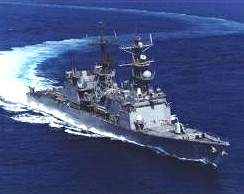 |  | 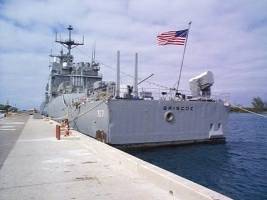 |
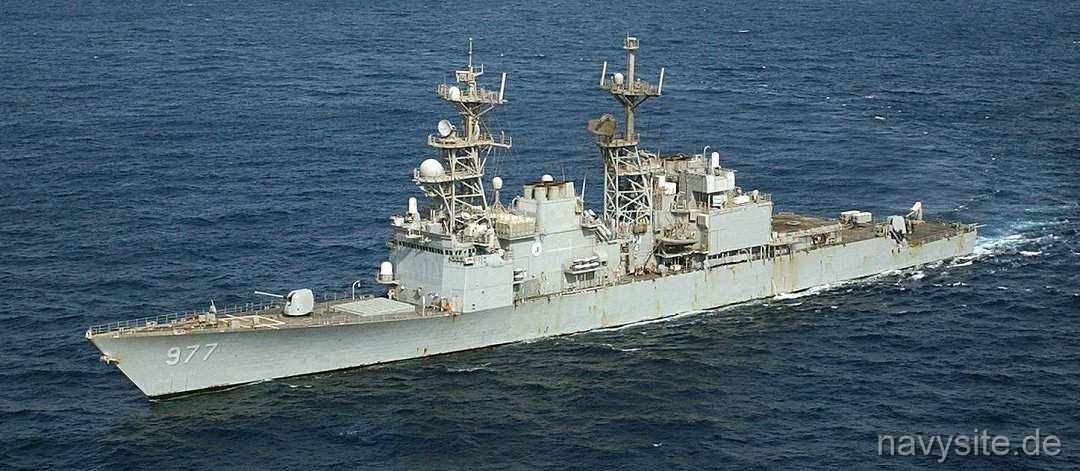
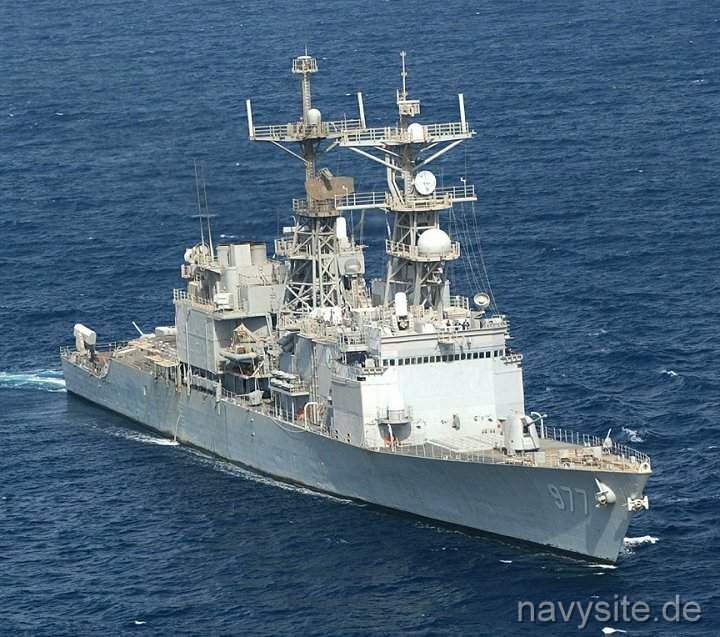
USS BRISCOE was the fifteenth of the 31 SPRUANCE - class destroyers. During her 25 years of service, the BRISCOE has deployed to the Arabian Gulf, Indian Ocean and the Mediterranean, Baltic and Black Seas. During these deployments, the ship participated in Operation Urgent Fury for the liberation of Grenada. BRISCOE established a U.S. record of 275 merchant vessel boardings in the North Red Sea, during the first of her two deployments to the area. While responding to a distress call from an Egyptian passenger ferry in 1994, BRISCOE acted as the on-scene commander for the ensuing rescue efforts of more than 500 passengers and coordinated the assistance of numerous vessels in the area.
Last homeported in Norfolk, Va., the BRISCOE was stricken from the Navy list on April 6, 2004, and was sunk as a target off the coast of Cherry Point on August 25, 2005.
| General Characteristics: | Keel Laid: July 21, 1975 |
| Launched: January 8, 1977 | |
| Commissioned: June 3, 1978 | |
| Decommissioned: October 2, 2003 | |
| Builder: Ingalls Shipbuilding, West Bank, Pascagoula, Miss. | |
| Propulsion system: four General Electric LM 2500 gas turbine engines | |
| Propellers: two | |
| Blades on each Propeller: five | |
| Length: 564,3 feet (172 meters) | |
| Beam: 55,1 feet (16.8 meters) | |
| Draft: 28,9 feet (8.8 meters) | |
| Displacement: approx. 9,200 tons full load | |
| Speed: 30+ knots | |
| Aircraft: two | |
| Armament: two | |
| Crew: approx. 340 |
 back to top go to the end of the pageback to top go to the end of the page
Crew List:
This section contains the names of sailors who served aboard USS BRISCOE. It is no official listing but contains the names of sailors who submitted their information.
back to top go to the end of the pageback to top go to the end of the pageUSS BRISCOE Cruise Books:
back to top go to the end of the pageback to top go to the end of the pageHistory of USS BRISCOE:
 USS BRISCOE's keel was laid on 21 July 1975. She was launched on 8 January 1977. USS BRISCOE was commissioned 3 June 1978 at the Ingalls Shipbuilding Division of Litton Industries in Pascagoula, Mississippi. She is the fifteenth destroyer in a series of 31 SPRUANCE-class destroyers.
Since commissioning, BRISCOE has deployed to the Arabian Gulf, the Indian Ocean, the Mediterranean Sea, served as a member of the Standing Naval Forces Atlantic, and sailed around South America during UNITAS XXX. In 1980, BRISCOE won the coveted Battenburg Cup as the top ship in the Atlantic Fleet.
BRISCOE participated in Operation Urgent Fury, the liberation of Grenada, and in the Multi-National Peacekeeping Forces off the coast of Lebanon, and in Baltic Operations 1990. BRISCOE also participated as a member of Middle East Forces deploying twice to the North Red Sea conducting Maritime Interception Operations in support of U.N. sanctions against Iraq. BRISCOE established a US record of 275 merchant vessel boardings in the North Red Sea during the first of her two deployments to the area.
In the second North Red Sea deployment in March 1994, BRISCOE responded to a distress call from an Egyptian passenger ferry, the AL-QAMAR AL-SAUDI AL-MISRI. BRISCOE acted as the On-Scene Commander for the ensuing rescue efforts for the over 500 passengers, coordinating the actions of the numerous vessels in the area.
In 1996, BRISCOE deployed to the Mediterranean and Black Sea for a six-month period. Deployed with Helicopter Antisubmarine Squadron Light 44 (Detachment 5), USS BRISCOE participated in Exercise Atlas Hinge with the Tunisian navy and Exercise Shark Hunt and Jaws, an undersea warfare exercise against US submarines in the Central and Eastern Mediterranean Sea.
USS BRISCOE took part in Exercise Classica 96, from August 31 through September 9, 1996, in the spirit of Partnership for Peace. Ships from the US Sixth Fleet, Black Sea and Mediterranean littoral nations (including Italy, Ukraine, Greece and Romania) trained together in the Black Sea promoting maritime peacekeeping operations. To help the exercise run smoothly, BRISCOE assigned two officers to act as a liaison between BRISCOE and other foreign vessels participating in the exercise. BRISCOE conducted a vertical replenishment (vertrep) with the Ukrainian ship CHERNIGHIV during the two-day, at sea phase of the exercise. While in Novorossyisk, Russia, BRISCOE joined in the observation of the Russian navy's 300th anniversary and the anniversary of the liberation of the city of Novorossyisk from Germany.
In September 1998, BRISCOE completed a deployment to the Arabian Gulf. She sailed 33,000 miles and conducted 115 vessel boardings, 7 MEDEVACS, and 1,032 hours of mishap-free flight operations in support of U.N. sanctions.
BRISCOE took part in the 12th annual Fleet Week in New York in May 1999. BRISCOE was again in the international headlines in June 1999 when she was tasked with conducting the solemn burial at sea of John F Kennedy, JR, his wife, and his sister-in-law after their tragic and untimely death. (Click here to watch a short video clip of the funeral of JFK jr. It shows the boat of the bereaved family of JFK jr, his wife and his sister-in-law coming alongside USS BRISCOE. (file size: 1.17MB) )
On June 21, 2000, USS BRISCOE departed for a scheduled six-month deployment to the Mediterranean and Arabian Gulf with the GEORGE WASHINGTON (CVN 73) Battle Group. Along with the rest of the battlegroup, it had trained for the previous eight months in preparation for this deployment through participation in a series of increasingly demanding exercises and operations.
While participating in Veritas VI exercises in the Western Mediterranean, USS BRISCOE conducted a rescue at sea of 12 passengers adrift on a small vessel, which had been adrift for three days with an inoperative engine, and had run out of food two days earlier and water the night before. BRISCOE returned to Norfolk, VA, in December 2000.
Routine deployment workups were interrupted in 2001, as BRISCOE responded to help provide aerial defense of the U.S. East Coast after the terrorist attacks, Sept. 11, 2001.
USS BRISCOE took part in Exercise Strong Resolve '02, one of the largest NATO exercises since the end of the cold war, which began on March 1, 2002, in Poland, Norway and the Baltic Sea. More than 26,000 military personnel from NATO and Partnership for Peace (PfP) nations were participating in the exercise, which encompassed two simultaneous crises in separate geographical regions. Forces encountered two types of NATO missions: an Article 5 collective defense operation and a crisis response operation (CRO). Strong Resolve exercises are held every four years and constitute the capstone in NATO's four-year training cycle.
On December 5, 2003, the USS HARRY S. TRUMAN (CVN 75) Battle Group, including USS BRISCOE, left the US east coast enroute to the carrier's second deployment to the Mediterranean and Arabian Sea. When Operation Iraqi Freedom started on March 20, 2003, USS BRISCOE was one of the ships that fired
USS BRISCOE was decommissioned on October 2, 2003, during a ceremony in her homeport at Naval Station, Norfolk, Va. Commander,
Destroyer Squadron 22, Capt. Thomas Abernathy, was the guest speaker.
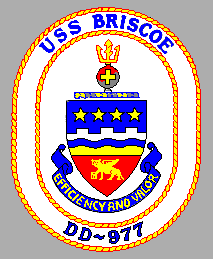
back to top go to the end of the pageAbout the Ship's Coat of Arms:As unique and colorful as its namesake, the ship's coat of arms is a proud reflection of the distinguished naval career of Admiral Robert P. Briscoe.
Standing boldly at the base of the shield is the Lion of St. Mark, which refers to the Admiral's leadership as Commander in Chief of Allied Southern Forces Europe. The fess and wavy bar, immediately above the Lion of St. Mark, suggest flowing water passing warships and small land areas. This is reminiscent of the Northern Solomon Islands where Admiral Briscoe commanded the USS DENVER in World War II. It was during this thirty six hour battle with enemy naval forces that the Admiral's skill and courage as a ship's Captain were most apparent. He fought his ship brilliantly, assisting in the sinking of five enemy warships, damaging four others and routing the enemy's surface forces. DENVER's guns had barely fired their last salvo when she was attacked by sixty-seven dive bombers. Under the Admiral's firm command, the ship reacted cooly and efficiently, downing seventeen enemy planes and thwarting the raid. In addition, his skill as a Destroyer Task Force and Cruiser Commander during the war prevented enemy reinforcements and supplies from reaching their destination.
The shield is completed by four stars, symbolic of Admiral Briscoe's leadership achievement and rank.
Atop the shield is a crest symbolic of further achievement in a long and successful career. The trident, symbol of Triton, ruler of the seas, refers to the U.S. Naval Academy where the Admiral served as a student, instructor and Department Head. The flash represents Prometheus' gift of science to mankind and alludes to Admiral Briscoe as one of the pioneers of modern electronics development in the Navy. The cross refers to the Navy Cross Admiral Briscoe received for his actions in the North Solomon Campaign. The crest is completed by the Taeguk which denotes the Admiral's Far East Naval Command.
The entire coat of arms is aptly summed up by the ship's motto EFFICIENCY AND VALOR, given to the ship by former Chief of Naval Operations, Admiral Robert Carney, as a tribute to his close friend.
back to top go to the end of the page
USS BRISCOE Image Gallery:
 |  |
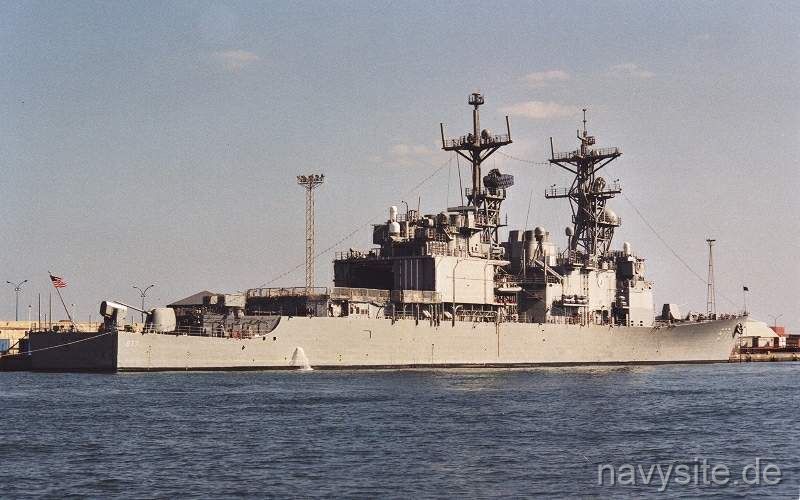
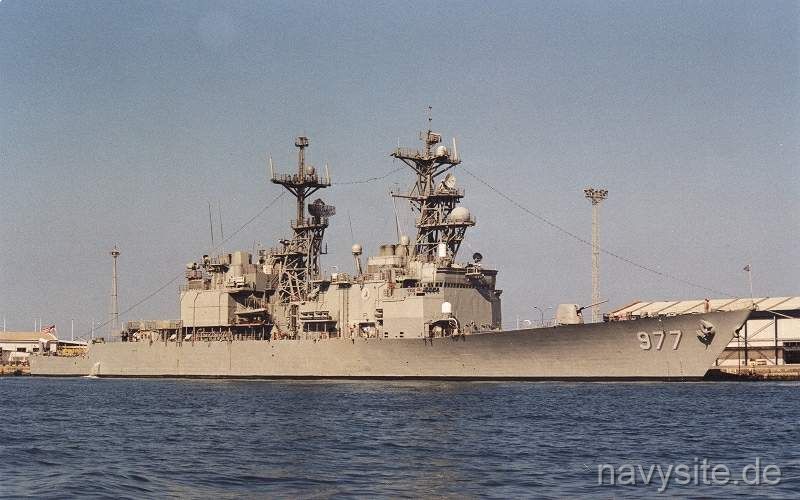
The photos below were taken by Fabio Peņa and show USS BRISCOE visiting Barcelona, Spain, on July 8, 2000.
 |  |
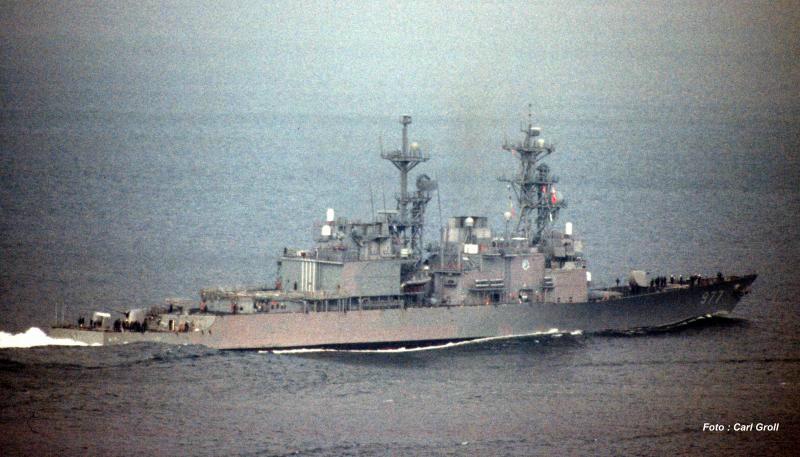
The photo below was taken by Carl Groll and shows the BRISCOE departing the port of Kiel, Germany, to participate in exercise Strong Resolve. The photo was taken in February 2002.
 |
back to top
 Back to Destroyers list. Back to ships list. Back to selection page. Back to 1st page.