
Search the Site with

|
Search the Site with
|
 General Characteristics Crew List Memorabilia History Image Gallery to end of page
 | 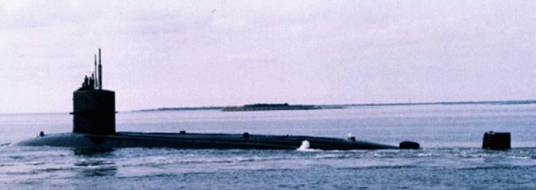 |
USS SAND LANCE was the 12th STURGEON - class attack submarine and the second ship in the Navy named after the fish.
Last homeported in Groton, CT, the SAND LANCE was both decommissioned and stricken from the Navy list on August 7, 1998, after she had already been deactivated while still in commission on April 1, 1998. She subsequently entered the submarine recycling program at the Puget Sound Naval Shipyard and recycling was completed at Bremerton on August 30, 1999.
| General Characteristics: | Awarded: October 24, 1963 |
| Keel Laid: January 15, 1965 | |
| Launched: November 11, 1969 | |
| Commissioned: September 25, 1971 | |
| Decommissioned: August 7, 1998 | |
| Builder: Portsmouth Naval Shipyard, Portsmouth, N.H. | |
| Propulsion system: one S5W2 nuclear reactor | |
| Propellers: one | |
| Length: 292 feet (89 meters) | |
| Beam: 31.7 feet (9.65 meters) | |
| Draft: 29.2 feet (8.9 meters) | |
| Displacement: Surfaced: approx. 4,250 tons | |
| Submerged: approx. 4,700 tons | |
| Speed: Surfaced: approx. 15 knots | |
| Submerged: approx. 30 knots | |
| Armament: four 533 mm torpedo tubes for | |
| Crew: 12 Officers, 95 Enlisted |
 back to top to end of the page
Crew List:
This section contains the names of sailors who served aboard USS SAND LANCE. It is no official listing but contains the names of sailors who submitted their information.
back to top go to the end of the pageback to top to end of the pageUSS SAND LANCE History:
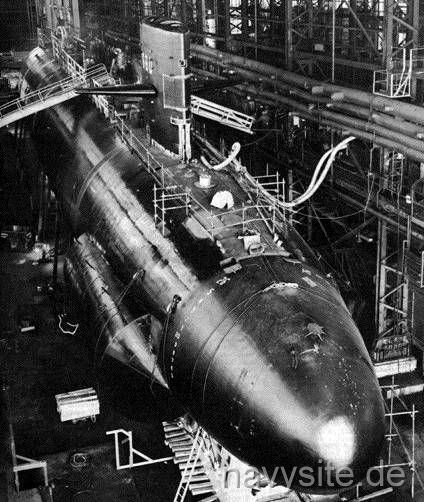
USS SAND LANCE was the second United States Navy ship to bear the name SAND LANCE and the twelfth STURGEON-class nuclear-powered attack submarine. The contract for USS SAND LANCE was awarded on October 24, 1963, to Portsmouth Naval Shipyard at Kittery, Maine. Her keel was laid there on January 15, 1965. She belonged to a design developed from the earlier THRESHER/PERMIT lineage and shaped by the United States Navy's post-THRESHER (SSN 593) emphasis on submarine safety, seawater-system integrity, quality assurance, quieting, sonar performance, and survivability. USS SAND LANCE was one of the later short-hull STURGEON-class submarines and became historically notable as the last United States Navy ship constructed at Portsmouth Naval Shipyard. She was launched on November 11, 1969, sponsored by Mrs. Thomas J. McIntyre, wife of Senator Thomas J. McIntyre of New Hampshire.
USS SAND LANCE was placed in service on January 4, 1971, and underwent initial builder's sea trials beginning on July 12, 1971. She was commissioned on September 25, 1971, with Commander William A. Kennington in command. She was delivered to the Navy on October 1, 1971, and on that date her initial home port was listed as Charleston, South Carolina.
From September through December 1971, USS SAND LANCE conducted shakedown operations and weapons certification. This early work followed the normal pattern for a newly commissioned nuclear attack submarine: proving propulsion and ship systems, qualifying the crew, confirming weapons and fire-control performance, and preparing the boat for operational service from her new Atlantic Fleet home port. The strategic setting was still shaped by the Vietnam War, but for Atlantic Fleet attack submarines the principal background remained the long undersea competition with the Soviet Navy. Soviet submarines were becoming more capable and more widely deployed, and American Sturgeon-class boats were central to tracking, acoustic collection, anti-submarine warfare training, and readiness in the Atlantic, Caribbean, Mediterranean, and northern approaches.
During 1972, USS SAND LANCE operated locally in the Charleston area dominated by local operations, training, and preparation for more demanding tasking. Charleston was an important submarine home port, and submarines operating from there could support western Atlantic training, Caribbean exercises, and deployments toward the Mediterranean or North Atlantic. For USS SAND LANCE, 1972 served as the first full year of operational integration into the Atlantic Fleet submarine force.
In February 1973, USS SAND LANCE departed Charleston for Chief of Naval Operations special operations. She returned to Charleston on April 21, 1973, remained in port until June 11, and then departed again on another period of Chief of Naval Operations special operations. She completed the second 1973 special-operations period in August and entered Faslane Naval Base, Scotland, on August 13, 1973. Faslane was a major submarine support site in Scotland and was closely associated with NATO and United States submarine activity in the North Atlantic. USS SAND LANCE left Faslane on August 20 and returned to Charleston on September 5, 1973.
From October through December 1973, USS SAND LANCE was assigned to the United States Sixth Fleet in connection with the Egypt-Israel conflict. The October 1973 Arab-Israeli War produced a major regional crisis and a heightened superpower naval posture in and around the Mediterranean. American forces watched Soviet naval movements closely, while the Sixth Fleet remained an important instrument of United States presence and crisis response. USS SAND LANCE was sent to the Mediterranean to monitor shipping through the Strait of Gibraltar during the Yom Kippur War. The Strait was, and remains, the key western entrance to the Mediterranean, and submarine monitoring there fit the Cold War requirement to observe naval movements between the Atlantic and Mediterranean during periods of crisis.
Commander Robert L. Bovey relieved Commander Kennington on January 22, 1974. In January and February 1974, USS SAND LANCE conducted local operations from Charleston, including sonar evaluations. In March and April 1974, she carried out operational weapons testing involving Mark 48 torpedoes, Subroc, and CAPTOR mine-related systems. These weapons represented several dimensions of the STURGEON-class mission: heavyweight torpedo attack against submarines and surface ships, nuclear anti-submarine missile capability through Subroc, and mine employment in support of broader naval operations. From September 1974 through March 1975, USS SAND LANCE conducted a Mediterranean deployment. Strategically, this cruise came during a period when the Sixth Fleet was still responding to the aftermath of the 1973 Middle East crisis and monitoring Soviet naval activity in the Mediterranean.
After returning from Mediterranean service, USS SAND LANCE continued local operations from Charleston. Public historical records describe the April through December 1975 period as local Charleston operations with sonar evaluations. In 1975 and 1976, USS SAND LANCE underwent an approximately fifteen-month overhaul at Norfolk Naval Shipyard in Portsmouth, Virginia. This yard period removed the submarine from the normal operating cycle for extensive maintenance, inspection, and modernization after her first years of special operations, Mediterranean deployment, weapons testing, and local Atlantic service.
Commander Michael C. Covell relieved Commander Bovey on April 18, 1977. In 1977, USS SAND LANCE conducted technical evaluation of the AN/BQQ-5 sonar system. This was an important development because the AN/BQQ-5 became one of the major submarine sonar suites of the Cold War attack-submarine force. Acoustic detection, classification, and tracking were central to the contest with Soviet submarines, and evaluation work of this type was directly related to the ability of American submarines to locate and follow increasingly capable Soviet units. USS SAND LANCE's participation in this evaluation shows that her work included technical assessment and fleet-development activity, not only deployments and local exercises.
In 1978, USS SAND LANCE was involved in a serious maintenance-related near-flooding event that was averted before it became a major casualty. Her historical record states that during maintenance, the commanding officer recognized that a flood-prevention collar was being installed on the wrong seawater valve. From January through June 1978, USS SAND LANCE conducted another Mediterranean deployment.
From February through April 1979, USS SAND LANCE conducted Chief of Naval Operations special operations. For this service, she received a Secretary of the Navy Navy Unit Commendation, and public summaries also associate her 1979 special operations with the Navy Expeditionary Medal. In June 1979, she transited the Panama Canal and proceeded toward Puget Sound Naval Shipyard, Bremerton, Washington, for a refueling overhaul. The refueling and overhaul period extended from June 1979 to January 1981. It was one of the major maintenance and modernization events of her career, involving the nuclear propulsion plant and other systems required to keep a STURGEON-class boat operational for further Cold War service.
In February 1981, USS SAND LANCE transited the Panama Canal again as she returned from the Pacific side to the Atlantic. Commander Hugh M. Doherty relieved Commander Covell on May 19, 1981. From November 1981 through April 1982, USS SAND LANCE conducted a Mediterranean deployment. This was another Sixth Fleet operating period, placing her in a region where American submarines supported NATO posture, monitored Soviet naval activity, trained with fleet forces, and remained available for regional contingencies.
From June 1983 through March 1984, USS SAND LANCE carried out three Chief of Naval Operations special operations. The boat received a Meritorious Unit Commendation for this period. Commander Orval L. Sweeney relieved Commander Doherty on July 23, 1984. His command period covered additional late-Cold-War operations at a time when American submarine activity remained intense. Soviet naval power was still a central planning concern, the United States Navy was operating forward under the maritime strategy of the 1980s, and STURGEON-class submarines remained important even as newer LOS ANGELES-class boats entered the fleet.
From May through July 1987, USS SAND LANCE conducted another period of Chief of Naval Operations special operations. That same year, she completed law-enforcement operations in the Caribbean Sea before shifting into another major shipyard period. In 1987, she was transferred to Portsmouth Naval Shipyard at Kittery, Maine, for a refueling overhaul, replacement of her propeller, and upgrades to hull coatings. Commander Hubert D. Hopkins relieved Commander Sweeney on November 23, 1987. The overhaul at Portsmouth Naval Shipyard occupied the period from 1987 into 1990. It was another major modernization and maintenance interval, removing the boat from normal deployment service and preparing her for late-Cold-War and post-Cold-War operations. She underwent sea trials in 1990 and returned to active service from Charleston.
Commander Brian J. Rabe relieved Commander Hopkins on September 5, 1990. By then, the strategic world had changed sharply. The Berlin Wall had fallen in November 1989, Eastern Europe was moving away from Soviet control, Germany reunified on October 3, 1990, and the Soviet Union was nearing collapse. At the same time, Iraq's invasion of Kuwait on August 2, 1990, led to Operations Desert Shield and Desert Storm.
From July through December 1991, USS SAND LANCE deployed as part of Unitas XXXII, the long-running annual exercise series with South American navies. In October 1991, during this deployment, she navigated Cape Horn. Unitas deployments were important naval diplomacy and training events. They allowed United States Navy units to operate with Latin American navies, improve interoperability, and demonstrate presence in the western hemisphere. A public Navy photograph from August 5, 1991, shows USS SAND LANCE arriving at a naval station during Unitas XXXII-related activity, with USS DAHLGREN (DDG 43) visible in the background. Another public image from September 14, 1991, shows a crew member aboard USS SAND LANCE tossing a messenger line alongside USS O'BANNON (DD 987) during Unitas. These documented images confirm her participation in a multinational exercise environment with U.S. surface units and South American naval forces.
In 1992, USS SAND LANCE conducted western Atlantic operations in support of national security objectives. Commander Randall J. Slack relieved Commander Rabe on February 26, 1993. From October 1993 through March 1994, USS SAND LANCE deployed to the Mediterranean. She conducted port visits to Naples, Italy; Monte Carlo, Monaco; Naval Support Activity Santo Stefano Island, Italy; Toulon, France; and Gibraltar. A public photograph places USS SAND LANCE in Gibraltar on December 25, 1993. This deployment returned the boat to the Sixth Fleet operating environment after the end of the Cold War. The Mediterranean remained important because of NATO commitments, instability in the Balkans and the Middle East, and the continuing need for American naval presence.
In 1994, while moored at Charleston ahead of USS GRAYLING (SSN 646), USS SAND LANCE suffered a serious flooding incident in the lower level of the engine room while a main seawater valve was being removed for maintenance. Public histories state that blank plates, intended to cover hull penetrations during the valve removal, had been placed over the wrong main seawater openings. The flooding was stopped, but not before most of the engine-room lower level was flooded. This was one of the most serious publicly described material casualties in the boat's career.
In January and February 1995, USS SAND LANCE conducted western Atlantic special operations. On April 5, 1995, her home port changed from Charleston to Groton, Connecticut, and she became part of Submarine Squadron Two. This move came during the post-Cold-War submarine-force drawdown. Charleston Naval Base was closing as part of the broader reduction of Cold War infrastructure, and older submarines were being shifted, inactivated, or decommissioned as the Navy consolidated around newer LOS ANGELES-class and later submarines. Commander George H. Baker Jr. relieved Commander Slack on June 8, 1995, becoming USS SAND LANCE's final commanding officer.
From March 1 through August 31, 1996, USS SAND LANCE conducted Ice-X 96, an Arctic Circle patrol. From June 5 through June 14, 1996, during that same operating period, she participated in Sorbet Royal 96, a submarine-rescue exercise. On July 12, 1996, she surfaced at the North Pole. Public cover and historical records identify this as her North Pole trip, and the event was commemorated by a special "Surfaced at the North Pole" postmark. For the Arctic operation, USS SAND LANCE received a Secretary of the Navy Letter of Commendation, and crew certificates associated with the period included Realm of the Arctic Circle and Domain of the Golden Dragon recognition.
From July through December 1997, USS SAND LANCE carried out her final deployment, Unitas XXXVIII. This was another deployment in the hemispheric exercise series with Latin American navies. On July 17, 1997, her historical record identifies the award of an Order of the Spanishman Certificate. In October 1997, she navigated Cape Horn for the second time. On November 30, 1997, during Unitas XXXVIII, her crew received the Imperium Neptuni Regis, or Shellback, certificate, marking a crossing of the equator. The deployment ended when USS SAND LANCE returned to her home port on December 22, 1997. She also received a Medical "M" award in this final period. The 1997 deployment gave the submarine a final major operational episode before inactivation, and it placed her once again in the role of a United States submarine supporting allied training, regional engagement, and naval presence in the western hemisphere.
USS SAND LANCE's inactivation ceremony was held on January 15, 1998. On February 4, 1998, she departed her Groton home port for the final time. On February 8, 1998, she transited the Panama Canal and received the traditional Order of the Ditch recognition associated with passage through the canal. In February 1998, during her approach to the Juan de Fuca Canyon in the Pacific Northwest operating areas, she conducted a final blow from 660 feet, a symbolic and operationally meaningful event for a submarine whose hull number was 660. On April 1, 1998, USS SAND LANCE was deactivated at Puget Sound Naval Shipyard, Bremerton, Washington.
USS SAND LANCE was formally decommissioned on August 7, 1998, and struck from the Naval Vessel Register on the same date. She subsequently entered the submarine recycling program and recycling was completed at Bremerton on August 30, 1999. After decommissioning, material associated with the boat's engineering spaces entered public preservation. Maneuvering room consoles of the type used aboard Cold War nuclear submarines, associated in public summaries with submarines including USS SAND LANCE, were displayed in the Smithsonian Institution's submarine exhibit and later stored for possible future exhibits.
back to top to end of the pageUSS SAND LANCE Image Gallery:
 |
back to top Back to Submarines list. Back to ships list. Back to selection page. Back to 1st page.