
Search the Site with

|
Search the Site with
|
 General Characteristics Crew List Memorabilia Accidents aboard the Ship History Patch Gallery to end of page
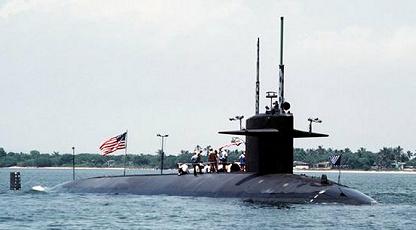 |  |
USS GREENLING was one of the PERMIT - class nuclear-powered attack submarines and the second ship in the Navy named after the elongate, fine-scaled fish which can be found from Kamchatka to California. Both decommissioned and stricken from the Navy list on April 18, 1994, the GREENLING entered the Navy's Nuclear Powered Ship and Submarine Recycling Program at the Puget Sound Naval Shipyard, Bremerton, Wash. Recycling was completed on September 30, 1994.
| General Characteristics: | Awarded: June 9, 1960 |
| Keel laid: August 15, 1961 | |
| Launched: April 4, 1964 | |
| Commissioned: November 3, 1967 | |
| Decommissioned: April 18, 1994 | |
| Builder: Electric Boat Division of General Dynamics Corporation, Groton, CT. | |
| Propulsion system: one S5W2 nuclear reactor | |
| Propellers: one | |
| Length: 292.3 feet (89.1 meters) | |
| Beam: 32.15 feet (9.8 meters) | |
| Draft: 28.9 feet (8.8 meters) | |
| Displacement: Surfaced: approx. 3,900 tons Submerged: approx. 4,600 tons | |
| Speed: Surfaced: approx. 20 knots Submerged: approx. 30 knots | |
| Armament: four 533 mm torpedo tubes for SUBROC, Mk-48 torpedoes and Harpoon missiles | |
| Crew: 12 Officers, 91 Enlisted |
 back to top go to the end of the pageback to top go to the end of the page
Crew List:
This section contains the names of sailors who served aboard USS GREENLING. It is no official listing but contains the names of sailors who submitted their information.
back to top go to the end of the pageback to top go to the end of the pageAccidents aboard USS GREENLING:
| Date | Where | Events |
|---|---|---|
| July 23, 1967 | off Hingham, Mass. | USS GREENLING strikes a buoy off Hingham, Mass., but only suffers minor damage. |
| March 27, 1973 | 250 miles northwest of Bermuda | USS GREENLING goes below her safe diving level while training because a needle on a depth gauge sticks. The true depth is disclosed on another gauge before the submarine reaches a depth that would have crushed her hull. On March 30, the submarine arrives at Groton, Conn., and on April 10, enters the Portsmouth Naval Shipyard for a thorough check. |
back to top go to the end of the pageUSS GREENLING History:
USS GREENLING was the second United States Navy ship to bear the name GREENLING and was built as a nuclear-powered attack submarine of the THRESHER/PERMIT design lineage. Her name carried forward that of USS GREENLING (SS 213), a World War II submarine that had served in the Pacific, and the later nuclear-powered USS GREENLING entered a Navy that was steadily expanding its undersea force for Cold War operations. Her construction contract was awarded on June 9, 1960, to the Electric Boat Division of General Dynamics at Groton, Connecticut, and her keel was laid there on August 15, 1961. Her keel was laid on the same building ways on which USS NAUTILUS (SSN 571) had been built and close to the ways that had produced the first USS GREENLING in 1940.
The construction history of USS GREENLING was affected by the loss of USS THRESHER (SSN 593) on April 10, 1963. In the aftermath of that disaster, the Navy imposed far more stringent standards for submarine construction, quality assurance, testing, seawater-system integrity, and emergency survivability. USS GREENLING was among the boats selected for modification to the improved design, together with USS FLASHER (SSN 613) and USS GATO (SSN 615). She was launched at Groton on April 4, 1964, sponsored by Mrs. Henry C. Bruton, wife of retired Rear Admiral Henry Chester Bruton, who had commanded the first USS GREENLING during World War II. On April 29, 1964, USS GREENLING was moved to the Electric Boat Quincy Division at Quincy, Massachusetts, for lengthening and Subsafe-related modifications. The work added 13 feet 9 inches to her hull, increased reserve buoyancy, improved internal arrangements, and provided room for additional equipment.
After a long fitting-out, modification, and trial period, USS GREENLING was commissioned at the United States Naval Submarine Base New London, Groton, Connecticut, on November 3, 1967. Representative George W. Andrews of Alabama gave the commissioning address, and Commander Guy H. B. Shaffer became her first commanding officer. At commissioning, USS GREENLING joined the Atlantic submarine force as a unit of Submarine Squadron Ten and Submarine Division One Hundred Two at New London.
Shortly before commissioning, on July 23, 1967, USS GREENLING struck a buoy off Hingham, Massachusetts. The damage was minor, and the incident caused little interruption to the final training and acceptance process. From December 1967 through May 1968, after entering commissioned service, she conducted her initial shakedown cruise, operating mainly in Caribbean waters near Puerto Rico and the Virgin Islands. This period included torpedo-tube test firings and the launch of two Subroc missiles. These early trials and weapons firings tested the boat and her crew after the extended construction and modification period and brought USS GREENLING into the operational routine of the Atlantic submarine force during the Vietnam War era and the broader Cold War naval competition.
On May 27, 1968, USS GREENLING was diverted from a fleet training exercise to take part in the search-and-rescue effort for USS SCORPION (SSN 589), which had gone missing while returning from deployment. Commander Shaffer was designated commander of the search-and-rescue task element, which consisted of three nuclear-powered submarines and four diesel-powered submarines. USS GREENLING remained involved in the search effort until June 12, 1968. Afterward she resumed Atlantic Fleet operations, took part in anti-submarine warfare exercises, and conducted a deployment later in 1968. On January 14, 1969, she hosted the Chief of Naval Operations of the Mexican Navy, and shortly afterward she deployed again. During this early operating period, she received the Submarine Division One Hundred Two Fire Control Excellence Award, the Submarine Squadron Ten nomination for the Ney food-service excellence award for 1968-1969, the Battle Efficiency "E" for Submarine Division One Hundred Two for 1968-1969, and her first two Navy Unit Commendations for operations conducted in the fall of 1968 and the spring of 1969. Commander Austin B. Scott Jr. relieved Commander Shaffer on May 13, 1969.
On May 19, 1969, USS GREENLING entered the Electric Boat shipyard at Groton for a four-month post-shakedown availability. After that yard period, she carried out a short shakedown cruise in southern waters and then resumed deployments, prospective commanding officer operations, and anti-submarine warfare exercises. In fiscal year 1970, she earned another Battle Efficiency "E" for Submarine Division One Hundred Two. She also received her third Navy Unit Commendation and her first Meritorious Unit Commendation for operations conducted during two separate periods in 1970. In November and December 1970, USS GREENLING was moored alongside USS FULTON (AS 11) at New London for pre-overhaul upkeep, preparing for the first major yard period of her commissioned career.
In February 1971, USS GREENLING arrived at the Ingalls Nuclear Shipbuilding Division at Pascagoula, Mississippi, for her first overhaul. The overhaul lasted about 13 months and included major modifications, upgrades to sonar and combat systems, and significant repair work. Commander William T. Johnson relieved Commander Scott on March 11, 1972, as the overhaul was ending. USS GREENLING then conducted a shakedown cruise, completed additional exercises, and deployed to the Mediterranean. Her return to Mediterranean operations placed her with the United States Sixth Fleet during a period when American submarines routinely supported North Atlantic Treaty Organization maritime planning, monitored Soviet naval activity, and provided undersea support to wider fleet operations in the Mediterranean basin.
Throughout 1973, USS GREENLING conducted anti-submarine warfare exercises, United States Naval Academy midshipman summer training cruises, and acoustic communications system tests. On March 27, 1973, while training about 250 miles northwest of Bermuda, she experienced one of the most serious known incidents of her career. A depth-gauge needle stuck, and the submarine went below her safe diving level before another gauge showed the true depth. The error was discovered before the boat reached a depth that would have crushed the hull. USS GREENLING arrived at Groton on March 30, 1973, and on April 10, 1973, entered Portsmouth Naval Shipyard for a thorough inspection and check. The incident became one of the few publicly described examples of the operational hazards faced by nuclear attack submarines during routine training as well as during forward operations.
In 1974, USS GREENLING returned to Sixth Fleet service in the Mediterranean. On April 4, 1974, helicopters from HS-3 operating with USS FORRESTAL (CVA 59), together with the destroyer USS DAVIS (DD 937), tracked and conducted simulated attacks against USS GREENLING during anti-submarine exercises. Later that year, USS GREENLING carried out another Mediterranean deployment with the Sixth Fleet and received a second Meritorious Unit Commendation for operations conducted from July 4 to July 28, 1974.
Commander Christopher O. Nichols relieved Commander Johnson on January 14, 1975. After the change of command, USS GREENLING immediately prepared for another Mediterranean cruise and conducted several forms of training, including prospective commanding officer operations. She deployed in May 1975 for Sixth Fleet operations. After returning to New London, she briefly participated in the major Second Fleet and North Atlantic Treaty Organization exercise Ocean Safari. She also received a third Meritorious Unit Commendation for operations in June and July 1975 as an element of Task Forces Sixty-Seven and Sixty-Nine in the Mediterranean. These assignments reflected the normal employment of an Atlantic Fleet nuclear attack submarine in the mid-1970s: repeated Mediterranean deployments, anti-submarine work, support of carrier and surface forces, and exercises with allied naval forces.
The bicentennial year, 1976, was active for USS GREENLING. She began the year with several Caribbean operations, then spent time in upkeep at New London. She also worked with United States Army Special Forces, Navy special warfare swimmers, and Marine Corps swimmers in lock-in and lock-out training. Such exercises used the submarine's ability to embark and recover personnel covertly and reflected the broader special-operations utility of nuclear-powered attack submarines. During the summer, she made another trip to the Caribbean for services and exercises. After several weeks of midshipman training cruises, she joined the major North Atlantic Treaty Organization exercise Teamwork 76, which included port visits in Scotland and Norway. She ended the year at New London with pre-overhaul testing and a short holiday standdown.
On February 4, 1977, USS GREENLING arrived at Charleston, South Carolina, for a refueling overhaul that lasted 22 months. The overhaul included major upgrades to much of the ship's equipment and extensive changes to her sonar system. Her external appearance was altered by the addition of a towed-array storage tube and fairing running along the length of the port side. This reflected the increasing importance of passive detection, long-range acoustic tracking, and improved anti-submarine warfare capabilities during the late Cold War. The overhaul was completed on December 17, 1978, when USS GREENLING returned to New London and resumed operations with Submarine Squadron Ten.
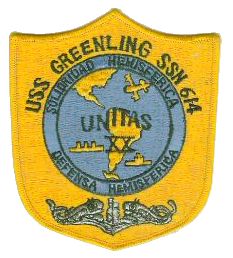
Commander William R. Witcraft relieved Commander Nichols on January 27, 1979. The early part of 1979 was devoted mainly to services and exercises in the Caribbean, followed by post-overhaul inspections, tests, and certifications. The summer included local operations, midshipman training cruises, and a Mark 48 torpedo proficiency exercise at the Atlantic Undersea Test and Evaluation Center range. Late in 1979, USS GREENLING got underway for Unitas XX as part of a United States task force operating with the navies of Argentina, Uruguay, and Brazil. That deployment brought exercises in waters off the eastern coast of South America and placed USS GREENLING in a long-running annual series of hemispheric naval exercises intended to improve interoperability between the United States Navy and South American navies.
In May 1980, USS GREENLING deployed to the Mediterranean with the Sixth Fleet. During that deployment, she made port visits at Cartagena, Spain; Sardinia; and Naples, Italy. She returned to New London in October 1980 by way of Halifax, Nova Scotia. The remainder of 1980 included training operations from Narragansett Bay to the Caribbean. In 1981, USS GREENLING completed her first Selected Restricted Availability, then carried out local and Caribbean training operations in preparation for another Mediterranean deployment in September. While operating with the Sixth Fleet on that deployment, she visited La Spezia, Santo Stefano, and La Maddalena, Italy. She remained in the Mediterranean into early 1982 and returned to New London in February 1982.
On March 12, 1982, Commander Kevin G. Rogers relieved Commander Witcraft. The remainder of 1982 was spent in local and Caribbean operations, including midshipman training cruises, an anti-submarine warfare exercise, and readiness examinations. In 1983, USS GREENLING underwent another Selected Restricted Availability and then carried out training exercises to prepare for another Mediterranean deployment in September. During that deployment she participated in numerous exercises with North Atlantic Treaty Organization forces and visited Palma, Spain; La Maddalena, Italy; and Toulon, France. She returned to New London early in 1984. Commander Michael W. O’Neil relieved Commander Rogers on March 23, 1984, and the rest of 1984 was spent in local and Caribbean operating areas for training exercises.
After this demanding operating cycle, USS GREENLING entered her final major overhaul. She arrived at Portsmouth Naval Shipyard, Portsmouth, New Hampshire, on September 22, 1984, for extensive upgrades to numerous systems, especially her fire-control systems. The overhaul lasted 35 months. In September 1987, USS GREENLING began sea trials and post-overhaul training operations, and in early October 1987 she returned to New London after a three-year absence from her home port. The year ended with post-overhaul operations in the Caribbean. Commander Stephen W. Zavadil relieved Commander O'Neil on December 18, 1987.
In 1988, USS GREENLING completed post-overhaul testing, inspections, certifications, and repairs. In May 1988, she deployed for the final time to the Mediterranean Sea, operating on an intensive Sixth Fleet schedule. That deployment brought port visits to Gibraltar, Toulon, France, and La Maddalena, Italy. She returned to New London on November 1, 1988. For the deployment, she won the Sixth Fleet Hook 'Em Award for anti-submarine warfare excellence and was also awarded the Atlantic Fleet Arleigh Burke Fleet Trophy for the greatest improvement in battle readiness for fiscal year 1988. The inactivation record also associates a Submarine Squadron Ten Battle Efficiency "E" with this late-1980s period, listing 1988 in the awards summary and tying the award in the narrative to her 1989 performance.
In 1989, USS GREENLING conducted numerous operations in local and southern waters for training exercises. In October 1989, she deployed to the western Atlantic for nine weeks before returning home for the end of the year. The year came as the strategic environment was changing rapidly. The Soviet Union remained the principal naval planning concern for the American submarine force, but political change in Eastern Europe, arms-control developments, and the weakening of the Warsaw Pact were beginning to alter the Cold War framework in which USS GREENLING had operated since commissioning.
The year 1990 began with USS GREENLING's first post-overhaul Selected Restricted Availability. Afterward she headed to southern waters for proficiency exercises and acoustic trials. Commander James A. Campbell relieved Commander Zavadil on May 29, 1990. On June 28, 1990, USS GREENLING deployed for Unitas XXXI, a major annual series of joint exercises with South American navies. Over the next five months, she circumnavigated South America, visited fifteen ports, and conducted extensive naval exercises with the navies of Colombia, Ecuador, Peru, Chile, Argentina, Brazil, and Venezuela. In addition to calls in South American countries, she visited Curacao in the Netherlands Antilles and Port of Spain, Trinidad. USS GREENLING was photographed moored alongside USS HAYLER (DD 997) at Rio de Janeiro in October 1990, while other imagery places elements of the exercise at Cartagena, Colombia, and in the Strait of Magellan.
In 1991, USS GREENLING's recorded activity consisted mainly of training exercises and inspections. On May 4, 1991, she was reassigned to Submarine Squadron Two after Submarine Squadron Ten was disestablished. The change also moved her normal in-port home from alongside USS FULTON at State Pier in New London to the United States Naval Submarine Base at Groton. This administrative move reflected the shrinking and reorganization of the United States Navy's submarine force as the Cold War ended.
In 1992, USS GREENLING conducted another Atlantic deployment, underwent another Selected Restricted Availability, and carried out exercises and local operations. Her recorded activity included a port visit to Halifax, Nova Scotia, and exercises followed by a port visit to Roosevelt Roads, Puerto Rico. On November 20, 1992, Commander Steven Clark Hall relieved Commander Campbell as commanding officer. In her final year of active operations, USS GREENLING participated in a major fleet exercise, conducted several operations with Canadian Navy units, made port visits to Port Canaveral, Florida, and Bermuda, carried out United States Naval Academy second-class midshipman training cruises, and completed several local operations. These final operations were training- and readiness-centered rather than part of the high-tempo Cold War deployment pattern that had defined much of her earlier career.
USS GREENLING held her inactivation ceremony at the Naval Submarine Base, Groton, on July 16, 1993. Commander Steven Clark Hall was the commanding officer, Captain Nils A. Sjostrom was Commander, Submarine Squadron Two, and Rear Admiral Guy H. B. Shaffer, retired, her first commanding officer, returned as principal speaker. The ceremony marked the end of her active service at the base where she had been commissioned on November 3, 1967. After the ceremony, USS GREENLING was scheduled to depart her long-time operational home on the Thames River for Puget Sound Naval Shipyard, Bremerton, Washington, where she would be inactivated. She was formally decommissioned at Bremerton on April 18, 1994, and struck from the Navy list the same day. She then entered the Navy's Nuclear Powered Ship and Submarine Recycling Program at Puget Sound Naval Shipyard, and recycling was completed on September 30, 1994. After her disposal, equipment from her control room was preserved and incorporated into a recreated submarine control-room exhibit at the Naval Undersea Museum in Keyport, Washington, including periscopes, the ship-control panel, the fire-control panel, and the ballast-control panel.
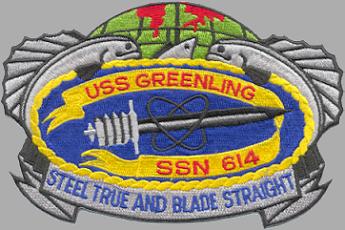
back to top go to the end of the pageUSS GREENLING Patch Gallery:
 |
back to top Back to Submarines list. Back to ships list. Back to selection page. Back to 1st page.