Search the Site with 
General Characteristics Crew List Memorabilia About the Ship's Coat of Arms About the Ship's Name History Patch Gallery Image Gallery to end of page
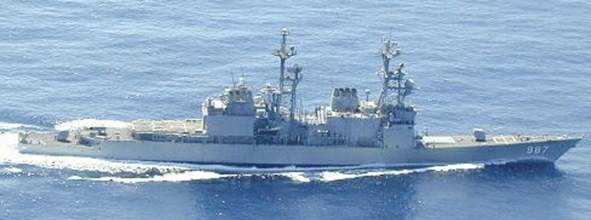
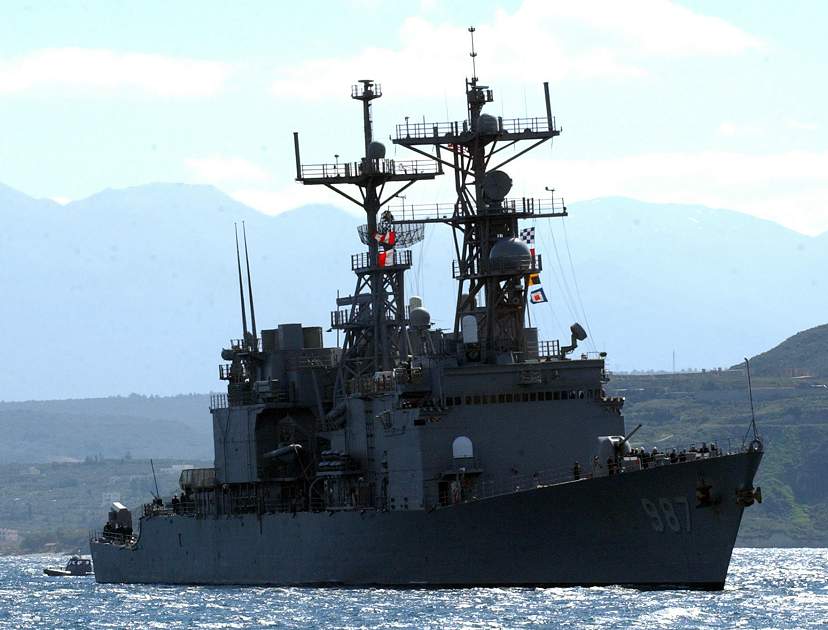
USS O'Bannon (DD 987)

- decommissioned -
- sunk as a target -


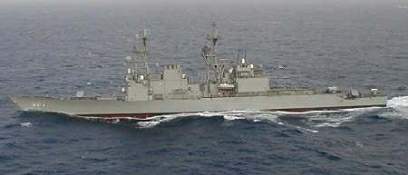
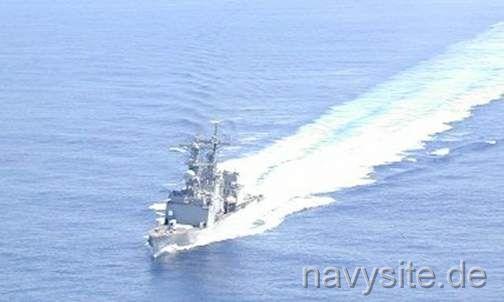
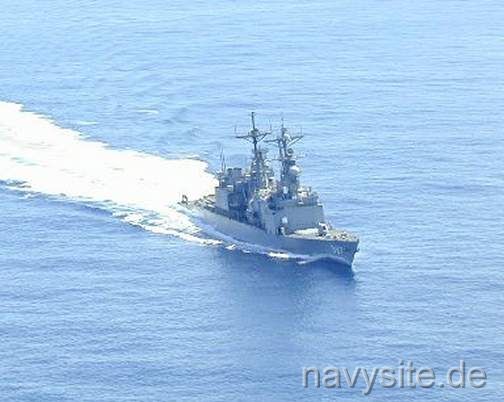
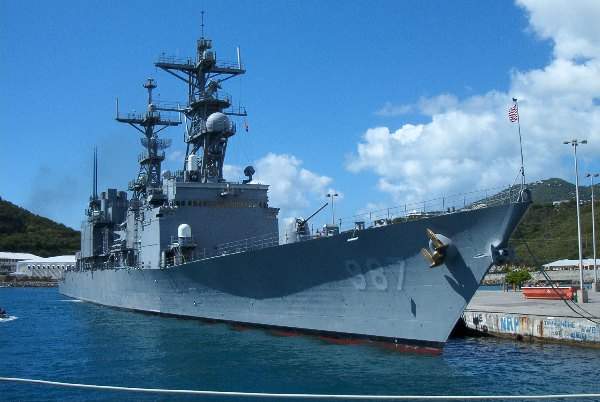
USS O'BANNON was the 25th SPRUANCE - class destroyer and the last east coast destroyer of her class decommissioned. USS O'BANNON was last homeported in Mayport, Fla., and was originally scheduled to be transfered to Turkey. The transfer was canceled and the O'BANNON was sunk as a target on October 6, 2008, by the USS STOUT (DDG 55).

General Characteristics:Awarded: January 15, 1975
Keel laid: February 21, 1977
Launched: September 25, 1978
Commissioned: December 15, 1979
Decommissioned: August 19, 2005
Builder: Ingalls Shipbuilding, West Bank, Pascagoula, Miss.
Propulsion system: four General Electric LM 2500 gas turbine engines
Propellers: two
Blades on each Propeller: five
Length: 564,3 feet (172 meters)
Beam: 55,1 feet (16.8 meters)
Draft: 28,9 feet (8.8 meters)
Displacement: approx. 9,200 tons full load
Speed: 30+ knots
Aircraft: two SH-60B Seahawk (LAMPS 3)
Armament: two Mk 45 5-inch/54 caliber lightweight guns, one Mk 41 VLS for Tomahawk, ASROC and Standard missiles, Mk 46 torpedoes (two triple tube mounts), Harpoon missile launchers, one Sea Sparrow launcher, two 20mm Phalanx CIWS, one Rolling Airframe Missile (RAM) System
Crew: approx. 340


Back to topback to top  go to endgo to the end of the page


Back to topback to top  go to endgo to the end of the page

Crew List:

This section contains the names of sailors who served aboard USS O'BANNON. It is no official listing but contains the names of sailors who submitted their information.


back to top  go to the end of the page


Back to topback to top  go to endgo to the end of the page

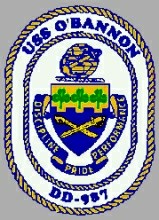
About the Ship's Coat of Arms:

Blue and Gold are the colors traditionally associated with the U.S. Navy and both are symbolic of the Navy's element, the sea and it's goal of excellence. The Shield symbolizes an event in 1805 during the Tripolitan War when LT Presley O'Bannon (USMC), at the head of an escort of seven Marines and one midshipman, stormed the fort at Derna in present day Libya. This fort is represented by the embattled partition line. With his own hands, O'Bannon hoisted an American Flag over a captured position for the first time in the history of the US. At Malta, according to tradition, Hamet presented O'Bannon with the jeweled sword he carried while a refugee with the Mameluke in Egypt. This type of blade, known as a Mameluke sword, is worn by Marine Officers today and is the oldest weapon in continuous use by the Armed Forces of the United States.

On his return home, O'Bannon was presented a second sword, this time a ceremonial one, by his native state of Virginia. The crossed sword and cutlass on the shield have been adopted from the Enlisted and Officers surface warfare badges and represent the two swords presented O'Bannon as well as the mission, capabilities, and personnel of the Spruance Class Destroyer. Three shamrocks refer not only to the O'Bannon's Irish heritage, but also the three ships to bear this name DD 177, DD/DDE 450 and DD 987. The globe and the anchor, adapted from a USMC seal, are direct references to Presley O'Bannon's outstanding service in the USMC.


Back to topback to top  go to endgo to the end of the page

About the Ship's Name:

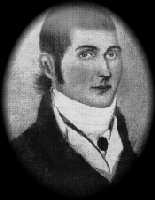
Presley Neville O'Bannon was born on 1776, in Fauquier County, Virginia. First appointed a Second Lieutenant in the U.S. Marine Corps on 18 January 1801, he served in various stations in the United States prior to assignment onboard USS ADAMS. Following a deployment to the Mediterranean on the ADAMS, First Lieutenant O'Bannon returned to the United States in November 1803. He was assigned to duty at Marine Barracks, Washington D.C.

In 1804, First Lieutenant O'Bannon was again called to sea duty, this time onboard PRESIDENT. Setting sail for the Mediterranean in May 1804, the USS PRESIDENT arrived at Gibraltar in August. Following several months in the Mediterranean, First Lieutenant O'Bannon was transferred to another warship, USS CONSTITUTION, and then to USS ARGUS. While serving as the Marine Officer on the later vessel, he was selected for a mission that later was commemorated in the colors of the Marine Corps and recorded in the Marine Hymn in the words "to the shores of Tripoli".

For many years the United States had maintained peace with the Barbary States by "buying" treaties and paying tributes to the Pasha. The states of Algiers, Morocco, and Tunis remained reasonably complacent under this system, though Tripoli continued to demand larger payments and make threats against the United States.

Finally, (May 14th 1801) the Pasha of Tripoli, Yousuf, demonstrated his dissatisfaction by cutting down the flag staff in front of the U.S. Consulate. This led to a declaration of war by the United States and more warships being dispatched to the Mediterranean. During a storm, one of these, USS PHILADELPHIA, went on the rocks off Tripoli, with her crew being captured and imprisoned at Derna.

This event, and the inability of U.S. agents to ransom the crew of the Philadelphia, led to the formation of a bold rescue plan, which included First Lieutenant O'Bannon. The plan, conceived by Naval Agent William Eaton, proposed the formation of an alliance with Prince Hamet of Tripoli, elder brother of the Pasha of Tripoli.

In January of 1805, First Lieutenant O'Bannon, in command of a Marine Detachment consisting of one sergeant and six privates, joined Eaton's allied force at Alexandria, Egypt. This army of 500 men then began an expedition against Derna. The ships HORNET, NAUTILUS, and ARGUS further augmented the force. Under a bombardment provided by these ships, Lt. O'Bannon led his force on March 27th 1805 through a shower of musketry and stormed the principal edifices, routing the enemy in such haste that their guns were left loaded and primed. First Lieutenant O'Bannon planted the United States Flag upon the ramparts and then turned the guns upon the enemy. After some two hours of hand-to-hand fighting, the stronghold was occupied and for the first time in history the flag of the United States flew over a fortress of the Old World.

The Tripolitains counter-attacked the fortress a number of times, but were repelled with heavy losses. Finally, through a spirited bayonet charge, the enemy was driven from the vicinity of Derna. This stubbornness and pugnacity by the Americans led to an almost mythical belief in their fighting ability.

On the occasion of his departure, Prince Hamet of Tripoli honored LT Presley O'Bannon by giving him his jeweled sword with a Mameluke Hilt. This sword was the model for the dress sword used by Marine Corps Officers today, making it the oldest continuously used weapon in the U.S. Military Arsenal. Upon his return to the United States, the state of Virginia presented O'Bannon a sword modeled after the original Mameluke blade given him by Prince Hamet of Tripoli.

Hailed as a national hero, "the hero of Derna", Presley O'Bannon resigned from the Marine Corps on March 6th, 1807. He went to Kentucky and served in the State Legislature. He died on September 12th, 1850 at the age of 74. A monument to his memory was erected over his grave in the state cemetery in Frankfort, Kentucky.


Back to topback to top  go to endgo to the end of the page


Back to topback to top  go to endgo to the end of the page

USS O'BANNON History:

USS O'BANNON took shape at Ingalls Shipbuilding, Pascagoula, as the third U.S. warship to bear the name. She was laid down on 24 June 1977, launched on 25 September 1978, and commissioned on 15 December 1979 at Pascagoula. Within days she departed for her first home port at Charleston, South Carolina, arriving on 21 December 1979 and joining Destroyer Squadron 4. Her first public-facing evolution was a short visit to Fort Lauderdale from 29 January to 3 February 1980 before she returned to Charleston on 7 April. On 21 April 1980, she entered a retrofit availability back at Pascagoula that ran to 18 July. During this period she shifted to Destroyer Squadron 6 and received early-fit improvements typical for the class, including an eight-canister HARPOON battery and the AN/SLQ-32(V)2 electronic warfare suite. She then began her first formal refresher training at Guantanamo Bay on 2 September 1980, completed REFTRA on 4 November, and ran naval gunfire support qualifications on 7 November, closing out her first year in service.

On 18 March 1981, O'BANNON sailed from Charleston for her first Mediterranean/North Atlantic deployment. In theater she underwent an intermediate maintenance availability alongside PUGET SOUND (AD 38) - the Sixth Fleet flagship at Gaeta - from 16 to 24 July 1981, a routine tender-supported pause between operations. She then took part in a freedom-of-navigation evolution off Libya on 18-19 August, part of the broader contest over the Gulf of Sidra "Line of Death" in which Sixth Fleet formations asserted high-seas navigation rights. She subsequently crossed the Arctic Circle on 1 September, marking the crew as "Blue Noses", and turned for the Atlantic crossing to Charleston to end the cruise.

Back in the western Atlantic, the destroyer joined readiness exercise 2-82 on 9 April 1982 and the large Caribbean exercise Ocean Venture that same month, making a port call at San Juan from 15 to 18 April. A summer of Caribbean evolutions led into a long southbound phase: on 10 August 1982 she crossed the Equator, then continued with a series of Latin American port visits through October-November associated with that year's UNITAS itinerary before shaping east to Africa for a West African Training Cruise - an exchange-heavy series aimed at seamanship, communications, and maritime security skills with regional partners - before returning to home waters at year's end.

Through 1983, the ship cycled through short dry-dock work (May-June) and local operating areas. In 1984, she ranged north into the Atlantic for a NATO-focused season, including another high-latitude crossing that again took her over the Arctic Circle, before entering a prolonged overhaul that began in November 1984 and ran into late 1985. The extended yard period matched the mid-decade rhythm for many Atlantic destroyers, combining hull-mechanical-electrical work with combat-system grooming to prepare for higher-tempo deployments as the Iran-Iraq War's "tanker war" escalated.

Released from overhaul, O'BANNON returned to blue-water operations in 1986, beginning a Mediterranean-Indian Ocean-Persian Gulf deployment on 6 October 1986 that lasted until 6 April 1987. Assigned to the Middle East Force, she patrolled primarily off Saudi Arabia near the exclusion boundary at the height of the tanker war, rotating with other surface combatants as convoy escort and maritime security tasks dominated the schedule. She reached Charleston in April. One month later, on 17 May 1987, the attack on USS STARK (FFG 31) underscored the hazards of the theater O'BANNON had just left.

The following year, she took part in New York City's Fleet Week from 19 to 25 April 1988, then spent much of 1988 in short Caribbean and East Coast operations as she worked up for another long cruise. On 5 December 1988, she deployed again for the Mediterranean and Middle East and remained forward through 21 July 1989, a period that straddled the cease-fire ending the Iran-Iraq War (August 1988) and the Sixth Fleet's return to more routine presence patrols and allied exercises. Ports and operating areas followed the classic winter-summer Med pattern, with repeated replenishments and screen duties around carrier task groups before the transit home.

At the turn of 1991, she was back at sea from Charleston for the tactical communications and command-and-control drill Square Shooter on 24 January, then made a public-relations visit to Boston from 21 to 23 February, at a moment when Atlantic Fleet schedules were being re-balanced in the wake of DESERT STORM. On 1 July 1991, O'BANNON sailed again - this time as U.S. flagship for UNITAS XXXII under Rear Admiral (lower half) Theodore C. Lockhart, Commander South Atlantic Force. Embarked were HSL-34 Detachment 6 with an SH-2F Seasprite and a Fleet Composite Squadron 6 detachment with BQM-74C target drones. She entered the Pacific via the Panama Canal on 1 August, crossed the Equator about a week later, and transited the Strait of Magellan on 4 October. Over five and a half months she completed seventeen port calls throughout South America and the Caribbean and conducted a dense program of bilateral and multilateral exercises. Photography and contemporaneous accounts place her in company at times with USS DAHLGREN (DDG 43) during the Magellan transit. She returned to Charleston on 13 December 1991, closing a circumnavigation of the continent that reinforced interoperability with regional navies at the end of the Cold War.

After returning from UNITAS at the end of 1991, she remained Charleston-based into the spring and put to sea for the large joint/combined exercise OCEAN VENTURE 92 from 1 May 1992 to 9 May 1992, operating with Atlantic and NATO units that rehearsed command-and-control, replenishment at sea, and maritime air defense across Western Atlantic ranges. Less than two months later, the destroyer stepped into a moment of naval diplomacy: on 5 July 1992, O'BANNON, in company with the guided-missile cruiser YORKTOWN (CG 48), made a historic port call at Severomorsk, principal base of Russia's Northern Fleet - the first visit by U.S. Navy ships to a Russian port since the dissolution of the Soviet Union. Photographs from the visit also show O'BANNON exercising at sea with the Russian destroyer RASTOROPNY in the Barents approaches, emblematic of the new, tentative military contacts of that year. For sustained material and tactical readiness through 1992 she received the Battle Efficiency "E" and a Command Excellence Award for Maritime Warfare.

A lengthy maintenance phase followed. O'BANNON entered dry dock at Charleston Naval Shipyard on 1 January 1993 and remained there until 7 July 1993 for hull-mechanical-electrical work and combat-systems grooming. On 18 November, she instituted a shipboard smoking ban within the hull (permitted only on weather decks), an early adoption of changing Navy health policies. A shorter, regular overhaul then ran from 1 January 1994 to 1 April 1994, after which she took part in "Fleet Week '94" at New York. With the closure of Naval Base Charleston impending, her home port formally shifted from Charleston to Mayport on 1 October 1994, placing the destroyer alongside other Atlantic Fleet combatants in northeast Florida as the service rebalanced basing along the East Coast.

Back at sea for sustained operations, O'BANNON deployed on 3 March 1995 for a six-month Sixth Fleet tour. Through the spring and summer she executed the standard Mediterranean cycle - carrier support, surface action group screens, anti-submarine warfare periods, and interoperability drills with allied navies - while visiting a string of ports that included Malaga, Spain, where she was photographed pierside on 19 March 1995. She completed the deployment on 22 August 1995 and, reflecting concurrent Atlantic Fleet administrative changes, was detached from Destroyer Squadron 8 and reassigned to Destroyer Squadron 24 on 1 September.

After inter-deployment training and upkeep in 1996, O'BANNON sailed again for the Mediterranean-Indian Ocean-Persian Gulf arc from July 1997 into January 1998. That cruise unfolded amid continued enforcement of United Nations sanctions on Iraq and routine Operation SOUTHERN WATCH coverage. Within that window she served under Fifth Fleet tasking and her force earned a Navy Unit Commendation for operations from October 1997 to April 1998, a period that captured the most demanding phase of the deployment and the turnover back to stateside training.

In 1998, she spent most of the year in Mayport, except for a Tomahawk training evolution - Sea-Launched Attack Missile Exercise (SLAMEX) 33-98 - on 11 June and post-maintenance sea trials from 24 June to 26 June. Late in the year, from 1 December to 18 December 1998, O'BANNON deployed forward with DESRON 14 for patrol duties in the Persian Gulf in support of SOUTHERN WATCH before making a port visit to San Juan, Puerto Rico, from 9 December to 11 December on her way home.

Through 2000, she alternated training with preparations for a different kind of deployment. Acting as the DESRON 14 flagship, she led a multi-ship "group sail" in January to sharpen maneuver, weapons, and tactical procedures and joined a focused anti-submarine warfare exercise from 9 June to 14 June. On 15 December 2000, her twenty-second commissioning anniversary, O'BANNON got underway from Mayport for a U.S. Southern Command counter-drug deployment. She transited the Panama Canal and entered the Pacific on 26 December to begin detection-and-monitoring operations typically conducted with embarked Coast Guard law-enforcement detachments and regional partners to interdict narcotics trafficking routes along the Pacific coasts of Central and South America.

Counter-drug patrols continued into February 2001, followed by a return to Mayport on 1 March and a brief emergent-repair period at Atlantic Dry Dock on the St. Johns River. From 2 May to 4 May 2001, she worked a bilateral exercise with the Peruvian Navy and Coast Guard that concentrated on boarding procedures and maritime interdiction tactics. After additional training, she entered a more substantial repair period from October to December 2001 at the same yard and spent the year-end holidays in home port, closing a cycle that had emphasized Western Hemisphere security cooperation and law-enforcement support in addition to traditional fleet skills.

In early 2003, O'BANNON again pivoted to the Caribbean. Following an upkeep period from 1 January to 17 January, she deployed for regional operations through the end of the month and then resumed counter-drug patrols in the western Caribbean from February through July 2003. The balance of the year mixed short underway periods for training with in-port maintenance. She crossed the Gulf of Mexico from 6 December to 7 December 2003 and remained in port for the holidays from 16 December 2003 to 12 January 2004.

In 2004, she sharpened readiness at home and then returned to the Mediterranean. On 14 August she conducted a PASSEX off Florida's coast; on 29 November she sailed on a scheduled six-month Sixth Fleet deployment, formally chopping from Second Fleet to Sixth Fleet on 2 December. On 15 December 2004, while in theater, O'BANNON marked twenty-five years in commission - by then one of only five SPRUANCE-class destroyers still active.

The final operational chapter featured both routine presence and a humanitarian assist. On 25 April 2005, during her Mediterranean patrol phase that included calls such as Souda Bay, Crete, O'BANNON answered a distress flare off Corsica, launched her rigid-hull inflatable boat, and rescued two mariners from a flooding 45-foot fishing vessel, transferring them safely aboard. She concluded the cruise and, amid the accelerated retirement of the class for budgetary reasons, was decommissioned at Mayport on 19 August 2005 and stricken the same day. Originally considered for foreign transfer, she ultimately served as a target and was sunk off Virginia on 6 October 2008 during an exercise by units of the EISENHOWER (CVN 69) Strike Group.


Back to topback to top  go to endgo to the end of the page

USS O'BANNON Patch Gallery:

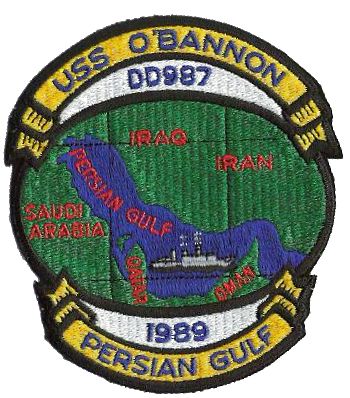
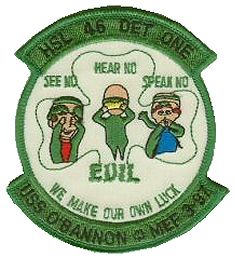
Med/Persian Gulf 1989HSL-46 Det. 1 - MEF 97-3


Back to topback to top  go to endgo to the end of the page


Back to topback to top


Back to Destroyers list. Back to ships list. Back to selection page. Back to 1st page.