Search the Site with 
General Characteristics Crew List Memorabilia Cruise Books Accidents aboard the Ship About the Ship's Coat of Arms History Image Gallery to end of page

USS Nashville (LPD 13)

- decommissioned -


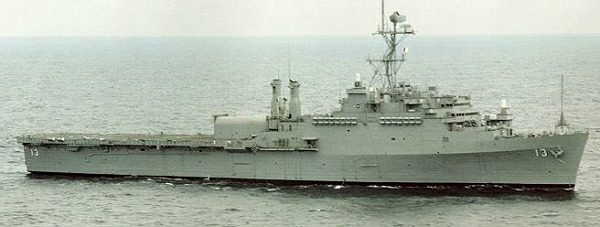
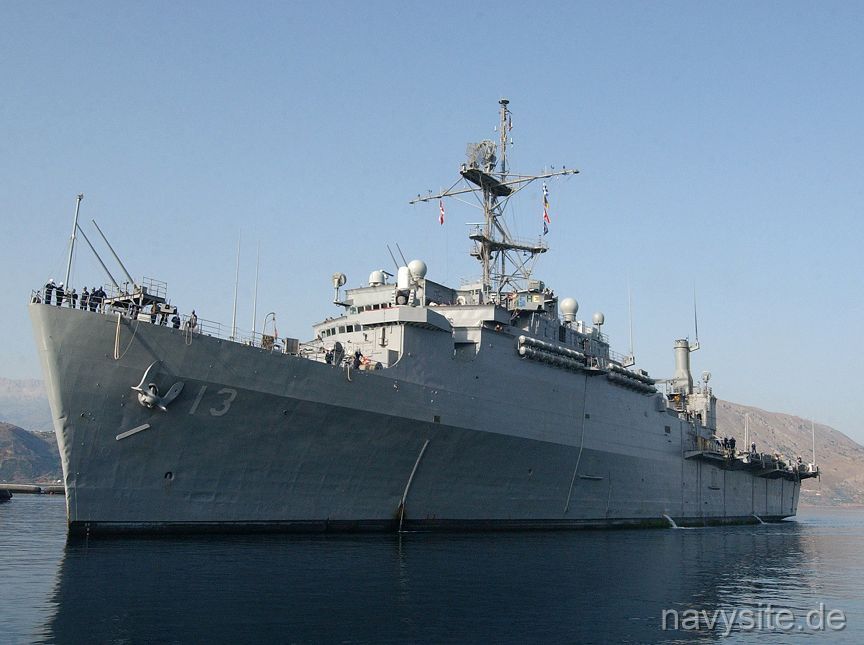
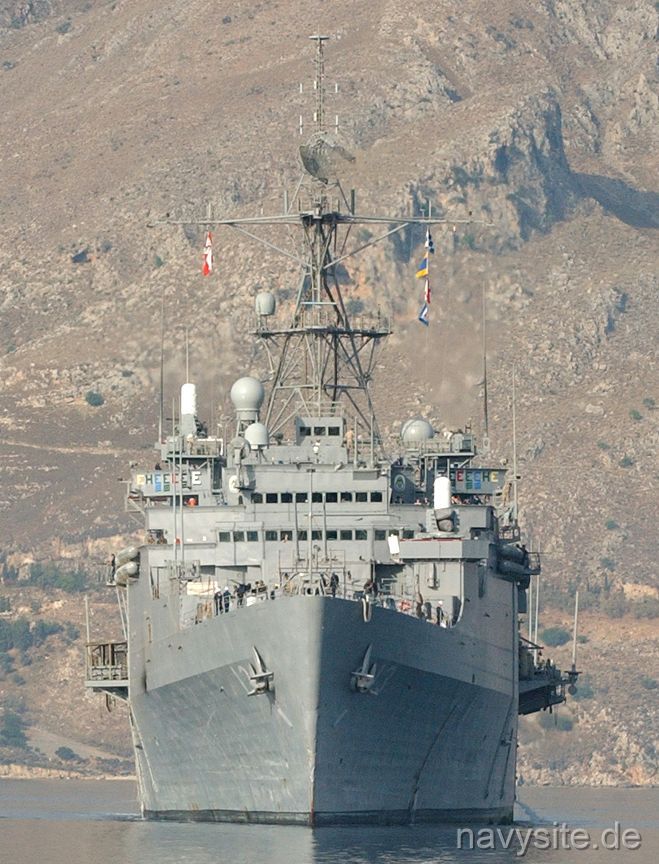
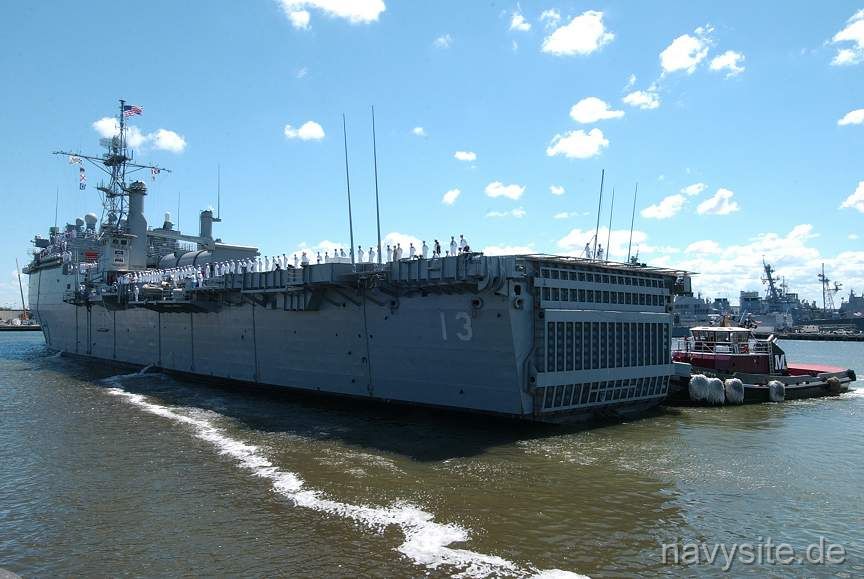
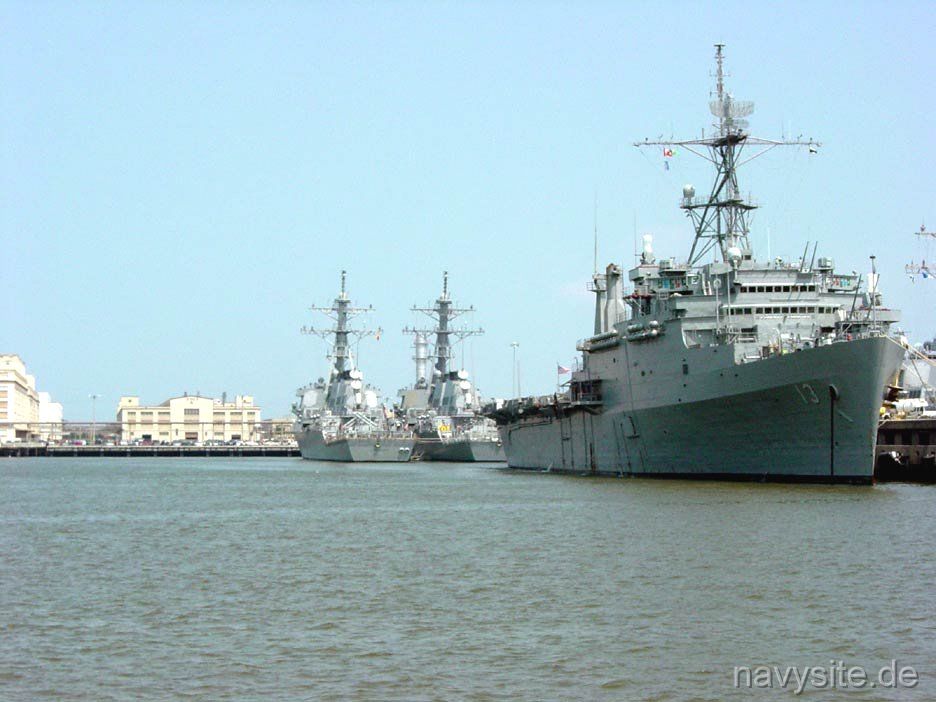
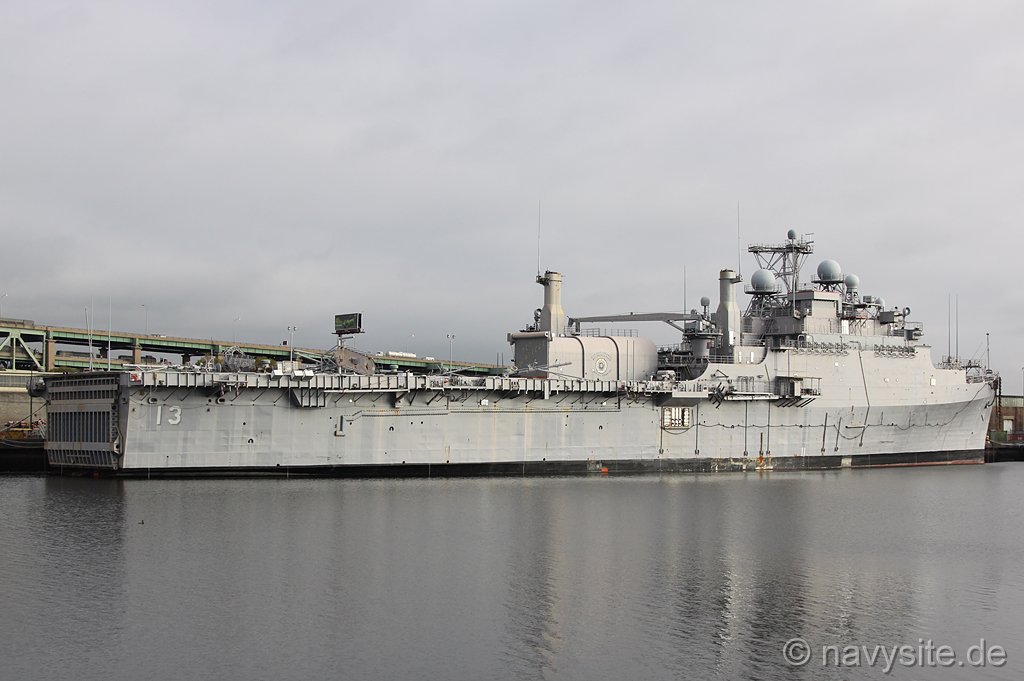
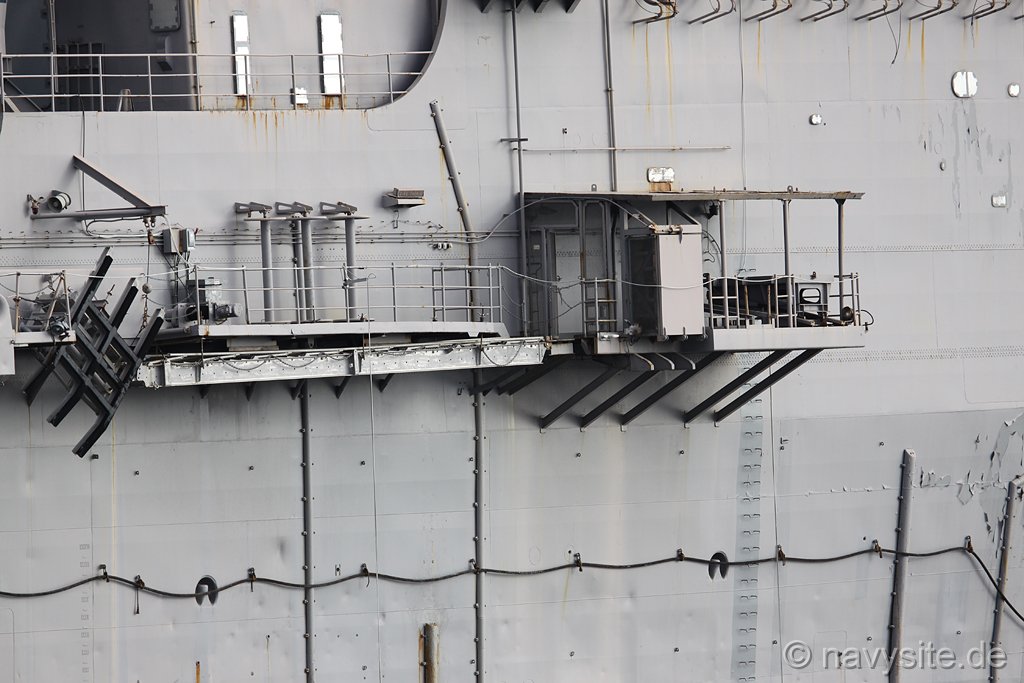
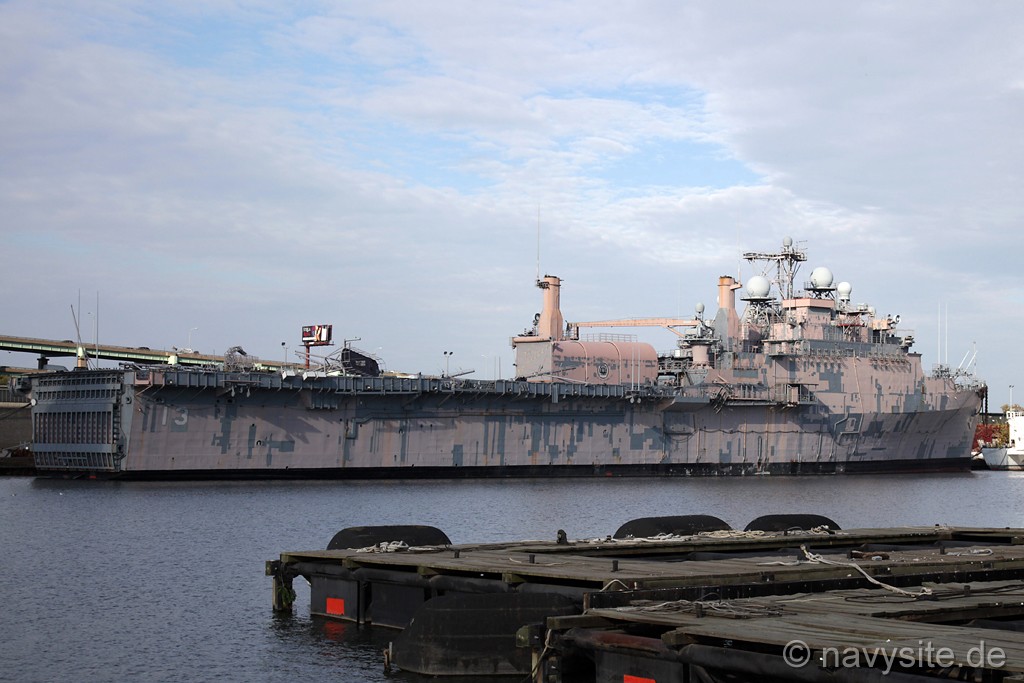
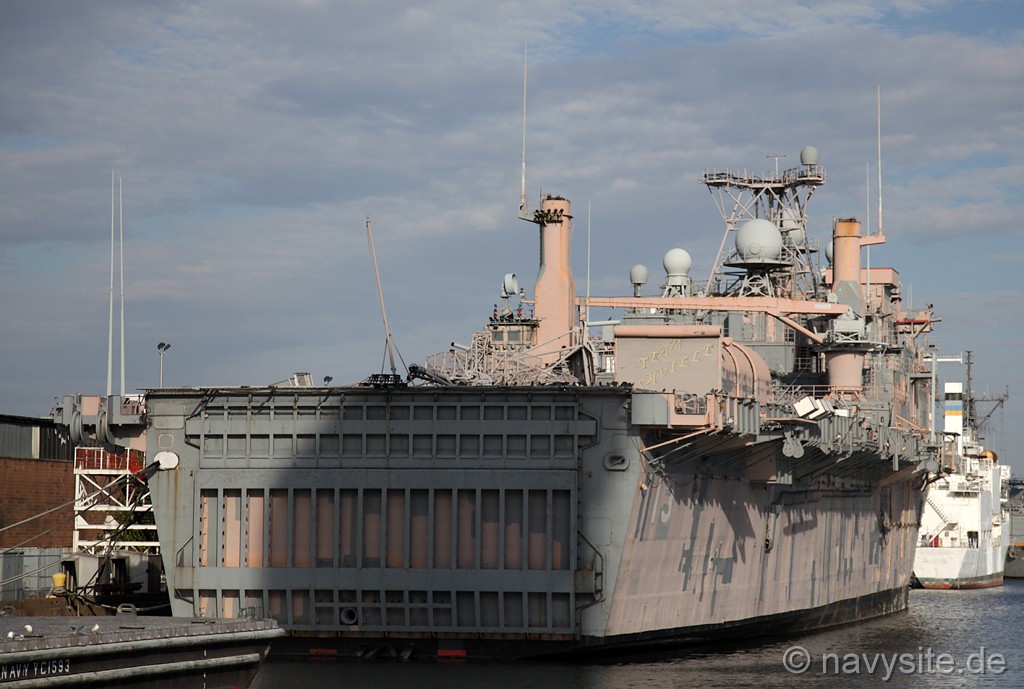
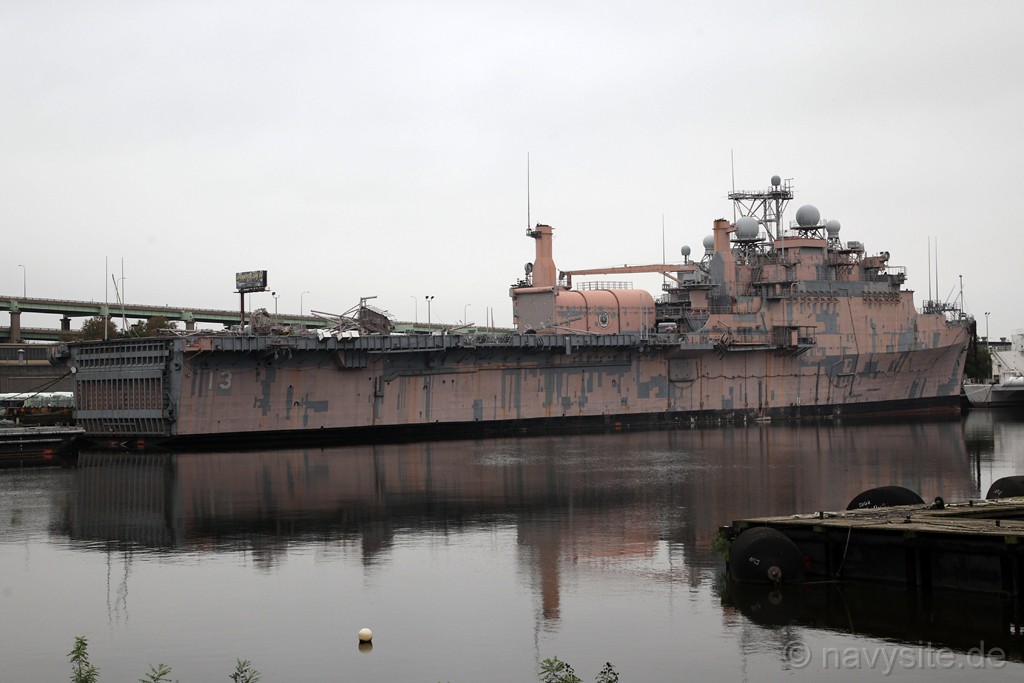
USS NASHVILLE was the tenth ship in the AUSTIN - class of Amphibious Transport Docks and the third ship in the Navy named after the capital city of Tennessee. USS NASHVILLE was last homeported in Norfolk, Va., and after decommissioning, she spent the following years laid up at Philadelphia, Penn. On April 8, 2022, she arrived under tow at All Star Metals, Brownsville, Tx., for scrapping.

General Characteristics:Awarded: May 15, 1964
Keel laid: March 14, 1966
Launched: October 7, 1967
Commissioned: February 14, 1970
Decommissioned: September 30, 2009
Builder: Lockheed Shipbuilding Co., Seattle, Wash.
Propulsion system: two boilers, two steam turbines
Propellers: two
Length: 569 feet (173.4 meters)
Beam: 105 feet (32 meters)
Draft: 23 feet (7 meters)
ballasted: 34 feet (10.4 meters)
Displacement: approx. 16,900 tons
Speed: 21 knots
Well deck capacity: one LCAC or one LCU or four LCM-8 or nine LCM-6 or 24 amphibious assault vehicles (AAV)
Aircraft: none, but telescopic hangar installed aboard. The hangar is not used to accommodate helicopters but on the flight deck there is space for up to six CH-46 helicopters.
Crew: Ship: 24 officers, 396 enlisted
Marine Detachment: approx. 900
Armament: two 20mm Phalanx CIWS, two 25mm Mk 38 guns, eight .50-calibre machine guns


Back to topback to top  go to endgo to the end of the page


Back to topback to top  go to endgo to the end of the page

Crew List:

This section contains the names of sailors who served aboard USS NASHVILLE. It is no official listing but contains the names of sailors who submitted their information.


back to top  go to the end of the page


Back to topback to top  go to endgo to the end of the page

USS NASHVILLE Cruise Books:


Back to topback to top  go to endgo to the end of the page

Accidents aboard USS NASHVILLE:

DateWhereEvents
February 23, 1972CaribbeanUSS NASHVILLE and USS SHREVEPORT (LPD 12) are slightly damaged in a collision during exercises in the Caribbean.
March 3, 19751,000 miles southwest
of the Azores
USS NASHVILLE and USS IWO JIMA (LPH 2) are severely damaged when IWO JIMA loses steering control and rams into the NASHVILLE during a highline transfer.


Back to topback to top  go to endgo to the end of the page

About the Ship's Coat of Arms:

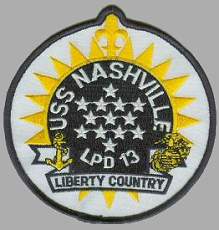
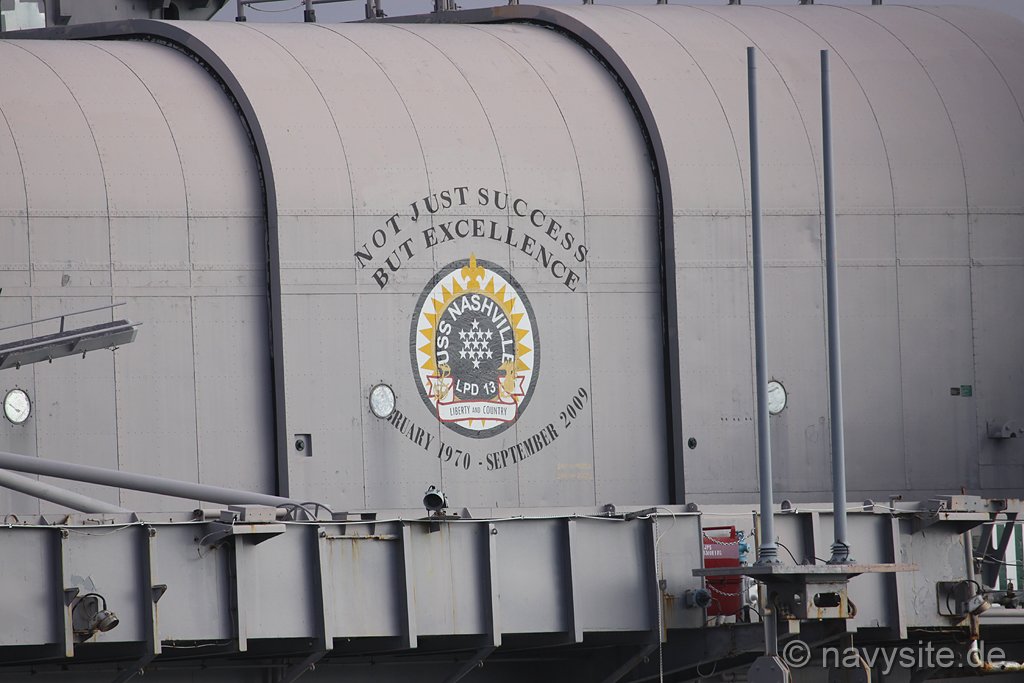
The insignia of USS NASHVILLE is centered about the thirteen stars that represent the original thirteen colonies. The stars allude to USS NASHVILLE as the thirteenth of her class of amphibious ships in the United States Navy. Surrounding the blue field and white stars is the gold compass rose from the Seal of the Metropolitan Government of the city of Nashville, Tennessee. This symbolizes the link between the ship and her namesake city.

Flanking the crest are the traditional emblems of the Navy and Marine Corps. Emblazoned on the banner is the motto taken from General Nash's dying words on the battlefield at Germantown: 'From the first dawn of the Revolution I have ever been on the side of liberty and my country'. During the Revolutionary War, Brigadier General Francis Nash, Continental Army, gave his life to ensure the independence of the colonies.


Back to topback to top  go to endgo to the end of the page

USS NASHVILLE History:

USS NASHVILLE was an AUSTIN-class amphibious transport dock built to embark, transport and land Marines, their vehicles and equipment by helicopter and landing craft. Her keel was laid on March 14, 1966, at Lockheed Shipbuilding and Construction Company in Seattle, Washington. She was launched on October 7, 1967, sponsored by the wife of Admiral Roy L. Johnson, and commissioned at Puget Sound Naval Shipyard, Bremerton, on February 14, 1970. From the outset, she was assigned to the Atlantic Fleet amphibious forces, with Norfolk, Virginia, as her home port, and after final post-commissioning preparations she transited via the Panama Canal to join her new operating areas in the Caribbean and western Atlantic.

During 1970, USS NASHVILLE began the pattern that would characterize much of her pre-1990 career: alternating periods of maintenance and training in home waters with deployments to the Caribbean and Mediterranean. In June 1970, she operated out of Guantanamo Bay, Cuba, where on June 9 she returned to begin shakedown training, working up her crew in damage control, amphibious operations, gunnery and engineering drills. Later that year, she is documented at the Guantanamo piers and at anchor off Frederiksted, St. Croix, supporting amphibious refresher training and local operations. In November 1970, she carried out a period of modified refresher training from Guantanamo, including underway replenishment evolutions with the fleet oiler USS CANISTEO (AO 99). These early cruises allowed NASHVILLE's crew and embarked Marines to practice the basic skills of ship-to-shore movement and sustainment in relatively benign waters while the ship settled into her role within the amphibious force.

Through 1971 and into 1972, USS NASHVILLE was heavily involved in routine amphibious training in the western Atlantic and Caribbean, including at least one deployment to the Mediterranean, as indicated by a 1971 Mediterranean cruise book, with operations alongside the Sixth Fleet. Her tasking in these years reflected the Cold War emphasis on maintaining flexible, sea-based forces able to move Marines rapidly between theaters. On February 2, 1972, while operating in Caribbean waters, NASHVILLE was involved in a collision with the amphibious transport dock USS SHREVEPORT (LPD 12). Both ships sustained damage but remained afloat and under control; after temporary repairs and inspections, they returned to service.

Over the next several years, NASHVILLE continued in this pattern of alternating maintenance and training with deployments, including another Mediterranean cruise in 1973 recorded in contemporary cruise book collections. She operated as part of Atlantic Fleet amphibious squadrons, conducting landing exercises along the U.S. East Coast, in the Caribbean and with NATO partners. These operations, though not always individually documented in detail, were part of the standing requirement to keep Marine amphibious forces ready to respond rapidly to regional crises, particularly in the Mediterranean and North Atlantic where NATO faced the Soviet Union and its allies.

A major incident in her mid-1970s service occurred on March 3, 1975, when USS NASHVILLE collided with the amphibious assault ship USS IWO JIMA (LPH 2) in the open Atlantic while both ships were engaged in operations. Contemporary reports describe the collision taking place roughly a thousand miles southwest of the Azores and note that both ships sustained damage. NASHVILLE was able to make her way under her own power to Frederiksted, St. Croix, in the U.S. Virgin Islands for initial assessment and repairs before returning to full service, while IWO JIMA also underwent repair work. The accident unfolded against the background of the U.S. withdrawal from Vietnam and a broader rebalancing of naval forces, but for NASHVILLE it primarily meant a temporary interruption in an otherwise steady pattern of amphibious operations.

In 1976, USS NASHVILLE took part in one of the major NATO Cold War exercises of the decade. In early September 1976, she embarked the 3rd Battalion, 10th Marines at Morehead City, North Carolina, as part of the 4th Marine Amphibious Brigade preparing for the Northern European cruise that included NATO exercise Teamwork 76 in Norway and exercise Bonded Item in Denmark and West Germany.

NASHVILLE served as the primary transport for the battalion headquarters and most of the Marines, sailing in company with the amphibious transport USS HERMITAGE (LSD 34), helicopter carrier USS GUADALCANAL (LPH 7) and tank landing ships USS SUMTER (LST 1181), USS LA MOURE COUNTY (LST 1194) and USS MANITOWOC (LST 1180). After crossing the Atlantic, the task group assembled at the historic anchorage of Scapa Flow, Scotland, where on September 15 allied officers met to finalize plans for the multinational landing force artillery organization. On September 20, the embarked Marines went ashore near Namsos, Norway, as part of the Teamwork 76 landing, watched by Norwegian King Olav V and senior NATO commanders.

Following the Norwegian phase, NASHVILLE and the other ships conducted liberty port visits between September 29 and October 9 in cities including Oslo, Copenhagen and Plymouth, then moved on to Denmark for exercise Bonded Item. In mid-October, the Marines landed at Oksbol, Denmark, with NASHVILLE continuing to provide logistic and command support throughout. These exercises demonstrated NASHVILLE's role in rapidly moving artillery and infantry units to northern Europe in a hypothetical reinforcement of NATO's northern flank.

By 1977, USS NASHVILLE was a well-established unit of the Atlantic Fleet amphibious force and that year served prominently as flagship of Amphibious Squadron 2 for significant periods. According to official command histories, she acted as squadron flagship from January 1 to March 11, again from April 29 to May 21 and from August 10 to December 31, 1977, while remaining assigned to the squadron throughout the year. In this role, she supported squadron staff command and control functions during deployments and exercises, including participation in NATO exercise Dawn Patrol 77 in the Mediterranean, where U.S. and allied navies rehearsed large-scale amphibious and naval operations in a Cold War context. These activities further reinforced NASHVILLE's importance as a command and lift platform within the amphibious force.

Although full day-to-day detail is not publicly preserved for every year, the available records and crew recollections show that through the late 1970s and early 1980s USS NASHVILLE continued to alternate between maintenance, training and forward deployments. She took part in multiple Mediterranean cruises as part of amphibious ready groups, several Caribbean Amphibious Ready Group deployments and at least one North Atlantic cruise in 1981 in which she crossed the Arctic Circle, giving her crew "Blue Nose" status and validating her ability to operate in colder, more demanding waters. These operations maintained a continuous U.S. amphibious presence in key regions and honed NASHVILLE's capabilities for rapid crisis response.

In 1982, USS NASHVILLE moved to the center of U.S. crisis response in the eastern Mediterranean. That summer, after Israel invaded Lebanon and fighting around Beirut intensified, the United States organized an evacuation of American and other foreign nationals trapped by the conflict. On June 24, 1982, NASHVILLE and the dock landing ship USS HERMITAGE lay offshore while landing craft ferried evacuees from the Christian-controlled port of Jounieh, about 10 miles north of Beirut, to the ships. News reports at the time noted that roughly 1,200 Americans and Europeans boarded U.S. Navy ships, with NASHVILLE serving as one of the primary receiving ships before the evacuees were transported to Cyprus. This non-combatant evacuation operation illustrated the ship's ability to receive large numbers of civilians at short notice and reinforced the political objective of removing Western nationals from an increasingly dangerous war zone.

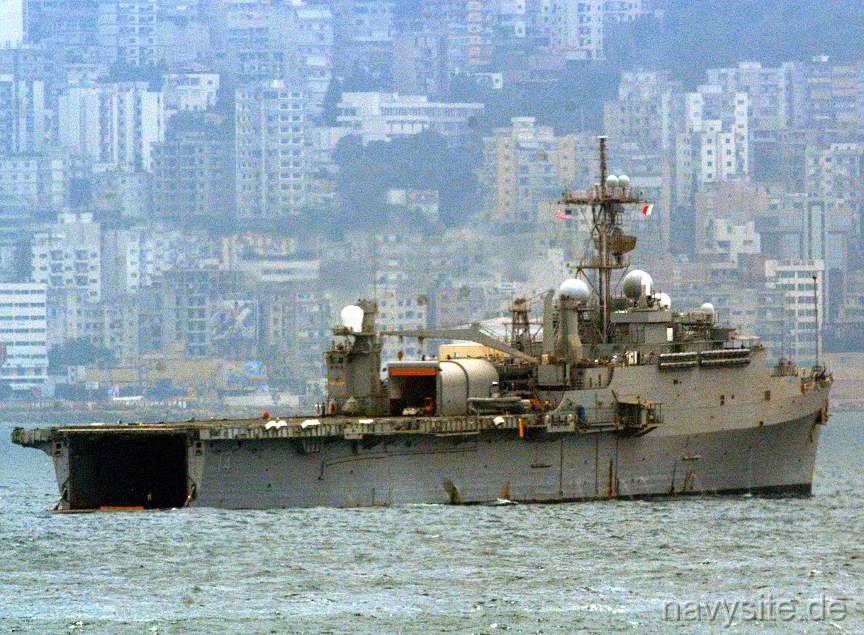
Following the initial evacuation, NASHVILLE remained in the eastern Mediterranean as part of an amphibious group supporting the multinational peacekeeping presence in Lebanon. Imagery from December 1, 1982, shows USS NASHVILLE underway off the Lebanese coast during multinational peacekeeping operations, reflecting her continued presence as forces tried to stabilize the situation after clashes between Israeli forces and the Palestine Liberation Organization. On September 10, 1982, she departed the Beirut area for Naples for a period of liberty, according to command history excerpts, before returning to Sixth Fleet duties in the Mediterranean.

Through late 1982 , she supported embarked Marines of the 32nd Marine Amphibious Unit and related formations, providing sea-based logistics, aviation support, and the option of further evacuations if the security situation around Beirut deteriorated.

In 1983, USS NASHVILLE's schedule reflected both routine training and crisis-related employment. Command history summaries indicate that from January 1 to February 22, 1983, she was in a period of leave and upkeep, after which, from February 23 to April 5, she conducted Caribbean Operations 83 ("Carib Ops 83"), with the Atlantic Fleet Commander in Chief embarked during the first half of that period. These Caribbean operations combined amphibious training with presence missions in a region where the United States was increasingly focused on instability in Central America and the Caribbean basin. Later in 1983, she again deployed to the Mediterranean with an amphibious ready group, returning to waters off Lebanon as the multinational force continued its mission following the withdrawal of PLO forces and amid mounting tensions that culminated in the October 23, 1983, bombing of the Marine barracks in Beirut. In this phase, NASHVILLE contributed sea-based lift, logistic support and a potential evacuation platform, although detailed day-by-day ship movements remain largely within internal command reports.

Through the mid-1980s, USS NASHVILLE continued to combine training, deployments and large-scale exercises. She participated in Mediterranean Amphibious Ready Group 1-85, underlining her continuing role in routine Sixth Fleet amphibious deployments, and in the large joint and combined exercise Ocean Venture 86 in the Caribbean and western Atlantic, where amphibious and carrier forces rehearsed reinforcement and power-projection scenarios tied to broader Cold War contingency planning.

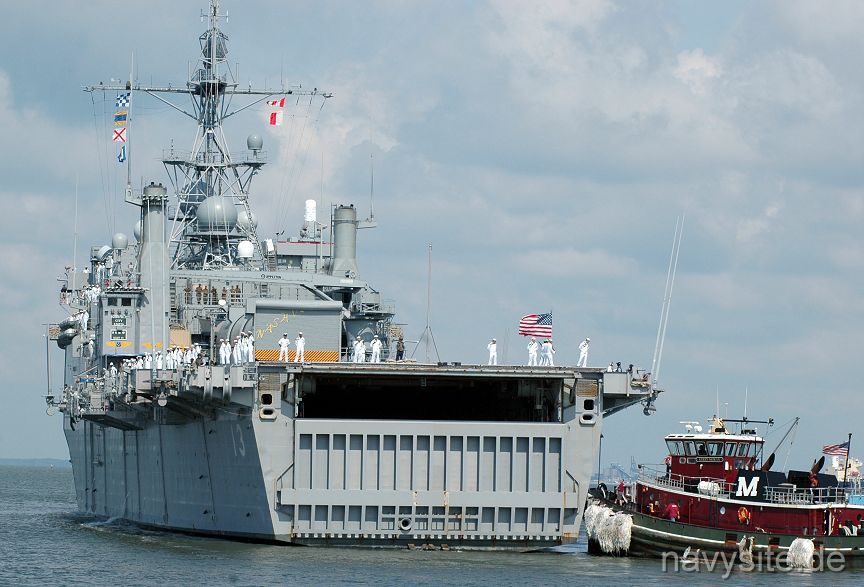
In 1986, she also took part in several high-profile North Atlantic and U.S. coastal events. On July 4, 1986, she was moored in New York Harbor during the International Naval Review that formed part of the centennial rededication celebrations for the Statue of Liberty, with official imagery showing USS NASHVILLE alongside tall ships as President Ronald Reagan reviewed assembled warships. Shortly afterward, she joined a North Atlantic deployment to NATO exercise Northern Wedding 86, sailing in company with ships including the tank landing ship USS SPARTANBURG COUNTY (LST 1192) and dock landing ship USS WHIDBEY ISLAND (LSD 41). Photographs dated August 1, 1986, show NASHVILLE maneuvering with these ships during "leapfrog" drills en route to the exercise area, which tested allied ability to reinforce northern Europe by sea under wartime conditions.

In the late 1980s, NASHVILLE continued to demonstrate the versatility of the LPD platform. Command history fragments for 1988 note that she crossed the Arctic Circle and visited ports including Copenhagen in Denmark during a northern deployment, further reinforcing her status as a "Blue Nose" ship and reflecting NATO's focus on the Greenland-Iceland-United Kingdom gap and northern flank during the final years of the Cold War. She also undertook at least one Mediterranean deployment in the 1988-1989 period, as indicated by official records and cruise book references, operating with amphibious ready groups and conducting amphibious training, port visits and presence missions alongside other U.S. and allied ships.

By 1990, USS NASHVILLE was a mature platform with two decades of amphibious experience behind her when she was assigned to operations off West Africa during the Liberian civil war. In late 1989 and early 1990 Liberia descended into civil conflict as forces of the National Patriotic Front of Liberia and other factions advanced on the capital, Monrovia, threatening U.S. diplomats, foreign nationals and local civilians. In response, the United States organized what became Operation Sharp Edge, a prolonged non-combatant evacuation operation and presence mission using amphibious ready groups off the Liberian coast. The initial evacuation phase began in early August 1990, with the amphibious assault ship USS SAIPAN (LHA 2), amphibious transport dock USS PONCE (LPD 15), tank landing ship USS SUMTER (LST 1181) and destroyer USS PETERSON (DD 969), which evacuated thousands of civilians between August 5 and late November.

Later in 1990, USS NASHVILLE joined the operation as part of the Mediterranean Amphibious Ready Group, relieving earlier ships off Monrovia and taking up station at "Mamba Station", the offshore operating area used by U.S. forces. Defense histories note that during Operation Sharp Edge, NASHVILLE relieved the dock landing ship USS WHIDBEY ISLAND and tank landing ship USS NEWPORT (LST 1179) off Liberia, assuming responsibility for continuing evacuation support and logistic sustainment of the Marine forces ashore and at sea.

From her position off Monrovia in the latter part of 1990, she embarked helicopters and small craft to shuttle supplies, personnel and evacuees, supporting the U.S. embassy and designated assembly areas ashore while simultaneously maintaining an offshore sanctuary and command node. Operation Sharp Edge continued into early 1991. Official Marine Corps accounts emphasize that by January 9, 1991, when NASHVILLE departed Mamba Station to rejoin the rest of her amphibious group in the Mediterranean, the operation had evacuated more than 2,600 people and was regarded as the longest-running non-combatant evacuation operation in recent U.S. naval history.

Shortly afterward, NASHVILLE's group became part of the larger coalition naval posture surrounding Operation Desert Shield and, after January 17, 1991, Operation Desert Storm against Iraq. She was assigned within the coalition's amphibious structure as part of the amphibious forces associated with Task Force 156, alongside units such as USS NASSAU (LHA 4), USS WHIDBEY ISLAND and USS NEWPORT, forming one of the amphibious elements held ready to conduct landings if ordered.

From the perspective of the crew, 1991 thus began with continuous deployed operations: first off West Africa, then under the shadow of the Gulf War as an amphibious presence supporting the wider coalition strategy. After completion of these operational commitments, NASHVILLE returned to Norfolk later in 1991 for post-deployment stand-down, upkeep and local training on the U.S. East Coast.

In 1992, NASHVILLE resumed the normal amphibious readiness cycle - maintenance, basic training, and work-ups with embarked Marines and helicopters - preparing for the next extended deployment. By late 1992, she had again left the United States as part of an amphibious task group that would be diverted toward the Horn of Africa in support of United Nations efforts to stabilise Somalia. A December 1992 status-of-forces summary lists USS NASHVILLE among the amphibious ships bound for a designated operating area off Mogadishu, Somalia, with an estimated arrival in early December, as part of the naval force supporting what became Operation Restore Hope. During this phase, she operated alongside larger amphibious ships such as USS WASP (LHD 1) and USS BARNSTABLE COUNTY (LST 1197), providing well-deck capacity for landing craft, flight-deck space for helicopters, and accommodation for Marines and their equipment during the multinational humanitarian intervention in Somalia.

Through late 1992 and into 1993, NASHVILLE's role was to serve as one of the principal sea bases from which troops, supplies and vehicles were moved toward Mogadishu and other coastal areas, supporting United Task Force (UNITAF) operations ashore. By May 1993, NASHVILLE had shifted from the Somali coast into the Persian Gulf region. A contemporary U.S. Navy photograph shows the ship moored pierside at Mina Sulman, Bahrain, in company with USS BARNSTABLE COUNTY, indicating that the amphibious group had redeployed northward into the Gulf to support the post-Desert Storm enforcement of U.N. resolutions and to maintain an afloat Marine presence.

After completing this deployment, she returned to Norfolk for maintenance and another turn in the training cycle, during which time the embarked Marine units and ship's company prepared for renewed contingency operations in the Caribbean and Atlantic.

In 1994, NASHVILLE's activities shifted focus toward the western Atlantic and Caribbean as the United States confronted political instability in Haiti and continuing migration crises in the region. She was assigned to the Caribbean amphibious structure supporting Operations Able Vigil and Able Manner, which were aimed at interdicting and managing Haitian migrant flows at sea, and Operation Support Democracy, the pre-intervention maritime phase that applied pressure on Haiti's military regime by maintaining amphibious forces and Marines ready to act. Status-of-forces reports list USS NASHVILLE among the amphibious ships aligned with MARFOR CARIB and the Haiti contingency posture, in company with units including USS SAIPAN, USS PONCE and USS PENSACOLA (LSD 38). During this period, she alternated between at-sea readiness in the Caribbean and port periods, serving as a key platform for amphibious rehearsals and for maritime interception operations linked to Haiti and Cuban migrant movements.

Later in 1994, she played a more direct role in the intervention in Haiti itself. Under the combined framework of Operations Support Democracy and Uphold Democracy, NASHVILLE embarked Marines and special operations forces as part of the amphibious force assembled to restore Haiti's elected government. Amphibious plans called for Marines in amphibious assault vehicles to launch from USS NASHVILLE while landing craft from USS ASHLAND (LSD 48) approached Haitian shores, ready to secure key facilities around Cap-Haitien and other points if a forcible entry proved necessary.

A negotiated agreement, supported by international pressure, ultimately allowed a largely unopposed entry by U.S. forces, but NASHVILLE remained one of the main amphibious ships supporting the presence off Haiti. Contemporary accounts note that she embarked elements of SEAL Team 8 and special boat units, with those forces staged aboard NASHVILLE as they prepared for possible combat operations before the peaceful transition. After initial operations off Haiti she made port calls including Roosevelt Roads, Puerto Rico, before returning to her homeport.

In 1995, NASHVILLE again deployed to the Mediterranean as part of wider U.S. and NATO operations linked to the conflicts in the former Yugoslavia. She operated with other amphibious units and the 24th Marine Expeditionary Unit, contributing to the amphibious presence in the Adriatic Sea that underpinned NATO operations Deny Flight and, later, Allied Force. Awards records and Marine histories indicate that NASHVILLE's service in this period was recognised with unit honours tied to Mediterranean and Adriatic operations.

On June 8, 1995, during the high-profile rescue of U.S. Air Force pilot Captain Scott O'Grady, who had been shot down over Bosnia six days earlier, NASHVILLE was among the naval units providing support to the operation, functioning as part of the maritime infrastructure that sustained the embarked Marines and aviation assets involved in the rescue mission.

Later that year, she also hosted developmental testing at sea: a Naval Air Warfare Center command history notes dynamic interface trials conducted aboard USS NASHVILLE on December 6, 1995, reflecting her use as a platform for evaluating helicopter and ship-handling procedures.

On November 25, 1996, NASHVILLE embarked with an amphibious ready group and the 26th Marine Expeditionary Unit for another Mediterranean cruise, with operations extending into spring 1997. During this cycle she became closely associated with events in Albania during that country's 1997 unrest. As the internal situation deteriorated in early 1997, U.S. planners prepared for a potential evacuation of American citizens. Amphibious forces of the 26th MEU, embarked on ships including USS GUAM (LPH 9), USS NASHVILLE and USS TRENTON (LPD 14), positioned in the Adriatic. A detachment of CH-46E and AH-1W helicopters from the MEU's aviation combat element was cross-decked to NASHVILLE, along with a reinforced Marine detachment, to give her an independent capability close to the Albanian coast while other ships headed toward scheduled port calls.

When Operation Silver Wake - the non-combatant evacuation from Albania - was executed in March 1997, NASHVILLE operated off Albania alongside USS RAMAGE (DDG 61) and other units, embarking evacuees and supporting helicopter and boat movements ashore and back to safer ports. After completing these tasks and subsequent exercises, she headed west and, according to a U.S. status-of-forces summary, was en route to a port visit in Rota, Spain from May 2-11, 1997, before redeploying to the United States.

In the late 1990s, NASHVILLE continued to alternate between deployments and East Coast training. She again deployed to the Mediterranean with an amphibious group in 1998-1999. Evidence of this deployment includes a 1999 Mediterranean cruise book and a status-of-forces report for February 1999 noting USS NASHVILLE and USS PENSACOLA conducting a port visit to Souda Bay, Crete, and operating in the central Mediterranean about 145 miles east of Augusta Bay, Sicily. During this period, she provided the usual blend of amphibious lift, well-deck and flight-deck capability for embarked Marines, and took part in NATO exercises and presence missions. As NATO's Operation Allied Force unfolded over Kosovo in 1999, naval reporting from that time indicates that NASSAU-group amphibious ships, including NASHVILLE, were in the Mediterranean supporting allied operations, held ready to provide contingency evacuation or amphibious options if required.

NASHVILLE deployed once more to the Mediterranean around the turn of the millennium. Cruise book records and photographs show her in the Mediterranean and Arabian regions in 2000-2001, including a port call at Toulon, France, in February 2001 where she was photographed alongside the submarine tender USS EMORY S. LAND (AS 39). A 2001 command history summary notes that on May 24, 2001, NASHVILLE arrived back in Norfolk, marking the official end of this deployment. During this cruise, she combined routine amphibious training and NATO exercises with contingency readiness in the Mediterranean and adjacent waters, as U.S. naval forces maintained presence in support of Balkan stability and broader regional security.

The year 2002 for USS NASHVILLE appears in open sources largely as an interval of stateside operations: upkeep, training and preparation for renewed deployment in the context of the post-September 11 security environment. She remained based in Norfolk, exercising with East Coast units and maintaining readiness for the more demanding missions that would follow in the Middle East and Africa.

On March 4, 2003, NASHVILLE departed Naval Station Norfolk as part of the USS IWO JIMA (LHD 7) Amphibious Ready Group with the 26th Marine Expeditionary Unit embarked, deploying in support of Operation Enduring Freedom and associated tasks in the broader Global War on Terrorism. After transiting the Atlantic and Mediterranean and passing through the Suez Canal, she supported operations in the U.S. Central Command area, where the ARG and MEU were involved in missions linked to the early phases of the Iraq War. Later in the deployment, the amphibious group was redirected from the Gulf to the West African coast, where Liberia again became a focus. Off Monrovia, NASHVILLE, IWO JIMA and USS CARTER HALL (LSD 50) supported peacekeeping and stabilisation efforts during Liberia's crisis, providing sea-based support and lift for Marines ashore in and around the capital. Elements of the 26th MEU began landing in Monrovia on August 14, 2003, as part of the quick reaction force supporting international forces and humanitarian operations. On October 1, 2003, the three amphibious ships pulled into Rota, Spain, to conduct an equipment wash-down and allow the crews some liberty before the trans-Atlantic return, and on October 24, 2003, NASHVILLE completed nearly eight months at sea when she returned to Norfolk.

After a shipyard period that extended through much of 2004, USS NASHVILLE resumed a high-tempo schedule. On April 25, 2005, she visited Fort Lauderdale, Florida, participating in Fleet Week activities that showcased the ship and her crew to the public. On May 25, 2005, she departed Norfolk with the USS SAIPAN Expeditionary Strike Group under the Navy's Fleet Response Plan, a concept designed to increase the ability of naval forces to surge quickly for contingencies, again in the context of the Global War on Terrorism. During this 2005 deployment, NASHVILLE took part in Exercise Barbary Thunder, a multinational maritime exercise that brought together forces from Britain, Spain, France, Italy, Morocco, Tunisia and Algeria to practise maritime security, interoperability and information sharing in the western Mediterranean. She then visited Souda Bay, Crete, on July 20, 2005, and later entered the Black Sea, where starting July 23 she and other U.S. assets - including USS MAHAN (DDG 72) - conducted training engagements with Bulgaria, Georgia, Romania, Turkey and Ukraine. After roughly three months deployed, she returned to Norfolk on August 25, 2005, having completed what was described as a surge deployment under the Fleet Response Plan.

On October 22, 2005, NASHVILLE, together with USS WASP and USS TRENTON, got underway from Norfolk toward south Florida, loaded with humanitarian supplies and equipment in case they were needed in the aftermath of Hurricane Wilma. This mission placed her on standby to provide disaster relief if requested by civil authorities, illustrating the flexibility of amphibious ships to switch quickly from combat-related deployments to humanitarian contingency roles.

In early 2006, NASHVILLE became an important test platform for unmanned aviation at sea. On January 16-17, 2006, the Navy's Vertical Takeoff and Landing Tactical Unmanned Air Vehicle (VTUAV) program achieved a milestone when an RQ-8A Fire Scout unmanned helicopter conducted a series of nine autonomous take-offs and landings on NASHVILLE's flight deck - three by the first air vehicle and six more by a second - marking the first time a major defence acquisition UAV programme had landed autonomously on a fleet vessel.

Shortly afterwards, on February 14, 2006, NASHVILLE and other ships of the USS IWO JIMA Expeditionary Strike Group completed ESG Integrated Training (ESGINT) in Onslow Bay, North Carolina, a pre-deployment exercise with the 24th Marine Expeditionary Unit to refine command-and-control and combined operations skills. On April 21, 2006, she conducted a friends-and-family day cruise from Norfolk, and on June 6, 2006, she left Norfolk again as part of the IWO JIMA Expeditionary Strike Group for a scheduled six-month deployment focused on maritime security operations in support of the Global War on Terrorism.

During the 2006 deployment, NASHVILLE's movements reflected shifting regional crises. She visited Souda Bay, Crete, on June 29, 2006, then on July 4 transited the Suez Canal as the strike group relieved USS PELELIU (LHA 5) in the U.S. 5th Fleet area. On July 19, 2006 - after another Suez Canal transit - NASHVILLE arrived in Cyprus and joined the emergency evacuation of U.S. citizens from Lebanon after fighting erupted between Israel and Hezbollah. As part of Commander Task Force 59, she and IWO JIMA, with Marines of the 24th MEU, shuttled evacuees from Beirut to safer ports, including Cyprus, providing accommodation and transport for hundreds of American citizens and other nationals. Once the evacuation phase ended, NASHVILLE and IWO JIMA transited the Suez Canal again on August 20, 2006, to return to the Persian Gulf region, where NASHVILLE supported maritime security operations and, more broadly, Operation Iraqi Freedom by contributing to persistent amphibious and maritime presence. She remained active in the Gulf through mid-September before the strike group began its homeward transit, crossing the Suez Canal westbound on November 8, 2006, and finally arriving back in Norfolk on December 6, 2006.

Training and pre-deployment work-ups continued into 2007. On August 24, 2007, NASHVILLE left Norfolk for an at-sea group exercise with the USS NASSAU Expeditionary Strike Group, and by late September, she was engaged in an Expeditionary Strike Group Integration exercise in the Atlantic, rehearsing the full range of amphibious operations with the 24th Marine Expeditionary Unit. She concluded a Composite Unit Training Exercise (COMPTUEX) and returned to Norfolk on December 15, 2007, certified and ready for the next deployment.

On February 20, 2008, USS NASHVILLE departed Norfolk with the NASSAU Expeditionary Strike Group for a scheduled deployment to the Mediterranean and Indian Ocean. After crossing the Atlantic she arrived at Rota, Spain, leaving there on March 6, 2008, after a three-day port visit. On April 2, 2008, a change of command ceremony was held aboard while the ship was in the Mediterranean, with Captain Tushar R. Tembe relieving Captain DeWolfe H. Miller as commanding officer. A few days later, from April 8-14, NASHVILLE visited Souda Bay and the nearby city of Chania, Crete, as part of Exercise Phoenix Express 2008, a multinational U.S.-sponsored maritime security exercise with participants from twelve countries across Europe and North Africa.

After a further port call at Rhodes ending April 28, she continued maritime security operations and theatre security cooperation tasks in the Mediterranean and adjacent waters. On June 17, 2008, she visited Haifa, Israel, before eventually returning to Norfolk on July 11, 2008, having spent nearly five months deployed.

On January 15, 2009, NASHVILLE left Norfolk for what would be her final deployment before decommissioning, this time as the primary platform for Africa Partnership Station (APS), an initiative focused on maritime capacity-building with African navies. She reached Rota on January 25 for a short port visit, then on February 3 arrived in Dakar, Senegal, for the in-country kickoff of the APS "NASHVILLE" deployment, hosting staff from Destroyer Squadron 60 and international partners. On February 20, she arrived in Sekondi, Ghana; on March 17 she reached Lagos, Nigeria, and on April 1 she arrived in Limbe, Cameroon, where she conducted a two-week port visit that included training, community relations and shipboard exchanges.

On April 15, NASHVILLE anchored off Libreville, Gabon, for a five-day stay and then moved to Port-Gentil, Gabon, for a longer, twelve-day engagement. She returned to Dakar on May 9 for a final African APS port visit and then headed back toward Europe, arriving again in Rota on May 29, 2009, for planning conferences tied to Africa Partnership Station 2010. On June 12, 2009, she came back into Norfolk, completing a five-month deployment in the U.S. 6th Fleet area that had emphasised partnership building and cooperative maritime security, rather than traditional combat operations.

Following this final deployment, the Navy prepared NASHVILLE for retirement. On September 30, 2009, USS NASHVILLE was decommissioned at Naval Station Norfolk and then towed to the Naval Inactive Ship Maintenance Facility in Philadelphia, where she was retained in a ready-reserve status for several years. She remained berthed there until she was stricken from the Naval Vessel Register in November 2017, and in March 2022 she was removed from Philadelphia and towed to Brownsville, Texas, arriving there on April 8, 2022 to be dismantled.


Back to topback to top  go to endgo to the end of the page


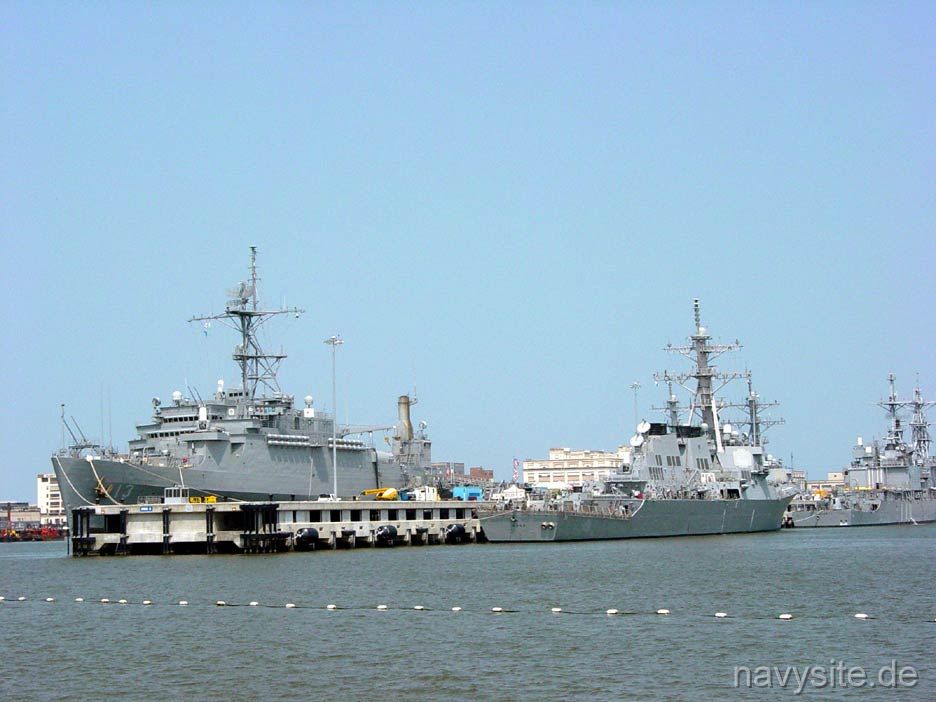
The photos below were taken by Brian Barton and show USS NASHVILLE at Naval Base Norfolk, Va., on July 23, 2002.


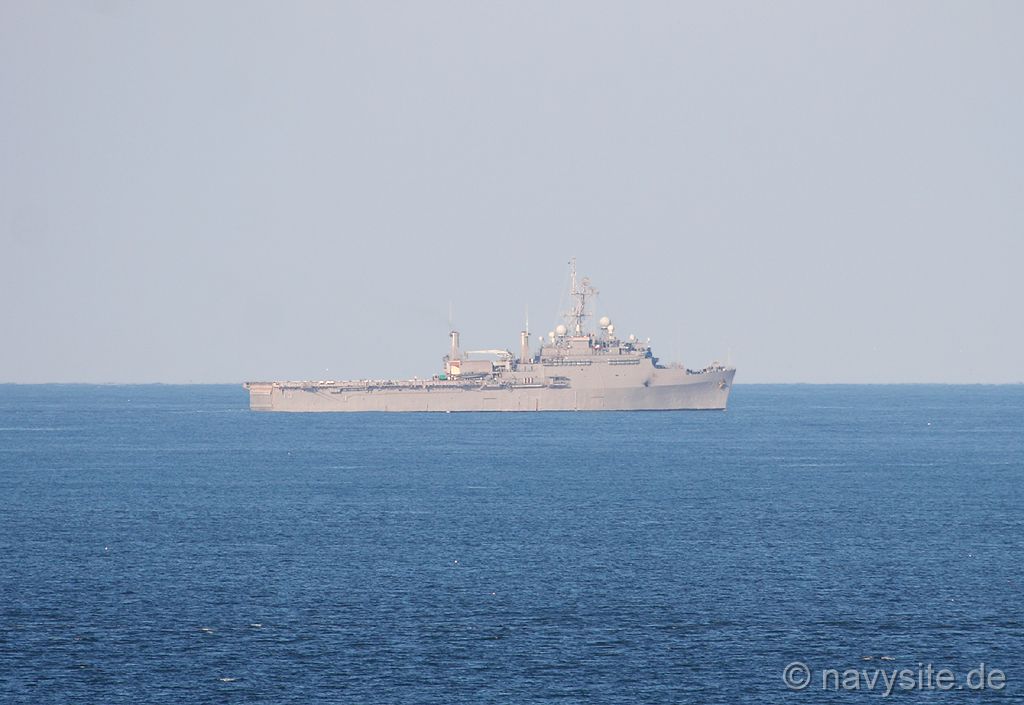
The photo below is a 400mm shot from my hotel balcony in Virginia Beach, Va. It shows the NASHVILLE steaming off the coast on November 10, 2008.


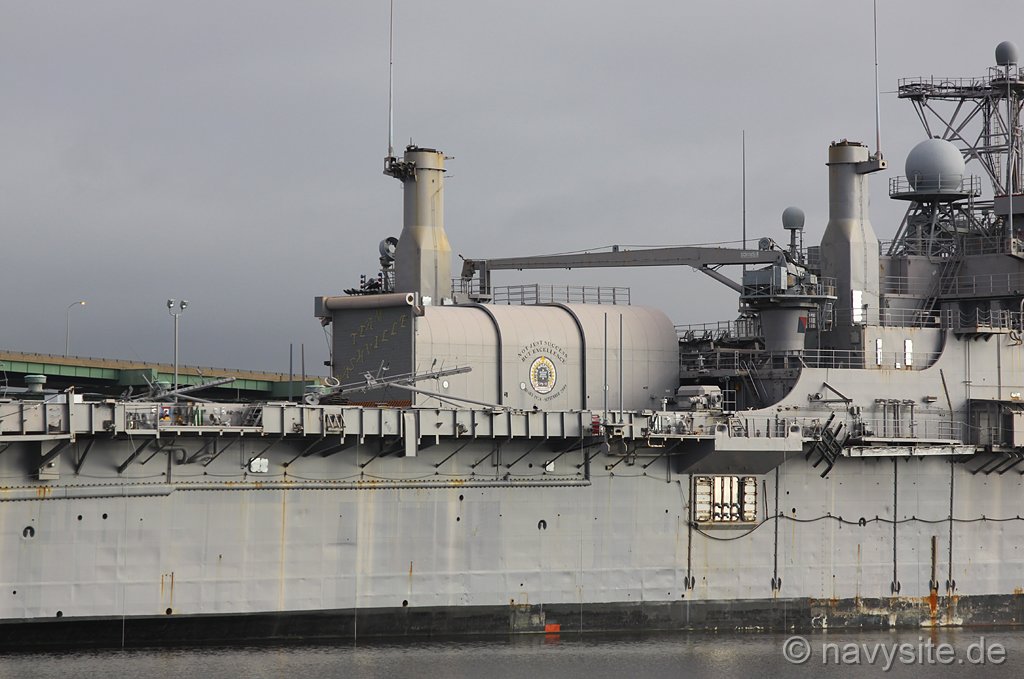
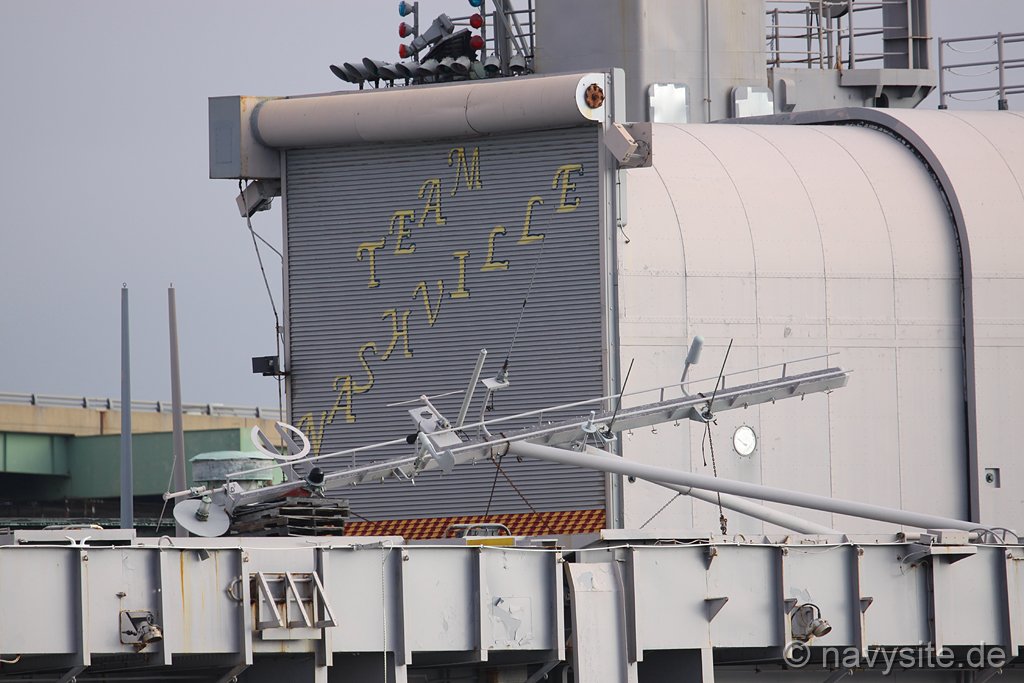
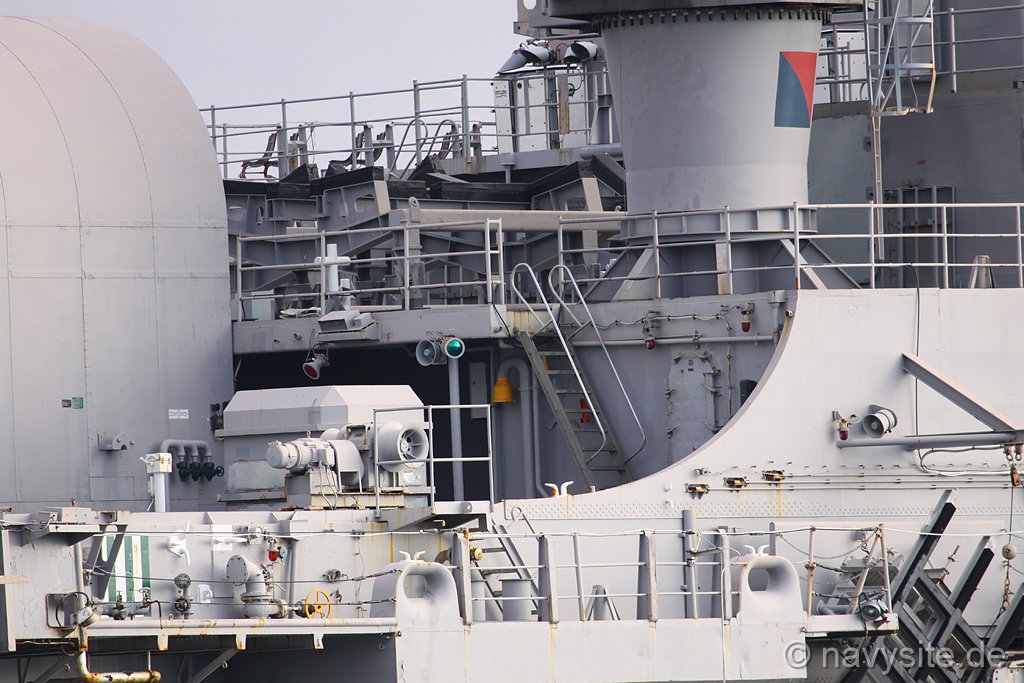
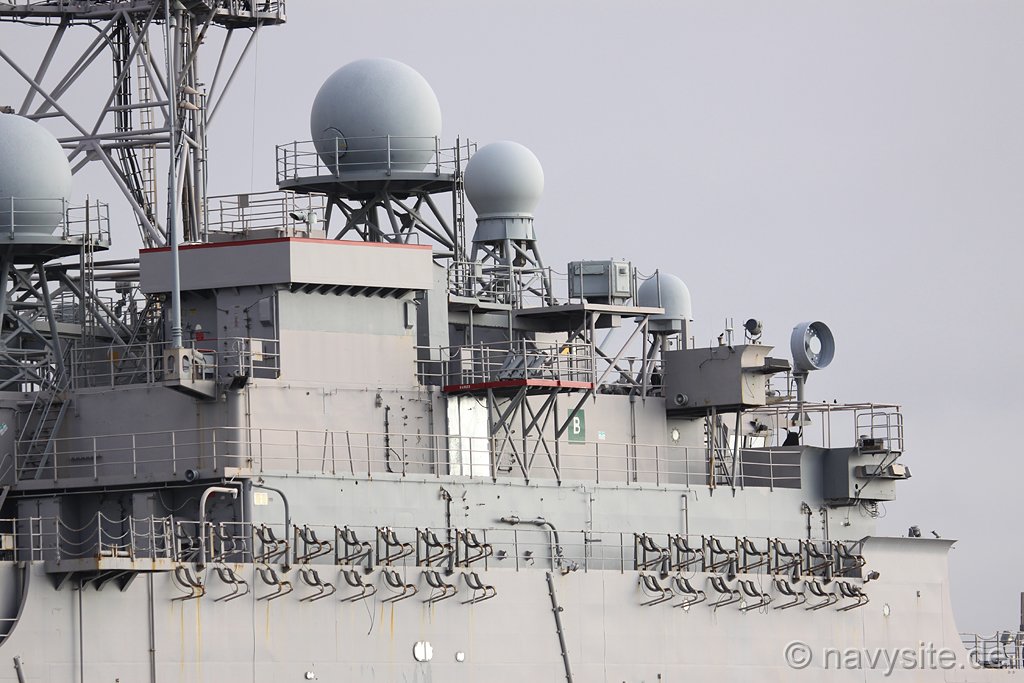
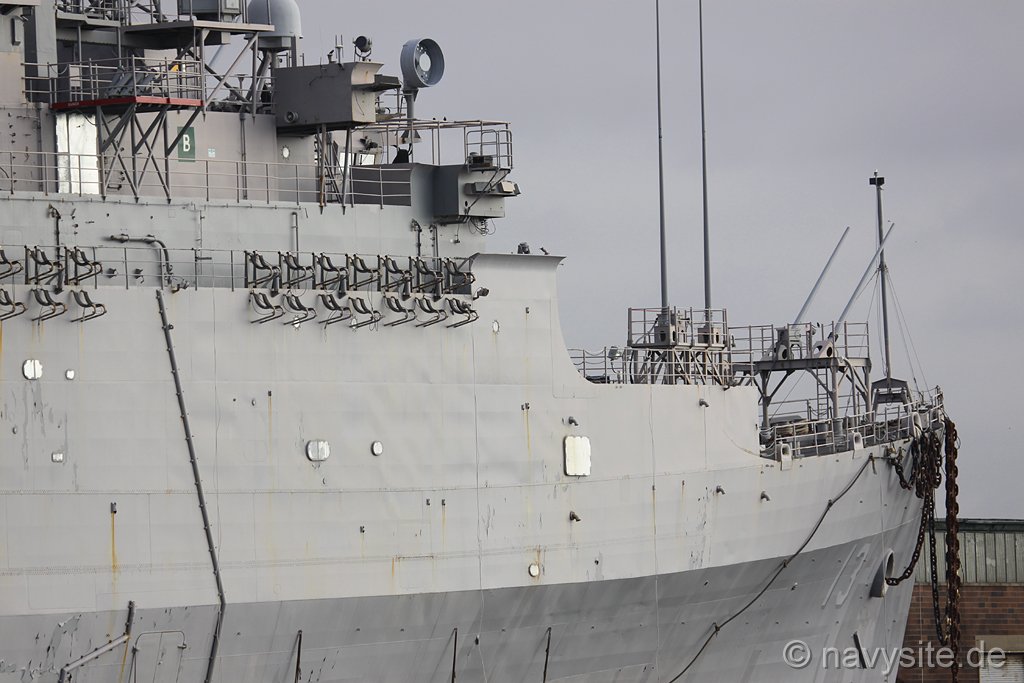
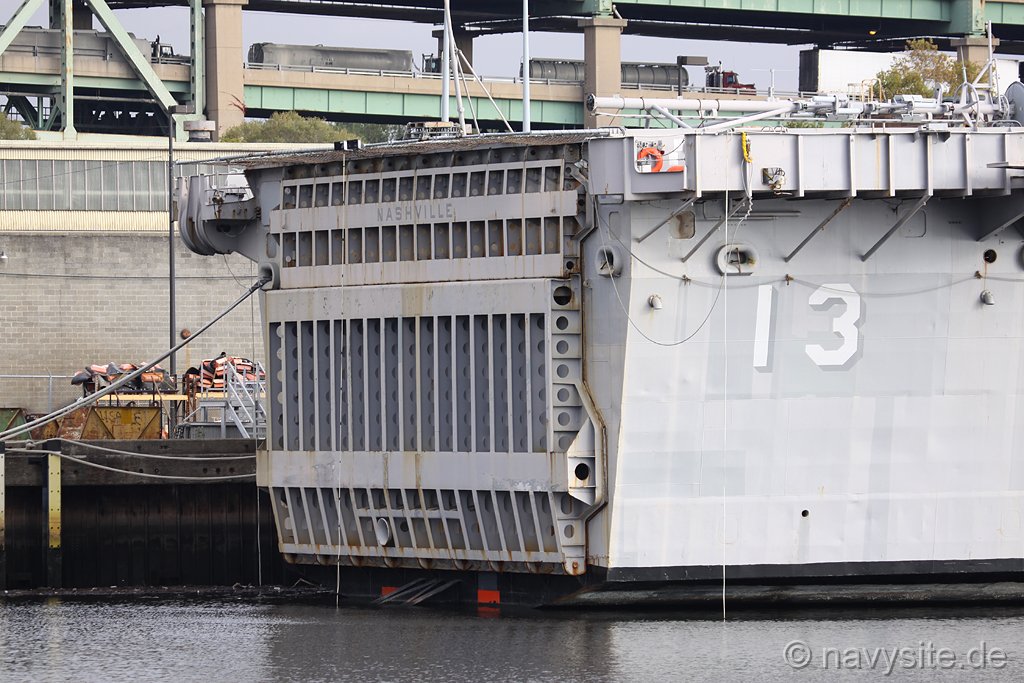
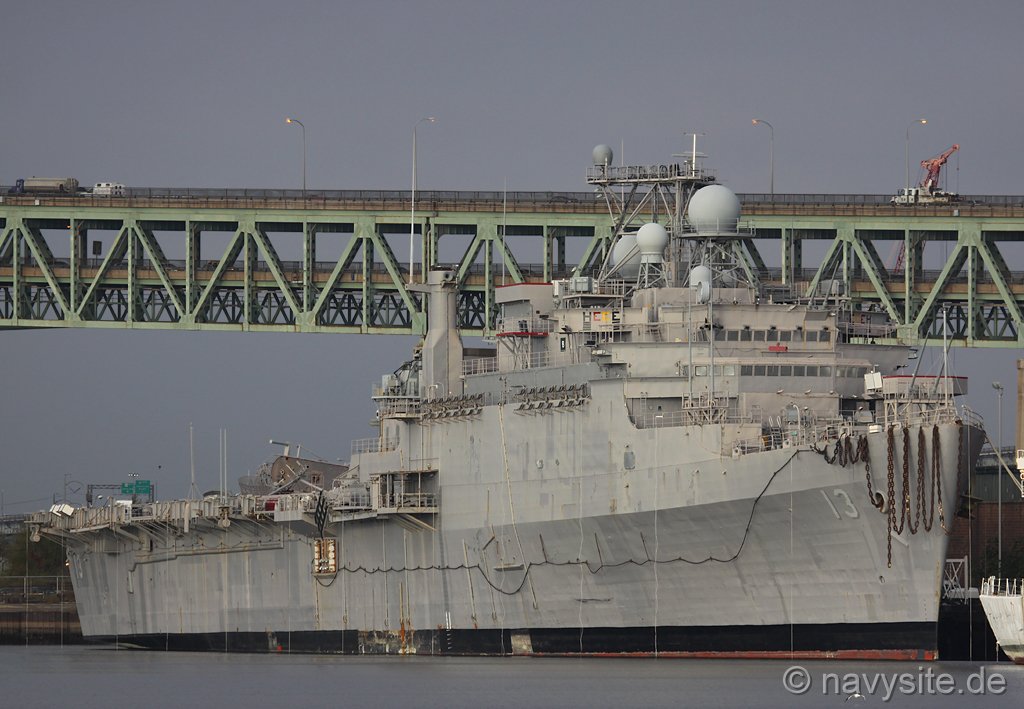
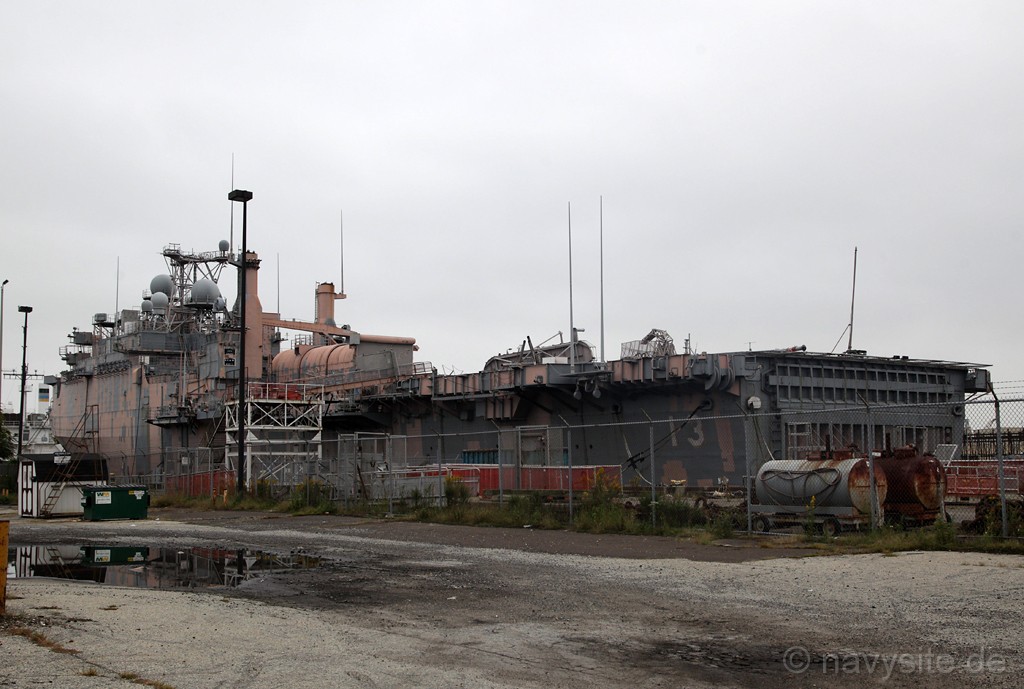
The photos below were taken by me and show the NASHVILLE laid up at the former Philadelphia Naval Shipyard, Philadelphia, Penn., on October 26, 2010.


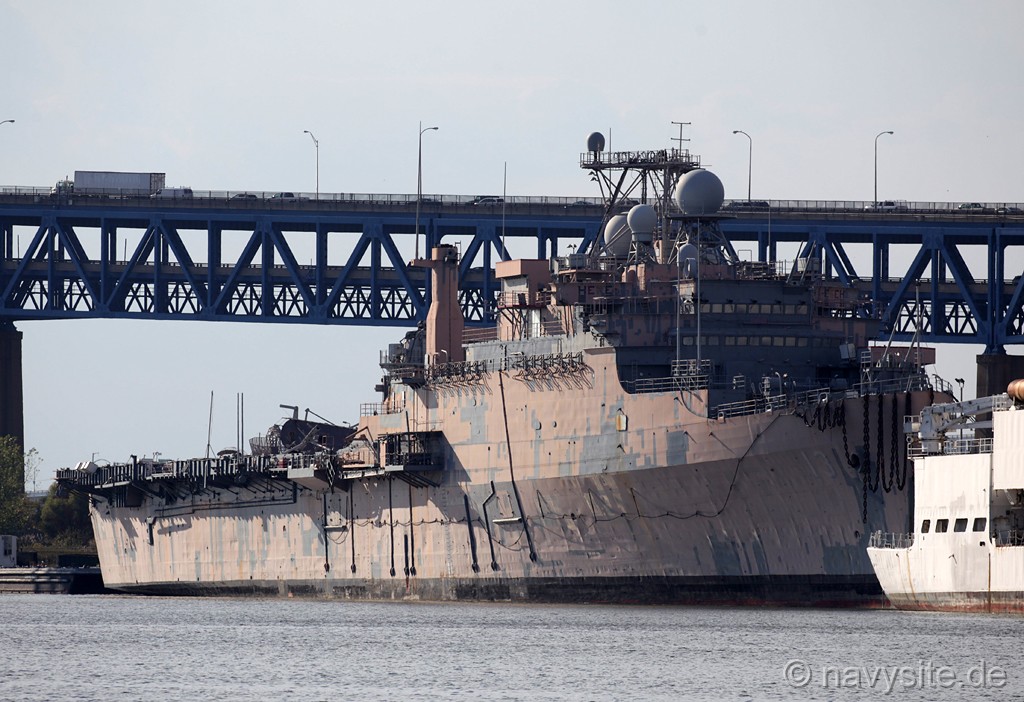
The photos below were taken by Michael Jenning and show the NASHVILLE laid up at the former Philadelphia Naval Shipyard, Philadelphia, Penn., on October 17, 2016.


The photos below were taken by Michael Jenning and show the NASHVILLE laid up at the former Philadelphia Naval Shipyard, Philadelphia, Penn., on October 7, 2018.


Back to topback to top


Back to Amphibious Transport Dock site. Back to ships list. Back to selection page. Back to 1st page.