![]() |
Search the Site with
|
![]() | ![]() |
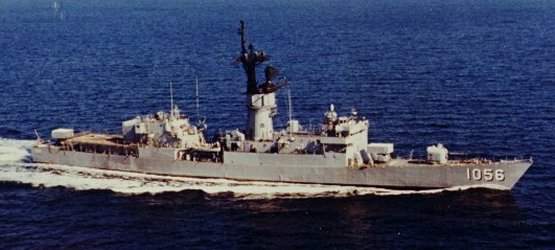
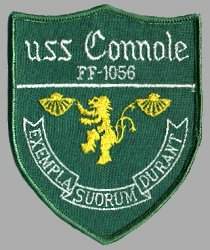
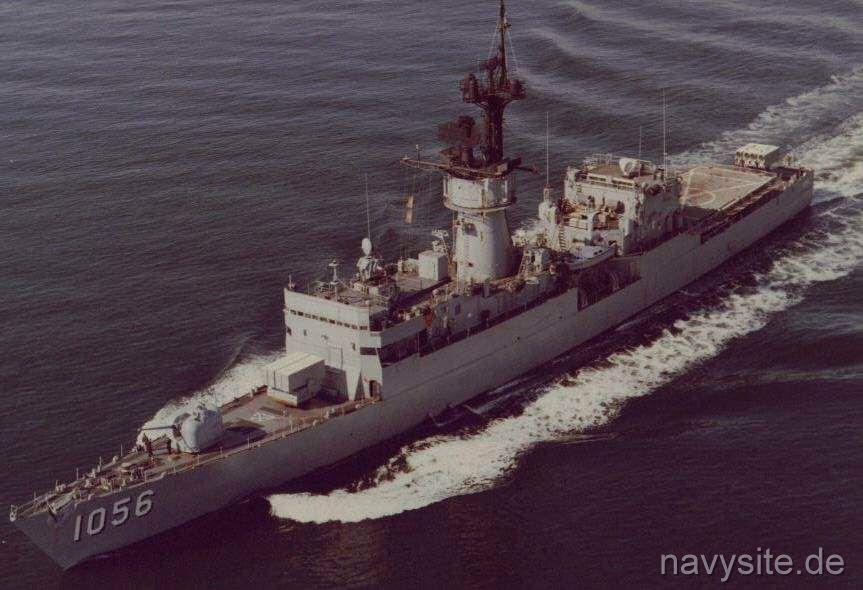
USS CONNOLE was the 5th KNOX - class frigate and the first ship in the Navy named after Commander David R. Connole. Decommissioned on August 30, 1992, and stricken from the Navy list on January 11, 1995, CONNOLE finally transferred to Greece. There, she was commissioned in the Hellenic Navy as IPIROS. The ship was finally decommissioned on July 29, 2003, and spent the following years laid up at Souda Bay, Crete, awaiting final disposal. The ship was later sunk as a target.
USS CONNOLE was last homeported in Newport, Rhode Island.
| General Characteristics: | Awarded: July 22, 1964 |
| Keel laid: March 23, 1967 | |
| Launched: July 20, 1968 | |
| Commissioned: August 30, 1969 | |
| Decommissioned: August 30, 1992 | |
| Builder: Avondale Shipyards, New Orleans, La. | |
| Propulsion system: 2 - 1200 psi boilers; 1 geared turbine, 1 shaft; 35,000 shaft horsepower | |
| Length: 438 feet (133.5 meters) | |
| Beam: 47 feet (14.4 meters) | |
| Draft: 25 feet (7.6 meters) | |
| Displacement: approx. 4,200 tons full load | |
| Speed: 27 knots | |
| Armament: one Mk-16 missile launcher for ASROC and | |
| Aircraft: one | |
| Crew: 18 officers, 267 enlisted As NRF Ship: 175 USN personnel and 150 reserve personnel |
Crew List:
This section contains the names of sailors who served aboard USS CONNOLE. It is no official listing but contains the names of sailors who submitted their information.
USS CONNOLE Cruise Books:
About the Ship's Name:
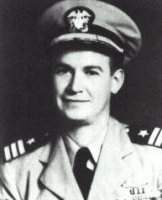
David R. Connole was born on September 8, 1912 in Madison, IL as the first son of Henry Connole and Mary Rickart Connole. He did well in school and also became an Eagle Scout. After attending Illinois College for two years, he gained entrance to the U.S. Naval Academy in 1932 and graduated in 1936. For the next three years, he served aboard the cruiser USS BOISE then entered Submarine School.
From December 1939 to August 1943, Commander Connole served aboard the submarine USS POMPANO which was involved in numerous war patrols in the Pacific. He then became executive officer of the USS CUTTLEFISH. In 1944, he took command of the USS SENNET and in 1945, he became the commanding officer of the USS TRIGGER. Commander Connole was killed when the USS TRIGGER was lost in battle off the coast of Japan in March, 1945.
Commander Connole was awarded two Silver Star medals, the Bronze Star medal and the USS TRIGGER earned the Presidential Unit Citation for three war patrols.
USS CONNOLE History:
The contract for USS CONNOLE was awarded on July 22, 1964. Her keel was laid by Avondale Shipyards at Westwego, Louisiana, on March 23, 1967, and she was launched on July 20, 1968. Her sponsor was Mary Rickart Connole, Commander Connole's mother, and his son Rick Connole was also present at the launching. Construction, installation of machinery and electronics, fitting-out, and acceptance work continued through the remainder of 1968 and most of 1969. CONNOLE conducted acceptance sea trials during 1969 and was delivered to the Navy on August 22.
USS CONNOLE was commissioned at Naval Station Charleston, South Carolina, on August 30, 1969, with Commander Robert B. Robinson II in command. She was assigned to Destroyer Squadron 36 and Destroyer Division 361 and was homeported at Norfolk, Virginia.
Following commissioning, CONNOLE entered the normal sequence of fitting-out, trials, engineering examinations, weapons qualifications, and crew training required of a newly completed escort. She operated with the Atlantic Fleet from Norfolk, developing proficiency in engineering, navigation, damage control, communications, gunnery, replenishment, antisubmarine warfare, and helicopter operations. Commander Robert M. Leverone relieved Commander Robinson on October 8, 1970, and Commander David M. Foss assumed command on April 8, 1971. During these early years, CONNOLE increasingly became associated with antisubmarine warfare evaluation in addition to normal Atlantic Fleet readiness duties. Her combination of long-range active sonar, variable-depth equipment, experimental passive sensors, and aviation capability made her a useful platform for developing techniques intended to extend the distance at which surface escorts could detect and maintain contact with submarines.
Lieutenant Commander Tyler Field II relieved Commander Foss on August 30, 1972. CONNOLE deployed to the Mediterranean during 1973. Photographic documentation places her at sea during underway replenishment operations and at Naples, Italy, where she was moored with USS McCANDLESS (DE 1084), USS KOELSCH (DE 1049), and USS McCLOY (DE 1038). The deployment placed CONNOLE under the United States Sixth Fleet at a time when the Mediterranean was one of the principal areas of direct naval contact between the United States and the Soviet Union. Soviet submarines, cruisers, destroyers, intelligence-collection ships, and auxiliaries routinely operated near American carrier and amphibious forces. The Sixth Fleet in turn maintained a continuous presence on the southern flank of the North Atlantic Treaty Organization and near the politically unstable eastern Mediterranean and Middle East.
Commander John R. Dalrymple Jr. relieved Lieutenant Commander Field on June 3, 1974. CONNOLE continued Atlantic Fleet and Mediterranean-related training during the following period, with particular emphasis on antisubmarine warfare. Her sonar installation underwent continuing refinement, and by the middle of the decade she had become one of the Atlantic Fleet frigates used to evaluate techniques combining long-range active sonar, passive detection, towed sensors, and helicopter operations.
On June 30, 1975, the Navy redesignated CONNOLE from destroyer escort DE 1056 to frigate FF 1056 as part of the fleet-wide ship-classification changes.
Weapons and antisubmarine training continued during 1975. CONNOLE also participated in tests connected with the development of increasingly sophisticated long-range sonar and helicopter concepts. In October, she took part in evaluation work associated with concepts that would influence later Light Airborne Multi-Purpose System development. During 1976, CONNOLE operated as part of a specialized antisubmarine warfare organization assembled to test advanced detection techniques under operational conditions. Other frigates involved in the program included USS MOINESTER (FF 1097), USS VOGE (FF 1047), KOELSCH, and McCLOY. The ships carried different combinations of long-range active sonar, towed arrays, tactical data-processing equipment, variable-depth sensors, and SH-2 helicopters. The purpose was to determine how a group of surface escorts could combine information from several active and passive sensors and airborne platforms to locate, classify, and maintain contact with submarines at ranges greater than those normally achieved by conventional escort tactics.
CONNOLE carried a modified sonar configuration, long-range active sonar, a towed sensor system, and an embarked SH-2 helicopter. Testing was conducted in Atlantic waters, including work associated with the Atlantic Undersea Test and Evaluation Center, before the specialized squadron continued operational evaluation during a Mediterranean deployment. During the summer of 1976, CONNOLE demonstrated the capabilities being investigated when she maintained an unalerted active convergence-zone sonar contact on a Soviet ECHO II-class nuclear-powered guided-missile submarine for approximately 13 hours. Convergence-zone detection exploited the manner in which sound refracted through deep ocean water and returned to the surface at long range, allowing submarine contacts to be obtained well beyond the normal direct-path sonar range.
The deployment coincided with the Lebanese Civil War. By 1976, fighting among Lebanese political and religious factions and Palestinian organizations had made conditions in Beirut increasingly dangerous for foreign nationals. The United States prepared Operation Fluid Drive to evacuate Americans and citizens of other countries by sea. On June 20, 1976, 110 American citizens and 157 nationals of other countries were evacuated from Beirut and transferred to USS SPIEGEL GROVE (LSD 32). CONNOLE served as one of the escort ships protecting the evacuation movement toward Greece. USS LITTLE ROCK (CG 4), the Sixth Fleet flagship, was among the American naval units supporting the operation. Soviet naval forces closely observed the American formation, and three Soviet ships, including the KARA-class cruiser KERCH, shadowed the evacuation group. SPIEGEL GROVE reached Piraeus on June 22.
The situation in Lebanon remained unstable. A second maritime evacuation took place on July 27, when USS CORONADO (LPD 11) removed another group of civilians. CONNOLE was photographed in the Kithira Strait on June 25, 1976, operating in close proximity to both American and Soviet naval units. American amphibious forces were in the area, and CONNOLE passed between USS GUADALCANAL (LPH 7) and the Soviet KASHIN-class destroyer KRASNY KRIM, with USS IWO JIMA (LPH 2) also nearby. Such close surveillance was characteristic of Cold War naval operations in the Mediterranean, where ships of both blocs regularly observed one another's formations, sensors, aircraft operations, and tactical movements.
During the 1976 Mediterranean deployment, Commander Richard F. Pittenger assumed command of CONNOLE. Under his command, the frigate continued the specialized antisubmarine work for which the squadron had been organized. After returning to Atlantic Fleet operations, the ship continued evaluating sonar and helicopter tactics and maintaining normal readiness for overseas deployment.
CONNOLE deployed again to the Mediterranean in June 1977. On July 20, she reached Rota, Spain, and relieved USS BLAKELY (FF 1072), which was completing its own Sixth Fleet deployment. CONNOLE then continued Mediterranean operations through the remainder of the year. The deployment concluded in December 1977.
Commander Theodore Fijak Jr. subsequently assumed command. During 1978 and into 1979, CONNOLE entered an extensive maintenance cycle. Contemporary photographs show her conducting helicopter operations and tracking submarines. One image from the period shows a Soviet FOXTROT-class diesel-electric submarine on the surface following detection by CONNOLE's helicopter. Another records the frigate refueling a helicopter that did not belong to her own permanently assigned detachment, illustrating the flexibility of her aviation facilities.
During 1979, CONNOLE was drydocked at Bath Iron Works in Maine for overhaul and maintenance work. Following the industrial period, she returned to operational training and qualification.
In June 1979, CONNOLE's home port changed from Norfolk to Newport, Rhode Island. Newport remained her home port for the remainder of her United States Navy career. On November 27, 1979, CONNOLE departed Newport for another Mediterranean deployment. She crossed the Atlantic during a period of rapidly increasing international tension. The Iranian Revolution had removed Shah Mohammad Reza Pahlavi from power, the United States embassy in Tehran had been seized earlier in November, and American naval planning was increasingly focused on developments in both the Mediterranean and the approaches to the Persian Gulf.
After reaching the Mediterranean, CONNOLE operated with forces associated with the carrier battle group centered on USS FORRESTAL (CV 59). During December, the group included USS WAINWRIGHT (CG 28), USS TATTNALL (DDG 19), USS PAUL (FF 1080), and KOELSCH. From December 13 through December 22, these ships conducted task-group operations involving air defense, antisubmarine warfare, surface surveillance, tactical maneuvering, and protection of the carrier.
The Christmas period was affected by severe Mediterranean weather. CONNOLE and KOELSCH were at Toulon, France, during the holiday period. CONNOLE continued Sixth Fleet operations into 1980 before eventually returning to Newport. Commander Serge A. Yonov relieved Commander Fijak on February 20, 1980. The ship spent the remainder of the year in the Atlantic Fleet readiness cycle, combining maintenance with sonar, aviation, weapons, tactical, and engineering training.
On January 20, 1981, CONNOLE arrived at the General Dynamics shipyard at Quincy, Massachusetts. She had rounded Cape Cod in seas reaching approximately 15 feet and entered the yard heavily coated with ice, a visible illustration of the severe conditions encountered during winter operations off New England. The yard period provided maintenance before the frigate resumed training and prepared for another Mediterranean deployment.
During 1981, CONNOLE again deployed with the Sixth Fleet. One of the best-documented port visits occurred at Barcelona, Spain. On the morning of July 13, CONNOLE entered Barcelona together with USS JOSEPHUS DANIELS (CG 27) and PAUL. The American ships berthed in the South Wharf area, with the two frigates on the northern side and the cruiser on the channel side. They remained in Barcelona through July 22. The visit followed exercises in the vicinity of the Strait of Gibraltar and formed part of the usual Sixth Fleet combination of training, maintenance, presence, and naval diplomacy. The Mediterranean remained strategically important as the Soviet Mediterranean Squadron maintained surface and submarine forces in the region and political tensions involving Libya, Lebanon, the Arab-Israeli dispute, and the Persian Gulf continued to affect American naval planning. CONNOLE completed the deployment and returned to Newport later in the year.
Commander Edwin P. Nicholson relieved Commander Yonov on August 20, 1982. On September 1, CONNOLE was photographed at Naval Station Newport moored alongside USS MILLER (FF 1091). The frigate subsequently prepared for another Mediterranean deployment, which would place her close to the renewed crisis in Lebanon.
Israel had invaded Lebanon in June 1982, and the resulting fighting led to international efforts to supervise the evacuation of Palestine Liberation Organization forces and later to the deployment of a multinational peacekeeping force in Beirut. United States Marines went ashore as part of that force while Sixth Fleet ships maintained an offshore presence. CONNOLE was in the Mediterranean by December 1982. On December 7, south of Crete, she relieved USS AYLWIN (FF 1081), which had completed its Sixth Fleet assignment and began its return to the United States. CONNOLE continued operations in the eastern Mediterranean during the winter and was at Barcelona on December 25.
During the opening months of 1983, CONNOLE supported Sixth Fleet activities associated with the volatile situation in the eastern Mediterranean and Lebanon. Photographs show her alongside the Sixth Fleet flagship and destroyer tender USS PUGET SOUND (AD 38) at Beirut together with USS LA MOURE COUNTY (LST 1194). Periods alongside the tender allowed the frigate to receive repairs, technical support, spare parts, and stores without leaving the operational theater.
CONNOLE also participated in a politically sensitive Black Sea operation. During March 1983, she operated with USS FARRAGUT (DDG 37). The two ships formed Task Group 68.1 and passed through the Turkish Straits into the Black Sea on March 22 and March 23. American warship visits to the Black Sea were conducted under the international navigation arrangements governing passage through the Turkish Straits. Soviet forces monitored the American ships closely. A GRISHA-class antisubmarine corvette and an intelligence-collection trawler shadowed the formation, while Soviet Be-12, Yak-28, Tu-16, and Tu-22 aircraft conducted aerial surveillance. CONNOLE and FARRAGUT returned through the Turkish Straits on March 25 and March 26 and resumed Mediterranean operations.
After completing her Sixth Fleet assignment, CONNOLE returned to the United States. Later in 1983 she received another overseas tasking, this time toward Central America. On October 15, she stopped at Naval Weapons Station Earle, New Jersey, to load weapons before beginning special operations in the region. From October through December 1983, CONNOLE passed through the Panama Canal, operated in Central American and eastern Pacific waters, and subsequently returned through the canal. Her documented port calls included Puerto Cortes, Honduras, and Fort Lauderdale, Florida, before she returned to Newport. The deployment occurred during a period of intense American concern over political and military developments in Central America, particularly the conflicts involving Nicaragua and El Salvador and the wider requirement to maintain naval surveillance and contingency forces in the Caribbean and eastern Pacific.
CONNOLE remained at Newport during January and early February 1984. From February 14 through February 16, she visited Naval Weapons Station Yorktown, Virginia, to load ammunition and weapons before a North Atlantic deployment. She subsequently joined forces assembling for Exercise Teamwork '84. From March 5 through March 22, 1984, CONNOLE participated in Teamwork '84, a large North Atlantic and Norwegian Sea exercise designed to test the reinforcement of northern Europe, protection of sea lines of communication, coordinated antisubmarine warfare, air defense, and operations in high-latitude waters. The Norwegian Sea was strategically important during the Cold War because Soviet Northern Fleet submarines and surface ships had to move through the region when operating between their bases and the North Atlantic.
After the principal phase of Teamwork, CONNOLE visited Aarhus, Denmark, from March 27 through April 1. She then proceeded into the Baltic and visited Stockholm, Sweden, from April 4 through April 9. From April 10 through April 13, she participated in Baltic Operations '84. The exercise emphasized tactical maneuvering, communications, air and surface surveillance, and allied naval operations in the confined Baltic environment close to Warsaw Pact territory. During the homeward phase, CONNOLE operated in company with ships including USS KIDD (DDG 993), USS JACK WILLIAMS (FFG 24), USS JOHN RODGERS (DD 983), and USS CANISTEO (AO 99). The ships rendezvoused in the vicinity of the Azores during the Atlantic crossing. CONNOLE returned to Newport on April 29.
She remained at Newport until June 19, when she returned to sea for local gunnery training and provided antisubmarine warfare services for the nuclear-powered attack submarine USS GATO (SSN 615). Additional local exercises followed. From July 8 through July 9, CONNOLE loaded ammunition at Naval Weapons Station Yorktown. From August 7 through August 9, CONNOLE visited Naval Weapons Station Earle for her final major weapons and ammunition offload before overhaul. Preparations were then completed for a major industrial period in the Boston area.
On September 10, 1984, CONNOLE entered Boston Shipyard Corporation for an overhaul initially valued at approximately 8.5 million dollars. Difficulties soon developed between the Navy and the contractor concerning the execution and schedule of the work. Late in September, the Navy terminated the shipyard's contract. The dispute escalated when the yard temporarily obstructed CONNOLE's removal with cranes and barges. Following court intervention, the frigate was removed from Boston Shipyard Corporation on October 2 and shifted to the Charlestown Navy Shipyard. The interrupted overhaul was subsequently reassigned. General Ship Corporation in East Boston received a Navy contract valued at $9,946,414 to complete repair and overhaul work on CONNOLE, with completion planned for May 1985.
The unusual sequence extended what otherwise would have been a conventional industrial availability. Work concentrated on restoring the material condition of a frigate that had accumulated approximately 15 years of Atlantic and Mediterranean service. Following completion of the yard period in 1985, machinery and combat systems required dockside testing, trials at sea, engineering examinations, and progressive crew requalification. Much of the remainder of the year was devoted to rebuilding proficiency in propulsion operations, navigation, damage control, antisubmarine warfare, helicopter support, communications, and weapons employment.
CONNOLE began 1986 with approximately two months of Caribbean operations. She departed Newport on January 3 and operated principally from Roosevelt Roads, Puerto Rico. During this period, the frigate fired missiles and exercise torpedoes and tested her sonar systems. She was photographed at Roosevelt Roads during January. Early in February, CONNOLE proceeded to Guantanamo Bay, Cuba, for approximately five weeks of refresher training. The program subjected the crew to engineering casualties, damage-control exercises, weapons firings, navigation drills, communications tests, and tactical scenarios intended to certify the ship for deployment. CONNOLE returned to Newport on March 18.
She participated in Fleet Exercise 11-86 during April, followed by approximately three weeks of intermediate maintenance in preparation for deployment. Commander Kenneth P. Weinberg relieved Commander Roy R. Twaddle III on May 23. CONNOLE departed Newport on the morning of June 4, 1986. The deployment had originally been expected to include movement toward the Indian Ocean, but developments in the Mediterranean resulted in the force remaining in that theater. Earlier in 1986, confrontation between the United States and Libya had produced armed clashes in the Gulf of Sidra, followed in April by American air strikes against targets in Libya after the United States attributed the bombing of a West Berlin nightclub to Libyan involvement.
CONNOLE joined the battle group centered on FORRESTAL in the western Atlantic. Other ships in the formation included WAINWRIGHT, USS MacDONOUGH (DDG 39), USS SELLERS (DDG 11), USS THOMAS C. HART (FF 1092), USS MILWAUKEE (AOR 2), and USS SURIBACHI (AE 21). During the Atlantic crossing, an F-14 fighter from FORRESTAL crashed shortly after takeoff. Ships of the battle group participated in the resulting rescue and recovery effort. CONNOLE recovered debris from the aircraft and subsequently transferred recovered material to SELLERS. The force continued eastward, and CONNOLE completed the passage from Newport to Augusta Bay, Sicily, between June 4 and June 16.
CONNOLE conducted turnover activities at Augusta Bay on June 17 and June 18 and then proceeded to Naples, where she remained from June 21 through July 10. The extended port period provided maintenance, logistics, training, and crew liberty following the Atlantic crossing. After returning to sea, CONNOLE visited Taormina, Sicily, from July 15 through July 21. She then underwent an intermediate maintenance availability at Augusta Bay from July 22 through August 1. The frigate visited Toulon, France, from August 4 through August 14. After leaving France, she crossed the Mediterranean toward Turkey. August 19 marked the midpoint of the deployment while the ship was underway toward the Turkish coast.
CONNOLE visited Antalya, Turkey, from August 21 through August 24. During the visit, the ship hosted a diplomatic reception attended by the governor of Antalya Province, the senior local military commander, and more than 50 other dignitaries. The reception formed part of the representational role performed by Sixth Fleet ships during visits to allied countries. After additional operations, CONNOLE reached Gaeta, Italy, on August 30 for another intermediate maintenance availability that continued through September 14. Gaeta served as the home port of the Sixth Fleet flagship USS BELKNAP (CG 26). During the stay, members of CONNOLE's crew also visited an American military cemetery in Italy to commemorate Americans killed during the Second World War.
CONNOLE subsequently visited Naples from September 16 through September 19 and then returned to sustained operations at sea. Her antisubmarine duties included searching for, detecting, classifying, and maintaining contact with submarines operating in the Mediterranean. The ship also monitored Soviet naval formations. During the deployment, CONNOLE encountered a Soviet naval group at anchor and later observed the same formation underway as the Soviet ships moved toward the western exit of the Mediterranean. After approximately 30 consecutive days underway, CONNOLE arrived at Ibiza, Spain, on October 20 and remained there through October 28. Ibiza was the final port visit of the deployment. CONNOLE departed Ibiza on October 29 for the westbound Atlantic passage and returned to Newport on November 10, 1986. During the deployment, she had steamed approximately 24,940 miles. Her embarked helicopter accumulated approximately 482 flight hours and completed 558 landings.
CONNOLE resumed Atlantic Fleet operations following the deployment. On March 31, 1987, she joined USS JESSE L. BROWN (FF 1089), USS AINSWORTH (FF 1090), and USS AYLWIN (FF 1081) for approximately three weeks of special operations in the western Atlantic. The work emphasized the surveillance and tracking capabilities of the participating frigates.
During 1987, CONNOLE was photographed shadowing the Soviet aviation cruiser BAKU. Close observation of Soviet warships remained an important Cold War task and allowed American ships to record formation movements, aircraft operations, electronic emissions, sensor employment, and changes in Soviet equipment and tactics.
On June 1, 1987, CONNOLE was at the Naval Reserve Maintenance Facility in Newport with USS EDSON (DD 946) and USS KAUFFMAN (FFG 59). Later that year she was also photographed transiting the Cape Cod Canal. On October 20, 1987, Robert E. Derecktor of Rhode Island received a Navy contract valued at approximately 2.5 million dollars for repair and overhaul work on CONNOLE. The associated work continued into 1988 and supported continued operation of the aging steam-powered frigate.
Commander Marc A. Helgeson relieved Commander Weinberg on June 5, 1988. During the summer, CONNOLE joined forces associated with the carrier battle group centered on USS JOHN F. KENNEDY (CV 67). On August 12, 1988, CONNOLE was photographed underway in the North Atlantic as part of Task Group 24.4. She was among the ships in an 18-vessel formation accompanying JOHN F. KENNEDY toward the Mediterranean. After crossing the Atlantic, CONNOLE continued Sixth Fleet operations. The deployment occurred during a period in which American naval attention remained divided among Soviet activity, instability in the Middle East, and developments associated with the closing stage of the Iran-Iraq War. CONNOLE's principal duties remained antisubmarine and surface surveillance, escort operations, helicopter support, tactical training, and participation in carrier-battle-group activities.
After returning to Newport, CONNOLE resumed the Atlantic Fleet cycle of maintenance, training, inspections, sonar exercises, aviation work, weapons qualifications, and readiness operations. By the end of the decade, the strategic environment that had shaped the KNOX-class was changing rapidly. Relations between the United States and the Soviet Union were improving, Soviet naval activity was beginning to decline, and the United States Navy was preparing substantial reductions in its older steam-powered surface combatants.
Commander David A. Schwiering relieved Commander Helgeson on May 5, 1990, becoming CONNOLE's final commanding officer. The frigate remained based at Newport and continued Atlantic Fleet operations. The international situation changed dramatically during this period. Iraq invaded Kuwait on August 2, 1990, leading to Operation Desert Shield and, beginning in January 1991, Operation Desert Storm. Large numbers of American naval units were sent to the Middle East. CONNOLE did not deploy to the Middle East. CONNOLE continued overseas operations during 1991. During the summer she operated in northern European waters and visited Amsterdam in the Netherlands. She was berthed at the Oostelijke Handelskade from July 3 through July 7 with an SH-2 Seasprite embarked. The visit occurred during the final months of the Cold War, as the Warsaw Pact had effectively ceased to function and the Soviet Union was moving toward dissolution.
By 1992, the United States Navy had decided to remove most of its remaining KNOX-class frigates from active service. Their steam plants required comparatively large engineering departments and substantial maintenance, while newer ships had assumed many of the escort and antisubmarine roles for which the class had originally been built. During the first half of 1992, CONNOLE continued limited operations while preparations were made for transfer to Greece. Greek sailors arrived to learn the ship's machinery, combat systems, navigation procedures, and daily operating routines. At the same time, the American crew removed material not included in the transfer, completed administrative and maintenance records, transferred stores and equipment, and prepared the ship for turnover.
A decommissioning and turnover ceremony was held at Newport on August 14, 1992. More than 50 members of Commander David Connole's extended family attended. The American crew remained aboard during the ceremony while the incoming Greek crew formed on the pier. Following the ceremony, the frigate left Newport for the Boston area, where approximately 45 days of additional work were planned before her departure for Greece. The transfer to Greece and administrative removal from United States Navy custody took effect on August 30, 1992. After almost 23 years in American service, the former CONNOLE became the Hellenic Navy frigate IPIROS (F 456), named for the Greek region of Epirus. She subsequently proceeded to Greece and entered operational service with the Hellenic Navy alongside other former KNOX-class frigates.
Although transferred to Greece, the ship remained administratively listed on the United States Naval Vessel Register until January 11, 1995, when she was formally struck. As IPIROS, the former CONNOLE continued serving with the Hellenic Navy for approximately another decade. IPIROs was subsequently withdrawn from active Greek service and retained for disposal. In 2006, the former CONNOLE was expended as a target during a Greek naval exercise and sank, ending the physical existence of the ship approximately 37 years after she had entered United States Navy service.
USS CONNOLE Image Gallery:
![]() |
Back to Frigates List.
Back to Ships List.
Back to selection page.
Back to 1st page.