![]() |
Search the Site with
|
![]() | ![]() |
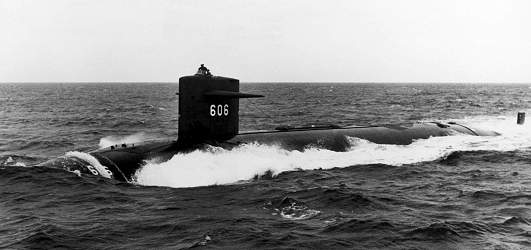
USS TINOSA was one of the PERMIT - class nuclear-powered attack submarines and the second ship in the Navy named after the poisonous, black, tropical fish. Both decommissioned and stricken from the Navy list on January 15, 1992, the TINOSA had already entered the Navy's Nuclear Powered Ship and Submarine Recycling Program at the Puget Sound Naval Shipyard, Bremerton, Wash., on July 15, 1991. Recycling was completed on August 15, 1992.
| General Characteristics: | Awarded: December 17, 1958 |
| Keel laid: November 24, 1959 | |
| Launched: December 9, 1961 | |
| Commissioned: November 17, 1964 | |
| Decommissioned: January 15, 1992 | |
| Builder: Portsmouth Naval Shipyard, Kittery, ME. | |
| Propulsion system: one S5W2 nuclear reactor | |
| Propellers: one | |
| Length: 278.5 feet (84.9 meters) | |
| Beam: 32.15 feet (9.8 meters) | |
| Draft: 28.9 feet (8.8 meters) | |
| Displacement: Surfaced: approx. 3,600 tons Submerged: approx. 4,300 tons | |
| Speed: Surfaced: approx. 20 knots Submerged: approx. 30 knots | |
| Armament: four 533 mm torpedo tubes for SUBROC, Mk-48 torpedoes and Harpoon missiles | |
| Crew: 12 Officers, 91 Enlisted |
Crew List:
This section contains the names of sailors who served aboard USS TINOSA. It is no official listing but contains the names of sailors who submitted their information.
Accidents aboard USS TINOSA:
| Date | Where | Events |
|---|---|---|
| June 7, 1963 | Portsmouth Naval Shipyard, NH. | USS TINOSA collides with the USS JOHN ADAMS (SSBN 620) while being moved in the Portsmouth Naval Shipyard, NH., when a tug towline snaps. The TINOSA received, what the Navy said, was a "small dent below the waterline" in the bow. |
USS TINOSA History:
USS TINOSA was contracted on December 17, 1958, and laid down on November 24, 1959, at Portsmouth Naval Shipyard in Kittery, Maine. She was a PERMIT-class nuclear-powered attack submarine and the second United States Navy ship to bear the name Tinosa, following the World War II submarine USS TINOSA (SS 283). The name referred to a poisonous, dark tropical fish, Caranx lugubris, known in waters around Cuba and elsewhere in warm Atlantic and Pacific regions. The earlier USS TINOSA had served in the Pacific War, completed twelve war patrols, and became especially associated with the operational discovery of major Mark 14 torpedo defects. The new nuclear-powered USS TINOSA carried the name into a very different naval environment: the Cold War submarine force, where endurance, quietness, sonar performance, deep-diving capability, and long-range antisubmarine warfare had become central to United States naval planning.
USS TINOSA was launched on December 9, 1961, sponsored by Mrs. Samuel S. Stratton, wife of Representative Samuel S. Stratton of New York. Rear Admiral Lawrence R. Daspit, who had been the first commanding officer of the wartime USS TINOSA, delivered the principal address at the launching. Because of the bow-first launching position and the weight of the submarine, special buoyancy tanks were fitted for the launching evolution.
During construction, USS TINOSA was involved in a minor shipyard accident before she entered service. On June 7, 1963, while being moved at Portsmouth Naval Shipyard, she collided with USS JOHN ADAMS (SSBN 620) after a tug towline snapped. The Navy described the resulting damage to USS TINOSA as a small dent below the waterline in the bow. The incident did not prevent the submarine from continuing toward completion.
After a long fitting-out and testing period, USS TINOSA was commissioned on October 17, 1964, with Commander Robert B. Brumsted in command. She entered service at a time when the Navy was still absorbing the lessons of USS THRESHER (SSN 593)'s loss in April 1963, refining nuclear-submarine safety standards, and expanding the use of nuclear-powered attack submarines in Atlantic, Caribbean, Mediterranean, and classified Cold War operations.
Following commissioning, USS TINOSA conducted shakedown out of New London, Connecticut. These early operations tested her propulsion plant, diving systems, sonar, weapons systems, fire-control equipment, communications, navigation, watchstanding routines, and crew proficiency. The Atlantic Fleet used areas off the East Coast and in the Caribbean for the controlled testing and training that a new nuclear submarine required. Her early work also introduced the crew to the dual character of PERMIT-class service: she was an operational submarine, but she also functioned as a platform for evaluating antisubmarine warfare procedures, sonar performance, and weapons employment.
After shakedown, USS TINOSA continued early Atlantic Fleet operations. She operated as a new nuclear-powered attack submarine at a time when the United States Navy was increasingly focused on the Soviet undersea threat in the North Atlantic and on developing the tactics needed to counter it. The broader strategic setting was demanding: American involvement in Vietnam was expanding, but NATO still required strong maritime defenses in the Atlantic and Mediterranean, where Soviet submarines and surface units were becoming more active.
From April through June 1966, USS TINOSA underwent an availability at her builder's yard. After that work, she made a cruise that included Faslane, Scotland, and the Caribbean Sea. Faslane placed her within the allied submarine-support environment in the United Kingdom, where American and British naval forces cooperated closely in North Atlantic and strategic-submarine operations. The Caribbean portion of the cruise returned her to familiar training and weapons-test waters. This pattern - yard work, Atlantic training, allied support locations, and Caribbean exercises - became typical of many Atlantic Fleet nuclear-powered attack submarines during the period.
From March through June 1967, USS TINOSA underwent another overhaul. Afterward she resumed Atlantic Fleet operations. Through the first three months of 1968, she provided services for the Naval Underwater Sound Laboratory at New London. During this work, she was based at New London and, for part of the period, at Port Everglades, Florida. She also visited Bermuda during the course of operations.
USS TINOSA continued to operate off the eastern seaboard and in the Caribbean into 1969. These operations placed her in the normal Atlantic Fleet cycle of training, readiness work, weapons exercises, inspections, and services to surface and air antisubmarine forces. During this period, the United States submarine force was also responding to the loss of USS SCORPION (SSN 589) in May 1968, an event that reinforced concern with submarine safety, maintenance discipline, and operational control. For USS TINOSA, as for other early nuclear submarines, the next major phase was a long shipyard period that incorporated the Navy's post-THRESHER submarine-safety improvements.
In May 1969, USS TINOSA entered Portsmouth Naval Shipyard for a major overhaul that included SUBSAFE work. The overhaul continued until December 1971. SUBSAFE modifications were intended to improve hull integrity, seawater-system reliability, and the ability of a submarine to recover from flooding or other emergencies. For USS TINOSA, the yard period removed her from active operations for more than two and a half years but brought her into line with the safety and material standards that had become central to the nuclear submarine force.
Following completion of the overhaul in December 1971, USS TINOSA resumed active operations off the eastern seaboard and in the Caribbean. She continued this pattern into the middle of 1972. The return to sea after such a long overhaul required rebuilding crew proficiency, testing ship systems, conducting sea trials, and restoring the boat's readiness for deployment. By mid-1972, she was ready for extended operations away from home waters.
In July 1972, USS TINOSA crossed the Atlantic for visits to northern European ports and for operations that included deployment to the Mediterranean with the Sixth Fleet. During this period, she operated from support points including Sardinia and Holy Loch. Holy Loch was a major American submarine-support location in Scotland, while Sardinian support was connected with the growing use of forward submarine facilities in the Mediterranean. The deployment took place during a tense period of Cold War naval competition. The Soviet Navy had increased its Mediterranean presence, and Sixth Fleet submarines supported NATO's southern maritime posture, surveillance, and antisubmarine readiness. USS TINOSA returned home in December 1972 and then conducted tests connected with a project sponsored by the Massachusetts Institute of Technology. She received a Meritorious Unit Commendation for Mediterranean Sea operations in 1972.
From February 1, 1973, until the end of March, USS TINOSA worked out of New London, operating with submarines and surface craft in exercises and maneuvers. In late April, she made a three-day visit to the United States Naval Academy at Annapolis, Maryland, where she served in a familiarization program for midshipmen. Such visits allowed future officers to observe submarine operations directly and gave the submarine force a role in officer education beyond its operational commitments. After the Annapolis visit, USS TINOSA underwent a tender availability alongside at New London. During the following months, she twice deployed to Bermuda and operated off Andros Island. In December 1973, she participated in joint United States-Canadian antisubmarine warfare exercises off the Florida coast. Those exercises reflected the close connection between American and Canadian maritime defense in the western Atlantic and the continuing NATO emphasis on submarine detection and tracking.
From January through March 1974, USS TINOSA was drydocked in an auxiliary repair drydock at New London. On May 19, 1974, she departed New London for the Mediterranean and conducted her second deployment with the Sixth Fleet through the summer months. From June 24 to July 1, she visited Bizerte, Tunisia, becoming the first nuclear-powered submarine to visit Tunisia. This port call took place in a Mediterranean region shaped by Cold War competition, post-colonial politics, Arab-Israeli tensions, and the increasing visibility of Soviet and American naval forces. USS TINOSA returned to New London on November 16, 1974, and then operated locally from her home port into late February 1975.
After local operations, USS TINOSA operated in the Narragansett Bay area into the spring of 1975. On July 23, 1975, she departed New London for Charleston, South Carolina, and later shifted south to operate off the Florida coast. In August 1975, she entered Ingalls Shipbuilding at Pascagoula, Mississippi, for a second major overhaul. The overhaul included installation of a new long-life reactor core and the latest sonar system. The work removed her from operational service for more than two years but renewed the submarine's propulsion endurance and combat-system relevance. The overhaul was completed on December 12, 1977.
After completing the Ingalls overhaul, USS TINOSA resumed operations with the Atlantic Fleet. From February 13 to May 20, 1978, she conducted two months of weapons-system testing in the Caribbean. In mid-April, during this same broader operating period, she also participated in a combined exercise with units of the Royal Canadian Navy off Florida. These activities marked her return to operational service after the long overhaul: weapons-system testing verified ship and crew readiness, while the Canadian exercise placed her again within the allied antisubmarine warfare framework in which she had operated before the yard period. Most of the summer of 1978 was spent preparing for another Mediterranean deployment.
On September 13, 1978, USS TINOSA departed New London for five months of operations with the Sixth Fleet. At the end of 1978, she was in upkeep at La Maddalena, Sardinia, after operations with a NATO task force composed of United States, British, Italian, and Turkish naval units. La Maddalena had become an important support point for American nuclear-powered attack submarines in the Mediterranean, allowing upkeep closer to Sixth Fleet operating areas. Her operations with a multinational NATO task force placed her in the allied maritime system that sought to maintain readiness in confined, heavily trafficked, and acoustically complex Mediterranean waters. She returned from that deployment in early 1979 and resumed the Atlantic Fleet cycle of upkeep, training, local operations, and preparations for further deployments.
In October 1981, USS TINOSA made a port visit to Frederiksted, St. Croix, in the United States Virgin Islands. St. Croix and the surrounding Caribbean operating areas were frequently used by Atlantic Fleet submarines for training, weapons exercises, testing, and liberty periods. The visit is one of the clearer publicly recorded port calls from this otherwise thinly documented phase of her career. She remained active in the same broad Atlantic Fleet structure during 1981, when older PERMIT-class submarines were still being used for major deployments, Caribbean operations, and allied exercises even as newer LOS ANGELES-class boats were entering service in greater numbers.
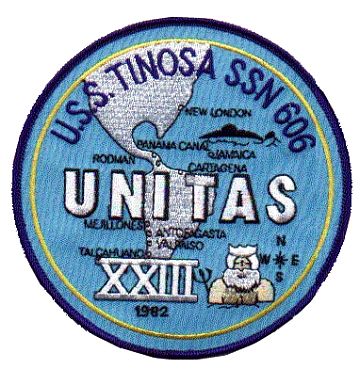
Later material associates USS TINOSA with UNITAS operations in the early 1980s, including UNITAS 1982. UNITAS was the long-running series of exercises between the United States Navy and South American navies. These cruises combined port visits, communications drills, surface and air antisubmarine warfare training, and multinational procedures intended to strengthen interoperability with Latin American partners. For a nuclear-powered attack submarine, UNITAS provided a realistic target for allied ships and aircraft while also exposing the submarine crew to varied operating areas and partner-navy procedures.
From July 1983 to August 1985, USS TINOSA underwent her final major overhaul at Portsmouth Naval Shipyard. This yard period again removed her from the operating cycle while major maintenance and modernization work was completed. By this time, she was approaching two decades in commission, and the overhaul reflected the Navy's effort to preserve useful operational capability in older PERMIT-class submarines. The early 1980s were a period of renewed Cold War naval emphasis, with the United States Navy expanding forward operations and placing strong emphasis on tracking and countering Soviet submarines.
After completing the Portsmouth overhaul, USS TINOSA returned to active service. By 1986 and 1987, she was again part of the Atlantic Fleet's operational submarine force, available for exercises, training services, Mediterranean assignments, and independent operations. On January 4, 1988, USS TINOSA departed New London for six months of operations with the Sixth Fleet in the Mediterranean. This deployment placed her again in a familiar but still strategically important theater. The Mediterranean in 1988 remained a region of Soviet naval activity, NATO presence, Middle Eastern instability, North African political tension, and continued American commitment to forward naval operations. The year came after the Gulf of Sidra confrontations and other regional crises of the mid-1980s, and although the immediate Cold War atmosphere was beginning to change under U.S.-Soviet diplomacy, the Sixth Fleet still required submarines for surveillance, readiness, exercises, and contingency operations.
In October 1988, USS TINOSA departed New London for sixty days of North Atlantic operations and crossed the Arctic Circle. This placed her in waters that remained central to NATO naval planning. The northern Atlantic, Norwegian Sea, and approaches toward the Barents Sea were important because Soviet submarines could move from northern bases into Atlantic patrol areas through those waters.
In October 1990, Commander Robert E. Fraile relieved as commanding officer. USS TINOSA commenced deactivation dismantling at Puget Sound Naval Shipyard on July 1, 1991. She was deactivated while still in commission on July 15, 1991. This sequence meant that the technical process of removing, documenting, and preparing equipment and systems for disposal began before formal decommissioning. Nuclear-powered submarine inactivation required careful handling of reactor-plant systems, classified material, reusable equipment, records, and hazardous materials.
USS TINOSA was decommissioned and stricken from the Naval Vessel Register on January 15, 1992. Her commissioned service had lasted more than twenty-seven years. After decommissioning, ex-TINOSA entered the Nuclear-Powered Ship and Submarine Recycling Program at Puget Sound Naval Shipyard in Bremerton, Washington. Ex-TINOSA's disposal was completed in 1992.
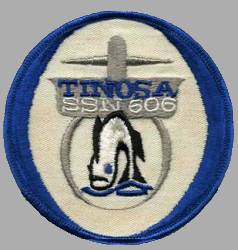
USS TINOSA Patch Gallery:
![]() |
Back to Submarines list.
Back to ships list.
Back to selection page.
Back to 1st page.