![]() |
Search the Site with
|
![]() |
![]() | ![]() |
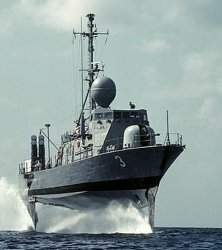
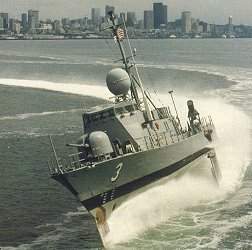
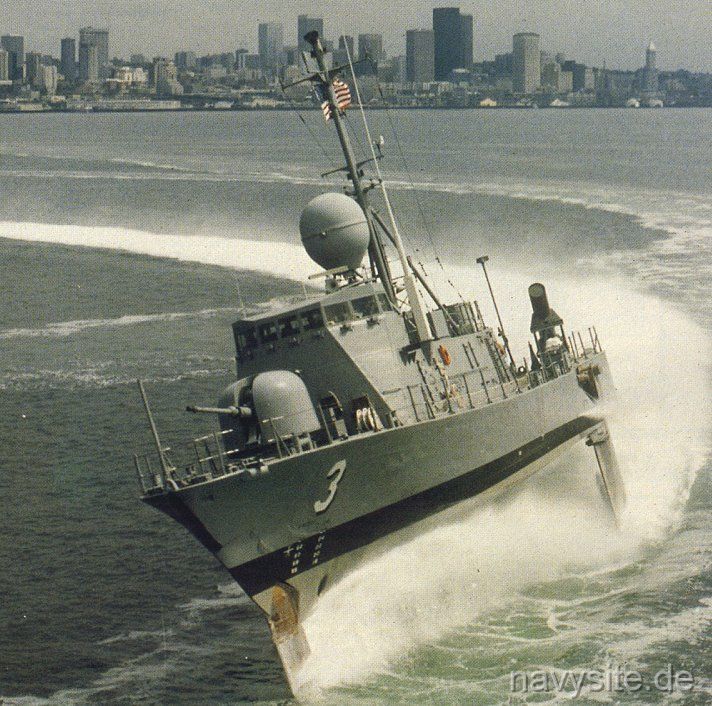
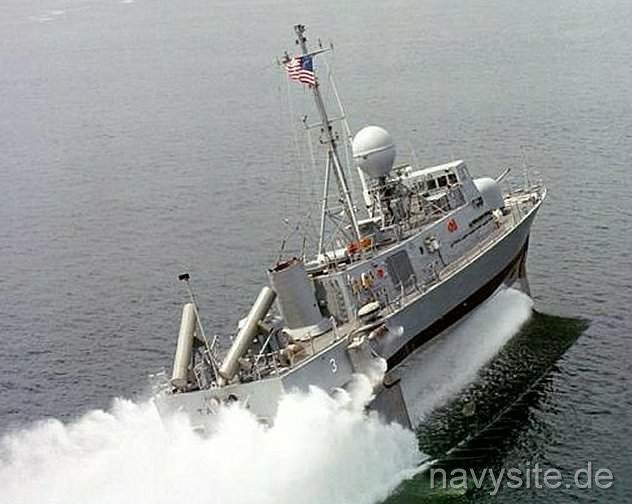
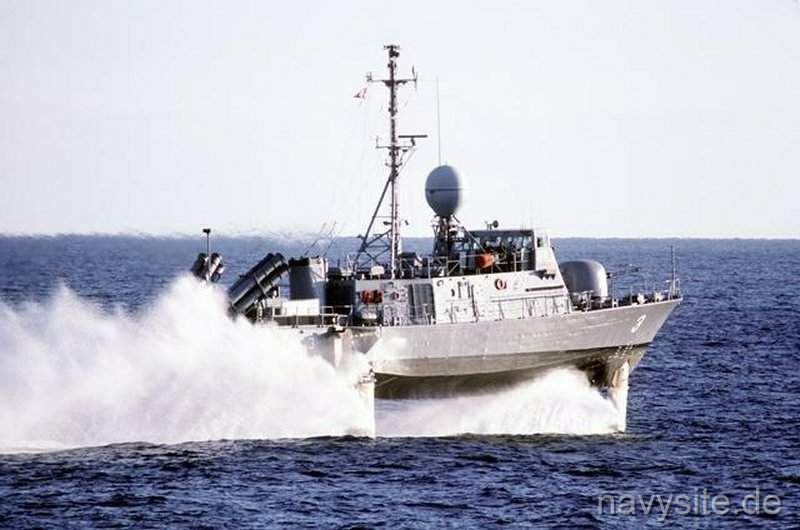
USS TAURUS was the third ship in the PEGASUS class of hydrofoil boats. She was homeported in Key West, Florida, and on July 30, 1993, all six ships of her class were decommissioned and stricken from the Navy list. TAURUS was sold for scrapping on August 19, 1996.
| General Characteristics: | Awarded: October 20, 1977 |
| Keel laid: January 30, 1979 | |
| Launched: May 8, 1981 | |
| Commissioned: October 10, 1981 | |
| Decommissioned: July 30, 1993 | |
| Builder: Boeing, Seattle, Wash. | |
Propulsion system:
| |
| Hull Length: 133 feet (40.5 meters) | |
| Beam: 28 feet (8.5 meters) | |
| Displacement: approx. 255 tons full load | |
| Speed: hullborne: 12 knots foilborne: 48 knots | |
| Armament: two Mk-140 | |
| Crew: 4 officers, 17 enlisted |
Crew List:
This section contains the names of sailors who served aboard USS TAURUS. It is no official listing but contains the names of sailors who submitted their information.
USS TAURUS History:
USS TAURUS emerged from a very specific Cold War requirement: a small, extremely fast surface combatant able to exploit hydrofoil technology for rapid reaction in constrained seas and along coastlines. In November 1972, Germany, Italy, and the United States signed a memorandum of understanding to share development costs for a missile-equipped patrol hydrofoil; the United States committed to construct the lead ship, and - after the prototype period - the Navy moved toward a small operational squadron of production craft. Within that context, a contract for the follow-on boats was awarded on October 20, 1977, and USS TAURUS - built by Boeing at the company's Marine Systems facility in Renton, Washington - was laid down on January 30, 1979. She was launched on May 8, 1981, during ceremonies at the Boeing Marine Systems plant, where she was christened by her sponsor, Mrs. John D. H. Kane, Jr. As completed, the ship combined a hullborne mode for low-speed maneuvering with a foilborne mode powered by a General Electric LM2500 gas turbine for very high speed. She carried two quad Harpoon missile launchers and a 76mm gun, embodying the concept of delivering outsized punch from a compact, fast platform.
Commissioning followed on October 10, 1981, at Puget Sound Naval Shipyard in Bremerton, Washington. The commissioning program explicitly presented USS TAURUS as the first production hydrofoil of the new class that followed the prototype experience, reflecting lessons identified during the earlier test-and-evaluation period. Lieutenant Commander W. Scott Slocum assumed command for the ship's entry into active service, and USS TAURUS began the practical work of turning a specialized, technologically distinctive craft into an operational unit. Although the public record is far thinner on the ship's day-to-day trials and early workups than it is for larger combatants, the strategic direction for the class was clear: these hydrofoils were intended to operate as a small squadron, rapidly concentrating firepower and surveillance in littoral waters while remaining agile enough to respond to short-notice tasking.
A major, well-documented shift came in the summer of 1982 when the hydrofoil squadron coalesced in its primary operational area. On July 15, 1982, USS TAURUS got underway from Bremerton, Washington, in company with USS AQUILA (PHM 4) and the tank landing ship USS FREDERICK (LST 1184), shaping a course for Key West, Florida, the hydrofoils' forward operating base. During the relocation, USS FREDERICK escorted the hydrofoils as far as Rodman in the Canal Zone, after which USS EL PASO (LKA 117) took over escort duties. The group transited the Panama Canal on August 8, 1982, and arrived at Key West on August 11, 1982 - bringing USS TAURUS into the Caribbean-centered operational environment that would define much of her career. From that point, the ship's routine increasingly aligned with a mix of training, readiness events, and short-notice operational tasking typical of a small, high-tempo craft based at Key West's Trumbo Point area.
That operational pattern became immediately relevant during the regional turbulence of late 1983. From October 10 to October 20, 1983, USS TAURUS operated in the Caribbean Sea with USS AQUILA and USS SPARTANBURG COUNTY (LST 1192) on "special operations" tasking. In mid-November 1983, USS TAURUS and USS AQUILA joined USS AUBREY FITCH (FFG 34) at Guantanamo Bay, Cuba, for an intended evaluation of operating guided-missile frigates and missile hydrofoils together in the same task organization; events tied to the U.S. presence around Grenada overtook that plan. The resulting employment placed USS TAURUS into follow-on operations connected to the U.S. intervention in Grenada: she was credited with conducting a 44-day operation in support of U.S. action there, and - together with USS AQUILA and USS AUBREY FITCH - performed patrol duties and relief-related work off Grenada until mid-December. In the broader geopolitical context, these operations occurred during a period when the United States was simultaneously asserting regional security interests in the Caribbean while maintaining global Cold War commitments, and the hydrofoils offered a niche blend of speed, persistence (within their operating constraints), and credible surface strike capability for small-unit maritime task groups.
Through the second half of the 1980s and into the early 1990s, USS TAURUS's verified highlights reflect the increasing prominence of maritime law-enforcement and counter-narcotics activity in the Caribbean and adjacent waters. She was credited with seizing 500 kilograms of cocaine during 1986 law-enforcement operations and with participating in UNITAS XXVII, the long-running multinational maritime exercise series focused on interoperability and combined operations in the Western Hemisphere. At an unspecified point during her service, she also hosted U.S. Vice President George Bush during a visit to Miami, Florida, underscoring the visibility that the hydrofoil program could attract when showcased close to the U.S. mainland. USS TAURUS also conducted a U.S. Naval Academy staff and midshipman orientation cruise during Graduation Week - an example of how small combatants were sometimes used to connect future officers with operational ships in a concentrated, short-duration underway period.
In November 1989, USS TAURUS rescued five crewmembers from a downed U.S. Customs Service helicopter, an episode that fit the realities of Caribbean operations where Navy units, other federal agencies, and law-enforcement missions could overlap in time-critical situations. The ship's counter-narcotics record continued: during 1990 law-enforcement operations she reminded observers that speed could be operationally decisive by making three separate narcotics seizures totaling 2,900 kilograms of cocaine confiscated, and she was credited with a further 700-kilogram cocaine seizure during a 1992 operation. In mid-1991, she conducted a 40-day unsupported mini-deployment - an event notable specifically because it emphasized operating without the usual degree of immediate external support, a meaningful benchmark for a small craft whose effectiveness depended heavily on logistics planning, maintenance discipline, and careful management of limited onboard capacity.
Command continuity for USS TAURUS over these years - important for understanding how such a specialized platform maintained readiness - was recorded in the ship's decommissioning materials as follows: Lieutenant Commander W. Scott Slocum from October 1981 to July 1983; Commander R. S. Moore, Jr. from July 1983 to July 1985; Lieutenant Commander Vincent P. Mocini from July 1985 to August 1987; Lieutenant Commander Andrew J. Pitts from August 1987 to July 1989; Lieutenant Commander P. H. Greene in July 1989; Lieutenant Commander L. W. Dodson from June 1991 to April 1993; and Lieutenant Commander Stephen F. Allor from April 1993 until decommissioning, with Allor specifically recorded as having assumed command on April 15, 1993.
The end of the ship's active life followed broader post-Cold War force-structure reductions and shifting priorities: on July 30, 1993, USS TAURUS was decommissioned and stricken from the Navy list as the Navy inactivated the entire PEGASUS-class hydrofoil force the same day. After removal from service, TAURUS's final disposition was recorded as sale for scrapping on August 19, 1996.
USS TAURUS Image Gallery:
![]() | ![]() | ![]() | ![]() | ![]() |
![]() | ![]() |
Back to Patrol Combatant Missile (Hydrofoil) List.
Back to Ships List.
Back to selection page.
Back to 1st page.