![]() |
Search the Site with
|
![]() | ![]() |
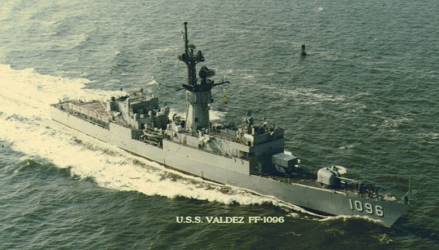
USS VALDEZ was the 45th and last but one KNOX - class frigate. She was the first ship in the Navy named after Hospitalman Third Class Valdez. Decommissioned on December 16, 1991, and stricken from the Navy list on January 11, 1995, the USS VALDEZ was later given to Taiwan. Arriving there in October 1999, the VALDEZ was recommissioned as YI YANG.
| General Characteristics: | Awarded: August 25, 1966 |
| Keel laid: June 30, 1972 | |
| Launched: March 24, 1973 | |
| Commissioned: July 27, 1974 | |
| Decommissioned: December 16, 1991 | |
| Builder: Avondale Shipyards, New Orleans, La. | |
| Propulsion system: 2 - 1200 psi boilers; 1 geared turbine, 1 shaft; 35,000 shaft horsepower | |
| Length: 438 feet (133.5 meters) | |
| Beam: 47 feet (14.4 meters) | |
| Draft: 25 feet (7.6 meters) | |
| Displacement: approx. 4,200 tons full load | |
| Speed: 27 knots | |
| Armament: one Mk-16 missile launcher for ASROC and | |
| Aircraft: one | |
| Crew: 18 officers, 267 enlisted |
Crew List:
This section contains the names of sailors who served aboard USS VALDEZ. It is no official listing but contains the names of sailors who submitted their information.
Accidents aboard USS VALDEZ:
| Date | Where | Events |
|---|---|---|
| September 9, 1980 | off Antwerp, Belgium | USS VALDEZ suffers a material failure to its sole gyro compass following departure from Antwerp, Belgium. The ship operates on magnetic compass only for the next six weeks, throughout exercise Teamwork '80. This degrades the performance of weapons systems and satellite navigation, and makes refueling at sea more complicated. |
About the Ship's Name:
Phil Isadore Valdez - born on 13 April 1946 in Dixon, N.M. - graduated from Espanola (N.M.) High School in May 1965 and enlisted in the Navy on 1 November 1965. After completing basic training, he was trained at the Naval Hospital Corps School at San Diego, Calif. Advanced to the rating of hospitalman in May 1966, Valdez served at the Naval Hospital, Key West, Fla., until 19 December 1966 at which time he was transferred to the 1st Battalion, 1st Marines, Fleet Marine Force, serving ashore in Vietnam near Danang.
On the morning of 29 January 1967, Valdez was assigned as corpsman with the 3rd Platoon when that unit was flown in by helicopter to provide support for the embattled Company "H," 2nd Battalion. Upon landing, Valdez' unit came under heavy sniper fire, and several marines went down as a result. The hospitalman sprang into action instantly. First, he ran about 70 meters across open land being raked by enemy fire to aid a fallen marine. He helped that man to a safer place and quickly dressed his wounds. After completing that task, he dashed back out into the hail of fire to assist another wounded marine some 50 meters away. Upon reaching his new charge, he positioned himself so as to protect the wounded man from the enemy fire and began to dress his wound. At that point, the enemy got his range, and Valdez fell to their fire mortally wounded. His "...heroic action and selfless devotion to duty..." saved the lives of two wounded marines and, in recognition of his "...conspicuous gallantry and intrepidity in action," HN Valdez was advanced to the rate of hospitalman, third class, and awarded the Navy Cross, both posthumously.
USS VALDEZ History:
USS VALDEZ (DE 1096), later USS VALDEZ (FF 1096), was a KNOX-class ocean escort and frigate built during the late Cold War, when the U.S. Navy was expanding and modernizing its Atlantic and Pacific escort forces to counter the growth of the Soviet submarine fleet and to protect carrier groups, amphibious forces, convoys, and sea lines of communication. She was named for Hospitalman Phil Isadore Valdez. The ship that bore his name was ordered on August 25, 1966, laid down at Avondale Shipyards, Westwego, Louisiana, on June 30, 1972, and launched on March 24, 1973. Her sponsor was Manuelita Valdez, the mother of the namesake. USS VALDEZ was acquired by the Navy on July 12, 1974, and commissioned at Charleston, South Carolina, on July 27, 1974. Her original designation, DE 1096, reflected the "ocean escort" classification used by the Navy at the time, but on June 30, 1975, in the Navy-wide ship reclassification, she became FF 1096.
After commissioning, USS VALDEZ remained at Charleston for fitting out, administrative organization, engineering checks, inspections, and the many corrections and refinements required before a new escort could be considered fully operational. On October 27, 1974, she departed Charleston for Guantanamo Bay, Cuba, where she began shakedown training. Guantanamo Bay was then the standard Atlantic Fleet training area for newly commissioned ships, and USS VALDEZ used the period to test and train her crew in engineering operations, seamanship, damage control, gunnery, anti-submarine procedures, communications, and shiphandling. After approximately seven weeks of shakedown training, she returned to Charleston for holiday leave, upkeep, and preparation for the post-shakedown repair period. On February 25, 1975, she began her post-shakedown availability, which continued until April 11, 1975. That yard and repair period corrected deficiencies found during shakedown and prepared the ship for full Atlantic Fleet service.
During the spring of 1975, USS VALDEZ entered the normal operational rhythm of a newly commissioned Atlantic Fleet escort. In the final week of May and the first week of June 1975, she participated in Exercise Solid Shield in the vicinity of Morehead City, North Carolina. Solid Shield was a major amphibious and joint exercise, and for USS VALDEZ it provided early experience in coordinated fleet operations, amphibious screening, communications, maneuvering with other naval and Marine Corps forces, and the practical use of an ocean escort in support of larger task-group activity. On June 6, 1975, she returned to Charleston and resumed local operations, maintenance, and preparations for her first overseas deployment. While in this period, on June 30, 1975, she was redesignated from ocean escort DE 1096 to frigate FF 1096.
USS VALDEZ departed Charleston on August 18, 1975, for her first overseas deployment. USS JESSE L. BROWN (FF 1089) was part of the same broad movement toward the Mediterranean and the Middle East, and the deployment pattern reflected the renewed importance of the Suez route after the reopening of the Suez Canal in June 1975. USS VALDEZ reached Rota, Spain, on August 29, 1975, and shifted to Sixth Fleet operational control. From Rota she proceeded eastward through the Mediterranean to Egypt and transited the Suez Canal on September 5, 1975. The next day, September 6, 1975, she reported for duty with the Middle East Force at Djibouti, then in the French Territory of the Afars and Issas. Her arrival in that region placed her in a small but strategically important U.S. naval command responsible for presence, training, and diplomatic contact in the Red Sea, Gulf of Aden, Arabian Sea, Persian Gulf, and adjacent Indian Ocean waters. This was a period in which the United States was maintaining access and relationships across a complicated region shaped by the Cold War, the aftermath of the 1973 Arab-Israeli War, the reopening of Suez, the importance of Persian Gulf oil routes, and the continuing Western relationship with pre-revolutionary Iran.
During her Middle East Force tour, USS VALDEZ participated in bilateral exercises with French, Iranian, Abu Dhabi, Pakistani, and Kuwaiti forces. She also embarked Saudi Arabian naval officers for training and took part in the multinational CENTO exercise Midlink 75. Her documented port calls during this deployment included Bandar Abbas, Iran; Bahrain; Kuwait; Sharjah and Abu Dhabi in the United Arab Emirates; Karachi, Pakistan; Assab, Ethiopia; Victoria in the Seychelles; and Jidda, Saudi Arabia. In September 1975, in the Bandar Abbas area, USS VALDEZ operated in an exercise setting with USS JESSE L. BROWN and units of the Imperial Iranian Navy, including FARAMARZ, PALANG, and MILANIAN. Those activities reflected the regional security structure that existed before the 1979 Iranian Revolution, when Iran was still a major U.S. security partner in the Persian Gulf. In November 1975, her participation in Midlink 75 placed her in the CENTO training environment, which linked U.S. and allied interests with Pakistan, Iran, Turkey, and the United Kingdom in a Cold War framework intended to support security along the southern tier of the Soviet Union.
USS VALDEZ completed her Middle East Force assignment in early 1976. She retransited the Suez Canal on January 31, 1976, reached Rota on February 5, and remained there until February 8. She then visited Brest, France, from February 11 to February 14, 1976. During the Brest visit, she participated in a ceremonial gun-salute event connected with the historic French recognition of the American flag during the Revolutionary War period. From France she crossed the Atlantic by way of the Azores and Bermuda and returned to Charleston on February 25, 1976. That arrival closed a demanding first deployment that had taken her from the U.S. East Coast through the Mediterranean, Suez Canal, Red Sea, Persian Gulf, Arabian Sea, and western Indian Ocean, and back again.
After post-deployment leave and upkeep at Charleston, USS VALDEZ resumed Atlantic Fleet training, readiness work, local operations, and maintenance. On October 4, 1976, USS VALDEZ departed Charleston for a Sixth Fleet deployment. She reached Rota on October 14, 1976, and entered the Mediterranean on October 16. Her deployment formed part of a broader Atlantic Fleet rotation that also involved ships such as USS WILLIAM V. PRATT (DDG 44) and USS JULIUS A. FURER (FFG 6). This deployment group's Sixth Fleet duties also included service in the screen of USS FRANKLIN D. ROOSEVELT (CV 42). Strategically, this deployment occurred during a period when the Mediterranean remained one of the most active Cold War naval theaters. Soviet ships operated from the Black Sea into the eastern Mediterranean, NATO maintained a constant maritime presence on its southern flank, and U.S. carrier and escort deployments served both deterrent and crisis-response purposes.
USS VALDEZ remained in the Mediterranean into 1977 and returned to Charleston on April 21, 1977. On arrival, she began a 30-day leave and upkeep period. Through the summer of 1977 she operated from Charleston, conducting local Atlantic Fleet training, inspections, engineering work, and readiness activity. On September 27, 1977, she departed Charleston for a North Atlantic deployment with a NATO task group. During this deployment, she participated in Exercise Combined Effort and related NATO operations. These exercises were part of the alliance's continuing focus on sea control and reinforcement routes across the North Atlantic, where NATO planning assumed that wartime resupply and troop movements from North America to Europe would have to be defended against Soviet submarines and surface forces. USS VALDEZ's port visits during this North Atlantic deployment included Lisbon, Portugal; Portsmouth, England; Amsterdam, Netherlands; Bremerhaven, West Germany; and Cherbourg, France. The deployment combined operational training with visible alliance presence in European ports. USS VALDEZ returned to Charleston on December 2, 1977.
On January 16, 1978, USS VALDEZ departed the United States for a South Atlantic training and goodwill deployment in company with USS INCHON (LPH 12) and USS SPRUANCE (DD 963). The cruise was planned as a ten-week deployment to West Africa, South America, and the Caribbean, combining independent ship training, task-group operations, diplomatic port visits, and possible small-scale combined exercises with host-country forces. For USS VALDEZ, this deployment was a marked contrast to the Middle East Force and NATO cycles of her earlier service. Its emphasis was naval diplomacy, presence, and maritime contact in regions where the United States used ship visits to maintain relationships, demonstrate professional naval capability, and support wider diplomatic engagement. The countries listed for the cruise included Morocco, Guinea-Bissau, Liberia, Togo, Ivory Coast, Nigeria, Senegal, and Brazil. During the deployment, USS VALDEZ was selected to visit Guinea-Bissau and Lome, Togo, independently. Her Guinea-Bissau visit was noteworthy because contemporary Navy reporting described her as possibly the first American warship to visit that newly independent West African state. That call required careful navigation along the Geba River and had a strong ceremonial and diplomatic character, with local visitors coming aboard and the ship serving as a visible American naval presence in a country that had only recently emerged from Portuguese colonial rule. USS VALDEZ returned to Charleston on April 18, 1978. A period of repairs, leave, and upkeep followed, and she then spent the summer conducting operations from her home port.
On September 12, 1978, USS VALDEZ departed Charleston for Boston, Massachusetts. On September 15, 1978, she began a regular overhaul at the Bethlehem Steel shipyard. USS VALDEZ remained in overhaul status into 1979. By 1980, USS VALDEZ was operating in the Atlantic Fleet and Naval Reserve Force environment. On September 9, 1980, after departing Antwerp, Belgium, she suffered a material failure of her sole gyrocompass. The casualty was significant because the ship had to operate on magnetic compass information only for the next six weeks, including during Exercise Teamwork 80. That degraded weapons-system performance, affected satellite-navigation integration, and complicated underway refueling. Exercise Teamwork 80 was one of NATO's major northern maritime exercises, designed to test allied reinforcement, sea control, anti-submarine warfare, and command-and-control in the North Atlantic and northern European waters. USS VALDEZ's participation, even while dealing with the gyrocompass casualty, placed her within the same Cold War maritime problem for which the KNOX-class had been designed: defending sea lanes and operating with allied forces in waters where submarine threats, weather, and navigation demands were central concerns.
On June 24, 1982, USS VALDEZ was photographed underway in the Mediterranean as part of Task Group 6 while taking part in the transfer of Americans and third-country personnel from Juniyah, Lebanon, to Larnaca, Cyprus. This occurred during the 1982 Lebanon War, after Israel's invasion of Lebanon and amid rapidly deteriorating security conditions ashore. For the U.S. Navy, the evacuation movement demonstrated one of the practical roles of forward-deployed Sixth Fleet ships: to remain close enough to a crisis area to support the safe movement of civilians, coordinate with diplomatic authorities, and provide secure transport from a dangerous coastline to a safer regional port.
On August 14, 1982, USS VALDEZ was assigned to the Naval Reserve Force, Atlantic. This did not end her commissioned service, but it changed the character of her employment. As a Naval Reserve Force frigate, she combined operational readiness with the training of Selected Reserve personnel, providing a mobilization asset and a platform for maintaining reserve surface-warfare skills.
During the late 1980s, USS VALDEZ also appears in a humanitarian-assistance context in the Caribbean. Navy reporting credited USS VALDEZ, USS STEPHEN W. GROVES (FFG 29), and USS PENSACOLA (LSD 38) with using their shipboard evaporators to distill fresh water for residents of St. Croix during a local water shortage. In May 1988, USS VALDEZ was photographed at Key West, Florida, sailing past Fort Taylor, another documented indication of her continued Atlantic and Caribbean operating pattern during her Naval Reserve Force years.
The final phase of USS VALDEZ's U.S. Navy career took place amid major strategic change. By the end of the 1980s the Cold War was ending, the Berlin Wall had fallen, the Warsaw Pact was dissolving, and the U.S. Navy was beginning to reduce and reshape its force structure. The KNOX-class frigates, built for Cold War anti-submarine escort work, were increasingly aging relative to newer OLIVER HAZARD PERRY-class frigates, Aegis cruisers, and Aegis destroyers. VALDEZ remained part of the Atlantic and reserve-force structure until her removal from active service. USS VALDEZ was decommissioned on December 16, 1991, after seventeen years and four months in commissioned U.S. Navy service. She was stricken from the Naval Vessel Register on January 11, 1995.
The former USS VALDEZ did not end her operational life after leaving the U.S. Navy list. On April 29, 1998, she was leased to the Republic of China and renamed ROCS YI YANG, with the hull number FFG 939. She was recommissioned into the Republic of China Navy on October 18, 1999. In Taiwanese service, the former USS VALDEZ joined the CHI YANG-class, a group of ex-U.S. KNOX-class frigates acquired to strengthen Taiwan's surface escort and anti-submarine forces. Her second career placed the ship in a strategic environment very different from the Atlantic, Mediterranean, Middle East, and South Atlantic settings of her U.S. Navy service. Around Taiwan, her principal relevance lay in surveillance, escort duties, anti-submarine warfare, and maritime presence in a region shaped by the continuing military pressure of the People's Republic of China and the modernization of the People's Liberation Army Navy. In mid-2006, ROCS YI YANG completed a Taiwanese modification program known as Wu San Hua, part of the adaptation of the former KNOX-class hulls to Republic of China Navy requirements. She remained listed as an active Taiwanese frigate long after her U.S. Navy contemporaries had left American service, giving the hull an unusually long operational life.
Back to Frigates List.
Back to Ships List.
Back to selection page.
Back to 1st page.