
Search the Site with

|
Search the Site with
|
 General Characteristics Crew List Memorabilia About the Ship's Coat of Arms About the Name "Halyburton" History Patch Gallery Image Gallery to end of page
 |  |
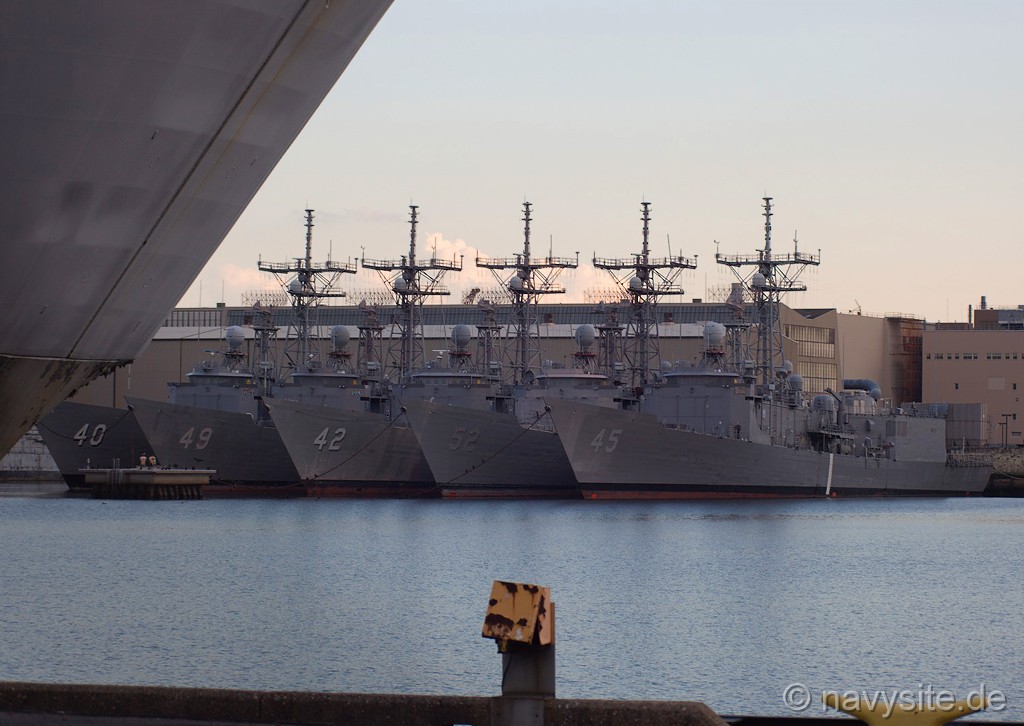
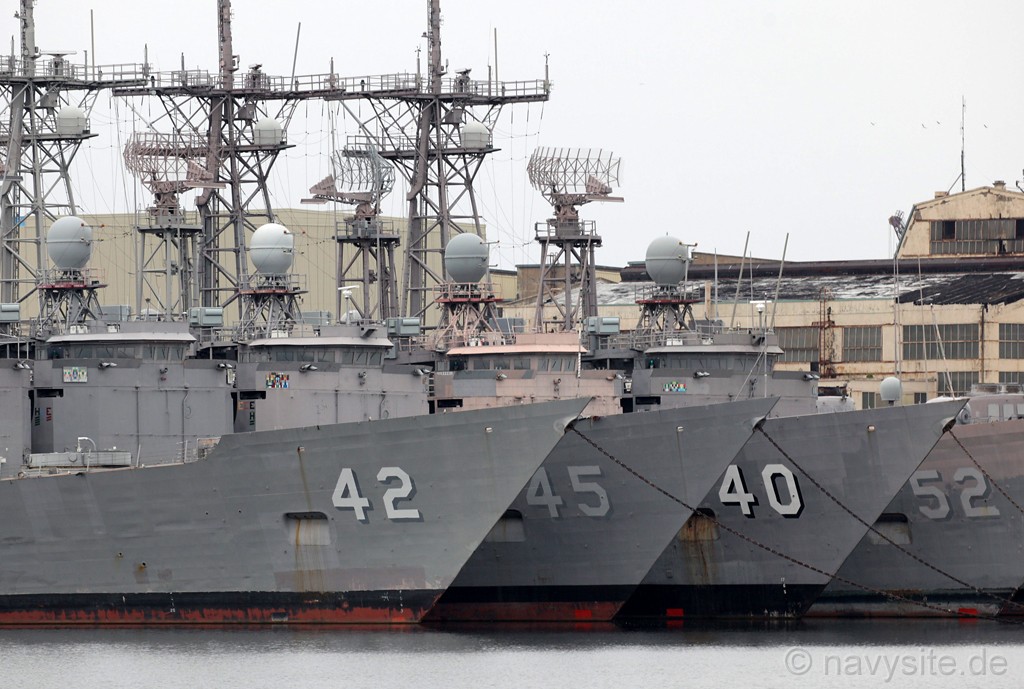
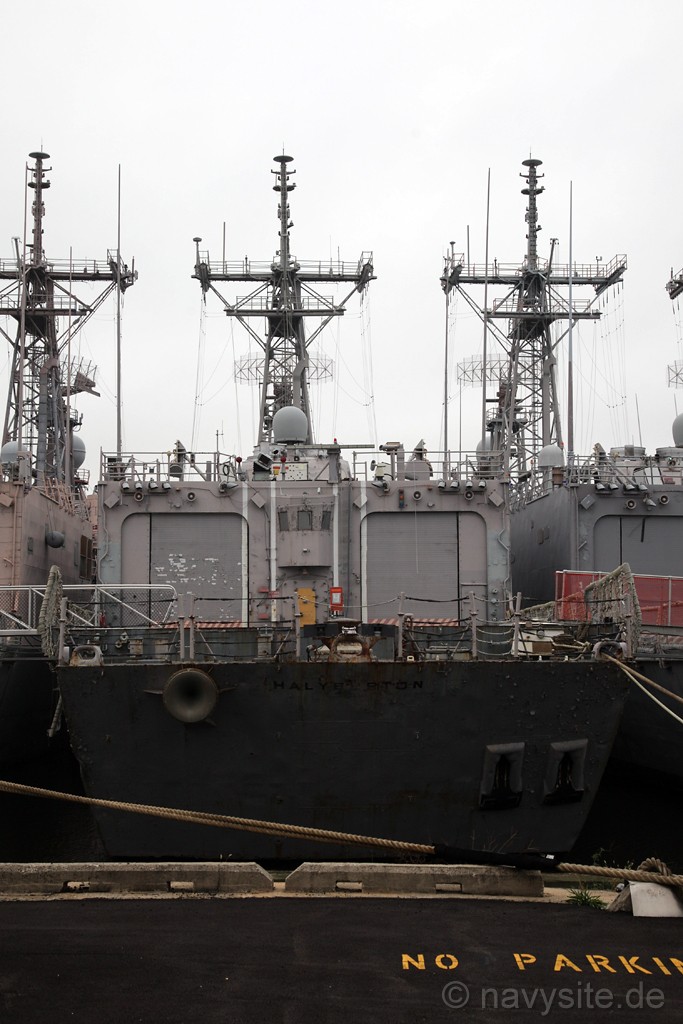
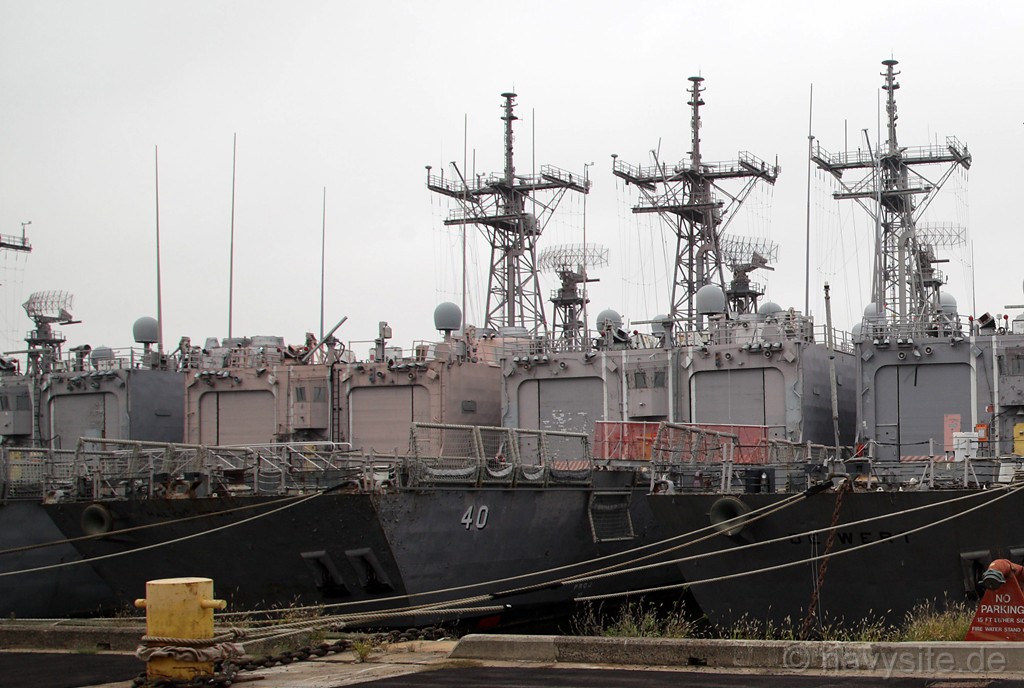
USS HALYBURTON was the 31st OLIVER HAZARD PERRY - class guided missile frigate and the sixth ship in that class built by Todd in Seattle. USS HALYBURTON held a decommissioning ceremony at her homeport of Mayport, Fla., on September 6, 2014, and was officially decommissioned and stricken from the Navy list two days later. Also on September 8, the ship left Mayport under tow for Philadelphia, Penn., to be laid up.
| General Characteristics: | Keel Laid: September 26, 1980 |
| Launched: October 13, 1981 | |
| Commissioned: January 7, 1984 | |
| Decommissioned: September 8, 2014 | |
| Builder: Todd Pacific Shipyards Co., Seattle Division, Seattle, Wash. | |
| Propulsion system: two General Electric LM 2500 gas turbines, two 350 Horsepower Electric Drive Auxiliary Propulsion Units | |
| Propellers: one | |
| Blades on each Propeller: five | |
| Length: 453 feet (138 meters) | |
| Beam: 47 feet (14.32 meters) | |
| Draft: 24,6 feet (7.5 meters) | |
| Displacement: 4,100 tons | |
| Speed: 28+ knots | |
| Aircraft: two | |
| Armament: one | |
| Crew: 17 Officers and 198 Enlisted |
 back to top go to the end of the pageback to top go to the end of the page
Crew List:
This section contains the names of sailors who served aboard USS HALYBURTON. It is no official listing but contains the names of sailors who submitted their information.
back to top go to the end of the pageback to top go to the end of the pageAbout the Ship's Coat of Arms:
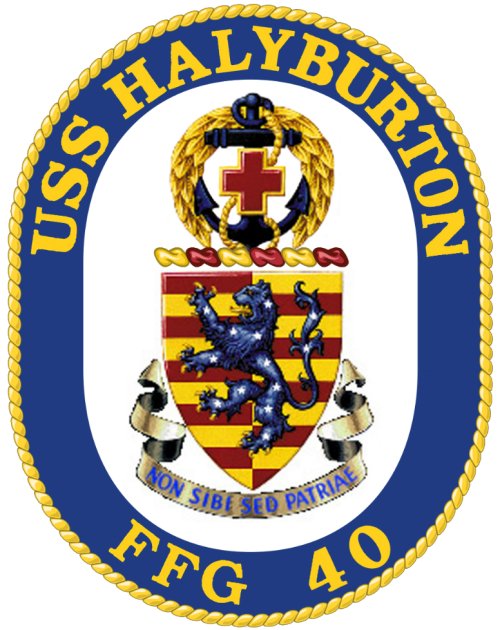 (Click on the crest for a larger version)
The ship's crest was designed to represent the heroic action on the Island of Okinawa in World War II for which Pharmacist's Mate Second Class William David Halyburton, Jr. was posthumously awarded the Medal of Honor. The Scarlet and gold bars in the shield denote service in a land action with the U.S. Marines; the alternating colors of the bars symbolize the exchange of fire with an opposing force. The heraldic lion rampant in the midst of the field denotes a single act of great courage, i.e., Halyburton placing himself in the line of fire, in complete disregard for his own safety, in order to shield from further harm, and render medical aid to, a fallen Marine, thereby giving his own life in exchange. The lion is blue, the color of the Medal of Honor ribbon, and is strewn with thirteen stars, as is that decoration, the nation's highest.
The gold laurel wreath, inverted, is symbolic of the posthumous awards to Pharmicist's Mate Halyburton in addition to the Medal of Honor: The Purple Heart, the Asiatic Pacific Campaign Medal and the World War II Victory Medal. The anchor and cross denote naval service and the provision of medical care on the battlefield.
back to top go to the end of the pageAbout the Ship's Name, about Pharmacist's Mate Second Class William David Halyburton, Jr.:
 USS HALYBURTON is named for the late Pharmacist's Mate Second Class William David Halyburton, Jr. , USN. A native of Canton, North Carolina, he was a graduate of New Hanover High School, Wilmington, North Carolina. His enrollment at Davidson College, Davidson, North Carolina, where he planned to prepare himself for the ministry, was put aside to go into the service.
His citation is as follows:
"For conspicuous gallantry and intrepedity at the risk of life above and beyond the call of duty while serving with a Marine Rifle Company in the 2d Battalion, 5th Marines, 1st Marine Division, during action against the enemy Japanese forces on Okinawa Shima in the Ryukyu Chain on 10 May 1945. Undaunted by the deadly accuracy of Japanese counterfire as his unit pushed the attack through a strategically important draw and up the hill into an open fireswept field where the Company advance squad was suddenly pinned down under a terrific concentration of mortar, machinegun, and sniper fire with resultant severe casualties. Moving steadily forward despite the enemy's merciless barrage, he reached the wounded Marine who lay farthest away and was rendering first aid when his patient was struck for the second time by a Japanese bullet. Instantly placing himself in the direct line of fire, he shielded the fallen fighter with his own body and staunchly continued his ministrations although constantly menaced by the slashing fury of shrapnel and bullets falling at his sides. Alert, determined, and completely unselfish in his concern for the helpless Marine, he persevered in his efforts until he himself sustained mortal wounds and collapsed, heroically sacrificing himself that his comrade might live. By his outstanding valor and unwavering devotion to duty in the face of tremendous odds, Petty Officer Halyburton sustained and enhanced the highest traditions of the United States Naval Service. He gallantly gave his life in the service of his country."
back to top go to the end of the pageUSS HALYBURTON History:
USS HALYBURTON was laid down on September 26, 1980, at Todd Pacific Shipyards, Seattle Division, in Seattle, Washington, and launched on October 13, 1981. The ship was sponsored by Mrs. Mae P. Halyburton, mother of Pharmacist's Mate Second Class William David Halyburton Jr., for whom the frigate was named. Delivered to the U.S. Navy on December 22, 1983, she was commissioned at Seattle on January 7, 1984, with Cmdr. Robert K. Peters in command. The ship was assigned to Destroyer Squadron Six and designated Naval Station Charleston, South Carolina, as her first homeport.
Following commissioning, USS HALYBURTON completed initial outfitting, equipment inspections, and operational preparations before proceeding to the Atlantic Fleet. During 1984, the frigate conducted shakedown training, engineering evaluations, weapons exercises, and combat systems qualifications in the Western Atlantic and Caribbean. Her activities included antisubmarine warfare training and preparations for the introduction of the SH-60B Seahawk helicopter and its LAMPS Mk III system. In September, HALYBURTON entered Bath Iron Works in Bath, Maine, for a six-month Post-Shakedown Availability (PSA).
The availability continued through the first months of 1985 and included extensive modifications to the frigate's weapons and aviation systems. Improvements included fire-control and weapons-system upgrades, installation of fin stabilizers, a Recovery Assist, Secure and Traverse (RAST) system for embarked helicopters, a LAMPS Mk III data link, additional acoustic processors, and modifications to shipboard firefighting equipment. The work represented approximately 35,000 man-days and was one of the largest post-shakedown work packages undertaken on an Oliver Hazard Perry-class frigate at that time.
On February 12 and 13, 1985, USS HALYBURTON successfully completed an Engineering Light-Off Examination. She departed Bath Iron Works on March 1 and immediately conducted operational trials involving an embarked SH-60B Seahawk helicopter. The trials evaluated the ship's newly installed helicopter recovery and data-link equipment. On March 4, HALYBURTON arrived at Naval Weapons Station Yorktown, Virginia, to load ammunition before conducting several days of exercises and returning to Charleston on March 9.
During April 1985, USS HALYBURTON completed additional helicopter qualifications and operational training in the Charleston operating areas. On April 30, she departed Charleston for Grenada, arriving at St. George's on May 2. During the visit, the frigate hosted American and Grenadian officials, supported training activities with the Grenadian Coast Guard cutter TYRREL BAY, and conducted community relations projects. After departing Grenada, HALYBURTON conducted antisubmarine warfare exercises off Cherry Point, North Carolina, from May 6 to 8.
Between May 24 and June 11, 1985, USS HALYBURTON participated in the Charleston Midshipmen Training Squadron, conducting exercises and port visits in the Western Atlantic and Caribbean. During this period, the frigate visited Fort Lauderdale, Florida, from May 28 to 31 and supported an emergency medical evacuation at Guantanamo Bay, Cuba, on June 2. The following day, HALYBURTON successfully fired a Standard SM-1 surface-to-air missile during an exercise at the Atlantic Fleet Missile Range near Puerto Rico. On June 4, she anchored off St. Martin in the Netherlands Antilles before returning to Charleston.
From June 17 to July 20, 1985, USS HALYBURTON conducted refresher training at Naval Station Guantanamo Bay. During this period, the engineering department successfully completed an Operational Propulsion Plant Examination (OPPE). On July 21, the frigate conducted operations with two SH-60B Seahawk helicopters embarked simultaneously, becoming the first OLIVER HAZARD PERRY-class frigate to do so. Helicopter Antisubmarine Squadron Light Forty-Two, Detachment Five (HSL-42 Det. 5), officially joined the ship for her upcoming overseas deployment.
Following an Intermediate Maintenance Availability at Charleston from July 22 to August 23, USS HALYBURTON departed on August 26, 1985, for NATO Exercises Ocean Safari and BALTOPS '85. Two SH-60B Seahawks from HSL-42 Detachment Five were embarked. On August 28, the frigate joined the aircraft carrier USS AMERICA (CV 66), battleship USS IOWA (BB 61), and guided missile cruiser USS TICONDEROGA (CG 47) for Exercise Ocean Safari, which was intended to evaluate NATO's ability to protect transatlantic reinforcement convoys in the event of a major conflict.
On August 30, USS HALYBURTON successfully fired two surface-to-air missiles during an exercise at the Mobile Sea Range. She subsequently joined USS IOWA in a Battleship Surface Action Group, operating north of the participating convoy formations and carrier battle group. The ships proceeded through the Denmark Strait and along the coast of Greenland, crossing the Arctic Circle on September 6. During the same day, HALYBURTON conducted an underway replenishment with USS IOWA.
On September 10, 1985, USS HALYBURTON rejoined USS AMERICA south of Iceland before continuing into the Norwegian Sea for operations in Vestfjord. On September 13, she provided emergency flight deck assistance to a British Sea King helicopter experiencing hydraulic difficulties. The helicopter landed safely aboard HALYBURTON, was repaired, and departed the following day.
On September 20, 1985, USS HALYBURTON rescued a sailor who had fallen overboard from the fast combat support ship USS DETROIT (AOE 4) while the latter was replenishing ships in Vestfjord. HALYBURTON was operating as a lifeguard ship astern of USS DETROIT and recovered the sailor within six minutes. After receiving treatment for hypothermia, he was returned to his ship.
Following completion of Ocean Safari, USS HALYBURTON visited Kristiansund, Norway, from September 22 to 25; Oslo, Norway, from September 27 to 30; Aalborg, Denmark, from October 1 to 7; and Gothenburg, Sweden, from October 8 to 12. The frigate then participated in BALTOPS '85 from October 14 to 19, conducting coordinated maritime exercises with American and allied warships in the Baltic Sea. Other American ships participating in BALTOPS included USS IOWA, USS TICONDEROGA, and additional surface combatants and auxiliary vessels. Following completion of the exercise, USS HALYBURTON visited Kiel, West Germany, from October 19 to 26 before beginning her return passage across the Atlantic. She arrived at Craney Island, Virginia, on November 6 for deperming operations and returned to Charleston on November 8.
From November 18 to December 18, 1985, USS HALYBURTON underwent an Intermediate Maintenance Availability alongside the destroyer tender USS SIERRA (AD 18). During this period, the frigate completed inspections and maintenance, including a command inspection conducted from December 3 to 5. After sea trials on December 19 and 20, she remained at Charleston for holiday leave and upkeep.
During the first months of 1986, USS HALYBURTON conducted preparations for another Mediterranean deployment. The frigate subsequently operated with the U.S. Sixth Fleet during a period of increasing tensions between the United States and Libya. In April, she was assigned to operations in the Gulf of Sidra as American naval forces prepared for possible military action against Libyan installations following terrorist attacks attributed to the Libyan government.
On April 14, 1986, USS HALYBURTON was operating in the Gulf of Sidra when American naval and air forces began preparations for Operation El Dorado Canyon. During the early hours of April 15, the frigate was at General Quarters in support of the coordinated American air strikes against military targets in Libya. HALYBURTON remained ready to defend the naval force against possible Libyan air or surface attacks. Following completion of the operation, she continued Sixth Fleet assignments in the Mediterranean. On April 18, Cmdr. Craig Welterlen relieved Cmdr. Robert K. Peters as commanding officer.
During the remainder of 1986 and throughout 1987, USS HALYBURTON continued Atlantic Fleet operations, including antisubmarine warfare training, helicopter exercises, combat systems inspections, and readiness evaluations. Her assignments included operations with other American and allied naval forces in the Atlantic and Mediterranean, as well as maintenance periods at Charleston in preparation for subsequent deployments.
During 1988, USS HALYBURTON deployed to the Middle East Force in the Persian Gulf during the final phase of the Iran-Iraq War. American warships operating in the region were conducting merchant vessel protection and escort duties under Operation Earnest Will, which had begun in July 1987. HALYBURTON participated in tanker escort operations, maritime surveillance, and patrols intended to protect commercial shipping against mines, antiship missiles, and attacks by small naval craft.
The frigate conducted escort operations during the summer of 1988, accompanying merchant vessels through the Strait of Hormuz and within the Persian Gulf. Although Iran and Iraq agreed to a ceasefire in August, American warships continued maintaining a presence to protect shipping and monitor the security situation. On May 18, Cmdr. Louis J. Giannotti had relieved Cmdr. Craig Welterlen as commanding officer.
During 1989 and 1990, USS HALYBURTON continued operational training, maintenance, and maritime security assignments from Charleston. The frigate conducted exercises in the Western Atlantic and Caribbean, including antisubmarine warfare training, helicopter operations, and readiness inspections. On March 31, 1990, Cmdr. Robert M. Hartling relieved Cmdr. Louis J. Giannotti as commanding officer.
During the 1990-1991 Persian Gulf conflict, USS HALYBURTON supported American naval operations associated with the enforcement of sanctions against Iraq and the protection of maritime traffic. In February 1991, an embarked SH-60B Seahawk suffered an engine failure during takeoff operations and made an emergency landing in the sea. All three helicopter crewmembers were rescued, although the aircraft was lost.
During 1992, USS HALYBURTON continued maritime law enforcement and counter-narcotics operations, in addition to her regular Atlantic Fleet training schedule. Her participation in joint maritime security operations was recognized through a second Joint Meritorious Unit Award. On March 20, Cmdr. Robert F. Brado relieved Cmdr. Robert M. Hartling as commanding officer.
During 1993, USS HALYBURTON deployed to the Mediterranean with NATO's Standing Naval Force Mediterranean (STANAVFORMED). The multinational naval formation conducted maritime surveillance and enforcement of United Nations sanctions associated with the conflict in the former Yugoslavia. HALYBURTON participated in the identification, questioning, inspection, and diversion of merchant vessels suspected of violating the embargo in the Adriatic Sea. These operations formed part of the international maritime enforcement effort that was consolidated under Operation Sharp Guard in June 1993.
The frigate also conducted multinational exercises and port visits with participating NATO warships. Following completion of her Mediterranean assignment, USS HALYBURTON returned to Charleston and resumed training and operational preparations. On December 22, 1993, Cmdr. Robert D. Reilly relieved Cmdr. Robert F. Brado as commanding officer.
During the first months of 1994, USS HALYBURTON underwent maintenance, inspections, and operational readiness training in preparation for another deployment to the Middle East. The frigate completed engineering and combat systems evaluations, helicopter qualifications, and exercises in the Western Atlantic before departing for a six-month deployment in the autumn.
On October 21, 1994, USS HALYBURTON departed Charleston for Middle East Force Deployment 1-95. The following day, she rendezvoused with the guided missile cruiser USS GETTYSBURG (CG 64) and the Military Sealift Command oiler USNS JOSHUA HUMPHREYS (T-AO 188). The ships proceeded south through the Atlantic toward the Cape of Good Hope, conducting tactical exercises and replenishment operations during the voyage.
On October 30, 1994, USS HALYBURTON crossed the equator before continuing toward South Africa. On November 8, the frigate arrived at Simon's Town, South Africa, and two days later proceeded to Cape Town. HALYBURTON and USS GETTYSBURG were among the first American warships to visit South African ports since 1967. During the visit, the ships participated in professional exchanges and exercises with units of the South African Navy. On November 14, HALYBURTON conducted coordinated operations with South African naval forces before continuing toward the Indian Ocean.
On November 22, 1994, USS HALYBURTON arrived at Mombasa, Kenya, for a port visit before proceeding north toward the Arabian Sea. On November 29, the frigate entered the U.S. Naval Forces Central Command area of responsibility to begin her assigned Middle East operations. The following day, however, HALYBURTON and USS GETTYSBURG were ordered to assist the Italian cruise ship ACHILLE LAURO, which had caught fire off the coast of Somalia.
On November 30, 1994, USS HALYBURTON proceeded toward the burning passenger ship and joined the international rescue operation. The frigate and USS GETTYSBURG used their embarked SH-60B Seahawk helicopters and small boats to assist with the evacuation and transfer of passengers and crew. HALYBURTON also provided medical supplies and other assistance to merchant vessels involved in the rescue.
On December 1, 1994, USS HALYBURTON embarked 47 survivors from ACHILLE LAURO. The frigate provided medical assistance, food, accommodation, and other support to the passengers before proceeding to Djibouti. On December 4, HALYBURTON arrived at Djibouti and disembarked all 47 survivors. The operation took place during the final days of the cruise ship, which sank on December 2 after suffering extensive damage from the fire.
Following completion of the rescue operation, USS HALYBURTON resumed her deployment to the Middle East. During December 1994 and the first months of 1995, the frigate conducted Maritime Interdiction Operations (MIO) in the Persian Gulf, enforcing United Nations economic sanctions imposed against Iraq following its invasion of Kuwait in August 1990. Her boarding teams monitored and inspected merchant vessels, while the ship's embarked helicopter supported surveillance and vessel identification.
During the deployment, USS HALYBURTON operated with other American and coalition naval forces maintaining maritime security in the Persian Gulf and Gulf of Oman. Port visits and logistics stops included Bahrain and other locations in the region. The frigate conducted patrols in the northern Arabian Gulf, monitoring merchant traffic and supporting the continued enforcement of international sanctions.
On March 18, 1995, USS HALYBURTON departed Bahrain to begin her return passage to Charleston. The frigate transited the Strait of Hormuz and proceeded through the Gulf of Oman and Red Sea, making a brief fuel stop at Jeddah, Saudi Arabia, on March 25. On March 28, she transited the Suez Canal northbound and entered the Mediterranean Sea. The following day, HALYBURTON arrived at Rhodes, Greece, for a three-day port visit.
On April 1, 1995, USS HALYBURTON departed Rhodes for Barcelona, Spain, arriving on April 5. After a two-day visit, the frigate proceeded westward and rendezvoused with USS GETTYSBURG on April 8 for the homeward Atlantic crossing. The two warships made brief fuel stops in the Azores and Bermuda, where relatives and guests embarked for the final passage to their respective homeports. USS HALYBURTON returned to Charleston on April 20, completing Middle East Force Deployment 1-95.
During May 1995, USS HALYBURTON underwent post-deployment maintenance and inspections at Charleston. The work included a Harpoon missile system upgrade and an Intermediate Maintenance Availability beginning on May 16. Following completion of preparations for counter-narcotics operations, the frigate embarked HSL-44 Detachment Eight and departed Charleston on June 6 for a deployment to the eastern Pacific.
On June 13, 1995, USS HALYBURTON transited the Panama Canal and continued into the eastern Pacific, where she conducted maritime surveillance and counter-narcotics operations in cooperation with U.S. law enforcement agencies. The assignment involved patrols along routes used by vessels transporting illegal drugs from South and Central America. Following completion of these operations, the frigate returned to the Atlantic Fleet.
On July 17, 1995, USS HALYBURTON officially changed her homeport from Charleston to Norfolk, Virginia, and was reassigned to Destroyer Squadron Two. On September 1, she was reassigned to Destroyer Squadron Twenty-Eight, and Cmdr. William H. Millward relieved Cmdr. Robert D. Reilly as commanding officer. During the remainder of the year, HALYBURTON conducted training, maintenance, and operational preparations from Norfolk.
During the first months of 1996, USS HALYBURTON underwent a Selected Restricted Availability, followed by extensive engineering and combat systems evaluations. On April 17, she hosted the Dutch mine countermeasures vessels HNLMS URK and HNLMS HELLEVOETSLUIS during a visit to Norfolk. On April 23, the frigate departed for ammunition loading at Naval Weapons Station Yorktown, Virginia, before beginning a Tailored Ship's Training Availability (TSTA), which continued from April 29 to May 3.
During the following months, USS HALYBURTON conducted training and operational readiness evaluations in the Western Atlantic. Her activities included antisubmarine warfare exercises, helicopter operations, weapons qualifications, and engineering inspections intended to prepare the ship for another Middle East deployment.
On July 19, 1996, USS HALYBURTON rescued five fishermen from the sinking fishing vessel AMANDA M. JESSICA approximately 60 miles southeast of Nantucket, Massachusetts. The rescue was conducted at night under difficult weather conditions, including heavy fog, strong winds, and rough seas. The frigate's rescue boat recovered all five fishermen before their vessel sank. Following completion of the rescue operation, HALYBURTON continued toward Bar Harbor, Maine, where she participated in events associated with the town's bicentennial celebration.
During the autumn of 1996, USS HALYBURTON completed further engineering and combat systems training and preparations for deployment. On December 10, she departed Norfolk in company with USS NICHOLSON (DD 982) for Middle East Force Deployment 1-97. The voyage included Atlantic and Mediterranean port visits and logistics stops at Bermuda; Las Palmas, Canary Islands; Livorno, Italy; and La Maddalena, Sardinia, before the frigate continued through the Suez Canal and Red Sea toward the Arabian Gulf.
On January 8, 1997, USS HALYBURTON rescued three crewmembers of an SH-60B Seahawk helicopter assigned to USS NICHOLSON after the aircraft crashed into the Gulf of Aden. The frigate launched a rescue boat, which recovered the two pilots and an enlisted crewmember from the water. One of the rescued sailors suffered a back injury and required medical attention, but all three survived. The helicopter crew subsequently returned to USS NICHOLSON.
On January 17, 1997, USS HALYBURTON arrived at Bahrain and assumed Middle East Force responsibilities from USS STEPHEN W. GROVES (FFG 29). During the following months, the frigate conducted maritime surveillance, merchant vessel escort operations, and inspections intended to enforce United Nations sanctions against Iraq. Her embarked helicopter provided additional surveillance and supported the identification of vessels operating in the Persian Gulf.
On January 21, 1997, USS HALYBURTON began participation in Exercise SHAREM 119, an antisubmarine warfare exercise involving American and allied naval forces. The frigate subsequently resumed maritime security patrols in the Persian Gulf. During the deployment, she also conducted escort and surveillance operations associated with the protection of merchant shipping and coalition naval activities.
Between February 23 and 27, 1997, USS HALYBURTON visited Kuwait before returning to her assigned operating area. From March 12 to 16, she visited Doha, Qatar, and subsequently participated in exercises with the Royal Saudi Navy near Jubail from March 22 to 26. During these operations, the frigate conducted tactical communications, coordinated ship maneuvers, and maritime warfare training with regional naval forces. On April 2, HALYBURTON arrived at Dubai, United Arab Emirates, for a port visit that continued until April 5.
During the deployment, USS HALYBURTON also conducted operations with naval forces associated with the USS THEODORE ROOSEVELT (CVN 71) Battle Group. Her duties included surveillance and maritime security assignments in the Persian Gulf and surrounding waters. On April 21, 1997, Cmdr. Kevin Morrissey relieved Cmdr. William H. Millward as commanding officer during a change-of-command ceremony.
Following completion of her Middle East assignment, USS HALYBURTON began her return voyage toward the Mediterranean and Atlantic. The frigate visited Aden, Yemen, from April 28 to 30; Massawa, Eritrea, from May 4 to 7; Aqaba, Jordan, from May 16 to 18; and Palma de Mallorca, Spain, from May 23 to 27. She subsequently crossed the Atlantic and returned to Portsmouth, Virginia, on June 9, 1997, after approximately six months overseas.
During the summer of 1997, USS HALYBURTON resumed training and maintenance in the Western Atlantic. On July 20 and 21, the frigate participated in events in the Boston area commemorating the 200th anniversary of the commissioning of USS CONSTITUTION. HALYBURTON accompanied the historic frigate during its sail in Massachusetts Bay, part of the celebrations surrounding the restoration and continued service of the U.S. Navy's oldest commissioned warship.
During the remainder of 1997 and throughout 1998, USS HALYBURTON continued Atlantic Fleet operations, including engineering readiness evaluations, helicopter exercises, antisubmarine warfare training, and maritime security assignments. Her activities included participation in exercises and operational preparations in the Western Atlantic and Caribbean. On October 21, 1998, Cmdr. William Larsen relieved Cmdr. Kevin Morrissey as commanding officer.
On March 26, 1999, USS HALYBURTON departed Norfolk for a six-month deployment to the Mediterranean Sea and Persian Gulf. During the initial phase, the frigate supported U.S. and NATO naval operations associated with Operation Noble Anvil, the American contribution to NATO's military campaign against the Federal Republic of Yugoslavia during the Kosovo conflict. The deployment included maritime surveillance, escort duties, and coordinated operations with American and allied warships operating in the Adriatic and Mediterranean.
Following completion of her Mediterranean assignments, USS HALYBURTON proceeded toward the Middle East to join U.S. Fifth Fleet forces in the Persian Gulf. During this phase of the deployment, she conducted Maritime Interdiction Operations enforcing United Nations sanctions against Iraq. The ship's boarding teams inspected merchant vessels suspected of carrying prohibited cargo, while her embarked helicopter supported maritime surveillance and vessel identification.
During the 1999 deployment, USS HALYBURTON conducted 33 merchant vessel boardings. The cruise also included participation in Exercise SHAREM 128, engineering maintenance, and port visits and logistics stops at Rota, Spain; Naples, Italy; Haifa, Israel; Muscat, Oman; Kuwait; Doha, Qatar; Aqaba, Jordan; and Palma de Mallorca, Spain. While operating in the Persian Gulf, the frigate underwent repairs to one of her gas turbines during a maintenance period at Bahrain.
Following completion of her assigned Middle East operations, USS HALYBURTON began her return passage through the Red Sea, Suez Canal, Mediterranean Sea, and Atlantic Ocean. She returned to Norfolk on September 22, 1999, completing her six-month deployment. After post-deployment maintenance and leave, the frigate entered a Docking Selected Restricted Availability (DSRA) at NORSHIPCO in Norfolk on December 2.
The shipyard availability continued into 2000 and included extensive maintenance, equipment repairs, and inspections of the hull, propulsion plant, and combat systems. Following completion of the availability, USS HALYBURTON resumed operational training and readiness evaluations in the Western Atlantic. On June 9, 2000, Cmdr. Warren E. Rhodes III relieved Cmdr. William Larsen as commanding officer.
On July 17, 2000, USS HALYBURTON officially changed her homeport from Norfolk to Naval Station Mayport, Florida, and was reassigned to Destroyer Squadron Fourteen. The frigate subsequently conducted local exercises, inspections, and operational preparations in the Western Atlantic and Caribbean in anticipation of another counter-narcotics deployment.
On January 18, 2001, USS HALYBURTON departed Mayport for Group Sail operations in the Puerto Rican operating area. During the training period, the frigate refueled at Key West, Florida, on January 23 and visited Naval Station Roosevelt Roads, Puerto Rico, from January 27 to 28. From February 2 to 6, she visited St. Thomas in the U.S. Virgin Islands before returning to Mayport on February 9.
On March 9, 2001, USS HALYBURTON departed Mayport with Helicopter Antisubmarine Squadron Light Forty-Four, Detachment Five (HSL-44 Det. 5), embarked for a counter-narcotics deployment in the U.S. Southern Command area of responsibility. The frigate transited the Panama Canal and entered the eastern Pacific to conduct maritime surveillance and interdiction operations in cooperation with Joint Interagency Task Force South and U.S. law enforcement agencies. USS HALYBURTON arrived at Vasco Nunez de Balboa Naval Base, Panama, on March 15, 2001, and subsequently returned there from March 29 to 31. On April 5, the frigate anchored off Esmeraldas, Ecuador, to transfer 149 migrants who had been rescued from the fishing vessel FORTUNA. The ship subsequently continued counter-narcotics patrols and made additional logistics stops at Balboa from April 11 to 13 and April 29 to May 3.
On May 11, 2001, USS HALYBURTON participated in the interception of a high-speed drug smuggling boat in the eastern Pacific. Following the interdiction, the frigate recovered approximately 3,300 pounds of cocaine. HALYBURTON subsequently continued maritime surveillance and counter-narcotics operations before returning briefly to Mayport on May 18 for a mid-deployment Intermediate Maintenance Availability.
On June 4, 2001, USS HALYBURTON departed Mayport to resume her deployment. The frigate visited Roosevelt Roads from June 8 to 9 and Oranjestad, Aruba, on June 19 before returning to Balboa, Panama, from June 25 to 26. On July 2, she arrived at Callao, Peru, for a week-long port visit and bilateral training with the Peruvian Navy.
During the remainder of July 2001, USS HALYBURTON conducted additional exercises and port visits along the Pacific coast of South America. Her operations included activities with Peruvian naval forces and patrols associated with counter-narcotics enforcement. Following visits to Callao and an anchorage off Salinas, Ecuador, the frigate arrived at Bahia Malaga, Colombia, on August 2.
USS HALYBURTON subsequently participated in the Pacific phase of Exercise UNITAS 42-01, conducting multinational maritime training with participating South American naval forces. The exercise included tactical communications, combined ship maneuvers, maritime surveillance, and coordinated warfare training. After additional movements between Bahia Malaga, Manta, and Vasco Nunez de Balboa, where she remained from August 16 to 19, HALYBURTON transited the Panama Canal northbound on August 20.
During the final phase of the deployment, USS HALYBURTON visited Freeport, Bahamas, from August 23 to 27 before returning to Mayport on August 28, 2001. Following the five-and-a-half-month deployment, the frigate resumed maintenance and readiness preparations. From October 3 to 5, she offloaded ammunition at Naval Weapons Station Earle, New Jersey, and then operated as a training ship at Newport, Rhode Island, from October 7 to 12. She returned to Mayport on October 15 and began a five-month Partial Restricted Availability.
During the first months of 2002, USS HALYBURTON continued maintenance, inspections, and preparations for resuming regular operations. On February 25, Cmdr. William C. McQuillen relieved Cmdr. Warren E. Rhodes III as commanding officer. Following completion of the maintenance period, the frigate conducted sea trials, engineering evaluations, and operational training in the Western Atlantic and Caribbean.
Between August 30 and September 2, 2002, USS HALYBURTON visited Gloucester, Massachusetts, for the city's annual Schooner Festival. During the autumn, the frigate completed additional training and readiness preparations for an upcoming NATO deployment. On November 5, she departed Mayport for Group Sail operations in the Puerto Rican operating area before returning on November 21.
On January 10, 2003, USS HALYBURTON departed Mayport for a six-month deployment with NATO's Standing Naval Force Atlantic (STANAVFORLANT). The deployment was conducted in support of Operation Active Endeavour, the NATO maritime security operation established following the terrorist attacks of September 11, 2001. HALYBURTON conducted maritime surveillance, escort duties, and tactical training with participating NATO warships. During the initial phase of the deployment, USS HALYBURTON crossed the Atlantic and made a brief stop at Rota, Spain, on January 21, 2003. The frigate subsequently proceeded north and visited Rotterdam, the Netherlands, on January 25; Gdynia, Poland, from January 31 to February 3; Kiel, Germany, from February 8 to 9; and Portsmouth, England, from February 13 to 15.
Following completion of these visits, USS HALYBURTON returned to southern European waters and operated from Rota during several periods in February and March 2003. Between March 14 and 18, the frigate conducted escort and surveillance operations in the Strait of Gibraltar in support of Operation Active Endeavour. These assignments involved monitoring merchant vessels and coordinating maritime security activities with allied naval units.
On March 29, 2003, USS HALYBURTON arrived at Gaeta, Italy, for a port visit that continued until April 1. The frigate then began regular patrol operations in the eastern Mediterranean, including waters off Cyprus and Syria. On April 4, HALYBURTON conducted an underway replenishment with the German Navy oiler FGS SPESSART, followed by another replenishment with the Italian replenishment ship ITS VESUVIO on April 8.
Between April 10 and 15, 2003, USS HALYBURTON visited Aksaz, Turkey, before continuing maritime security patrols in the eastern Mediterranean. The frigate subsequently visited Souda Bay, Crete, from April 24 to 29 and again from May 9 to 13. Her operations included the identification and questioning of merchant vessels and coordinated patrols with other NATO warships enforcing maritime security measures in the Mediterranean.
During May 2003, USS HALYBURTON continued Operation Active Endeavour patrols before returning to Aksaz from May 21 to 28. On June 6, she arrived at Valletta, Malta, for another port visit, followed by additional maritime surveillance in the central Mediterranean. During the latter half of June, the frigate conducted patrols in the Hurd Bank area and visited Palma de Mallorca, Spain, from June 26 to July 1.
Following completion of her NATO assignment, USS HALYBURTON visited Rota from July 3 to 4 before proceeding south toward Dakar, Senegal. On July 7, the frigate supported security operations associated with a visit by the President of the United States to the region. She subsequently proceeded to the Canary Islands, refueling at Santa Cruz de Tenerife from July 10 to 12 before beginning her homeward Atlantic crossing.
USS HALYBURTON returned to Mayport on July 21, 2003, completing more than six months of NATO operations. Following post-deployment leave and maintenance, the frigate offloaded ammunition at Naval Weapons Station Yorktown from September 8 to 13. On September 15, Cmdr. Herbert M. Hadley relieved Cmdr. William C. McQuillen as commanding officer.
On September 17, 2003, USS HALYBURTON entered a Selected Restricted Availability (SRA) for repairs and maintenance to the ship's hull, machinery, combat systems, and support equipment. Following completion of the availability, the frigate conducted post-maintenance sea trials from December 16 to 19 before returning to Mayport for the remainder of the year.
During the first half of 2004, USS HALYBURTON resumed operational training and inspections in preparation for another counter-narcotics deployment. Between May 26 and 30, the frigate participated in Fleet Week activities in New York City, where she hosted visitors and took part in public events. From July 1 to 5, HALYBURTON visited Mobile, Alabama, before continuing maintenance and operational preparations.
On October 8, 2004, USS HALYBURTON departed Mayport for a six-month deployment in support of Joint Interagency Task Force South counter-narcotics operations. The assignment included Operation Caper Focus and maritime security activities intended to detect and intercept vessels transporting illegal drugs through the Caribbean and eastern Pacific. The frigate operated with a U.S. Coast Guard Law Enforcement Detachment and an embarked helicopter detachment to support surveillance and interdiction operations.
During October 2004, USS HALYBURTON proceeded south through the Caribbean and Panama Canal region. She visited Cartagena, Colombia, beginning on October 15, followed by Colon, Panama, from October 18 to 19 and Vasco Nunez de Balboa Naval Base on October 20. On October 26, the frigate called at Golfito, Costa Rica, before continuing her counter-narcotics patrols in the eastern Pacific. During November 2004, USS HALYBURTON continued maritime surveillance and interdiction operations along the Pacific coast of Central and South America. The deployment included visits to Manta, Ecuador, from November 7 to 10; Balboa, Panama, from November 17 to 23; and Golfito, Costa Rica, on November 30. Her embarked helicopter supported the identification and tracking of suspected smuggling vessels, while boarding teams worked with Coast Guard personnel to inspect vessels and recover contraband.
On December 10, 2004, USS HALYBURTON arrived at Acapulco, Mexico, for a port visit that continued until December 13. Following additional counter-narcotics operations, the frigate returned to Balboa from December 24 to 28 before transiting the Panama Canal northbound on December 29. HALYBURTON then resumed operations in the Caribbean in support of Operation Caribbean Shield and arrived at Cartagena, Colombia, on December 31.
During the first months of 2005, USS HALYBURTON continued counter-narcotics patrols in the Caribbean and eastern Pacific in cooperation with American and regional law enforcement agencies. The frigate also conducted maritime security operations and logistical support activities with other participating naval units. On April 8, 2005, USS HALYBURTON returned to Mayport after completing her six-month deployment. During the cruise, HALYBURTON and USS BOONE (FFG 28) were jointly credited with the seizure of nearly eight metric tons of cocaine, with an estimated street value of approximately $249 million. Following her return, the frigate entered a period of post-deployment maintenance and operational training.
On May 20, 2005, Cmdr. William D. Byrne relieved Cmdr. Herbert M. Hadley as commanding officer of USS HALYBURTON. During the remainder of the year, the frigate conducted inspections, maintenance, and readiness preparations for another overseas deployment. Her training included helicopter operations, engineering evaluations, antisubmarine warfare exercises, and coordinated tactical training with other Atlantic Fleet units.
On June 30, 2006, USS HALYBURTON departed Mayport for a surge deployment involving multinational exercises and maritime security operations in the U.S. Southern Command and European operating areas. During the initial phase, the frigate proceeded south through the Caribbean and along the Pacific coast of South America. From July 12 to 14, HALYBURTON and USS CARNEY (DDG 64) participated in the Silent Forces Exercise with Peruvian and Spanish naval forces in Peruvian coastal waters.
During July 2006, USS HALYBURTON participated in the Pacific phase of Exercise UNITAS 47-06, conducting multinational maritime warfare training with South American naval forces. By July 23, the frigate was operating off Antofagasta, Chile, where the exercise included coordinated surface warfare, antisubmarine warfare, maritime surveillance, and tactical communications.
During August 2006, USS HALYBURTON continued maritime exercises in Central and South American waters. On August 18, she participated in Exercise PANAMAX 2006, a multinational operation intended to evaluate the ability of participating forces to protect the Panama Canal and its approaches against maritime security threats. The exercise included coordinated naval patrols, surveillance, tactical communications, and simulated responses to threats against commercial shipping.
Following completion of the South American phase, USS HALYBURTON returned to the Atlantic and underwent a maintenance period at Norfolk. On October 6, 2006, the frigate departed Norfolk in company with USS SAMUEL B. ROBERTS (FFG 58) and USS ROOSEVELT (DDG 80) for a transatlantic deployment to participate in Exercise Neptune Warrior. During Neptune Warrior, USS HALYBURTON conducted multinational maritime warfare exercises with British and allied naval forces in the North Atlantic and waters surrounding the British Isles. The exercise included antisubmarine warfare, air defense, maritime surveillance, and coordinated tactical operations under NATO procedures. On November 5, HALYBURTON arrived at Rotterdam, the Netherlands, for a port visit before continuing her operational commitments.
Following completion of the European exercise, USS HALYBURTON returned across the Atlantic and visited Philadelphia, Pennsylvania, from December 1 to 3, 2006, during events associated with the annual Army-Navy football game. The frigate subsequently participated in the Southeast Anti-Submarine Warfare Integrated Training Initiative while returning toward Florida. She arrived at Mayport on December 8 after a deployment that had covered more than 20,000 miles and included visits to nine countries.
On December 15, 2006, Cmdr. Everett S. Pratt relieved Cmdr. William D. Byrne as commanding officer. During the first months of 2007, USS HALYBURTON conducted maintenance, inspections, and training in preparation for another counter-narcotics deployment. Her assignments included maritime security exercises and readiness evaluations in the Western Atlantic and Caribbean.
During 2007, USS HALYBURTON deployed to the eastern Pacific for counter-narcotics operations in cooperation with Joint Interagency Task Force South and embarked Coast Guard law enforcement personnel. The frigate conducted maritime surveillance and interdiction patrols along drug trafficking routes off Central and South America. In October, she visited Salaverry, Peru, departing on October 11 after a three-day port call. Following completion of the deployment, HALYBURTON returned to Mayport on November 30, 2007.
During the first half of 2008, USS HALYBURTON resumed local training, maintenance, and operational readiness evaluations in the Western Atlantic and Caribbean. On June 27, Cmdr. Michael P. Huck relieved Cmdr. Everett S. Pratt as commanding officer. The frigate continued preparations for another deployment to the Middle East and Indian Ocean operating areas.
On February 21, 2009, USS HALYBURTON departed Mayport with the USS DWIGHT D. EISENHOWER (CVN 69) Carrier Strike Group for deployment to the U.S. Fifth Fleet area of responsibility. After crossing the Atlantic, the frigate entered the Mediterranean Sea and arrived at Souda Bay, Crete, on March 12 for a port visit and logistics support. She subsequently proceeded through the Suez Canal toward the Red Sea and Gulf of Aden for counter-piracy operations.
On April 8, 2009, Somali pirates attempted to seize the American-flagged container ship MAERSK ALABAMA approximately 300 nautical miles off the coast of Somalia. Although the merchant vessel's crew regained control of their ship, the pirates escaped aboard a lifeboat with the vessel's master, Captain Richard Phillips, as a hostage. American naval forces in the region were ordered to respond to the incident. On April 10, 2009, USS HALYBURTON joined the guided missile destroyer USS BAINBRIDGE (DDG 96) in the waters off Somalia to assist with the hostage rescue operation. The amphibious assault ship USS BOXER (LHD 4) also supported the American response. HALYBURTON assisted with maritime surveillance and security operations while the pirates remained aboard the lifeboat with Captain Phillips.
During the confrontation, American forces maintained surveillance of the lifeboat while negotiations and preparations for a possible rescue continued. On April 12, 2009, U.S. Navy SEAL snipers aboard USS BAINBRIDGE killed the three pirates holding Captain Phillips and secured his release. A fourth pirate, who had surrendered earlier, was taken into custody. Following completion of the rescue, USS HALYBURTON continued counter-piracy and maritime security operations in the region.
During the remainder of the 2009 deployment, USS HALYBURTON conducted patrols in the Gulf of Aden and surrounding waters, supporting efforts to protect commercial shipping against piracy. Her assignments included maritime surveillance, vessel identification, and coordinated operations with American and coalition naval forces. On July 16, the frigate visited London, England, before beginning her final return passage across the Atlantic. USS HALYBURTON returned to Mayport on July 31, 2009, completing her deployment. Following post-deployment maintenance and leave, she resumed local training and operational preparations. On December 12, Cmdr. John R. Schmidt relieved Cmdr. Michael P. Huck as commanding officer.
During the first half of 2010, USS HALYBURTON participated in training, maintenance, and public events along the eastern coast of the United States. On March 12, she arrived at Charlestown Navy Yard in Boston, Massachusetts, for activities associated with the city's St. Patrick's Day celebrations. On April 26, the frigate visited Port Everglades, Florida, for Broward Navy Days Fleet Week. Additional training and preparations followed as the ship readied for another overseas deployment.
On January 3, 2011, USS HALYBURTON departed Mayport for a seven-month deployment to the Mediterranean Sea and Middle East. Her embarked aviation unit, Helicopter Antisubmarine Squadron Light Forty-Two, Detachment Two (HSL-42 Det. 2), included one SH-60B Seahawk and two MQ-8B Fire Scout unmanned helicopters. The deployment marked the first operational blue-water deployment of the MQ-8B Fire Scout, following the system's earlier operational introduction aboard USS McINERNEY (FFG 8) in 2009-2010.
During the deployment, USS HALYBURTON operated with NATO and coalition naval forces conducting maritime security, counter-piracy, and surveillance missions. The MQ-8B Fire Scouts were employed for intelligence, surveillance, and reconnaissance operations, extending the frigate's ability to monitor maritime traffic and suspected pirate activity beyond the range of her shipboard sensors.
On January 11, 2011, USS HALYBURTON visited Funchal, Madeira, before continuing through the Mediterranean toward the Red Sea and Gulf of Aden. On January 28, the frigate assisted a Yemeni fishing dhow that had been drifting at sea for approximately ten days. The ship's crew provided assistance after the disabled fishing vessel had been located and monitored by the embarked Fire Scout system. During the following weeks, USS HALYBURTON continued counter-piracy patrols in the Gulf of Aden and surrounding waters. The frigate worked with Combined Task Force 508 and other NATO and coalition units, including USS BAINBRIDGE, conducting surveillance of merchant shipping and suspected pirate vessels. Her embarked SH-60B Seahawk and MQ-8B Fire Scouts supported maritime patrols, vessel identification, and the monitoring of suspicious activity.
On March 19, 2011, USS HALYBURTON participated in the rescue of thirteen people aboard the pirated Greek-flagged merchant vessel IRENE SL. The operation involved coordinated surveillance and counter-piracy activities with other coalition naval forces, with the embarked Fire Scout providing intelligence and reconnaissance support. Following completion of the operation, HALYBURTON continued maritime security patrols in the region.
On April 7, 2011, USS HALYBURTON arrived at Muscat, Oman, for a port visit and logistics support. During the following months, the frigate operated in both the U.S. Fifth and Sixth Fleet areas of responsibility, conducting maritime surveillance and supporting NATO operations associated with the civil war in Libya. While operating in the Mediterranean, USS HALYBURTON participated in Operation Unified Protector, NATO's military operation implementing United Nations Security Council resolutions concerning Libya. The frigate's MQ-8B Fire Scouts conducted intelligence, surveillance, and reconnaissance missions off the Libyan coast, including observation of military activity and support for operations intended to enforce the arms embargo.
On June 21, 2011, one of USS HALYBURTON's MQ-8B Fire Scouts was lost while conducting a mission near Zliten, Libya. The aircraft was subsequently determined to have been brought down by hostile fire. The loss occurred during the system's first extended blue-water deployment, in which the unmanned aircraft were being employed for operational surveillance and targeting support. During the seven-month deployment, USS HALYBURTON's embarked aviation detachment accumulated more than 1,000 flight hours, including 438 hours flown by the MQ-8B Fire Scouts. The unmanned aircraft were employed during operations in the Gulf of Aden, Strait of Hormuz, Bab el-Mandeb, and Mediterranean Sea, demonstrating their ability to support extended maritime surveillance without requiring a land-based diversion airfield.
On August 2, 2011, Cmdr. Bertram C. Hodge relieved Cmdr. John R. Schmidt as commanding officer. USS HALYBURTON returned to Mayport the following day, August 3, completing her seven-month deployment. Following her return, the frigate underwent maintenance, inspections, and operational readiness preparations.
During the first half of 2012, USS HALYBURTON conducted training and exercises in the Western Atlantic and along the eastern coast of the United States. On June 26, the frigate participated in the War of 1812 Commemoration Fleet Exercise, conducted as part of the bicentennial observances associated with the conflict. Additional training and maintenance followed in preparation for another overseas deployment.
On August 10, 2012, USS HALYBURTON departed Mayport for deployment to the Mediterranean Sea and Middle East in support of NATO maritime security and counter-piracy operations, including Operation Ocean Shield. The frigate crossed the Atlantic and entered the Mediterranean before arriving at Souda Bay, Crete, on August 28 for a port visit and logistics support. During the following months, USS HALYBURTON continued through the Suez Canal into the Red Sea and Gulf of Aden. Her assignments included maritime surveillance, merchant shipping protection, and counter-piracy patrols in the waters off Somalia and the Horn of Africa. The frigate worked with NATO and international naval forces conducting operations intended to protect commercial shipping and disrupt piracy.
On November 1, 2012, USS HALYBURTON arrived at Djibouti before participating in the at-sea phase of Exercise Cutlass Express 2012-2. The multinational exercise involved maritime security training, communications, and coordinated responses to criminal activity and piracy in eastern African waters. Following completion of the exercise, the frigate continued south and visited Dar es Salaam, Tanzania, on November 8.
During December 2012, USS HALYBURTON continued counter-piracy operations in the western Indian Ocean and Gulf of Aden. The frigate conducted surveillance of merchant vessel traffic and suspected pirate activity while coordinating with participating NATO and coalition naval forces. By January 1, 2013, HALYBURTON had arrived at Victoria, Seychelles, for a port visit and logistical support. On January 3, Cmdr. David E. Fowler relieved Cmdr. Bertram C. Hodge as commanding officer.
On January 5 and 6, 2013, USS HALYBURTON participated in a counter-piracy operation in cooperation with the French frigate FS SURCOUF. The operation began after a merchant vessel reported a pirate attack approximately 260 nautical miles off Somalia. HALYBURTON responded to the distress call and deployed her embarked helicopter to assist in locating the suspected pirate vessels. The search resulted in the identification of two suspect craft. A helicopter operating from FS SURCOUF also participated in the surveillance, while a French boarding team intercepted the vessels and detained twelve suspected pirates. HALYBURTON provided aerial surveillance and operational support during the coordinated response. The detained men were subsequently transferred to the authorities of Mauritius for possible prosecution.
Following completion of the operation, USS HALYBURTON continued her deployment and visited Souda Bay, Crete, on January 19, 2013. On January 31, she refueled at Funchal, Madeira, before beginning the final Atlantic crossing toward the United States. The frigate returned to Mayport on February 9, 2013, after six months overseas.
During the remainder of 2013, USS HALYBURTON conducted maintenance, inspections, and operational training in preparation for her final scheduled deployment. The ship's activities included exercises in the Western Atlantic and Caribbean, helicopter operations, and readiness evaluations associated with counter-narcotics missions.
On January 15, 2014, USS HALYBURTON departed Mayport for her final operational deployment to the U.S. Fourth Fleet area of responsibility. Her embarked aviation detachment, Helicopter Maritime Strike Squadron Forty-Six, Detachment Four (HSM-46 Det. 4), operated an MH-60R Seahawk helicopter. The frigate also embarked U.S. Coast Guard law enforcement personnel for counter-narcotics operations in cooperation with Joint Interagency Task Force South.
During the deployment, USS HALYBURTON participated in Operation Martillo, a multinational effort to disrupt drug trafficking and other transnational criminal activities in the Caribbean and eastern Pacific. The frigate conducted maritime patrols, surveillance, and interdiction operations along routes used by vessels transporting illegal drugs from Central and South America. Following departure from Mayport, she refueled at Naval Station Guantanamo Bay, Cuba, on January 18 before proceeding toward her assigned operating area.
On February 6, 2014, USS HALYBURTON responded to a helicopter accident involving a Panamanian National Aeronaval Service Bell 412 helicopter during a counter-narcotics operation near Mansukum in the Guna Yala region of Panama. The helicopter, designated AN-137, had crashed in difficult terrain while monitoring an area where suspected drug smugglers had brought their vessel ashore. The accident killed Panamanian aviation mechanic Lt. Agustín Santos Vinda, who was subsequently promoted posthumously to captain, and injured eight other personnel. USS HALYBURTON assumed responsibilities as on-scene commander for the search-and-rescue operation and dispatched her embarked MH-60R Seahawk to assist the survivors. The helicopter supported the recovery and transport of six injured Panamanian personnel, coordinating with Panamanian authorities and other participating units.
Following completion of the rescue operation, USS HALYBURTON continued her counter-narcotics mission in the Caribbean and Central American operating areas. The frigate conducted patrols and maritime surveillance in cooperation with regional law enforcement agencies, supporting efforts to intercept suspected drug smuggling vessels.
During the latter part of February 2014, USS HALYBURTON visited Cartagena, Colombia, before resuming operations in the Caribbean. In mid-March, the frigate visited Coxen Hole on Roatan, Honduras, where her crew participated in professional exchanges and community activities. The ship subsequently continued counter-narcotics patrols in Central American and Caribbean waters. From April 8 to 11, 2014, USS HALYBURTON visited Naval Station Guantanamo Bay, Cuba, for logistical support before resuming maritime security operations. During May, the frigate conducted additional patrols and visited Oranjestad, Aruba, on May 26. She subsequently proceeded northward along the eastern coast of Florida and arrived at Port Everglades on June 3 to embark relatives and guests for the final passage to Mayport.
On June 4, 2014, USS HALYBURTON returned to Mayport following completion of her final five-month deployment. During the cruise, the frigate and participating Coast Guard personnel had supported operations that disrupted nine cocaine shipments totaling approximately 1,899 kilograms. The operations were conducted in cooperation with Joint Interagency Task Force South and regional maritime security agencies under Operation Martillo.
Following her return, USS HALYBURTON began preparations for decommissioning, including equipment inventories, inspections, and the removal of material associated with her transfer to inactive status. On September 6, 2014, a decommissioning ceremony was held at Naval Station Mayport, marking the conclusion of more than thirty years of commissioned service.
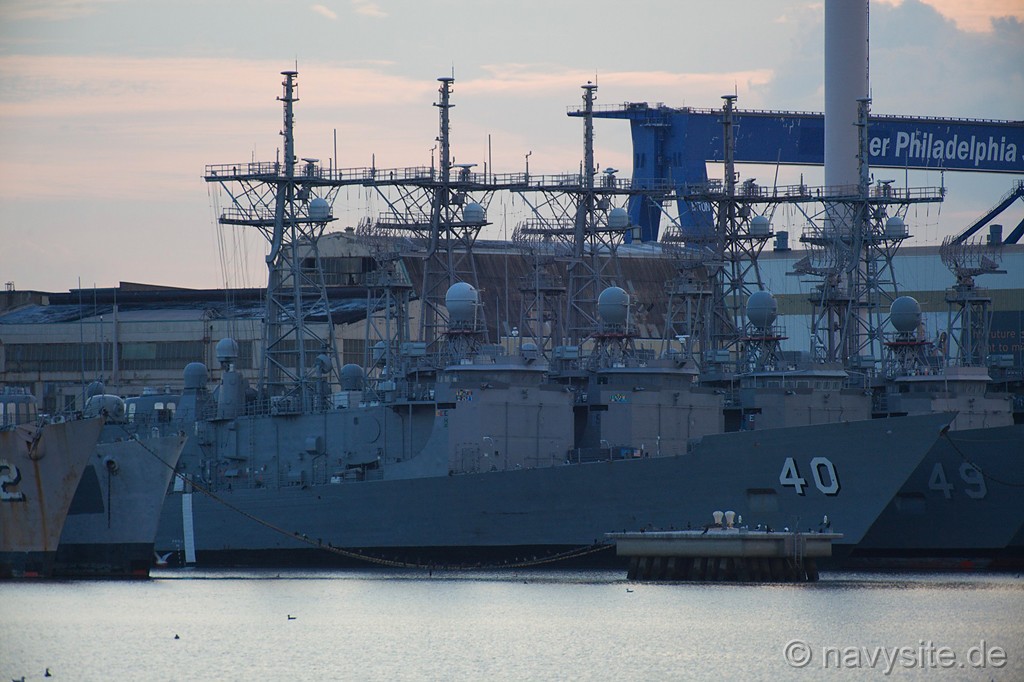
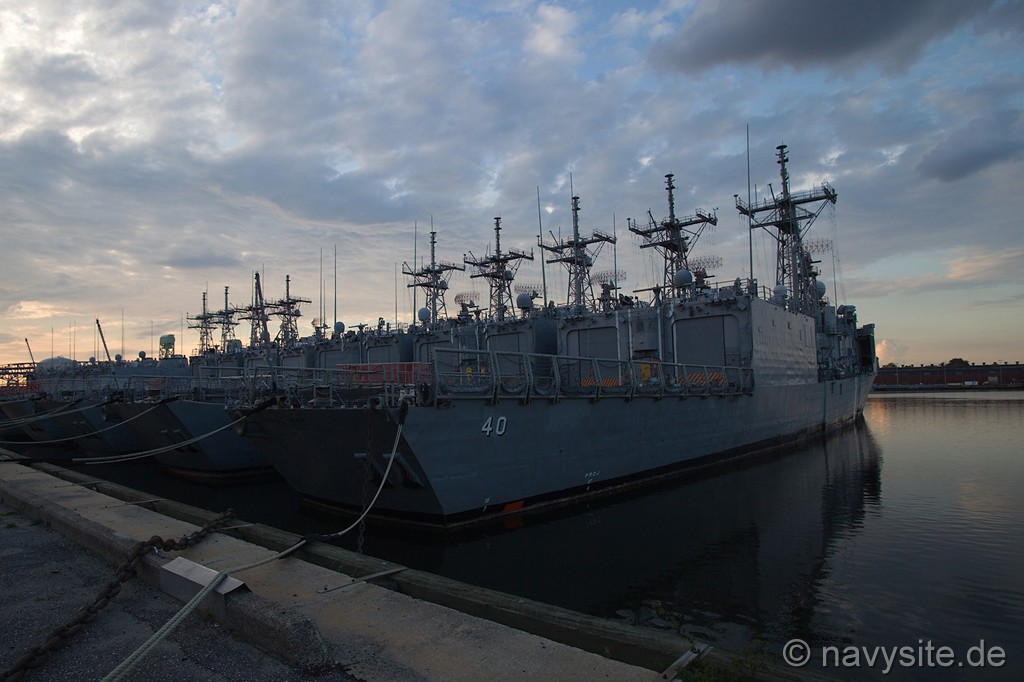
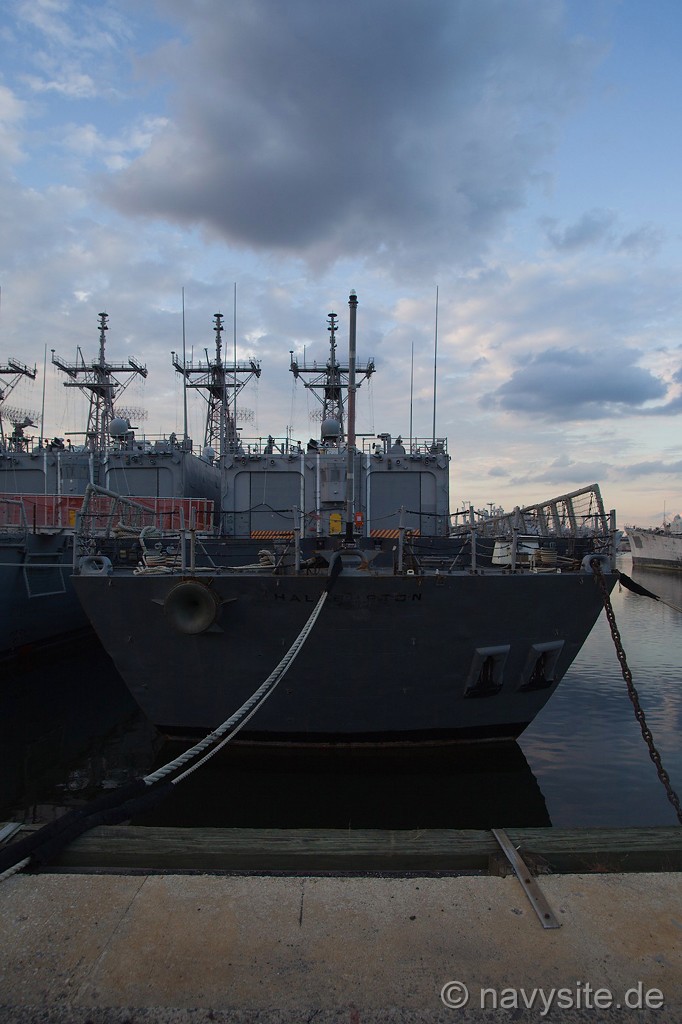
USS HALYBURTON was officially decommissioned and stricken from the Naval Vessel Register on September 8, 2014. Later that day, the former frigate departed Mayport under tow for the Naval Inactive Ship Maintenance Facility at the former Philadelphia Naval Shipyard, Pennsylvania, where she was subsequently laid up in inactive status.
back to top go to the end of the pageUSS HALYBURTON Patch Gallery:
 |  |  |  |  |
back to top go to the end of the page back to top go to the end of the page
USS HALYBURTON Image Gallery:
 |  |
The photo below was taken by me and shows the HALYBURTON at Naval Station Mayport, Fla., on July 31, 2000.
 |
The photos below were taken by Michael Jenning and show the decommissioned HALYBURTON laid up at the former Philadelphia Naval Shipyard on October 21, 2014.
 |  |  |  |
The photos below were taken by Michael Jenning and show the decommissioned HALYBURTON laid up at the former Philadelphia Naval Shipyard on October 7, 2018.
 |  |  |
back to top Back to Frigates list. Back to ships list. Back to selection page. Back to 1st page.