
Search the Site with

|
Search the Site with
|
 General Characteristics Crew List Memorabilia History Image Gallery to end of page
 |  |
USS BALTIMORE was the 17th LOS ANGELES-class submarine. On July 10, 1998, BALTIMORE was decommissioned and stricken from the Navy list after almost 16 years of service. The submarine was subsequently laid up at the Puget Sound Naval Shipyard, Bremerton, Wash., awaiting her turn in the Navy's recycling program which she entered in 2013.
| General Characteristics: | Awarded: October 31, 1973 |
| Keel Laid: May 21, 1979 | |
| Launched: December 13, 1980 | |
| Commissioned: July 24, 1982 | |
| Decommissioned: July 10, 1998 | |
| Builder: Electric Boat Division of General Dynamics Corporation, Groton, CT | |
| Propulsion system: one nuclear reactor | |
| Propellers: one | |
| Length: 360 feet (109.73 meters) | |
| Beam: 33 feet (10 meters) | |
| Draft: 32,15 feet (9.8 meters) | |
| Displacement: Surfaced: approx. 6,000 tons | |
| Submerged: approx. 6,900 tons | |
| Speed: Surfaced: approx. 15 knots | |
| Submerged: approx. 32 knots | |
| Armament: four 533 mm torpedo Tubes for | |
| Cost: approx. $900 million | |
| Crew: 12 Officers, 115 Enlisted |
 back to top go to the end of the pageback to top go to the end of the page
Crew List:
This section contains the names of sailors who served aboard USS BALTIMORE. It is no official listing but contains the names of sailors who submitted their information.
back to top go to the end of the pageback to top go to the end of the pageUSS BALTIMORE History:
The nuclear-powered attack submarine USS BALTIMORE was conceived in the early 1970s as part of the first flight of the LOS ANGELES-class, built to give the United States Navy a larger, faster, and quieter hunter-killer submarine force for the late Cold War. The contract to construct the boat was awarded on October 31, 1973, to the Electric Boat Division of General Dynamics at Groton, Connecticut, reflecting the yard's central role in building the new class. Her keel was laid there on May 21, 1979, and over the next year and a half her pressure hull, reactor plant, and combat systems were assembled in line with the baseline LOS ANGELES-class configuration, without the vertical launch system that would characterize later flights. USS BALTIMORE was launched at Groton on December 13, 1980, sponsored by congresswoman Marjorie S. Holt of Maryland. She was the sixth U.S. Navy ship to carry the name of the city of Baltimore.
Following launch, the submarine entered a prolonged fitting-out period at Electric Boat, during which her reactor was brought critical, her engineering plant completed, and her weapons and sensor suites tested pier-side and at sea. Builder's trials and acceptance trials in the western Atlantic verified propulsion performance, diving characteristics, and the operation of sonar, fire-control and navigation systems, preparing the boat for delivery to the Navy. On July 24, 1982, USS BALTIMORE was commissioned at Naval Submarine Base New London in Groton, formally joining the Atlantic Fleet as a nuclear-powered attack submarine assigned to high-priority antisubmarine warfare and surveillance missions against the backdrop of continuing Cold War tensions.
In the period immediately after commissioning, the boat conducted shakedown operations and training exercises out of New London, working up her crew on torpedo handling, sonar tracking, and submerged operations. Official photographs from 1982 and April 1983 show USS BALTIMORE operating on the surface in the Atlantic in moderate seas, reflecting this early training phase as she moved from basic trials toward full operational readiness.
During these first years, she participated in local and fleet exercises with other Atlantic Fleet units, honing coordinated antisubmarine tactics that were central to U.S. efforts to track and deter Soviet submarines in the North Atlantic and Norwegian Sea. Because detailed patrol routes and submarine operating areas remain classified, open sources do not specify the exact patrol patterns of USS BALTIMORE in these early deployments, but her assignment to the fast attack submarine force meant that her missions combined intelligence collection, tracking of foreign submarines and surface ships, and readiness for potential wartime torpedo attacks.
By the mid-1980s, the submarine was regularly operating from the major Atlantic submarine bases at New London and from Naval Station Norfolk, Virginia. A December 15, 1986 Navy photograph shows USS BALTIMORE moored at Pier 22 at Norfolk alongside the fleet ballistic missile submarine USS NATHANAEL GREENE (SSBN 636), which was in the process of decommissioning, illustrating both the concentration of nuclear submarines at Norfolk and the gradual retirement of older strategic boats as newer classes entered service. This image anchors USS BALTIMORE firmly within the Atlantic submarine community at the end of the Cold War, at a time when U.S. strategy continued to emphasize robust antisubmarine capabilities to counter Soviet naval forces.
In the later 1980s, USS BALTIMORE took part in fleet exercises with surface combatants as the Navy refined its combined surface-subsurface tactics. A command history of the frigate USS JESSE L. BROWN (FF 1089) records that when JESSE L. BROWN resumed underway operations on May 16, 1988, she spent three days exercising with USS BALTIMORE and the attack submarine USS BATON ROUGE (SSN 689). These exercises in the western Atlantic highlighted the role of attack submarines as both adversary and partner in antisubmarine warfare training, as surface ships practiced detection, classification, and engagement procedures against modern nuclear submarines while the submarines refined their own evasion and targeting techniques.
As the Cold War ended and regional crises replaced superpower confrontation as the principal focus of U.S. naval operations, USS BALTIMORE's missions shifted accordingly. Official unit-award documentation compiled in an OPNAV notice on unit awards and campaign medals lists BALTIMORE with an entry labeled "MU" for the period from May 1, 1990 to February 1, 1993. In the Navy's internal coding, this denotes a unit-level commendation covering that entire span, a period that includes Operations Desert Shield and Desert Storm and follow-on activities in the Persian Gulf and adjacent waters. Open sources aimed at veterans further state that the submarine received a unit-level commendation connected with Gulf War service and that crew members were credited with associated campaign awards, though the specific patrol tracks and operations remain classified and are not detailed in publicly released command histories.
Together, these records indicate that USS BALTIMORE was among the LOS ANGELES-class boats whose deployments supported U.S. and coalition operations in Southwest Asia in the early 1990s, providing covert strike potential, intelligence collection, and antisubmarine coverage, even though the exact nature of her activities has not been released. Beyond Southwest Asia, secondary sources and veteran accounts agree that during the late 1980s and early 1990s, USS BALTIMORE undertook deployments to the Mediterranean Sea, the Persian Gulf, and the western Pacific, typical for Atlantic Fleet LOS ANGELES-class units that alternated between Atlantic, European, and occasionally Pacific tasking as operational requirements dictated.
These deployments would have included extended submerged patrols, port calls at selected allied naval bases when schedules and security permitted, and frequent participation in multinational exercises designed to integrate U.S. submarines into joint and combined operations. However, official declassified patrol reports for USS BALTIMORE have not been released, public sources do not provide specific port lists or exact in-port dates for most of these cruises.
By the mid-1990s, USS BALTIMORE was closely tied to carrier battle group operations out of Norfolk. A January 1996 press article on the upcoming deployment of the carrier USS GEORGE WASHINGTON (CVN 73) identifies two nuclear-powered attack submarines as part of the battle group: USS SCRANTON (SSN 756) and USS BALTIMORE. Later that year, on July 17, 1996, a series of Navy photographs captured the battle group in formation during the closing phase of a six-month deployment. One widely reproduced image shows the guided-missile frigate USS SAMUEL B. ROBERTS (FFG 58) and USS BALTIMORE closing in on USS GEORGE WASHINGTON during battle-group formation maneuvers in the Atlantic, while another shows crewmen on the deck of USS BALTIMORE preparing to receive mail from an SH-60 Seahawk helicopter.
File descriptions accompanying these official Navy photographs explain that the GEORGE WASHINGTON battle group was completing a scheduled six-month deployment to the Mediterranean, during which it conducted sustained operations in support of NATO-led peacekeeping efforts in Bosnia and enforcement of United Nations sanctions against Iraq in the Persian Gulf. Within that framework, USS BALTIMORE served as the group's primary submerged antisubmarine asset, providing screening against potential submarine threats, conducting intelligence and surveillance tasks, and maintaining the ability to launch torpedoes or, via embarked weapons load, other underwater weapons if required.
The award documentation mentioned earlier also lists an additional entry for USS BALTIMORE covering March 5 to March 30, 1996, associated with a campaign or service award coded "FS", which corresponds to the early portion of this GEORGE WASHINGTON deployment. While the abbreviated code in the OPNAV list does not spell out the full name of the medal, its presence confirms that the submarine's crew qualified for a specific campaign or service ribbon as a result of operations during that window, further underlining the operational character of her participation in the 1996 Mediterranean deployment.
Budgetary pressures and the desire to retire older units in favor of more capable designs led the Navy to examine which first-flight LOS ANGELES-class submarines should be refueled and modernized and which should be decommissioned at the end of their original core life. Because USS BALTIMORE lacked the vertical launch system and other improvements of later units, the Navy decided not to refuel her reactor when she approached the end of her first core. Instead, she was selected for early retirement. After completing her final operational period, she was prepared for inactivation. On July 10, 1998, USS BALTIMORE was decommissioned at Norfolk and struck from the Naval Vessel Register the same day, ending just under sixteen years of commissioned service.
Following decommissioning, the submarine was moved to Bremerton, Washington, to await dismantling under the Nuclear Powered Ship and Submarine Recycling Program at Puget Sound Naval Shipyard. U.S. Navy sources note that by 2013, USS BALTIMORE's hull had entered the formal recycling process there, joining other early LOS ANGELES-class units being systematically defueled and scrapped. The program removes the reactor compartment as a sealed unit for disposal, salvages recyclable metals, and disposes of remaining structures in accordance with environmental regulations, so that by the end of the process the submarine ceases to exist as an intact vessel.
back to top go to the end of the pageUSS BALTIMORE Image Gallery:
 |
The photos below were taken by me and show the BALTIMORE laid up at the Puget Sound Naval Shipyard, Bremerton, Wash., on May 12, 2012. The remains of the "704" can still be seen on the submarine's sail.
 |  |
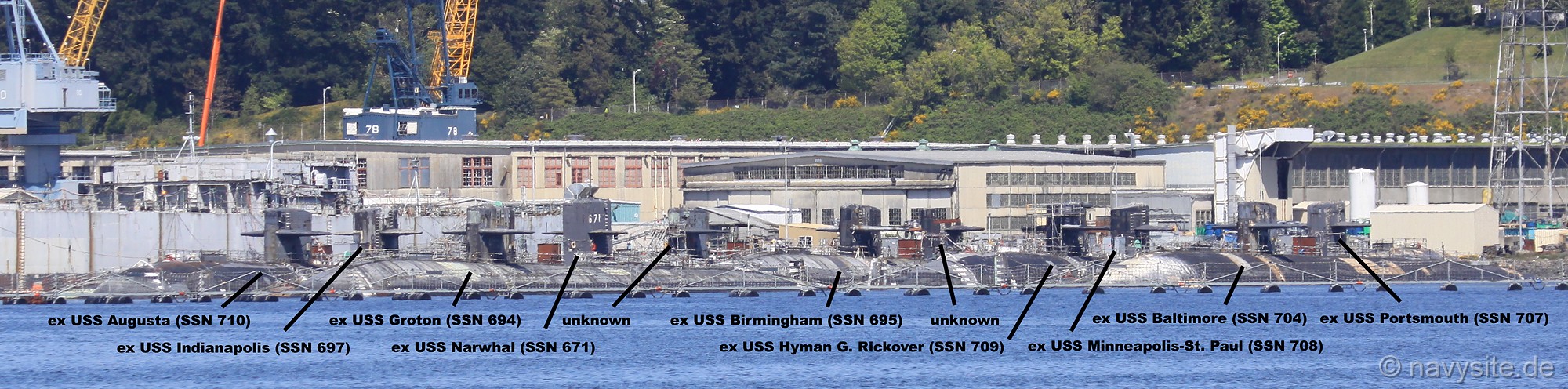
The photo below was taken by me and shows a number of decommissioned nuclear-powered attack submarines laid up at the Puget Sound Naval Shipyard, Bremerton, Wash. The photo was taken from Port Orchard, Wash., on May 12, 2012. The submarines' names are on the photo.
 back to top
 Back to Submarines list. Back to ships list. Back to selection page. Back to 1st page.