![]() |
Search the Site with
|


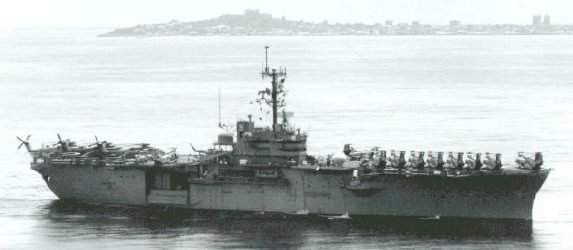
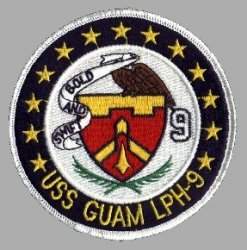
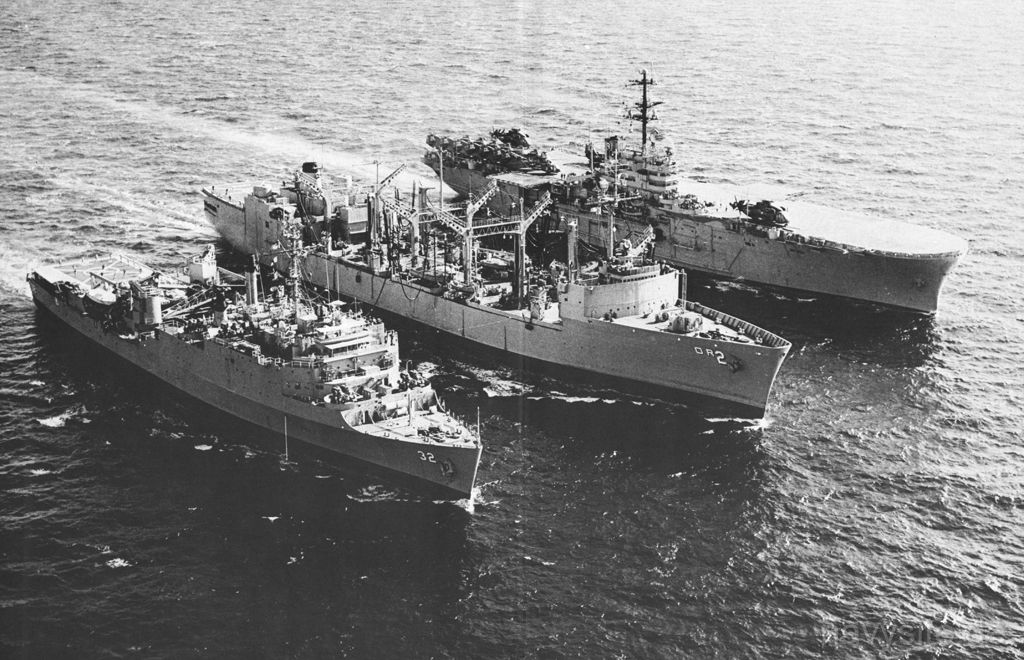
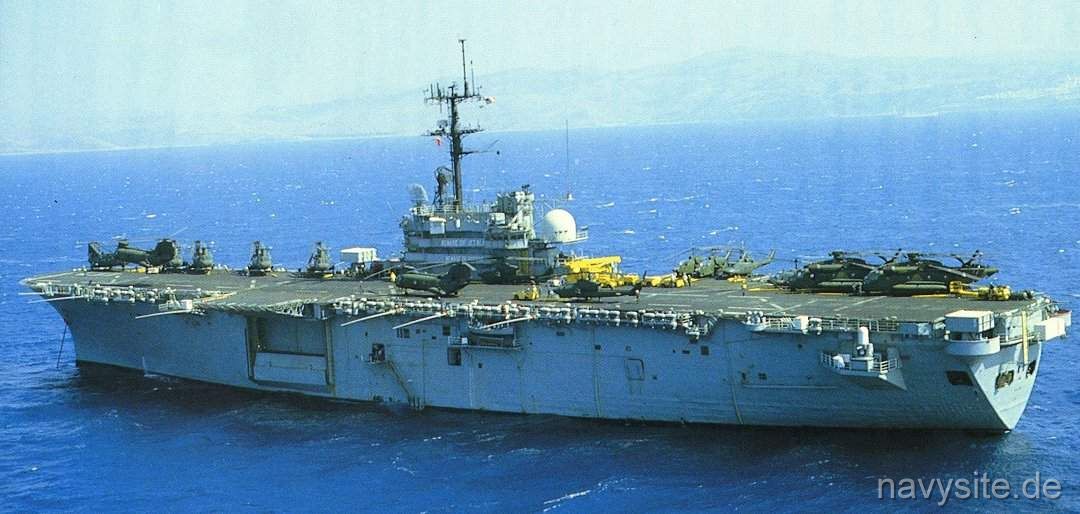
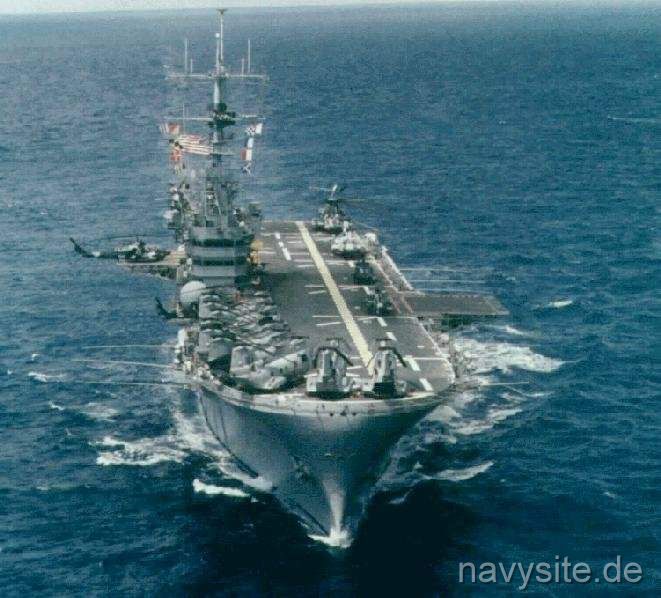
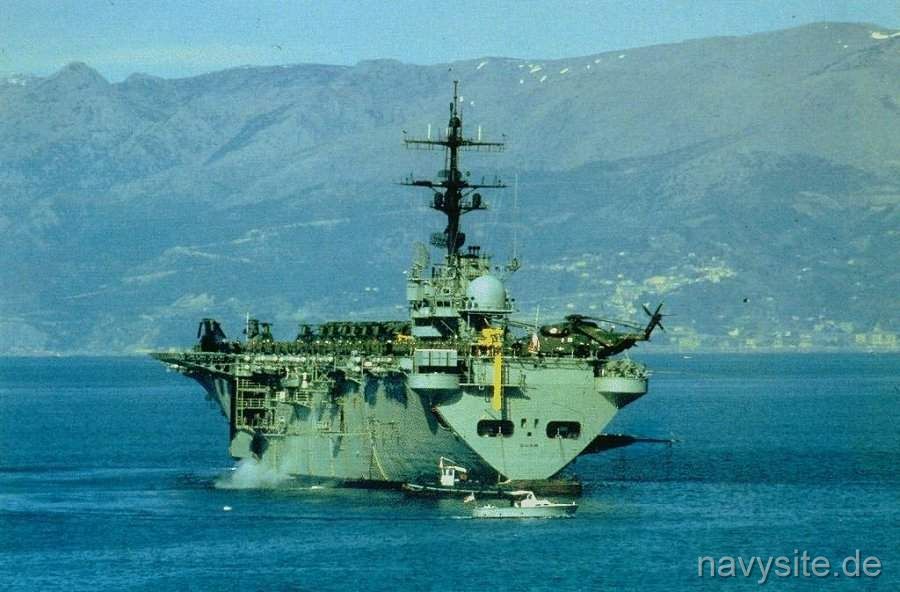
USS GUAM was the fourth IWO JIMA - class Amphibious Assault Ship (Helicopter) and the third ship in the Navy named after the largest island of the Marianas group and the first United States Ship so christened in commemoration of the historical World War II battle for the island Guam.
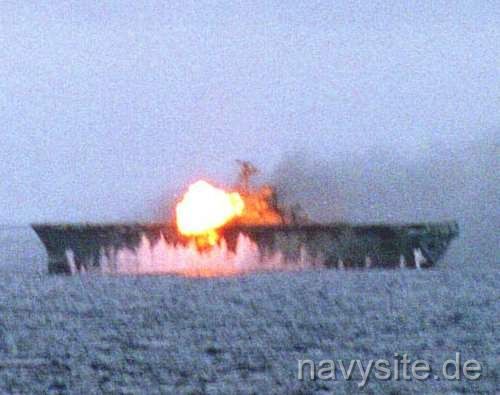
Decommissioned and stricken from the Navy list on August 25, 1998, the GUAM was disposed of as a target off the US east coast on October 16, 2001. The SINKEX was conducted by the USS JOHN F. KENNEDY (CV 67) Battle Group and the exact location was 031° 14' 22.0" North, 071° 16' 35.0" West.
USS GUAM has earned the following awards: Combat Action Ribbon, Navy Unit Commendation (3 awards), Navy Meritorious Unit Commendation (3 awards), Navy Battle "E" Ribbon (6 awards), Navy Expeditionary Medal (2 awards for the Lebanon campaign), National Defense Service Medal, Armed Forces Expeditionary Medal (6 awards), Southwest Asia Service Medal, Armed Forces Service Medal, Humanitarian Service Medal (2 awards for the Beirut campaign), Coast Guard Meritorious Unit Commendation and the Kuwait Liberation Medal.
| General Characteristics: | Awarded: September 21, 1961 |
| Keel laid: November 15, 1962 | |
| Launched: August 22, 1964 | |
| Commissioned: January 16, 1965 | |
| Decommissioned: August 25, 1998 | |
| Builder: Philadelphia Naval Shipyard, Philadelphia, Penn. | |
| Propulsion system: Two boilers, one geared steam turbines, one shaft, 22,000 total shaft horsepower | |
| Propellers: one | |
| Length: 603, 65 feet (184 meters) | |
| Beam: 104 feet (31.7 meters) | |
| Draft: 25,9 feet (7.9 meters) | |
| Aircraft elevators: two | |
| Displacement: approx. 19,500 tons full load | |
| Speed: 23 knots | |
| Aircraft: 20 | |
| Armament: two | |
| Crew: 80 officers, 638 enlisted, 1,750 Marine Detachment |
Crew List:
This section contains the names of sailors who served aboard USS GUAM. It is no official listing but contains the names of sailors who submitted their information.
USS GUAM Cruise Books:
Accidents aboard USS GUAM:
| Date | Where | Events |
|---|---|---|
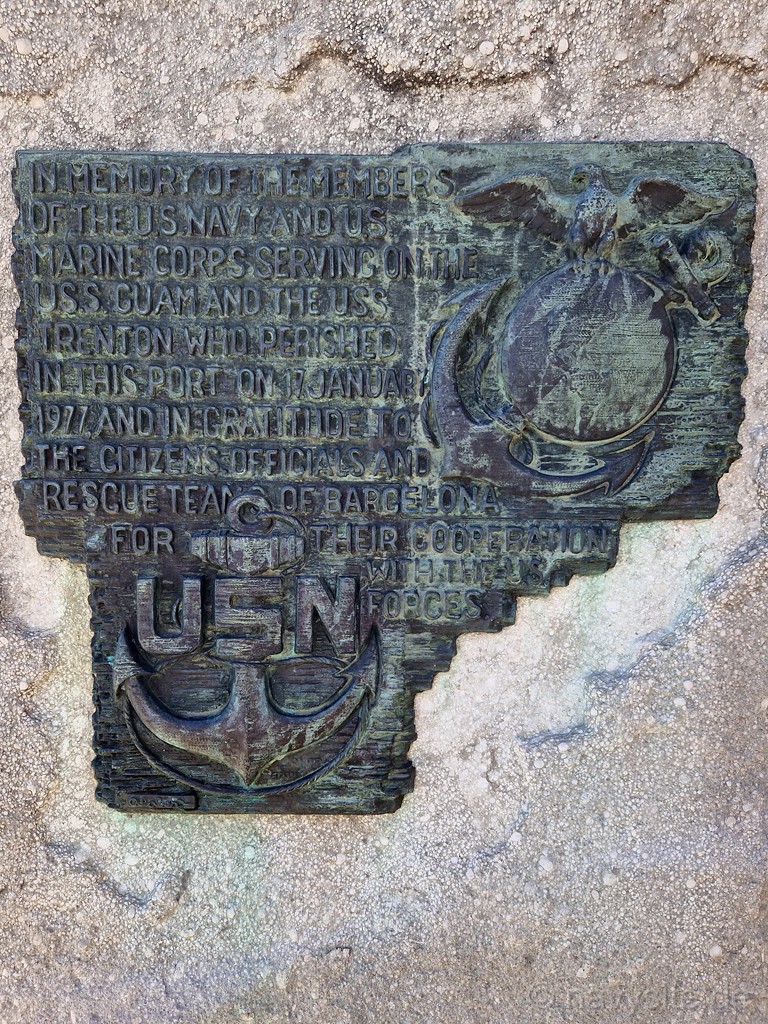
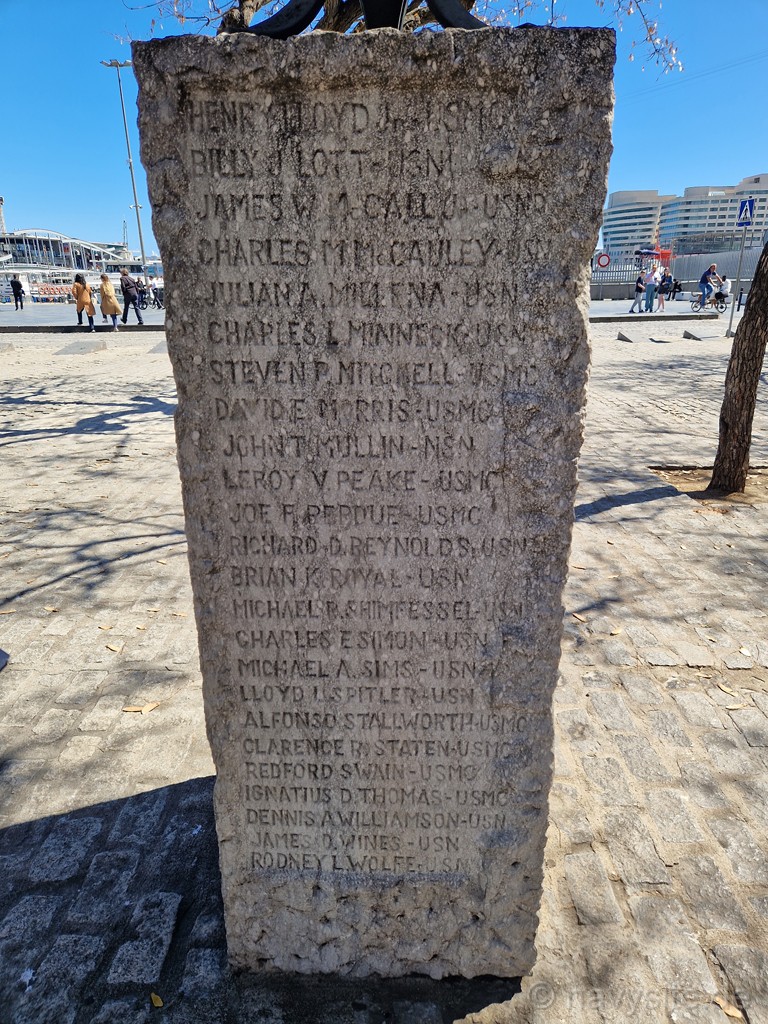
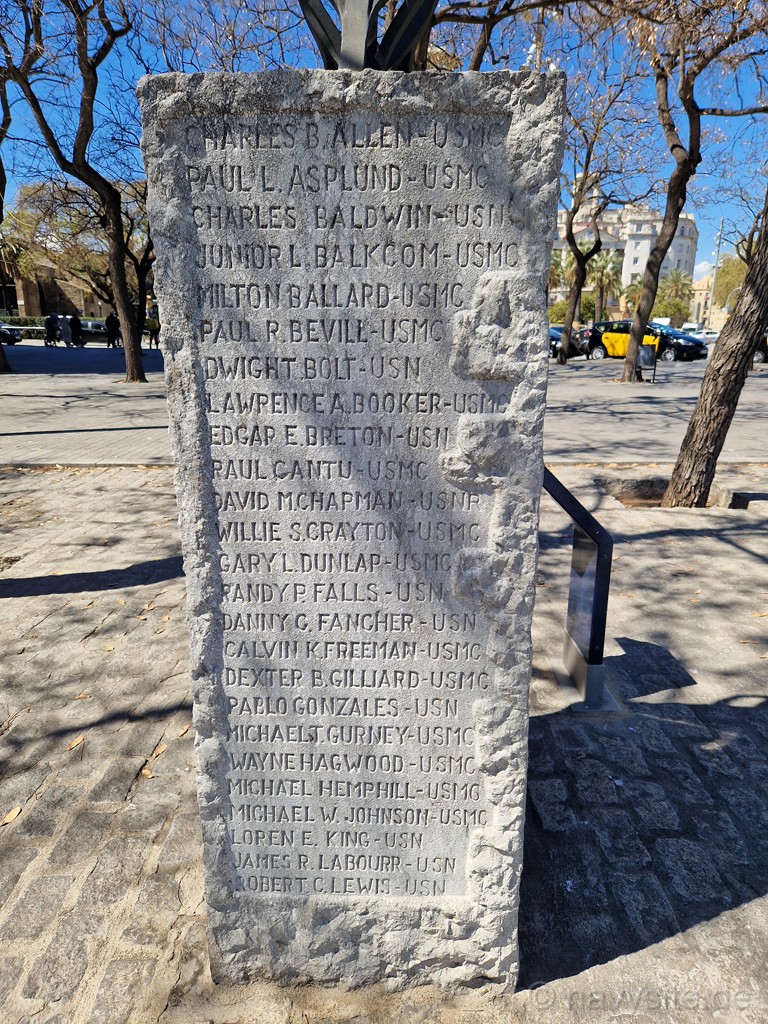
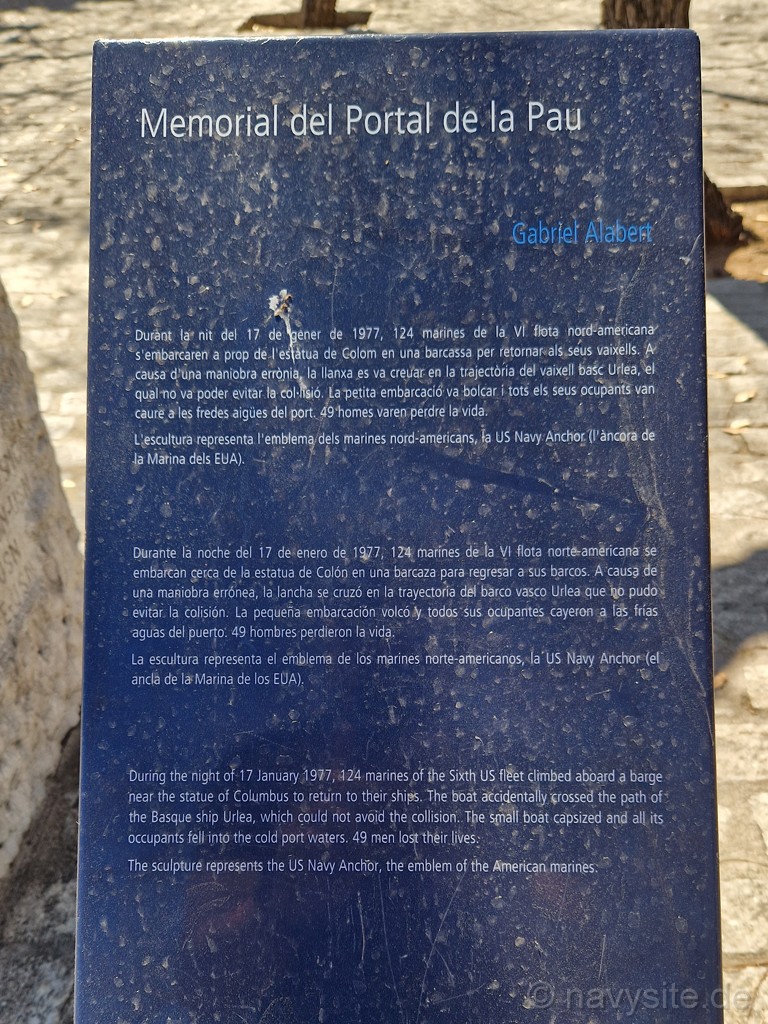
| January 17, 1977 | Barcelona, Spain | An LCM-6 from USS TRENTON (LPD 14) carrying 124 marines and sailors from shore back to TRENTON and USS GUAM, collided with the merchant vessel URLEA which was entering the port of Barcelona. The LCM-6 capsized. 49 servicemen were killed in the accident. A sculpture was erected near the Columbus Monument in the port of Barcelona to remember the servicemen killed in the accident. The photos below show the sculpture and were taken by me in Barcelona on April 3, 2023.
![]() |
| January 27, 1981 | Norfolk, Va. | USS GUAM suffers a minor fire of suspicious origin in an unoccupied compartment while at Norfolk Naval Base. |
| July 19, 1981 | 35 miles southeast of Moorehead City, NC | A CH-53 helicopter crashes and burns while landing aboard USS GUAM during training operations in the Atlantic, killing 4 and injuring 11 other Marine and Navy personnel. |
USS GUAM History:
USS GUAM was an IWO JIMA-class amphibious assault ship built at Philadelphia Naval Shipyard as part of the post-Korean War effort to give the United States Navy dedicated helicopter assault platforms for Marine expeditionary forces. Her keel was laid on November 15, 1962, she was launched on August 22, 1964, with Mrs. Vaughn H. Emory Greene as sponsor, and she was commissioned at Philadelphia on January 16, 1965 under Captain Norman E. Thurman.
Designed to embark more than 2,000 fully equipped Marines and a mix of assault and transport helicopters, she joined the Atlantic Fleet on April 21, 1965, arrived at her home port of Norfolk the next day and began a cycle of trials and shakedown training off the Virginia Capes and at Guantanamo Bay, Cuba, to work up ship's company and air department for operational service. By early summer 1965, she was back in Norfolk for intensive amphibious training in preparation for deployment with an amphibious ready group in the Caribbean.
On November 29, 1965 USS GUAM sailed from Hampton Roads, embarked Marine Battalion Landing Team 3/8 off Onslow Beach and joined some fifty other ships for the large, combined PHIBASWEX/MEBLEX exercise, which culminated in a major landing on Vieques, Puerto Rico. After the exercise, she and three consorts remained in the region as the Caribbean Ready Amphibious Squadron under COMPHIBRON 12, providing a helicopter-borne contingency force during a period of political instability in parts of the Caribbean and Central America. Cruise book material and association records indicate that during this first extended deployment, she conducted training landings at Vieques and offered liberty calls in ports such as San Juan, St. Thomas, Barbados and Kingston, using these visits to exercise her ability to move Marines ashore and to host visitors on board. From February 16 to 28, 1966, she patrolled south of the Dominican Republic ready to land forces on Hispaniola if renewed unrest required intervention, then continued amphibious exercises until entering Philadelphia Naval Shipyard on June 1, 1966, for post-shakedown availability.
USS GUAM left Philadelphia on August 2, 1966, and returned to Norfolk to prepare for duty as the prime recovery ship for the Gemini XI manned space mission, reflecting her secondary design role as a casualty-receiving and recovery platform. She sailed from Norfolk on September 6, 1966, and took station some 710 miles east of Florida. On September 15, 1966, she recovered astronauts Pete Conrad and Dick Gordon and their Gemini XI capsule within minutes of splashdown, using embarked helicopters and swimmers to secure capsule and crew. After completing the space-recovery mission, she returned to Atlantic Fleet exercises, joining LANTFLEX 66 in late November and at the end of that year again became flagship of an amphibious squadron and a Caribbean amphibious ready group, maintaining a high state of readiness while operating in the western Atlantic and Caribbean through early 1967.
In 1970, USS GUAM's employment shifted toward a mix of large NATO and national exercises and humanitarian work. In May 1970, she left Norfolk to take part in the large-scale joint exercise EXOTIC DANCER THREE off the North Carolina coast, then moved south to join the Caribbean Ready Group again. En route toward Cristobal in the Panama Canal Zone, she received new orders after the catastrophic Peruvian earthquake of late May 1970. Transiting the Panama Canal and loading relief supplies and medical teams at Balboa, she steamed south to Peru, where she anchored offshore from June 12 to June 21, 1970. From this anchorage, her embarked helicopter squadron flew hundreds of sorties delivering food, tents, blankets and medical stores to devastated communities and evacuating the most seriously injured back to the ship's medical facilities for treatment. Some 5,000 Peruvians later toured the ship during a two-day port visit to Lima.
Leaving Peru on June 25, 1970, she resumed Caribbean duty and then in 1971 completed another Mediterranean deployment with a Marine amphibious unit embarked, before being selected as the test ship for the Navy's Interim Sea Control Ship (ISCS) concept. To support the ISCS program, USS GUAM underwent an extensive refit at Portsmouth Naval Shipyard, where she received additional command facilities and aviation-related modifications to operate a mixed group of anti-submarine helicopters and vertical/short-takeoff-and-landing jets.
In January 1972, she began several years of experimentation as an interim sea control ship, embarking Marine AV-8A Harriers and SH-3 Sea King anti-submarine helicopters and working with convoy formations and escorts in the Atlantic to test whether a smaller aviation platform could substitute for large fleet carriers in some roles during a conflict with the Soviet Union. After completion of the formal ISCS evaluation on July 1, 1974, she deployed to the Atlantic and the Mediterranean on September 23 with this mixed aviation group that typically included six AV-8A, eight CH-46F, five CH-53D and utility helicopters such as the UH-1N under Marine Corps control. The cruise lasted until March 26, 1975, when GUAM returned to Norfolk.
After entering the Mediterranean, she transited the Suez Canal on December 12, 1976, and proceeded toward East Africa. Off Kenya, she launched thirteen embarked Harrier aircraft to Nairobi for a fly-past marking the 13th anniversary of Kenyan independence, highlighting how the Navy used the ship's aviation capability for diplomatic as well as combat roles. Returning westward in early 1977, she took part in the amphibious exercise PHIBLEX 1-77 and then visited Barcelona in January. During this port call, on January 17, 1977, a landing craft used as a liberty boat and carrying personnel from USS GUAM and USS TRENTON (LPD 14) was struck by the Spanish freighter URLEA near the harbor entrance. The boat capsized and came to rest against the quay wall. Forty-nine sailors and Marines from the two ships died despite immediate rescue efforts by shipmates and Spanish authorities. A memorial erected near the landing site and later relocated within the remodeled waterfront would become a recurring point of remembrance on subsequent visits.
On the passage back to the United States in May 1977, GUAM took part in joint oceanographic research with Soviet vessels, a sign of the limited but growing naval cooperation late in the detente period.
During the late 1970s and early 1980s, USS GUAM alternated between maintenance periods, local operations from Norfolk, and extended deployments with amphibious ready groups. Crew recollections and reunion materials show that she visited ports including Guantanamo Bay, Hamburg and Norwegian ports while supporting NATO cold-weather training above the Arctic Circle and amphibious exercises in the North Atlantic, and that she continued to serve as flagship for amphibious squadrons.
On July 19, 1981, while operating about fifty kilometers southeast of Morehead City, North Carolina, two embarked Sikorsky CH-53 Sea Stallion helicopters collided during landing operations and one crashed into another CH-53 and a UH-1N on the flight deck. Four crew members were killed and ten injured in the accident, which highlighted the risks inherent in intensive flight operations from a relatively compact amphibious platform.
The ship's most prominent missions came in the 1980s. In mid-1982, she deployed to the Mediterranean amid the Lebanese civil war. As Israeli forces advanced into Lebanon and fighting intensified around Beirut, USS GUAM was sent to the Lebanese coast to prepare for evacuation of non-combatants. In June and July, she participated in the evacuation of more than 600 people - including Lebanese citizens, Americans and other foreign nationals - from the port of Juniyah north of Beirut, using her helicopters to shuttle evacuees from shore to the ship.
In August 1982, she landed Marines in Beirut as part of a multinational peacekeeping force that included French and Italian contingents, then assisted in the supervised evacuation by sea of Palestine Liberation Organization fighters from Beirut as part of international efforts to stabilize the city. For this combination of humanitarian and peacekeeping duties she received a Navy Unit Commendation and the Humanitarian Service Medal.
In October 1983, USS GUAM sailed again with a Mediterranean-bound amphibious ready group, MARG 1-84, carrying the 22nd Marine Amphibious Unit. En route, the task group was diverted to the Caribbean when the United States decided to intervene on the island of Grenada after a violent coup. Off Grenada, the ship served for about ten days as flagship for Commander, Joint Task Force 120 during Operation Urgent Fury, coordinating helicopter-borne assaults and other operations ashore. She launched four major airborne assaults, including two at night, and acted as the primary casualty receiving ship, treating more than seventy wounded U.S. personnel, civilians and prisoners without loss of life. She also temporarily held captured leaders of the Grenadian junta.
After completion of operations around Grenada, she continued to the Mediterranean and eventually returned to the United States on May 1, 1984, closing a deployment that combined combat, peace enforcement and traditional presence missions.
In early 1985, USS GUAM entered Philadelphia Naval Shipyard for a major overhaul that lasted several months. During this availability, she received, among other upgrades, two Phalanx close-in weapon systems to improve defense against anti-ship missiles, reflecting lessons from the Falklands War and evolving Cold War naval threats. Back in service, she was at sea off the southeastern United States on January 28, 1986, when the space shuttle CHALLENGER was destroyed shortly after launch. Ordered into the search area off Florida, she recovered numerous pieces of floating debris, including one of the solid-rocket-booster nose cones that was craned onto her flight deck and later turned over to NASA. For her role in the joint Navy-Coast Guard recovery effort the ship's company received a Meritorious Unit Commendation.
From May to November 1986, she deployed again with a Mediterranean amphibious group (MARG 2-86). During the Atlantic crossing, the ship and her escorts encountered a severe tropical storm. GUAM suffered damage to her stern and flight-deck structures and subsequently spent almost three weeks in Toulon, France, undergoing repairs before resuming the deployment, which included standard NATO and bilateral exercises and port visits.
By the late 1980s, USS GUAM was a seasoned flagship for amphibious squadrons. The 1988-1989 Mediterranean cruise book shows her serving as flagship for COMPHIBRON 4, embarking Marine aviation and ground units and visiting a range of Mediterranean ports while conducting amphibious exercises with allied navies.
GUAM entered the 1990s just as the international situation changed with Iraq's invasion of Kuwait. In August 1990, she departed Norfolk under Captain Chuck Saffell with Marines embarked for the Persian Gulf, joining the multinational naval buildup for Operation Desert Shield. She spent the latter part of 1990 in the Gulf region as part of the large amphibious force whose presence along the Kuwaiti coast tied down Iraqi units expecting a seaborne assault.
USS GUAM and USS TRENTON were detached on January 2, 1991, to the coast of Somalia for Operation Eastern Exit, prompted by the sudden collapse of the Somali government and the danger to diplomatic missions in Mogadishu. On January 5-6 helicopters from GUAM and TRENTON evacuated 282 people - including American diplomats, other embassy staff and foreign nationals such as the Soviet ambassador and his team - from the U.S. embassy compound to the two ships offshore. After landing the evacuees in Oman on January 11, the ships returned to the Gulf, and GUAM resumed support for coalition operations. During the ground campaign, elements of this force executed an amphibious feint that contributed to Iraqi uncertainty about coalition plans. For her performance in these Gulf and Somali operations, she added further unit commendations and campaign medals to an already long list and in 1993 received the Marjorie Sterrett Battleship Fund Award as the most battle-ready ship in the Atlantic Fleet.
In June 1994, the ship represented the U.S. Navy at events marking the fiftieth anniversary of the Normandy landings, visiting Southampton and Cherbourg for ceremonies alongside allied warships and veterans. Two years later, in the spring and early summer of 1996, USS GUAM operated off Monrovia, Liberia, as flagship for Operation Assured Response. With Marines from the 22nd Marine Expeditionary Unit embarked and working with other amphibious ships including USS AUSTIN (LPD 4), USS TORTUGA (LSD 46) and USS HARLAN COUNTY (LST 1196), she provided a secure offshore base while Marines guarded the U.S. embassy and supported evacuation and protection of American citizens and other foreign nationals during renewed fighting in the Liberian civil war. During this period, she also conducted Harrier and helicopter operations in training and contingency modes, maintaining the flexibility that had characterized her career since the sea-control trials two decades earlier.
USS GUAM's final deployment began in October 1997, when she left Norfolk once more for the Mediterranean with an embarked Marine unit and amphibious ready group staff. Through late 1997 and early 1998, she took part in multinational exercises and port visits typical of a Med cruise, but she was again sent on short notice to the Persian Gulf when tensions rose over Iraqi non-compliance with United Nations weapons-inspection regimes. In early 1998, she joined other U.S. naval forces assembled for Operation Desert Thunder, intended to pressure Iraq to permit renewed inspections. Soon after the reinforced naval presence, Iraq agreed to allow inspectors to return. During this deployment, she also made what would be her last visit to Barcelona, where the memorial to the 1977 liberty-boat accident victims was rededicated in a formal ceremony. Returning to the United States, she arrived at her home port for the last time on April 2, 1998.
The Navy decided soon afterwards to retire the aging IWO JIMA-class helicopter carriers in favor of newer amphibious assault ships. USS GUAM was decommissioned and stricken from the Naval Vessel Register on August 25, 1998, after more than thirty-three years of service. Laid up for several years, she was finally expended as a target in a SINKEX exercise in October 2001 off the U.S. east coast with aircraft from the battle group built around USS JOHN F. KENNEDY (CV 67) carrying out the final attacks. With all watertight doors sealed, the hull remained afloat for many hours before settling beneath the Atlantic, closing the career of a ship that had been continuously engaged in front-line amphibious and expeditionary tasks from the mid-1960s to the eve of the twenty-first century.
USS GUAM Image Gallery:
![]() | ![]() | ![]() | ![]() | |
![]() | ||||
Back to Amphibious Assault Ships list.
Back to Ships list.
Back to Selection Page.
Back to 1st Page.