
Search the Site with

|
Search the Site with
|
 General Characteristics Crew List Memorabilia About the Ship's Name History Image Gallery to end of page
 | 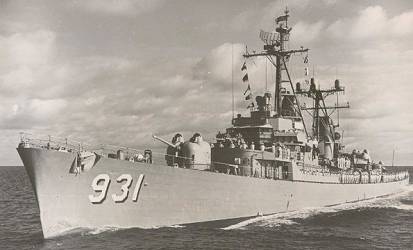 |
USS FORREST SHERMAN was the lead ship of the FORREST SHERMAN - class of destroyers and the first ship in the Navy named after Admiral Forrest P. Sherman who was the 12th Chief of Naval Operations. Decommissioned on November 5, 1982, and stricken from the Navy list on July 27, 1990, the FORREST SHERMAN was sold for scrapping in 1994, but was repossessed by the Navy on October 10, 1996. The FORREST SHERMAN was subsequently laid-up at the Naval Inactive Ships Maintenance Facility Philadelphia, PA. For many years, the FORREST SHERMAN was kept on hold for possible donation as a museum and memorial, however, on April 2, 2010, her status was changed and on December 15, 2014, the ship was sold for scrapping to ESCO Marine of Brownsville, Tx.
| General Characteristics: | Awarded: March 10, 1951 |
| Keel laid: October 27, 1953 | |
| Launched: February 5, 1955 | |
| Commissioned: November 9, 1955 | |
| Decommissioned: November 5, 1982 | |
| Builder: Bath Iron Works, Bath, Maine | |
| Propulsion system: four-1200 lb. boilers; two steam turbines; two shafts | |
| Propellers: two | |
| Length: 418.3 feet (127.5 meters) | |
| Beam: 45,3 feet (13.8 meters) | |
| Draft: 22 feet (6.7 meters) | |
| Displacement: approx. 4,000 tons full load | |
| Speed: 32+ knots | |
| Aircraft: none | |
| Armament: three Mk-42 5-inch/54 caliber guns, Mk-32 ASW torpedo tubes (two triple mounts) | |
| Crew: 17 officers, 275 enlisted |
 back to top go to the end of the pageback to top go to the end of the page
Crew List:
This section contains the names of sailors who served aboard USS FORREST SHERMAN. It is no official listing but contains the names of sailors who submitted their information.
back to top go to the end of the pageback to top go to the end of the pageback to top go to the end of the page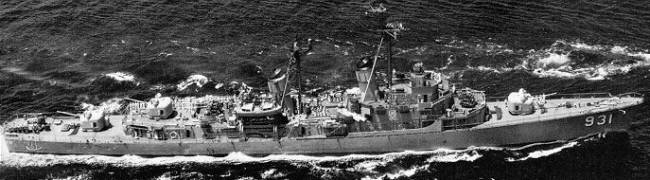 back to top go to the end of the page
USS FORREST SHERMAN History:
USS FORREST SHERMAN was launched 5 February 1955 by Bath Iron Works Corp., Bath, Maine; sponsored by Mrs. Forrest P. Sherman, widow of Admiral Sherman; and commissioned 9 November 1955, Commander R. S. Crenshaw in command.
After a year of initial training and fitting out, FORREST SHERMAN arrived at her home port, Newport, R.I., 15 January 1957. Two days later she sailed for Washington, D.C., where she was open for public visiting during the week of the second inauguration of President Dwight D. Eisenhower. From Newport, FORREST SHERMAN sailed on training and fleet exercises along the east coast and in the Caribbean, until the summer of 1957, when she took part in the midshipman cruise to South America and the International Naval Review in Hampton Roads 12 June.
On 3 September 1957, FORREST SHERMAN sailed for NATO Operation "Strikeback", screening a carrier striking group in exercises off Norway. She called at Plymouth, England, and Copenhagen, Denmark, before returning to Narragansett Bay 22 October. In preparation for her first deployment to the Mediterranean, the destroyer took part in amphibious exercises off Puerto Rico in July 1958, and arrived at Gibraltar 10 August. She patrolled the eastern Mediterranean through the rest of the month, then sailed to join the 7th Fleet in its operations off Taiwan in support of the threatened islands of Quemoy and Matsu. Sailing eastward to complete a cruise around the world, FORREST SHERMAN returned to Newport 11 November.
During the summer of 1959, FORREST SHERMAN joined in Operation "Inland Sea", the cruise of a task force into the Great Lakes in celebration of the opening of the St. Lawrence Seaway. She served as escort to the Royal Yacht HMS BRITTANIA with President Dwight D. Eisenhower and Queen Elizabeth II embarked for the naval review on Lake St. Louis 26 June, then sailed on to entertain over 110,000 visitors at Great Lakes ports. Returning to Newport, FORREST SHERMAN took part in coastal exercises with the Atlantic Fleet, then underwent minor repairs and alterations in the Boston Naval Shipyard.
More training exercises began in 1960 for the destroyer, and on 21 March she sailed on a 7-month cruise to the Mediterranean and duty with the 6th Fleet. En route home in October, FORREST SHERMAN came to the aid of the Liberian freighter ALLEN CHRISTENSEN who had a severely injured man on board. Taking off the patient in a motor whaleboat at night, FORREST SHERMAN sped him to Bermuda, site of the nearest hospital. The destroyer arrived at Newport on 15 October and some 4 weeks later entered the Boston Naval Shipyard for major overhaul, lasting into 1961.
Beginning in early 1961, USS FORREST SHERMAN emerged from a lengthy overhaul at the Boston Naval Shipyard that had carried over from 1960 into the new year and resumed Atlantic Fleet training out of Newport, Rhode Island, cycling through type exercises and short Caribbean periods while the destroyer force honed anti-submarine warfare procedures during the tense first months of the Kennedy administration. In the immediate aftermath of the Bay of Pigs crisis in Cuba (17-20 April 1961), the ship earned Navy Expeditionary Service credit for operations conducted off Cuba from 21 April 1961 to 26 April 1961, a short, tightly controlled deployment that reflected the U.S. posture of maritime vigilance in the Caribbean.
In mid-1961, the destroyer shifted to a public-diplomacy role on a West African goodwill swing. By late August 1961, contemporaneous press accounts - later summarized in a Library of Congress Historic American Engineering Record (HAER) compilation - described the ship distributing "10,000 lollipops" to local children during port calls, an emblematic vignette of Cold War "people-to-people" outreach intended to counter Soviet influence among newly independent African states. Specific port sequences were not preserved in that summary, but the reporting fixes the tour's timing in the late-summer window.
After winter workups, the ship took part in the Atlantic Fleet's high-profile operational capability and weapons demonstration for President John F. Kennedy in mid-April 1962, staged off the Virginia-North Carolina littoral and centered on the carrier ENTERPRISE (CVAN 65). The event combined at-sea missile firings and antisubmarine displays by surface units and air assets. Official Kennedy Library photographs and Navy image captions fix the date and scenario, and contemporary summaries place FORREST SHERMAN among the destroyers participating in that review. In the same training season she embarked midshipmen on the customary summer cruise.
Space operations briefly shaped her autumn schedule: during Commander Walter M. "Wally" Schirra's Mercury-Atlas 8 orbital flight on 3 October 1962, the ship stood with the Atlantic Recovery Forces on station, one of many U.S. Navy units ringed along the Western Range to support potential capsule recovery. Within weeks the destroyer shifted south as the Cuban Missile Crisis broke on 16 October 1962. She operated in the Caribbean during the naval quarantine period through the end of October, a tempo captured in a January 1963 Navy "All Hands" note that also recorded an impressive underway-replenishment benchmark the ship set in October 1962 - taking on stores from RIGEL (AF 58) at 71 tons per hour while on task.
In the final weeks of 1962 the ship transited eastward across the Mediterranean and through the Suez Canal for duty with the Middle East Force, reflecting Washington's decision to bolster partners unsettled by the Yemen civil war and broader regional turbulence. U.S. consular records from Dhahran document FORREST SHERMAN in the Persian Gulf at Dammam, Saudi Arabia, with port visits recorded in December 1962 (together with POWER (DD 839)) and again in January 1963, anchoring the destroyer's presence there to specific months as the Saudi government navigated a fraught internal and regional scene.
Back on the U.S. East Coast later in 1963, photography places the destroyer off Boston in October 1963, an image consistent with post-deployment trials and local operations that closed her year's cycle. Through 1964-1965 she continued routine Second Fleet workups, NATO exercises, and periodic Mediterranean commitments typical of the Newport-based destroyer force - training arcs that kept crews current in anti-air and anti-submarine doctrine as the Navy's operational focus was split between Atlantic alliance obligations and an escalating conflict in Southeast Asia.
By 1966, she is documented operating in the Caribbean with the carrier force. A dated photograph shows FORREST SHERMAN refueling alongside WASP (CVS 18) from SEVERN (AO 61) on 8 December 1966, emblematic of the destroyer's screening and plane-guard duties around fast-carrier groups during winter exercises. The following year was dominated by Sixth Fleet service. Ammunition-ship deck logs from the Mediterranean fix multiple rearming evolutions with FORREST SHERMAN - notably on 27 April 1967 in the Aegean operating areas and again on 21 May 1967, when GREAT SITKIN (AE 17) rearmed SARATOGA (CVA 60), FORREST SHERMAN, WILLIAM R. RUSH (DD 714), and ALBANY (CG 10) during a sustained NATO and Sixth Fleet period at the hinge of the Arab-Israeli crisis that soon erupted in June.
A significant technical milestone followed: during an overhaul in 1968, the ship's ASW fit and topside battery were rationalized in line with class updates. Official HAER documentation notes the removal of the original 21-inch ASW torpedo tubes and the forward 3-inch twin mount, changes that reflected the Navy's move toward lighter triple Mk 32 torpedo tubes and a focus on the three 5-inch/54 main battery mounts for surface and shore fire support.
After late-1960s Atlantic and Mediterranean cycles, FORREST SHERMAN headed to Northern Europe in 1970, a deployment that earned the ship a Navy Unit Commendation for operations conducted from 5 May 1970 to 1 September 1970. The cruise combined NATO exercises in the North Atlantic and Baltic approaches with high-visibility port visits that supported alliance diplomacy. A municipal archive photograph places the destroyer at Kiel's Tirpitzmole during Kiel Week on 23 June 1970, moored in company with RICHARD L. PAGE (FFG 5) amid one of the largest naval gatherings on the Baltic rim.
The ship's early-1970s routine returned to the familiar rhythm of training, short deployments, and occasional ceremonial port calls on the U.S. East Coast and in the Mediterranean, interleaved with upkeep. An "All Hands" feature from early 1972, covering winter fleet events in the Port of New York, counted FORREST SHERMAN among Atlantic Fleet units visiting alongside large combatants such as LEAHY (DLG 16) and WAINWRIGHT (DLG 28), illustrating how Cold War presence missions at major American ports complemented operational tasking by maintaining public engagement with the Navy.
In the later 1970s, the destroyer continued Atlantic and European commitments while absorbing incremental combat-systems refreshes typical for the class. Photography captions identify her "after modernization" appearance by 1978, with altered topside profiles reflecting the decade's electronics and sensor updates. These were the years when the 18-ship class - first post-war destroyers designed from the keel up - was steadily refined to remain credible escorts for carrier and amphibious groups.
A final major operational surge came with the Indian Ocean and Persian Gulf reorientation of 1979-1980. Following the Soviet invasion of Afghanistan (December 1979) and the Iran hostage crisis (beginning 4 November 1979), U.S. naval planners reinforced the Middle East Force and sustained an Indian Ocean presence. FORREST SHERMAN deployed with that effort from 1 April 1980 to 11 July 1980, a period for which the ship received Navy Expeditionary Medal credit. The cruise encompassed Arabian Sea patrols and Gulf of Oman transits characteristic of the contingency posture after Operation Eagle Claw (the failed Tehran rescue attempt on 24-25 April 1980), with logistics anchored on regional ports such as Mina Salman, Bahrain, and the Omani coast that supported the force's endurance. The formal award window fixes the ship's in-theater dates within that geopolitical frame.
The destroyer closed her career with additional Atlantic Fleet duty and routine training legs before decommissioning on 5 November 1982, drawing down as the Navy retired the last all-gun destroyers from front-line service in favor of missile-armed escorts. Administrative records show she was later stricken and, after several years in inactive status, disposed of - an endgame common to her contemporaries - while three of her sisters eventually entered museum preservation.
back to top go to the end of the page
USS FORREST SHERMAN Image Gallery:
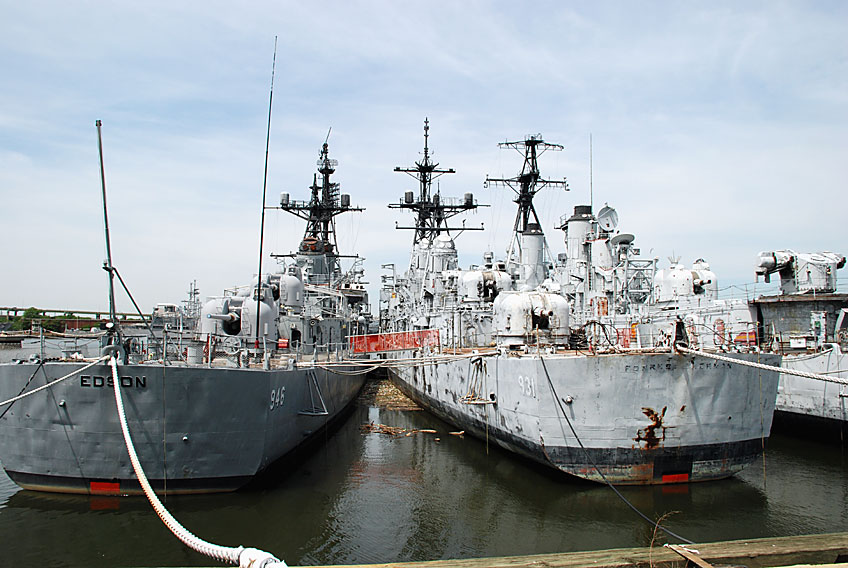
The photo below was taken by Brian Barton on May 22, 2007, and shows the FORREST SHERMAN at the Philadelphia Naval Shipyard. Tied up alongside the FORREST SHERMAN is the USS EDSON (DD 946) which is normally tied up alongside the USS INTREPID (CV 11) in New York City, however, at that time the INTREPID was in dry dock and so the EDSON was towed to Philadelphia to be refurbished as well.
 |
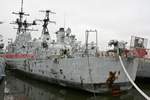
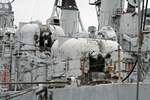
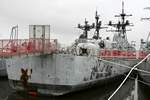
The photos below were taken by me on November 7, 2008, and show the FORREST SHERMAN laid up at the Naval Inactive Ship Maintenance Facility (NISMF) Philadelphia, PA.
 |  |  |  |
back to top
 Back to Destroyers list. Back to ships list. Back to selection page. Back to 1st page.