Search the Site with 
General Characteristics Crew List Memorabilia Accidents aboard the Ship History Image Gallery to end of page

USS Bonefish (SS 582)

- decommissioned -

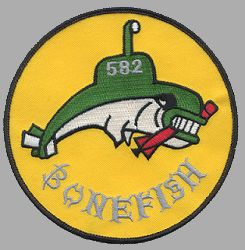
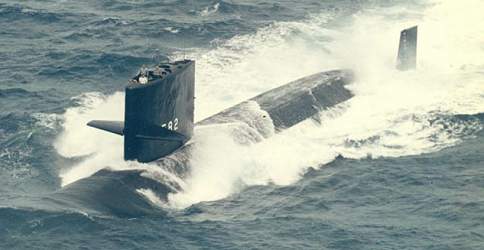
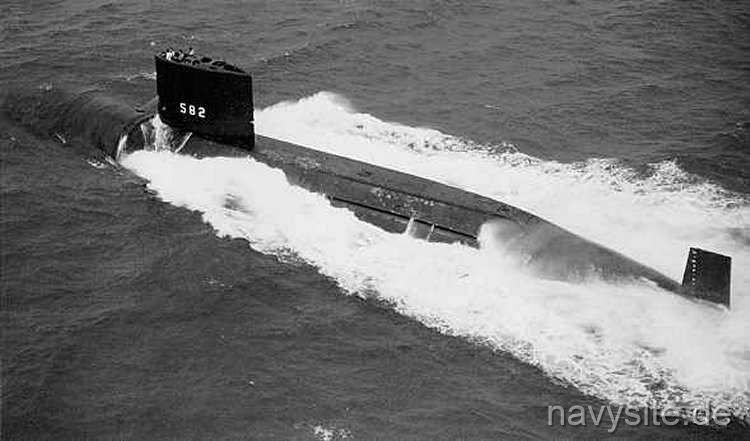
USS BONEFISH was the Navy's last conventionally-powered submarine and the second ship in the Navy to bear the name. Heavily damaged by a fire on board on April 24, 1988, the BONEFISH was subsequently decommissioned on September 28, 1988. Stricken from the Navy list on February 28, 1989, the submarine was sold for scrapping on August 17, 1989.

General Characteristics:Keel laid: June 3, 1957
Launched: November 22, 1958
Commissioned: July 9, 1959
Decommissioned: September 28, 1988
Builder: New York Shipbuilding Corp, Camden, NJ.
Propulsion system: three Fairbanks-Morse diesel engines, two General Electric motors
Propellers: one
Length: 219.5 feet (66.9 meters)
Beam: 28.9 feet (8.8 meters)
Draft: 27.9 feet (8.5 meters)
Displacement: Surfaced: approx. 2,570 tons     Submerged: approx. 2,895 tons
Speed: Surfaced: approx. 15 knots     Submerged: approx. 25 knots
Armament: six 533 mm torpedo tubes
Crew: 8 Officers, 70 Enlisted


Back to topback to top  go to endgo to the end of the page


Back to topback to top  go to endgo to the end of the page

Crew List:

This section contains the names of sailors who served aboard USS BONEFISH. It is no official listing but contains the names of sailors who submitted their information.


back to top  go to the end of the page


Back to topback to top  go to endgo to the end of the page

Accidents aboard USS BONEFISH:

DateWhereEvents
June 12, 1982Pacific
USS BONEFISH suffers main engine casualties when all three main engines spaces are flooded while operating on the surface in the Pacific. No personnel injuries occur.
April 24, 1988Caribbean
USS BONEFISH suffers explosions and fire in her battery compartment during operations with the USS JOHN F. KENNEDY (CV 67) and the USS CARR (FFG 52) in the Caribbean, killing three. The BONEFISH surfaces and order is given to abandon ship since the fire is spreading quickly, filling the submarine with dense smoke.

The BONEFISH is later towed into port but as a result of the extensive damage, the submarine is decommissioned in September 1988.

The official cause of the fire was an electrical short across the battery bus ties that eventually caught the insulation on fire.

Click here for a crewmember's recollection of the accident.


Back to topback to top  go to endgo to the end of the page

USS BONEFISH History:

USS BONEFISH was one of three BARBEL-class diesel-electric attack submarines constructed at the end of the 1950s. The class represented the final generation of conventionally powered attack submarines built for the U.S. Navy before nuclear propulsion became standard for newly constructed American attack submarines. The contract for her construction was awarded to the New York Shipbuilding Corporation at Camden, New Jersey, where her keel was laid on June 3, 1957. She was launched on November 22, 1958, sponsored by Mrs. Lawrence L. Edge Sr., widow of the final commanding officer of the first USS BONEFISH (SS 223), which had been lost with all hands in the Sea of Japan during World War II. Following fitting out and trials, the new BONEFISH was commissioned on July 9, 1959, with Lieutenant Commander Elmer H. Kiehl in command.

Following commissioning, BONEFISH remained on the Atlantic side of the United States while completing trials, training, and the evaluation program associated with bringing a newly constructed submarine into operational service. She operated off the New England coast through the remainder of 1959 and during the opening months of 1960. On April 1, 1960, she departed New London, Connecticut, for transfer to the Pacific Fleet. After completing the interocean transit, she reported to Submarine Division 33 at San Diego, California, on May 23, 1960. During the following months, she conducted training and local operations while preparing for her first extended overseas deployment.

On September 16, 1960, BONEFISH departed for her first deployment to the western Pacific. Operating with the Seventh Fleet, she participated in fleet exercises and training and visited ports in Japan, the Philippines, the Mariana Islands, and Hong Kong. These deployments formed part of the continuing American naval presence in East Asian waters during the Cold War and also provided surface ships and aircraft with opportunities to train against a modern conventional submarine. BONEFISH completed her first western Pacific deployment when she returned to San Diego on March 13, 1961.

The submarine spent the following months conducting Pacific Fleet operations from San Diego. On October 4, 1961, BONEFISH entered Mare Island Naval Shipyard at Vallejo, California, for her first regular overhaul. The work continued through the winter and was completed on March 6, 1962. She subsequently carried out post-overhaul trials and refresher training before departing for another western Pacific deployment in May 1962. During this second deployment, she again operated with the Seventh Fleet, combining training and exercises with visits to Far Eastern ports. BONEFISH returned to San Diego in December 1962 and entered an extended upkeep period.

In February 1963, BONEFISH transferred her home port from San Diego to Pearl Harbor, Hawaii. During the summer of 1963, she conducted another approximately two-month cruise to the western Pacific, returning to Pearl Harbor in August. She then spent roughly four months operating in Hawaiian waters. In January 1964, she again departed for the western Pacific and remained deployed until July 1964. Following her return to Oahu, she completed a post-deployment period and resumed local operations before entering Pearl Harbor Naval Shipyard for another regular overhaul. Shipyard work occupied the remainder of 1964.

After completing the overhaul, BONEFISH returned to operational service during 1965 and conducted training in Hawaiian and eastern Pacific waters. One specifically documented visit outside the immediate Hawaiian operating area occurred on November 18, 1965, when BONEFISH was at Vancouver, British Columbia. The remainder of the year was devoted principally to readiness training and preparations for another western Pacific deployment.

BONEFISH departed Pearl Harbor for the western Pacific in April 1966. The deployment placed her within the extensive American and allied naval activity occurring in East Asian waters during both the Vietnam War and the broader Cold War confrontation with the Soviet Union. In July, she participated in the multinational antisubmarine warfare exercise Crossed T III. The American force was centered on antisubmarine warfare carrier USS KEARSARGE (CVS 33). Japanese Maritime Self-Defense Force participation included JDS AMATSUKAZE (DDG 163), JDS AYANAMI (DD 103), JDS ISONAMI (DD 104), JDS SHIKINAMI (DD 106), and JDS URANAMI (DD 105), while South Korean naval units and aircraft also took part.

The combined force passed through the Tsugaru Strait and entered the Sea of Japan. On July 27, 1966, while allied ships were operating on southerly courses through the Gulf of Tartary between Sakhalin and the Asian mainland, dense fog reduced visibility. Soviet destroyer VESKIY (DD 022) appeared and shadowed the force, and Soviet missile boats subsequently joined the surveillance. BONEFISH rejoined the formation during the afternoon of July 28. Soviet ships and aircraft continued to observe the allied formation as it operated close to Soviet waters. The episode reflected the close surveillance that commonly accompanied major American and allied naval exercises near Soviet territory during the Cold War.

After completion of the exercise phase in northeast Asian waters, BONEFISH continued her Seventh Fleet deployment. She operated in the Gulf of Tonkin during the Vietnam War, when American naval forces maintained a large and continuous presence off the Vietnamese coast. Official campaign records credit BONEFISH with qualifying Vietnam service from August 31 through September 7, 1966, and again from September 29 through October 9. She completed the approximately seven-month deployment and returned to Pearl Harbor in November 1966.

Following post-deployment leave and upkeep, BONEFISH resumed operations from Pearl Harbor during 1967. In October, she departed again for the western Pacific. During the deployment, she conducted Seventh Fleet training and exercises and made documented visits to Hong Kong and ports in Japan and the Philippines. Campaign records identify November 29 through December 1, 1967, as another period of qualifying Vietnam service. BONEFISH completed the deployment and returned to Oahu in April 1968.

After several months of operations in Hawaiian waters, BONEFISH entered Pearl Harbor Naval Shipyard in September 1968 for another scheduled overhaul. She remained under repair through the remainder of the year and into 1969. The overhaul was completed in June 1969, after which the submarine conducted post-overhaul sea trials and refresher training to restore full operational readiness.

In November 1969, BONEFISH departed Hawaii for another deployment to the western Pacific. The cruise combined operational periods, exercises, and port visits in Far Eastern waters. Her service from December 4, 1969, through May 26, 1970, was later recognized by a Meritorious Unit Commendation. Campaign records also identify March 9 through March 12, 1970, as qualifying Vietnam service. BONEFISH completed the deployment and returned to Pearl Harbor in June 1970.

During the following months, BONEFISH resumed local operations from Hawaii. In January 1971, she participated in antisubmarine warfare exercises with USS CARPENTER (DD 825), COCHRANE (DDG 21), and USS SAILFISH (SS 572), giving participating surface forces an opportunity to practice submarine detection, tracking, and attack procedures against an operational diesel-electric submarine.

On February 9, 1971, BONEFISH departed Pearl Harbor for another Seventh Fleet deployment. During this cruise, she combined exercises and port visits with service associated with Task Force 77 in the Gulf of Tonkin. Task Force 77 was the Seventh Fleet carrier striking force operating in connection with the continuing Vietnam War, and BONEFISH's assignment placed her within the broader naval forces deployed in support of American operations in the region. Campaign records identify June 29 through July 4, 1971, as another period qualifying for the Vietnam Service Medal. BONEFISH completed the deployment and returned to Pearl Harbor on August 10, 1971.

After the usual post-deployment standdown and subsequent Hawaiian operations, BONEFISH entered Pearl Harbor Naval Shipyard for another regular overhaul on February 7, 1972. The work continued throughout the remainder of the year. Sea trials began during 1973, but a material casualty involving the submarine's snorkel piping system during trials in March delayed completion of the overhaul. Repair work consequently extended into July 1973. BONEFISH finally returned to sea that month for refresher training and subsequently spent approximately ten months carrying out local operations and restoring full operational proficiency.

On May 24, 1974, BONEFISH departed Pearl Harbor for another assignment with the Seventh Fleet in the western Pacific. Official records describe the cruise as a regular Far Eastern deployment involving fleet operations and training. BONEFISH returned to Pearl Harbor on November 7, 1974.

Thirteen months of local training and operations followed. On December 6, 1975, BONEFISH again departed Oahu for East Asian waters. During this deployment, she participated in exercises involving South Korean and Taiwanese naval forces and the Japanese Maritime Self-Defense Force. By this period, conventionally powered submarines such as BONEFISH were increasingly valuable not only as operational submarines but also as realistic opponents for allied antisubmarine warfare forces because their acoustic and operating characteristics differed substantially from those of American nuclear-powered submarines.

After completing her assignments, BONEFISH departed Subic Bay in the Philippines on April 25, 1976, to begin her return voyage. She arrived at Pearl Harbor on May 15. Following a four-week post-deployment standdown and a brief period of operations, she entered Pearl Harbor Naval Shipyard on July 26, 1976, for an extensive period of repairs and modifications. The work lasted almost eleven months. BONEFISH emerged from the shipyard on June 25, 1977, and began post-overhaul trials and refresher training.

The submarine remained based at Pearl Harbor through the following months, conducting training until early November. Her long period of home-port assignment in Hawaii then came to an end. On November 8, 1977, BONEFISH departed Pearl Harbor for transfer to San Diego, arriving at her new home port on November 18. Approximately three weeks were devoted to the administrative and personal requirements associated with the home-port change. On December 6, she returned to sea and resumed operations along the California coast.

BONEFISH spent approximately the first twenty weeks of 1978 conducting exercises and training from San Diego. On May 17, 1978, she departed for another western Pacific deployment. Her activities again included Seventh Fleet exercises, operational periods, and port visits. BONEFISH returned to San Diego on October 28. She spent the remainder of 1978 and the opening months of 1979 conducting type training and other exercises along the California coast. Her performance during the period from October 1, 1978, through September 30, 1979, resulted in the award of the Navy "E" Ribbon.

During the first five months of 1979, BONEFISH underwent another regular overhaul at Pearl Harbor Naval Shipyard. After completing the work she did not immediately return to the normal western Pacific deployment cycle. Instead, on June 1, 1979, she departed on an extended cruise connected with Unitas XX, the annual series of exercises conducted between United States naval forces and Latin American navies. After passing through the Panama Canal into the Caribbean, BONEFISH joined the American Unitas task group at Roosevelt Roads, Puerto Rico. Other principal American participants included USS DEWEY (DDG 45), USS JESSE L. BROWN (FF 1089), and USS TRIPPE (FF 1075). The force departed Roosevelt Roads on June 20, 1979.

The task group first operated with the Navy of Trinidad and Tobago and visited Port of Spain from June 24 through June 25. It subsequently refueled at Puerto de Hierro, Venezuela, and conducted antisubmarine warfare, gunnery, and electronic warfare exercises with Venezuelan naval forces. The American group visited La Guaira from July 2 through July 5 and got underway again on July 6. Further combined operations with Venezuelan and Colombian forces followed before a visit to Cartagena, Colombia, from July 13 through July 16. BONEFISH's own operational record confirms calls during the Caribbean portion of the deployment in Trinidad and Tobago, Curacao, Venezuela, Colombia, and the Netherlands Antilles.

The Unitas force subsequently transited the Panama Canal and continued along the Pacific coast of South America. With BONEFISH attached, the task group operated with Ecuadorian forces and called at Manta and Guayaquil before continuing southward. Exercises with the Peruvian Navy followed, together with visits on the Peruvian coast. The force then continued into Chilean waters. The documented task-group itinerary included operations and port periods associated with Iquique, Valparaiso, and Talcahuano while United States and Chilean naval units conducted combined training. BONEFISH's own official history confirms visits to Ecuador, Peru, and Chile during this stage of the deployment.

On September 15, 1979, BONEFISH was detached from the Unitas task group to begin her return to the United States, while the surface ships continued their South American deployment. Following completion of her extended cruise, BONEFISH resumed normal operations from San Diego.

Most of 1980 was likewise devoted to training and exercises from her California home port. During May and June, BONEFISH participated in antisubmarine warfare training with CARPENTER and USS McKEAN (DD 784), again providing surface forces with the opportunity to operate against a conventionally powered submarine.

On December 8, 1980, BONEFISH departed San Diego for another deployment with the Seventh Fleet. During the cruise, she alternated operational and training periods at sea with port visits in the western Pacific. Her presence at Subic Bay in the Philippines during this deployment is documented. BONEFISH completed the deployment when she returned to San Diego on July 14, 1981. Post-deployment leave and upkeep followed, after which she resumed West Coast operations.

BONEFISH remained assigned to San Diego through the first half of 1982. During this period, submarine tender USS McKEE (AS 41) was among the vessels providing maintenance and support to her. On June 8, 1982, BONEFISH departed San Diego for permanent transfer to the Atlantic Fleet. She transited the Panama Canal on June 23 and arrived at Charleston, South Carolina, her new home port, on July 6.

Barely five weeks after her arrival, BONEFISH departed Charleston on August 11, 1982, for North Atlantic exercises with forces of the North Atlantic Treaty Organization. These operations occurred during a period in which the defense of Atlantic sea lanes and the ability to reinforce Western Europe remained major elements of alliance maritime planning. Following the exercise period, BONEFISH visited Hamburg, West Germany, and Portsmouth, England. She returned to Charleston on October 9 and spent the remainder of 1982 conducting Atlantic Fleet operations.

BONEFISH continued operating from Charleston during the opening weeks of 1983. On January 25, she entered Charleston Naval Shipyard for a major overhaul. The repair and modernization period lasted approximately fourteen months. BONEFISH returned to active service on April 5, 1984, and resumed operations in the western Atlantic and West Indies.

During the remainder of 1984, the submarine was frequently employed as an operational opponent for antisubmarine warfare training. On November 17, 1984, BONEFISH operated against USS KIDD (DDG 993) during the final antisubmarine warfare phase of Composite Training Unit Exercise 1-85, which formed part of the destroyer's preparations for deployment.

BONEFISH continued active service from Charleston throughout 1985. Her performance during the period from October 1, 1984, through September 30, 1985, resulted in another Navy "E" Ribbon. On November 17 and November 18, 1985, she participated in antisubmarine warfare training with USS JOHN RODGERS (DD 983) and aircraft operating from USS JOHN F. KENNEDY (CV 67). During this exercise, BONEFISH again served as the submarine opponent against which surface and aviation forces practiced detection and attack procedures.

By 1986, BONEFISH was one of only four conventionally powered attack submarines remaining in active United States Navy service, together with USS DARTER (SS 576), USS BARBEL (SS 580), and USS BLUEBACK (SS 581). She remained based at Charleston and continued a mixture of fleet exercises, training services, upkeep, and maintenance.

On July 4, 1986, BONEFISH participated in the international naval review held in New York Harbor in connection with the centennial celebrations of the Statue of Liberty. After returning to Charleston, she underwent an important maintenance period during which her main storage battery was replaced between July 31 and September 7, 1986. Because the submarine depended upon large lead-acid batteries for submerged propulsion when operating without her diesel engines, battery condition was central to her operational capability.

Later that year, BONEFISH returned to fleet training duties. From December 8 through December 12, 1986, she participated in torpedo exercises involving USS BOONE (FFG 28), USS NARWHAL (SSN 671), and submarine rescue ship USS PETREL (ASR 14).

BONEFISH remained in active service at Charleston throughout 1987, carrying out Atlantic Fleet training and submarine support missions. Inspections and evaluations conducted under Submarine Squadron Four during the latter part of the year identified deficiencies in elements of training and material readiness aboard the submarine. Beginning in October 1987 and continuing into 1988, additional supervisory attention and training measures were directed toward improving readiness. These matters later formed part of the Navy's examination of the submarine's condition and operating history following the casualty of April 1988.

During early 1988, BONEFISH continued training and readiness activities from Charleston. On April 16, 1988, she departed Charleston for what became her final period at sea. Her assignment took her into waters off Florida and the Caribbean for advanced antisubmarine warfare training associated with the JOHN F. KENNEDY battle group.

On April 24, 1988, BONEFISH was operating submerged off the Florida coast while providing submarine services to guided-missile frigate USS CARR (FFG 52). During the afternoon, the submarine was at a depth of approximately 150 feet and proceeding at about seven knots. At approximately 1631, a fire was reported in the lower level of the midships compartment in the vicinity of the crew's berthing spaces and the forward battery electrical distribution system. The casualty developed in an area through which high-current electrical cables connected the forward battery to the submarine's propulsion and electrical systems. The subsequent Navy investigation documented a history of water intrusion and corrosion in and around this part of the submarine. Corrosion had affected several fittings and penetrations, and saltwater leakage had occurred from components associated with nearby systems. Conditions in the difficult-to-access area above the battery connections allowed salt water to reach electrical components carrying extremely high current.

After the initial report of the fire, the crew began damage-control efforts while the submarine remained submerged. At approximately 1634, BONEFISH conducted a baffle-clearance maneuver and subsequently proceeded toward periscope depth. The maneuver was not an attempt to clear surface ships but a normal submarine maneuver associated with sonar conditions astern. As the casualty developed, attempts were made to locate and extinguish the electrical fire and isolate affected equipment.

At approximately 1639, a major electrical short circuit and flashover occurred. The fire intensified rapidly, producing heavy smoke and extreme heat. Because the submarine's battery continued to provide a substantial source of electrical energy, the casualty was particularly difficult to isolate and extinguish. The commanding officer ordered the submarine brought to the surface. After BONEFISH reached the surface, conditions inside continued to deteriorate. Smoke spread through the submarine and the increasing heat made continued occupation of affected spaces impossible. Personnel progressively moved topside, and the decision was made to abandon the submarine.

CARR recognized the seriousness of the situation and closed BONEFISH to assist. The frigate became the principal surface rescue vessel and maneuvered near the stricken submarine while evacuation proceeded. Eighteen injured BONEFISH crewmen were initially taken aboard CARR, and boats and helicopters were employed as the rescue expanded. Ultimately, all 89 surviving members of BONEFISH's crew were recovered.

JOHN F. KENNEDY was approximately 42 nautical miles from BONEFISH when the carrier received word of the emergency at about 1718. The carrier immediately organized aviation and medical assistance. The first Sea King rescue helicopter was launched at approximately 1740, two more followed at approximately 1744, and an additional helicopter was launched later in the evening. The first helicopter carrying BONEFISH personnel reached JOHN F. KENNEDY at approximately 1844. Additional flights subsequently transferred casualties and survivors between CARR and the carrier. Twenty-three submariners suffering respiratory injuries were treated in the carrier's inpatient medical facilities. JOHN F. KENNEDY subsequently proceeded toward Mayport, Florida, while arrangements were made to transfer survivors and injured personnel ashore.

Three members of BONEFISH's crew died during the casualty: Lieutenant Ray E. Everts Jr., Radioman First Class Robert W. Bordelon Jr., and Yeoman Third Class Marshal Todd Lindgren. Their bodies could not immediately be recovered because heat, smoke, and internal damage made re-entry into parts of the submarine unsafe.

A formal Navy investigation into the casualty was convened on April 25, 1988. Investigators examined the electrical system, maintenance history, water intrusion, corrosion, damage-control response, evacuation, rescue operations, training, and material condition of the submarine.

Recovery and salvage activity continued around BONEFISH while the abandoned submarine remained afloat. The bodies of the three sailors who had died were recovered on April 27. Later that day, salvage ship USS HOIST (ARS 40) began towing BONEFISH toward Charleston. USS McCLOY (FF 1038) was also documented alongside the damaged submarine during the recovery operation on April 28. The tow reached Charleston on April 29, where BONEFISH was secured alongside submarine tender USS FRANK CABLE (AS 40).

Examination of the submarine and the electrical system showed that saltwater intrusion into the forward battery cable and connector area had played a central role in initiating the casualty. The investigation documented corrosion, leakage paths, and difficult-to-inspect spaces in the vicinity. Salt water reaching high-current electrical components resulted in arcing, electrical heating, and ignition. Once established, the fire was extremely difficult to control because of the electrical energy available from the battery and the confined environment of the submarine. The investigation also examined broader questions concerning maintenance practices, inspections, training, material readiness, and the response to known deficiencies. The formal investigation was closed on June 14, 1988. The investigating officer forwarded the completed report on June 25, together with findings and recommendations concerning the causes of the casualty and measures intended to prevent similar accidents.

The damage sustained by BONEFISH was extensive. Heat, smoke, electrical damage, and contamination affected substantial portions of the submarine, and restoration to operational condition would have required major repairs. Given the extent of the damage, the submarine's age, and the Navy's continuing transition away from conventionally powered attack submarines, BONEFISH was not returned to service.

BONEFISH was formally decommissioned at Charleston on September 28, 1988, ending more than twenty-nine years of commissioned service. After decommissioning, BONEFISH remained in Navy custody while final disposition arrangements were completed. She was struck from the Naval Vessel Register on February 28, 1989. On August 17, 1989, the former submarine was disposed of for scrapping.


Back to topback to top  go to endgo to the end of the page


Back to topback to top


Back to Submarines list. Back to ships list. Back to selection page. Back to 1st page.