Search the Site with 
General Characteristics Crew List Memorabilia About the Ship's Name History Image Gallery to end of page

USS Tecumseh (SSBN 628)

- formerly WILLIAM PENN -
- decommissioned -


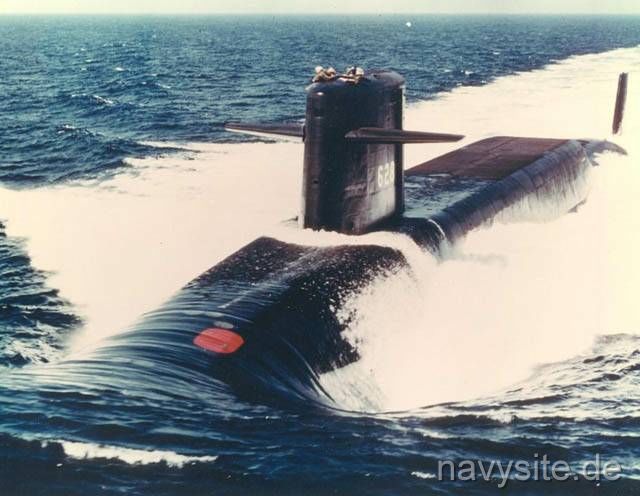
USS TECUMSEH was the 12th LAFAYETTE - class nuclear powered fleet ballistic missile submarine and the fourth ship in the Navy to bear the name. Initially named WILLIAM PENN, the submarine was renamed TECUMSEH on April 11, 1962. Placed “in commission, in reserve,” on February 15, 1993, TECUMSEH began the Navy’s Nuclear Powered Ship and Submarine Recycling Program at Bremerton, Washington the same day. Decommissioned and stricken from the Navy list on July 23, 1993, she emerged from the recycling program on April 1, 1994, as scrapped. However, her port torpedo tubes and a large piece of pressure hull were preserved and are now on display at the US Naval Undersea Museum at Keyport, Wash. The museum is located only a couple of miles east of the Bangor Submarine Base in Kitsap County, Wash.

General Characteristics:Awarded: July 20, 1961
Keel laid: June 1, 1962
Launched: June 22, 1963
Commissioned: May 29, 1964
Decommissioned: July 23, 1993
Builder: Electric Boat Division of General Dynamics Corp., Groton, CT.
Propulsion system: one S5W nuclear reactor
Propellers: one
Length: 425 feet (129.6 meters)
Beam: 33 feet (10 meters)
Draft: 31.5 feet (9.6 meters)
Displacement: Surfaced: approx. 7,250 tons; Submerged: approx. 8,250 tons
Speed: Surfaced: 16 - 20 knots;Submerged: 22 - 25 knots
Armament: 16 vertical tubes for Polaris or Poseidon missiles, four 21" torpedo tubes for Mk-48 torpedoes, Mk-14/16 torpedoes, Mk-37 torpedoes and Mk-45 nuclear torpedoes
Crew: 13 Officers and 130 Enlisted (two crews)


Back to topback to top  go to endgo to the end of the page


Back to topback to top  go to endgo to the end of the page

Crew List:

This section contains the names of sailors who served aboard USS TECUMSEH. It is no official listing but contains the names of sailors who submitted their information.


back to top  go to the end of the page


Back to topback to top  go to endgo to the end of the page

About the Ship's Name:

While still a youth, Tecumseh - a Shawnee Indian chief born near the present site of Springfield, Ohio, sometime in or around 1768 - won renown as a brave and skillful warrior. He devoted his life to opposing the advance of white settlers. Reasoning that land in North America - especially in the Ohio valley - belonged to all of the tribes in common, Tecumseh maintained that sales of territory by any single tribe to the United States were null and void. After the Federal Government refused to recognize this principle, Tecumseh attempted to organize a great Indian Confederacy to stem the white tide.

However, while he was in the South working to unite the tribes, Federal troops under Governor William Henry Harrison defeated and scattered Indian forces on 7 November 1811 in the battle of Tippecanoe. This defeat doomed the Indian Confederacy.

After Congress declared war on Great Britain the following year, Tecumseh accepted a commission as a brigadier general in the British army. He cooperated with British troops to win a number of victories in the Great Lakes region, including the capture of Detroit. However, Comdr. Oliver Hazard Perry’s victory on Lake Erie, late in the summer of 1813, cut British supply lines and prompted them to withdraw along the Thames Valley. Tecumseh and his braves covered the British retirement until American troops led by Harrison - now a major general - caught up with them at Moraviantown. Tecumseh was killed in the ensuing Battle of the Thames on 5 October 1813.

In June 1930, a bronze replica of the figurehead of ship-of-the-line DELAWARE was presented by the Class of 1891 to the United States Naval Academy. This bust - perhaps the most famous relic on the campus - has been widely identified as Tecumseh. However, when it adorned the American man-of-war, it commemorated not Tecumseh but Tamanend, the revered Delaware chief who welcomed William Penn to America when he arrived in Delaware country on 2 October 1682.


Back to topback to top  go to endgo to the end of the page

USS TECUMSEH History:

USS TECUMSEH was ordered on July 20, 1961, from the Electric Boat Division of General Dynamics at Groton, Connecticut, as part of the second generation of United States fleet ballistic missile submarines later grouped as the JAMES MADISON-class. Originally, the boat was to bear the name WILLIAM PENN, but on April 11, 1962, before her keel was laid, the Navy reassigned her name to honor the Shawnee leader Tecumseh, continuing a line of earlier U.S. Navy ships that had carried the same name. Her keel was laid at Groton on June 1, 1962, and she took shape as a 425-foot nuclear-powered submarine built around the S5W pressurized-water reactor, with 16 missile tubes for Polaris A3 ballistic missiles and four 21-inch torpedo tubes in the bow. TECUMSEH was launched on June 22, 1963, sponsored by Mildred Inez Sikes, wife of congressman Robert L. F. Sikes of Florida, and she was commissioned on May 29, 1964. At commissioning the Navy established the standard two-crew arrangement: the Blue Crew under Commander Arnett B. Taylor and the Gold Crew under Commander Charles S. Carlisle, allowing the submarine to spend as much time as possible on deterrent patrol.

Following commissioning, TECUMSEH conducted her shakedown operations in the Atlantic. Photographs from the period show her visiting Fort Lauderdale, Florida, in June 1964, indicating that her early training and trials included operations in the western Atlantic and off the Florida coast, where Polaris missile submarines routinely carried out missile system checks and crew training under the supervision of the Atlantic Fleet Ballistic Missile Submarine Force. During these months, the crews learned to handle the new ship, tested her reactor and propulsion plant at progressively higher speeds and depths, and exercised her navigation, fire-control and torpedo systems. At the same time, the Navy was finalizing plans to base a group of Polaris submarines in the Pacific, and TECUMSEH was slated to be one of the early units assigned to that theater.

Once her shakedown and post-shakedown availability were complete, TECUMSEH shifted to the Pacific. Based from Pearl Harbor, Hawaii, she departed on December 17, 1964, for forward deployment to the Mariana Islands, transiting west across the Pacific and arriving at Guam on December 29, 1964. There, she entered Apra Harbor to begin her first Polaris A3 strategic deterrent patrols under Commander Submarine Squadron 15, the newly established Guam-based Polaris squadron. From late 1964 through 1969, TECUMSEH completed 21 strategic deterrent patrols in the Pacific. On this cycle, she would load missiles and supplies alongside a tender at Guam, proceed to patrol areas in the Pacific - at distances that allowed her Polaris A3 missiles to hold targets in the Soviet Far East and parts of China at risk - then return to Guam for refit while the off-crew conducted training and leave, primarily through support facilities at Pearl Harbor. These patrols took place against the backdrop of a tense Cold War environment in Asia: the Vietnam War escalated, the People's Republic of China carried out nuclear tests, and the Soviet Union continued to expand its own strategic missile forces. TECUMSEH's contribution, like that of other Polaris boats, was to maintain a continuous, covert sea-based nuclear deterrent in the Pacific, though the details of her patrol tracks and specific on-station dates remain classified.

By 1969, the Navy was reorganizing its ballistic missile submarine force as newer boats and the Poseidon missile came into service, and it was decided to transfer TECUMSEH from the Pacific to the Atlantic to receive the Poseidon C3 missile system. After completing her 21st Pacific patrol, she returned to Pearl Harbor and then sailed east across the Pacific, transited the Panama Canal, and proceeded to the U.S. East Coast. On November 8, 1969, she arrived at Newport News, Virginia, and soon afterward entered the Newport News Shipbuilding and Drydock Company for a major overhaul and conversion from Polaris A3 to Poseidon C3. During this shipyard period, the missile compartment was modified to accept the larger Poseidon missiles, the associated fire-control equipment and navigation systems were upgraded to the Mark 88 system, and the ship received general machinery, habitability, and electronics improvements typical of a mid-life overhaul. TECUMSEH emerged from dry dock on May 9, 1970, and remained in the yard area for the remainder of 1970 for the completion of her overhaul and post-conversion testing.

On February 18, 1971, the Navy assigned TECUMSEH a new home port at Charleston, South Carolina, then an important Atlantic Fleet base for fleet ballistic missile submarines. From Charleston, she conducted sea trials and shakedown operations to verify the performance of her new Poseidon missile system and the overhauled propulsion plant. As with other Poseidon conversions, a key milestone was the Demonstration and Shakedown Operation (DASO), in which the ship had to execute a successful test launch of an operational missile. On July 17, 1971, the Gold Crew of TECUMSEH launched a Poseidon C3 missile, completing the ship's DASO and certifying both crews and the ship for operational deployment with the new missile system. On September 22, 1971, following crew certification and work-up exercises, TECUMSEH deployed from Charleston for her first operational Poseidon deterrent patrol, becoming the sixth SSBN to enter service with Poseidon C3 missiles.

After these initial Atlantic patrols, TECUMSEH shifted to forward deployment in European waters. In early 1972, she sailed north from Charleston and on February 9, 1972, arrived at Holy Loch, Scotland, the long-standing U.S. forward base for Atlantic ballistic missile submarines. From Holy Loch, she conducted a series of deterrent patrols in the North Atlantic and Norwegian Sea regions, operating under the control of Commander Submarine Squadron 14 and supported by a submarine tender anchored in the loch. Between 1972 and 1976, TECUMSEH completed 18 deterrent patrols from Holy Loch, alternating between Blue and Gold crews on the standard cycle of refit, deployment, and off-crew training. These patrols formed part of the NATO-linked strategic posture in the European theater: by remaining on station in the North Atlantic and nearby waters, TECUMSEH and her sister ships provided continuous sea-based nuclear coverage of targets in the western Soviet Union, supplementing land-based missiles and strategic bombers during a period that included events such as the final stages of the Vietnam War, detente, the signing of the SALT I agreement, and continuing tensions in Europe.

In addition to routine deterrent patrols, TECUMSEH took part in formal testing of the Poseidon C3 system. On January 24, 1973, while still assigned to Atlantic operations, her Gold Crew launched four Poseidon C3 missiles as part of the fifth Poseidon C3 operational test series, a multi-round firing intended to demonstrate the reliability and accuracy of the new missile system under realistic conditions. This series of launches contributed to the broader validation of Poseidon as the standard SLBM for the LAFAYETTE-, JAMES MADISON-, and BENJAMIN FRANKLIN-class boats during the 1970s.

Through the mid- and late 1970s, TECUMSEH continued operating as a front-line Poseidon SSBN in the Atlantic. Although detailed patrol dates and operating areas remain classified, she is recorded as maintaining the regular pattern of deterrent patrols out of Holy Loch, interspersed with periods of refit alongside a tender, maintenance availabilities, and training exercises. As the U.S. Navy introduced the new OHIO-class Trident submarines late in the decade, older Polaris-only units were retired or refitted, but TECUMSEH, already upgraded to Poseidon, remained an active part of the Atlantic deterrent force.

By the early 1980s, after nearly two decades of intensive service, TECUMSEH's reactor plant required refueling and the boat needed a comprehensive life-extension overhaul if she was to remain in service into the late Cold War period. She was homeported in Charleston again by at least March 1982, operating from there on Atlantic patrols until she was scheduled for a major refueling overhaul at Newport News Shipbuilding. She entered Newport News in 1983 for this extended yard period. The refueling overhaul, which ran into the spring of 1987, included replacement of the reactor core, extensive work on the propulsion train, and modernization of combat systems, sensors, and ship control equipment to align the boat with contemporary standards for strategic submarines. Throughout the overhaul, the missile compartment retained its Poseidon configuration; unlike some of her JAMES MADISON- and BENJAMIN FRANKLIN-class sisters, TECUMSEH does not appear in official missile assignment lists as having received the later Trident I (C4) missile, and available sources consistently describe her as a Poseidon-armed SSBN through the end of her operational career.

When the overhaul was completed in the spring of 1987, TECUMSEH put to sea once more for post-refit sea trials and shakedown. As with her earlier Poseidon conversion, the Navy used an at-sea missile firing to verify the performance of the refurbished missile and fire-control systems, and TECUMSEH carried out a successful launch of a Poseidon missile before returning to her home port of Charleston. From 1987 through 1992, she operated as part of the Atlantic Fleet ballistic missile submarine force, with Charleston as her home port and patrols staged both directly from Charleston and via forward deployment to Holy Loch. This period coincided with significant geopolitical shifts: the signing of the Intermediate-Range Nuclear Forces (INF) Treaty in 1987, the end of the Cold War, the fall of the Berlin Wall in 1989, the dissolution of the Soviet Union in 1991, and the negotiation and implementation of strategic arms reduction measures. As the U.S. strategic force structure was adjusted downward and the newer OHIO-class Trident submarines assumed the primary deterrent role, older Poseidon boats like TECUMSEH were gradually removed from the ballistic missile mission.

In 1992, reflecting these arms control-driven force reductions, TECUMSEH off-loaded her Poseidon missiles at Charleston and left the operational deterrent patrol rotation. Rather than retire immediately, she spent a period supporting anti-submarine warfare training and fleet exercises, operating without ballistic missiles to provide a realistic nuclear-powered submarine target for attack submarines, surface combatants, and maritime patrol aircraft learning to track and prosecute submarines under peacetime conditions. These war games off the U.S. East Coast allowed the Navy to gain training value from a still-capable platform whose strategic role was ending.

In January 1993, TECUMSEH left the Atlantic for the last time. She transited south to the Caribbean, passed through the Panama Canal into the Pacific, and then proceeded north to Bremerton, Washington, where the U.S. Navy's Ship-Submarine Recycling Program was located at Puget Sound Naval Shipyard. There, she was prepared for inactivation and disposal. On July 23, 1993, USS TECUMSEH was formally decommissioned and stricken from the Naval Vessel Register at Bremerton. Her dismantling under the Ship-Submarine Recycling Program was completed on April 1, 1994, bringing an end to nearly three decades of service that had spanned the height of the Cold War and its conclusion.

Although the submarine itself was recycled, parts of TECUMSEH were preserved as a memorial. Her starboard torpedo tubes and a large section of her pressure hull were removed during scrapping and later installed at the Naval Undersea Museum in Keyport, Washington, where they are displayed to the public.


Back to topback to top  go to endgo to the end of the page


Back to topback to top


Back to Ballistic Submarines list. Back to ships list. Back to selection page. Back to 1st page.