
Search the Site with

|
Search the Site with
|
 General Characteristics Crew List Memorabilia USS SCOTT's 1995/96 Med-deployment Patch Gallery Image Gallery to end of page
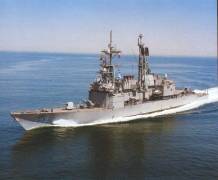 |  | 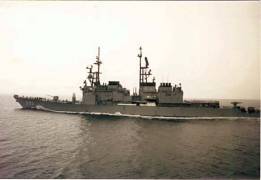 |
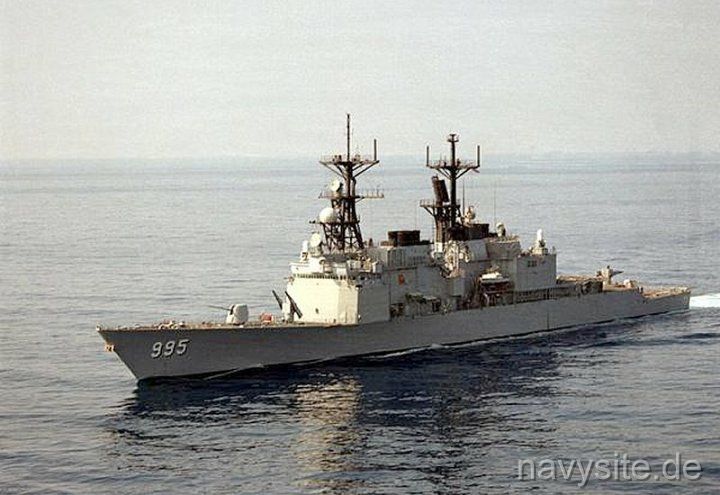
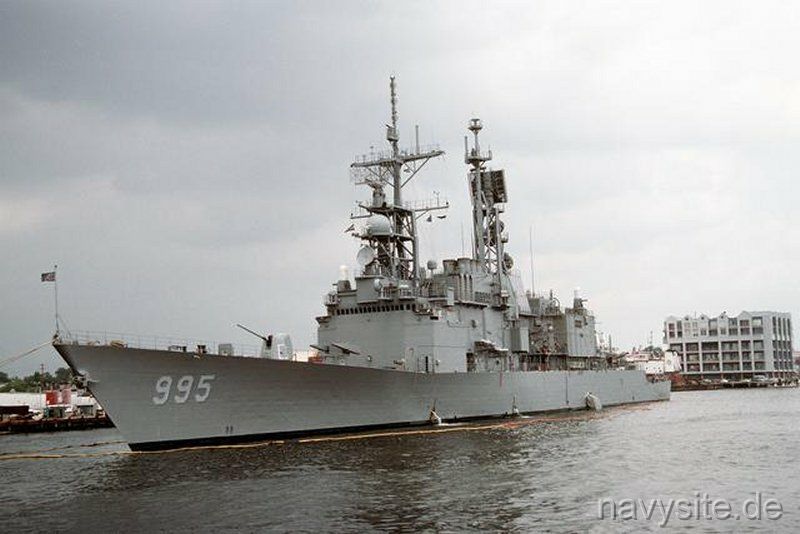
USS SCOTT was the last but one KIDD class guided missile destroyer. Originally built for Iran, the ship was first named NADER, but after the destroyer’s takeover by the U.S. Navy the ship was renamed SCOTT.
The destroyer was last homeported in Mayport, FL. In 2005, the SCOTT was transfered to TAIWAN where she was recommissioned as TZUO-YING.
| General Characteristics: | Keel Laid: 1979 |
| Commissioned: October 24, 1981 | |
| Decommissioned: December 11, 1998 | |
| Builder: Ingalls Shipbuilding, West Bank, Pascagoula, Miss. | |
| Propulsion system: four General Electric LM 2500 gas turbine engines | |
| Propellers: two | |
| Blades on each Propeller: five | |
| Length: 564,3 feet (172 meters) | |
| Beam: 55,1 feet (16.8 meters) | |
| Draft: 31,5 feet (9.6 meters) | |
| Displacement: approx. 9,500 tons full load | |
| Speed: 30+ knots | |
| Aircraft: two | |
| Armament: two | |
| Crew: approx. 340 |
 back to top go to the end of the pageback to top go to the end of the page
Crew List:
This section contains the names of sailors who served aboard USS SCOTT. It is no official listing but contains the names of sailors who submitted their information.
back to top go to the end of the pageback to top go to the end of the pageUSS SCOTT’s 1995/96 Med-deployment:
Since leaving Norfolk, Va., at the end of August 1995, SCOTT has steamed more than 28,000 nautical miles in 126 days underway.
During the deployment to the U.S. Sixth Fleet, SCOTT visited Augusta Bay, Sicily; Valletta, Malta; Istanbul, Turkey; Varna, Bulgaria; Constanta, Romania; Volos, Greece; Salamis, Greece; Alexandria, Egypt; Naples, Italy; and Corfu, Greece.
SCOTT performed a wide variety of missions in support of Sixth Fleet and NATO operations. The ship served as Redcrown, the air control ship in the Adriatic Sea; destroyer escort for the USS WASP (LHD 1) Amphibious Ready Group; and supported NATO and U.N. maritime operations Sharp Guard, Deny Flight, and Decisive Endeavor.
Additionally, SCOTT has served as the flagship for Commander, Destroyer Squadron Fourteen, and participated in several exercises in the Partnership for Peace (PfP) program, which promotes exercise interaction between NATO and former Soviet Bloc nations. One PfP exercise included Iolkus-95, a maritime coordination exercise which involved several ships from the Greek, Italian, and Romanian navies, and observers from Bulgaria and Albania.
SCOTT also participated in smaller scale exercises and personnel exchanges with the Bulgarian and Romanian navies while operating in the Black Sea.
The first of SCOTT's multi-national and NATO exercises was Caduceus-95, a coordinated undersea warfare exercise with the German and British navies.
Bright Star 95, a land, sea, and air exercise, stressed all naval warfare areas with U.S., French, British, and Egyptian forces. Scott also participated in Exercise Final Courage in the Adriatic Sea, a coordinated battle group exercise involving French, British, Italian, and U.S. Naval and Air Force participants.
SCOTT concluded its deployment exercise schedule with Dogfish 96, a medium-scale Southern Region live undersea warfare exercise with U.S., British, Spanish, Turkish, Greek, Italian, German, Dutch, Canadian, French, and Portuguese ships, aircraft, and submarines.
Early in the deployment, SCOTT conducted a series of port visits which began with a visit to Valetta, Malta, in conjunction with Malta's Independence Day celebration. Scott later conducted a two-week Black Sea operation enhancing military and diplomatic ties with NATO ally Turkey, and with Bulgaria and Romania. This period included port visits to Istanbul, Turkey; Varna, Bulgaria; and Constanta, Romania.
While in the Black Sea, SCOTT's crew spent a day painting and cleaning in Varna at the House for Homeless Children. They also delivered English textbooks, personal hygiene supplies, and paper to the Varna community center. In addition, they handed out food supplies to Holt International School for Orphaned Children in Constanta. The crew also helped out at Casa Speranta (House of Hope), an orphanage for HIV positive children in Constanta.
SCOTT and embarked Destroyer Squadron Fourteen also participated in several military and civil protocol events, including hosting shipboard receptions in Valetta, Malta; Varna, Bulgaria; Constanta, Romania; and Alexandria, Egypt in support of the visits and exercises. These receptions fostered friendships between the various nations and were attended by military and civilian officials, including ambassadors, consuls general, naval commanders in chief, and members of the local business communities.
USS SCOTT served as a member of Task Force Sixty and the USS AMERICA (CV 66) Battle Group, commanded by RADM William V. Cross. The task force conducted ongoing multinational operations in support of U.N. and NATO resolutions, including the Dayton Peace Accord.
back to top go to the end of the pageUSS SCOTT Patch Gallery:
 |
back to top go to the end of the pageUSS SCOTT Image Gallery:
 |  |
back to top
 Back to Destroyers list. Back to ships list. Back to selection page. Back to 1st page.