
Search the Site with

|
Search the Site with
|
 General Characteristics Crew List Memorabilia Cruise Books About the Ship's Name History Homeports of USS Cochrane Image Gallery to end of page
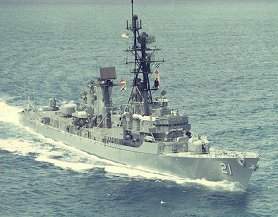 | 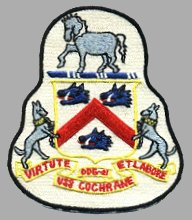 | 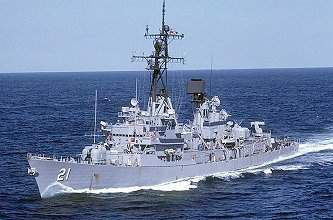 |
USS COCHRANE was the 20th CHARLES F. ADAMS-class guided missile destroyer and the first ship in the Navy named after Admiral Edward Lull Cochrane. COCHRANE was stricken from the Navy list on November 20, 1992, and was subsequently berthed at Pearl Harbor, HI. The destroyer was sold to Brownsville International Shipbreaking Corp, Tx., for scrapping.
| General Characteristics: | Awarded: March 25, 1960 |
| Keel laid: July 31, 1961 | |
| Launched: July 18, 1962 | |
| Commissioned: March 21, 1964 | |
| Decommissioned: October 1, 1990 | |
| Builder: Puget Sound Bridge and Drydock, Seattle, Wash. | |
| Propulsion system:4 - 1200 psi boilers; 2 geared turbines | |
| Propellers: two | |
| Length: 437 feet (133.2 meters) | |
| Beam: 47 feet (14.3 meters) | |
| Draft: 20 feet (6.1 meters) | |
| Displacement: approx. 4,500 tons | |
| Speed: 31+ knots | |
| Aircraft: none | |
| Armament: two Mk 42 5-inch/54 caliber guns, | |
| Crew: 24 officers and 330 enlisted |
 back to top go to the end of the pageback to top go to the end of the page
Crew List:
This section contains the names of sailors who served aboard USS COCHRANE. It is no official listing but contains the names of sailors who submitted their information.
back to top go to the end of the pageback to top go to the end of the pageUSS COCHRANE Cruise Books:
back to top go to the end of the pageAbout the Ship's Name:
Edward Lull Cochrane was born on 18 March 1892 to Brig. Gen. Henry C. Cochrane, USMC, and Elizabeth F. L. Cochrane at Mare Island Navy Yard, Calif. After his retirement from the Marine Corps on 10 March 1905, Henry Cochrane moved the family back to his hometown of Chester, Pa. Edward attended Chester High School before entering the University of Pennsylvania. In 1910, he received an appointment to the United States Naval Academy at Annapolis, Md. by the U.S. Representative for the Seventh District of Pennsylvania Thomas S. Butler.
While at the academy, the young midshipman excelled as a member of the Fencing Team. In addition to serving as the Vice President of the Intercollegiate Fencing Association, Cochrane was the team's manager and Sabre Champion for 1913 and 1914. In his final year at the academy, he was the most proficient in great gun target practice, ordnance or gunnery (1914). An achievement commemorated by having his name engraved on the cup presented annually by the General Society of the Sons of the Revolution. Cochrane graduated with distinction from Annapolis second in a class of 154 and received his commission on 6 June 1914.
Ens. Cochrane reported to RHODE ISLAND (BB 17) on 20 June 1914. Detached from Rhode Island on 3 January 1916, he entered the Postgraduate School at the Naval Academy on 10 January to pursue course work to prepare him for service in the Construction Corps. To advance his education, Cochrane transferred to the Massachusetts Institute of Technology (MIT), reporting on 21 September 1916 but had to halt his studies soon after the U.S. entered World War I on 6 April 1917. He reported as an Assistant Naval Constructor in the Hull Division at the Philadelphia Navy Yard on 16 April where he remained until late 1919. He returned to MIT on 3 October 1919 and earned a Master of Science in Naval Architecture in June 1920.
His education complete, Cochrane returned to the Hull Division at Philadelphia on 21 June 1920. He later transferred to Washington, D.C. to join the Bureau of Construction and Repair Design Division to work on submarines on 3 April 1924. In 1929, Cochrane traveled as the technical advisor with U.S. delegation to the Conference for the on Safety of Life at Sea to London, England. Following his return to the U.S., he worked in submarine construction until 1933. In May 1933, he joined the Scouting Force as Force Constructor for (May 1933-September 1935). Cochrane returned to the Bureau of Construction and Repair, Design Division in September 1935. He served in this capacity for several years with the exception of the three months (3 July-29 September) he attended the Naval War College at Newport, R.I. in 1939. He reported to the Bureau of Construction and Repair on 2 October 1939.
With war raging in Europe, Cochrane travelled to London, reporting to the American Embassy in London on 22 September 1940, to study battle damage of British ships. Inspired by his observation of the damage, Cochrane saw the need for American anti-submarine ships. His efforts led to the development of destroyer escorts. Detached from duty in London on 14 January 1941, he reported to the Bureau of Ships, to head the Design Division of the Bureau less than a fortnight later, on 25 January. Cochrane accompanied Secretary of the Navy Frank Knox to assess the damage done to Pearl Harbor on December 1941. On 21 November 1942, he received a promotion to the rank of rear admiral and was commissioned Chief of the Bureau of Ships, with additional duty as Coordinator of Shipbuilding for the Naval Establishment, to rank from 1 November. He served as the bureau's chief for the duration of the war. He was relieved of that duty to pending retirement on 1 November 1947.
After his retirement, Cochrane returned to MIT where he eventually became the Dean of Engineering in addition to Vice President for Industrial and Government Relations. He also continued his public service as a member of multiple governmental, civic and maritime organizations. Cochrane was a member of the panel appointed to investigate the collision between the Italian ocean liner ANDREA DORIA and the Swedish liner STOCKHOLM (25 July 1956).
While returning from New York, N.Y. to his home in New Haven, Conn., Admiral Cochrane suffered a heart attack. He died in his home on 14 November 1959 and is interred at Arlington National Cemetery.
back to top go to the end of the pageUSS COCHRANE History:
USS COCHRANE entered service at Bremerton on March 21, 1964, then headed across the North Pacific to her new home waters at Pearl Harbor for shakedown, weapons qualifications, and post-shakedown fixes. Through late 1964 and early 1965, she worked up in Hawaiian and eastern-Pacific ranges with emphasis on anti-air warfare centered on the TARTAR/Standard system, ASW training around the SQS-23/ASROC suite, and replenishment drills in company with cruisers and carriers bound for the Western Pacific.
By the spring of 1965, she was already operating with the Seventh Fleet: on May 15, 1965, COCHRANE steamed in the South China Sea alongside the fast carrier MIDWAY (CVA 41) and the stores ship ALUDRA (AF 55) as U.S. naval presence expanded with the escalation of the Vietnam War. The new destroyer settled into the rhythm that would define her first decade - forward deployments built around plane-guard and air-defense screening for carriers on YANKEE Station, patrols and surveillance along the Vietnam littorals, and cycles of upkeep at the established hubs in Japan and the Philippines, interspersed with brief liberty pauses. In the second half of 1966, near the end of a line period in the Gulf of Tonkin, she put into Hong Kong from November 25-30 and then stopped at Yokosuka on December 7-8 before returning to Hawaiian waters, a sequence typical of Seventh Fleet rotations in that phase of the war.
Back in the central Pacific, COCHRANE began 1969 in Pearl Harbor and, as the U.S. space effort reached its stride, took a very different kind of station: during the first two weeks of March she stood watch roughly 750 miles north of Hawaii in support of the Apollo 9 mission's Pacific contingencies, an example of the fleet's routine role in recovery and safety coverage for manned spaceflight. The rest of the year returned her to normal destroyer business - gunnery, missile shoots, refresher training, and local operations out of Pearl Harbor - preparing for renewed Seventh Fleet duty as the long war at sea ground on.
The ship's Vietnam combat operations reached their most intense phase in 1972-1973 as the conflict surged again. In the summer and autumn of 1972, COCHRANE alternated PIRAZ/picket and carrier-screen assignments with extended naval gunfire support periods along the Vietnamese coasts, part of the interdiction and close-support effort that accompanied the LINEBACKER campaigns. On the night of October 25-26, 1972, while never directly hit, she took shrapnel and topside holing from coastal-artillery shellbursts, a reminder of the hazards of working close to defended shores. In December, as LINEBACKER II opened, she was operating with fellow destroyers HOEL (DDG 13) and FLOYD B. PARKS (DD 884) under Task Unit 77.1.1 near Haiphong when, on December 19, the destroyer GOLDSBOROUGH (DDG 20) was struck by shore fire with fatal casualties. COCHRANE was diverted to the scene and onward tasking in response to that emergency, then continued the deployment into early 1973. The tour closed with a Navy Unit Commendation for sustained performance across the October 1972-February 1973 period, and the ship returned to Pearl Harbor in the spring as U.S. naval combat operations wound down.
Post-ceasefire duties shifted from sustained combat to presence and contingency support. In April 1975, COCHRANE was among the escorts detailed to protect the helicopter-borne evacuation from Saigon and Vung Tau during Operation FREQUENT WIND, providing the air-defense screen and sea-space management that enabled continuous helicopter cycles between ashore pickup points and the amphibious ships and carriers offshore. After that turbulent finale, she resumed the now familiar pattern of Pacific Fleet deployments and Pearl Harbor upkeep. Yard work and modernization kept her combat systems credible for the 1980s - by mid-1982, she emerged from a Pearl Harbor Naval Shipyard period to complete trials and refit - and her operating areas widened as the Cold War's maritime center of gravity shifted from Southeast Asia to the broader Indo-Pacific and Indian Ocean.
Humanitarian and presence missions punctuated that late-Cold-War routine. On October 1, 1980, COCHRANE rescued 104 Vietnamese refugees about 620 miles east of Saigon, taking them onboard from a small craft in the South China Sea and delivering them safely to onward care. In the mid-1980s, she exercised frequently with carrier and cruiser companions across the Western Pacific. On September 28, 1985, she was photographed underway with the guided-missile cruiser REEVES (CG 24), emblematic of her regular role as an air-defense and surface-action escort in Seventh Fleet groups. As tensions in the Persian Gulf and northern Arabian Sea rose during the Iran-Iraq War, the ship's forward-deployed tempo reflected the Navy's emphasis on continuous presence: by 1986-1987, COCHRANE was operating from Western Pacific logistics nodes into the North Arabian Sea and lower Gulf on surveillance, escort, and deterrence tasks typical of the pre-reflagging period. The last years of the decade found her still Far East-based, ranging from Japan to Southeast Asia and the Indian Ocean and operating alongside U.S. and allied units. An image from December 1989 shows COCHRANE with the destroyer TOWERS (DDG 9) and the Japanese support ship CHIYODA, another snapshot of the multinational fabric of her final deployments.
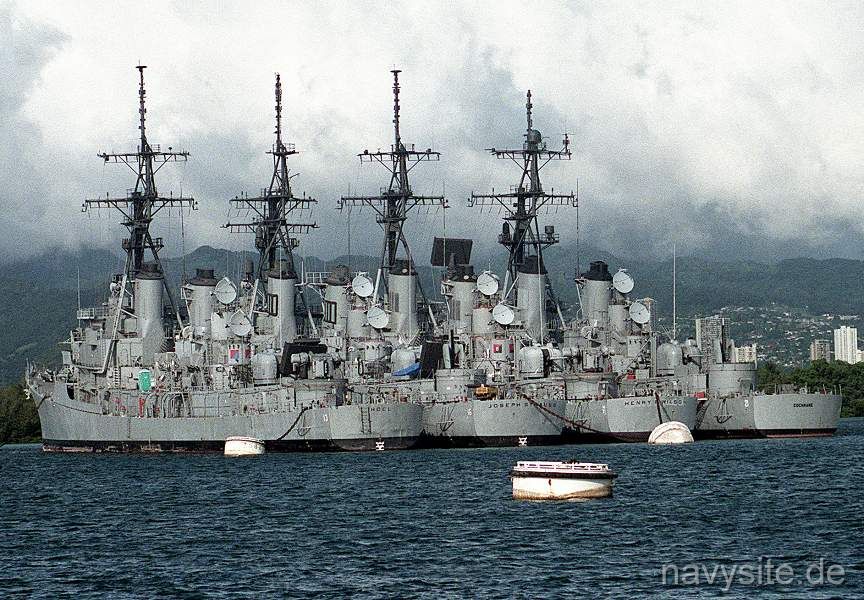
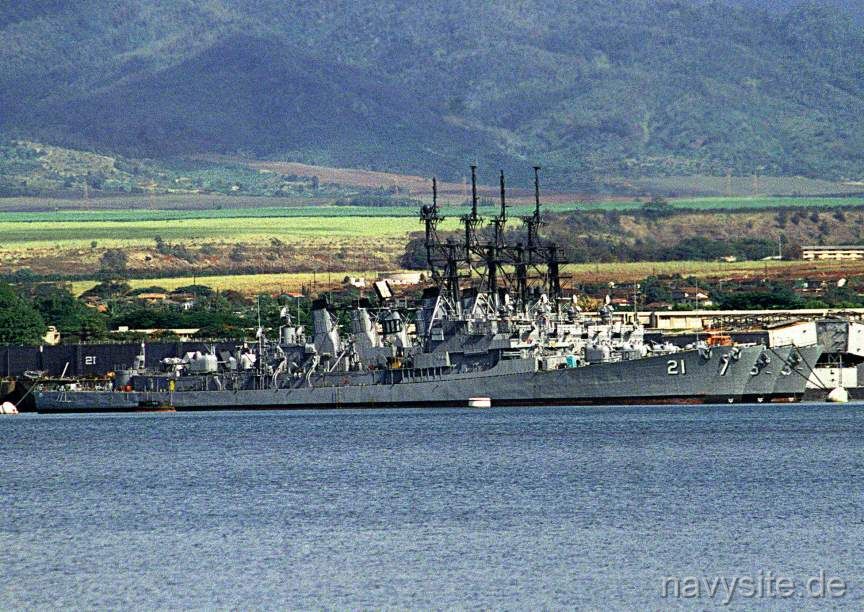
After more than twenty-six years of service, COCHRANE completed her last operating cycle in 1990. She was decommissioned at Pearl Harbor on October 1, 1990, and placed in inactive status. Two years later, on November 20, 1992, her name was struck from the Naval Vessel Register. The hulk remained berthed at Pearl Harbor with other retired ADAMS-class ships until sale. Towed to Texas in March 2001, she was dismantled at International Shipbreaking in Brownsville, closing the career of a Pacific destroyer whose logbooks trace nearly three decades of carrier screening, coastal gunfire, multinational exercises, humanitarian assist missions, and steady forward presence from the South China Sea to the Arabian Sea.
back to top go to the end of the pageHomeports of USS COCHRANE:
| Period | Homeport |
|---|---|
| commissioned at Bremerton, Wash. | |
| 1964 - 1983 | Pearl Harbor, Hi. |
| 1983 - 1990 | Yokosuka, Japan |
back to top go to the end of the pageUSS COCHRANE Image Gallery:
 |  | 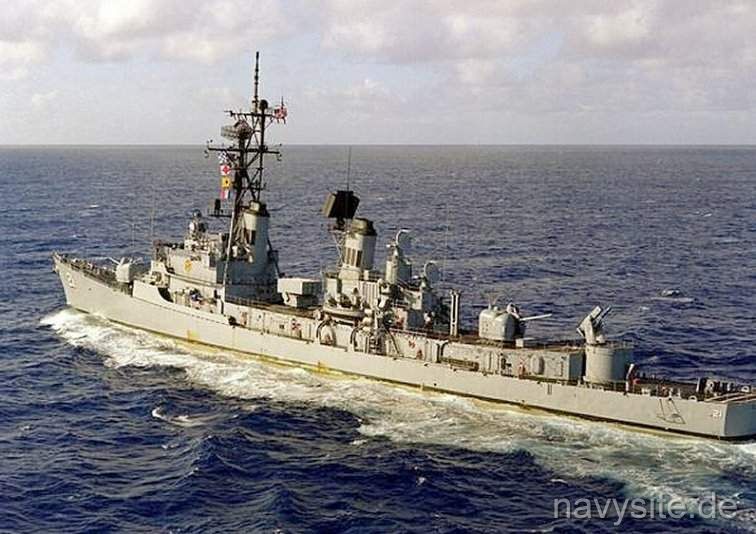 |
The photos below are official US Navy photos taken on June 1, 1991. They show four CHARLES F. ADAMS - class ships laid up at the Pearl Harbor Naval Inactive Ship Maintenance Facility. On the first photo one can see (from left to right): HOEL (DDG 13), JOSEPH STRAUSS (DDG 16), HENRY B. WILSON (DDG 7), and COCHRANE. The second photo is a close-up of the COCHRANE.
 |  |
back to top
 Back to Destroyer list. Back to ships list. Back to selection page. Back to 1st page.