
Search the Site with

|
Search the Site with
|
 General Characteristics Crew List Memorabilia Accidents aboard the Ship History Image Gallery to end of page
 |  |
USS NARWHAL was the Navy's 100th nuclear-powered submarine and the third ship in the Navy to bear the name. Basically a STURGEON - class attack submarine, the USS NARWHAL was the Navy's test submarine for the S5G nuclear reactor, resulting in increased length and displacement compared to the other STURGEON - class submarines. This new reactor was designed to considerably reduce the noise level of a submarine and made the NARWHAL, at the time of commissioning, the quietest submarine in the US Navy.
Formally decommissioned in July 1999, the NARWHAL was subsequently laid up at the Puget Sound Naval Shipyard, Bremerton, Wash. Initial plans to turn her into a museum failed. In 2016, a naval historical evaluation found her eligible for listing in the National Register of Historic Places because of her one-ship class status, unique propulsion plant, unusual layout, and importance in submarine quieting and propulsion development. The evaluation did not preserve her from eventual disposal. By 2020, after a period of dismantling at Puget Sound Naval Shipyard, the former USS NARWHAL had been cut.
| General Characteristics: | Awarded: 1964 |
| Keel Laid: January 17, 1966 | |
| Launched: September 9, 1967 | |
| Commissioned: July 12, 1969 | |
| Decommissioned: July 1, 1999 | |
| Builder: General Dynamics Corp., Groton, Conn. | |
| Propulsion system: one S5G nuclear reactor | |
| Propellers: one | |
| Length: 314 feet (95.7 meters) | |
| Beam: 38 feet (11.6 meters) | |
| Draft: 26 feet (7.9 meters) | |
| Displacement: Surfaced: approx. 4,800 tons | |
| Submerged: approx. 5,350 tons | |
| Speed: Surfaced: approx. 20 knots | |
| Submerged: approx. 25 knots | |
| Armament: four 533 mm torpedo tubes for | |
| Crew: 12 Officers, 95 Enlisted |
 back to top go to the end of the pageback to top go to the end of the page
Crew List:
This section contains the names of sailors who served aboard USS NARWHAL. It is no official listing but contains the names of sailors who submitted their information.
back to top go to the end of the pageback to top go to the end of the pageAccidents aboard USS NARWHAL:
| Date | Where | Events |
|---|---|---|
| December 31, 1985 | Palma de Majorca, Spain | USS NARWHAL drifts for several hours in Palma Bay and drags the bottom a few times after her anchor chain breaks during a storm on New Year's Eve. A subsequent investigation reveals that NARWHAL's anchor chain was defective. |
| September 22, 1989 | Charleston, SC. | USS NARWHAL sustains minor damage during Hurricane Hugo while submerged at the Charleston Naval Base. The submarine was moored with nine double wires and two three-inch ship's lines, all but one of which were ripped loose during the first half of the storm. During the eye of the storm, the captain discovered the submarine had drifted to the center of the Cooper River. Tugboats and the NARWHAL crew unsuccessfully tried to move the submarine back to the pier. As the storm began again, the captain submerged the submarine in the river and the NARWHAL rode out the remainder of the hurricane with only part of its conning tower exposed. |
back to top go to the end of the pageUSS NARWHAL History:
USS NARWHAL was the third United States Navy submarine to bear the name Narwhal, after the arctic whale known for the long ivory tusk carried by the male. The name had already been used by earlier American submarines, including the large interwar and Second World War submarine USS NARWHAL (SS 167). The nuclear-powered USS NARWHAL was one of the most unusual American attack submarines of the Cold War. She was not simply another STURGEON-class boat, even though she was related in general mission, period, and broad attack-submarine role to that generation. She was a one-ship class, designed around a unique propulsion plant and quieting features that made her both an operational fleet submarine and a testbed for concepts later reflected in other American submarine designs.
USS NARWHAL was built by the Electric Boat Division of General Dynamics at Groton, Connecticut. Her keel was laid down on January 17, 1966. She was launched on September 9, 1967, sponsored by Mrs. Glynn R. Donaho, wife of retired Vice Admiral Glynn R. Donaho. She was commissioned on July 12, 1969, with Commander Willis A. Matson II in command. At commissioning, she was often described as the Navy's one hundredth nuclear-powered submarine, and she entered service as one of the quietest submarines then available to the United States Navy.
Her design set her apart from standard attack submarines of the period. USS NARWHAL was larger than the contemporary STURGEON-class submarines, about 314 feet long, with a beam of roughly 33 feet and a submerged displacement of about 5,300 tons. She was powered by a single S5G pressurized-water reactor, a natural-circulation design intended to reduce the need for noisy reactor-coolant-pump operation under some conditions. Her machinery arrangement also included a large direct-drive turbine rather than the more conventional reduction-gear arrangement. Other quieting-related features included seawater and machinery arrangements intended to reduce pump and mechanical noise, together with an internal layout that differed significantly from other submarines of her era. These features made USS NARWHAL a distinctive experimental and operational submarine at the same time. She was not a laboratory craft in the narrow sense; she was a deployable attack submarine that carried out regular fleet missions, but her design also allowed the Navy to evaluate machinery and quieting concepts in real service.
After commissioning, USS NARWHAL was initially assigned to Submarine Detachment Two at New London, Connecticut. Her early service combined testing, training, and operational employment. In July 1970, she made her first deployment and visited Holy Loch and Faslane, Scotland. Holy Loch was then a major United States ballistic-missile-submarine support site, and Faslane was central to British and Nato submarine operations on the Clyde. Those visits placed the new boat directly into the North Atlantic submarine environment that would shape much of her service. The North Atlantic, the Greenland-Iceland-United Kingdom gap, and the approaches to Soviet Northern Fleet operating areas were central to Cold War maritime strategy. USS NARWHAL's quieting features made her particularly valuable in that strategic setting.
USS NARWHAL deployed again in March 1971, followed by a port visit to Bremerhaven, West Germany. West Germany was one of the central states of the NATO alliance during the Cold War, and American naval visits there supported the wider pattern of alliance presence and readiness. USS NARWHAL was awarded a Meritorious Unit Commendation for operations in this early phase of her career. On July 1, 1971, she was reassigned to Submarine Squadron Two at New London, and on July 9, 1971, Commander Edward S. Kellogg III relieved Commander Matson as commanding officer.
In 1972, USS NARWHAL completed two extended deployments. These included further visits to Holy Loch and Faslane, Scotland. During that year, she earned her first Battle Efficiency "E" for Submarine Division Twenty-Three. Public summaries also associate her with a Navy Unit Commendation for a 1972 deployment. During this period, the Soviet submarine force was expanding in both number and capability, and the United States Navy and its allies placed heavy emphasis on quiet submarine tracking, anti-submarine tactics, undersea surveillance, and protection of Atlantic sea lines.
In 1973, USS NARWHAL completed two more extended deployments and visited Rosyth, Scotland. Rosyth was another important British naval facility, and its appearance in her record again reflects the North Atlantic and NATO orientation of her early career. In the same year, she was awarded the Edward F. Ney Memorial Award for Food Service Excellence as Best Small Mess Afloat, a notable distinction because it was the first time in the award's history that a submarine had won that category.
From February 1974 to March 1975, USS NARWHAL underwent a regular overhaul at Electric Boat Shipyard in Groton, Connecticut. This yard period interrupted the heavy deployment rhythm of the early 1970s and was the first major maintenance phase of her service after her initial operational years. On April 5, 1975, Commander Michael A. Colley became commanding officer.
In 1975 and 1976, USS NARWHAL deployed with the United States Sixth Fleet in the Mediterranean Sea. During that deployment cycle, she visited Naples and Taranto, Italy. The Mediterranean remained one of the main maritime theaters of the Cold War. Soviet naval forces operated there regularly, the region was still affected by the consequences of the 1973 Arab-Israeli War, and the Sixth Fleet maintained continuous American naval presence on NATO's southern flank. USS NARWHAL's presence in the Mediterranean therefore linked her quiet attack-submarine capability to a theater where surveillance, anti-submarine operations, deterrence, and crisis response all mattered. In 1976, she was awarded the Battle Efficiency "E" and the Anti-Submarine Warfare Gold "A" for Submarine Squadron Two.
USS NARWHAL deployed again in early 1977 and received a second Meritorious Unit Commendation for that operation. On August 27, 1977, Commander Donald M. Olsen relieved Commander Colley as commanding officer. During 1977, USS NARWHAL again earned the Battle Efficiency "E" and Anti-Submarine Warfare Gold "A" for Submarine Squadron Two. In 1978, she again deployed with the United States Sixth Fleet in the Mediterranean and visited Naples, La Spezia, and La Maddalena, Italy. These Italian ports were recurring locations for American submarines operating in the Mediterranean, and La Maddalena in particular was important as a submarine support location in Sardinia. The deployment continued USS NARWHAL's pattern of alternating between North Atlantic and Mediterranean employment.
An extended deployment in early 1979 was followed by port visits to Holy Loch, Scotland, and Rotterdam, Netherlands. USS NARWHAL received a third Meritorious Unit Commendation for the operation. She also earned her fourth Battle Efficiency "E" and the Engineering Red "E" for Submarine Squadron Two. A port visit to Bermuda came just before she reported to her new home port at Charleston, South Carolina, after being reassigned to Submarine Squadron Four in November 1979. This shift from New London to Charleston became important for the later part of her career. Charleston was a major submarine home port and repair location, and USS NARWHAL would spend much of the remainder of her active life associated with that base and its submarine community.
In November 1982, USS NARWHAL again deployed with the United States Sixth Fleet in the Mediterranean. During that deployment, she visited Toulon, France, and Naples and La Maddalena, Italy. The Mediterranean in the early 1980s was a tense operating area. The Soviet invasion of Afghanistan, continuing instability in the Middle East, the aftermath of the Iranian Revolution, and Soviet naval presence all influenced United States naval deployments.
In 1984, USS NARWHAL won her fifth Battle Efficiency "E" and the Engineering Red "E" for Submarine Squadron Four. In September 1984, she began an extended deployment from which she returned to Charleston in December 1985. On January 19, 1985, Commander Malcolm I. Fages became commanding officer.
On December 31, 1985, USS NARWHAL experienced an anchoring casualty at Palma de Mallorca, Spain. During a New Year's Eve storm, her anchor chain broke, and the submarine drifted for several hours in Palma Bay, dragging along the bottom more than once. A later investigation found that the anchor chain was defective.
In September 1986, USS NARWHAL departed on another deployment. That deployment included port visits to Portsmouth, England, and Brest, France. She returned to Charleston in April 1987. On October 24, 1987, Commander Daniel L. Whitford relieved Commander Fages as commanding officer. During 1988, USS NARWHAL participated in Fleet Exercise 1-88 and operated with Standing Naval Forces Atlantic. She then conducted a two-month Selected Restricted Availability from March to May 1988. In the summer of 1988, she participated in NATO Exercise Teamwork 88 and made port visits to Haakonsvern, Norway, and Faslane, Scotland. Teamwork 88 belonged to the large NATO exercise tradition in the North Atlantic and Norwegian Sea, where allied forces practiced reinforcement, anti-submarine warfare, sea control, and operations in northern waters close to Soviet naval operating routes.
In early 1989, USS NARWHAL deployed to the Mediterranean Sea as part of the United States Sixth Fleet for the fourth time in her service. This was her fourteenth deployment. She returned to Charleston in July 1989 after operations and port visits to Naples and La Maddalena, Italy, Toulon, France, and Gibraltar. During the year, she won the Supply Blue "E" for Submarine Squadron Four. The deployment was part of the final Cold War operating cycle. The Berlin Wall had not yet fallen, Soviet naval forces remained active, and the United States submarine force was still organized around the demands of surveillance, anti-submarine warfare, and forward presence.
On September 22, 1989, USS NARWHAL was caught in Hurricane Hugo at Charleston. The submarine had been moored at Charleston Naval Base with additional lines and wires as the storm approached. During the first half of the hurricane, all but one of the mooring lines were torn loose, and the submarine drifted into the Cooper River. Tugboats and the crew tried unsuccessfully to return her to the pier during the eye of the storm. With the second half of the hurricane approaching, the commanding officer ordered the submarine to submerge in the river. USS NARWHAL flooded down onto the river bottom with only part of her sail exposed and rode out the storm in that condition. The incident became one of the most widely remembered events in her career because it was an unusual use of submarine capability in a harbor emergency rather than at sea. The resulting damage was minor.
In October 1989, USS NARWHAL began an overhaul at Charleston Naval Shipyard. On May 4, 1990, Commander Gary H. Graupman became commanding officer during the overhaul period. The ship then completed a thirty-six-month refueling overhaul and installation of a modern sonar system. Public descriptions of this modernization associate it with a major improvement in towed-array and sonar capability. The overhaul was one of the most important material events of USS NARWHAL's later career because it renewed the propulsion plant and updated the submarine for post-Cold-War service. On November 20, 1992, after the overhaul period, Commander Horatio A. Lincoln became commanding officer.
Following post-overhaul inspections and certification, USS NARWHAL deployed again to the Mediterranean with the United States Sixth Fleet from February to August 1994. During this deployment, she visited Gibraltar; Antalya, Turkey; Toulon, France; Naples and La Maddalena, Italy; and Haifa, Israel. The early 1990s Mediterranean was no longer the same bipolar Cold War theater it had been in the 1970s and 1980s, but it remained important for American naval presence, regional crisis response, and operations connected with the Balkans, the Middle East, and North Africa. During 1994, USS NARWHAL won the Commander in Chief Atlantic Fleet Golden Anchor Award for excellence in quality-of-life programs, the Commander Submarine Squadron Four Supply Blue "E", the Medical Yellow "M", and was a finalist for the Edward F. Ney Memorial Award for Food Service Excellence.
In October 1994, USS NARWHAL was reassigned to Submarine Squadron Six and homeported at Norfolk, Virginia. In January 1995, she was awarded her sixth Battle Efficiency "E" and the Deck Seamanship White "D" for Submarine Squadron Four. During 1995, she conducted local operations in support of fleet training exercises. On September 8, 1995, Commander Jerry S. Davidson became commanding officer. Later that year, from September to December 1995, USS NARWHAL entered a Selected Restricted Availability at Norfolk Naval Shipyard in Portsmouth, Virginia.
In 1996, USS NARWHAL participated in Unitas 37-96, completing a four-month deployment, her sixteenth deployment overall, and circumnavigating South America. Unitas was a long-running series of multinational naval exercises with Latin American navies. Its purpose was to improve interoperability, anti-submarine warfare, maritime coordination, communications, and professional relationships between the United States Navy and regional naval forces. USS NARWHAL's participation gave the exercise a nuclear-powered attack-submarine element. Public imagery and captions from the exercise identify USS NARWHAL as part of a task group that also included USS JOHN L. HALL (FFG 32) and USS LA MOURE COUNTY (LST 1194). During Phase 5 of Unitas 37-96, USS NARWHAL was associated with operations off Chile, including the Coquimbo area, where the Chilean submarine THOMSON also appeared in exercise imagery. In November 1996, USS NARWHAL transited the Panama Canal. The deployment was significant because it combined exercise operations, regional engagement, and a full South American circumnavigation late in the submarine's career.
In 1998, USS NARWHAL received her second Commander in Chief Atlantic Fleet Golden Anchor Award for excellence in retention and quality-of-life programs. She also received Submarine Squadron Six's Blue "E" for best supply organization, the Red and Green Navigation "N" for navigation excellence, the Red "DC" for damage-control excellence, the White Tactical "T" for tactical excellence, and the Green Communications "C" for communications excellence. She also earned an Excellent evaluation on her Tactical Readiness Evaluation and was recognized as a Tactical Readiness Evaluation top performer. These awards show that, despite her age and unique machinery, USS NARWHAL remained operationally relevant and professionally competitive late in her service life. On December 12, 1997, Commander Mark W. Bock had become commanding officer, and he led the submarine through her final deployment and the inactivation period.
In June 1998, USS NARWHAL began her seventeenth and final deployment. She reported to the Commander, United States Sixth Fleet, in the Mediterranean Sea for the sixth time. The deployment included port visits to Gibraltar, Souda Bay on Crete, and La Maddalena, Italy. While deployed, USS NARWHAL participated in three major exercises that demonstrated her utility as an anti-submarine and carrier-opposition training platform. During these exercises, three aircraft carriers and two fast attack submarines were successfully hunted and simulated destroyed by USS NARWHAL in the exercise setting. USS NARWHAL was also tasked with supporting two NATO operations during the deployment. In early November 1998, she returned home from the deployment with every crew member qualified to wear submarine dolphins. She subsequently received Submarine Squadron Six's Engineering "E" and Tactical "T".
USS NARWHAL entered the final phase of her commissioned life in January 1999. A large inactivation ceremony was held at Norfolk in January 1999, attended by many former crew members and representatives of the earlier Second World War USS NARWHAL community. Public administrative records place her deactivation while still in commission on January 16, 1999. She was formally decommissioned and stricken from the Naval Vessel Register on July 1, 1999. Her active service had lasted just short of thirty years, unusually long for a one-off experimental attack submarine whose machinery and layout were unlike those of the rest of the force.
After decommissioning, USS NARWHAL did not immediately disappear. She entered the Navy's Nuclear Powered Ship and Submarine Recycling Program process at Puget Sound Naval Shipyard at Bremerton, Washington, on October 1, 2001, but preservation plans complicated her post-service story. Efforts were made to make her the centerpiece of a planned National Submarine Science Discovery Center in Newport, Kentucky. Legislation signed on September 30, 2003, authorized the Secretary of the Navy to transfer USS NARWHAL to that organization after removal of her nuclear reactor, propulsion equipment, and sensitive or classified material. The concept envisioned replacing the removed machinery section with a plug containing educational spaces such as a theater and classroom. The project did not succeed. In April 2006, the planned museum effort was canceled after fundraising failed to produce the needed resources.
USS NARWHAL then remained at Puget Sound Naval Shipyard for years. In 2016, a naval historical evaluation found her eligible for listing in the National Register of Historic Places because of her one-ship class status, unique propulsion plant, unusual layout, and importance in submarine quieting and propulsion development. The evaluation did not preserve her from eventual disposal. By 2020, after a period of dismantling at Puget Sound Naval Shipyard, the former USS NARWHAL had been cut up as part of the ship-submarine recycling process, with the reactor compartment handled through the standard naval nuclear disposal route. Her physical end came more than two decades after her decommissioning and more than half a century after her keel had been laid at Groton.
back to top go to the end of the pageUSS NARWHAL Image Gallery:
 |
The photo below was taken by me and shows the NARWHAL laid-up at the Puget Sound Naval Shipyard, Bremerton, Wash. on March 14, 2010.
 |
The photo below was taken by me and shows the NARWHAL laid-up at the Puget Sound Naval Shipyard, Bremerton, Wash. on May 12, 2012.
 |
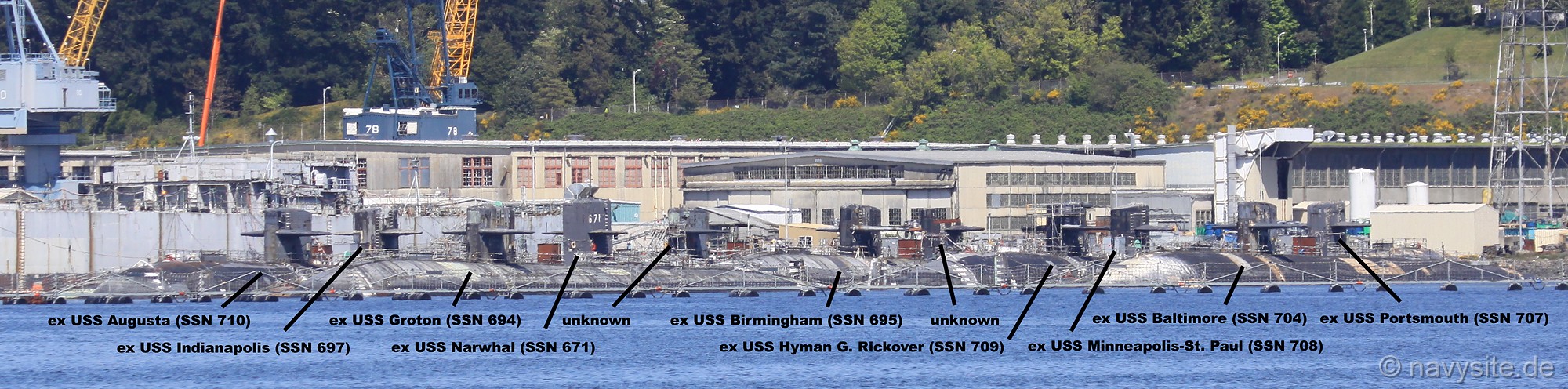
The photo below was taken by me and shows a number of decommissioned nuclear-powered attack submarines laid up at the Puget Sound Naval Shipyard, Bremerton, Wash. The photo was taken from Port Orchard, Wash., on May 12, 2012. The submarines' names are on the photo.
 back to top
 Back to Submarines list. Back to ships list. Back to selection page. Back to 1st page.