Search the Site with

|
Search the Site with
|
 General Characteristics Crew List Memorabilia Cruise Books About the Coat of Arms About the Ship's Name History Homeports of USS Stout Image Gallery to end of page
 |  |  |
USS STOUT is the fifth ARLEIGH BURKE-class guided missile destroyer and the first U.S. Navy ship named in honor of Rear Admiral Herald F. Stout, U.S. Navy (1903-1987), who was awarded two Navy Crosses for heroism while in command of the destroyer USS CLAXTON (DD 571) during World War Two.
| General Characteristics: | Keel Laid: August 8, 1991 |
| Launched: October 16, 1992 | |
| Commissioned: August 13, 1994 | |
| Builder: Ingalls Shipbuilding, West Bank, Pascagoula, Miss | |
| Propulsion system: four General Electric LM 2500 gas turbine engines | |
| Propellers: two | |
| Blades on each Propeller: five | |
| Length: 505,25 feet (154 meters) | |
| Beam: 67 feet (20.4 meters) | |
| Draft: 30,5 feet (9.3 meters) | |
| Displacement: approx. 8.300 tons full load | |
| Speed: 30+ knots | |
| Aircraft: None. But LAMPS 3 electronics installed on landing deck for coordinated DDG/helicopter ASW operations. | |
| Armament: two | |
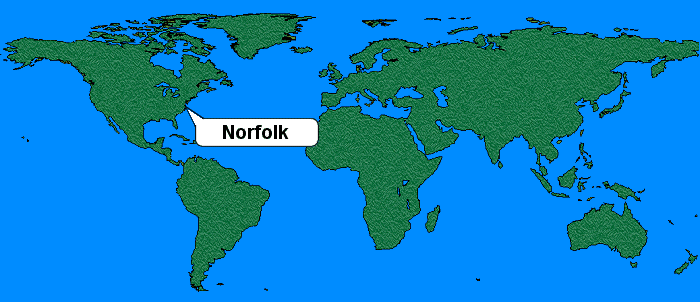
| Homeport: Norfolk, Va. | |
| Crew: 23 Officers, 24 Chief Petty Officers and 291 Enlisted |
 back to top go to the end of the pageback to top go to the end of the page
Crew List:
This section contains the names of sailors who served aboard USS STOUT. It is no official listing but contains the names of sailors who submitted their information.
back to top go to the end of the pageback to top go to the end of the pageUSS STOUT Cruise Books:
back to top go to the end of the pageAbout the Ship's Coat of Arms:
 (Click on the coat of arms for a larger version)
The Shield:
The battle-axe is adapted from the Stout family's coat of arms. Its upright position underscores Stout's massive firepower and high survivability while the double axe head, facing both ways, alludes to the all-encompassing offensive and defensive power of the integrated AEGIS combat system. The star highlights Admiral Stout's many awards, as well as reference to the Silver Star. With resolute courage and daring aggressiveness, Admiral Stout, as Commanding Officer of the destroyer USS CLAXTON, aided his task force in sinking five heavily armed, enemy warships to establish our beachhead on Bougainville Island. This Naval battle is symbolized by the wedge piercing the field of the shield; the wedge representing Admiral Stout and United States Naval force disabling and destroying a surface force of superior firepower, signified by the field.
The Crest:
The cross suggests the Navy Cross, one of many decorations awarded to Admiral Stout; and exemplifies the strong devotion to God and Country that characterized Admiral Stout's Naval career. It is inflamed to recall the fierce bombardment of the naval battle in the Solomon Islands. The lion, a symbol of courage, strength and tactical hunting skills, commemorates Rear Admiral Stout and the men and officers who served under his leadership.
back to top go to the end of the pageAbout the Ship's Name:
Rear Admiral Herald Franklin Stout was born on June 15, 1903, in Dover, Ohio, the son of Franklin Lee Stout and Jemima Mae Tong Stout. After graduating as valedictorian of Roosevelt High School in Dover, he entered the United States Naval Academy at Annapolis, Maryland, in 1922. He graduated and was commissioned an Ensign on June 3, 1926. On the same day, he married Louise Frederica Finley, with whom he later had three sons.
Following graduation, Stout reported aboard the light cruiser USS CINCINNATI (CL 6), where he served in various engineering, communications and gunnery assignments. In June 1931, he transferred to the destroyer USS BRECKINRIDGE (DD 148) as Torpedo and Communications Officer. A year later, he joined USS HATFIELD (DD 231), serving as Torpedo Officer and First Lieutenant until April 1933. He subsequently attended the Naval Postgraduate School at Annapolis and, from May 1934 to June 1936, served as an instructor in electrical engineering and physics at the Naval Academy.
In June 1936, Stout returned to sea as Executive Officer and Navigator of USS ELLIOT (DD 146). He remained aboard until 1939, when he returned to the Naval Academy as an instructor. Following specialized training at the Mine Warfare School in Yorktown, Virginia, he assumed command of the destroyer minelayer USS BREESE (DM 18). When Japanese aircraft attacked Pearl Harbor on December 7, 1941, BREESE was moored in the harbor. Her antiaircraft gunners were credited with shooting down one Japanese aircraft, and the ship subsequently participated in a depth-charge attack against a Japanese midget submarine.
In September 1942, Stout was assigned to command the new FLETCHER-class destroyer USS CLAXTON (DD 571), which was commissioned on December 8, 1942. After initial Atlantic service, CLAXTON transferred to the Pacific in May 1943 and joined Destroyer Squadron 23, known as the "Little Beavers," during the Solomon Islands campaign. The squadron participated in a series of surface engagements, shore bombardments and operations supporting Allied landings.
During the night of November 1-2, 1943, Stout commanded CLAXTON in the Battle of Empress Augusta Bay, fought against Japanese naval forces attempting to attack the American landing area on Bougainville. CLAXTON formed part of the American destroyer force that engaged the Japanese ships and helped prevent them from disrupting the landings. Stout was awarded the Navy Cross for his actions during the battle.
CLAXTON continued combat operations around Bougainville during November 1943. During the night of November 16-17, Stout maneuvered his destroyer close to dangerous reefs while bombarding Japanese installations at Buka, enabling the ship's guns to engage their targets effectively. Later that month, CLAXTON participated in the Battle of Cape St. George on November 24-25, when American destroyers intercepted and defeated a Japanese force attempting to reinforce positions in the northern Solomon Islands. For his service commanding CLAXTON during the Solomon Islands campaign, Stout received a second Navy Cross. He was also entitled to the Presidential Unit Citation awarded to Destroyer Squadron 23.
In March 1944, Stout relinquished command of CLAXTON and became Commander, Destroyer Division 10. During the Allied campaign to liberate the Philippines, he directed destroyer operations in support of amphibious landings and naval bombardments. On December 7, 1944, during fighting in Ormoc Bay, Leyte, his division provided gunfire support and air defense while Japanese aircraft attacked the American landing forces. For his leadership during the engagement, Stout received the Silver Star. His wartime decorations also included recognition for earlier bombardment operations in the Solomon Islands.
From February 1945 until January 1946, Stout commanded Destroyer Squadron 56. Following the end of World War II, he served as Chief Staff Officer to Commander, San Francisco Group, Pacific Reserve Fleet. In June 1948, he assumed command of the destroyer tender USS SIERRA (AD 18). Between September 1949 and January 1952, he held assignments involving naval industrial facilities and material administration at the Navy Department in Washington, D.C.
In January 1952, during the Korean War, Stout became Commander, Mine Squadron 3, Commander, Western Pacific Minesweeping Force, and Commander, Task Group 95.6. His responsibilities included coordinating minesweeping operations, maintaining cleared approach channels, supporting naval blockades and assisting amphibious operations along the Korean coast. His forces also participated in rescue operations, provided assistance to the Republic of Korea Navy and supported naval activities directed against North Korean supply routes. For his service in Korean waters from February 1952 to February 1953, he received the Navy Distinguished Service Medal.
In April 1953, Stout was assigned as Assistant Chief of Staff for Logistics to the Commandant of the Eleventh Naval District in San Diego, California. He also served as District Plans Officer and, during 1956, as Acting Commandant of the district. On June 30, 1956, he retired from active naval service and was advanced to the rank of Rear Admiral on the retired list in recognition of his combat decorations.
Following retirement, Stout worked as a senior reliability design engineer for Convair, a division of General Dynamics involved in the development and production of the Atlas missile. He later worked as a reliability engineer for the company's Astronautics Division. After the death of his first wife, he married Zoe E. Anderson in 1976.
Rear Admiral Herald Franklin Stout died on March 23, 1987, in La Mesa, California, at the age of 83. His naval career included service during the attack on Pearl Harbor, combat operations in the Solomon Islands and the Philippines, and command responsibilities during the Korean War.
back to top go to the end of the page

back to top go to the end of the pageUSS STOUT History:
USS STOUT was laid down at Ingalls Shipbuilding in Pascagoula, Mississippi, on August 8, 1991. She was launched on October 16, 1992, sponsored by Bettie M. Boorda, wife of Admiral Jeremy M. Boorda, and delivered to the U.S. Navy on May 16, 1994. The destroyer was commissioned at the Port of Houston, Texas, on August 13, 1994, with Commander Carl E. Garrett, Jr., as her first commanding officer. Named in honor of Rear Admiral Herald F. Stout, she followed the destroyer design first introduced by USS ARLEIGH BURKE (DDG 51) and was assigned to Norfolk, Virginia, as her homeport.
Following commissioning, STOUT proceeded through shakedown training, combat-system evaluations and engineering inspections, preparing her Aegis combat system, propulsion plant and weapons for fleet service. Her early underway periods, commissioning activities and post-shakedown work were recorded in the ship's 1994-95 cruise book. During 1995, the destroyer continued exercises in the western Atlantic and Caribbean operating areas in preparation for her first major deployment with an aircraft carrier battle group.
In late January 1996, STOUT deployed from Norfolk with the USS GEORGE WASHINGTON (CVN 73) Battle Group for operations in the Mediterranean Sea and Persian Gulf. The carrier departed Norfolk on January 26, and its surface escorts included STOUT, USS BARRY (DDG 52) and USS SAN JACINTO (CG 56). In the Adriatic Sea, the battle group supported NATO's Operation Joint Endeavor, conducted following the Dayton Peace Agreement and the deployment of the Implementation Force in Bosnia and Herzegovina. STOUT conducted air-defense and escort assignments and participated in allied exercises before proceeding through the Suez Canal for operations in the Persian Gulf in support of Operation Southern Watch.
On May 30, 1996, STOUT was in the Mediterranean when the fleet oiler USS MERRIMACK (AO 179) suffered a boiler casualty during engineering training; STOUT was in the area and available to assist if required. During the homeward portion of the deployment, the battle group returned through the Mediterranean and across the Atlantic. STOUT completed the deployment in July 1996, and GEORGE WASHINGTON arrived back at Norfolk on July 23. The destroyer subsequently resumed maintenance and operational training from her homeport.
Throughout 1997 and the first part of 1998, STOUT conducted readiness evaluations, air-defense exercises, engineering training and operations in the western Atlantic. The ship visited Halifax, Nova Scotia, in June 1997 and was back at Norfolk in July 1998. She continued integrated exercises in preparation for another deployment with a carrier battle group.
On November 6, 1998, STOUT deployed with the USS ENTERPRISE (CVN 65) Battle Group for operations in the Mediterranean Sea and Persian Gulf. The force included USS PHILIPPINE SEA (CG 58), USS GETTYSBURG (CG 64), USS NICHOLSON (DD 982), USS KLAKRING (FFG 42) and USS DETROIT (AOE 4). After crossing the Atlantic, the group entered the Mediterranean and continued through the Suez Canal to the Middle East. During Operation Desert Fox, conducted against Iraqi targets from December 16 to 19, aircraft from ENTERPRISE carried out strikes while STOUT performed escort and air-defense duties. The destroyer continued operations associated with Operation Southern Watch before returning to the United States in the spring of 1999. The deployment is documented in her 1998-99 Mediterranean and Arabian Sea cruise book.
During 2000, STOUT conducted exercises and training in the western Atlantic and along the Canadian coast. On July 5, she departed with USS GONZALEZ (DDG 66) for a training cruise to Halifax, Nova Scotia, where the ships arrived on July 7. Following further Atlantic Fleet operations and deployment preparations, STOUT joined the ENTERPRISE Battle Group for its next overseas cruise in 2001.
The ENTERPRISE Battle Group deployed from Norfolk on April 25, 2001, to the Mediterranean and Middle East. STOUT operated in the surface screen, performing air-defense, antisubmarine, escort and maritime-security assignments and maintaining readiness for Tomahawk strike operations. After the terrorist attacks on the United States on September 11, the carrier group was directed to support Operation Enduring Freedom. STOUT remained involved in the battle group's operations during the ensuing period before resuming duties from Norfolk after the deployment.
In 2002, STOUT continued Atlantic Fleet exercises, including operations with elements of the GEORGE WASHINGTON Battle Group. On May 8, she conducted a towing exercise with USS MONTEREY (CG 61) in the Caribbean Sea. Additional training and readiness work followed in preparation for an independent Mediterranean deployment.
On June 16, 2003, STOUT departed Norfolk with the guided missile frigate USS NICHOLAS (FFG 47) for a deployment to the Mediterranean Sea. The ships were assigned to maintain a U.S. naval presence, participate in exercises with allied forces and undertake maritime-security duties. During the deployment, STOUT operated with Standing Naval Force Mediterranean and visited Genoa, Italy, in November, followed by Trieste later that month. After completing her Mediterranean assignment, she returned to Norfolk and resumed training with the Atlantic Fleet.
During 2004, STOUT conducted regional training, maintenance and preparations for the Navy's Sea Swap initiative. On September 9, 2005, her crew departed Norfolk to relieve the crew then serving aboard GONZALEZ in the Fifth Fleet area of responsibility. The replacement personnel passed through Rota, Spain, in mid-September before taking over the deployed destroyer. The rotation also involved the crew of USS LABOON (DDG 58) and allowed GONZALEZ to remain forward deployed while its crews changed. The operation was a deployment of STOUT's sailors aboard GONZALEZ, not a deployment of STOUT herself.
After resuming shipboard training, STOUT participated in Partnership of the Americas 2006 with the GEORGE WASHINGTON Strike Group. She conducted antisubmarine and multinational exercises in the Caribbean and Latin American operating areas during the spring and returned to Norfolk on May 24, 2006. The remainder of the year included maintenance, inspections and preparations for another overseas deployment.
In 2007, STOUT deployed with the ENTERPRISE Carrier Strike Group to the Mediterranean, Indian Ocean and Fifth Fleet area of responsibility. While operating under Combined Task Force 150 in international waters off Somalia, she responded on September 25-26 to a distress call from the Tanzanian-flagged ferry SPICE ISLAND, which was en route from Oman to Tanzania without passengers and had exhausted its fuel. A helicopter from USS JAMES E. WILLIAMS (DDG 95) reached the ferry first and established communications. STOUT arrived that night, and on September 26 a boarding team inspected the vessel. The destroyer took the ferry under tow while its crew supplied food, water and approximately 7,800 gallons of fuel to the ten mariners aboard. After engineering assistance restored propulsion, SPICE ISLAND resumed her passage. STOUT continued her maritime-security assignments during the deployment.
From March 10 to 14, 2008, STOUT underwent a Board of Inspection and Survey (INSURV) material inspection that identified serious deficiencies. The resulting assessment found the ship unfit for sustained combat operations. The findings, reported publicly in April, led to additional maintenance, corrective work and follow-on readiness measures. USS CHOSIN (CG 65) was also cited for unsatisfactory results during the same period.
During a 2009 deployment to the U.S. Sixth Fleet area of responsibility, STOUT operated in the Mediterranean and Black Seas, conducting maritime-security and partnership activities. She arrived at Batumi, Georgia, on July 14 and completed visit, board, search and seizure and damage-control training with the Georgian Coast Guard. On July 17, she proceeded to Poti, where she remained until July 19 and participated in further cooperative exercises. Later in July she visited Constanta, Romania, and also operated in Bulgarian waters, including a visit to Varna, before returning to the Mediterranean. The ship completed the deployment and returned to Norfolk later in 2009.
In October 2010, STOUT took part in the multinational Exercise Joint Warrior in waters off the United Kingdom and conducted port visits in northern Europe. She returned to Norfolk on October 28 following the exercise. On December 15, the destroyer departed again for a deployment to the U.S. Sixth Fleet area of responsibility, conducting ballistic missile-defense and maritime-security assignments in the Mediterranean.
On March 19, 2011, STOUT launched Tomahawk land-attack missiles against targets in Libya during the opening phase of Operation Odyssey Dawn, conducted following United Nations Security Council Resolution 1973. U.S. Navy vessels involved in the initial attacks also included USS BARRY, USS PROVIDENCE (SSN 719), USS SCRANTON (SSN 756) and USS FLORIDA (SSGN 728). STOUT subsequently continued patrol, air-defense and maritime-security operations in the Mediterranean and returned to Norfolk on June 18, 2011, after a six-month deployment.
Following maintenance and training during 2012 and the first half of 2013, STOUT departed Norfolk on August 18, 2013, for an independent deployment to the Mediterranean Sea. The ship operated in the eastern Mediterranean during heightened tensions over the civil war in Syria and provided a ballistic missile-defense presence. She conducted maritime-security patrols and exercises with allied and partner navies and visited Limassol, Cyprus, in December 2013. In January 2014, she carried out gunnery exercises and visited Haifa, Israel; in February she called at Split, Croatia.
On March 16, 2014, U.S. Navy SEALs operating from USS ROOSEVELT (DDG 80) boarded and secured the tanker MORNING GLORY in international waters southeast of Cyprus. The vessel had been seized by armed Libyans after taking aboard oil belonging to Libya's national oil company without authorization. STOUT dispatched a team of sailors to the tanker to relieve the SEALs and oversee its movement toward Libya. On March 19, USS ELROD (FFG 55) relieved STOUT in this task and took over the escort and embarked security personnel. STOUT returned to Norfolk on April 4, 2014, following an approximately eight-month deployment in the Sixth Fleet area of responsibility.
The ship subsequently resumed maintenance and readiness training along the East Coast. In March 2016, she conducted small-boat defense exercises in preparation for another deployment. On May 14, 2016, STOUT departed Norfolk ahead of the DWIGHT D. EISENHOWER (CVN 69) Carrier Strike Group's deployment to the Mediterranean and Middle East. The destroyer participated in the Cyprus-hosted multinational search-and-rescue exercise Argonaut and arrived at Limassol on June 1 for a scheduled port visit. She then continued into the Fifth Fleet area of responsibility to conduct ballistic missile-defense and maritime-security operations, also supporting Operation Inherent Resolve.
During the second half of 2016, STOUT operated in the Persian Gulf and surrounding waters, visiting Bahrain in August and conducting an underway replenishment with USNS ARCTIC (T-AOE 8) on September 9. The destroyer participated in escort, air-defense and maritime-security assignments before returning through the Mediterranean and Atlantic. She arrived at Norfolk on November 13, 2016, after 183 days away, having steamed more than 36,000 nautical miles. On May 19, 2017, Commander Daniel Broadhurst relieved Commander Adam Cheatham as commanding officer; the ship subsequently underwent a maintenance availability and returned to training.
Throughout 2018 and 2019, STOUT continued maintenance, certification exercises and local operations along the U.S. East Coast. On June 12, 2019, she arrived at Nassau, Bahamas, for a scheduled port visit. Further workups prepared the destroyer for a deployment with the DWIGHT D. EISENHOWER Carrier Strike Group early the following year.
STOUT departed Norfolk in mid-January 2020, initially participating in the DWIGHT D. EISENHOWER Carrier Strike Group's Composite Training Unit Exercise before continuing across the Atlantic. After a logistical stop at Rota, Spain, in late February, she deployed to Fifth and Sixth Fleet waters, providing escort and maritime-security support to the DWIGHT D. EISENHOWER and USS NIMITZ (CVN 68) carrier strike groups, the USS BATAAN (LHD 5) Amphibious Ready Group and Coalition Task Force Sentinel. As COVID-19 restrictions curtailed port visits, STOUT remained continuously underway from early March until October 3, 2020, when she moored at Rota after 215 consecutive days at sea, a record for the U.S. Navy at that time. The ship was sustained by 36 replenishments at sea and carried out an extended period of maintenance while still underway. STOUT returned to Norfolk on October 12, ending a deployment of nearly nine months.
On November 16, 2020, BAE Systems received a contract for a major Docking Selected Restricted Availability (DSRA) for STOUT at Norfolk. The ship entered the associated maintenance program in 2021; in June, the Navy documented preparations to dock her at the BAE Systems yard. The work involved preservation and repairs to the hull, tanks and propulsion machinery, along with electrical and electronic system improvements. On June 11, 2021, Commander Tammy McCreary relieved Commander Richard Eytel as commanding officer. Repairs and equipment modernization continued through 2022, with the destroyer still at the yard in September of that year.
In June 2023, STOUT began resuming operations at sea after more than two years of extended maintenance. On June 2, Commander Jeffrey Applebaugh was relieved of command by Captain Blair Guy, with Captain Scott Rosetti subsequently assigned as interim commanding officer. On July 21, Commander Desmond Walker assumed command during a ceremony at Naval Station Norfolk. The destroyer continued post-availability trials, crew training and operational certifications for the remainder of 2023.
In April 2024, STOUT participated in a group-sail exercise off the U.S. East Coast with Carrier Strike Group Eight, led by USS HARRY S. TRUMAN (CVN 75). On April 29, while operating off North Carolina, the ship received a request for medical assistance from the merchant vessel GRANDE PORTOGALLO after a crew member was injured by hot fuel oil. STOUT sent a medical team aboard by rigid inflatable boat and coordinated with the U.S. Coast Guard, which evacuated the injured mariner by helicopter. The destroyer resumed training and preparations for the carrier strike group's overseas deployment.
In late September 2024, STOUT departed Norfolk for operations with the HARRY S. TRUMAN Carrier Strike Group, which also included USS GETTYSBURG and USS JASON DUNHAM (DDG 109). The force conducted exercises in the North Atlantic and waters around northern Europe before moving south toward the Mediterranean. STOUT visited Brest, France, in November, where Navy Cargo Handling Battalion 1 conducted a vertical launching system ammunition offload and reload using live ordnance as part of an expeditionary logistics demonstration with French support. On December 13, the destroyer conducted an underway replenishment with the French fleet replenishment ship JACQUES CHEVALLIER in the Mediterranean.
In January and February 2025, STOUT operated in the Red Sea and adjacent waters in support of Combined Maritime Forces' Combined Task Force 153. Her sailors conducted maritime-security patrols, observed merchant traffic and practiced visit, board, search and seizure procedures in coordination with the multinational force. The ship also supported the wider HARRY S. TRUMAN Carrier Strike Group deployment in Fifth and Sixth Fleet waters, conducting replenishments, flight operations and other underway training while assigned to maritime-security duties. STOUT returned to Naval Station Norfolk on June 1, 2025, after an approximately eight-month deployment, and subsequently entered a post-deployment maintenance and training period.
On September 21, 2026, STOUT departed Norfolk on another scheduled overseas deployment under the command of Commander Kevin Taylor. The destroyer entered the U.S. Sixth Fleet area of responsibility and arrived at Agadir, Morocco, on October 11 for a port visit. Later in the month, she called at Augusta Bay, Sicily. On October 25, while alongside in Augusta Bay, an engineering casualty interrupted electrical power aboard the ship. Essential systems were restored within approximately 36 hours, and full power was reestablished within three days. Following repairs, STOUT continued her scheduled deployment in the Mediterranean Sea.
back to top go to the end of the pageHomeports of USS STOUT:
| Period | Homeport |
|---|---|
| commissioned at Houston, Tx. | |
| 1994 - present | Norfolk, Va. |
back to top go to the end of the pageUSS STOUT Image Gallery:
 |  |  |
The photo below was taken by Karl-Heinz Ahles and shows USS STOUT at Norfolk, Va, on May 11, 1999.
 |
The photos below were taken by me and show the USS STOUT at Naval Base Norfolk, Va, on November 9, 2008.
 |  |  |  |
The photos below were taken by me and show the USS STOUT passing the Chesapeake Bay Bridge Tunnel on her way to Naval Base Norfolk, Va, on October 28, 2010. The STOUT is returning home after participating in exercise Joint Warrior held off Great Britain earlier in October. The last photo shows the STOUT moored at Naval Base Norfolk on October 29.
 |  |  |  |  |
 |
The photos below were taken by me and show the USS STOUT at Naval Base Norfolk, Va, on May 6, 2012.
 |  |
The photo below was taken by Michael Jenning and shows the USS STOUT at Naval Weapons Station Yorktown, Va, on May 8, 2014.
 |
The photos below were taken by Michael Jenning and show the USS STOUT at Naval Base Norfolk, Va, on April 29, 2015.
 |  |  |
The photos below were taken by Michael Jenning and show the USS STOUT at Naval Base Norfolk, Va, on October 6, 2015.
 |  |  |  |
The photos below were taken by Michael Jenning and show the USS STOUT at Naval Base Norfolk, Va, on October 4, 2017.
 |  |
The photos below were taken by Michael Jenning and show the USS STOUT at Naval Base Norfolk, Va, on September 21, 2018.
 |  |  |
The photos below were taken by Michael Jenning and show the USS STOUT at the BAE Systems shipyard in Norfolk, Va, on September 6, 2022. Note the painting on the forward 5-inch mount.
 |  |
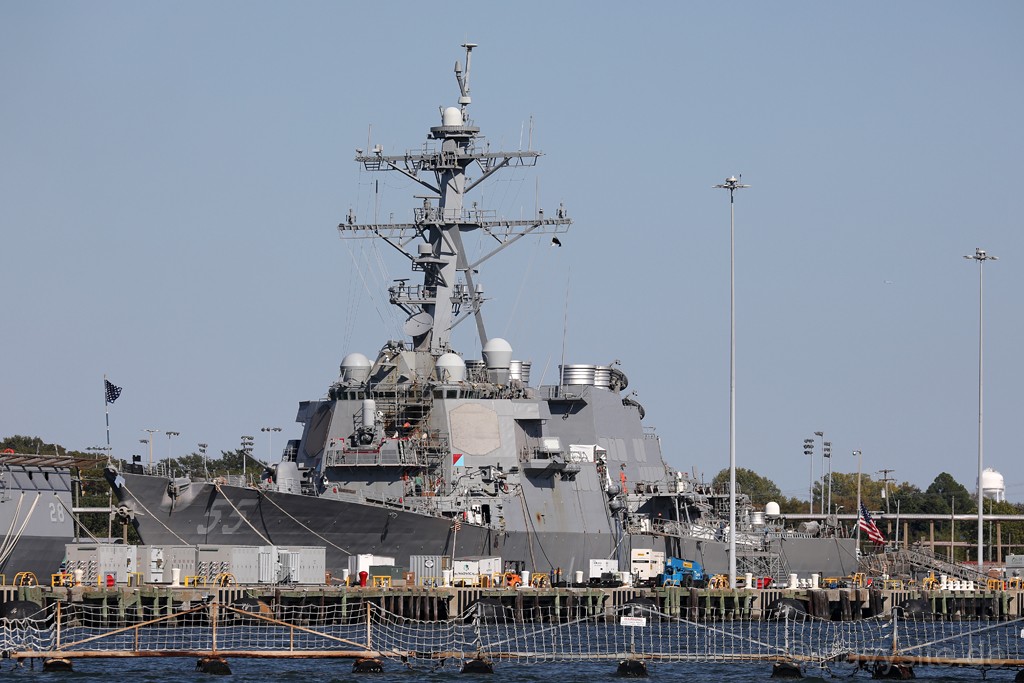
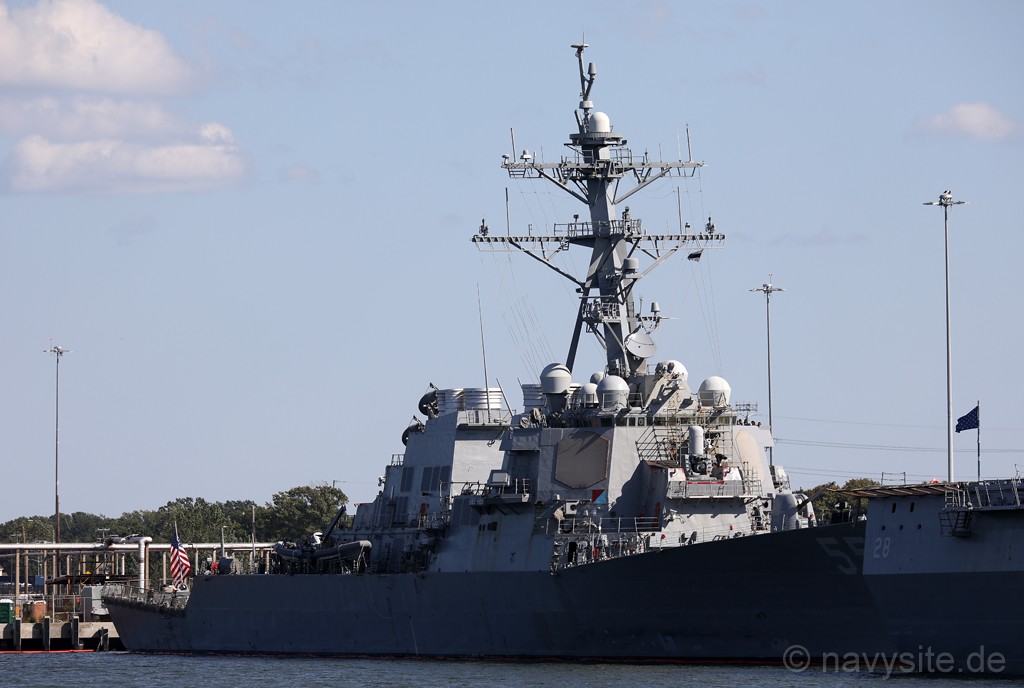
The photos below were taken by Michael Jenning and show the USS STOUT at Naval Base Norfolk, Va., on October 9, 2023.
 |  |
back to top
 Back to Destroyers list. Back to ships list. Back to selection page. Back to 1st page.