Search the Site with 
General Characteristics Crew List Memorabilia Cruise Books Accidents aboard USS Nicholson Patch Gallery About the Name "Nicholson" History Image Gallery to end of page

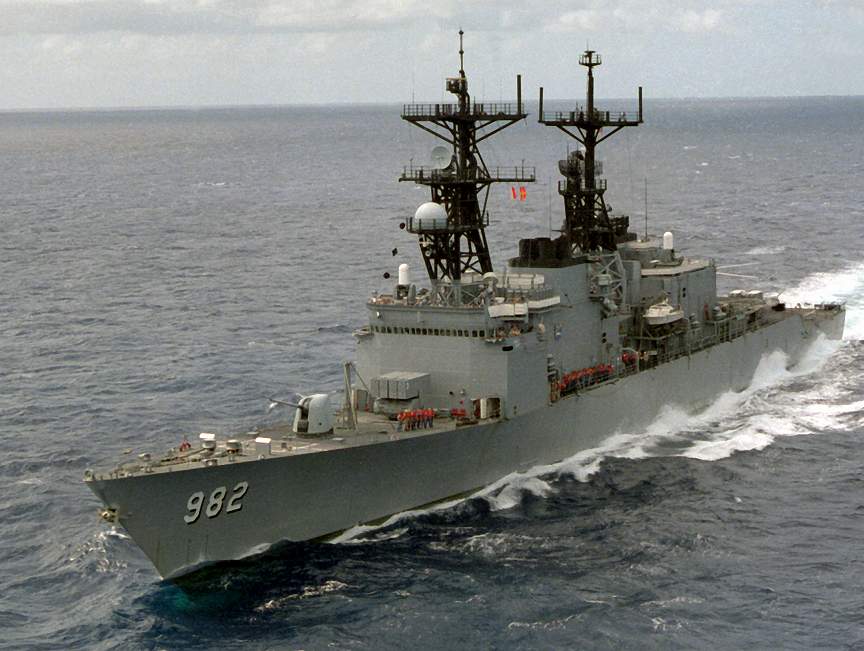
USS Nicholson (DD 982)

- decommissioned -
- sunk as a target -


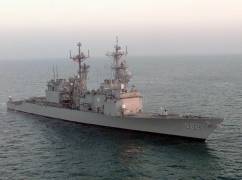
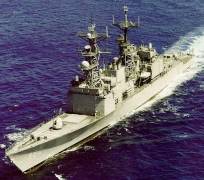
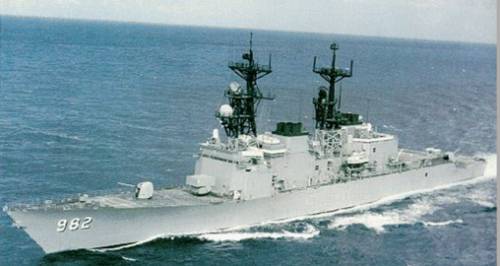
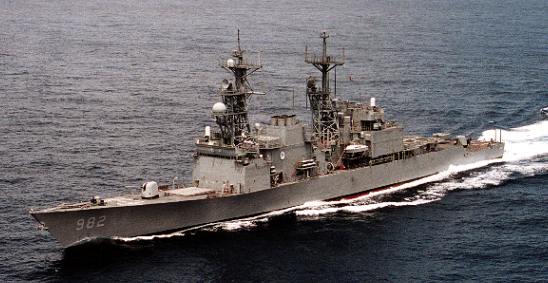
USS NICHOLSON was the 20th ship in the SPRUANCE class and the fourth ship in the Navy to bear the name.

Originally homeported in Charleston, S.C., as part of Destroyer Squadron 6, NICHOLSON was later transferred to Norfolk Naval Shipyard, Portsmouth, Va., as part of Destroyer Squadron 18, and finally to Naval Station Norfolk.

Sailing on 11 deployments and wetting her keel in every ocean of the world, NICHOLSON has been awarded the Joint Meritorious Unit Award, Meritorious Unit Commendation, Navy Battle Efficiency Ribbon (five awards), National Defense Service Medal (two awards), Armed Forces Expeditionary Medal (four awards), Southwest Asia Service Medal (two awards), Sea Service Deployment Ribbon (eleven awards), Navy Arctic Service Ribbon and the Coast Guard Special Operations Service Ribbon (two awards).

On November 18, 1980, NICHOLSON started its first deployment and in 1999, she supported NATO Operation Allied Force by firing Tomahawk missiles on Yugoslav ground targets. Decommissioned on December 18, 2002, and stricken from the Navy list on April 6, 2004, the NICHOLSON was sunk as a target on July 30, 2004.

General Characteristics:Awarded: January 15, 1974
Keel laid: February 20, 1976
Launched: November 29, 1977
Christened: January 28, 1978
Commissioned: May 12, 1979
Decommissioned: December 18, 2002
Builder: Ingalls Shipbuilding, West Bank, Pascagoula, Miss.
Propulsion system: four General Electric LM 2500 gas turbine engines
Propellers: two
Blades on each Propeller: five
Length: 564,3 feet (172 meters)
Beam: 55,1 feet (16.8 meters)
Draft: 28,9 feet (8.8 meters)
Displacement: approx. 9,200 tons full load
Speed: 30+ knots
Aircraft: two SH-60B Seahawk (LAMPS 3)
Armament: two Mk 45 5-inch/54 caliber lightweight guns, one Mk 41 VLS for Tomahawk, ASROC and Standard missiles, Mk 46 torpedoes (two triple tube mounts), Harpoon missile launchers, one Sea Sparrow launcher, one Rolling Airframe Missile (RAM) System, two 20mm Phalanx CIWS
Crew: approx. 340


Back to topback to top  go to endgo to the end of the page


Back to topback to top  go to endgo to the end of the page

Crew List:

This section contains the names of sailors who served aboard USS NICHOLSON. It is no official listing but contains the names of sailors who submitted their information.


back to top  go to the end of the page


Back to topback to top  go to endgo to the end of the page

USS NICHOLSON Cruise Books:


Back to topback to top  go to endgo to the end of the page


Back to topback to top  go to endgo to the end of the page

Accidents aboard USS NICHOLSON:

DateWhereEvents
August 27, 2000100 miles east off Norfolk, Va.
USS NICHOLSON collided with the Fast Combat Support Ship USS DETROIT (AOE 4) early Sunday night during a refueling maneuver. The destroyer sustained light damage on the port side of its helicopter hangar about 8:45 p.m. when it bumped the starboard side of the USS DETROIT (AOE 4), officials said. Damage to the Detroit was negligible, they said.
A handful of sailors from the NICHOLSON suffered minor injuries, the Navy reported: an injured ankle, possible shock, an elbow injury, possible torn knee ligaments, and a head cut that required stitches.
In the incident, the NICHOLSON and the DETROIT were steaming alongside each other, as is customary during a replenishment at sea. While the maneuver was described as a training session for the crews of both ships, it also involved an actual fuel transfer. No cause for the accident has been released. The weather was not a significant factor. The weather there was good at the time of the mishap, with seas 2 to 4 feet, light southeast winds and unlimited visibility.
Normally, during an at-sea refueling there is a separation of 90 to 180 feet between the two ships. A refueling ship such as the DETROIT generally maintains a set course and speed while the ship being refueled approaches it from astern, then matches the refueling ship's course and speed. Fuel lines are then transferred to begin the refueling.
After a similar collision with two other Navy ships just two month before some experts warned of a phenomenon called the "Venturi Effect," in which a powerful suction is created near the stern area of one ship that can pull in an overtaking vessel at close quarters, causing a collision.
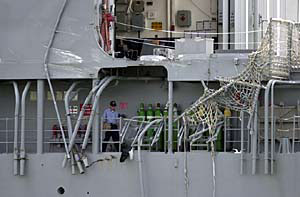
The damage aboard USS NICHOLSON.


Back to topback to top  go to endgo to the end of the page

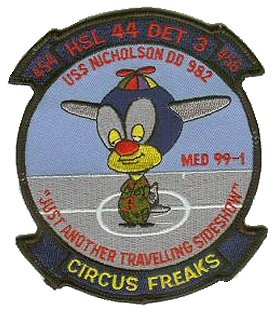
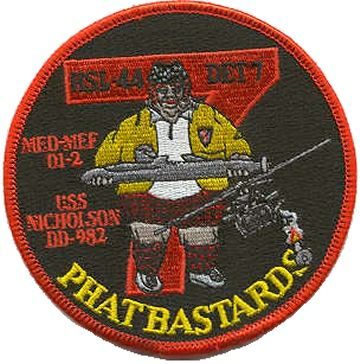
USS NICHOLSON Patch Gallery:

HSL-44 Det 3 - MED 99-2HSL-44 Det 7 - MED 01-2


Back to topback to top  go to endgo to the end of the page

About the Ship's Name, about the Nicholson Family:

USS NICHOLSON is the fourth Navy ship to be named for the five members of the Nicholson family renowned in American naval history. The original three brothers, James, Samuel and John, served with great distinction during the Revolutionary War. In the next generation, John's son, William, served during both the War of 1812 and the Civil War, and likewise in the third generation, Samuel's grandson, James, served during the Civil War.

Captain James Nicholson (1737 - 1804) was the senior Continental Navy Captain in the Revolutionary War. Prior to receiving his commission in the Continental Navy, he served in the Colonial Navy with the British and was present during the assault on Havana in 1762. During the Revolutionary War, he commanded three ships of the line: DEFENSE, TURNBULL and VIRGINIA. Most notable, when his ship was blockaded at Baltimore, Captain Nicholson took his men to join Washington at Trenton, and aided in that victory.

Captain Samuel Nicholson (1732 - 1811) first served under John Paul Jones in the BON HOMME RICHARD. Later, while in command of DEAN, he brilliantly captured three British sloops-of-war. He assumed duties of Superintendent of the construction of the CONSTITUTION ("OLD IRONSIDES") and served on board as her first Commanding Officer.

Captain John Nicholson (1756 - 1844) was commissioned a Lieutenant in the Continental Navy in October 1776, and the next month was promoted to Captain to command the sloop HORNET. After the war, he was active in public affairs in the State of Maryland.

Captain William C. Nicholson (1800 - 1872) entered the Navy as a Midshipman in 1812. He served under Stephen Decatur during the War of 1812, and later commanded the steam frigate ROANOKE during the Civil War.

Admiral James W. C. Nicholson (1821 - 1887) participated in Commodore Mathew G. Perry's Japanese Expedition of 1853. During the Civil War, he commanded the ISAAC SMITH, SHAMROCK, MANHATTAN and MOHONGO. As an Admiral, he commanded a European Station from 1881 to 1883. During the British bombardment of Alexandria, Egypt in 1882, he rescued the records of the American Consulate, and evacuated many American and European officials. He received numerous commendations and awards, both at home and abroad, for his operation.

The Nicholson name was carried to sea in the service of America by either a family member or ship named for the family in each major naval conflict up to, and including, World War II. It is most appropriate that this tradition by resumed by DD 982 in a class of ships, which, for the most part, carry the names of Americans of Distinguished Naval Service.


Back to topback to top  go to endgo to the end of the page

USS NICHOLSON History:

USS NICHOLSON was built at Ingalls Shipbuilding, Pascagoula, Mississippi, her keel laid on 20 February 1976, launched on 29 November 1977, christened on 28 January 1978, and commissioned on 12 May 1979. She entered the Atlantic Fleet based at Charleston, South Carolina, beginning her post-commissioning trials and local training while building toward an initial overseas deployment.

After work-ups through 1980, NICHOLSON commenced her first extended deployment on 18 November 1980. The cruise established the ship's operating rhythm for the early 1980s: blue-water transits, multi-ship exercises, and presence operations with allied navies, followed by intermediate maintenance and refresher training from Charleston.

In 1983, the destroyer deployed to the Persian Gulf with the Middle East Force amid the Iran-Iraq War's "Tanker War" phase, operating in the Red Sea, Gulf of Aden, Arabian Sea and the Gulf in support of regional stability and sea-lane security. Homeward bound late in the deployment she refueled at Djibouti, transited the Suez Canal, and made a liberty call at Barcelona, Spain. Heavy North Atlantic seas on the westbound crossing damaged her bow sonar dome, necessitating repair.

From May 1984 through February 1985, NICHOLSON completed a major maintenance availability at the Brooklyn Navy Yard that incorporated sonar-dome repairs and scheduled upgrades and preservation. After sea trials, she returned to Charleston and immediately began a post-availability readiness sequence: Combat Systems Ship Qualification Trials, dedicated anti-submarine warfare exercises in the Caribbean, and refresher training at Guantanamo Bay to certify for deployment.

By the mid-1980s, NICHOLSON had resumed forward operations across the Mediterranean-Indian Ocean-Persian Gulf arc. A documented six-month deployment ran from April 1986 to October 1986, consistent with the heightened, routine rotation of Atlantic Fleet destroyers into the Gulf during the later stages of the Iran-Iraq War. Her cycle included a dependents' day cruise at the outset, followed by long stretches of patrols and exercises with embarked LAMPS detachment flight operations in warm-weather theaters before returning to Charleston for upkeep.

In the second half of 1988, NICHOLSON shifted from Middle East duty to the Western Hemisphere, transiting the Panama Canal in July and joining UNITAS XXIX, the annual multinational circumnavigation of South America. From July to December 1988 she worked anti-submarine and surface-action problems with partner navies, executed extensive port-visit diplomacy, and crossed the Equator (shellback initiation on 20 August 1988) while operating in both the Pacific and Atlantic during the cruise. She closed the year back on the U.S. East Coast for post-deployment maintenance.

With regional tensions rising again in the Gulf at the turn of the decade, NICHOLSON deployed with the Middle East Force in February 1990 for a six-month tour alongside the guided-missile destroyer DAHLGREN (DDG 43). The ship's duties combined patrol and escort work through the Strait of Hormuz and northern Gulf with maritime interception and coalition coordination. Two incidents stood out: on one transit a pair of armed Iranian F-4s overflew the ship, and as the deployment concluded, NICHOLSON and DAHLGREN cleared the theater roughly a week before Iraq's invasion of Kuwait on 2 August 1990. She returned to Charleston late summer 1990 and entered an intensive inter-deployment training cycle while the coalition's DESERT SHIELD buildup unfolded.

In January 1992, NICHOLSON departed for a six-month assignment with NATO's Standing Naval Force Atlantic (STANAVFORLANT). She joined the task force in the Puerto Rican operating areas and then worked progressively north and east into the North Atlantic and Northern European waters, executing a succession of multinational exercises and port calls that emphasized interoperability in air defense, anti-submarine warfare, replenishment at sea, and combined command-and-control. Ports included Roosevelt Roads, Puerto Rico; St. Maarten; Boston, Massachusetts; Halifax, Nova Scotia; Tromso and Bergen, Norway; Den Helder, Netherlands; Antwerp, Belgium; Porto, Portugal; Rosyth, Scotland; Frederikshavn and Aarhus, Denmark; and St. John's, Newfoundland. Mid-cruise, NICHOLSON assumed flagship duties for the force under Rear Admiral Dwyer, U.S. Navy, succeeding a Dutch commodore. Among the ships she operated with were HNOMS OSLO (first half), HMCS SKEENA, NRP VASCO DA GAMA (first half), HMS BRAVE (first half) and HMS EXETER (second half), HNLMS JACOB VAN HEEMSKERCK (first half) and HNLMS BLOYS VAN TRESLONG (second half), HDMS OLFERT FISCHER (second half), and the German frigates NIEDERSACHSEN (first half) and RHEINLAND-PFALZ (second half). She detached from STANAVFORLANT in Den Helder after completing the six-month rotation and returned to the United States in autumn to close the deployment.

In October 1992 she transited the Panama Canal and crossed the Equator during follow-on operations, and in January 1993 she ranged far enough north to cross the Arctic Circle, earning "Blue Nose" honors during winter exercises.

Through late 1993, NICHOLSON prepared for, and then executed, another forward deployment. From October 1993 into February 1994 she operated with the SARATOGA (CV 60) battle group in the Mediterranean, the Adriatic, and onward to the Indian Ocean and the Persian Gulf. In the Adriatic she supported three intertwined operations that defined the naval contribution to the Bosnian conflict: the enforcement of the no-fly zone over Bosnia (Operation Deny Flight), sustained logistics support to humanitarian relief (Operation Provide Promise), and the maritime embargo and challenge-inspection regime against Serbia and Montenegro (Operation Sharp Guard). After work in the Gulf, she returned to the Atlantic to begin a lengthy maintenance period.

From February 1994 through January 1996, NICHOLSON was largely in overhaul, a transition that culminated in her becoming the last ship ever overhauled at Charleston Naval Shipyard. She conducted post-availability sea trials on 29 September 1995 and, rather than returning to the closing yard, shifted home port to Norfolk, Virginia, arriving there on 6 October 1995 as the Navy reorganized Atlantic Fleet surface forces and reassigned her to Destroyer Squadron 18. The base-realignment closure of Charleston became official on 1 April 1996, marking a turning point in East Coast ship support infrastructure as NICHOLSON settled into her new Tidewater routine.

She returned to sustained forward operations when she departed Norfolk on 10 December 1996 for a six-month Middle East Force deployment. In the Northern Arabian Gulf, NICHOLSON conducted maritime interception operations enforcing United Nations sanctions on Iraqi oil exports and war-related contraband. On 3 February 1997, working in concert with USS CUSHING (DD 985) and airborne detachment HSL-16 Det 8 - and cued by ELINT from USS COWPENS (CG 63) - she helped seize a Chinese-flagged tanker smuggling Iraqi oil in violation of UN sanctions. Within the same operating period, she integrated into a theater ballistic-missile defense exercise on 8 February that linked the KITTY HAWK (CV 63) battle group at sea with Patriot batteries ashore in Bahrain and USSPACECOM assets, reflecting the post-Gulf-War evolution of joint air and missile defense in U.S. Central Command's area. She completed the deployment in the spring of 1997 and returned to the East Coast.

After refresher training and stateside workups in 1998, NICHOLSON joined the ENTERPRISE (CVN 65) battle group for a major complex exercise in the Caribbean that culminated on 9 August 1998 with a SINKEX off Puerto Rico. In coordinated air-surface strikes with USS PHILIPPINE SEA (CG 58), USS THORN (DD 988), and Carrier Air Wing THREE, she helped send the decommissioned cruiser ex-RICHMOND K. TURNER (CG 20) to the bottom, validating battle-group strike sequencing from HARM and Harpoon shots through follow-on precision attacks.

NICHOLSON deployed with ENTERPRISE on 6 November 1998 to relieve DWIGHT D. EISENHOWER (CVN 69) in the Persian Gulf for Operation Southern Watch. From 16-19 December 1998, she took part in Operation Desert Fox, the four-day Anglo-American strike designed to degrade Iraqi WMD-related capabilities and military command-and-control. During the 70-hour assault she launched Tomahawk land-attack missiles against assigned Iraqi targets. With the new year the group exited the Gulf, and by 1 January 1999 ENTERPRISE was northbound through the Suez toward Sixth Fleet. Within weeks, as NATO initiated Operation Allied Force against the Federal Republic of Yugoslavia, NICHOLSON shifted to the Adriatic with other U.S. and allied units to strike Serbian military and security targets and support the coercive air campaign. She was among the U.S. naval forces that fired Tomahawks during the opening phase. The ENTERPRISE battle group concluded its deployment on 6 May 1999.

Stateside in 2000, the destroyer operated along the Virginia Capes and in the western Atlantic, with a notable mishap on 27 August 2000 about 100 nautical miles east of Cape Henry: during a night underway replenishment she and fast combat support ship USS DETROIT (AOE 4) made minor contact, suffering modest damage and two minor injuries aboard NICHOLSON. Both ships remained seaworthy and proceeded independently for inspection and repair.

In the spring and summer of 2001, NICHOLSON again joined the ENTERPRISE battle group - entering as a late deployer alongside USS THORN and USS McFAUL (DDG 74) - to relieve HARRY S. TRUMAN (CVN 75) forces in the Mediterranean and transit to Fifth Fleet. After the terrorist attacks of 11 September 2001, she shifted immediately to combat tasking in Operation Enduring Freedom, contributing Tomahawk strikes against Taliban and al-Qaeda targets in Afghanistan as part of the opening naval salvos that combined carrier aviation and long-range cruise-missile strikes from the Arabian Sea. She completed the deployment and returned to the United States in November 2001.

With the rapid modernization of the surface fleet and the drawdown of the SPRUANCE-class, NICHOLSON closed her career the following year. She held her decommissioning ceremony at Naval Station Norfolk on 18 December 2002 and was formally decommissioned on 20 December 2002. Stricken from the Naval Vessel Register on 6 April 2004, she was sunk as a target on 30 July 2004, closing more than two decades of service.


Back to topback to top  go to endgo to the end of the page


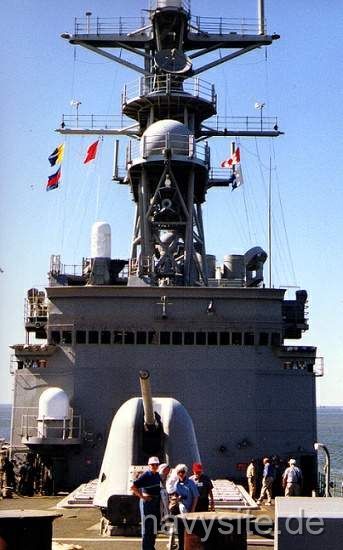
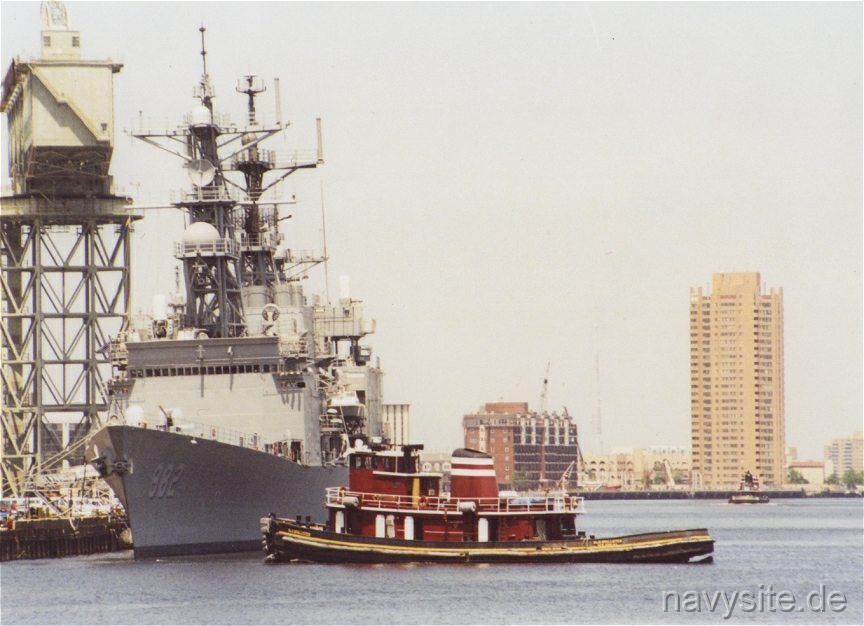
The photo below was taken by Karl-Heinz Ahles and shows USS NICHOLSON at Norfolk, Va.


Back to topback to top


Back to Destroyers list. Back to ships list. Back to selection page. Back to 1st page.