
Search the Site with

|
Search the Site with
|
 General Characteristics Crew List Notes of Interest Some Details About the Name ARCTIC History Image Gallery to End of Page


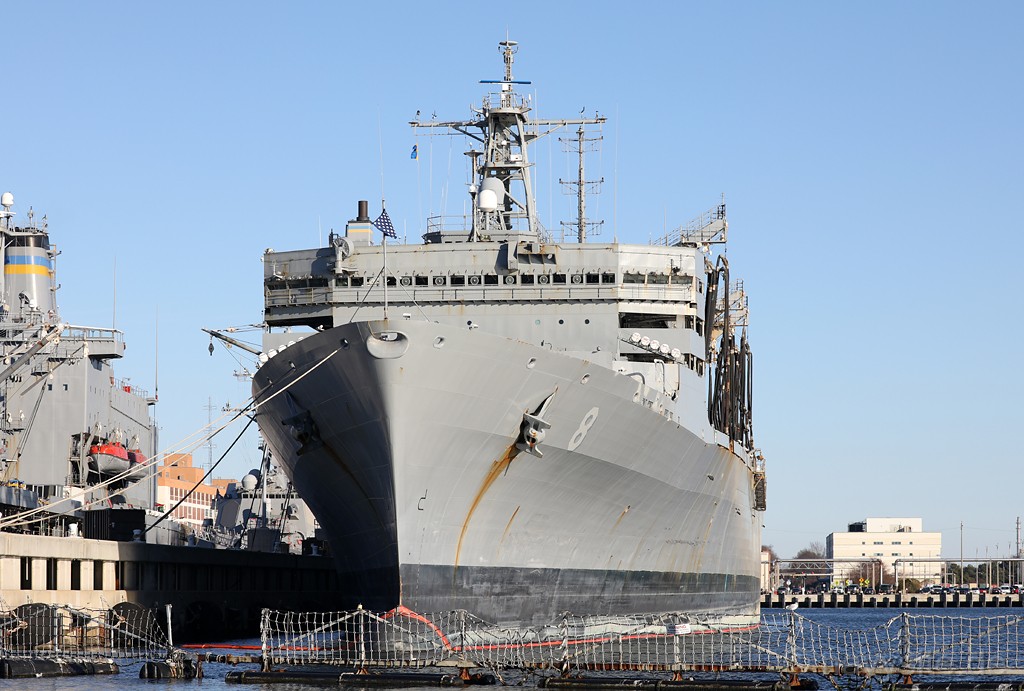
USNS ARCTIC is the third ship in the SUPPLY - class of fast combat support ships and is the fifth supply ship to carry the name of the region surrounding the North Pole. Since June 14, 2002, ARCTIC is operated by the Military Sealift Command. As a US Naval Ship, ARCTIC does no longer carry the weapons systems she previously (as "USS ARCTIC") was equipped with. One of these systems was the Phalanx CIWS.
| General Characteristics: | Awarded: December 6, 1989 |
| Keel laid: December 2, 1991 | |
| Launched: October 30, 1993 | |
| Commissioned: September 11, 1995 | |
| Decommissioned: June 14, 2002 | |
| MSC "in service": June 14, 2002 | |
| Builder: National Steel and Shipbuilding Company San Diego, California | |
| Propulsion System: four General Electric LM 2500 gas turbine engines | |
| Propellers: two | |
| Length: 754,6 feet (230 meters) | |
| Beam: 107 feet (32.6 meters) | |
| Draft: 39 feet (11.9 meters) | |
| Displacement: approx. 48,800 tons | |
| Speed: 26 knots | |
| Aircraft: two MH-60S | |
| Armament: none | |
| Homeport: Earle, N.J. | |
| Crew: 176 civilians, 59 military |
 back to top go to the end of the pageback to top go to the end of the page
Crew List:
This section contains the names of sailors who served aboard USNS ARCTIC. It is no official listing but contains the names of sailors who submitted their information.
back to top go to the end of the page back to top go to the end of the page
Notes of Interest:
back to top go to the end of the pageAbout the Name "ARCTIC":
USNS ARCTIC is named for the region north of the Arctic Circle (66 50' North Latitude). The arctic region derives its name from the Greek word "arktos" or "bear". Celestial "bears" appear frequently in the northern sky; the constellations Ursa Major (larger bear) and Ursa Minor (minor bear), and the navigational star Arcturus (the bear’s guard).
back to top go to the end of the pageSome Details (as USS ARCTIC AOE 8):
 back to top go to the end of the page
USS / USNS ARCTIC History:
USS ARCTIC traces its lineage to the U.S. Navy's post-Cold War requirement for a fast, high-capacity logistics ship able to keep pace with carrier and expeditionary formations while delivering fuel, ammunition, and stores in fewer alongside periods than traditional oilers and cargo ships. The contract for the third SUPPLY-class fast combat support ship was awarded on December 6, 1989, and construction at National Steel and Shipbuilding Company (NASSCO) in San Diego followed with the keel laid on December 2, 1991. The ship was launched on October 30, 1993, then completed fitting-out and trials as the Navy prepared to commission a new generation of multi-product replenishment ships for an era defined by frequent crisis-response deployments, sustained no-fly-zone enforcement over Iraq, and later the long logistics tail of operations in Afghanistan and Iraq.
Sponsored by Dotty Johnston, the wife of Senator J. Bennett Johnston, the ship entered commissioned service as USS ARCTIC (AOE 8) on September 16, 1995, at Naval Station Norfolk, Virginia. As a commissioned warship, USS ARCTIC carried Navy crews and defensive systems appropriate for an underway replenishment ship operating with high-value units. In that role, she immediately slotted into the Atlantic Fleet's workup-and-deployment cycle, routinely supporting carrier and amphibious forces preparing for or returning from Mediterranean and Middle East operations that required rapid, repeated replenishment at sea. By the late 1990s, USS ARCTIC was operating as a regular logistics enabler for East Coast carrier battle group activity.
In 1999, USS ARCTIC deployed as the fast combat support ship with the USS THEODORE ROOSEVELT (CVN 71) battle group, departing East Coast bases on March 26, 1999, for what had been planned as a six-month deployment to the Arabian Gulf. Very early in the deployment, the group's tasking changed in response to the escalating Kosovo crisis: on April 6, 1999, the carrier and its battle group were diverted into the Ionian Sea to support NATO's air campaign, Operation Allied Force, shifting the operational focus from a routine Gulf rotation to sustained strike operations under NATO operational control - an unusual command-and-control arrangement for a U.S. carrier battle group at the time. Within that framework, USS ARCTIC's role was the one she had been built for: enabling high-tempo carrier and escort operations by transferring aviation fuel, ship fuel, ordnance, and dry cargo during repeated replenishment evolutions at sea so that the force could remain on station without frequent port reliance.
After roughly ten weeks of Kosovo-related tasking, the deployment pivoted back toward U.S. Central Command requirements. The carrier force subsequently moved east to resume no-fly-zone support over Iraq as part of Operation Southern Watch, entering the Arabian Gulf on July 14, 1999. The strike group remained on station there for about six weeks, and USS THEODORE ROOSEVELT departed the Arabian Gulf on August 28, 1999 after being relieved. The carrier completed the deployment by returning to Norfolk on September 24, 1999, closing a single continuous 1999 deployment cycle in which the same battle group executed major operations in two separate theaters.
After nearly seven years as a commissioned combat logistics ship, USS ARCTIC ended her Navy-crew era on June 14, 2002, when she was decommissioned and immediately transitioned into Military Sealift Command service the same day as USNS ARCTIC (T-AOE 8). The redesignation reflected a broader Navy logistics model: the ship remained a fast combat support ship assigned to sustain carrier strike groups and other task forces, but now operated with a predominantly civilian mariner crew augmented by a small military detachment, aligning cost, crewing, and operational flexibility with the high demand for replenishment ships in the post-9/11 operating environment. Homeporting for USNS ARCTIC was established at Earle, New Jersey, placing her close to Atlantic fleet operating areas and major ammunition and logistics infrastructure.
The early years of USNS ARCTIC's MSC service coincided with the most intense sustained deployment tempo the U.S. Navy had experienced in decades. From October 2, 2003, to February 29, 2004, USNS ARCTIC operated as the fast combat support ship associated with USS ENTERPRISE (CVN 65) on a deployment that combined Operation Southern Watch and Operation Enduring Freedom. The documented port itinerary tied to that deployment included Palma, Spain; Cannes, France; Portsmouth, United Kingdom; Lisbon, Portugal; and Rhodes, Greece - ports that bracketed an operational pattern of Mediterranean presence, eastward movement to support aviation and maritime operations connected to Iraq no-fly-zone enforcement and Afghanistan operations, and then return to the Atlantic. The strategic context during this period was defined by the transition from the pre-2003 no-fly-zone regime over Iraq to the post-invasion environment, and by the continuing requirement to sustain carrier air operations linked to Afghanistan from distant sea bases, both of which made the rapid replenishment capacity of a T-AOE especially valuable.
USNS ARCTIC also proved useful beyond combat deployments. In the wake of Hurricane Katrina, when the storm struck the Gulf Coast on August 29, 2005, the Navy formed a large amphibious and logistics relief force centered on USS IWO JIMA (LHD 7). During the final days of August and the first days of September 2005, USNS ARCTIC supported that amphibious relief effort logistically as ships moved to waters off New Orleans to function as sea-based hubs for helicopters, landing craft, fuel, water, and relief supplies while shore infrastructure was heavily damaged.
By the later 2000s, USNS ARCTIC was repeatedly documented operating with East Coast carrier strike groups as U.S. operations in Iraq and Afghanistan continued and maritime security demands remained high in the Arabian Gulf and nearby waters. From November 5, 2007, to June 4, 2008, she deployed with USS HARRY S. TRUMAN (CVN 75) during a cruise that included the exercises Majestic Eagle and Medshark and supported Operation Enduring Freedom and Operation Iraqi Freedom tasking. The deployment's documented port visits included Naples, Italy; Souda Bay, Greece; Bahrain; Jebel Ali, United Arab Emirates; and Portsmouth, United Kingdom - ports that matched a classic pattern of Mediterranean staging, Fifth Fleet sustainment, and UK logistics/engagement stops. Within that deployment, a specific underway replenishment evolution illustrates her day-to-day work: on May 27, 2008, USNS ARCTIC conducted a multi-ship replenishment in the U.S. Fifth Fleet area that included USS HARRY S. TRUMAN, USS WINSTON S. CHURCHILL (DDG 81), and the United Kingdom destroyer HMS MANCHESTER, an example of how replenishment ships frequently sustain not only U.S. escorts but also allied ships operating alongside U.S. carrier forces.
The risks of flight-deck and aviation operations around replenishment ships - particularly during special operations training - were highlighted on October 22, 2009, when a U.S. Army UH-60 Black Hawk crashed onto USNS ARCTIC during a fast-rope training evolution about 20 miles off Fort Story, Virginia. The accident killed one soldier, Staff Sgt. James R. Stright, and injured eight others, underscoring that even outside combat zones the ship's flight deck could become the focus of complex, hazardous joint training.
After completing post-overhaul workups in the Atlantic Ocean, USNS ARCTIC was repeatedly documented supporting USS ENTERPRISE (CVN 65) through the carrier's 2010-2011 training-and-deployment cycle. On July 16, 2010, ARCTIC conducted an underway replenishment with ENTERPRISE in the Atlantic while the carrier was at sea for fleet replacement squadron carrier qualifications and broader preparations for her next deployment. On October 14, 2010, during the ENTERPRISE Carrier Strike Group's Composite Training Unit Exercise in the Atlantic, ARCTIC again replenished the carrier as the strike group trained as an integrated force ahead of deployment. When ENTERPRISE deployed from Norfolk on January 13, 2011 for operations in the U.S. 5th and 6th Fleet areas of responsibility, ARCTIC is specifically documented replenishing the carrier during that deployment as well. On February 4, 2011, the two ships executed a nighttime vertical replenishment in the Mediterranean Sea, transferring cargo by helicopter in support of maritime security operations and theater security cooperation activity. The strike group returned to the United States in mid-July 2011
From July 22, 2013, to April 18, 2014, USNS ARCTIC deployed with USS HARRY S. TRUMAN on another Operation Enduring Freedom-linked cruise. The documented ports included Marseille, France; Hidd, Bahrain; Jebel Ali, United Arab Emirates; and Souda Bay, Crete, Greece, matching a period when U.S. carrier presence remained a core instrument of Middle East posture while the U.S. drawdown in Afghanistan proceeded and regional security concerns expanded beyond counterinsurgency to broader deterrence and maritime security requirements.
The mid-2010s brought continued operational employment plus well-documented transits and at-sea sustainment events. USNS ARCTIC was photographed underway off Virginia Beach on February 11, 2016, consistent with an East Coast operating pattern of workups and replenishment support for deploying units. On July 8, 2016, she was documented transiting the Suez Canal in company with USS DWIGHT D. EISENHOWER (CVN 69) and USS NITZE (DDG 94), a chokepoint movement that typically marks the shift between Mediterranean operations and Red Sea/Arabian Sea tasking, and that underlines the ship's role as the "gas station and warehouse" that must move where the strike group moves.
In 2018, USNS ARCTIC supported a major Atlantic workup-and-deployment cycle for USS HARRY S. TRUMAN that reflected renewed emphasis on high-end warfighting readiness and allied integration. She conducted replenishment-at-sea events with escorts while in the Atlantic - one documented replenishment with USS FARRAGUT (DDG 99) on February 24, 2018, and a later evolution on February 28, 2018, that involved USS HARRY S. TRUMAN and the German frigate FGS HESSEN - illustrating how replenishment ships routinely sustain multinational formations during pre-deployment training. From April 11, 2018, to July 21, 2018, USNS ARCTIC deployed with USS HARRY S. TRUMAN as part of a carrier strike group that included USS NORMANDY (CG 60), USS ARLEIGH BURKE (DDG 51), USS BULKELEY (DDG 84), USS FORREST SHERMAN (DDG 98), USS FARRAGUT, and FGS HESSEN. The deployment record associates the cruise with Exercise Lightning Handshake 2018 and Operation Inherent Resolve, reflecting the Navy's combined focus on interoperability with European allies and ongoing operations against the Islamic State. Port visits recorded for that deployment included Souda Bay, Crete, Greece, and Marseille, France, stops that supported both logistics and allied engagement.
From April 1, 2019, to January 20, 2020, USNS ARCTIC supported USS ABRAHAM LINCOLN (CVN 72) on a world cruise that transited the Mediterranean,
Arabian Sea and Western Pacific while the carrier changed its homeport from Norfolk, Va., to the US West Coast. During the deployment, the strike group supported Operations Freedom's Sentinel and Inherent Resolve.
From August 10, 2022, to April 23, 2023, she supported USS GEORGE H. W. BUSH (CVN 77) on a deployment tied to NATO and regional-security activity in Europe and the Mediterranean, including Exercise Neptune Strike 22.2 and Exercise Juniper Oak, with port visits recorded as Souda Bay, Crete, Greece; Split, Croatia; Naples, Italy; Marseille, France; and Piraeus, Greece. This period aligned with intensified allied maritime activity in Europe following the February 2022 Russian invasion of Ukraine, when carrier presence and allied exercises took on added signaling value, and with continued requirements to sustain combat air operations in the broader Middle East.
By the mid-2020s, USNS ARCTIC was still operating as an active MSC fast combat support ship, sustaining deployed naval forces across Atlantic and Middle East operating areas. In September 2024, ARCTIC deployed with the HARRY S. TRUMAN Strike Group. She was documented conducting a replenishment with the carrier on October 27, 2024, while underway in the North Sea, indicating continued integration into the strike group's sustainment plan in European waters. In 2025, she was again documented supporting deployed surface combatants during U.S. operations tied to persistent Middle East maritime demands: on April 18, 2025, USS OSCAR AUSTIN (DDG 79) conducted a replenishment-at-sea with USNS ARCTIC while underway in the central Red Sea, and on April 28, 2025, USS THOMAS HUDNER (DDG 116) conducted a replenishment-at-sea with USNS ARCTIC while underway in the northern Arabian Sea - events that reflect the ship's continuing role in keeping high-tempo surface forces supplied in a region where U.S. naval presence remains closely connected to the security of key sea lanes and strategic chokepoints. ARCTIC returned home in early June 2025.
back to top go to the end of the pageUSS / USNS ARCTIC Image Gallery:
 |  |  |  |
 |  |
The photos below were taken by me and show the ARCTIC at the Naval Fuel Depot at Norfolk, Va., on October 27, 2010. The last photo was taken two days later and shows the ARCTIC at Naval Base Norfolk.
 |  |  |  |  |
 |  |  |  |  |
 |  |  |
The photos below were taken by Steven Collingwood and show the ARCTIC returning to Naval Base Norfolk, Va., on December 15, 2015.


The photos below were taken by Steven Collingwood and show the ARCTIC passing Fort Monroe after departure from Naval Base Norfolk, Va., on January 20, 2016.


The photos below were taken by Michael Jenning and show the ARCTIC at Naval Base Norfolk, Va., on April 13, 2016.
 |  |  |  |  |
 |  |  |
The photos below were taken by Michael Jenning and show the ARCTIC at Naval Base Norfolk, Va., on September 21, 2018.
 |  |  |
The photos below were taken by Michael Jenning and show the ARCTIC at Naval Base Norfolk, Va., on December 26, 2021.
 |  |  |  |
back to top Back to Fast Combat Support Ships site. Back to ships list. Back to selection page. Back to 1st page.
