
Search the Site with

|
Search the Site with
|
 General Characteristics Crew List Memorabilia Cruise Books About the Ship's Coat of Arms Accidents aboard the Ship History Image Gallery to end of page
 | 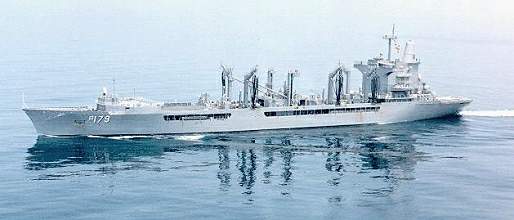 |
USS MERRIMACK was the third ship in the CIMARRON-class of five fleet oilers. Decommissioned on December 18, 1998, the ship spent the following years laid up on the James River at Fort Eustis, Va. Sold for scrapping on May 1, 2013, the MERRIMACK left Virginia under tow for Southern Recycling at Amelia, La., on May 21, 2013. She was last homeported in Norfolk, Va.
| General Characteristics: | Awarded: January 25, 1977 |
| Keel laid: July 16, 1979 | |
| Launched: May 17, 1980 | |
| Commissioned: November 14, 1981 | |
| Decommissioned: December 18, 1998 | |
| Builder: Avondale Shipyards, Inc., New Orleans, LA | |
| Propulsion system: two 600psi Boilers (Automated Steam) | |
| Propellers: one | |
| Length: 700 feet (213.4 meters) | |
| Beam: 88 feet (26.8 meters) | |
| Draft: 32 feet (9.7 meters) | |
| Displacement: approx. 37,000 tons | |
| Speed: 19 knots | |
| Capacity: 150,000 barrels of fuel oil or aviation fuel and several tons of additional goods | |
| Aircraft: none, but helicopter platform | |
| Armament: two | |
| Crew:15 officers and 215 enlisted |
 back to top go to the end of the pageback to top go to the end of the page
Crew List:
This section contains the names of sailors who served aboard USS MERRIMACK. It is no official listing but contains the names of sailors who submitted their information.
back to top go to the end of the pageback to top go to the end of the pageUSS MERRIMACK Cruise Books:
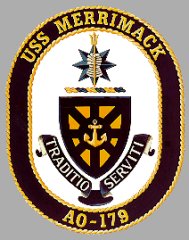
back to top go to the end of the pageAbout the Ship's Coat of Arms:
The Shield:
MERRIMACK is represented by the anchor at the center. Located on a blue disc, it radiates to the border, representing the Fleet. The anchor's centralized location alludes to MERRIMACK's responsibilities in the distribution of various fuels throughout the free fleets of the world, thereby acting as a focal point for worldwide mobility.
The Crest:
Basic Colors, blue and gold, representing the United States Naval power; blue and gold are the U.S. Navy colors. Star with gauntlet holding a trident: The three parts of this symbol represent the three previous ships to have borne the name MERRIMACK. The eight-pointed star reflects the eight battle stars awarded to the oiler USS MERRIMACK (AO 37) during World War II. The gauntlet suggests the Civil War; MERRIMACK, the first ironclad for the Southern States. The trident represents the first MERRIMACK, a sailing man-of-war launched in 1798, and the skillful seamanship necessary to navigate under sail.
The Motto:
"TRADITIO SERVITI" from Latin, meaning "Tradition of Service".
back to top go to the end of the pageAccidents aboard USS MERRIMACK:
| Date | Where | Events |
|---|---|---|
| May 30, 1996 | Mediterranean Sea, 60 nautical miles south of France | USS MERRIMACK experienced a boiler casualty while lighting off the 1-B boiler at approximately 1:24 p.m. local time. The crew was conducting a routine
light-off of the 1-B boiler while conducting basic engineering casualty control exercises. There was no apparent damage to the boiler, however the accident required an inspection and recertification of the 1-B boiler. No personnel injuries or casualties were reported. An investigation of the accident was conducted. The ship was conducting routine Sixth Fleet operations at the time of the accident. USS STOUT (DDG 55) was in the area to provide assistance if needed. |
back to top go to the end of the pageUSS MERRIMACK History:
USS MERRIMACK was the third of the post-Vietnam CIMARRON-class fleet oilers built to keep Atlantic and Mediterranean task groups fueled at sea during the late Cold War and into the immediate post-Gulf War era. Contracted on January 25, 1977, laid down at Avondale Shipyards, New Orleans, on July 16, 1979, launched on May 17, 1980, and commissioned on November 14, 1981, she homeported at Norfolk and entered service with COMBAT LOGISTICS GROUP TWO. As completed she was 700 feet long, propelled by automated 600-psi steam plants driving a single screw, carried two PHALANX CIWS for point defense, and could deliver simultaneously to two alongside receivers while also conducting vertical replenishment from a stern flight deck.
By 1985, the oiler was a familiar presence in Western Atlantic work-ups and NATO exercises. On January 11, 1985, she completed an UNREP with the recommissioned battleship USS IOWA (BB 61) off the Virginia Capes, a period image that captures MERRIMACK's core mission in the era of the 600-ship navy. That autumn, she went north into the Baltic for BALTIC OPERATIONS '85, where on October 1, 1985 she refueled the frigate USS PHARRIS (FF 1094) and worked in serials that also included the Royal Navy destroyer HMS LIVERPOOL (D 92), underscoring NATO at-sea interoperability in constrained northern waters.
Stateside in 1986, MERRIMACK's routine movements are incidentally recorded in the log of the rescue and salvage ship USS GRASP (ARS 51): from July 31 to August 2, 1986, GRASP escorted MERRIMACK from a Chesapeake Bay rendezvous to Little Creek, a small but telling snapshot of the oiler's continuous coastal operating rhythm between training periods and underway replenishment commitments.
MERRIMACK then shifted to sustained Sixth Fleet duty. Her 1986-1987 Mediterranean deployment - documented in the ship's cruise book - shows the oiler supporting carrier and surface action group operations around the basin and participating in "Operation Friendship", a mid-1987 goodwill series along the Cote d'Azur that blended liberty port calls with public-relations events coordinated by Commander, Sixth Fleet.
Through the late 1980s, she alternated Atlantic and northern waters assignments with deployments to the Med. Hull-level deployment tallies place MERRIMACK in the North Atlantic in August-September 1988 and again in June-July 1989, typical windows for NATO evolutions and U.S. work-ups conducted in cooler seas before the fall exercise season.
A major mid-career rebuild followed. Under a Navy "jumboization" program contracted to Avondale, MERRIMACK entered an extended availability in 1989-1991 in which a 108-foot parallel mid-body was inserted, capacity was increased markedly, the original highly skewed seven-bladed propeller was replaced by a five-bladed wheel, and the rudder was enlarged. Shipbuilder records list the Avondale jumboization award on July 15, 1988, with delivery targeted for April 22, 1991. The Navy's post-conversion standardization trials then ran at the Hatteras Range on July 11-14, 1991, documenting the new displacement and hydrodynamic changes. These modifications aligned the oiler with the demands of larger, higher-tempo carrier groups of the early 1990s.
After returning to service, MERRIMACK resumed transatlantic and Mediterranean logistics, then extended farther east as U.S. naval presence shifted toward the Red Sea and Arabian Gulf in the wake of DESERT STORM. Deployment summaries place her in the Mediterranean-Indian Ocean circuit from 1993 into July 1994, reflecting the routine but vital flow of fuel to units enforcing post-war sanctions and maintaining regional stability. A ship identification photo from 1994 shows her underway in Hampton Roads during this cycle of turnarounds.
In 1995, she conducted a maintenance period and local Atlantic operations, followed by a short Caribbean deployment in September-October - typical of logistics support to East Coast groups during counter-narcotics seasons and autumn exercises - before cycling back to Sixth Fleet.
Her 1996 deployment demonstrated the oiler's ability to bridge theaters. Although listed with a February-July Mediterranean deployment, imagery records MERRIMACK in the Arabian Gulf on April 29, 1996, conducting a simultaneous refueling of the aircraft carrier USS GEORGE WASHINGTON (CVN 73) and the cruiser USS SAN JACINTO (CG 56) while those units supported OPERATION SOUTHERN WATCH air policing over southern Iraq. A month later, on May 30, 1996, while again under Sixth Fleet control in the Mediterranean about 60 nautical miles south of France, MERRIMACK suffered a boiler light-off casualty to 1-B boiler. There were no injuries, and the destroyer USS STOUT (DDG 55) was in the vicinity to render assistance if required. The boiler required inspection and recertification before the oiler returned to tasking.
MERRIMACK continued routine Atlantic and Mediterranean service into the late 1990s. The Navy considered foreign transfer options in 1998 as part of end-of-Cold-War drawdowns, but the oiler instead finished out her U.S. career that year. She was decommissioned at Norfolk on December 18, 1998, struck the same day, and entered lay-up with the James River Reserve Fleet at Fort Eustis, Virginia. Title was later transferred to the Maritime Administration for continued preservation pending disposal.
After more than a decade in reserve, MERRIMACK was sold for dismantlement on May 1, 2013, and departed the James River Reserve Fleet under tow on May 21, 2013, for Southern Recycling at Amelia, Louisiana - closing a 32-year service life that spanned late-Cold-War NATO exercises, high-tempo Sixth Fleet logistics in the Mediterranean, and sustained post-Gulf War presence operations from the Red Sea to the Arabian Gulf.
back to top go to the end of the page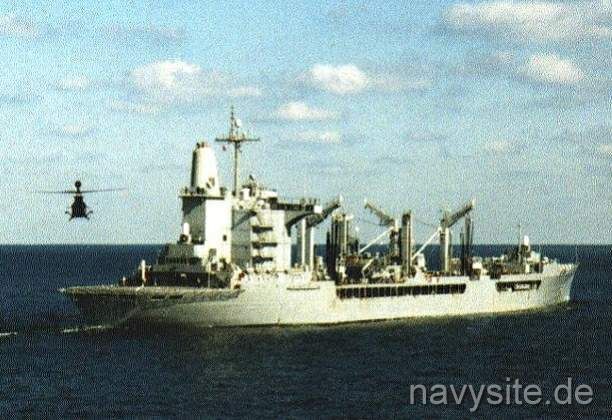 back to top go to the end of the page
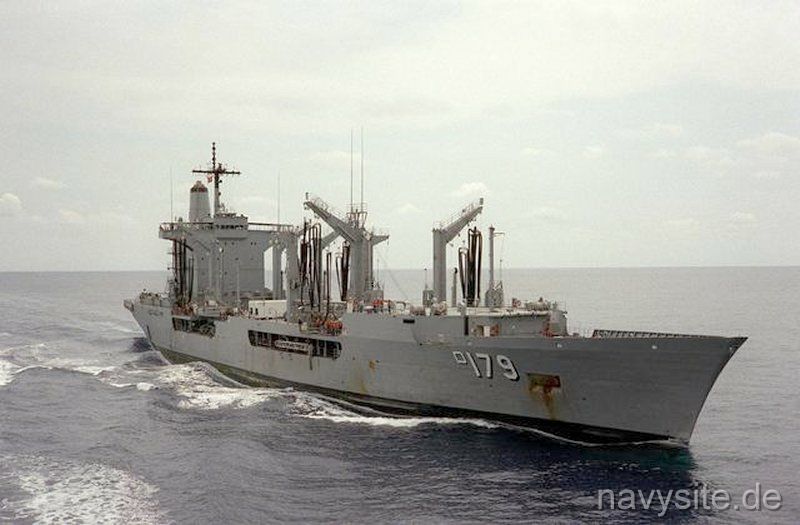
USS MERRIMACK Image Gallery:
 |
back to top Back to Fleet Oilers page. Back to ships list. Back to selection page. Back to 1st page.