Search the Site with 
General Characteristics Crew List Memorabilia Cruise Books About the Ship's Coat of Arms USS Elrod History Homeports of USS Elrod Patch Gallery About the Name "ELROD" Image Gallery to end of page
USS Elrod (FFG 55)

- decommissioned -


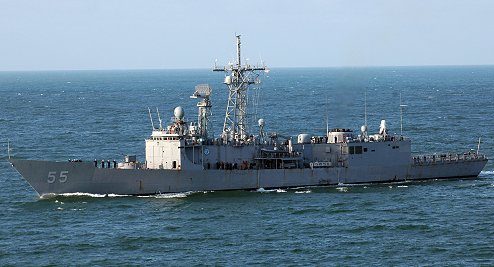
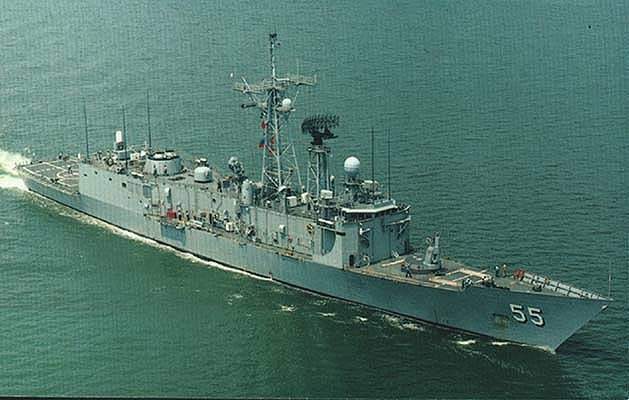
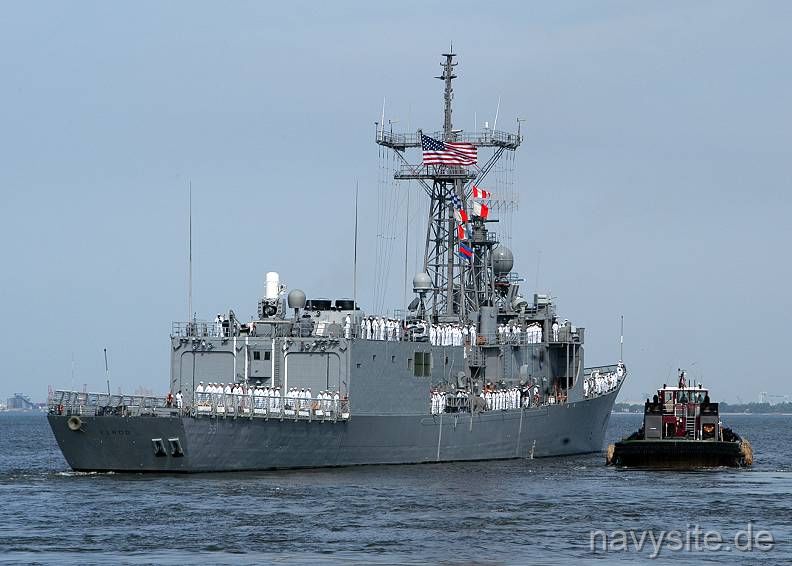
USS ELROD was an OLIVER HAZARD PERRY - class guided missile frigate and the first ship in the Navy named after Marine Major Henry T. Elrod. Decommissioned at her homeport of Norfolk, Va., on January 30, 2015, the ELROD was towed to Philadelphia, Penn., for lay up the following day. Throughout her service life, the ELROD has completed a total of 19 deployments and has travelled almost 2 million nautical miles.

General Characteristics:Keel Laid: November 21, 1983
Launched: May 12, 1984
Commissioned: May 18, 1985
Decommissioned: January 30, 2015
Builder: Bath Iron Works, Bath, Maine
Propulsion system: two General Electric LM 2500 gas turbines, two 350 Horsepower Electric Drive Auxiliary Propulsion Units
Propellers: one
Blades on each Propeller: five
Length: 453 feet (135.9 meters)
Beam:45 feet (13.5 meters)
Draft: 24,6 feet (7.5 meters)
Displacement: 4,100 tons
Speed: 28+ knots
Aircraft: two SH-60 Sea Hawk (LAMPS 3)
Armament: one Mk 75 76mm/62 caliber rapid firing gun, MK 32 ASW torpedo tubes (two triple mounts), one Phalanx CIWS
Crew: 17 Officers and 198 Enlisted


Back to topback to top  go to endgo to the end of the page


Back to topback to top  go to endgo to the end of the page

Crew List:

This section contains the names of sailors who served aboard USS ELROD. It is no official listing but contains the names of sailors who submitted their information.


back to top  go to the end of the page


Back to topback to top  go to endgo to the end of the page

USS ELROD Cruise Books:


Back to topback to top  go to endgo to the end of the page

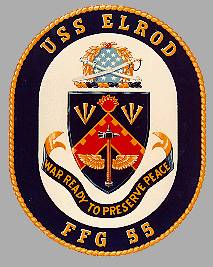
About the Ship's Coat of Arms:

The ship’s crest is a heraldic representation of Marine Major Henry T. Elrod’s heroic actions during the Battle of Wake Island in December 1941. It was during this battle the Major Elrod was killed and for his actions was posthumously awarded the Medal of Honor. The colors, blue, red, and gold (yellow) are those of the Navy and the Marine Corps. The chevron in the shield has fifteen crenellations to represent the number of days the embattled Marines held Wake Island against a vastly superior Japanese invasion force. The fireball in the upper part of the shield represents major Elrod’s single-handed sinking of the Japanese destroyer KISARGI after being the sole U.S. plane to penetrate a squadron of enemy fighter-bombers protecting the Japanese battle group. Similarly, the pheons on both sides of the fireball represent the two Japanese planes shot down by Major Elrod. The broken aviators wings and the war hammer symbolize Major Elrod’s further distinguished actions in ground combat after all the aircraft in his squadron had been destroyed. The hammer also signifies the destructive force of the guided missile frigate ELROD. Major Elrod’s service as a Marine Officer is symbolized by the unsheathed mameluke sword, which also draws attention to the fact the he was among the first to engage the Japanese in World War II. The blue background and thirteen stars represent the Medal of Honor awarded to Major Elrod for his heroic actions on Wake Island. The gold wreath, pointed downward, commemorates his honorable death in action.


Back to topback to top  go to endgo to the end of the page

History of USS ELROD:

USS ELROD was ordered in May 1981 as part of the later flight of OLIVER HAZARD PERRY-class guided-missile frigates and assigned to the Atlantic Fleet. Her keel was laid on November 21, 1983, at Bath Iron Works in Bath, Maine, and she was launched there on May 12, 1984, sponsored by Norma J. McDonald, wife of Admiral Wesley L. McDonald, then Commander in Chief, Atlantic Fleet. After delivery to the Navy on May 10, 1985, the frigate was commissioned on May 18, 1985, at Bath Iron Works in Maine, followed by a large ceremonial commissioning event held in Brunswick, Georgia, on July 6, 1985. From commissioning, she was assigned to the Atlantic Fleet and initially homeported at Charleston, South Carolina, beginning a period of shakedown training, trials and local operations along the U.S. East Coast and in the Caribbean as the crew worked up the ship's combat systems, propulsion plant and aviation detachment before her first overseas deployment.

In 1987, ELROD began the pattern that would define much of her career: repeated deployments to the Persian Gulf and Mediterranean in support of U.S. and NATO operations. On one of her earliest overseas cruises, she joined the Middle East Force during the period of Operation Earnest Will, the U.S. effort to escort reflagged tankers during the closing phases of the Iran-Iraq War. During this six-month deployment, ELROD's primary tasking was to escort U.S.-flagged tankers from the Gulf of Oman through the Strait of Hormuz to Kuwaiti ports, providing surface and air protection while allied minesweeping tugs led the convoys through mine-threatened waters. She operated in the northern Arabian Gulf with mobile sea base barges HERCULES and WIMBROWN VII, which housed special operations forces tasked with interdicting Iranian mining and small-boat activity around Farsi Island. The deployment also saw ELROD's embarked LAMPS III helicopters set a record for flight hours for a two-aircraft detachment during a six-month cruise, reflecting the heavy reliance on airborne surveillance and surface search in the constrained waters of the Gulf.

A dramatic incident during this Gulf period occurred on December 25, 1987, when an Iranian speedboat attacked the South Korean tanker HYUNDAI NO. 7 with rocket-propelled grenades near Abu Musa, about twenty miles southwest of Sharjah. ELROD was on patrol in the area and launched an SH-60B Seahawk, call sign "Magnum 442", from Helicopter Antisubmarine Squadron (Light) 44 Detachment 3. The aircraft, flown by Lieutenant Neil W. T. Hogg with Lieutenant Gregory P. Curth as copilot and two enlisted aircrewmen, recovered eleven members of the tanker's crew from the water and delivered them to the British frigate SCYLLA, whose own Westland Lynx helicopter rescued the remaining nine survivors. The incident illustrated the ship's dual role in Earnest Will: both as an escort warship and as an on-scene rescue platform in a contested littoral environment where merchant shipping was under attack.

At the turn of the decade, ELROD again deployed to the Persian Gulf area during the crisis that culminated in Operation Desert Storm. During the Gulf War period, she supported aggressive air and surface surveillance operations and took part in naval exercises with the navies of Gulf Cooperation Council countries, helping to knit together regional maritime forces as the coalition enforced embargoes and prepared for combat operations against Iraq. After the war, she returned to the region for a third Arabian Gulf deployment, during which she again conducted surveillance and exercised with regional partners, reinforcing the security architecture that had been built during Desert Shield and Desert Storm. These repeated Gulf cruises, interspersed with training and maintenance at Charleston, established ELROD as a regular presence in the northern Arabian Gulf in the early 1990s.

In 1992, ELROD shifted focus from the Gulf to the North Atlantic when she took part in TEAMWORK '92, a large NATO anti-submarine and maritime exercise conducted in the Norwegian Sea and Arctic regions. Operating in the North Sea and Norwegian Sea, she crossed the Arctic Circle and worked closely with allied surface ships, submarines and maritime patrol aircraft to practice high-end anti-submarine warfare in cold-water conditions, demonstrating the flexibility of the PERRY-class as both escort and independent surface combatant. After the exercise, she proceeded south again, eventually redeploying to the Arabian Gulf, underscoring how the end of the Cold War had not eliminated either Atlantic or Middle Eastern commitments for U.S. surface forces.

From 1993 through 1996, ELROD spent much of her deployed time in the Adriatic and central Mediterranean, participating in Operation Sharp Guard, the combined NATO and Western European Union enforcement operation that implemented United Nations sanctions on the former Yugoslavia. During these years, she cycled repeatedly into the Adriatic, acting as part of the multinational embargo force that monitored and intercepted shipping bound to and from ports on the Adriatic coast. A 1993 command history records that between July and November of that year, the frigate spent sixty-eight days in the Montenegro operating area, where she held primary warfare responsibilities within her surface action group and supported the boarding and inspection regime used to enforce the arms and oil embargo. When not on station off the Balkans she operated with Sixth Fleet ships in the wider Mediterranean and returned periodically to her homeport for maintenance and training.

During this period her administrative base also changed. Originally homeported in Charleston, ELROD shifted her homeport to Norfolk, Virginia, in March 1995 as part of the broader drawdown and restructuring of East Coast naval infrastructure. From Norfolk she continued to deploy frequently to the Mediterranean, Adriatic and Persian Gulf, demonstrating presence with Standing Naval Forces Mediterranean and Standing Naval Forces Atlantic and providing a visible U.S. contribution to NATO's maritime posture in both regions. By the late 1990s, she had completed five deployments to the Persian Gulf, three to the Mediterranean and one to the Adriatic, a deployment pattern reflecting the focus of U.S. maritime strategy on the Balkans and Middle East after the Cold War.

On November 22, 1999, ELROD returned to Norfolk at the end of a six-month Mediterranean deployment with the U.S. Sixth Fleet, closing out a decade in which she had moved repeatedly between Gulf operations, embargo enforcement in the Adriatic and more traditional Mediterranean presence duties. In early 2000, she entered a three-month Selected Restricted Availability alongside at Naval Station Norfolk to conduct maintenance and upgrades. Sea trials on April 19-20, 2000, confirmed the results of the availability and prepared the ship for renewed operations. On May 9, 2000, she sailed from Norfolk for the western Atlantic to participate in the Canadian exercise CRO 2/00 near Halifax, working with Royal Canadian Navy units in anti-submarine and surface warfare scenarios. After the exercise, she shifted to Naval Station Newport, Rhode Island, where she remained from June 8-19 for Surface Warfare Officer School training and other alongside events. On July 3, 2000, ELROD anchored in New York Harbor as part of International Fleet Review 2000 and OpSail 2000, joining warships from numerous navies in a ceremonial gathering that marked the new millennium. Later that year, on October 16, she departed Mayport, Florida, to take part in a Joint Tactical Fleet Exercise in the Puerto Rican operating area with Destroyer Squadron 28, sharpening her readiness for future deployments through complex multi-ship training.

Operational tempo increased further in 2001. From May 31 to July 2, 2001, ELROD was at sea in the Puerto Rican operating area for a Composite Training Unit Exercise (COMPTUEX), followed by a Joint Task Force Exercise from August 1-19. These evolutions tested strike group integration, air defense, anti-submarine warfare and maritime interception skills alongside other surface combatants and carrier aviation. On September 19, 2001 - just over a week after the September 11 attacks - ELROD departed Naval Station Norfolk for a scheduled deployment as part of the THEODORE ROOSEVELT (CVN 71) Battle Group. After crossing the Atlantic, she took over duties from the destroyer GONZALEZ (DDG 66) on October 2, assuming Standing Naval Forces Mediterranean responsibilities at a time when NATO was implementing maritime security measures in response to the attacks on the United States. In November, she contributed to Operation Active Endeavour, NATO's long-running counter-terrorism and maritime security operation in the Mediterranean, conducting surveillance and boarding operations from November 6-20. Port periods punctuated this work: ELROD visited Souda Bay, Crete, twice, including a stay from November 25-30, and she spent December 17-25, 2001, alongside at La Maddalena, Sardinia, providing rest and maintenance during the deployment's holiday period.

The deployment continued into early 2002. From February 23-27, 2002, ELROD participated in exercise Dogfish in the Sixth Fleet area, further honing anti-submarine skills with allied units, before completing her six-month deployment and returning to Norfolk on March 19, 2002. Later that year, on July 15, she entered the NORSHIPCO shipyard in Portsmouth, Virginia, for a three-month Drydocking Selected Restricted Availability, receiving hull, mechanical and electrical maintenance as well as updates to combat and communications systems. Returning to sea, she acted as an opposition-force unit from October 28 to November 5, 2002, supporting the HARRY S. TRUMAN (CVN 75) battle group's Joint Task Force Exercise and contributing to the complex free-play scenarios designed to certify the carrier strike group for deployment.

In 2003, ELROD alternated between training and inspections. She conducted Group Sail operations from May 6-8 and July 9-16 with other destroyer squadron units, practicing coordinated maneuvering, air defense and surface warfare. On July 23, she put to sea for her Board of Inspection and Survey (INSURV), a comprehensive material assessment required of all warships. Later that year, on September 16, 2003, she sortied from Norfolk to avoid Hurricane Isabel, returning on September 20 and then getting underway again on September 25 to complete navigation certification. On October 2, the Navy removed her Mk 13 guided-missile launching system in accordance with the fleet-wide divestment of that launcher from the PERRY-class, marking a major change in her weapons suite as she transitioned away from Standard and Harpoon missile capability. From October 16-27, 2003, she went back to sea for Group Sail with Destroyer Squadron 28, and on November 13 she supported the GEORGE WASHINGTON (CVN 73) carrier strike group's COMPTUEX as an opposition-force unit. ELROD returned to Norfolk on December 19, 2003, completing a year dominated by readiness and configuration changes rather than long deployments.

ELROD quickly shifted back into deployment mode in 2004. From January 19-24, she conducted Group Sail operations with the GEORGE WASHINGTON carrier strike group, and from February 26-29, she was at sea for testing of the Mk 53 Nulka active decoy system, followed by additional Group Sail events on March 8-9. On April 30, 2004, the frigate sailed from Norfolk for a Mediterranean deployment as part of Surface Strike Group 04-1, supporting the Global War on Terrorism. After transiting the Strait of Gibraltar, she entered the Mediterranean on May 9 in company with the destroyers RAMAGE (DDG 61) and ROSS (DDG 71). In early June, she called at La Spezia, Italy, from June 2-7, joining Standing Naval Force Mediterranean and conducting maritime interdiction operations in the Aegean Sea under Operation Active Endeavour, boarding and querying merchant traffic as NATO sought to deter and disrupt terrorist-related movement at sea. In August, she took part in Operation Distinguished Games, the maritime security effort mounted to protect the 2004 Athens Olympic Games, providing presence and surveillance in waters around Greece. In September, ELROD visited Novorossiysk, Russia, arriving on September 7 as the first U.S. Navy warship to call at that Black Sea port since 2001, a politically significant port visit underscoring U.S.-Russian naval engagement in the post-Cold War era. She returned to Norfolk on September 17, 2004, after four and a half months with Sixth Fleet.

After a period of local operations and maintenance, ELROD shifted to North Atlantic and Mediterranean training in 2006. On February 10, 2006, she left Norfolk to participate in the multinational exercise Neptune Warrior in the North Atlantic, operating alongside ships from the United Kingdom, Germany and Denmark in complex anti-submarine, anti-surface and air defense scenarios. She arrived at Her Majesty's Naval Base Clyde at Faslane, Scotland, on February 23 to continue the exercise in Scottish waters. Later that year, on August 1, 2006, she transited the Bosporus southbound to join Standing NATO Maritime Group 2 on deployment in the Eastern Mediterranean, supporting Operation Active Endeavour and the broader Sixth Fleet mission set. During this period, she contributed to maritime security operations and also supported Joint Task Force Lebanon, part of the international response to the 2006 conflict between Israel and Hezbollah, by helping monitor and stabilize sea lines of communication off the Lebanese coast. ELROD returned to Norfolk on November 13, 2006, closing a deployment that combined training, NATO partnership and real-world contingency operations.

A new operational focus emerged in 2008, when ELROD was assigned to Africa Partnership Station (APS) and Northern European exercises. She left Norfolk on June 2, 2008, for a deployment in the U.S. Sixth Fleet area of responsibility that included both exercises with Russia and Norway and maritime capacity-building with African partners. After participating in Northern Eagle 2008, a twelve-day trilateral exercise with Russian and Norwegian forces in the Norwegian and Barents Seas, she entered Severomorsk on July 27 to take part in Russian Navy Day celebrations, a noteworthy public symbol of post-Cold War naval cooperation. In early September, she shifted south to West Africa, arriving at Mindelo, Cape Verde, on September 8 for a goodwill port visit in support of Africa Partnership Station. While in Mindelo, her crew conducted community-relations projects and training with the Cape Verdean coast guard. On September 10 her in-port emergency team assisted local firefighters in extinguishing a blaze at a port authority building, earning public appreciation from Cape Verdean officials. Later in the deployment, she proceeded down the African coast and on October 13, 2008, pulled into Lobito, Angola, only the second U.S. Navy warship ever to visit that port and the fourth to visit Angola overall, reinforcing maritime engagement with a country emerging from decades of civil war. ELROD returned to Norfolk on December 3, 2008, after six months in European and African waters.

The ship's role shifted again toward maritime security and counter-piracy in 2010. On May 14, 2010, ELROD sailed from Norfolk for a Middle East deployment covering both the U.S. Fifth and Sixth Fleet areas of responsibility. She joined multinational forces conducting anti-piracy and maritime security operations in the Gulf of Aden, Arabian Sea and adjacent waters, while also calling at ports including Italy, Djibouti, Oman, Jordan, Seychelles, Greece and Croatia, which provided logistical support and opportunities for theater security cooperation. On May 26, 2010, in the Western Mediterranean off Morocco, she encountered a small boat suspected of drug trafficking. Her actions formed part of a growing focus on transregional narcotics and smuggling routes linking West Africa and Europe. A few weeks later, on July 5, 2010, ELROD carried out a high-profile rescue operation when her crew rescued sixteen Pakistani fishermen whose vessel AL AN WARI had sunk in the Gulf of Aden. A P-3C Orion from Patrol Squadron 16, forward-deployed to Djibouti, located the survivors floating in a life raft about 144 miles west of Socotra Island and directed an SH-60B from ELROD to the scene. The Seahawk recovered twelve mariners, while the frigate herself brought the remaining four aboard, treated all sixteen for exposure and dehydration, and later transferred them to the Pakistani warship BABUR, part of the same multinational maritime security task group. ELROD concluded this deployment and returned to Norfolk on November 15, 2010.

In 2011, ELROD remained primarily in Western Atlantic waters, but she continued to demonstrate her readiness for heavy weather and deployment. On August 25, 2011, she sortied from Norfolk to evade Hurricane Irene, riding out the storm at sea before returning to port. Late in the year, she completed a three-week certification exercise off the Florida coast, ensuring her combat systems and crew were ready for complex missions in the Caribbean and beyond.

On January 18, 2012, ELROD departed Norfolk for a six-month deployment to the Caribbean and eastern Pacific in the U.S. Fourth Fleet area of responsibility, focused on counter-illicit trafficking as part of Operation Martillo and related efforts. Operating with an embarked Helicopter Antisubmarine Squadron Light 60 detachment and a Coast Guard Law Enforcement Detachment, she patrolled key drug-smuggling routes by day and night, frequently working with U.S. Coast Guard aircraft and partner-nation surface forces. She visited Naval Station Guantanamo Bay, Cuba, from March 27 for a three-day logistics and rest stop, then returned to intensive interdiction patrols. During this deployment, ELROD achieved a series of major narcotics seizures: on March 22, 2012, she intercepted a fast-moving speedboat carrying about 1,000 pounds of cocaine; on April 20 she recovered 89 bales of cocaine weighing roughly 4,840 pounds, valued at more than $360 million on U.S. streets; on May 17 she and her embarked Coast Guard detachment recovered 57 bales weighing 3,790 pounds; on June 10 she interdicted another suspected smuggling vessel with more than 1,000 pounds of cocaine; and on July 3 she recovered approximately 5,000 pounds of marijuana jettisoned in the Caribbean. These figures made her 2012 Caribbean deployment one of the most productive counter-drug cruises by a single frigate in that period. ELROD returned to Norfolk on July 20, 2012.

From late 2012 into 2013, the frigate entered a final phase of maintenance and inspections to prepare for one more deployment and eventual decommissioning. In March 2013, she completed a five-month phased maintenance availability at the General Dynamics NASSCO shipyard in Norfolk, receiving hull preservation, machinery overhauls and updates to sensors and communications systems. She then shifted temporarily to Naval Station Mayport, Florida, arriving on September 30, 2013, to prepare for another Board of Inspection and Survey. ELROD conducted INSURV rehearsals at sea on October 21-22 and underwent the formal inspection on November 4, 2013, demonstrating that despite her age she remained materially fit for overseas deployment.

Her final deployment began on January 14, 2014, when ELROD left Norfolk with Helicopter Anti-Submarine Squadron Light 60 Detachment 2 embarked for a Mediterranean cruise in support of U.S. Africa Command counter-terrorism and intelligence, surveillance and reconnaissance missions. She entered the eastern Atlantic, then on February 2 moored at Tangier, Morocco, for a four-day port visit, reinforcing ties with a long-standing regional partner. On February 6, she conducted a passing exercise with the Moroccan frigate ALLAL BEN ABDELLAH (FMMM 615), practicing communications, maneuvering and maritime security procedures with the Royal Moroccan Navy. As part of NATO's Operation Active Endeavour and broader U.S. counter-terrorism efforts, ELROD spent much of early 2014 on patrol in the central and eastern Mediterranean, using both her embarked helicopter and, at times, the MQ-8 Fire Scout unmanned helicopter system to extend surveillance ranges against suspect shipping.

In March 2014, ELROD became involved in an internationally noted maritime incident involving the oil tanker MORNING GLORY. The tanker, carrying a cargo of crude oil loaded at the Libyan port of As-Sidra without authorization from the Libyan government, had been seized by three armed Libyans earlier in the month and declared a "stateless vessel" by U.S. officials. In response to requests from Libya and Cyprus, U.S. forces intervened. On March 16, a team of U.S. Navy SEALs boarded MORNING GLORY from the destroyer ROOSEVELT (DDG 80) in international waters southeast of Cyprus, seized control of the ship and detained the hijackers. The destroyer STOUT (DDG 55) then took on the escort mission. On March 19, 2014, ELROD relieved STOUT as escort for MORNING GLORY, maintaining security around the tanker while it proceeded toward Libyan waters. On March 22, U.S. sailors turned the tanker over to Libyan forces in international waters west of Tripoli, enabling Libyan authorities to bring the ship into the port of Zawiya and regain control of the oil cargo.

ELROD's final deployment also had a humanitarian dimension. On June 7, 2014, while patrolling in the Mediterranean, she responded to reports of a small, sinking vessel carrying people in distress at sea amid the broader flow of migrants and refugees crossing from North Africa toward Europe. The frigate rendered assistance to those on board, contributing to the maritime search-and-rescue effort that had become a recurring task for naval and coast guard forces in the region. After completing her assigned missions, ELROD returned to Norfolk on July 19, 2014, for the last time, ending nearly three decades of active seagoing service.

Following her return, preparations accelerated for inactivation. The Navy scheduled ELROD for retirement as part of the drawdown of the OLIVER HAZARD PERRY-class frigate force. On January 30, 2015, she was formally decommissioned and stricken from the Naval Vessel Register during a ceremony at Naval Station Norfolk, nearly thirty years after entering service. Her crew marked the end of the ship’s active life and then transferred her to the custody of the Inactive Ships On-site Maintenance Office at Philadelphia, Pennsylvania, where she lay pierside awaiting final disposition, with the option of potential foreign military sale still under consideration. Over her career ELROD accumulated a substantial record of awards, including the Joint Meritorious Unit Award, Navy Meritorious Unit Commendation, Coast Guard Meritorious Unit Commendation, several Battle Efficiency Excellence Awards, Secretary of the Navy Energy Conservation Award, Armed Forces Recreation Society Award, and various departmental and mission-specific awards for excellence reflecting her repeated service in the Persian Gulf, Mediterranean, Adriatic, Caribbean and off Africa.


Back to topback to top  go to endgo to the end of the page

Homeports of USS ELROD:

PeriodHomeport
commissioned at Bath, Maine
1985 - 1995Charleston, SC.
1995 - 2015Norfolk, VA.


Back to topback to top  go to endgo to the end of the page

USS ELROD Patch Gallery:

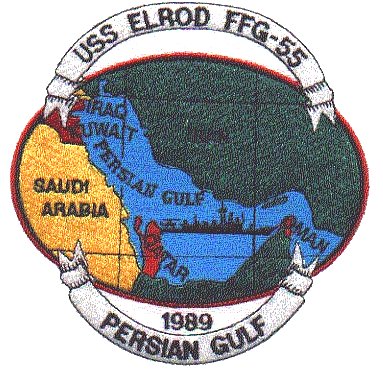
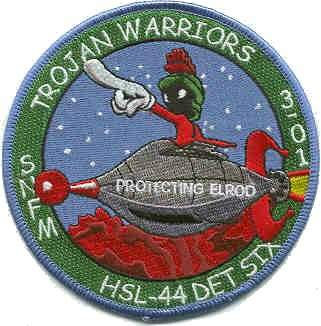
Persian Gulf 1989HSL-44 Det.6 - Standing Naval Force Med '01/'02


Back to topback to top  go to endgo to the end of the page

About the Frigate's Name, about Major Henry Talamge Elrod, USMC :

Major Henry T. Elrod, U.S. Marine Corps, was born 27 September 1905, in Turner County, Georgia. He attended the University of Georgia, and then Yale University, until his father passed away in 1927. He enlisted in the Marine Corps in December 1927, and was appointed a Marine Second Lieutenant in February 1931.

On 4 December 1941, Captain Elrod flew on to Wake Island with 12 aircraft, 12 pilots and the VMF-211 ground crew. Hostilities in the air over Wake Island commenced on 8 December 1941.

During the defense of Wake, Captain Elrod repeatedly displayed conspicuous gallantry and intrepidity at the risk of his life, above and beyond the call of duty. On the 12th of December he single-handedly attacked a flight of 22 enemy planes and shot down two. On several flights, he executed low altitude bombing and strafing runs on enemy ships. On one of these runs, he became the first man to sink a major warship with small caliber bombs delivered from a fighter aircraft.

When his plane was destroyed by hostile fire, he organized a group of ground troops into a beach defense unit, and repulsed repeated Japanese attacks. On 23 December 1941, Captain Elrod fell, mortally wounded, while protecting his men who were carrying ammunition to a gun emplacement.

He was posthumously promoted to Major on 8 November 1946. His widow was presented with the Congressional Medal of Honor. This posthumous medal was awarded to her husband for his heroic actions during the last, bitter days of the defense of Wake Island. His widow is now Mrs. Elizabeth Carleson.


Back to topback to top  go to endgo to the end of the page


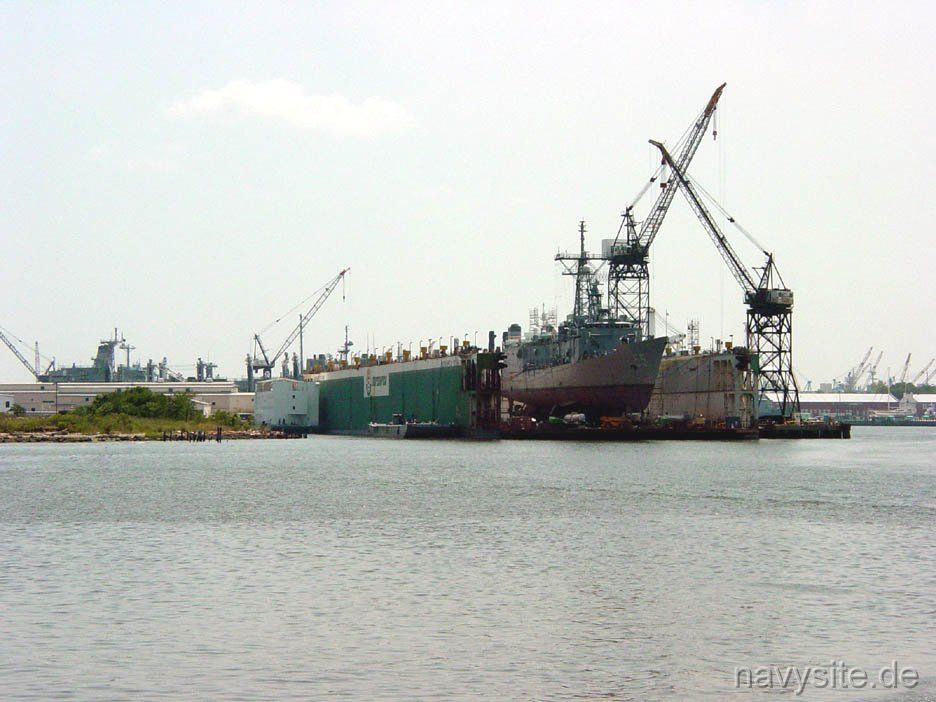
The photo below was taken by Brian Barton and shows the ELROD dry-docked near Naval Base Norfolk on July 23, 2002.


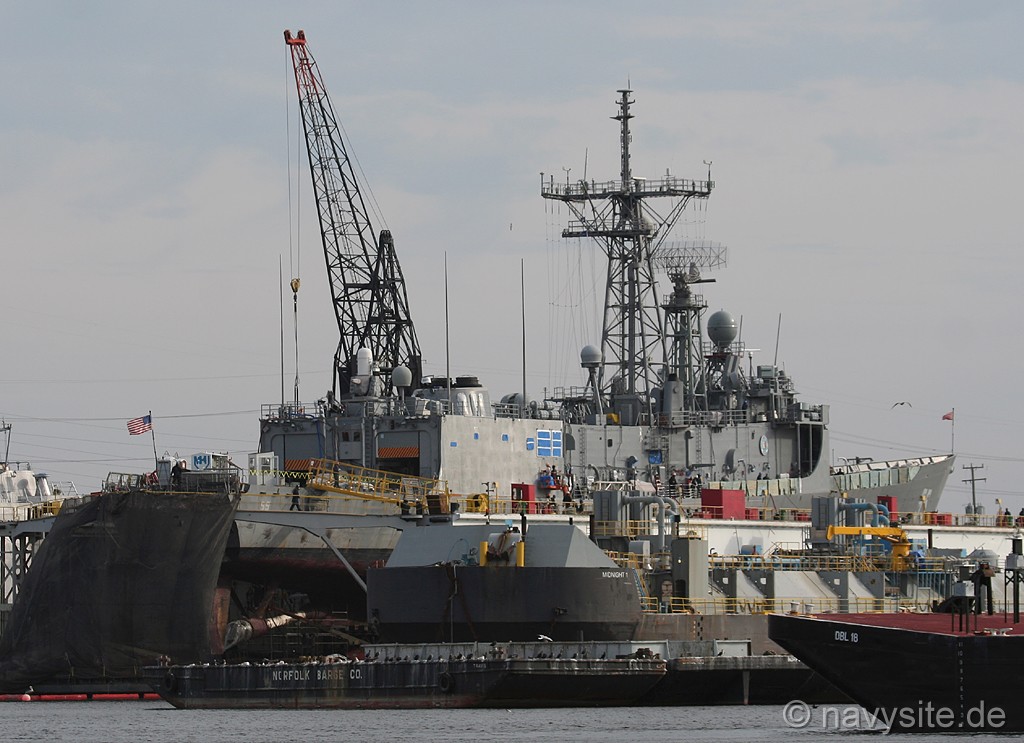
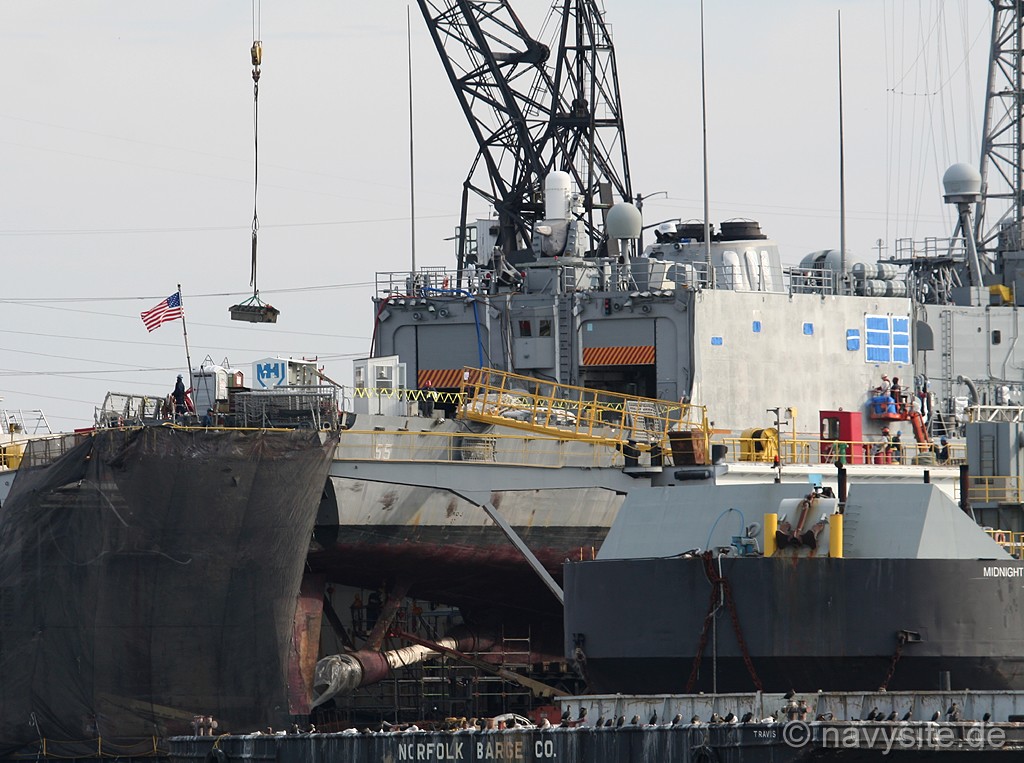
The photos below were taken by me and show the ELROD dry-docked at Norfolk, Va., on February 3, 2009. Note the missing propeller.


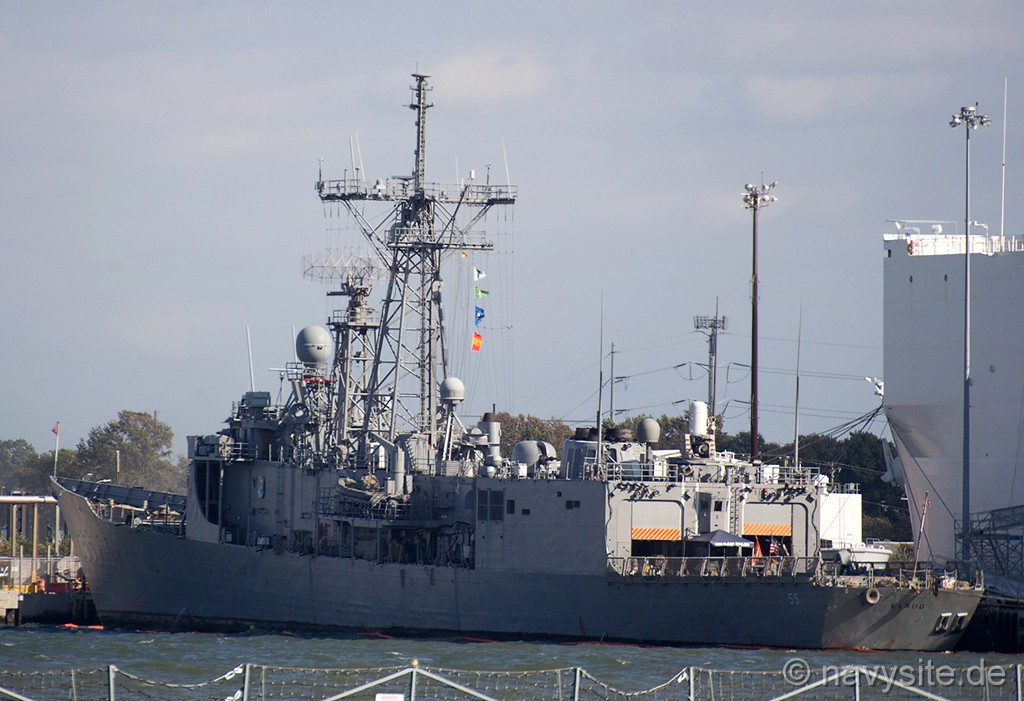
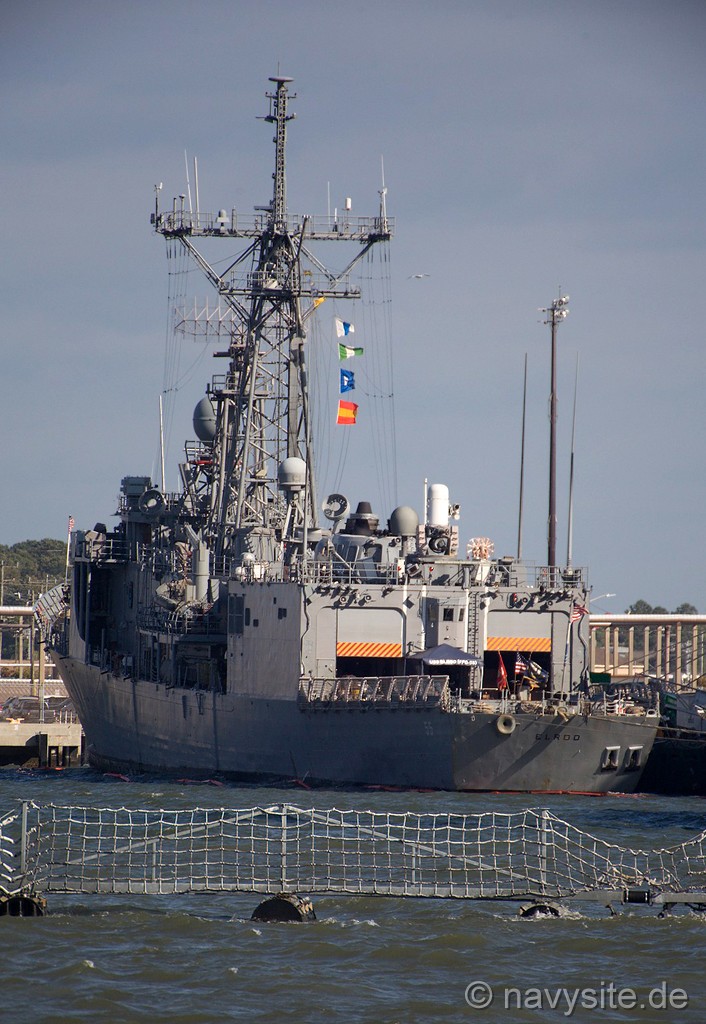
The photos below were taken by Michael Jenning and show the ELROD at Naval Base Norfolk, Va., on October 21, 2014.


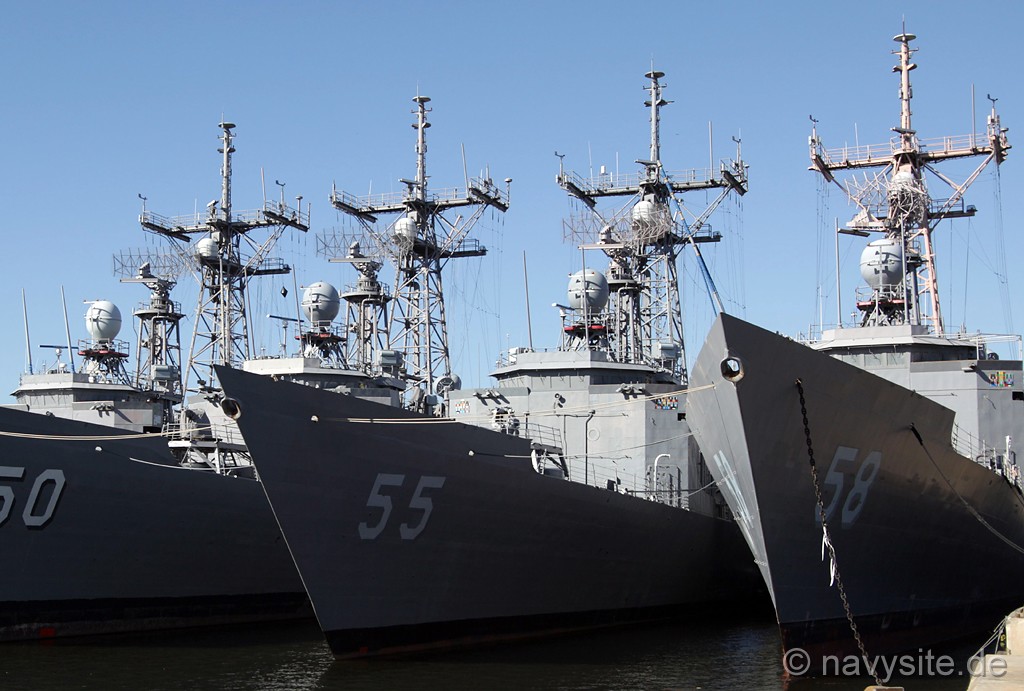
The photos below were taken by Michael Jenning and show the ELROD laid up among her sisterships at the former Philadelphia Naval Shipyard, Philadelphia, Penn., on October 16, 2015.
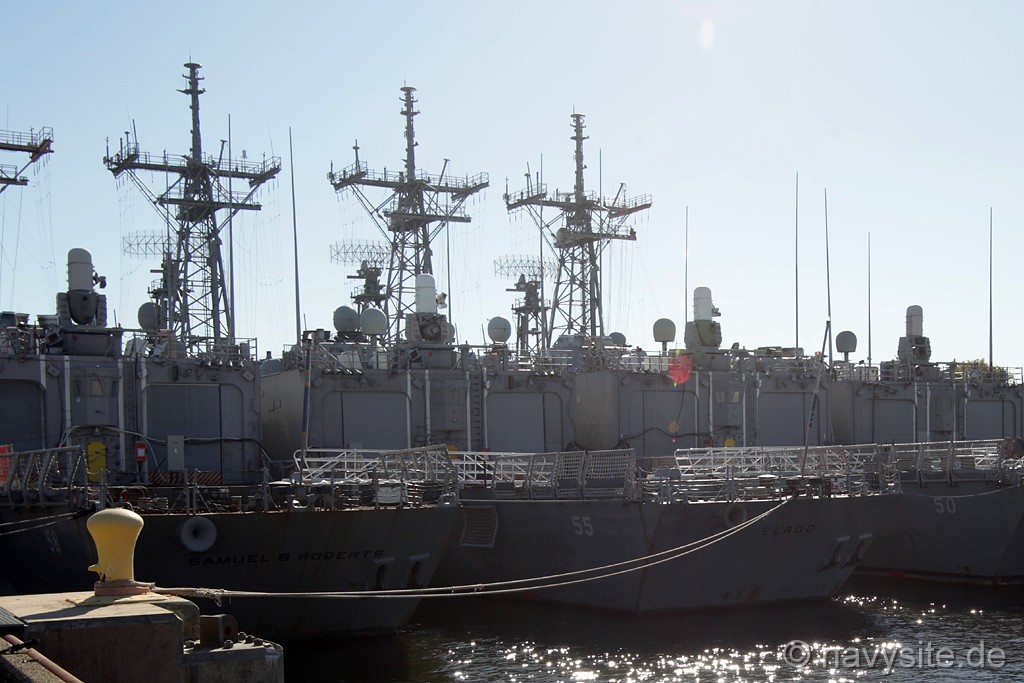


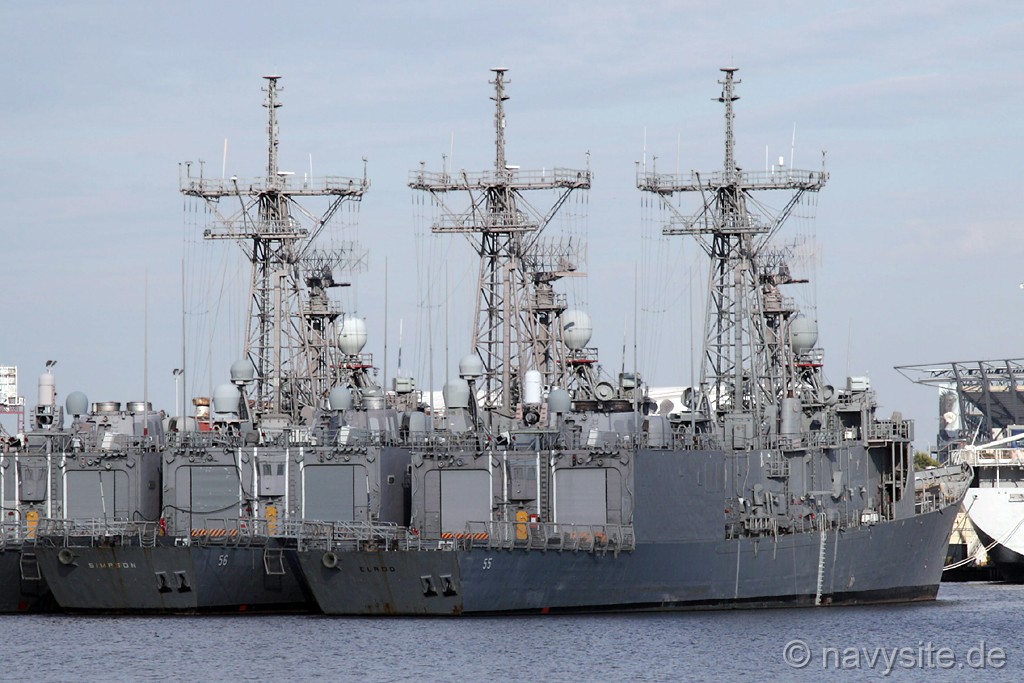
The photos below were taken by Michael Jenning and show the ELROD laid up alongside her sisterships at the former Philadelphia Naval Shipyard, Philadelphia, Penn., on October 17, 2016.
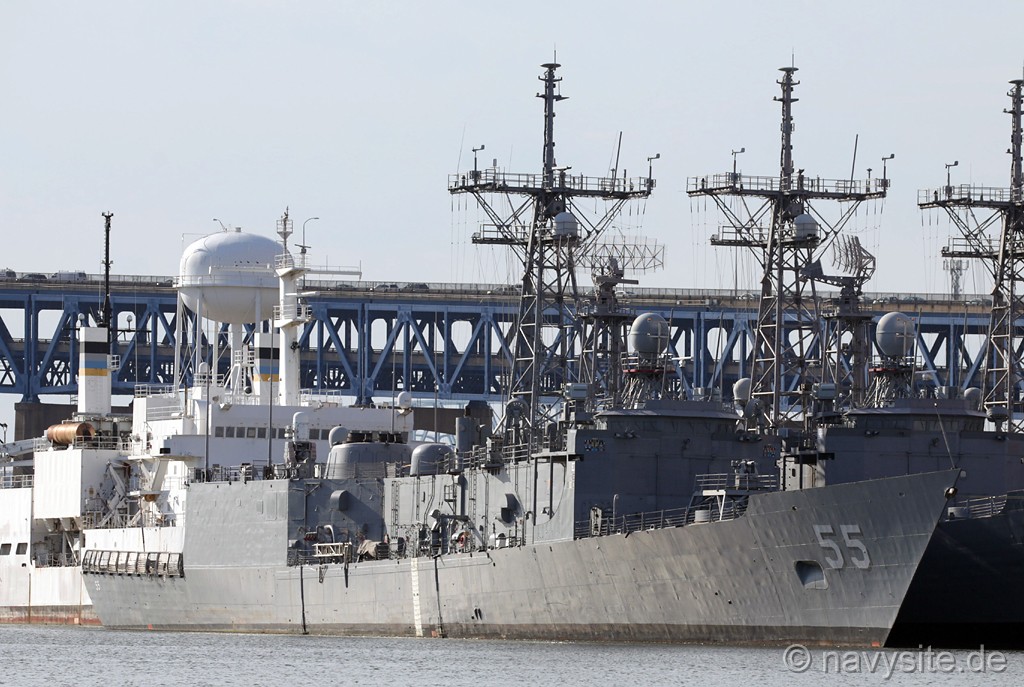


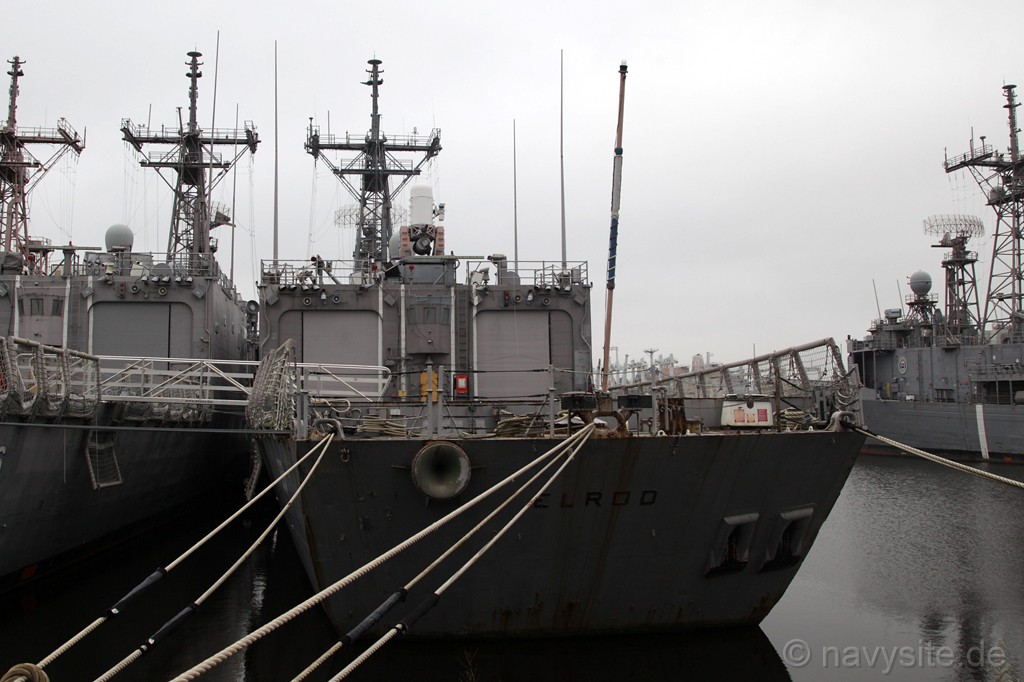
The photos below were taken by Michael Jenning and show the ELROD laid up at the former Philadelphia Naval Shipyard, Philadelphia, Penn., on October 7, 2018.
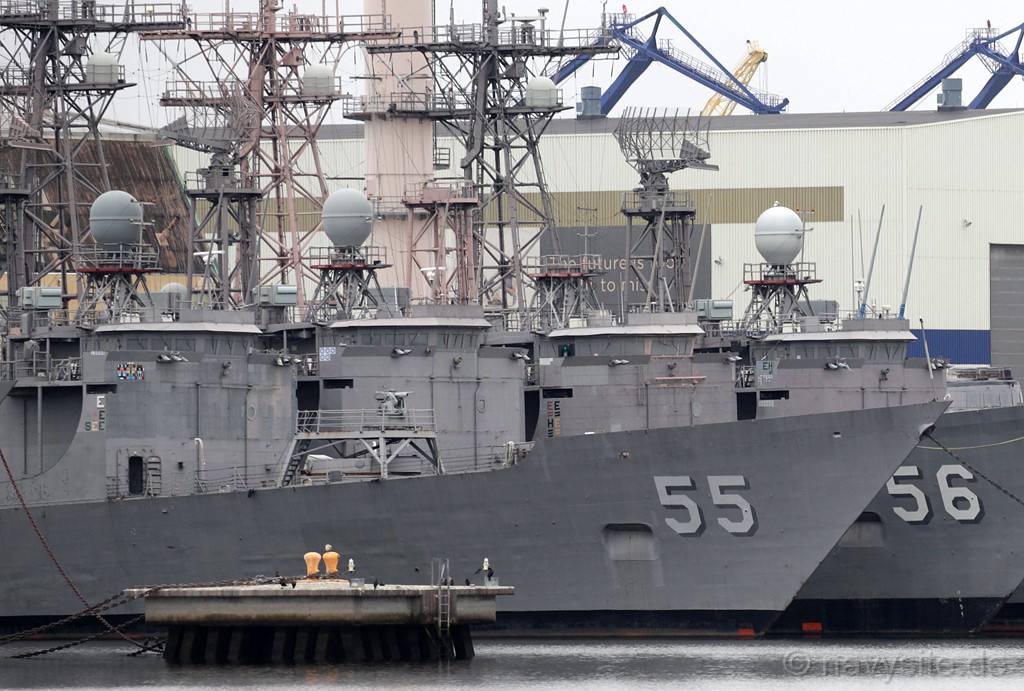


The photo below was taken by Michael Jenning and shows ELROD laid up at the former Philadelphia Naval Shipyard, Philadelphia, Penn., on May 27, 2022.
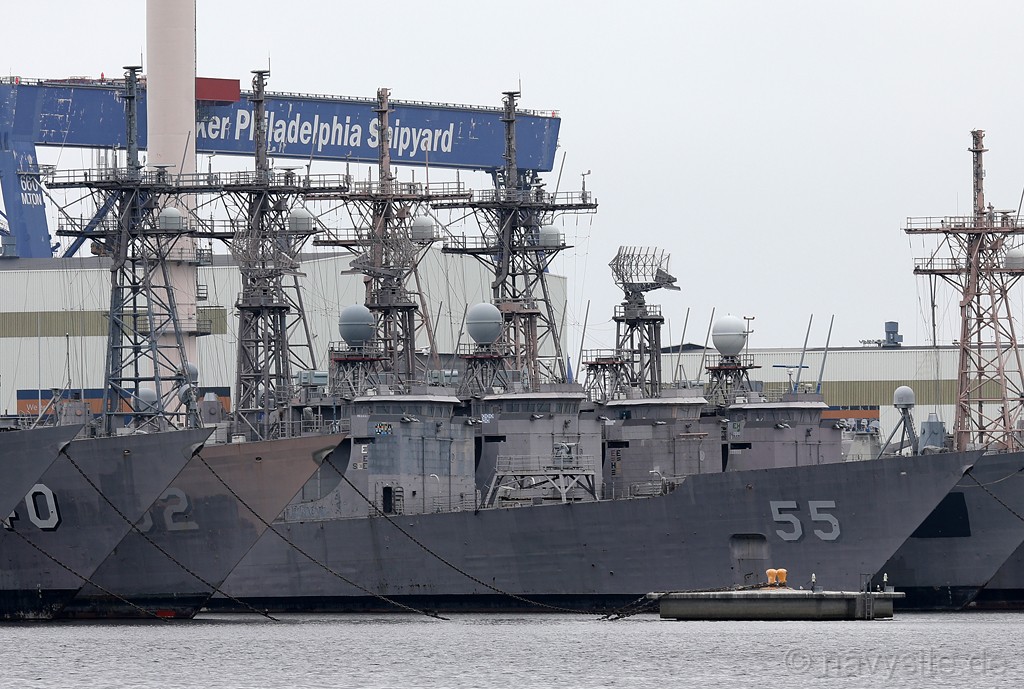


Back to topback to top


Back to Frigates list. Back to ships list. Back to selection page. Back to 1st page.