
Search the Site with

|
Search the Site with
|
 General Characteristics Crew List Memorabilia Cruise Books About the Ship's Coat of Arms About the Name "John Paul Jones" History Homeports of USS John Paul Jones Image Gallery to end of page
 |  |  |
USS JOHN PAUL JONES is the third ship in the ARLEIGH BURKE - class of guided missile destroyers and was the first AEGIS destroyer to join the Pacific Fleet.
| General Characteristics: | Keel Laid: August 8, 1990 |
| Launched: October 26, 1991 | |
| Commissioned: December 18, 1993 | |
| Builder: Bath Iron Works, Bath, Maine | |
| Propulsion system: four General Electric LM 2500 gas turbine engines | |
| Propellers: two | |
| Blades on each Propeller: five | |
| Length: 505,25 feet (154 meters) | |
| Beam: 67 feet (20.4 meters) | |
| Draft: 30,5 feet (9.3 meters) | |
| Displacement: approx. 8.300 tons full load | |
| Speed: 30+ knots | |
| Aircraft: None. But LAMPS 3 electronics installed on landing deck for coordinated DDG/helicopter ASW operations. | |
| Armament: two | |
| Homeport: Everett, Wash. | |
| Crew: 23 Officers, 24 Chief Petty Officers and 291 Enlisted |
 back to top go to the end of the pageback to top go to the end of the page
Crew List:
This section contains the names of sailors who served aboard USS JOHN PAUL JONES. It is no official listing but contains the names of sailors who submitted their information.
back to top go to the end of the pageback to top go to the end of the pageUSS JOHN PAUL JONES Cruise Books:
back to top go to the end of the pageAbout the Ship's Coat of Arms:
The Shield:
The dark blue and gold, in the ships shield, are the colors traditionally associated with the Navy. The anchor interlaced with the officer and enlisted swords symbolize sea prowess and teamwork. The AEGIS system's octagonal shape highlights the modern weaponry of JOHN PAUL JONES with its anti-air, surface, sub-surface and strike warfare capabilities. The white border with the thirteen black rivets represents day and night vigilance, solidity and determination. The number of rivets, resembling cannon balls, also recalls the thirteen colonies and the naval guns used by John Paul Jones in battle.
The flags, on either side of the shield, were displayed by John Paul Jones on his warships. The thirteen star flag commemorates the most famous Revolutionary War naval combat when John Paul Jones captured the Serapis. The rattlesnake "Don't Tread on Me" flag reflects the temperament of the times.
The Crest:
The portrait, on the crest, is of John Paul Jones, father of the American Navy. His heroism against larger and better equipped forces established a naval tradition that has never been forgotten. The naval gun represents weaponry of that period.
back to top go to the end of the pageAbout the Destroyer's Name, about Commodore John Paul Jones:
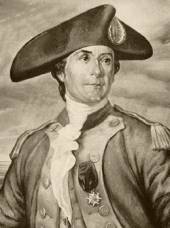 USS JOHN PAUL JONES honors the Father of the American Navy. Born in Scotland, Commodore John Paul Jones earned the undying respect and admiration of his countrymen by his extraordinary courage, tactical genius and audacity during the American War for Independence. Without hesitation, he single-handedly took the war at sea to the British, attacking their coastlines and capturing their ships in the British fleets' home waters. These acts inspired and transformed the fledgling Colonial Navy from an upstart band of rebels to a recognized fighting force, providing critical support for the colonies and their bid for independence from Great Britain. John Paul Jones is best remembered for his heroic defeat of the British 50-gun frigate Serapis on 23 September 1779. The three hour battle off Flamborough Head, in which John Paul Jones, in command of Bonhomme Richard, was victorious over a vastly superior British foe, established the spirit from which has grown the greatest navy the world has ever known.
back to top go to the end of the pageUSS JOHN PAUL JONES History:
USS JOHN PAUL JONES entered service on December 18, 1993, at Naval Station San Diego following construction at Bath Iron Works and a 1991 launch in Bath, Maine. The Flight I destroyer immediately began basic training and local operations in Southern California. In the spring of 1994, she ranged up the U.S. West Coast on shakedown and engagement port calls - among them Eureka, California (March 31, 1994), Crescent City (April 3, 1994), Alameda (April 15, 1994), Seattle (May 20, 1994), and Vancouver, British Columbia (May 27, 1994) - before returning south to continue trials and workups. Later that year, she was selected as the class shock-trial platform. The crew and ship spent much of 1994 preparing for and executing the most demanding surface-ship shock test program the Navy had run, with a sequence of near-ship underwater explosions conducted to evaluate DDG-51 survivability and harden equipment for future deployments.
From late 1995 into 1996, JOHN PAUL JONES made her first Western Pacific and Arabian Gulf deployment, operating in company with a carrier battle group and spending extended periods in the North Arabian Sea and Gulf supporting post-Desert Storm enforcement missions. Records list this as a WestPac-Indian Ocean-Persian Gulf cruise commencing in October 1995. After workups and transits she joined the broader enterprise of Southern Watch-era presence operations that defined the Navy's posture in the region in the mid-1990s.
In 1997, she again deployed west, entering the Fifth Fleet area of operations for maritime security and air-defense tasking and making an extended liberty call in Dubai followed by several days in Manama, Bahrain, in late June. These port periods bookended long on-station stretches for air-defense and escort duties, reflecting the normal rhythm of Gulf deployments at the time.
After additional training cycles and local operations, the destroyer sailed on another WestPac/Gulf deployment from September 1999 into March 2000 during a period of heightened U.S. carrier tempo in the region. A contemporaneous cruise book documents the sequence of operations and ports of call across the deployment, with the ship shifting between independent air-defense picket duties and screen stations with her strike group before returning to San Diego in the spring of 2000.
Following combat system and readiness workups in 2001, JOHN PAUL JONES deployed in the late summer toward the Fifth Fleet. On September 15, 2001, she transited the Strait of Hormuz in company with the guided-missile cruiser ANTlETAM (CG 54) while moving from the Arabian Gulf to the North Arabian Sea as the post-9/11 crisis unfolded. On October 7, 2001 - the opening night of Operation Enduring Freedom - she launched Tomahawk Land-Attack Missiles into Afghanistan, one of the first U.S. Navy salvos of the campaign. Through the remainder of 2001, she provided air-defense and screen duties for carrier task forces supporting strikes and Southern Watch enforcement.
The ship continued deployed operations into 2002, alternating time in the North Arabian Sea and Gulf with logistics calls and brief port stops typical of Fifth Fleet rotations, and closing out the OEF deployment late in the year. She returned to a Southern California basic phase in 2003. On April 3, 2003, during the opening month of Operation Iraqi Freedom, JOHN PAUL JONES conducted an underway replenishment with JOHN C. STENNIS (CVN 74) off Southern California while JOHN C. STENNIS trained up for sustained operations. JOHN PAUL JONES's role during this period was to sustain readiness and support West Coast carrier workups as the fleet surged.
In 2004, the destroyer took part in RIMPAC 2004 around Hawaii, including a Pearl Harbor port visit from June 29 to July 5 and a second three-day stop beginning July 23. She conducted missile events during the exercise and returned to the West Coast following the multinational phase.
During a Western Pacific deployment in 2005, JOHN PAUL JONES made a routine port visit to Sasebo, Japan, on May 17, 2005, en route to major combined training. The ship was scheduled to participate in the U.S.-Australian exercise Talisman Sabre in Seventh Fleet waters as part of her cruise.
Through early 2006, she operated in the Southern California operating areas, conducting underway replenishments - including evolutions on January 17, 2006, off the coast with MSC fast combat support ship USNS BRIDGE (T-AOE 10) - as she cycled through certifications and pre-deployment training.
In 2007, the destroyer deployed with the NIMITZ (CVN 68) Carrier Strike Group to the U.S. Central Command region, providing air-defense and maritime security as part of the screen for the carrier and operating in company with the strike group's escorts. Mid-deployment, senior leadership visited the ship to recognize performance while the group supported Fifth Fleet missions. Upon return to the Eastern Pacific, she participated in a sea-power demonstration with NIMITZ and embarked Carrier Air Wing 11 for families and guests, firing her 5-inch gun during the event.
In 2008, JOHN PAUL JONES ranged north into Alaska, making a port call at Seward in May during an extended Northern Pacific period of operations, then completed a maintenance and training cycle that set up a major modernization effort to follow. The ship entered the pioneering hull, mechanical and electrical (HM&E) phase of the DDG 51 modernization program in June 2010 at San Diego - the first destroyer to undergo the package. She completed dry-dock work by September and concluded modernization sea trials on March 4, 2011. On June 10, 2011, she anchored off Malibu, California, for "Navy Days", the first U.S. Navy warship port call to Malibu. On November 29, 2011, she became the first ship to deploy after receiving the HM&E upgrades, getting underway for an independent seven-month Fifth Fleet deployment.
By early January 2012, JOHN PAUL JONES was operating with the JOHN C. STENNIS Carrier Strike Group in Fifth Fleet. On January 6, 2012, she conducted a fueling at sea alongside JOHN C. STENNIS in the Arabian Sea. Days later she made a port visit to Manama, Bahrain (January 9, 2012). On March 15, 2012, while assigned to Combined Maritime Forces, she rescued 24 mariners from the Liberian-flagged chemical tanker STOLT VALOR after an explosion and fire in the Persian Gulf, later transferring the survivors to USCGC BARANOF (WPB 1318) for repatriation to Manama. The ship completed the deployment in the spring and returned to the Pacific.
In 2013, the destroyer completed an intensive AEGIS test period that set the stage for her role as the Navy's Integrated Air and Missile Defense (IAMD) test ship. Over 2014, she executed a homeport shift from San Diego to Joint Base Pearl Harbor-Hickam and began a run of high-end live-fire events from the Pacific Missile Range Facility (PMRF). In February 2014, equipped with AEGIS Baseline 9C, she launched a Standard Missile-2 (SM-2) and destroyed two AQM-37 targets during a complex engagement. In June 2014, she conducted a multi-day series firing SM-6s and an SM-2, engaging six targets over three days - a pace-setting demonstration for long-range surface-to-air employment.
On November 1, 2015, during the "Fierce Sentry" FTO-02 E2 layered defense test centered on Wake Island and surrounding waters, JOHN PAUL JONES successfully defeated a surrogate anti-ship cruise-missile target but did not record an intercept on a separate medium-range ballistic-missile target - an outcome the Navy and MDA used to refine IAMD performance.
On January 18, 2016, operating from PMRF, she fired an anti-surface warfare variant of the SM-6 and sank the decommissioned frigate REUBEN JAMES (FFG 57) in a landmark demonstration of the missile's extended surface-warfare utility. Later that year, she conducted additional missile-defense events validating sea-based terminal concepts.
On February 3, 2017, the destroyer achieved the first intercept by the new SM-3 Block IIA (a U.S.-Japan co-development), engaging a medium-range ballistic-missile target from PMRF waters. On August 29-30, 2017, she fired two SM-6s and scored a successful intercept on a complex medium-range ballistic-missile target in the central Pacific, marking a decisive demonstration of the missile's dual air-and-terminal defense roles and the Baseline 9 combat system's capability. She remained based in Hawaii throughout 2017-2018, with routine Pearl Harbor pier periods between tests, training, and local operations.
After additional readiness cycles in Hawaii, JOHN PAUL JONES returned to forward operations. In 2020, she deployed to Fifth Fleet with the NIMITZ Carrier Strike Group, executing maritime security, coalition integration, and chokepoint transit missions in the Arabian Gulf and Arabian Sea. She took part in exercises with regional partners and was photographed on October 27, 2020, during a passing exercise with Royal Bahrain Naval Force ship AL MANAMA while supporting Coalition Task Force Sentinel, the operational arm of the International Maritime Security Construct.
On April 30, 2021, the ship returned to Pearl Harbor from a combined Fifth and Seventh Fleet deployment - operations that included independent tasking and time as part of Carrier Strike Group 11. In August 2021, she changed homeport from Hawaii to Naval Station Everett, Washington, joining Destroyer Squadron 9 in the Pacific Northwest waterfront.
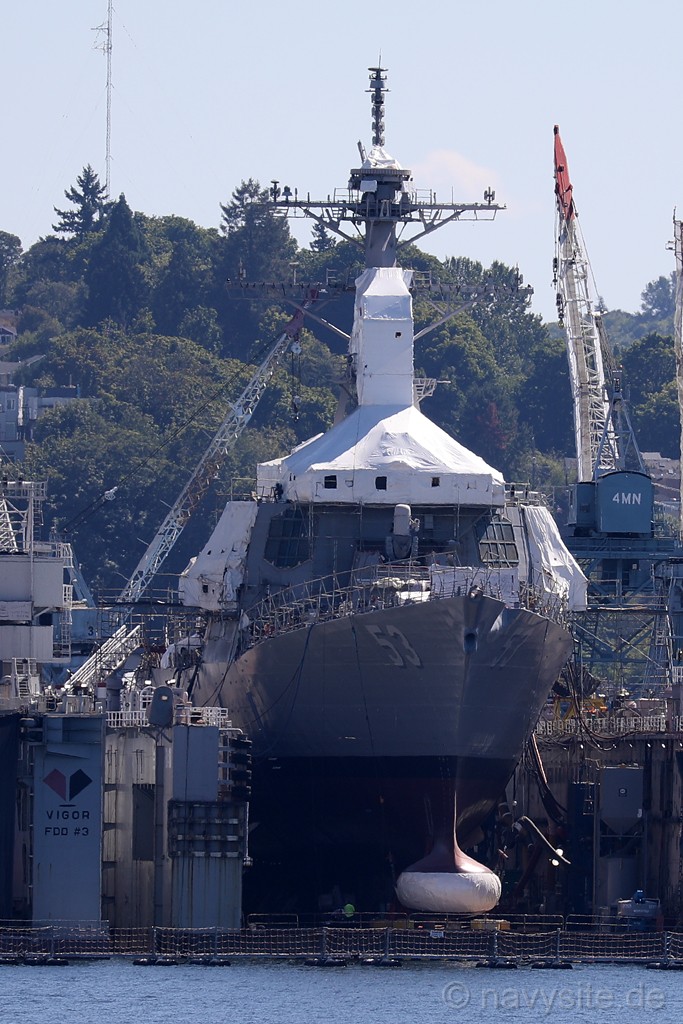
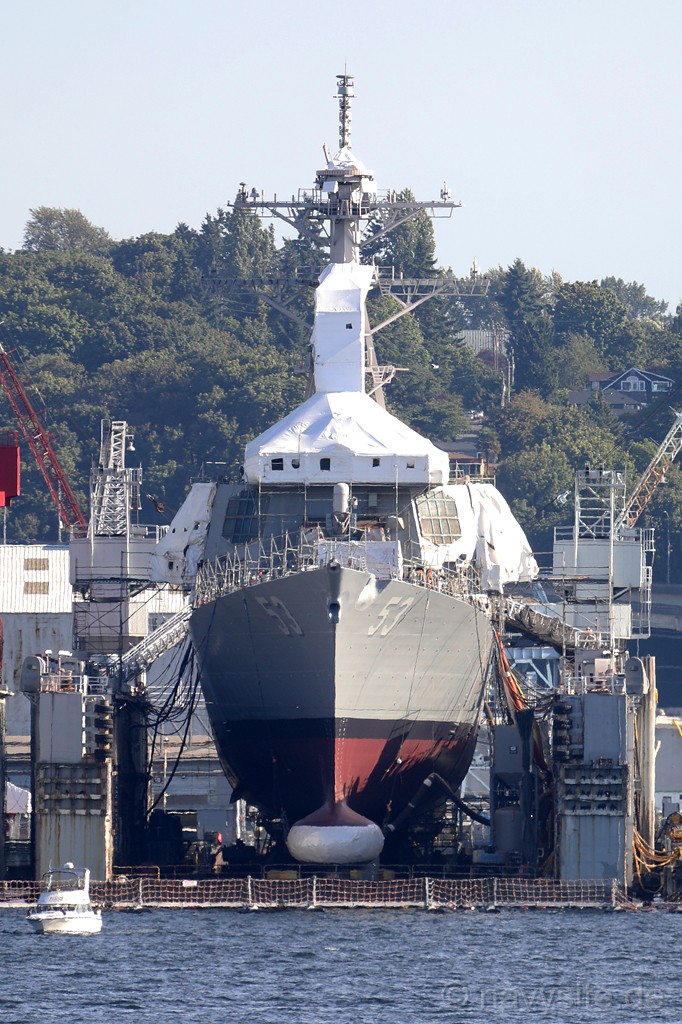
From 2022 into 2023, she balanced local operations out of Everett with maintenance. In November 2023, JOHN PAUL JONES entered a docking selected restricted availability (DSRA) at Vigor's Harbor Island shipyard in Seattle under a $131 million package, joining other Pacific Fleet surface combatants cycling through Puget Sound yards. She completed the DSRA in early 2024 and resumed routine operations and crew events in the Puget Sound area.
In 2025, the Everett-area community formally strengthened ties with the crew: on September 2, 2025, the City of Mukilteo adopted USS JOHN PAUL JONES, recognizing the destroyer's sailors and families and underscoring the ship's role in the region's naval presence as she continued training, certifications, and Pacific Northwest tasking with DESRON 9.
back to top go to the end of the pageHomeports of USS JOHN PAUL JONES:
| Period | Homeport |
|---|---|
| commissioned at San Diego, Calif. | |
| 1993 - 2014 | San Diego, Calif. |
| 2014 - 2021 | Pearl Harbor, Hi. |
| 2021 - present | Everett, Wash. |
back to top go to the end of the pageUSS JOHN PAUL JONES Image Gallery:
 |  |  | 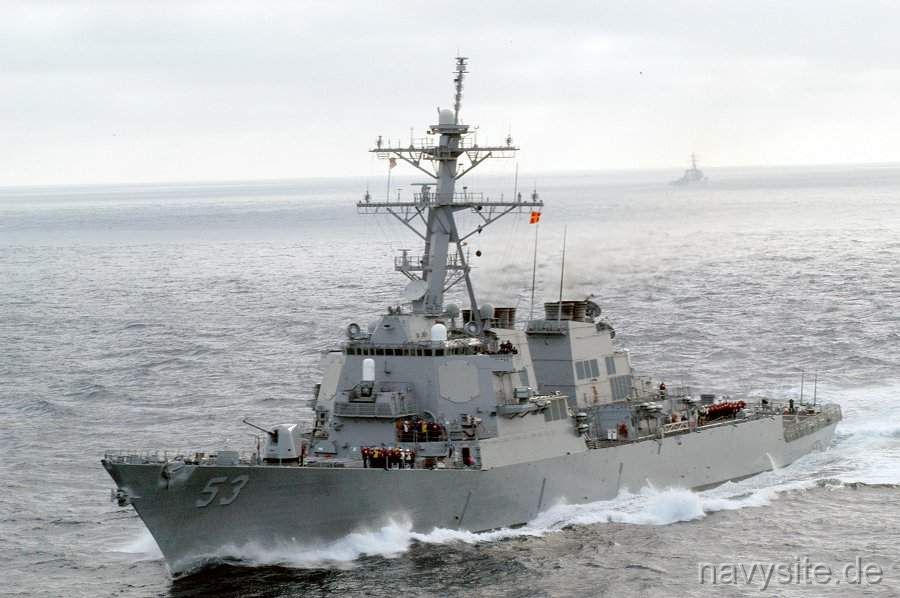 | |
 |  |  |  | |
The photo below was taken by Thomas Heinrich and shows the JOHN PAUL JONES at Naval Base San Diego, Calif., on March 21, 2009.
 |
The photos below were taken by me and show the JOHN PAUL JONES at Naval Base San Diego, Calif., on March 23, 2010.
 |  |
The photos below were taken by me and show the JOHN PAUL JONES undergoing a 12-month Drydocking Selected Restricted Availability at BAE Ship Repair in San Diego, Calif. The photos were taken on October 3, 2012. JOHN PAUL JONES entered the shipyard on September 12.
 |  |  |
The photo below was taken by Michael Jenning and shows the JOHN PAUL JONES at Naval Base Pearl Harbor, Hi., on October 14, 2017.
 |
The photo below was taken by Michael Jenning and shows the JOHN PAUL JONES at Naval Base Pearl Harbor, Hi., on June 8, 2019.
 |
The photos below were taken by Michael Jenning and show JOHN PAUL JONES undergoing a Drydocking Selected Restricted Availability (DSRA) at Vigor Shipyards, Seattle, Wash., on August 3, 2023.
 |  |  |
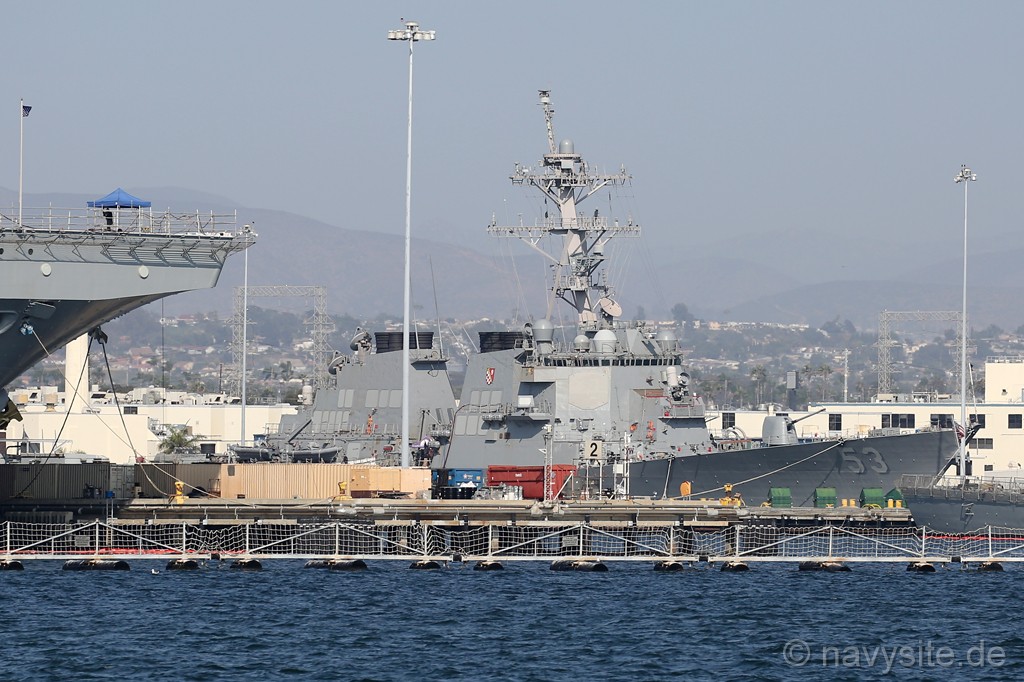
The photos below were taken by me and show JOHN PAUL JONES at Naval Base San Diego, Calif., on July 26, 2024.
 |  |  |  |
back to top
 Back to Destroyers list. Back to ships list. Back to selection page. Back to 1st page.