![]() |
Search the Site with
|
![]() | ![]() |
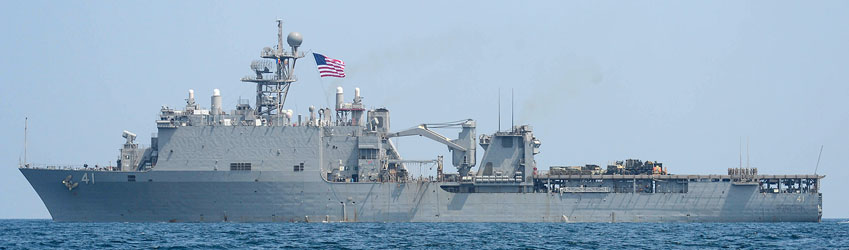
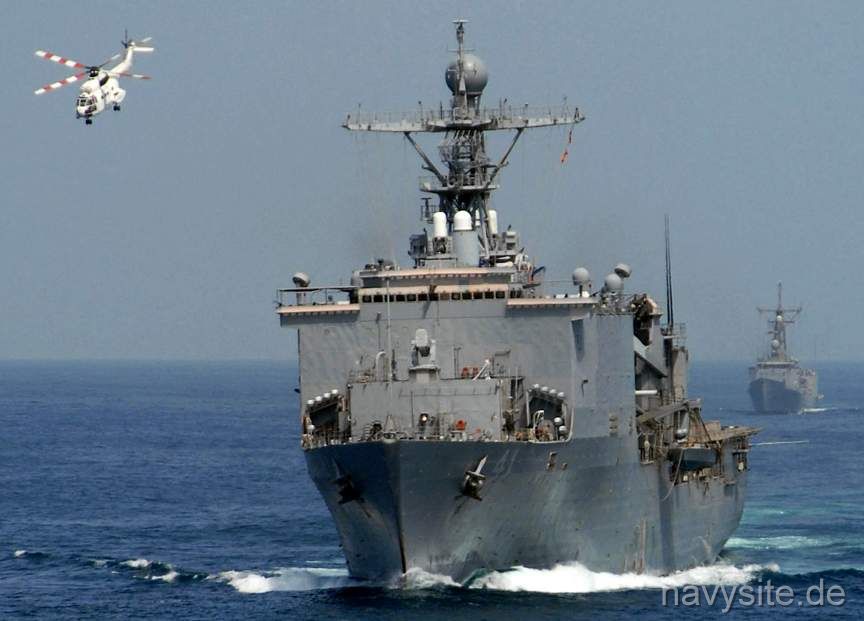
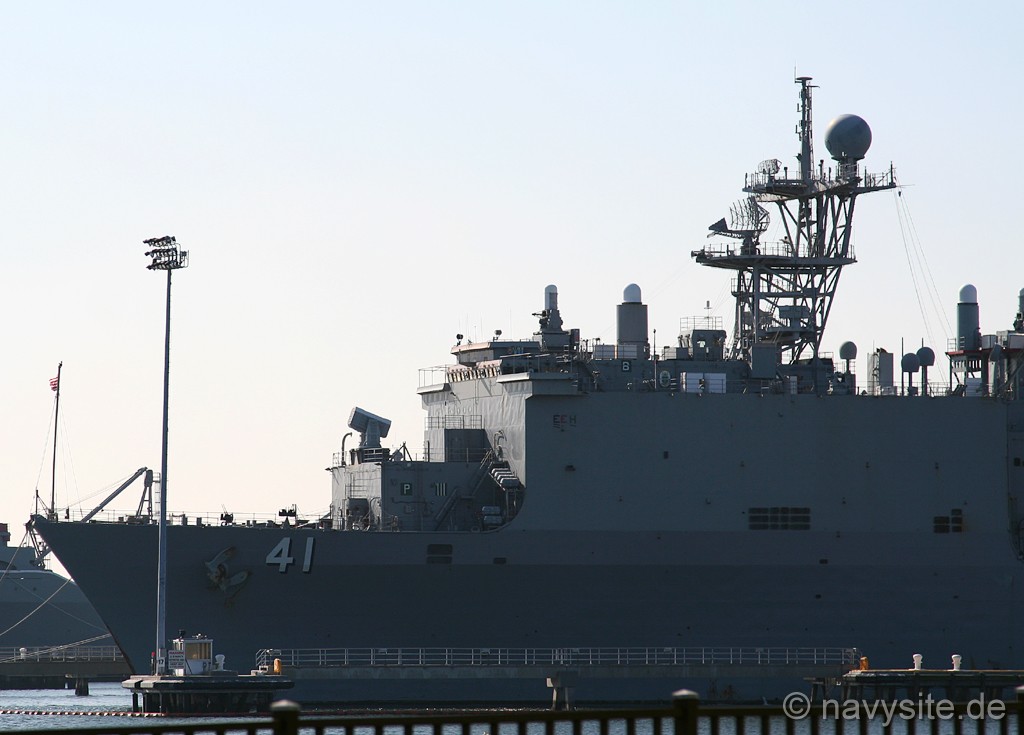
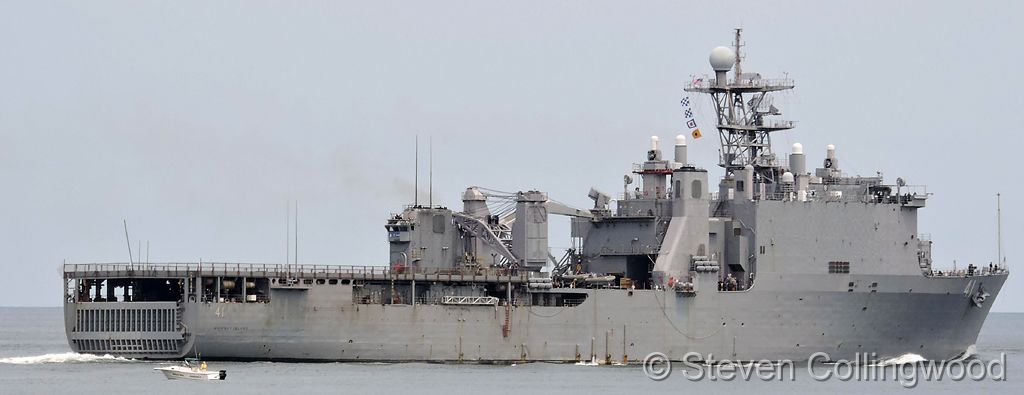
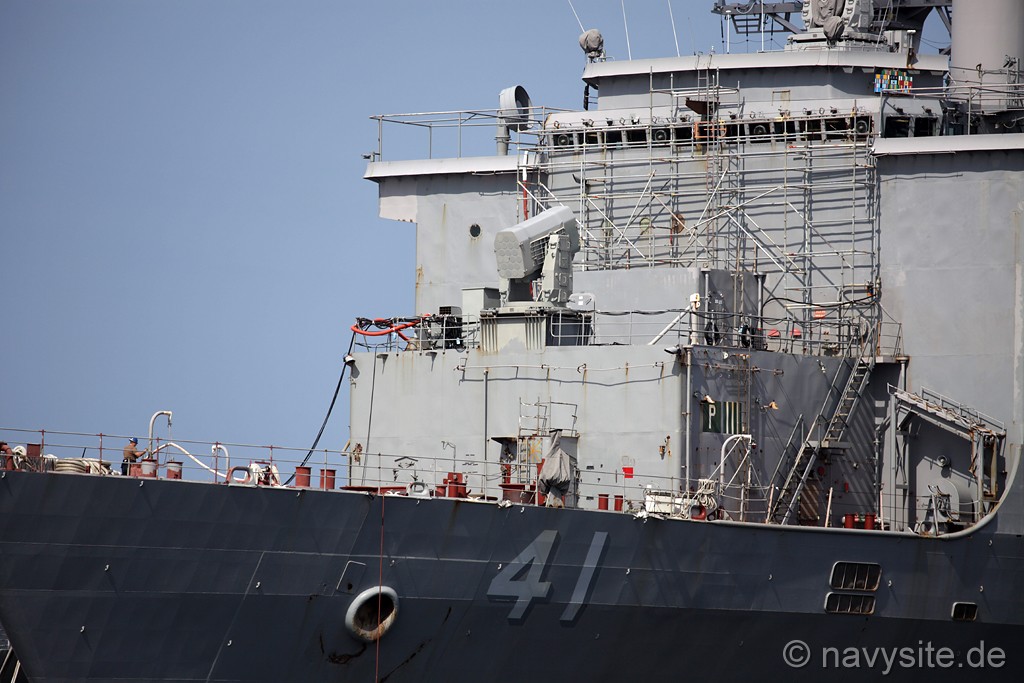
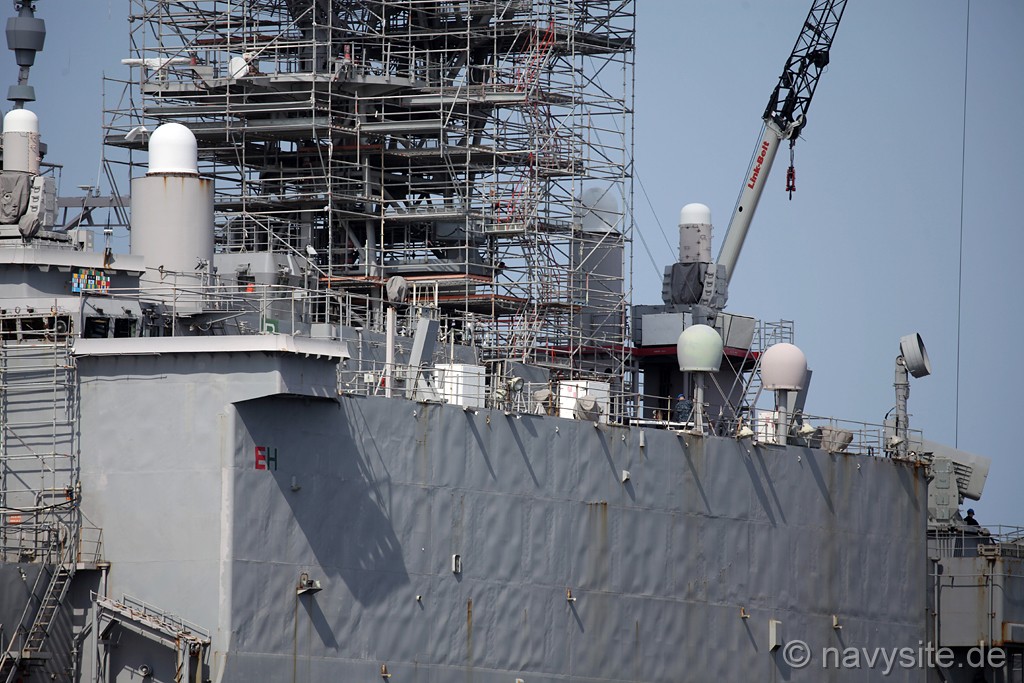
USS WHIDBEY ISLAND was the lead ship of the WHIDBEY ISLAND class of Dock Landing Ships and the first ship in the Navy named for Whidbey Island, Washington - a thirty five mile long island in Puget Sound north of Seattle. On July 22, 2022, WHIDBEY ISLAND held a decommissioning ceremony at her homeport Joint Expeditionary Base Little Creek-Fort Story, Va. On August 20, 2022, she was officially decommissioned and subsequently towed to Philadelphia, Penn., for lay-up. Sold for scrapping in 2025, ex-WHIDBEY ISLAND arrived under tow at Brownsville, Tx., on January 13, 2026, and was subsequently broken up.
| General Characteristics: | Awarded: February 9, 1981 |
| Keel laid: August 4, 1981 | |
| Launched: June 10, 1983 | |
| Commissioned: February 9, 1985 | |
| Decommissioned: August 20, 2022 | |
| Builder: Lockheed Shipbuilding, Seattle, Wash. | |
| Propulsion system: four Colt Industries 16 Cylinder Diesels | |
| Propellers: two | |
| Length: 610 feet (186 meters) | |
| Beam: 84 feet (25.6 meters) | |
| Draft: 21 feet (6.4 meters) | |
| Displacement: approx. 16,000 tons full load | |
| Speed: 22 knots | |
| Well deck capacity: four LCAC or 21 LCM-6 (on deck: one LCM-6, two LCPL and one LCVP) | |
| Aircraft: none, but two landing spots allow for operation of aircraft as large as the | |
| Crew: Ship: 20 Officers, 25 Chief Petty Officers, 302 Enlisted | |
| Marine Detachment: approx. 400 + approx. 100 surge | |
| Armament: two | |
| Cost: $339 million |
Crew List:
This section contains the names of sailors who served aboard USS WHIDBEY ISLAND. It is no official listing but contains the names of sailors who submitted their information.
USS WHIDBEY ISLAND Cruise Books:
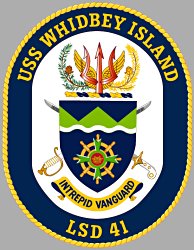
About the Ship's Coat of Arms:
The Shield:
The dark blue and white colors refer to the sea, with the angular green area, representing the vergreenterrain of WHIDBEY ISLAND, backed by blue sky. The color gold is symbolic of excellence, and the ship's wheel of gold reflects the sea-going pride and professionalism of the ship's crew. The green Maltese Cross refers to the humanitarian mission of USS WHIDBEY (AG 141), the first ship to carry the name WHIDBEY. The gold crown emblazoned on red at the center of the wheel recalls the expedition under the British Crown, which explored the Pacific Northwest in the 1790s. The island in these waters is named for Lieutenant Joseph Whidbey, who was a member of this English exploration. The crossed swords of the Navy and Marine Corps Officers attest to the Navy Marine Corps teamwork and leadership that are the foundation and key elements for accomplishment of WHIDBEY ISLAND’s amphibious warfare mission.
The Crest:
The trident is the traditional symbol of sea power; however, the winged trident of LSD 41 further represents the revolutionary dimension of amphibious warfare this ship introduces. WHIDBEY ISLAND provides a quantum improvement in the projection of power ashore, with an increased capacity for vertical assault, combined with the new generation of Landing Craft Air Cushion (LCAC). Again, the gold and red colors of the winged trident portray the excellence and courage of those who will man the ship. The wreath of Western Hemlock, the State Tree of Washington, represents the spirit of the ship's namesake, which will accompany the ship to the distant quarters of the globe.
History of USS WHIDBEY ISLAND:
USS WHIDBEY ISLAND was laid down at Lockheed Shipbuilding in Seattle on August 4, 1981, launched on June 10, 1983, delivered to the Navy on January 8, 1985, and commissioned on February 9, 1985, as the lead ship of a new class of dock landing ships designed from the keel up to operate the Navy's then-revolutionary air-cushion landing craft (LCAC). In her first year in service she completed shakedown and early workups from the U.S. East Coast and immediately entered the fleet's LCAC operational and developmental test program, supporting sustained craft trials from July through September 1985 and again in May and July 1986 - a first indication of the class's intended role in fast, over-the-horizon amphibious assault.
Early in 1986, the ship completed post-shakedown work at Metro Machine in Norfolk and then shifted to high-end NATO training. On August 1, 1986, while en route north through the Atlantic, WHIDBEY ISLAND executed "leapfrog" maneuvering drills as she joined allied forces for the large maritime-amphibious exercise Northern Wedding '86 - Cold War-era deterrence training that massed U.S. and European amphibious forces across the North Atlantic and Norwegian Sea.
Her first extended deployment began in January 1987 with PHIBRON FOUR and the 26th Marine Amphibious Unit (MARG 2-87). Operating across the Mediterranean, she conducted seven amphibious landing exercises - including SARDINIA-87 events off southern Sardinia and in the Tyrrhenian Sea - and was tasked as a presidential support ship for the World Economic Summit at Venice in May 1987, reflecting her role as the LCAC-capable transport within a ready group postured for crisis response.
A second Mediterranean deployment followed in December 1988 as part of MARG 1-89, with combined landings alongside Spanish, French, and Italian naval and marine forces. After returning to the Western Hemisphere in September and October 1989, WHIDBEY ISLAND shifted from training to humanitarian action, supporting disaster-relief operations in the Caribbean after Hurricane Hugo before conducting additional operations off Guantanamo Bay late that year. These missions typified the ship's flexibility at the close of the Cold War - swinging from allied amphibious integration to rapid regional relief.
In August 1990, the ship departed again for the Mediterranean with MARG 3-90 just as West Africa destabilized. Rerouted mid-crossing, she took station off Monrovia, Liberia, as the flagship for Operation SHARP EDGE, the non-combatant evacuation during Liberia's civil war. Stationed at "MAMBA Station" for 105 consecutive days and remaining at sea for 126 days before reaching a first liberty port at Las Palmas, she then returned to the Western Mediterranean during the opening phases of the 1990-1991 Gulf crisis, supporting Sixth Fleet presence operations linked to DESERT STORM. The Liberian evacuation and extended at-sea endurance became signature moments in the ship's early record. WHIDBEY ISLAND returned to homport in March 1991 from the extended seven-month deployment.
From December 1991 into mid-1992, WHIDBEY ISLAND deployed with MARG 1-92 and was tapped to represent the amphibious ready group in the Black Sea as the post-Soviet region opened to U.S. port calls. She visited Samsun, Turkey; Constanta, Romania; and Burgas, Bulgaria, becoming the first U.S. amphibious ship - and the largest U.S. warship - to operate in the Black Sea, the first U.S. ship to visit Samsun in seventy years, and the first ever to visit Burgas. She returned to homeport on June 5, 1992, with the deployment emblematic of the Navy's immediate post-Cold War outreach.
In January 1993, the ship shifted to the Caribbean sea lanes for migrant-interdiction duty off Haiti in support of Operations SEA SIGNAL and ABLE MANNER, enforcing U.S. policy as political violence and economic hardship drove maritime migration. Later in 1993, she pivoted thousands of miles south for UNITAS 34-93/WATC '93 with partner navies around South America and West Africa, leading an amphibious landing at Tierra del Fuego - the southernmost amphibious exercise to that date by a ship of her class - and returning on December 17, 1993. These evolutions underscored the Navy-Marine Corps team's habit of combining multinational exercises with real-world contingency duties.
In 1994, WHIDBEY ISLAND again became a workhorse for maritime crises in the Americas. She provided emergent lift to help evacuate Combined Task Force 160 migrant camps from Grand Turk Island and, as the Cuban "rafters" exodus surged, rescued and transported more than 8,100 Cuban migrants from the Straits of Florida during Operation ABLE VIGIL. Weeks later she supported the multinational intervention for Haiti's democratic restoration during Operation UPHOLD DEMOCRACY (September-October 1994). These successive operations - mass maritime rescue followed by a U.N.-authorized intervention - captured the intense tempo of the Western Hemisphere that year.
After cold-weather NATO training during STRONG RESOLVE '95, WHIDBEY ISLAND deployed again on August 28, 1995, with the 26th MEU. Through late 1995 and early 1996, she exercised with regional partners (ATLAS HINGE, ODYSSEUS '95, NOBLE SHIRLEY, BRIGHT STAR, and ALEXANDER THE GREAT) and spent more than three months in the Adriatic Sea supporting peacekeeping linked to the Dayton Accords that ended the Bosnian War. She returned to Little Creek on February 29, 1996, and in June entered a major dry-docking phased maintenance availability at NORSHIPCO, a period that also prepared the ship to embark mixed-gender crews as the Navy expanded opportunities for women at sea.
From July 1 to December 13, 1997, the ship completed UNITAS 38-97/WATC '97, conducting an unusually large number of multinational amphibious assaults with Latin American and West African partners. In February-March 1998, she supported additional LCAC skirt testing at Panama City, Florida, and then, on October 18, 1998, executed a milestone at sea: alongside the combat stores ship USNS CONCORD (T-AFS 5), WHIDBEY ISLAND became the first LSD 41-class ship to conduct simultaneous connected underway replenishment for both stores and fuel - procedural proof of how the class had been integrated into sustained blue-water operations.
On September 15, 1999, she sailed on her sixth Mediterranean deployment with the 22nd Marine Expeditionary Unit. Through late 1999 and 2000, the ship combined major exercises - BRIGHT STAR (Egypt), NOBLE SHIRLEY (Israel), and INFINITE MOONLIGHT (Jordan) - with a string of port visits that included Alicante, Antalya, Haifa, Palermo, Genoa, Souda Bay, and Aqaba. She then entered a modernization period at Norfolk Shipbuilding and Drydock (NORSHIPCO) beginning May 24, 2000, to receive twin Rolling Airframe Missile (RAM) launchers and the Ship Self-Defense System (SSDS) Mk 1, significantly improving her point-defense and combat-systems integration.
After completing basic training on June 11, 2001, and an intermediate workup cycle, WHIDBEY ISLAND sailed on September 19, 2001, with the BATAAN (LHD 5) Amphibious Ready Group and 26th MEU, just eight days after the 9/11 attacks. She participated in BRIGHT STAR off Egypt, then transited the Suez Canal to the North Arabian Sea and northern Persian Gulf for Operation ENDURING FREEDOM, remaining on station for an extended stretch as Marines projected combat power far inland. Port calls during the long cruise included Marmaris, Jebel Ali, Split, and Rota. The deployment ended in mid-2002, closing a cycle in which the Navy-Marine team established the amphibious template for the opening phase of the Afghanistan campaign.
After returning to Naval Amphibious Base Little Creek in the summer, she moved through post-deployment stand-down, corrective maintenance, and the Surface Force's basic phase: engineering and damage-control drills, navigation checks in the Virginia Capes, flight-deck recertification, and repeated well-deck evolutions with LCUs and LCACs. Short underways into late summer and early autumn rebuilt watch-team proficiency and validated material fixes, while staff planning began to align the ship with an emerging "expeditionary strike group" concept that would marry an ARG/MEU to cruisers, destroyers, and a fast-attack submarine for sea-control tasks alongside amphibious lift.
Through 2003, she progressed methodically from unit-level training into group integration as part of the first East Coast Expeditionary Strike Group built around USS WASP (LHD 1) and the 22D MARINE EXPEDITIONARY UNIT (SOC). By late June, the Marine Corps had formally announced the blue-green teamings - WASP, WHIDBEY ISLAND, and USS SHREVEPORT (LPD 12) with surface escorts USS LEYTE GULF (CG 55), USS YORKTOWN (CG 48), USS McFAUL (DDG 74), and USS CONNECTICUT (SSN 22) - and through the autumn the ships executed ESG exercises and a maritime in-port group exercise to knit together C2, communications, and composite air-defense while the amphibious ships kept their well-deck certifications current. These events were the bridge to deployment and the proof-of-concept for a more lethal, independent amphibious formation.
Deployment followed at the start of 2004. On February 17, 2004 the WASP ESG/22D MEU sailed, with the Marine element formally announcing its departure on February 21. WHIDBEY ISLAND settled quickly into Fifth Fleet patterns shaped by Operation Iraqi Freedom and maritime security. Photographic records place her VBSS teams working fishing dhows in the Gulf of Oman on April 28, 2004, illustrative of the compliant-boarding regime then used to police coastal traffic and interdict smuggling. By mid-May, contemporaneous reporting from Bahrain highlighted Marines pulling round-the-clock security at Iraq's offshore oil platforms - KAAOT and ABOT - with WHIDBEY ISLAND serving as a staging base for boarding teams and connectors that shuttled people and gear to the terminals. The broader policy backdrop was clear: coalition forces were reopening and protecting oil export infrastructure that underwrote Iraq's post-war revenue, while the ESG provided persistent sea-based presence and lift. The strike group retraced to the Mediterranean late in the summer. WASP returned September 18, and WHIDBEY ISLAND closed out her own seven-month loop to Little Creek in that same window to begin post-deployment maintenance and inspections.
During 2005, the ship remained stateside, turning lessons from the Gulf into syllabus items for the next work-up. Materially, she cleared corrective actions from the 2004 cruise and preserved hull-mechanical-electrical margins through a targeted availability while requalifying crews across the amphibious and security skill sets - LCAC/LCU well-deck operations, small-boat handling, flight-deck ops, and VBSS. The mission set she would soon resume - maritime security and critical-infrastructure defense in the Northern Arabian Gulf - was by then well established, with naval forces and Marine detachments providing continuous protection at ABOT and KAAOT and using afloat platforms as staging bases for joint teams and patrol craft. WHIDBEY ISLAND's training plan and inspections were deliberately oriented to that reality as she moved through ULTRA/INSURV preparations and group workups with the IWO JIMA (LHD 7) Expeditionary Strike Group and the 24TH MEU.
She deployed again in early summer 2006 with the IWO JIMA ESG - USS IWO JIMA, USS NASHVILLE (LPD 13), and WHIDBEY ISLAND - carrying the 24TH MEU eastward. A first waypoint came on June 18, 2006, when WHIDBEY ISLAND made an early liberty and logistics stop at Rota, Spain, while the rest of the formation continued its Mediterranean track. By mid-July, as the Lebanon war erupted, U.S. European Command and Sixth Fleet redirected the ESG to conduct the largest U.S. non-combatant evacuation since Vietnam. On July 19, the 24TH MEU was ordered to Lebanon. WHIDBEY ISLAND's LCACs fitted with personnel-transport modules shuttled evacuees from Dbaye Beach to the ship, which then delivered them to Limassol, Cyprus for State Department processing. The assisted-departure mission ran at pace for more than a week; the final scheduled lifts were announced July 26, and tallying later placed WHIDBEY ISLAND's contribution at hundreds moved among the 14,000-plus evacuated by the task force.
With the immediate crisis past, the ESG transited back through the Suez Canal to Fifth Fleet. WHIDBEY ISLAND off-loaded elements of the 24TH MEU at Bahrain to support onward operations ashore and then took up Northern Arabian Gulf duties under Commander, Task Force 158. From late summer into autumn, she served as an afloat forward staging base for the defense of KAAOT and ABOT - critical infrastructure that coalition forces had brought back online in 2003-2004 - coordinating with U.S., British, Australian and Iraqi units to maintain 24-hour security and maritime-interdiction patrols. Routine Gulf hazards punctuated the watch: on May 26, 2006 (as the task force's summer tempo was rising), a fire at KAAOT triggered a joint response. By November 2006, coalition craft were still conducting search-and-rescue for distressed Iraqi mariners in the area while the security mission continued. The expeditionary strike group's homeward itinerary included brief calls at Civitavecchia, Italy, and Tunis before WHIDBEY ISLAND's early-December homecoming to Little Creek. The ship's 2006 performance was later recognized with the Battle Efficiency "E" awarded on February 16, 2007.
On October 1, 2007, WHIDBEY ISLAND deployed once more, this time to the Horn of Africa at the height of the first surge in Somali piracy. On December 2, 2007, WHIDBEY ISLAND assisted the merchant vessel AL MARJAN immediately after pirates released the ship and its crew off Somalia, providing boarding support and aid - one of the earliest publicly documented Navy assists in that theater as coalition presence expanded along the Somali coast.
In December 2007, during heightened U.S.-Iran tensions at the Strait of Hormuz, the Navy disclosed that WHIDBEY ISLAND had fired warning shots on December 19 to deter a small, fast-approaching Iranian craft - an incident separate from the widely reported January 2008 harassment of U.S. warships there. The December action, conducted under graduated-response procedures, ended without escalation and illustrated the routine, disciplined seamanship demanded in the constrained Gulf chokepoint.
Back on the U.S. East Coast in the months that followed, the WHIDBEY ISLAND moved through the standard post-deployment rhythm at Joint Expeditionary Base Little Creek - stand-down, corrective maintenance, and the Navy's basic phase re-certifications (engineering, damage control, navigation, well-deck and flight-deck checks), interspersed with short underways off the Virginia Capes to rebuild watch-team proficiency and keep LCAC/LCU operations current. By spring 2009, WHIDBEY ISLAND shifted into a scheduled shipyard availability in Norfolk that also added a fuel-saving stern-flap modification. Industry and Navy accounts at the time noted she was the first dock landing ship to receive the upgrade, with installation beginning in mid-April at Metro Machine's SPEEDE dry dock and a planned return to sea late in the year. The availability combined lifecycle maintenance with a tangible efficiency gain at a moment when the surface force was investing heavily in fuel-economy retrofits.
Through 2010, the crew focused on inspections, certifications, and pre-deployment preparations, but the year was defined by a major in-port fire on October 5, 2010. At about 0400, watch standers detected smoke and a high-temperature alarm. The fire burned for nearly three hours before it was extinguished. A subsequent command investigation found the most probable cause to be spontaneous combustion of unauthorized linseed oil stored in a deck division space. Damage spread across dozens of compartments, with losses ultimately estimated at more than $9 million. Investigators also cited an inoperative audible alarm, delayed recognition of a visual alarm, and deficiencies in watchstanding and damage-control proficiency. Repairs and targeted retraining followed, and the episode became a widely circulated "lessons learned" case across the fleet's safety community.
As 2011 began, WHIDBEY ISLAND completed integration events with the BATAAN Amphibious Ready Group and the 22nd Marine Expeditionary Unit - planning conferences, ship-to-shore training, and the usual ARG/MEU workups that knit together amphibious connectors, aviation control, and composite warfare command relationships. In late January and early February 2011, the ARG/MEU team participated in a Warfare Commanders' Conference at Tactical Training Group Atlantic to align the formation for deployment tasks. When unrest in North Africa accelerated and NATO moved toward operations over Libya, the Navy advanced the deployment timetable: beginning March 23, 2011, the ship sailed with the BATAAN Amphibious Ready Group for what became a ten-and-a-half-month cruise spanning NATO's Libya operations and a long Sixth Fleet presence mission. She transited the Strait of Gibraltar on April 24, 2011, operated in the central Mediterranean through early summer, and on July 11 called at Naval Support Activity Souda Bay, Crete. In August, she entered the Black Sea to take part in SUMMER STORM 2011 off Romania, then redeployed eastward, transiting toward the Arabian Gulf on November 13 for continued maritime-security duties. WHIDBEY ISLAND made a first-ever call at Valletta, Malta, on January 13, 2012, before the ARG's return to the United States the following month.
From February 5, 2012, the day she returned to the United States at the end of her deployment, USS WHIDBEY ISLAND shifted from combat operations to a reset and basic-phase training rhythm in Hampton Roads. Her crew immediately stood down, completed post-deployment maintenance, and rotated personnel in preparation for the next cycle.
Beginning in mid-2012, WHIDBEY ISLAND entered an Extended Selected Restricted Availability in Norfolk, a deep modernization and repair period that kept the ship pier-side for roughly twenty-two months. She emerged to sea on May 3, 2014, for post-availability trials to prove out hull, mechanical and electrical work, and to re-certify the well deck, flight deck, and combat systems for the training ahead. The long yard period - typical of the class in that era, when LSD 41/49 modernizations focused on engines, electrical plant upgrades and habitability - set conditions for the ship to rejoin the amphibious force before year's end.
In late October and early November 2014, the ship took part in the East Coast amphibious exercise BOLD ALLIGATOR 2014, operating off Virginia and North Carolina as part of a large Navy-Marine Corps force that rehearsed sea control, ship-to-shore movement, and crisis response after years of focus on land campaigns. The well deck cycled landing craft and tracked vehicles in heavy surf while the crew refined beach-group and LCAC interface procedures under the eye of evaluators. The exercise also served as a re-integration milestone for WHIDBEY ISLAND after her long maintenance interval.
Through early 2015, the ship remained based at Joint Expeditionary Base Little Creek-Fort Story, running unit-level drills at sea off the Virginia Capes and completing certifications in navigation, seamanship, engineering readiness, and flight and well-deck operations that are prerequisites to deploying as part of an Amphibious Ready Group. Those graded events fed directly into the spring 2016 work-ups, when WHIDBEY ISLAND combined with USS WASP, USS SAN ANTONIO (LPD 17) and the 22ND MEU. After the ARG/MEU Exercise in April, she executed COMPTUEX in May, cycling through integrated amphibious operations with MV-22 OSPREY detachments, AAV and LCU traffic in the well deck, and live-fire events on the MK-38 and other defensive systems that certify a task group for deployment.
On June 25, 2016 the WASP ARG got underway from Norfolk and Little Creek for a scheduled six-month deployment, with WHIDBEY ISLAND as the dock landing ship in AMPHIBIOUS SQUADRON SIX's formation. The task group crossed the Atlantic into the U.S. 6th Fleet theater at a moment of elevated tension in the Black Sea region following Russia's actions in Ukraine, and on July 21, 2016, WHIDBEY ISLAND was photographed transiting northbound through the Bosphorus, entering the Black Sea under the Montreux Convention regime to support presence operations and allied engagement. A week later, she took part in exercise SEA BREEZE 2016 off Odesa, Ukraine, putting Marines from the 22ND MEU ashore and operating with Ukrainian and other NATO/partner forces to rehearse combined amphibious landings, maritime interdiction and casualty handling.
Following operations in European waters, WHIDBEY ISLAND pressed through the Suez Canal into the U.S. 5th Fleet theater for Arabian Gulf and Red Sea duties with the WASP ARG. She moored at Jebel Ali, United Arab Emirates, in early October for a mid-deployment voyage repair - routine corrective and preventive maintenance to keep the ship fully mission-capable for the remainder of the cruise - getting back underway after completion on October 12, 2016. The ship's Red Sea and Indian Ocean periods included live-fire evolutions and continuing theater security cooperation while conducting well-deck operations with the embarked amphibious forces.
In December 2016, the ARG shaped back toward the Atlantic. WHIDBEY ISLAND conducted a port visit to Lisbon, Portugal, on December 10, where Portuguese Fuzileiros came aboard for bilateral training and the crew carried out community-relations projects. By December 24, 2016, the WASP ARG ships were back pierside at Norfolk and Little Creek, closing the deployment at the holidays.
Starting in August 2017, the ship entered a lengthy maintenance availability in Norfolk aimed at life-extension, systems reliability and correcting material discrepancies found in pre-dock inspections. Much of 2018 and 2019 was spent in the hands of the industrial team and ship's force completing work packages. In December 2019, she ran contractor sea trials to prove the repairs. On February 3, 2020, WHIDBEY ISLAND got underway from Little Creek for type-commander sea trials and "Mariner Skills Week", formally returning to the operational waterfront. On February 3, 2020, she also marked her 35th year in commission, then the Navy's oldest non-nuclear-powered warship still in active service.
During 2020-2021, as the fleet adjusted operating patterns amid the COVID-19 pandemic and the amphibious force's modernization plans, WHIDBEY ISLAND remained Atlantic-based and pier-side for periods of training, groom and crew turnover. In mid-August 2021, she supported LARGE SCALE EXERCISE 2021 at Little Creek by hosting and executing a mass-casualty drill scenario, integrating ship's company, waterfront medical teams and other units in a complex casualty-flow rehearsal designed to stress command-and-control and damage-control processes.
The Navy's December 2020 long-range shipbuilding plan projected placing the ship out of commission in reserve in 2022. After final preparations and material off-load, WHIDBEY ISLAND held her decommissioning ceremony at Joint Expeditionary Base Little Creek-Fort Story on July 22, 2022, ending nearly thirty-eight years of commissioned service. The declaration placed her in "Out-of-Commission, In Reserve" status pending final disposition decisions.
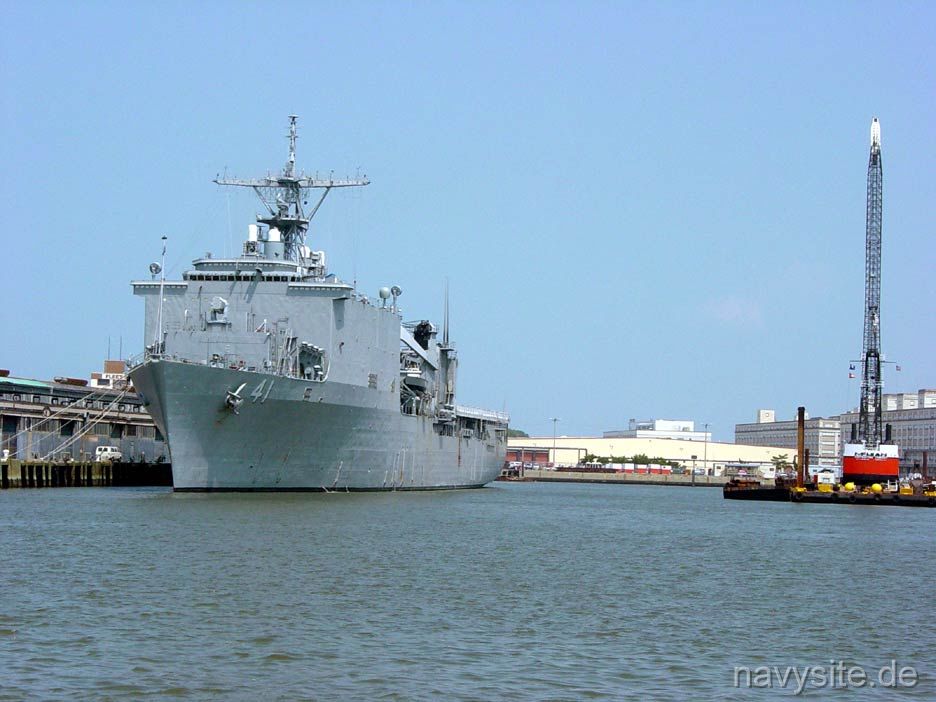
In August 2022, the ex-WHIDBEY ISLAND departed Hampton Roads under tow for the Naval Inactive Ship Maintenance Facility at Philadelphia, where she arrived and moored in late summer 2022. Photographs taken on September 23, 2022, show the former dock landing ship alongside at the basin across from other inactive units. She has remained in caretaker status at Philadelphia, maintained by the Inactive Ships Office while the Navy evaluated long-term options. Sold for scrapping in 2025, ex-WHIDBEY ISLAND arrived under tow at Brownsville, Tx., on January 13, 2026, and was subsequently broken up.
Homeports of USS WHIDBEY ISLAND:
| Period | Homeport |
|---|---|
| commissioned at Seattle, Wash. | |
| 1985 - 2022 | Little Creek, Va. |
USS WHIDBEY ISLAND Image Gallery:
![]() | ![]() |
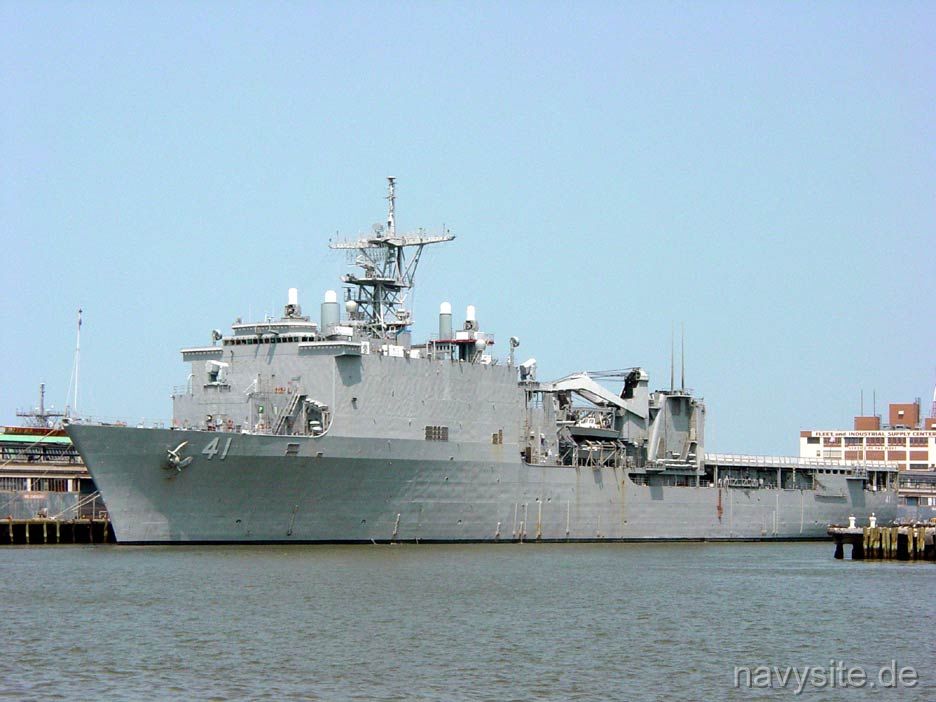
The photos below were taken by Brian Barton when USS WHIDBEY ISLAND was at Naval Base Norfolk on July 23, 2002.
![]() | ![]() |
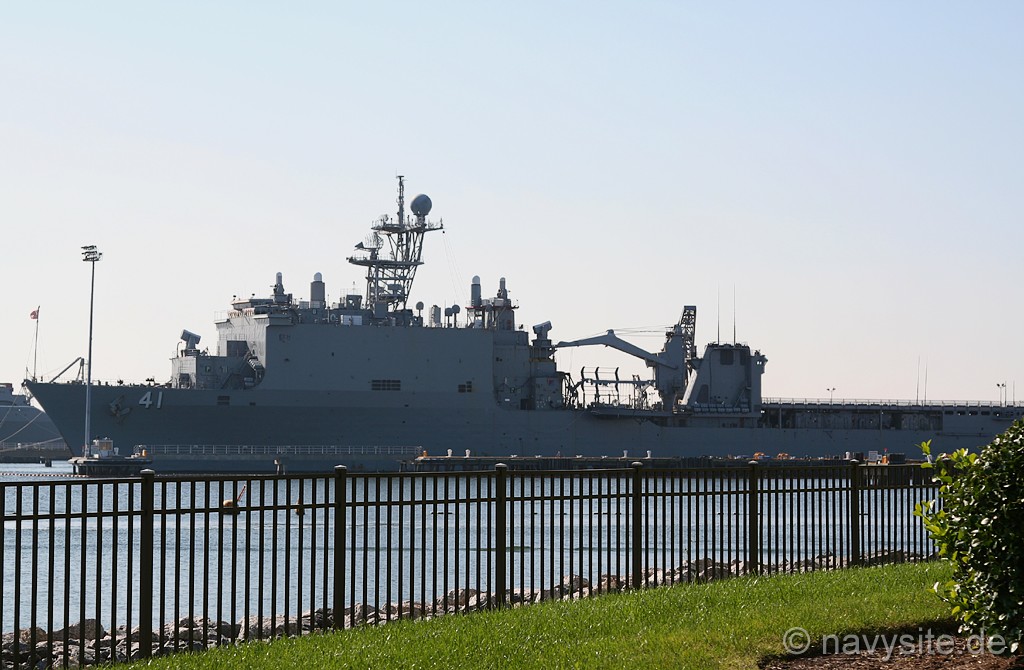
The photos below were taken by me and show the USS WHIDBEY ISLAND at her homeport of Little Creek, Va., on November 11, 2008.
![]() | ![]() |
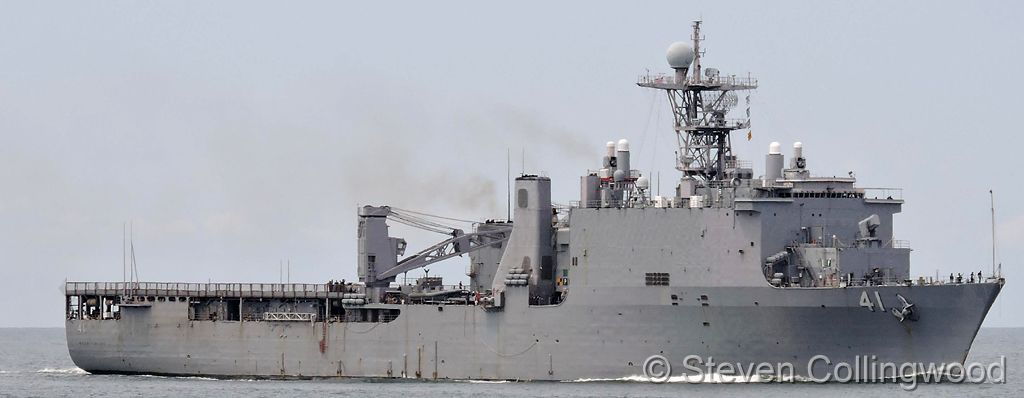
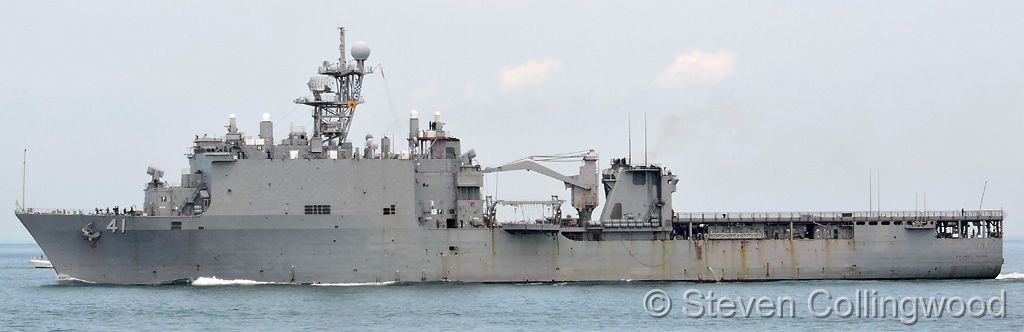
The photos below were taken by Steven Collingwood and show the USS WHIDBEY ISLAND after departure from Little Creek, Va., on July 27, 2015.
![]() | ![]() |
The photo below was taken by Steven Collingwood and shows the USS WHIDBEY ISLAND returning to Little Creek, Va., on August 5, 2015, after completing a 9-day underway for routine training.
![]() |
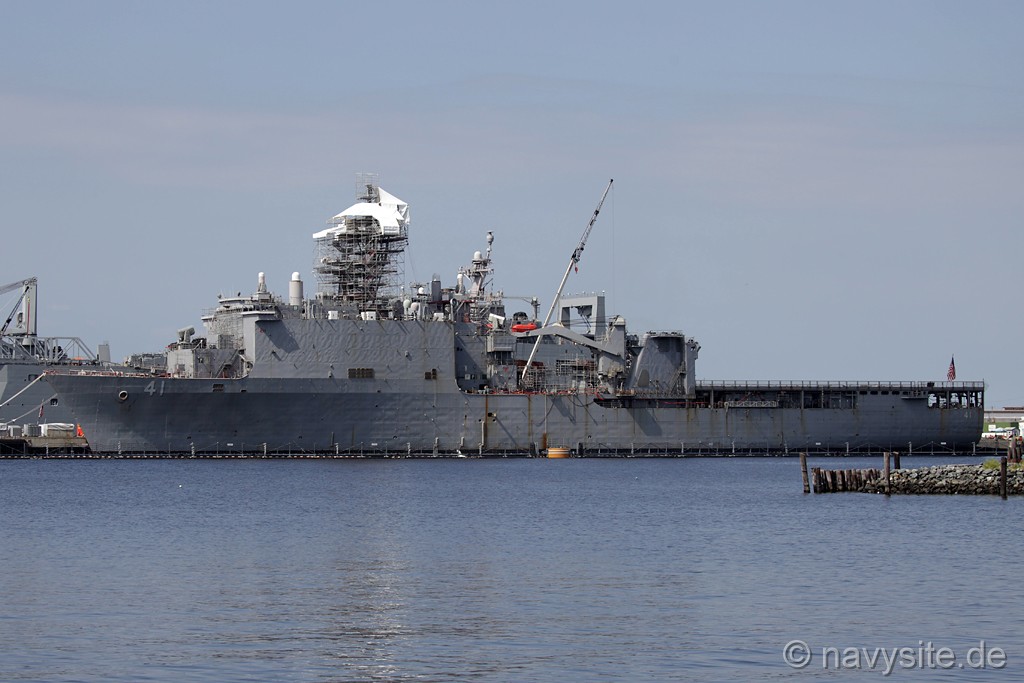
The photos below were taken by Michael Jenning and show the USS WHIDBEY ISLAND at the Marine Hydraulics Industries (MHI) Ship Repair & Services shipyard in Norfolk, Va., for a Phased Maintenance Availability (PMA) on October 4, 2017.
![]() | ![]() | ![]() |
The photos below were taken by Michael Jenning and show the USS WHIDBEY ISLAND at the Marine Hydraulics Industries (MHI) Ship Repair & Services shipyard in Norfolk, Va., for a Phased Maintenance Availability (PMA) on September 21, 2018.
![]() | ![]() | ![]() | ![]() |
Back to Dock Landing Ship site.
Back to ships list.
Back to selection page.
Back to 1st page.