![]() |
Search the Site with
|
![]() | ![]() | ![]() |
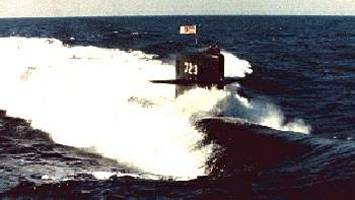
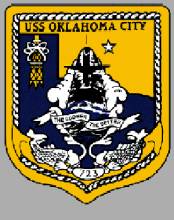
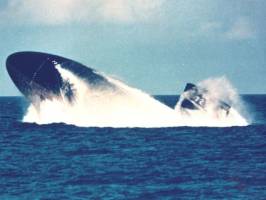
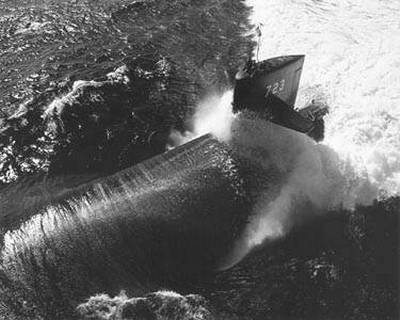
USS OKLAHOMA CITY was one of the LOS ANGELES - class attack submarines and the second ship in the Navy to bear the name. The submarine held a decommissioning ceremony at Puget Sound Naval Shipyard, Bremerton, Wash., on May 20, 2022, and was officially decommissioned and stricken from the Navy list on September 9, 2022.
| General Characteristics: | Awarded: August 13, 1981 |
| Keel Laid: January 4, 1984 | |
| Launched: November 2, 1985 | |
| Commissioned: July 9, 1988 | |
| Decommissioned: September 9, 2022 | |
| Builder: Newport News Shipbuilding Co., Newport News, Va. | |
| Propulsion system: one nuclear reactor | |
| Propellers: one | |
| Length: 360 feet (109.73 meters) | |
| Beam: 33 feet (10 meters) | |
| Draft: 32,15 feet (9.8 meters) | |
| Displacement: Surfaced: approx. 6,255 tons | |
| Submerged: approx. 7,102 tons | |
| Speed: Surfaced: approx. 15 knots | |
| Submerged: approx. 32 knots | |
| Armament: | |
| Cost: approx. $900 million | |
| Crew: 12 Officers, 115 Enlisted |
Crew List:
This section contains the names of sailors who served aboard USS OKLAHOMA CITY. It is no official listing but contains the names of sailors who submitted their information.
Commanding Officers of USS OKLAHOMA CITY:
| Period | Name |
|---|---|
| September 1985 - March 1987 | Commander Joseph J. Krol, USN |
| March 1987 - January 1991 | Commander Kevin J. Reardon, USN |
| January 1989 - July 1991 | Commander James C. Holloway, USN |
| July 1991 - March 19, 1994 | Commander Phillip M. Polefrone, USN |
| March 19, 1994 - August 2, 1996 | Commander Richard L. Snead, USN |
| August 2, 1996 - November 16, 1998 | Commander John G. Cooke V., USN |
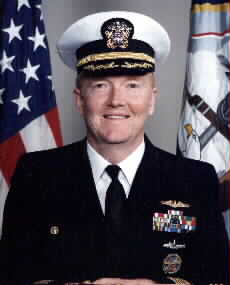
| November 16, 1998 - July 2001 | Commander James G. Foggo III., USN |
| July 2001 - November 2002 | Commander Richard S. Voter, USN |
| November 2002 - December 2002 | Captain Howard F. Reese, USN |
| December 2002 - January 2003 | Commander Ronald A. LaSalvia, USN |
| January 2003 - June 2005 | Commander Gorden C. Williams, USN |
| June 2005 - November 2008 | Commander Louis E. Mayer IV., USN |
| November 2008 - March 2011 | Commander Aaron M. Thieme, USN |
| March 2011 - December 2013 | Commander Andrew G. Peterson III., USN |
| December 2013 - January 2016 | Commander Michael R. Conner, USN |
| January 2016 - August 2016 | Commander John P. Friedman, USN |
| August 2016 - November 2018 | Commander Thomas P. O'Donnell, USN |
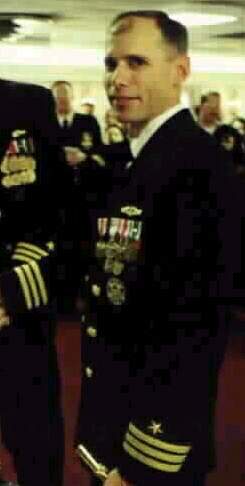
| November 2018 - September 2022 | Commander Steven C. Lawrence, USN |
History of USS OKLAHOMA CITY:
USS OKLAHOMA CITY, a LOS ANGELES-class nuclear-powered attack submarine, began its story in the late Cold War. The contract for the boat was awarded to Newport News Shipbuilding and Dry Dock Company in Newport News, Virginia on August 13, 1981, as part of the continuing expansion and modernization of the U.S. attack submarine force designed for open-ocean anti-submarine warfare, intelligence collection, and land-attack missions. The keel was laid on January 4, 1984, and the hull took shape through the mid-1980s in a period when NATO and the Soviet Union were still locked in maritime competition. The submarine was launched on November 2, 1985, with Linda Nickles, wife of senator Don Nickles, serving as sponsor at a ceremony that linked the boat to its namesake city in Oklahoma. After fitting-out and trials, the Navy accepted delivery on June 26, 1988, and the submarine was commissioned on July 9, 1988 at Norfolk Naval Base, with commander Kevin John Reardon in command and Norfolk, Virginia as its homeport.
In its first years in service, USS OKLAHOMA CITY joined Submarine Squadron 8 within the Atlantic Fleet. Operating from Norfolk in 1988 and 1989, the submarine conducted shakedown operations, weapons certification, and fleet exercises along the U.S. East Coast and in the western Atlantic, integrating into carrier battle group operations and refining tactics for the emerging Tomahawk land-attack missile capability. Public sources do not provide a detailed day-by-day account of these early training periods, but they mark the transition from a newly built platform to a fully operational unit ready for deployment.
The submarine's first extended operational deployment came in March 1990, when USS OKLAHOMA CITY deployed to the Mediterranean Sea with the battle group centered on aircraft carrier USS DWIGHT D. EISENHOWER (CVN 69). During this deployment, the security environment changed rapidly: Iraq invaded Kuwait in August 1990, triggering Operation Desert Shield and a large multinational buildup in the region. The submarine operated in support of this response, conducting surveillance and anti-submarine warfare tasks in support of Sixth Fleet and Central Command requirements. For its performance, the boat received Sixth Fleet's "Hook 'em" award recognizing anti-submarine warfare excellence and was awarded a Meritorious Unit Commendation. It also earned the Battle Efficiency "E" for 1990 from Commander, Submarine Squadron 8, and the Engineering "E" for outstanding engineering performance, reflecting consistently high scores in Atlantic Fleet competitions.
In September 1991, still based in Norfolk, USS OKLAHOMA CITY again deployed to the Mediterranean with the EISENHOWER battle group. By then, Operation Desert Storm had concluded, and U.S. naval forces were focused on post-conflict stability, sanctions enforcement against Iraq, and routine presence missions in a changing post-Cold War environment. The submarine remained deployed until March 1992, providing undersea surveillance and strike-capable presence at a time when the U.S. Navy was redefining its role after the collapse of the Soviet Union. Over this period, the submarine again achieved high readiness ratings: it won a second consecutive Battle Efficiency "E" for 1991 and was recognized with the Marjorie Sterrett Battleship Fund Award for the Atlantic Fleet in 1991, an award given annually to one ship per coast for overall excellence.
Following its return from the second Mediterranean deployment, USS OKLAHOMA CITY entered a major modernization and test phase that would define the mid-1990s. For roughly a year, beginning after its March 1992 homecoming, the submarine underwent backfitting with the BQQ-5E sonar and CCS Mk 2 combat control system, at that time the Navy's most advanced sonar and fire-control suite for non-improved LOS ANGELES-class submarines. From March 1993 through February 1995, the submarine served as a primary test platform for this modernized combat system. During this period, it fired four Tomahawk cruise missiles and two Harpoon anti-ship missiles, as well as more than seventy torpedoes, in a combination of test and evaluation firings and tactical exercises, validating the integration of sensors, fire control, and weapons for fleet-wide upgrade programs valued in the billions of dollars.
Immediately after completing this demanding test program, USS OKLAHOMA CITY transitioned back into operational deployment. It worked up for another extended cruise and then deployed again to the Mediterranean, this time associated with the battle group centered on aircraft carrier USS AMERICA (CV 66). The deployment extended into the Arabian Gulf, reflecting ongoing U.S. naval involvement in the enforcement of United Nations sanctions on Iraq and broader security commitments in the Middle East. During this period the submarine was again recognized by Submarine Squadron 8 with a third Battle Efficiency "E", as well as a 1994 Engineering "E" and the 1995 Supply "E" for logistics readiness, and it received an honorable mention in the 1996 Edward F. Ney food service competition, which measured the quality of life support and galley performance on board.
By the mid-1990s, the Navy began to reduce force structure while extending the service life and capability of newer units, and USS OKLAHOMA CITY followed that pattern. It entered Portsmouth Naval Shipyard in Kittery, Maine, for an extended Depot Modernization Period of about fifteen months, during which machinery, electronics, and habitability systems were overhauled or replaced. This period provided an opportunity to incorporate lessons learned from the combat system testing and early deployments into the boat's permanent configuration. After sea trials that were reported as notably problem-free, the submarine returned to its Norfolk homeport in March 1998 with significantly refreshed capabilities.
In 1998, under the command of then-commander James G. Foggo, USS OKLAHOMA CITY's performance in exercises and inspections earned it another Battle Efficiency "E" and the Admiral Arleigh Burke Fleet Trophy, given to the most improved ship in the Atlantic Fleet. This recognition reflected both the impact of the modernization work just completed and the crew's ability to bring the updated submarine rapidly back to a high operational standard.
The early 2000s brought a shift toward operations in challenging environments. In 2001, the submarine participated in Atlantic Submarine Ice Exercise (LANTSUBICEX) 1-01, alongside USS SCRANTON (SSN 756) and USS CONNECTICUT (SSN 22). This three-submarine exercise was conducted in the Arctic and North Pole region, demonstrating U.S. Navy attack submarine capability to operate under and through the polar ice and emphasizing assured access to international waters in the High North. For USS OKLAHOMA CITY, the exercise tested sensors, communications, navigation, and survivability in a harsh environment, and it reflected growing strategic interest in the Arctic as sea ice patterns began to change.
After the terrorist attacks of September 11, 2001, U.S. naval operations shifted strongly toward support of the global War on Terror. On June 20, 2002, USS OKLAHOMA CITY departed Naval Station Norfolk as part of the USS GEORGE WASHINGTON (CVN 73) battle group for a scheduled Mediterranean deployment in support of Operation Enduring Freedom. The submarine's tasks during this deployment included surveillance, intelligence collection, and readiness to launch Tomahawk land-attack missiles if required, at a time when U.S. and allied forces were conducting operations in Afghanistan and maintaining pressure on terrorist networks. The deployment gained particular attention because of an incident late in the cruise. On November 13, 2002, while transiting the western Mediterranean east of the Strait of Gibraltar and coming to periscope depth in international waters, USS OKLAHOMA CITY collided with the Norwegian liquefied natural gas tanker NORMAN LADY. No one on either vessel was injured, and there were no reported fuel or cargo leaks, but the submarine sustained damage to its sail and periscope area. It diverted to La Maddalena, Sardinia, for repairs and a careful assessment of damage and procedures. The commanding officer, commander Richard Voter, was relieved of command on November 30 in La Maddalena after higher authority determined a loss of confidence in his ability to command, and several other crew members received non-judicial punishment. The submarine completed repairs, underwent recertification to confirm readiness, and then returned to Norfolk on December 18, 2002, concluding a deployment that had combined routine presence, counter-terrorism support, and a high-profile navigational mishap.
In the years immediately following the 2002 deployment, USS OKLAHOMA CITY remained in the Atlantic Fleet, conducting local operations, exercises, and maintenance from Norfolk. Publicly available sources provide only limited detail for 2003, but they show the submarine preparing for more ambitious global operations that would soon test its endurance and flexibility. This period included ongoing integration of advanced navigation systems as the Navy moved away from paper charts, a transition in which OKLAHOMA CITY would play a leading role.
A significant milestone came with a major inter-fleet operation in the mid-2000s. In 2004, the submarine deployed from the Atlantic toward the Pacific. As part of this deployment, it transited beneath the Arctic ice to reach the Pacific Ocean, becoming, according to later Navy documentation, only the third submarine to make such an under-ice passage from the Atlantic to the Pacific, and the first second-flight LOS ANGELES-class boat to do so. During this deployment, USS OKLAHOMA CITY conducted operations in the Pacific in support of national security interests and the global War on Terror, underscoring the flexibility of nuclear-powered attack submarines to shift between theaters. On December 20, 2004, the submarine made a rare port visit to Pearl Harbor, Hawaii, drawing notice because Atlantic-based submarines seldom visited that base. On January 20, 2005, it completed a six-month deployment that effectively circumnavigated North America: after its operations in the Pacific it returned to the Atlantic via the Panama Canal and steamed back to Norfolk.
The tempo remained high in 2005. On May 12, 2005, USS OKLAHOMA CITY once again left Norfolk, this time for a Middle East deployment in support of ongoing operations in the broader global War on Terror. During this deployment, it operated in and around the Arabian Sea and adjacent waters, supporting maritime security and strike-support missions tied to U.S. operations in Iraq and Afghanistan. In October 2005, the submarine called at Souda Bay, Crete, a frequent logistics and rest stop for U.S. and NATO ships in the eastern Mediterranean. It returned to Norfolk on November 9, 2005, concluding another six-month deployment.
Operations shifted southward the following year. On August 29, 2006, USS OKLAHOMA CITY arrived at HMAS Stirling at Garden Island, near Perth, Australia, for a brief port call before taking part in a Submarine Command Course, a demanding exercise aimed at training future submarine commanding officers. In this phase it operated alongside Royal Australian Navy units including submarine HMAS DECHAINEUX, frigate HMAS NEWCASTLE, and fleet oiler HMAS SIRIUS. The exercise reflected close U.S.-Australian naval cooperation and provided complex anti-submarine and tactical scenarios in the Indian Ocean approaches.
Technological change defined 2007. In early that year, USS OKLAHOMA CITY became the first U.S. Navy submarine certified to navigate exclusively with Digital Nautical Charts using the Voyage Management System, part of the Electronic Chart Display and Information System-Navy (ECDIS-N). This move away from traditional paper charts to a fully electronic navigation suite was described by the Navy as the most significant change in its navigation practices since the introduction of GPS in the 1990s. Later accounts note that, while still assigned to Submarine Squadron 8, the submarine went on to complete a full deployment using this all-electronic navigation system, validating the concept for fleet-wide implementation.
From May to November 2007, USS OKLAHOMA CITY deployed to the Persian Gulf region once more, this time explicitly in support of the War on Terror. As part of a broader U.S. naval presence in the region, the submarine conducted surveillance, deterrent patrols, and readiness operations against a backdrop of coalition operations in Iraq and ongoing concerns about regional security and proliferation. In 2008, its operational focus briefly shifted to the Eastern Pacific. From May to July 2008 the submarine operated under U.S. Southern Command in support of counter-drug missions, working with other U.S. and partner-nation forces to interdict narcotics trafficking by sea. During this deployment, according to later Navy and open-source summaries, USS OKLAHOMA CITY was credited with supporting seizures totaling more than 11 metric tons of cocaine, with an estimated street value exceeding one and a half billion dollars. For its combined performance, the boat was awarded the 2008 Squadron Eight Battle "E" for excellence in wartime readiness.
Returning from a surge deployment, USS OKLAHOMA CITY arrived back in Norfolk on July 21, 2008. On November 22, 2008, command of the submarine passed from commander Louis Edward Mayer IV to commander Aaron M. Thieme, marking a transition into a period focused on deep maintenance and a major change in strategic orientation. Thieme's later biographical profiles note that he would take the submarine through an engineered overhaul and an eventual change of homeport to Guam in the western Pacific, aligning the boat with the growing U.S. emphasis on the Indo-Pacific region.
The late 2000s and very early 2010s saw USS OKLAHOMA CITY undergo a long engineered overhaul of roughly twenty-six months at Portsmouth Naval Shipyard. This period included significant hull, mechanical, and electrical work; modernization of combat systems; and the embedding of the proven all-electronic navigation suite into the submarine's standard configuration. By early 2011, the overhaul was complete and the boat was prepared for a new phase of service far from its original Atlantic homeport.
The submarine shifted to the Pacific in early 2011. After departing the U.S. West Coast, it called at Pearl Harbor, Hawaii, in February 2011, then continued westward. On March 3, 2011, USS OKLAHOMA CITY arrived at Apra Harbor, Guam, where it joined Commander, Submarine Squadron 15 as one of three forward-deployed fast attack submarines. It replaced USS CITY OF CORPUS CHRISTI (SSN 705), which shifted to Pearl Harbor, and its arrival marked an increase in flexible undersea presence in the western Pacific at a time when the U.S. was emphasizing the strategic "rebalance" toward Asia.
From its new Guam base, USS OKLAHOMA CITY began a pattern of Indo-Pacific patrols and regional port visits. In March 2011, the submarine was photographed in Santa Rita, Guam, underscoring its new forward-deployed status, and later that year it operated across the western Pacific under Seventh Fleet control. In November 2011, it visited Fleet Activities Yokosuka in Japan during a deployment, and imagery and reports from that period show Tomahawk cruise missiles being loaded into its vertical launch system at Polaris Point, Guam, highlighting its strike role.
Operations continued steadily in the following years. In 2012 and early 2013, USS OKLAHOMA CITY maintained a regular rhythm of patrols and maintenance in Guam. Imagery from March 2013 shows a Mk 48 ADCAP torpedo being offloaded from the submarine at Apra Harbor, indicating weapons handling and likely preparations for maintenance or another deployment. In December 2013, a change-of-command ceremony took place on board at Naval Base Point Loma in San Diego, demonstrating that the submarine's movements occasionally brought it back to the U.S. West Coast for periods of upkeep and operational re-alignment even as Guam remained its forward base.
By mid-2014, the submarine was firmly integrated into Seventh Fleet patterns. Navy historical documentation notes that on July 7, 2014, USS OKLAHOMA CITY made a three-day port call at Fleet Activities Yokosuka in Japan, shortly after departing Guam for another western Pacific patrol. The visit underscored its role in routine presence missions, port visits that strengthened ties with Japan, and exercises in the region's busy sea lanes.
In 2015, the submarine again appeared in Japanese waters. On April 22, 2015, USS OKLAHOMA CITY arrived at Fleet Activities Yokosuka for a port visit during a deployment to the western Pacific. Photographs from that day show the American flag being raised and the boat moored at the pier, while Navy press releases described it as the crew's first port visit of that deployment, a chance for rest as well as logistical support. The submarine was tugged through Tokyo Bay to the base, with the port call reinforcing its regular pattern of operations across the broader Indo-Pacific.
In January 2016, the submarine briefly entered wider public view when its commanding officer, commander Michael Conner, was relieved of command for what Navy leadership described as "lackluster leadership", a decision taken while the boat was in an extended maintenance and modernization phase. Reports at the time indicated that this occurred amid ongoing hull and systems work and did not involve a specific operational incident, but it underlined the Navy's focus on performance and standards even in periods away from deployment.
In the latter half of the 2010s, USS OKLAHOMA CITY remained forward-deployed from Guam as regional focus shifted toward competition in the South and East China Seas and broader Indo-Pacific security. On February 23 of an unspecified year in this period - context from allied reporting indicates 2017 - Navy records show the submarine participating in Exercise Ocean Explorer in the Pacific, a multinational exercise off Australia designed to test joint maritime operations and interoperability.
A particularly busy deployment occurred in 2018. On March 16, 2018, USS OKLAHOMA CITY arrived in Singapore for a port visit as part of an Indo-Pacific deployment. Navy press releases noted that with a crew of roughly 150, the submarine would conduct multiple missions during this deployment and maintain proficiency in the latest undersea warfare capabilities, reflecting an operational context centered on deterrence, intelligence collection, and support to allies and partners.
Later that spring, from April 27 to 29, 2018, the submarine took part in the anti-submarine warfare exercise Guardian Sea in the Andaman Sea. There it trained alongside the guided-missile destroyer USS HALSEY (DDG 97) and ships of the Royal Thai Navy, practicing combined ASW tactics and maritime security operations in a region that links the Indian Ocean and the western Pacific through key chokepoints like the Malacca Strait.
On June 15, 2018, USS OKLAHOMA CITY was photographed participating in a major photo exercise during Exercise Malabar 2018 east of Saipan. In that event, the submarine maneuvered in formation with the aircraft carrier USS RONALD REAGAN (CVN 76), the guided-missile cruiser USS CHANCELLORSVILLE (CG 62), the Japan Maritime Self-Defense Force destroyer JS SUZUNAMI (DD 114), and Indian Navy units such as the corvette INS KAMORTA, in a trilateral U.S.-Japan-India exercise focused on high-end maritime warfare and interoperability.
At the end of that patrol, on June 29, 2018, USS OKLAHOMA CITY returned to its homeport of Apra Harbor, Guam, after roughly four months at sea. Navy reports described routine patrols across the Indo-Pacific in support of maritime security operations and the maintenance of key partnerships - language that reflects presence operations, undersea surveillance, and participation in combined exercises rather than specific, publicly detailed missions.
Operations remained steady into 2019. On March 11, 2019, USS OKLAHOMA CITY moored in Apra Harbor alongside dry cargo ship USNS CESAR CHAVEZ (T-AKE 14) for a mobile logistics demonstration. The exercise tested the ability of underway replenishment ships to provide supplies to submarines in an expeditionary setting, part of the Navy's broader effort to increase distributed maritime operations and sustain undersea forces far from traditional fixed bases.
That summer, the submarine again undertook a regional patrol. On August 18, 2019, it returned to Apra Harbor from a several-month deployment that had taken it throughout the Indo-Pacific. Official statements once again emphasized maritime security operations, stability, and partnership building, themes increasingly central to Seventh Fleet's undersea mission.
On September 25, 2019, USS OKLAHOMA CITY hosted a family day cruise in Apra Harbor, taking visitors, including families of crew members, to sea for a short underway period. Photographs from the event show officers explaining emergency breathing equipment and submarine systems, illustrating how, even for a forward-deployed boat, the Navy maintained ties between the crew's operational life and their families ashore.
The submarine continued to patrol into the final years of its career. On July 27, 2020, USS OKLAHOMA CITY departed Apra Harbor for another scheduled Indo-Pacific patrol, as recorded in later Navy historical evaluations. Public sources do not provide detailed information about the dates and ports associated with this final patrol, but its departure reflects the continued use of the aging LOS ANGELES-class boats in front-line roles even as newer VIRGINIA-class submarines entered service.
By late 2021, after more than three decades of service, USS OKLAHOMA CITY's active career was drawing to a close. On November 22, 2021, the submarine arrived at Naval Base Kitsap-Bremerton in Washington and moored at the Puget Sound Naval Shipyard and Intermediate Maintenance Facility to begin inactivation. This phase involved defueling the nuclear reactor, removing sensitive equipment, and preparing the hull for long-term storage and eventual recycling, in line with Navy practices for nuclear-powered vessels. On February 10, 2022, the submarine was formally inactivated and placed in reserve, listed in "stand down" status. A decommissioning ceremony followed at Puget Sound Naval Shipyard on May 20, 2022, commemorating nearly thirty-four years of active service in the Atlantic and Pacific fleets. The official administrative decommissioning and striking from the Naval Vessel Register occurred on September 9, 2022, closing the record of USS OKLAHOMA CITY as an operational unit and leaving the hull at Puget Sound for final disposition.
Accidents aboard USS OKLAHOMA CITY:
| Date | Where | Events |
|---|---|---|
| November 13, 2002 | Mediterranean Sea east of the Strait of Gibraltar | USS OKLAHOMA CITY came into brief contact with another vessel while transiting the western Mediterranean Sea east of the Strait of Gibraltar. The accident occurred in international waters at approximately 1:30 p.m. (GMT). At the time of the incident, the submarine was proceeding to periscope depth. Preliminary reports indicated the OKLAHOMA CITY's sail made brief contact with another vessel's hull. The submarine surfaced and located a merchant vessel in close proximity. OKLAHOMA CITY attempted to make radio contact with the other vessel. However, the other vessel did not respond and did not appear to need assistance, and departed the area. OKLAHOMA CITY continued to search the area for other vessels in the vicinity. OKLAHOMA CITY returned to port for further inspection of damage and repairs. There were no injuries aboard OKLAHOMA CITY, and the damage appeared to be limited to the submarine's periscope and sail area. Cmdr. Richard Voter, commanding officer of USS OKLAHOMA CITY, was relieved of command Nov. 30 in La Maddalena, Sardinia. Voter, one other officer and two enlisted crew members were also disciplined in a non-judicial punishment proceeding Dec. 2. Charged with dereliction of duty, they each received punishment ranging from punitive letters of reprimand to reduction in rank. The officers were relieved of their duties and ordered to return to their prent squadron, Submarine Squadron 8, in Norfolk, Va. The enlisted crew members remained aboard the submarine. |
About the Ship's Name, about Oklahoma City:
Oklahoma City was born on the afternoon of April 22, 1889, when the central portion of what is now Oklahoma was opened to settlement by presidential proclamation. Thousands crossed the borders of the "unassigned district" at the sound of gunfire at high noon. By the time the dust had settled on that historic day, many of these people had staked their claim at "Oklahoma Station," an area which was destined to become a leading city in 20th century America: Oklahoma City. The term "Sooner," a nickname for all Oklahomans, was also derived that day. As a term describing those "enterprising" individuals who crossed the border early (sooner than "legally" allowed) and were waiting on their compatriots with claims already staked, the Sooner designation is now a proud reminder of an unusual heritage.
Jumping from zero to 10,000 people in the space of a single afternoon is a growth feat hard to duplicate, and the city's growth rate has been orderly and steady over the last nine decades. Oklahoma City is one of the nation's largest cities in terms of land area, covering a total of 621 square miles.
The city developed as a distribution point for crops and cattle with extensive growth after being named state capital in 1910, three years after Oklahoma attained statehood. Now a major transportation center, it is the chief market processing point for the state's vast livestock industry, and a shipping point for cotton, wheat and cattle.
On December 4, 1928 oil was discovered beneath a section of the already growing city, leading to development of what was then the largest oil stake ever made. Today, petroleum remains a major industry in Oklahoma City with about 1,400 wells producing oil within the city limits, including some on the state capital grounds. The economy is, however, highly diversified with manufacturing of petroleum products, executive aircraft, oil-field machinery, electronic equipment, computers, and fabricated steel, merging with a rich agricultural and livestock industry.
The word Oklahoma is derived from two Choctaw Indian words: okla, "people" and humma, "red," which is especially fitting considering the deep Indian heritage of the state, formerly known as the Indian Territories. Additionally, the area was a major player in the development of the "wild west" and is the home of The National Cowboy Hall of Fame and Western Heritage Center.
Oklahoma City is a blend of old and new. Cowboys and Indians re-enact old customs in a modern metropolitan atmosphere that has developed flourishing medical research centers; major aeronautical, chemical, and electronic industries; extensive educational facilities, and renown cultural and entertainment activities. It is a city with a rich, rowdy history: modern, growing and on the move. It is a fitting namesake for a fast, powerful ship.

USS OKLAHOMA CITY Image Gallery:
![]() | ![]() | ![]() | ![]() | ![]() |
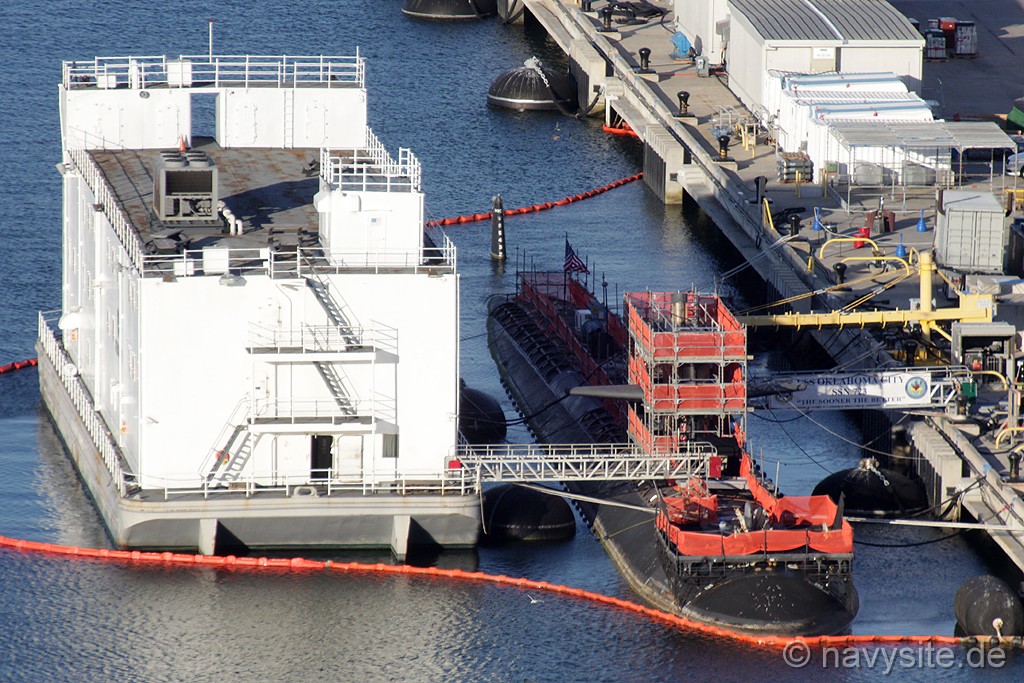
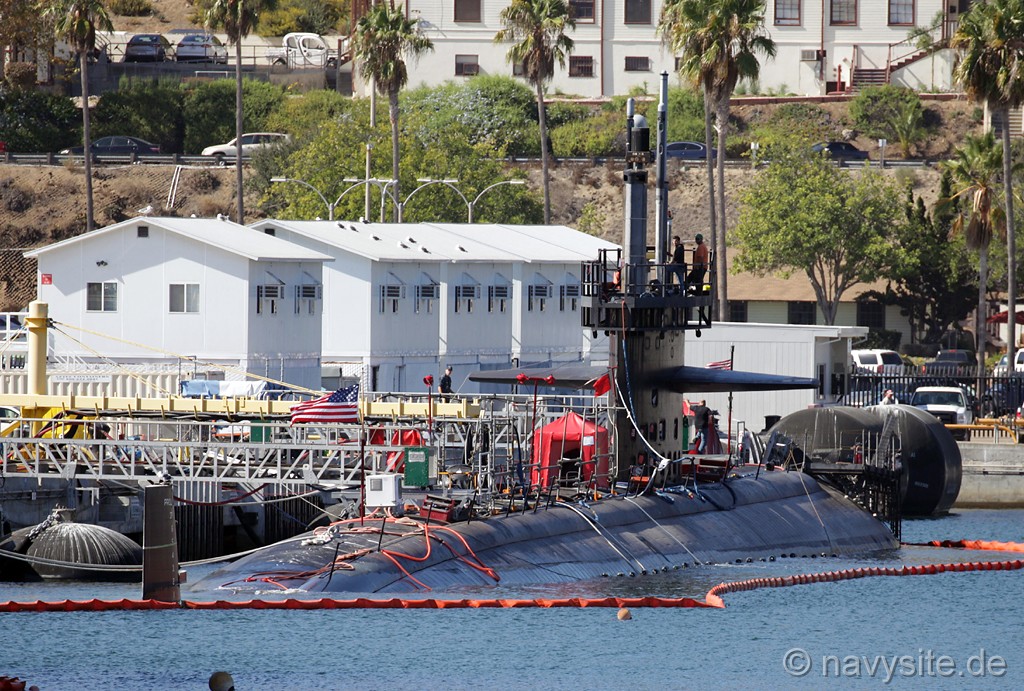
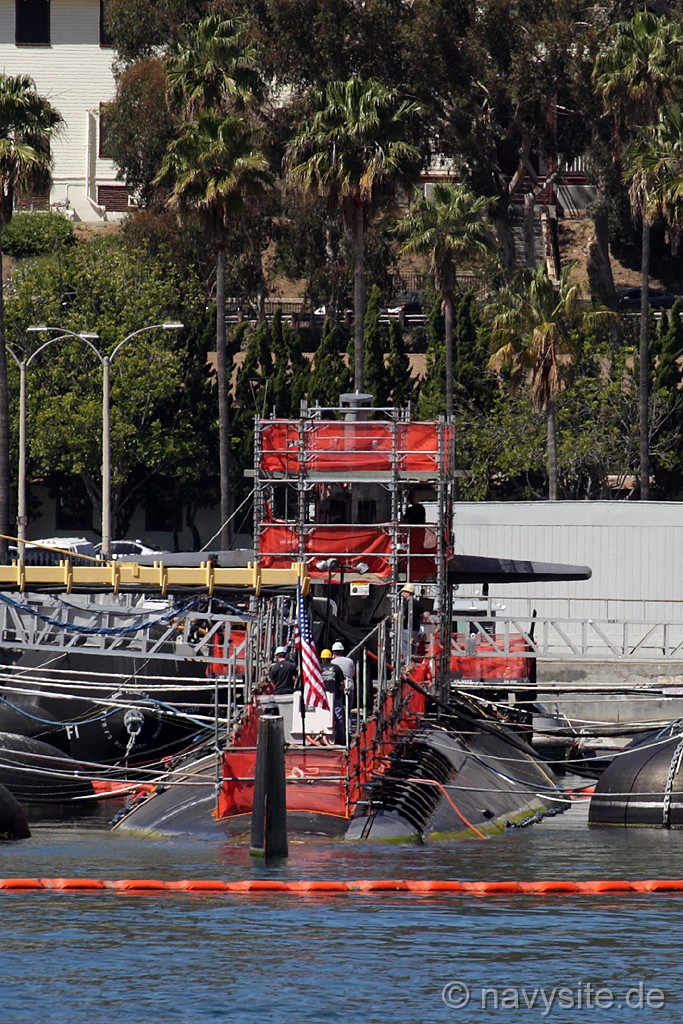
The photos below were taken by Michael Jenning and show the Guam-based OKLAHOMA CITY undergoing a maintenance availability at Submarine Base Point Loma, Calif., on April 18, 2016.
![]() | ![]() |
The photo below was taken by John Rebus (Michael) and shows the OKLAHOMA CITY dry docked in ARCO (ARDM 5) and undergoing repairs to her Emergency Diesel Generator (EDG) at Naval Base Point Loma, Calif., on June 2, 2016.
![]() |
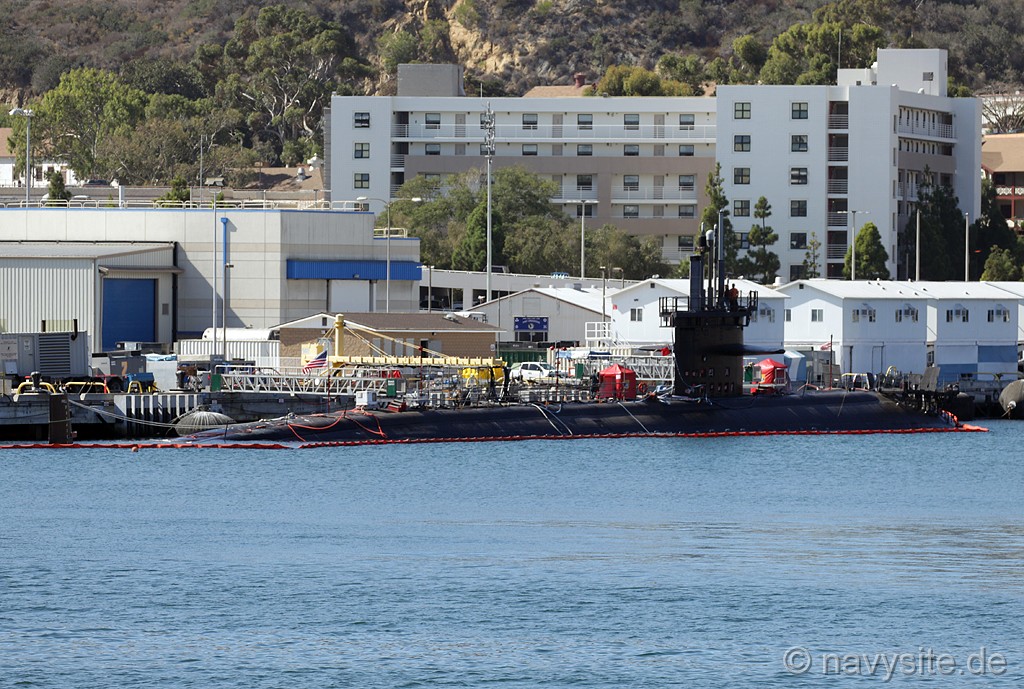
The photos below were taken by Michael Jenning and show the Guam-based OKLAHOMA CITY undergoing a maintenance availability at Submarine Base Point Loma, Calif., on October 6, 2016.
![]() | ![]() | ![]() | ![]() |
The photos below were taken by Michael Jenning and show ex-OKLAHOMA CITY laid up at Bremerton, Wash., awaiting recycling on June 10, 2023.
![]() | ![]() | ![]() |
The photos below were taken by Michael Jenning and show ex-OKLAHOMA CITY laid up at Bremerton, Wash., awaiting recycling on August 4, 2023.
![]() | ![]() |
The photo below was taken by me and shows ex-OKLAHOMA CITY laid up at Bremerton, Wash., awaiting recycling on July 15, 2024.
![]() |
Back to Submarines list.
Back to ships list.
Back to selection page.
Back to 1st page.