Search the Site with 
General Characteristics Crew List Memorabilia Cruise Books History Image Gallery to end of page

USS Harry E. Yarnell (CG 17)

- formerly DLG 17 -
- decommissioned -


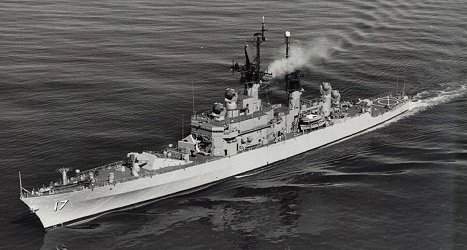
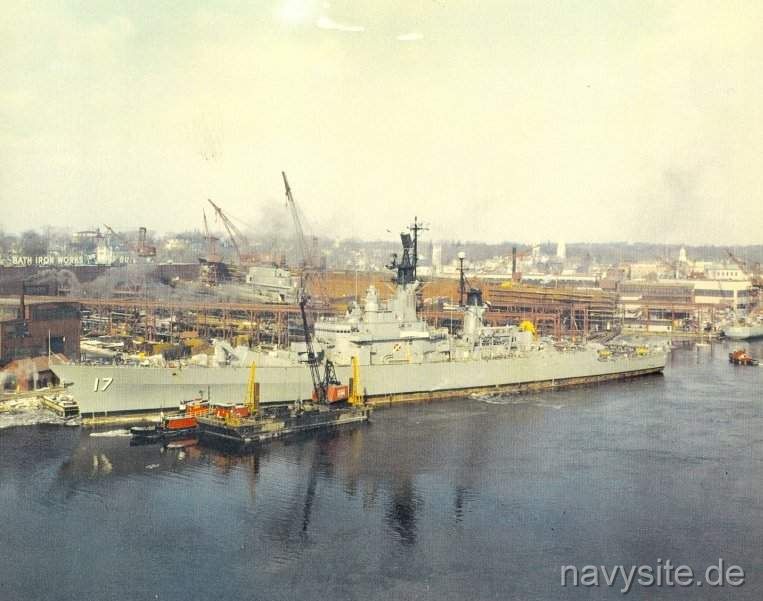
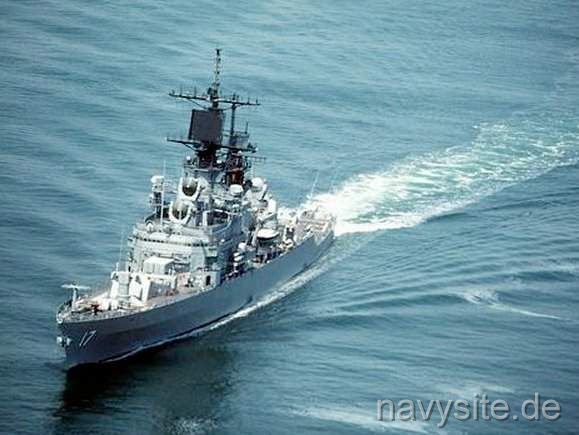
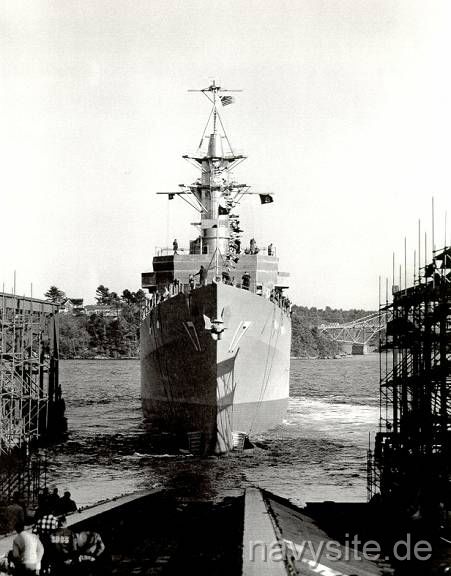
USS HARRY E. YARNELL was the second LEAHY-class guided missile cruiser. Reclassified as a guided missile cruiser on June 30, 1975, HARRY E. YARNELL was decommissioned and stricken from the Navy Register on October 29, 1993. Transferred to the Maritime Administration on February 15, 1994, she was laid up in the James River, Virginia, in the Reserve Fleet. Returned to the Navy on April 14, 1995, HARRY E. YARNELL was sold on February 16, 1995 to Northern Metal, New York City, for $294,692.34 for scrapping. Northern Metal was a subsidiary of N.R. Acquisition, Inc., of New York City and sub-contractors of that firm had been closed for polluting the environment. The scrapping contract was terminated in December 1996 and the ship was towed from Quonset Point, R.I., where she was being scrapped, to the Inactive Ship Facility in Philadelphia and accepted for lay-up.

General Characteristics:Keel laid: May 31, 1960
Launched: December 9, 1961
Commissioned: February 2, 1963
Decommissioned: October 29, 1993
Builder: Bath Iron Works, Bath, Maine
Propulsion system:4 - 1200 psi boilers; 2 General Electric geared turbines
Propellers: two
Length: 535 feet (163 meters)
Beam: 53 feet (16.1 meters)
Draft: 26 feet (7.9 meters)
Displacement: approx. 7,800 tons
Speed: 30+ knots
Aircraft: none
Armament: two Mk 141 Harpoon missile launchers, two 20mm Phalanx CIWS, two Mk-10 missile launchers for Standard missiles (ER), Mk 46 torpedoes from two Mk-32 triple mounts, one Mk 16 ASROC missile launcher
Crew: 27 officers and 413 enlisted


Back to topback to top  go to endgo to the end of the page


Back to topback to top  go to endgo to the end of the page

Crew List:

This section contains the names of sailors who served aboard USS HARRY E. YARNELL. It is no official listing but contains the names of sailors who submitted their information.


back to top  go to the end of the page


Back to topback to top  go to endgo to the end of the page

USS HARRY E. YARNELL Cruise Books:


Back to topback to top  go to endgo to the end of the page

USS HARRY E. YARNELL History:

USS HARRY E. YARNELL was built at Bath Iron Works - entered service on February 2, 1963, following a late-1961 launch. From the outset she was homeported at Norfolk and fell into the classic Cold War pattern: six-month Sixth Fleet deployments in the Mediterranean, interleaved with Atlantic training, Guantanamo Bay refresher phases, and short shipyard availabilities at Norfolk/Boston to keep sensors, weapons, and communications current.

In these first cycles HARRY E. YARNELL screened carrier task groups, stood air-defense picket stations, and joined NATO exercises while the Mediterranean saw repeated crises. Typical port calls included Naples, Gaeta, Barcelona, Palma de Mallorca, Toulon, Piraeus, and logistics resets at Augusta Bay, Sicily. During the spring–summer of 1964 and 1966 she operated in the Eastern Med as Arab-Israeli tensions periodically spiked. Her role - radar guard, surface picture compilation, and quick-reaction air-defense - mirrored the mission set for which the LEAHY - class had been designed.

As Vietnam demand peaked for Pacific-based units, HARRY E. YARNELL remained an Atlantic Fleet asset, alternating a short Caribbean period (counter-infiltration patrols and amphibious support drills) with North Atlantic work and a return to the Med. She served as plane-guard and screen commander during multi-carrier evolutions and completed a Selected Restricted Availability to swap out early electronics for more reliable solid-state sets, improving reaction times on the missile battery.

While sister ships rotated to the Western Pacific, HARRY E. YARNELL's contribution remained in the Atlantic/Northern Europe lanes and the Mediterranean. She embarked for a Sixth Fleet cruise during spring–fall 1970 as the Vietnam air war continued, providing the Navy with steady AAW coverage in the Med while other cruisers deployed to the Gulf of Tonkin. Port engagements that year included Naples and Valletta, paired with allied gunnery and anti-submarine serials.

Through 1971–1974, HARRY E. YARNELL participated in larger multinational exercises: National Week, Ocean Safari, and allied ASW and air-defense events - while completing combat-systems overhauls that brought Standard ER missiles into the Mk-10 launchers, updated fire-control radars, improved NTDS links, and added early electronic-warfare upgrades. In port, she mixed working stops at Souda Bay and Augusta Bay with liberty at Toulon, Barcelona, and Piraeus.

The Navy redesignated guided-missile frigates of HARRY E. YARNELL's type as cruisers and DLG 17 became CG 17 on June 30, 1975, aligning title with function: long-range air defense for carrier groups.

During 1976 she joined National Week 21 in the Western Med and completed mid-deployment repairs after a minor at-sea incident, then returned to the Atlantic for a short yard period and sonar and EW refresh. The rest of the decade saw renewed Sixth Fleet tours, North Atlantic evolutions, and Caribbean presence missions as U.S. focus toggled among Eastern Med contingencies, NATO readiness, and Central American instability. Port highlights included Haifa and Alexandria during an Eastern Med swing, and Rota and Lisbon during a North Atlantic phase.

As the Iran hostage crisis and Soviet activity kept the Indian Ocean and Med taut, HARRY E. YARNELL remained a Mediterranean/Atlantic workhorse. She embarked on a Sixth Fleet tour in 1982 and 1983 as Lebanon descended into crisis. Her tasking shifted toward command-and-control support and air-defense picket duty off Beirut, coordinated with amphibious and carrier forces. Brief in-port windows at Naples, Gaeta, and Haifa supported staff conferences and logistics.

Through 1984-1985 the cruiser alternated NATO exercises - Display Determination, Dragon Hammer - with a stateside availability that added Harpoon anti-ship missiles and Phalanx CIWS, refreshed communications, and hardened topside systems. In 1986, amid the Gulf of Sidra freedom-of-navigation operations and El Dorado Canyon strikes, HARRY E. YARNELL operated in central Med air-defense and surveillance roles while carriers pushed south. She rotated through Naples and Augusta Bay between evolutions.

The ship moved north for large NATO exercises (Northern Wedding/Ocean Safari) emphasizing blue-water AAW and replenishment under threat, then returned to the Med as Yugoslav friction built. Port calls broadened - Trieste, Split, Cagliari, Marseille - as allied coordination intensified. Stateside, a Selected Restricted Availability at Norfolk Naval Shipyard late in 1988 bundled hull preservation, radar refurbishment, and combat-direction system upgrades.

In mid-1990, HARRY E. YARNELL joined a UNITAS circumnavigation of South America, practicing combined ASW, air-defense, and maritime-interdiction skills with partner navies. She transited the Strait of Magellan and worked both coasts with outreach stops - Rio de Janeiro, Montevideo/Buenos Aires, Valparaiso, Callao - before returning to the Atlantic as the Cold War wound down.

With Desert Storm concluded in 1991, the cruiser's Mediterranean tasking pivoted to embargo and sanctions enforcement in the Adriatic. Under Maritime Monitor/Maritime Guard - and later Sharp Guard - she helped coordinate sea-lane control and interception procedures supporting U.N. resolutions on the former Yugoslavia. HARRY E. YARNELL's underway periods alternated with port and logistics stops at Naples, Souda Bay, Augusta Bay, Trieste, and Split, alongside short stateside maintenance to keep aging systems reliable.

As post–Cold War reductions accelerated and Aegis-equipped cruisers assumed long-range air-defense roles, USS HARRY E. YARNELL decommissioned on October 29, 1993. Stricken the same day, she was later disposed of by scrapping - closing a three-decade career that tracked the Navy's shift from carrier-screening and great-power deterrence in the 1960s-1980s to maritime embargo and crisis management in the early 1990s.


Back to topback to top  go to endgo to the end of the page


Back to topback to top


Back to Cruisers list. Back to ships list. Back to selection page. Back to 1st page.