Search the Site with

|
Search the Site with
|
 General Characteristics Crew List Memorabilia History Patch Gallery Image Gallery to end of page

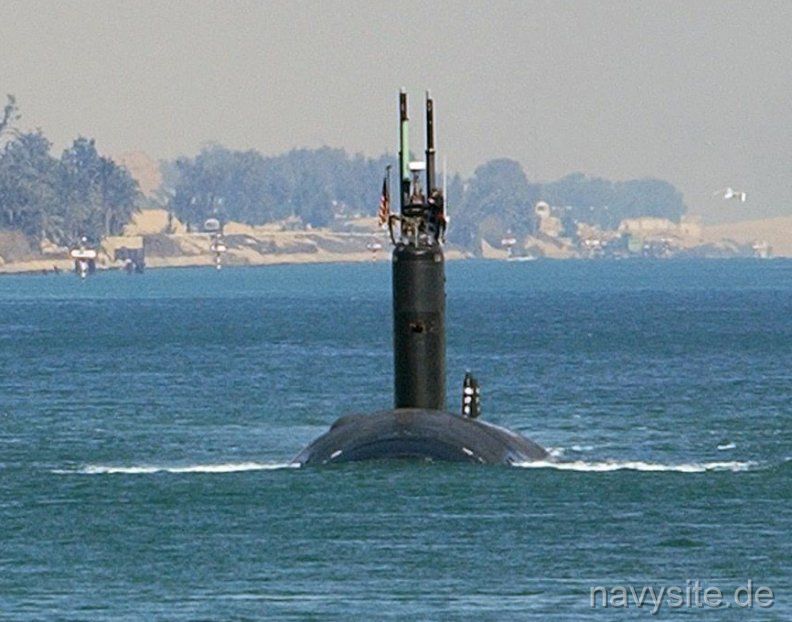
USS BOISE is one of the LOS ANGELES class attack submarines and the second ship in the Navy to bear the name of Idaho’s capital.
| General Characteristics: | Awarded: February 6, 1987 |
| Keel Laid: August 25, 1988 | |
| Launched: March 23, 1991 | |
| Commissioned: November 7, 1992 | |
| Builder: Newport News Shipbuilding Co., Newport News, Va. | |
| Propulsion system: one nuclear reactor | |
| Propellers: one | |
| Length: 360 feet (109.73 meters) | |
| Beam: 33 feet (10 meters) | |
| Draft: 32,15 feet (9.8 meters) | |
| Displacement: Surfaced: approx. 6,000 tons | |
| Submerged: approx. 6,900 tons | |
| Speed: Surfaced: approx. 15 knots | |
| Submerged: approx. 32 knots | |
| Armament: | |
| Cost: approx. $900 million | |
| Homeport: Norfolk, VA | |
| Crew: 13 Officers, 116 Enlisted |
 back to top go to the end of the pageback to top go to the end of the page
Crew List:
This section contains the names of sailors who served aboard USS BOISE. It is no official listing but contains the names of sailors who submitted their information.
back to top go to the end of the pageback to top go to the end of the pageUSS BOISE History:
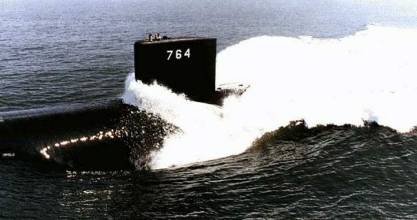 USS BOISE is an improved LOS ANGELES-class nuclear-powered attack submarine built at Newport News Shipbuilding in Virginia. The construction contract for the boat was awarded to Newport News on February 6, 1987, and her keel was laid on August 25, 1988. She was launched on March 23, 1991, sponsored by Louise McClure, wife of Idaho senator James A. McClure, and commissioned at Naval Station Norfolk, Virginia, on November 7, 1992, with Commander David D. Mericle in command. From commissioning onward her homeport and administrative base remained Norfolk, under Submarine Squadron 8 on the U.S. Atlantic coast.
After her initial sea trials off the Virginia Capes in 1991-1992, BOISE entered the typical post-commissioning cycle of inspections, certifications and work-ups. On January 4-6, 1993 she underwent a formal Board of Inspection and Survey (INSURV) examination, a key milestone for any new combatant, and later that month, on January 15, she hosted a regional conflict demonstration embarked by senior staff members of the House Armed Services Committee, reflecting congressional interest in the capabilities of the new generation of attack submarines. Through the rest of 1993, she remained based in Norfolk, conducting local operations and training in the western Atlantic as her crew completed tactical certification on the AN/BSY-1 integrated sonar and combat system that distinguished the improved LOS ANGELES-class boats.
In 1994, BOISE's stated mission was to complete the technical and operational evaluations of the AN/BSY-1 system, to train for deployment and then to deploy with a carrier battle group. She spent much of the year in intensive exercises and fleet support roles off the U.S. East Coast and in the North Atlantic, integrating with anti-submarine warfare (ASW) forces and refining strike and surveillance procedures for the post-Cold-War environment in which regional crises in the Balkans and Persian Gulf had replaced global East-West confrontation. By the autumn of 1994, her crew and systems were ready for extended operations and she was assigned to the battle group built around the aircraft carrier USS DWIGHT D. EISENHOWER (CVN 69).
On October 20, 1994, USS BOISE left Norfolk on her first overseas deployment, operating in both the U.S. Fifth Fleet and Sixth Fleet areas of responsibility. In the Mediterranean she supported the EISENHOWER battle group during a period of continued NATO maritime presence off the Balkans, while in the Red Sea and Arabian Gulf she contributed to maritime interception and surveillance operations enforcing United Nations sanctions on Iraq in the years between the 1991 Gulf War and the later campaigns against the Ba'athist regime. Her 1995 command history describes the mission for that year as completing deployment with the EISENHOWER battle group and supporting training for other deploying units, underlining her dual role as an operational asset and a platform for exercising battle group ASW and strike capabilities. BOISE returned to Norfolk on April 19, 1995, having completed about six months of forward presence and fleet exercises in the two key U.S. maritime theaters.
Soon after that first deployment, BOISE experienced material issues that required shipyard attention. On September 14, 1995, she arrived at Newport News Shipbuilding for what official descriptions refer to as emergency repairs in dry dock. Following that yard period, she conducted sea trials on December 15-16, 1995, to verify the effectiveness of the work before resuming routine fleet operations. Through 1996, she remained in the Norfolk area, carrying out the usual sequence of type training, evaluations and short fleet exercises that prepared her for a second major deployment late in the decade.
At the end of 1997, BOISE entered what would become one of her more closely documented early deployments. According to the commanding officer's published account, the boat was originally scheduled to deploy in mid-December 1997 for Arctic under-ice operations, including an AN/BSY-1 performance evaluation. Instead, changes in the international situation intervened: with Iraq again resisting United Nations weapons inspections, U.S. naval forces in the Mediterranean were redistributed toward the Arabian Gulf, and BOISE was retasked to reinforce the Sixth Fleet's presence in the Mediterranean rather than proceed north into the Arctic. The crew ultimately departed Norfolk on December 27, 1997, after a short delay that allowed additional time at home over the Christmas period.
The submarine's first weeks at sea illustrated the flexibility expected of attack submarines in the late 1990s. Routed toward the North Atlantic and then to the Strait of Gibraltar, she arrived in the Mediterranean ready for a completely different mission mix than the under-ice work originally planned: precision land-attack strike, participation in multi-national ASW exercises, and integration with carrier and surface forces. Within this framework, BOISE made several liberty and logistics calls that are recorded in subsequent histories. In early January 1998, she visited Faslane, Scotland, before proceeding south. By mid-January she had entered Gibraltar for a short port visit and then continued to Toulon, France, later in the month, followed by a two-week upkeep period at La Maddalena, Italy, the longstanding U.S. submarine support facility in the central Mediterranean.
During roughly six weeks in and around the Mediterranean, BOISE combined these port periods with an intensive schedule of exercises. A detailed article by her commanding officer describes how she was selected to act as Launch Area Coordinator (LAC) during the Sixth Fleet strike exercise CAESAR SWORD 98-1, the first time a submarine had been assigned the LAC function in a major Tomahawk Land Attack Missile (TLAM) event. In this role, BOISE coordinated TLAM firing by herself and the other attack submarines USS CITY OF CORPUS CHRISTI (SSN 705) and USS TOLEDO (SSN 769), with the destroyer USS JOHN RODGERS (DD 983) serving as alternate LAC and Commander, Sixth Fleet in Gaeta, Italy acting as overall Tomahawk Strike Coordinator. Shortly afterwards, she participated in the multinational ASW exercise DOGFISH in the Mediterranean, working with six diesel-electric submarines, maritime patrol aircraft and a second U.S. SSN to explore the use of active sonar against quiet conventional submarines - an issue of growing interest as more countries fielded modern non-nuclear boats.
After completing these Mediterranean tasks, BOISE resumed her original deployment concept. She left the Mediterranean in early March 1998, then carried out further tasking in the North Atlantic, including a documented port visit to Haakonsvern near Bergen, Norway, before returning to Norfolk on June 1, 1998. The deployment, which combined under-ice preparations, rapid redirection to the Mediterranean for crisis response, high-end strike and ASW exercises and a classified national security mission in the Atlantic, was used within the Submarine Force as a case study for multi-mission, multi-theater operations on six-month patrols in the late 1990s.
In April 1999, BOISE again deployed from Norfolk, this time for a six-month Mediterranean cruise that ran from April 12 to October 12. During this period, NATO was conducting and then consolidating Operation Allied Force over Kosovo and Serbia, and the U.S. submarine presence in the region supported both deterrence and ongoing maritime security tasks. Public attention to BOISE during this deployment largely centers on a Joint Task Force Exercise in which she was reported "sunk" in simulated combat by the Royal Netherlands Navy diesel-electric submarine HNLMS WALRUS, a training outcome that, along with WALRUS's notional "sinking" of multiple other allied ships including the carrier USS THEODORE ROOSEVELT (CVN 71) and the command ship USS MOUNT WHITNEY (LCC 20), was later widely cited in discussions of the challenge posed by modern non-nuclear submarines.
On May 9, 2000, BOISE carried out a ceremonial task that connected her to an earlier generation of submariners: she conducted a burial at sea for the remains of retired Captain George L. Street III, a World War II submarine officer and Medal of Honor recipient whose wartime patrols in the Pacific had become part of U.S. submarine heritage. The event underlined the way modern attack submarines are used not only for operations but also for commemorative duties within the Navy.
By the early 2000s, BOISE's focus shifted to the Middle East campaigns that followed the attacks of September 11, 2001. On January 28, 2002, she departed Norfolk for a deployment that would take her again through the Mediterranean and Suez Canal into the Fifth Fleet theater. During this period, she was assigned to the carrier strike group built around USS JOHN F. KENNEDY (CV 67) as that group supported Operation Enduring Freedom in Afghanistan and broader maritime security operations in the Arabian Sea and Arabian Gulf, including sea-based air support for ground operations and deterrent patrols vis-a-vis Iraq and Iran. BOISE returned to Norfolk on July 28, 2002 after this six-month Fifth and Sixth Fleet deployment.
Barely months later, she was again involved in major operations, this time in direct support of the 2003 invasion of Iraq. Under the command of Commander James M. Kuzma, BOISE deployed from February 13 to April 15, 2003, operating primarily in the Eastern Mediterranean and Red Sea. During the opening phase of Operation Iraqi Freedom she launched a full load of Tomahawk cruise missiles against designated targets ashore, contributing to the initial wave of precision strikes designed to degrade Iraqi command, control and air defense infrastructure. For this combat deployment the ship and crew received a Navy Unit Commendation, while Commander Kuzma was later awarded the Bronze Star Medal on December 3, 2003, for his leadership during the operation.
Following the high operational tempo of the early 2000s, BOISE entered a significant maintenance period. On January 9, 2004, she arrived in dry dock at Norfolk Naval Shipyard for a refit that lasted until August 9, 2004, a period used to perform reactor-plant, combat-system and hull maintenance typical of a mid-life availability for an improved LOS ANGELES-class boat. After post-refit sea trials and local operations in 2005 and early 2006, she prepared for and then executed another extended cruise that would mark a notable milestone in her career.
On October 30, 2006, BOISE deployed from Norfolk on a voyage that would eventually circumnavigate the globe, covering roughly 37,000 nautical miles before her return on May 30, 2007. The route took her under Arctic ice from the North Atlantic into the Pacific, where she called at Yokosuka, Japan, and Apra Harbor, Guam, before proceeding south to Singapore and into the Indian Ocean, reflecting the growing importance of the Western Pacific and Indian Ocean sea lanes in U.S. strategy. She then shifted into the Central Command and Sixth Fleet areas via the Arabian Sea and the Red Sea-Suez route, conducting various exercises and presence operations before transiting the Suez Canal northbound and crossing the Mediterranean. On her homeward leg she made port visits at Limassol, Cyprus, and Toulon, France, before crossing the Atlantic back to Norfolk. The deployment illustrated the ability of a single nuclear-powered attack submarine - the "one ship fleet" of BOISE"s motto - to undertake a mix of regional roles without returning to port in the United States.
The following year, BOISE again went to sea for an extended Sixth Fleet deployment. On June 19, 2008, she departed Naval Station Norfolk for a scheduled cruise in the European Command area of responsibility, with the official photo caption noting that she would complete final systems testing en route. During roughly six months forward, she operated with NATO partners including the Spanish, French, British and German navies and took part in maritime security operations off West Africa, reflecting allied concerns about trafficking, piracy and regional instability along the Gulf of Guinea. According to later compiled deployment summaries she returned to Norfolk on December 23, 2008.
In early 2009, BOISE entered another, shorter maintenance period. She went into dry dock at Norfolk Naval Shipyard for a limited refit and left the dock on July 16, 2009, having completed about five months of work focused on maintaining her material readiness for another set of deployments. After post-availability trials and work-ups, she once more deployed to the Fifth and Sixth Fleet regions, leaving Norfolk on June 22, 2010 and returning on December 22, 2010. Publicly available summaries indicate that she again combined routine presence, ASW training and maritime security operations in the Mediterranean and Middle East, at a time when coalition naval forces were heavily engaged in counter-piracy patrols in the Gulf of Aden and Indian Ocean and in maintaining freedom of navigation in the Strait of Hormuz.
BOISE's next major deployment began on May 2, 2012, when she sailed from Norfolk for another Sixth Fleet cruise. She returned on November 8, 2012 after roughly six months in European waters.
On July 16, 2014, USS BOISE again sailed from Norfolk, this time for a deployment explicitly described as a Middle East cruise. During this deployment she combined traditional submarine missions with visible port visits in the Gulf region. On August 14, she arrived at the General Cargo Terminal in Duqm, Oman, for a four-day liberty visit, underscoring the growth of Duqm as a logistics hub for U.S. and allied navies on the Arabian Sea. From September 2 to 6, she was alongside at Khalifa Bin Salman Port in Hidd, Bahrain, home to U.S. Fifth Fleet headquarters and a central node for coalition naval operations in the Gulf. Later in the deployment, she visited Jebel Ali in the United Arab Emirates and, on the homeward leg, the Spanish port of Rota and the U.S. naval support facility at Souda Bay in Crete. BOISE returned to Norfolk on January 16, 2015, having steamed more than 37,000 nautical miles during this deployment and supported a mix of maritime security operations and exercises in a region marked by the continuing conflicts in Iraq and Syria and tensions over maritime security in the Gulf.
Shortly after this deployment the submarine entered a prolonged maintenance limbo that became emblematic of the U.S. attack-submarine maintenance backlog. By February 2017, BOISE's diving certification had lapsed because she had been waiting so long for a major availability at a naval shipyard. As a result she was effectively restricted to remaining alongside the pier in Norfolk and could not submerge until her overhaul was accomplished. To help alleviate capacity constraints at public shipyards, the Navy decided to send her overhaul to a private yard. On October 16, 2017, Newport News Shipbuilding announced that it had received a contract, valued at about $59.7 million with options that could raise the total substantially, to plan and execute an extended engineering overhaul of USS BOISE.
In the years that followed, however, the start of the overhaul was repeatedly delayed. BOISE shifted from Norfolk to Newport News in advance of the availability, and by 2020 Navy reporting and Congressional Budget Office analyses were describing her as a prominent example of the consequences of limited shipyard throughput: a front-line attack submarine tied up for years awaiting and then undergoing depot-level work. She finally entered dry dock in early 2021, several years later than originally planned. The overhaul, which includes extensive maintenance on her nuclear propulsion plant and modernization of combat systems, was initially envisaged as a roughly 15-month effort, later revised to about 25 months and then extended again as the scope of work was better understood in light of issues encountered on sister boats such as USS HELENA (SSN 725) and USS COLUMBUS (SSN 762).
As of 2025 open sources continue to list USS BOISE as in overhaul at Newport News Shipbuilding, with completion of maintenance and return to operational service now expected around 2029.
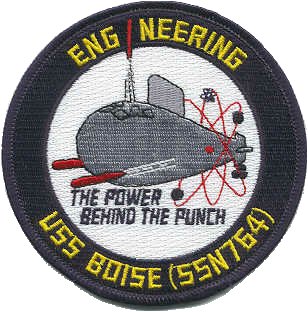
back to top go to the end of the pageUSS BOISE Patch Gallery:
 |
back to top go to the end of the pageUSS BOISE Image Gallery:
 |  |  |  |  |
back to top Back to Submarines list. Back to ships list. Back to selection page. Back to 1st page.