![]() |
Search the Site with
|
![]() | ![]() |
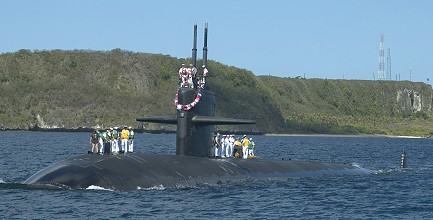
USS CITY OF CORPUS CHRISTI was the 18th LOS ANGELES class attack submarine and the 13th ship of that class built by Electric Boat in Groton, Conn. On May 31, 2017, the CITY OF CORPUS CHRISTI departed her homeport Pearl Harbor, Hi., enroute to Bremerton, Wash., to commence her year-long inactivation process. A decommissioning ceremony was held on May 30, 2017. The submarine was officially decommissioned and stricken from the Navy list on August 3, 2017.
| General Characteristics: | Awarded: October 31, 1973 |
| Keel Laid: September 4, 1979 | |
| Launched: April 25, 1981 | |
| Commissioned: January 8, 1983 | |
| Decommissioned: August 3, 2017 | |
| Builder: Electric Boat Division of General Dynamics Corporation, Groton, Conn. | |
| Propulsion system: one nuclear reactor | |
| Propellers: one | |
| Length: 360 feet (109.73 meters) | |
| Beam: 33 feet (10 meters) | |
| Draft: 32,15 feet (9.8 meters) | |
| Displacement: Surfaced: approx. 6,000 tons Submerged: approx. 6,900 tons | |
| Speed: Surfaced: approx. 15 knots Submerged: approx. 32 knots | |
| Armament: | |
| Cost: approx. $900 million | |
| Crew: 12 Officers, 115 Enlisted |
Crew List:
This section contains the names of sailors who served aboard USS CITY OF CORPUS CHRISTI. It is no official listing but contains the names of sailors who submitted their information.
USS CITY OF CORPUS CHRISTI History:
The contract to build the attack submarine that would become USS CITY OF CORPUS CHRISTI was awarded to the Electric Boat Division of General Dynamics in Groton, Connecticut, on October 31, 1973, as part of the early tranche of LOS ANGELES-class submarines intended to modernize the United States Navy's nuclear attack submarine force during the later Cold War. Originally designated simply CORPUS CHRISTI, the boat became the focus of a naming controversy when religious groups objected to a warship bearing a name that translated literally as "Body of Christ". In response, on May 10, 1982, the Navy formally modified the name to CITY OF CORPUS CHRISTI to make clear that the vessel honored the Texas city rather than a religious concept, a decision that was noted in congressional documentation on ship naming policy and in later Navy historical summaries.
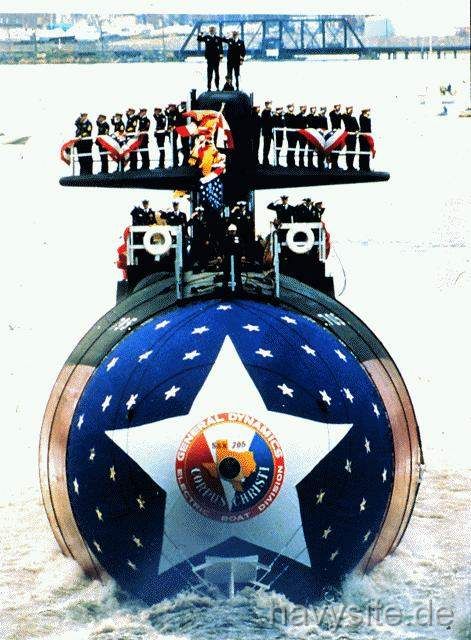
Construction proceeded at Electric Boat through the later 1970s. The keel of CITY OF CORPUS CHRISTI was laid down at Groton on September 4, 1979, and the hull took shape in the same building halls that had produced earlier LOS ANGELES-class units. After about nineteen months in the building dock, the submarine was launched on April 25, 1981, in a ceremony sponsored by Lilla Burt Cummings, the wife of senator John Tower of Texas.
Following fitting-out, the Navy accepted the boat on November 24, 1982, and CITY OF CORPUS CHRISTI was commissioned at Groton on January 8, 1983, joining Submarine Squadron Two at New London as the second U.S. warship to carry the Corpus Christi name. Publicly available sources give only limited detail on her first year in commission, but, in line with standard practice for a new nuclear submarine, CITY OF CORPUS CHRISTI spent 1983 completing post-delivery shakedown, acoustic trials, and workups in the western Atlantic and Caribbean from New London, validating her propulsion plant, combat systems, and crew proficiency before undertaking extended operations. By 1983, she was already associated with the Atlantic Undersea Test and Evaluation Center (AUTEC), as indicated by contemporary unit insignia linked to a torpedo proficiency competition there, suggesting early involvement in weapons and sensor trials in the Bahamas operating areas.
The submarine's first major deployment came in 1984. On March 31, 1984, CITY OF CORPUS CHRISTI departed Naval Submarine Base New London for a maiden deployment to the Indian Ocean at a time when the United States was maintaining a substantial naval presence in that region in connection with ongoing tensions in the Persian Gulf and the broader Cold War competition with the Soviet Union. During this cruise, she operated in the Atlantic, rounded the Cape of Good Hope into the Indian Ocean, and then continued across the Pacific and through the Panama Canal, effectively circumnavigating the globe. On October 14, 1984, she transited the canal, and on October 19, 1984, she returned to New London after nearly seven months away, completing a global voyage that demonstrated the reach and endurance of the LOS ANGELES-class.
In the second half of 1985, the boat shifted focus to North Atlantic and Arctic operations. From October to December 1985, CITY OF CORPUS CHRISTI conducted an extended North Atlantic underway period that included crossing the Arctic Circle in November, earning her crew the traditional "Blue Nose" status associated with Arctic operations. She returned to Groton on December 21, 1985, after roughly two months at sea. These Cold War patrols, carried out in the final years before the collapse of the Soviet Union, were recognized at the unit level: the submarine received a Meritorious Unit Commendation for her 1985 operations, and after commissioning, she received the Submarine Squadron Two Battle Efficiency and Engineering Excellence "E" awards for each year through 1989, reflecting the squadron's assessment of her readiness and engineering performance.
In early 1986, CITY OF CORPUS CHRISTI turned to the Mediterranean theater. Between March and July 1986, she deployed to the Mediterranean Sea, operating in support of U.S. and NATO maritime surveillance and anti-submarine warfare tasks during a period that included continuing friction with Libya and the broader Soviet naval presence in the region. On July 25, 1986, she returned to New London from what Navy documentation described as a three-month surge deployment to the Mediterranean, during which she made port calls at La Maddalena, Italy, and Toulon, France, both routine liberty and logistics stops for submarines operating with the U.S. Sixth Fleet. Her performance in 1986 Mediterranean operations was recognized with a Navy Unit Commendation.
From November 1986 through August 1988, CITY OF CORPUS CHRISTI was heavily involved in Chief of Naval Operations-directed testing of the Mk 48 ADCAP torpedo, reflecting the priority placed on integrating improved heavyweight torpedoes into the fleet. On January 5, 1987, she departed Port Canaveral, Florida, after loading Mk 48 ADCAP exercise weapons for test firings on the AUTEC range in the Bahamas. She paid a short visit to Port Everglades from January 15-16, then returned to Port Canaveral from January 17-19 before going back to New London on January 27. She conducted sea trials from February 25-27 and got underway again on March 2 for further ADCAP testing. The boat returned to Port Canaveral from March 4-7 and again March 17-21, and then headed back to Groton, arriving March 27. She was underway again on April 5 and briefly in Port Canaveral April 9-10 as the protracted series of ADCAP trials continued. Through this period, she remained assigned to Submarine Squadron Two at New London, balancing test operations with routine training and maintenance, and continuing to receive annual Battle Efficiency and Engineering Excellence awards through the end of the decade.
From October 1988 through March 1989, CITY OF CORPUS CHRISTI again deployed to the Mediterranean, taking part in the final phase of large U.S. submarine deployments to that region before the Cold War's end. During this cruise, she operated with Sixth Fleet task groups in surveillance, anti-submarine, and intelligence-collection roles typical for LOS ANGELES-class units, though open sources do not record detailed port visits or day-by-day movements. By the early 1990s, with the Soviet threat receding, her operations began to shift from Cold War forward presence to a mixture of training, regional presence, and exercise support in both the Atlantic and, increasingly, the Western Atlantic and Northern European waters.
Throughout the early 1990s, CITY OF CORPUS CHRISTI remained based at New London and under the administrative control of Submarine Squadron Two, taking part in Western Atlantic deployments and exercises. Navy historical summaries note Western Atlantic deployments in 1993 and 1994 that were sufficiently successful that the submarine was selected as the squadron's Battle Efficiency "E" award recipient for 1994, indicating high tactical performance, training results, and inspection outcomes across warfare areas.
The detailed command history for 1995, though not fully accessible in open form, shows her preparing and deploying again to the Western Atlantic, including a documented port visit to Faslane, Scotland, a key Royal Navy base for submarines, during that year's deployment. Following this 1995 deployment, she received the Submarine Squadron Two Tactical "T" award, recognizing excellence in tactical employment.
By the later 1990s, the submarine shifted under the administrative umbrella of Submarine Squadron Four. In 1997, CITY OF CORPUS CHRISTI joined that squadron and quickly distinguished herself in support areas, receiving the squadron's Communications "C" and Medical "M" awards for 1997, while the squadron's Junior Officer of the Year and Sailor of the Year both came from her crew, indicating strong individual performance within the command. Operationally, she continued to carry out Atlantic and Mediterranean deployments in a post-Cold War environment increasingly focused on regional crises, peace support operations, and alliance exercises rather than direct confrontation with a peer navies.
In 1998, CITY OF CORPUS CHRISTI conducted a short-notice deployment to the Mediterranean, reflecting the flexibility expected of Atlantic Fleet submarines at the time. During this deployment, she conducted operations in support of U.S. and NATO interests and made port visits to Gibraltar at the entrance to the Mediterranean, La Maddalena in Italy, Limassol in Cyprus, and Brest in France, illustrating a pattern of multi-nation port calls typical of Sixth Fleet submarine cruises in the immediate post-Cold War decade.
In 1999, the submarine undertook one of the most distinctive deployments of her Atlantic career, a six-month South American deployment in support of the multinational exercise series UNITAS. According to Navy summaries, CITY OF CORPUS CHRISTI spent about five and a half months on this deployment, circumnavigating the South American continent and visiting ports in six different South American countries while exercising with regional navies and U.S. surface and air units in anti-submarine warfare and joint operations.
Following UNITAS, she completed what official descriptions refer to as a "mission of national importance", the details of which remain classified in open sources. For her 1999 performance, she received the Submarine Squadron Four Tactical "T" and the Silver "S" for esprit de corps, underscoring both tactical effectiveness and crew cohesion at the turn of the century.
After nearly two decades of service, CITY OF CORPUS CHRISTI entered a major mid-life overhaul. In March 2000, she arrived at Portsmouth Naval Shipyard in Kittery, Maine, for an Engineered Refueling Overhaul (ERO) that would renew her nuclear fuel and modernize combat systems and habitability spaces. She remained there for nearly two years: local reporting in March 2002 described the boat departing the shipyard on sea trials after almost two years on the base, highlighting both the scale of the work and the shipyard's emphasis on efficiency in turning around LOS ANGELES-class submarines. The ERO was notable in Navy accounts as a record-breaking effort, with CITY OF CORPUS CHRISTI becoming the first 688-class submarine to complete such an overhaul in roughly twenty-four months, reflecting process improvements at Portsmouth.
Following post-overhaul trials, the submarine shifted her strategic focus to the Pacific. In September 2002, she arrived at Pearl Harbor at the end of her East Coast period, and on October 17, 2002, she reached Apra Harbor, Guam, stepping into a new role as the first forward-deployed fast-attack submarine homeported there and assigned to Submarine Squadron Fifteen. This basing decision reflected a broader U.S. defense strategy that placed more attack submarines in the Pacific to shorten transit times to East Asian operating areas and enhance presence in the western Pacific and Indian Ocean.
From her new Guam homeport, CITY OF CORPUS CHRISTI began a cycle of western Pacific deployments, exercises, and local operations. On January 8, 2003, she conducted an emergency sortie from Apra Harbor to avoid an approaching typhoon, returning on January 13. On February 2, 2003, she arrived at Pearl Harbor for primary relief valve testing and training, then went to sea from March 10-15 for a Basic Submarine Assessment and mine readiness certification before returning to Guam on March 23. From April 13-16 she again sortied to avoid Typhoon Kujira, then from April 21 to May 5 she operated in support of exercise Tandem Thrust 2003, a large joint and combined exercise in the western Pacific that tested U.S. joint task force concepts. In that exercise CITY OF CORPUS CHRISTI formed part of a forward-deployed expeditionary strike group built around the amphibious ready group centered on USS ESSEX (LHD 2), with USS FORT McHENRY (LSD 43), USS JUNEAU (LPD 10), USS ANTIETAM (CG 54), USS O'BRIEN (DD 975) and USS CURTIS WILBUR (DDG 54), and the 31st Marine Expeditionary Unit, collectively trialing expeditionary strike group concepts in the waters near Guam.
She then conducted sea trials from May 19-21, and on May 28 departed Guam for a Tactical Readiness Evaluation in Hawaiian waters, calling at Pearl Harbor June 4-7 and 13-18 before returning to Guam on June 25. A further set of sea trials took place July 24-25, after which, from July 28 through September 15, 2003, the submarine carried out a southern Pacific deployment in support of a tactical development exercise known as LUNGFISH.
Over the following years, CITY OF CORPUS CHRISTI settled into the pattern expected of Guam-based attack submarines: relatively short transits to operating areas in the Philippine Sea, South China Sea, and broader western Pacific and Indian Ocean, alternating with maintenance and training periods alongside Guam-based submarine tenders such as USS EMORY S. LAND (AS 39). Navy summaries note that she received Battle Efficiency "E" awards for 2003, 2004, 2005 and again in 2009, indicating consistently strong performance across those years, and that in 2011 she received another Meritorious Unit Commendation for her work while forward deployed.
In June 2006, CITY OF CORPUS CHRISTI took part in the first iteration of exercise Valiant Shield, a large U.S. joint exercise centered on Guam and the surrounding Pacific. Reporting at the time noted that Guam-based attack submarines USS HOUSTON (SSN 713) and CITY OF CORPUS CHRISTI joined multiple carrier strike groups, Air Force bombers, and other joint forces in combined training in surveillance, anti-submarine warfare, and strike warfare across a wide Pacific area, reflecting the growing focus on joint operations and on demonstrating U.S. capabilities in the Western Pacific. During 2006, her crew also crossed the equator in the Pacific on July 18, earning Shellback status in a long-standing naval tradition recorded in official summaries.
By October 24, 2009, the submarine was again in Southeast Asia, arriving in Laem Chabang, Thailand, for a scheduled port visit while forward-deployed from Guam. During this visit, her sailors participated in community relations projects, including a Habitat for Humanity septic tank installation and outreach activities at a local orphanage and university, as documented in Navy photo releases.
CITY OF CORPUS CHRISTI's Guam period also included dockyard work away from her homeport. A Docking Selected Restricted Availability (DSRA) was completed at Pearl Harbor Naval Shipyard in May 2010, with Navy reporting noting the work finished several days ahead of schedule and highlighting the ship's Guam-homeported status at the time, implying that the boat was temporarily in Hawaii for maintenance before returning west.
In April 2011, her Pacific basing story began to shift. On April 14, 2011, CITY OF CORPUS CHRISTI arrived in Brisbane, Australia, for a six-day port visit during a western Pacific deployment. Australian and naval reporting noted that the crew took part in local events, including assistance with flood-damage clean-up efforts, underscoring the diplomatic and outreach side of submarines' port calls. In May 2011 she arrived at her new homeport Pearl Harbor to begin the final phase of her service life. Upon arrival she was reassigned to Submarine Squadron Seven, joining the Pearl Harbor attack submarine force while remaining under Submarine Force, U.S. Pacific Fleet. From Pearl Harbor, CITY OF CORPUS CHRISTI continued to make deployments into the western Pacific. On November 4, 2013, she left Pearl Harbor for a scheduled western Pacific deployment.
Photographic records show her visiting Yokosuka, Japan, in December 2013 and January 2014 and operating in the western Pacific and Philippine Sea over the subsequent years. One of the most noted later-life events in the submarine's history occurred in October 2015. While operating in the Indian Ocean on October 16, 2015, CITY OF CORPUS CHRISTI took part in the trilateral exercise Malabar 2015 with Indian and Japanese naval forces. During the exercise, she joined surface ships and other submarines in complex anti-submarine and anti-surface warfare scenarios. Official Navy photography shows her transiting in formation during a photo exercise segment of Malabar. A widely cited Indian media account, referenced in Navy historical documentation, reported that during a simulated engagement the Indian Navy's KILO-class submarine INS SINDHUDHVAJ, equipped with the indigenous USHUS sonar, achieved a notional "kill" against CITY OF CORPUS CHRISTI in exercise conditions, illustrating both the realism of the training and the growing capabilities of regional navies.
By the mid-2010s, the submarine was nearing the end of her planned service life. On September 12, 2015, she departed Pearl Harbor on what would be her final western Pacific deployment. She operated again in the western Pacific and Indian Ocean, working with regional partners and U.S. forces, and on February 12, 2016, she moored at Sierra 10 Wharf at Joint Base Pearl Harbor-Hickam at the end of a five-month deployment, closing out more than three decades of worldwide operations. On May 30, 2016, a decommissioning ceremony was held for CITY OF CORPUS CHRISTI at Wharf S1B at Joint Base Pearl Harbor-Hickam, marking the formal inactivation of the submarine after more than thirty-three years of active service. Senior Pacific submarine force leaders used the occasion to underline her long record of Atlantic, Mediterranean, South American, and Pacific operations, from Cold War circumnavigation missions to forward-deployed patrols from Guam.
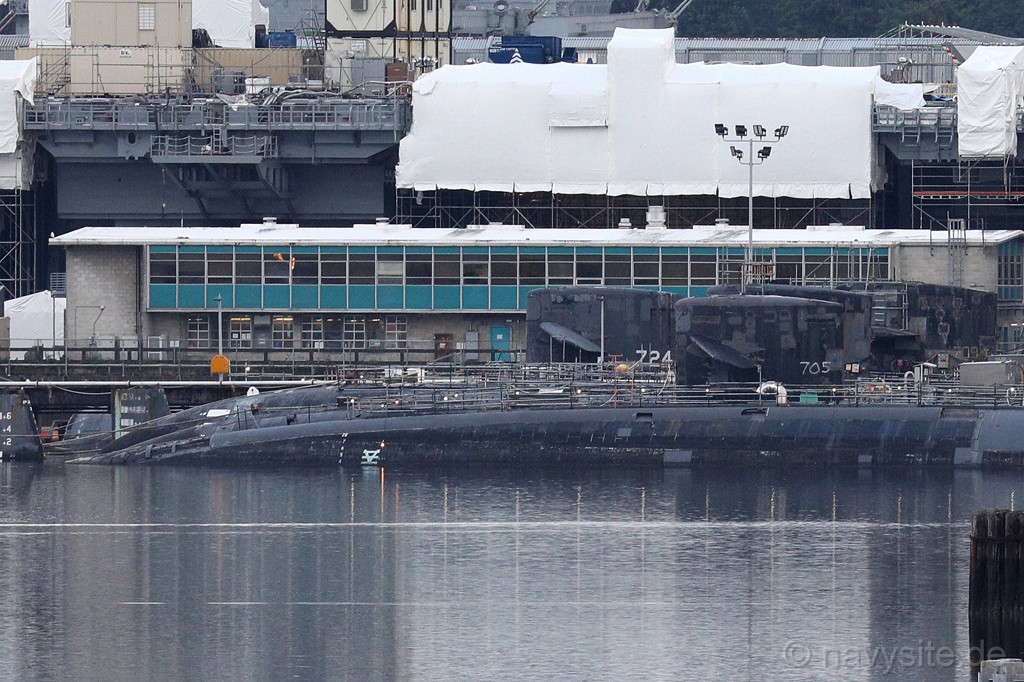
She was inactivated on July 28, 2016, and on August 3, 2017, she was formally decommissioned and stricken from the Naval Vessel Register, ending her status as a commissioned warship. Subsequently, CITY OF CORPUS CHRISTI was transferred to Puget Sound Naval Shipyard in Bremerton, Washington, to await final disposition under the Navy's submarine recycling program, where she remains as a stricken hulk pending dismantling.
![]() | ![]() | ![]() |
USS CITY OF CORPUS CHRISTI Image Gallery:
![]() | ![]() | ![]() | |
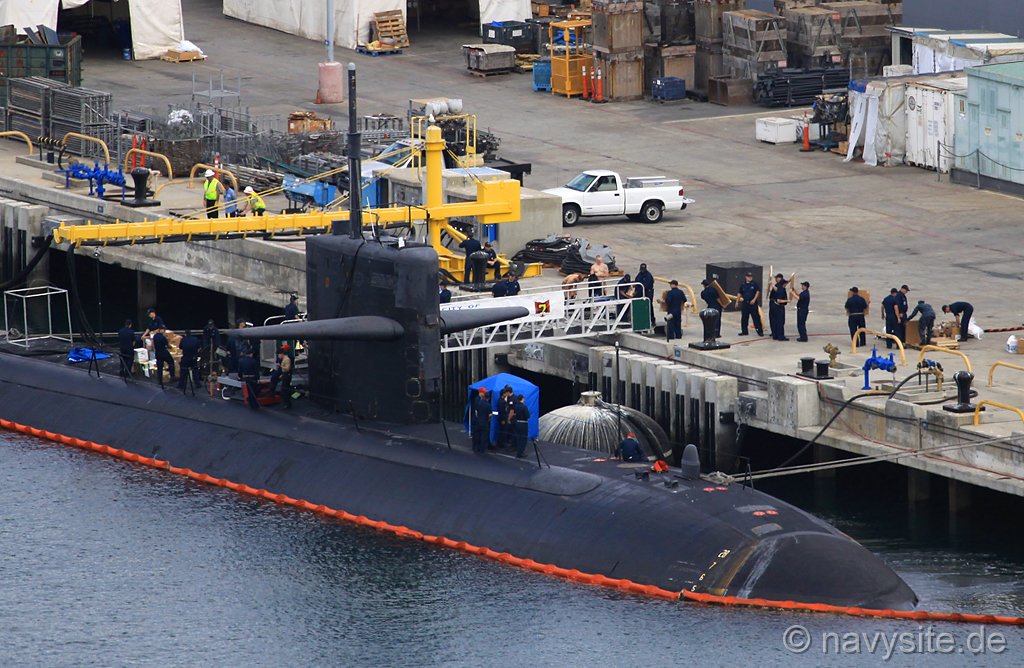
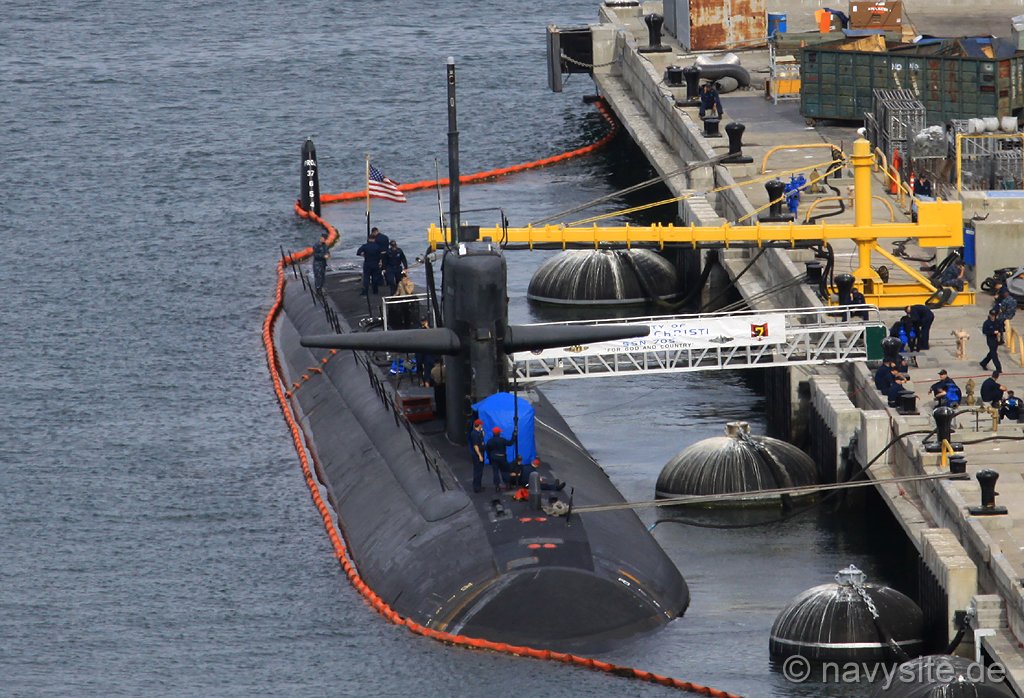
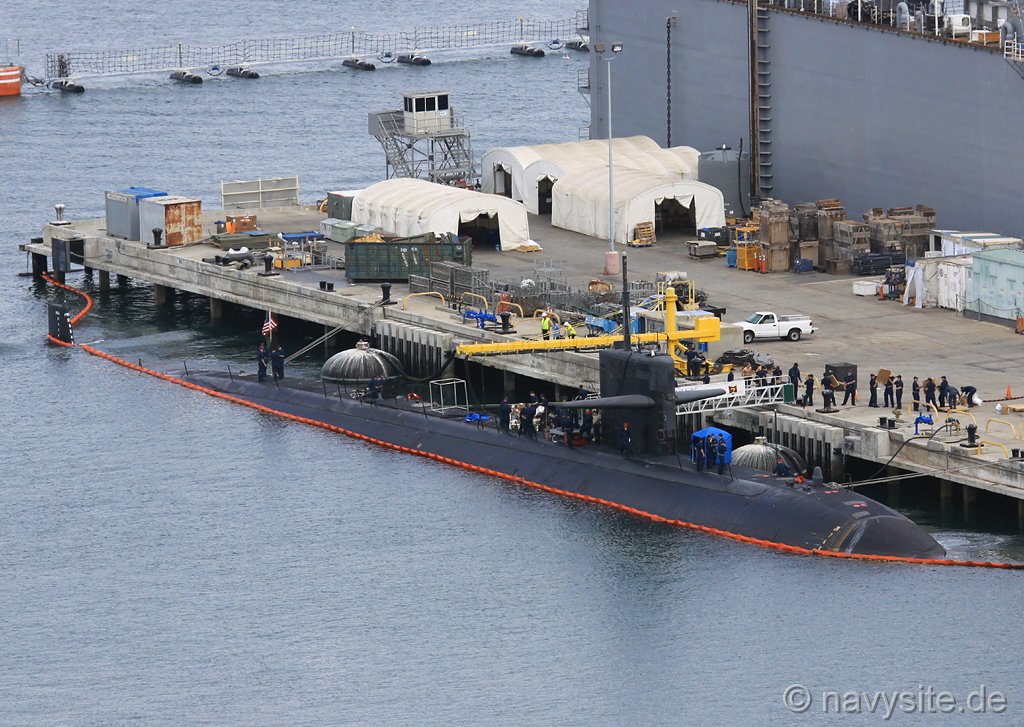
The photos below were taken by me and show the CITY OF CORPUS CHRISTI at Submarine Base Point Loma, Calif., on October 5, 2012. The submarine came to Point Loma for repairs to its Low Pressure Air Dryer.
![]() | ![]() | ![]() |
The photo below was taken by Michael Jenning and shows the ex-CITY OF CORPUS CHRISTI laid up at the Puget Sound Naval Shipyard, Bremerton, Wash., on June 12, 2022, awaiting recycling.
![]() |
Back to Submarines list.
Back to ships list.
Back to selection page.
Back to 1st page.