Search the Site with 
General Characteristics Crew List Memorabilia History Image Gallery to end of page

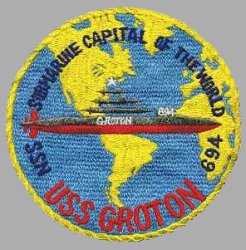
USS Groton (SSN 694)

- decommissioned -

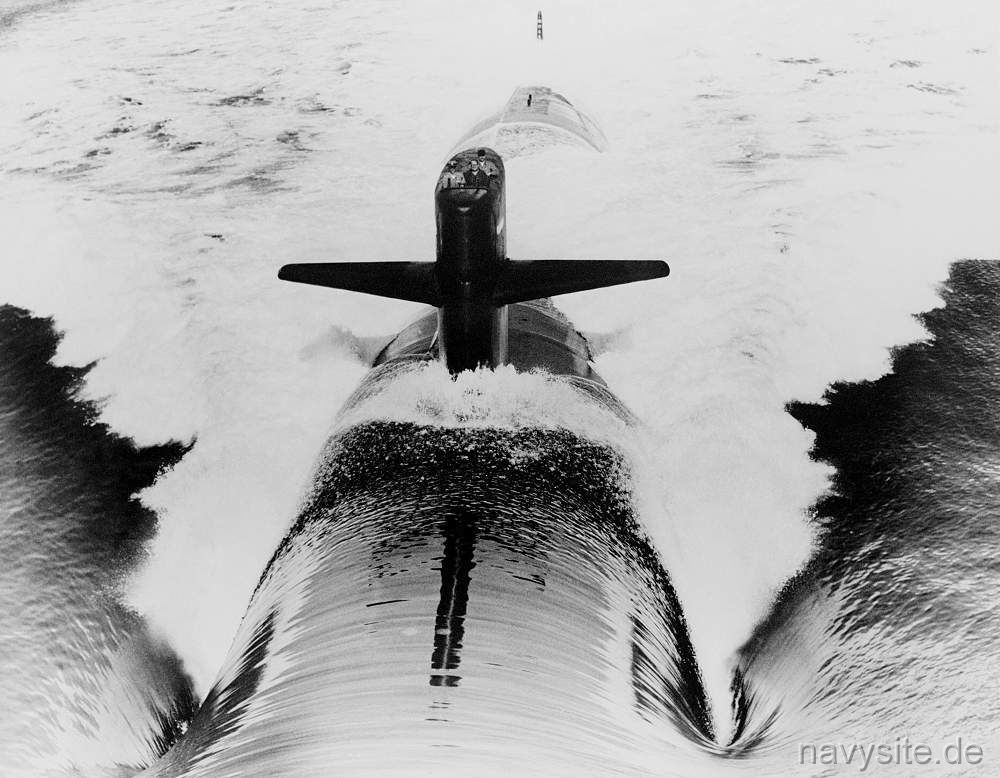
USS GROTON was the seventh LOS ANGELES - class attack submarine. Decommissioned and stricken from the Navy list on November 7, 1997, GROTON was subsequently laid up at the Puget Sound Naval Shipyard, Bremerton, Wash. She formally entered the Navy's ship and submarine recycling program on October 1, 2011, and her dismantlement was completed in 2014.

General Characteristics:Awarded: January 31, 1971
Keel Laid: August 3, 1973
Launched: October 9, 1976
Commissioned: July 8, 1978
Decommissioned: November 7, 1997
Builder: Electric Boat Division of General Dynamics Corporation, Groton, CT.
Propulsion system: one nuclear reactor
Propellers: one
Length: 360 feet (109.73 meters)
Beam: 33 feet (10 meters)
Draft: 32,15 feet (9.8 meters)
Displacement: Surfaced: approx. 6,000 tons
Submerged: approx. 6,900 tons
Speed: Surfaced: approx. 15 knots
Submerged: approx. 32 knots
Armament: four 533 mm torpedo tubes for Mk-48 torpedoes, Harpoon and Tomahawk missiles
Cost: approx. $900 million
Crew: 12 Officers, 115 Enlisted


Back to topback to top  go to endgo to the end of the page


Back to topback to top  go to endgo to the end of the page

Crew List:

This section contains the names of sailors who served aboard USS GROTON. It is no official listing but contains the names of sailors who submitted their information.


back to top  go to the end of the page


Back to topback to top  go to endgo to the end of the page

USS GROTON History:

USS GROTON was the seventh LOS ANGELES-class attack submarine and the third U.S. Navy vessel to carry the name of the Connecticut submarine-building city of Groton. Her construction contract was awarded to General Dynamics' Electric Boat division on January 31, 1971, as part of the early batch of 688-class boats ordered to replace the aging STURGEON-class and give the Navy a quieter, deeper-diving, fast nuclear attack submarine optimized for blue-water anti-submarine warfare against the Soviet Navy.

The keel was laid at Electric Boat in Groton on August 3, 1973, and the hull took shape through the mid-1970s as the yard adapted to serial production of the new design. GROTON was launched on October 9, 1976, sliding into the Thames River for the first time, sponsored by Anne Francis Richardson, wife of secretary of commerce Elliot L. Richardson. Through 1977 and 1978, the submarine was completed alongside the fitting-out pier at Electric Boat. Officers and crew reported in as the pre-commissioning unit, working with shipyard personnel to bring the nuclear propulsion plant, combat system, and hotel services to life and to correct the inevitable deficiencies that arose in tests. One of the future senior officers who began his sea-going career here was then-lieutenant Randall L. Zeller, assigned in 1977 as a division officer on the still-uncommissioned GROTON, a detail later recorded in a U.S. Senate tribute to his career. After dock trials, propulsion plant testing, and initial sea trials off the New England coast, the boat was judged ready to enter active service.

USS GROTON was commissioned at Groton on July 8, 1978, with Commander R. William Vogel III in command and Master Chief Joseph Pow as chief of the boat. She joined the Atlantic Fleet's Submarine Force, homeported at Naval Submarine Base New London in Groton, and entered the typical post-commissioning cycle for a new nuclear submarine: further trials at sea, weapons and systems qualifications, inspections, and exercises in the western Atlantic to certify her crew and equipment. Unclassified sources do not break out individual patrols or port visits for these first two years, but they make clear that the boat was being prepared for quick integration into the high-tempo Cold War operating pattern of the LOS ANGELES-class.

By early 1980, GROTON was considered ready for her first major overseas deployment. According to multiple naval historical summaries, she left Groton in March 1980 for the Indian Ocean, beginning what would become a circumnavigation of the globe on her maiden extended cruise. Operating far from the U.S. East Coast, she joined the growing American naval presence in the Indian Ocean that followed the 1979 Iranian Revolution and the Soviet invasion of Afghanistan, a presence intended to demonstrate U.S. resolve and support for regional partners at a time of heightened tension around the Arabian Sea. Publicly available accounts do not detail the specific ports she entered, but they agree that the deployment took her across the Indian Ocean and into the western Pacific before she returned to the Atlantic by transiting the Panama Canal. When she arrived back at Groton in October 1980, she had completed an around-the-world deployment on her first overseas tour, a point later noted both in naval reference works and in official summaries of the ship's history.

Between late 1980 and 1982, GROTON remained an active unit of the Atlantic submarine force. As is common for attack submarines, open sources give little day-by-day detail about these years, but a 2015 Naval Sea Systems Command historical evaluation notes that in 1980 she "set sail for the Indian Ocean and her first extended deployment" and then, in 1982, she "rejoined the Seventh Fleet to protect American interests in the Arabian Gulf". This indicates that in 1982, she again deployed away from the U.S. East Coast, this time to operate with the U.S. Seventh Fleet in the broader Indian Ocean and Arabian Gulf region, where the United States was trying to stabilize relationships with Gulf states during the Iran-Iraq War and to protect maritime traffic through the Strait of Hormuz. Details such as intermediate port visits and exact on-station dates remain classified or simply unreported in unclassified literature, but the deployment marked GROTON's second major blue-water cruise within her first four years of service.

From 1983 through 1985, GROTON focused on the North Atlantic. The Naval Sea Systems Command evaluation states that during this period she conducted three separate deployments to the "Northern Atlantic", a term that in contemporary U.S. Navy usage generally encompassed the Norwegian Sea, the North Atlantic approaches, and associated operating areas used to track Soviet submarines. The specifics of each cruise - the departure and return dates, the exact areas patrolled, and any liberty ports - do not appear in unclassified records, but the pattern of repeated deployments reflects the continued importance of forward anti-submarine patrols near the Greenland-Iceland-United Kingdom (GIUK) gap at the height of the Cold War. Between these cruises GROTON would have returned to Groton for upkeep, inspections, and training in the western Atlantic, maintaining crew proficiency in weapons employment, navigation, and engineering drills while preparing for the next overseas assignment.

The mid-1980s also saw changes in the ship's leadership and the beginning of the career association of Randall Zeller with the boat's later reputation. After earlier service on GROTON as a junior officer, Zeller spent several years in shore and sea billets elsewhere before returning to the submarine as executive officer in December 1987. During his XO tour, which lasted until July 1990, GROTON would carry out some of the most publicly documented operations of her career. Although individual patrols remain largely classified, a combination of Navy historical summaries and later Congressional testimony make clear that during this period she executed at least one deployment to the Mediterranean and eastern Atlantic under Sixth Fleet operational control.

One of these late-1980s deployments culminated in a notable distinction. Both the Naval Sea Systems Command evaluation and the Senate tribute to Captain Zeller record that in 1989 GROTON received the Sixth Fleet's "Hook 'Em" award, a trophy presented for anti-submarine warfare excellence. In the same passage, the Congressional Record notes that during Zeller's XO tour the submarine "played a key role in contingency operations near Lebanon". These brief official descriptions place GROTON in the eastern Mediterranean in the late 1980s, operating against submarine or surface targets in support of U.S. policy during the closing stages of the Lebanese civil war, when the United States and its allies were monitoring regional security and naval movements very closely. The details of those contingency operations - what specific units she tracked, how close she came to the Lebanese coast, and what tactical evolutions earned the award - remain classified, but the recognition from Sixth Fleet indicates sustained, effective performance in demanding anti-submarine warfare tasks.

The end of the 1980s and the beginning of the 1990s, were also a period of transition for the submarine force as the Cold War wound down and the focus began to shift from exclusively blue-water operations against the Soviet Navy to more varied missions, including support to joint operations and regional crises. The Naval Sea Systems Command evaluation summarizes GROTON's activity by stating that between 1989 and 1996 she completed four deployments to the Mediterranean Sea, one of which in 1994 directly supported enforcement of the arms embargo on the former Yugoslavia. Although open sources do not assign exact dates to each of the four Mediterranean cruises, this statement firmly anchors the boat in Sixth Fleet's area for much of the immediate post-Cold-War era.

During these years, GROTON also took part in large, multi-service exercises closer to home. A declassified U.S. Marine Corps "Status of Forces" briefing for May 1993 lists the submarine among the U.S. Navy forces participating in exercise Ocean Venture 93, a major joint and combined exercise in the Caribbean and western Atlantic. The scenario - built around a fictional Caribbean island called "St. Alexander" - was designed to practice crisis response, non-combatant evacuation, amphibious assault, and joint logistics in a politically unstable environment. The exercise brought together carriers, amphibious groups, surface combatants, submarines, and extensive air and ground forces. In the Navy order of battle for Ocean Venture 93, GROTON appears alongside sister submarine USS ALEXANDRIA (SSN 757) under Commander Submarine Force Atlantic, operating with a large surface force that included USS MOUNT WHITNEY (LCC 20) as command ship, carrier USS AMERICA (CV 66), cruiser USS NORMANDY (CG 60), destroyer USS SCOTT (DDG 995), oiler USS SAVANNAH (AOR 4), frigate USS AUBREY FITCH (FFG 34), and amphibious ships such as USS GUADALCANAL (LPH 7), USS SHREVEPORT (LPD 12), and USS ASHLAND (LSD 48). GROTON's role in this context would have included providing opposition force and protective submarine services - tracking and simulating attacks against the exercise fleet while also honing her crew's ability to integrate with joint and allied forces.

By 1993-1994, the focus of GROTON's Mediterranean deployments had shifted decisively toward the Balkans. The Naval Sea Systems Command history notes that one of her four Mediterranean cruises in the 1989-1996 period specifically involved "enforcement of the Yugoslavian arms embargo", a reference to NATO and Western European Union maritime operations off the former Yugoslavia. Public descriptions of Operation Sharp Guard - a combined NATO/WEU blockade of shipping to the former Yugoslavia conducted in the Adriatic Sea between June 15, 1993, and October 2, 1996 - list USS GROTON among the U.S. Navy units that contributed to the effort. Submarines in Sharp Guard monitored traffic routes, collected intelligence, and provided covert surveillance of suspect vessels and coastal movements while surface units hailed, inspected, and, when necessary, diverted merchant ships. Although the specific patrol patterns and contact reports remain classified, the combination of official Navy evaluation and NATO operation summaries makes it clear that GROTON played a concealed but direct part in the maritime enforcement effort that accompanied diplomatic and air operations over the Balkans.

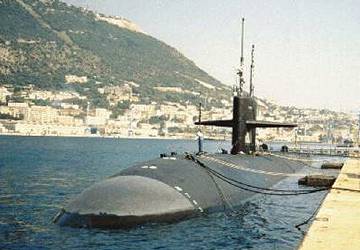
Open sources provide only fragmentary glimpses of GROTON's later 1990s deployments. The Naval Sea Systems Command document's statement that she completed four Mediterranean deployments between 1989 and 1996 implies a sustained pattern of Sixth Fleet operations through the end of Sharp Guard, but public records do not describe the intermediate port calls, exercises, or exact departure and return dates for each cruise. A widely circulated photograph taken at Naval Submarine Base Kings Bay in July 1996 shows the submarine alongside with a visibly cracked sonar dome, suggesting that at some point in that period she suffered bow-area damage that required depot-level repair. The available open sources that reproduce the image, however, do not specify the precise circumstances under which the damage occurred. What can be said with certainty is that by the mid-1990s GROTON had behind her a sequence of Cold War North Atlantic patrols, Indian Ocean and Arabian Gulf deployments, and post-Cold-War Mediterranean and joint exercises that matched the evolving tasks given to Atlantic Fleet attack submarines.

The final phase of GROTON's active service was relatively brief. With newer LOS ANGELES-class and then improved 688I boats entering service and the post-Cold-War Navy looking to reduce the size of the submarine force, she was selected for inactivation after roughly nineteen years in commission. She was decommissioned and stricken from the Naval Vessel Register on November 7, 1997, after 19 years, 3 months, and 30 days of active service, in a ceremony held at her long-time homeport in Groton. At that point she became "ex-GROTON", a non-commissioned hull awaiting final disposition.

Even in inactivation, the hull still figured in fleet movements. A detailed chronology of guided missile cruiser USS THOMAS S. GATES (CG 51) records that between March and June 1998, the cruiser conducted various East Coast operations and, in April of that year, performed tow-escort duty while the fleet tug USNS APACHE (T-ATF 172) towed ex-GROTON south to Fort Lauderdale with the submarine's final destination being the Puget Sound Naval Shipyard in Bremerton, Washington.

By the late 2000s the former submarine was laid up at Puget Sound Naval Shipyard in Bremerton, Washington, as part of the Navy's queue of nuclear-powered ships awaiting dismantlement. Ex-GROTON formally entered the Navy's ship and submarine recycling program on October 1, 2011, and her dismantlement was completed in 2014.


Back to topback to top  go to endgo to the end of the page


The photo below was taken by me and shows the GROTON laid-up at the Puget Sound Naval Shipyard, Bremerton, Wash. The three submarines are: AUGUSTA (SSN 710), GROTON and the INDIANAPOLIS (SSN 697). The photo was taken on March 14, 2010.


The photos below were taken by me and show the GROTON laid-up at the Puget Sound Naval Shipyard, Bremerton, Wash., on May 12, 2012.
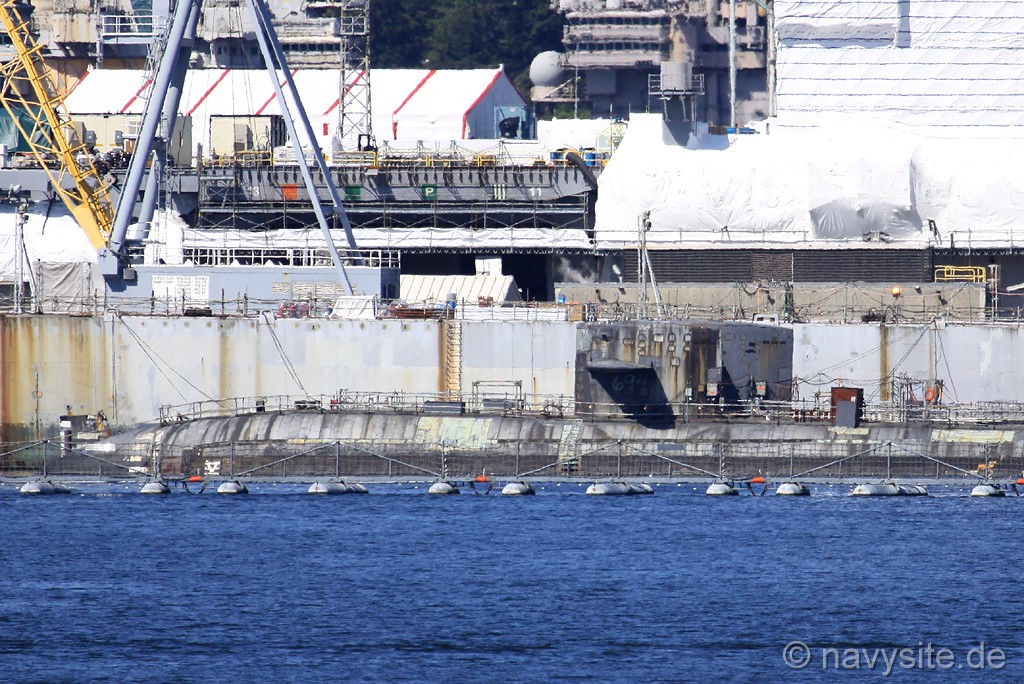


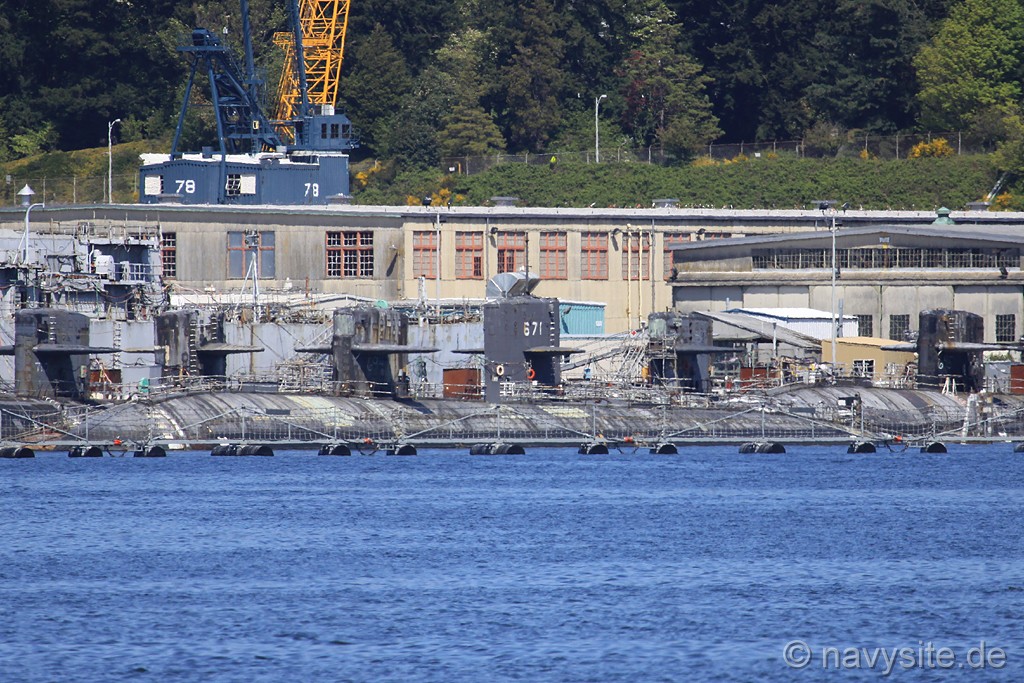
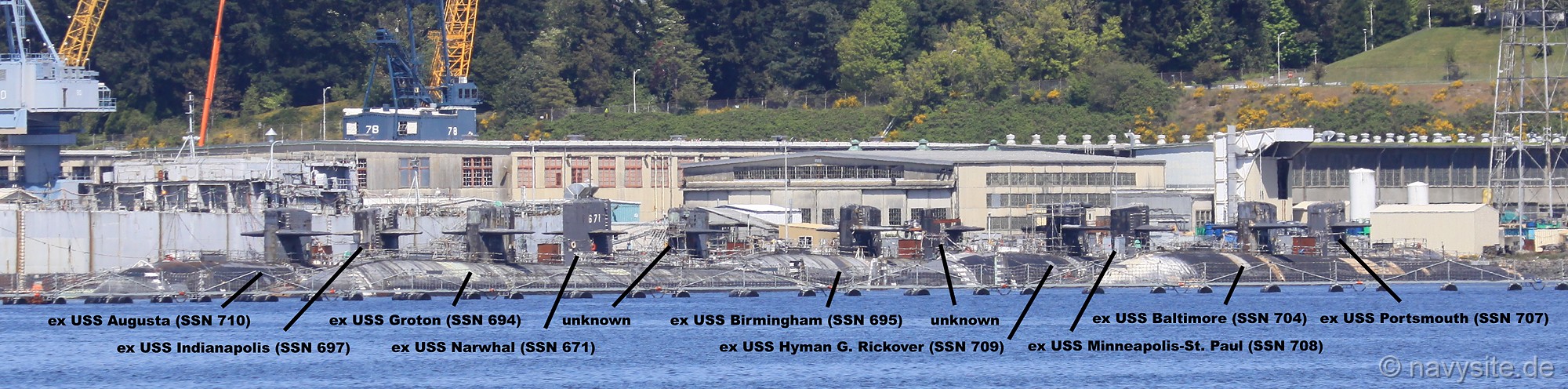
The photo below was taken by me and shows a number of decommissioned nuclear-powered attack submarines laid up at the Puget Sound Naval Shipyard, Bremerton, Wash. The photo was taken from Port Orchard, Wash., on May 12, 2012. The submarines' names are on the photo.


Back to topback to top


Back to Submarines list. Back to ships list. Back to selection page. Back to 1st page.