
Search the Site with

|
Search the Site with
|
 General Characteristics Crew List Memorabilia History Image Gallery to end of page
USS INDIANAPOLIS was the tenth LOS ANGELES-class attack submarine. She was decommissioned and stricken from the Naval Vessel Register on December 22, 1998, three days before Christmas, closing out just under 19 years of commissioned service. Although the submarine itself was recycled, significant parts of USS INDIANAPOLIS were preserved for memorial purposes. Her sail and selected external fittings were retained and are now centerpiece of a memorial at the Indiana Military Museum in Vincennes.
| General Characteristics: | Awarded: January 24, 1972 |
| Keel Laid: October 19, 1974 | |
| Launched: July 30, 1977 | |
| Commissioned: January 5, 1980 | |
| Decommissioned: December 22, 1998 | |
| Builder: Electric Boat Division of General Dynamics Corporation, Groton, CT. | |
| Propulsion system: one nuclear reactor | |
| Propellers: one | |
| Length: 360 feet (109.73 meters) | |
| Beam: 33 feet (10 meters) | |
| Draft: 32,15 feet (9.8 meters) | |
| Displacement: Surfaced: approx. 6,000 tons | |
| Submerged: approx. 6,900 tons | |
| Speed: Surfaced: approx. 15 knots | |
| Submerged: approx. 32 knots | |
| Armament: four 533 mm torpedo tubes for | |
| Cost: approx. $900 million | |
| Crew: 12 Officers, 115 Enlisted |
 back to top go to the end of the pageback to top go to the end of the page
Crew List:
This section contains the names of sailors who served aboard USS INDIANAPOLIS. It is no official listing but contains the names of sailors who submitted their information.
back to top go to the end of the pageback to top go to the end of the page back to top go to the end of the page
USS INDIANAPOLIS History:
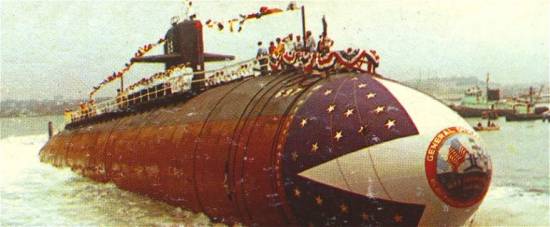
The nuclear-powered attack submarine USS INDIANAPOLIS was a first-flight LOS ANGELES-class boat built for the United States Navy in the later Cold War, intended to hunt Soviet submarines, screen carrier battle groups, and conduct covert intelligence and presence missions throughout the Pacific. The contract to build the submarine was awarded to the Electric Boat Division of General Dynamics at Groton, Connecticut, on January 24, 1972, as part of the early production run of the class. Electric Boat laid the keel of USS INDIANAPOLIS on October 19, 1974, beginning nearly five years of construction and system integration. She was launched on July 30, 1977, a date chosen to coincide with the anniversary of the 1945 loss of the heavy cruiser USS INDIANAPOLIS (CA 35), whose name she inherited. The launch ceremony at Groton was sponsored by Esther Bray, wife of former Indiana congressman William G. Bray, linking the new submarine symbolically to the city and state whose name she carried. Following fitting-out and sea trials, the yard delivered the completed submarine to the Navy on November 30, 1979.
USS INDIANAPOLIS was commissioned at the Naval Submarine Base New London in Groton on January 5, 1980, with Commander Harry P. Salmon Jr. as her first commanding officer. The commissioning ceremony was notable for the presence of many survivors of the World War II cruiser USS INDIANAPOLIS, underlining the strong commemorative element attached to the new boat. After commissioning, the submarine carried out post-shakedown trials and training in the Atlantic, testing her propulsion plant, combat system, and crew in the standard mix of deep-water operations, torpedo exercises, and ship-handling drills expected of a newly commissioned fast attack submarine. Open sources do not list a detailed day-by-day shakedown schedule, but they agree that these initial operations were completed while she was still based on the U.S. east coast.
By 1980, USS INDIANAPOLIS shifted her home port to Pearl Harbor, Hawaii, joining the Pacific Fleet's fast attack submarine force and operating from there for the remainder of her active career. She became part of the Cold War Pacific undersea screen, assigned to Submarine Squadron Seven (COMSUBRON SEVEN) at Pearl Harbor alongside other LOS ANGELES-class boats.
Through the early 1980s, she alternated between local training operations in Hawaiian waters, periodic maintenance at Pearl Harbor Naval Shipyard, and extended deployments west of Hawaii in support of U.S. Pacific Fleet and Seventh Fleet tasking. The unclassified record for these early years is sparse on specific patrol areas and dates, reflecting the continuing sensitivity of submarine operations, but it is clear that she was fully integrated into the standing pattern of anti-submarine warfare training and carrier battle group support that characterized Pacific Fleet SSN employment during the later Cold War. One of the earliest publicly documented operations occurred in the context of the continuing Indochinese refugee crisis. On April 12, 1982, while operating in the Gulf of Thailand or adjacent waters, USS INDIANAPOLIS encountered a small, overcrowded vessel carrying about 30 Vietnamese refugees. Contemporary press reporting from Singapore described an American submarine rescuing a boatload of Vietnamese refugees in the Gulf of Siam and taking them to safety, and later Navy historical summaries identified the submarine as USS INDIANAPOLIS.
The refugees were in poor physical condition and had exhausted their stocks of food and fresh water. The submarine took them aboard, provided emergency care, and turned them over to appropriate authorities at a safe port. For this mid-April 1982 rescue, the Navy later awarded USS INDIANAPOLIS the Humanitarian Service Medal, with official awards documentation recording the medal as covering a period ending April 21, 1982, and Naval History and Heritage Command summarizing the event by date as April 12, 1982.
Later the same year, USS INDIANAPOLIS was again drawn into humanitarian-related activity, this time in support of U.S. territory. On November 23, 1982, Hurricane Iwa struck the Hawaiian Islands, passing very near Kauai and causing severe damage to infrastructure and electrical power on that island. In the aftermath of the storm, U.S. authorities considered unconventional ways to restore essential services. Press reports from late November 1982 described USS INDIANAPOLIS being ordered into Nawiliwili Harbor on Kauai to stand by to provide emergency electrical power from her nuclear reactor to the island's main town of Lihue, with a reported capability on the order of 1.5 megawatts. National Archives image captions later documented the submarine, together with the salvage ship USS CONSERVER (ARS 39), alongside in Nawiliwili Harbor in the period after the hurricane, illustrating the Navy's visible presence in relief efforts. Whether or not the technical and regulatory issues could all be resolved to allow the submarine actually to feed power into Kauai's grid, USS INDIANAPOLIS spent this late-1982 period in a highly unusual standby role, emblematic of the flexibility that nuclear-powered submarines could offer in extreme civil emergencies.
During the remainder of the 1980s, detailed unclassified patrol narratives for USS INDIANAPOLIS are not publicly available, but COMSUBPAC command histories and fleet summaries confirm that she continued as an active unit of COMSUBRON SEVEN at Pearl Harbor throughout the decade. Like her sister ships, she would have alternated six-month deployment cycles with maintenance and training, supporting carrier battle groups, participating in anti-submarine warfare exercises with U.S. and allied surface forces and aircraft, and conducting independent operations in the North Pacific and Western Pacific aimed at tracking Soviet submarines and gathering intelligence on naval activity. These general patterns are documented for the Pacific Fleet submarine force as a whole, but individual patrols for USS INDIANAPOLIS remain largely classified or undescribed in open sources, so specific dates, areas, or port visits for most of the decade cannot be reconstructed from public records alone.
By 1991, as the Cold War wound down following the dissolution of the Soviet Union, USS INDIANAPOLIS was firmly established among the Pearl Harbor-based LOS ANGELES-class boats under COMSUBRON SEVEN. The Pacific submarine force was beginning to adjust to a new strategic environment that emphasized regional crises, support to carrier and amphibious groups in the Middle East and Western Pacific, and exercises with emerging partners. Within this context, the boat continued the familiar rhythm of local operations, maintenance availabilities at Pearl Harbor Naval Shipyard, and extended Western Pacific deployments.
A clearly documented deployment took place in 1992. The COMSUBPAC command history for that year lists USS INDIANAPOLIS among the submarines that deployed to the Western Pacific, noting that, on average, such deployments lasted around six months from homeport to homeport. Archival imagery and captions show USS INDIANAPOLIS arriving at Naval Station Subic Bay in the Philippines on February 21, 1992, mooring there during the final year of major U.S. naval presence at that base. This port call took place against the backdrop of the Philippine Senate's rejection of a new bases agreement in 1991 and the impending closure of Subic Bay following the eruption of Mount Pinatubo and the end of the Cold War, giving the visit additional historical resonance. Crew recollections compiled in later years also refer to a 1992 WestPac deployment that included both the Philippines and Thailand, reinforcing the picture of a typical multi-stop Western Pacific cruise by a Pearl Harbor-based SSN in the immediate post-Cold War era, though open sources do not document all individual ports and dates.
In the autumn of that same year, the submarine's operational focus briefly returned closer to home. In September 1992, Hurricane Iniki, the most destructive hurricane in modern Hawaiian history, struck Kauai, again devastating the island's infrastructure. Photograph captions record USS INDIANAPOLIS arriving at Kauai in December 1992 "to render assistance to the local population after Hurricane Iwa", almost certainly a reference to post-Iniki relief work given the dates involved. This second recorded visit to Kauai in a hurricane-relief context, a decade after Hurricane Iwa, illustrates that the submarine and her crew were again drawn into civil support missions beyond their strictly military role when circumstances demanded.
The mid-1990s saw USS INDIANAPOLIS continue a busy deployment schedule as part of the post-Cold War Pacific Fleet. A fleet timeline lists the boat among the units participating in a Western Pacific deployment running from September 6, 1994, to March 3, 1995, alongside fellow LOS ANGELES-class submarines USS BREMERTON (SSN 698) and USS JACKSONVILLE (SSN 699). Although individual port visits and specific exercise names for USS INDIANAPOLIS during this deployment are not detailed in unclassified sources, the same timeframe saw Pacific Fleet submarines heavily engaged in supporting carrier battle groups, conducting anti-submarine exercises with regional allies such as Japan and South Korea, and maintaining a U.S. undersea presence in the Western Pacific as regional security concerns shifted to focus on the Korean Peninsula and emerging Chinese naval capabilities. The available record confirms that USS INDIANAPOLIS was part of this broader pattern of operations, even when it does not break out her patrols one by one.
The final phase of USS INDIANAPOLIS's active career is better documented. By the mid-1990s, defense budgets were shrinking under the so-called "peace dividend", and the Navy faced choices about which earlier LOS ANGELES-class boats to refuel and modernize and which to inactivate early. As a first-flight unit without vertical launch system (VLS) cells, USS INDIANAPOLIS was among the boats earmarked for inactivation before the end of her nominal 30-year life, avoiding the considerable cost of a mid-life reactor refuelling overhaul.
Before leaving service, however, she undertook one last major deployment. Open-source summaries agree that her final deployment ran from April to October 1997 and that it was during this period that she reached the peak of her recognized operational performance. For operations between April 1 and September 1, 1997, USS INDIANAPOLIS was awarded a Navy Unit Commendation, as recorded in official Navy awards listings. At the same time, she received the Battle Efficiency "E", marking her as the top-performing submarine in her squadron for that cycle. The details of the missions that justified these awards remain largely classified or are summarized only in general terms in publicly released citations, but the awards together indicate a demanding series of forward-deployed operations in which the boat and her crew were judged to have performed at an exceptionally high level.
Following her return from that last deployment, USS INDIANAPOLIS entered the inactivation phase of her life cycle at Pearl Harbor. On February 17, 1998, during inactivation ceremonies, the Navy formally presented the Navy Unit Commendation recognizing her 1997 operations, highlighting that this was the first such unit award in her 18-year career.
She was decommissioned and stricken from the Naval Vessel Register on December 22, 1998, three days before Christmas, closing out just under 19 years of commissioned service. Like other early LOS ANGELES-class submarines, she then entered the Navy's Submarine Recycling Program at Puget Sound Naval Shipyard, where the hull was dismantled and the reactor compartment prepared for long-term storage.
Although the submarine itself was recycled, significant parts of USS INDIANAPOLIS were preserved for memorial purposes. Her sail and selected external fittings were retained and eventually transported to Indiana. The sail was installed as the centerpiece of a memorial at the Indiana Military Museum in Vincennes, where it was dedicated on June 8, 2019, in a ceremony attended by former officers and crew, linking the submarine back to the state and to the memory of the earlier cruiser that shared her name.
back to top go to the end of the pageUSS INDIANAPOLIS Image Gallery:
The photo below was taken by me and shows the INDIANAPOLIS laid-up at the Puget Sound Naval Shipyard, Bremerton, Wash. The three submarines are from front to back: AUGUSTA (SSN 710), GROTON (SSN 694) and the INDIANAPOLIS. The photo was taken on March 14, 2010.
 |
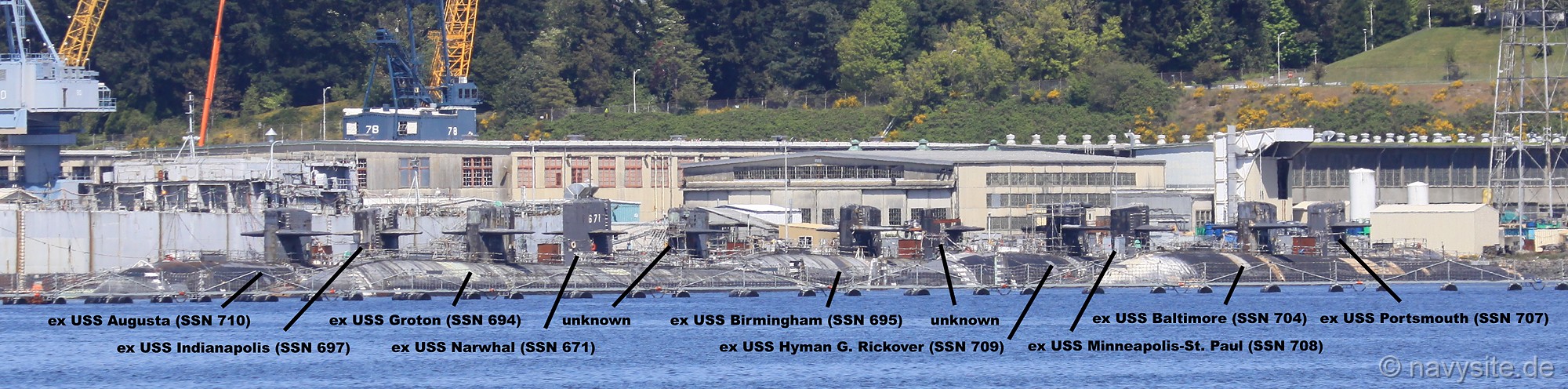
The photo below was taken by me and shows a number of decommissioned nuclear-powered attack submarines laid up at the Puget Sound Naval Shipyard, Bremerton, Wash. The photo was taken from Port Orchard, Wash., on May 12, 2012. The submarines' names are on the photo.
 back to top
 Back to Submarines list. Back to ships list. Back to selection page. Back to 1st page.