Search the Site with 
General Characteristics Crew List Memorabilia Accidents aboard the Ship History Image Gallery to end of page

USS Connecticut (SSN 22)

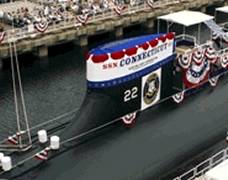
USS CONNECTICUT is the second of the three SEAWOLF - class nuclear powered Attack Submarines and the fifth ship in the Navy to bear the name of the state.

General Characteristics:Awarded: May 3, 1992
Launched and Christened: September 1, 1997
Commissioned: December 11, 1998
Builder: General Dynamics Electric Boat Division, Groton, Conn.
Propulsion system: one nuclear reactor
Propellers: one
Length: 353 feet (107.6 meters)
Beam: 40 feet (12.2 meters)
Draft: 35 feet (10.67 meters)
Displacement: Surfaced: approx. 7,460 tons
Submerged: approx. 9,137 tons
Speed: Surfaced: approx. 20 knots
Submerged: approx. 35 knots
Armament: Tomahawk missiles and Mk-48 torpedoes from eight 660 mm torpedo tubes, ability to lay mines
Homeport: Bremerton, Wash.
Crew: 12 Officers, 121 Enlisted


Back to topback to top  go to endgo to the end of the page


Back to topback to top  go to endgo to the end of the page

Crew List:

This section contains the names of sailors who served aboard USS CONNECTICUT. It is no official listing but contains the names of sailors who submitted their information.


back to top  go to the end of the page


Back to topback to top  go to endgo to the end of the page

Accidents aboard USS CONNECTICUT:

DateWhereEvents
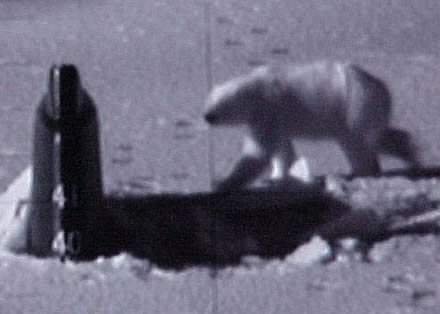
April 27, 2003near the North PoleDuring the ICEX 2003 naval exercises near the North Pole, USS CONNECTICUT was stalked and "attacked" by a "hostile" polar bear when the submarine poked its sail and rudder through the ice.

The damage to CONNECTICUT's rudder was reported to be minor.
April 14, 2021Naval Base Point Loma, Calif.USS CONNECTICUT strikes a pier, causing minor damage to the submarine and prompting a stand-down and investigation focused on navigation and seamanship standards.
October 2, 2021South China SeaWhile submerged and transiting through the South China Sea, USS CONNECTICUT collides with an uncharted seamount. The impact occurred in international waters in a region where the complex undersea topography and incomplete seabed charts pose navigation challenges for all navies. About eleven sailors are injured, with reported injuries including a broken scapula and a concussion, but no fatalities. The submarine's nuclear propulsion plant remained undamaged and fully operational, but the bow, including the sonar dome and forward ballast tanks, suffered significant structural damage. Subsequent reporting indicated that CONNECTICUT had been heading toward Okinawa.

Following the grounding, CONNECTICUT surfaced and began a transit to Guam, proceeding on the surface due to her damaged bow. She arrived at Naval Base Guam around October 8, 2021, after nearly a week of surface steaming across the Philippine Sea. There, she underwent initial damage assessment, temporary repairs and testing under the lead of Naval Sea Systems Command (NAVSEA). Official statements emphasized that the submarine remained in a safe, stable condition, that the reactor plant was unaffected, and that a team of specialists was evaluating the full extent of the damage and options for permanent repair.

The incident prompted a high-level investigation by U.S. Seventh Fleet, which concluded in 2022 that a combination of lax oversight, inadequate planning and failures in basic navigation procedures had led to the grounding. As a result, the commanding officer, executive officer and chief of the boat were relieved of command, and the Navy ordered reviews and additional training aimed at preventing similar accidents in the future.

During 2022, CONNECTICUT was moved to Puget Sound Naval Shipyard in Bremerton, Washington, where NAVSEA and PSNS & IMF planned a complex repair package. The submarine's return to service is not expected before 2026.


Back to topback to top  go to endgo to the end of the page

USS CONNECTICUT History:

USS CONNECTICUT is the second of the three SEAWOLF-class nuclear-powered fast attack submarines and one of the most capable and expensive submarines ever built by the U.S. Navy. Conceived near the end of the Cold War as a high-end hunter-killer, the class was sharply curtailed after the collapse of the Soviet Union, leaving only SEAWOLF (SSN 21), CONNECTICUT and JIMMY CARTER (SSN 23) in service instead of the nearly thirty hulls originally planned.

The contract to build USS CONNECTICUT was awarded to General Dynamics Electric Boat in Groton, Connecticut, on May 3, 1991, and her keel was laid there on September 14, 1992, marking the beginning of a protracted construction period for this complex design. She was launched on September 1, 1997, sponsored by Patricia L. Rowland, wife of the Governor of Connecticut, and commissioned at Naval Submarine Base New London in Groton on December 11, 1998, under the command of Captain Larry H. Davis. The submarine carries the motto "ARSENAL OF THE NATION", a nod both to the industrial history of her namesake state and to the heavy weapons load and advanced systems that distinguish the SEAWOLF-class.

During 1999, USS CONNECTICUT remained based at New London and spent the year in an intensive shakedown program designed to prove out her combat systems, sensors, propulsion plant and acoustic quieting. She took part in Joint Task Force Exercise 2-99 as an opposing-force asset, testing how a modern, very quiet attack submarine could be employed against a carrier strike group. In the same period she completed acoustic trials, shallow-water operations and anti-submarine warfare exercises that honed crew proficiency and allowed the Navy to validate new tactical approaches for SEAWOLF-class boats operating in the challenging littoral environments that had become a focus after the end of the Cold War.

In September 1999, USS CONNECTICUT entered a post-shakedown availability (PSA) at Electric Boat. According to official histories, the amount of work in this PSA grew by roughly 100 percent compared with the initial plan, making it one of the most demanding such availabilities undertaken for a submarine up to that point. Nonetheless, the shipyard and crew completed it ahead of schedule, and the PSA was noted as the safest in Electric Boat's century-long history, reflecting both the complexity of a first-of-type follow-on hull and the high priority placed on bringing the SEAWOLF-class fully into fleet service.

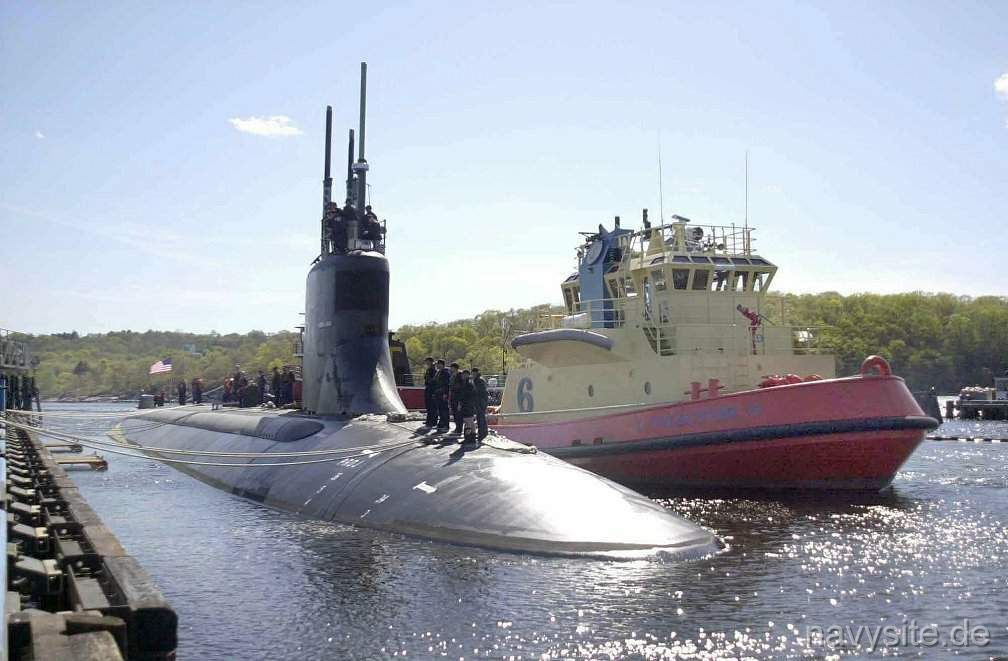
After returning to the fleet, USS CONNECTICUT began normal operations out of Groton. By mid-2002, she had completed a deployment to the North Atlantic, listed in veterans' deployment records as spanning approximately May through November 2002, a period that would have included exercises and presence missions in the traditional Cold War operating areas between North America and Europe. A photograph from May 2002 shows her in Groton, highlighting her continuing association with New England at that time.

In early 2003, USS CONNECTICUT shifted to Arctic operations, taking part in Ice Exercise (ICEX) 2003. She spent several months operating under the polar ice cap, conducting Mk 48 Advanced Capability (ADCAP) torpedo tests, tactical training and scientific support work. She surfaced through the ice at the Applied Physics Laboratory Ice Station (APLIS-03), a temporary Anglo-American camp established on an ice floe north of Prudhoe Bay, Alaska, on March 13, 2003. The camp, which hosted a submarine tracking range, science lab and small ice runway, drifted some 160 nautical miles before being disestablished on May 3, 2003. During one surfacing near the North Pole in April 2003, a young polar bear investigated the hole cut in the ice around CONNECTICUT's sail and was seen via the periscope nibbling at the submarine's rudder before losing interest and moving off, an incident that became one of the more widely publicized anecdotes from ICEX-03.

On March 31, 2004, USS CONNECTICUT deployed from New London as the submarine element of the WASP (LHD 1) Expeditionary Strike Group (ESG 2), joining the amphibious assault ship USS WASP (LHD 1), cruisers USS LEYTE GULF (CG 55) and USS YORKTOWN (CG 48), amphibious transport dock USS SHREVEPORT (LPD 12), dock landing ship USS WHIDBEY ISLAND (LSD 41) and destroyer USS McFAUL (DDG 74), together with the embarked 22nd Marine Expeditionary Unit. As ESG 2 crossed the Atlantic and entered the Mediterranean in March 2004, the group conducted U.S.-only exercises and the bilateral Adriatic PHIBLEX 04-5 off Albania, integrating amphibious operations, maritime interdiction and air support. The strike group transited the Suez Canal on March 16, 2004 and moved into the U.S. Fifth Fleet area in the Red Sea, Gulf of Oman, Arabian Sea and Persian Gulf, supporting the broader Global War on Terrorism and operations in Afghanistan and Iraq by providing maritime security, presence and strike options. During this deployment, CONNECTICUT operated in the Mediterranean, Indian Ocean and Persian Gulf, returning to New London on September 2, 2004, where crew members famously played Thin Lizzy's "The Boys Are Back in Town" over loudspeakers as the submarine came up the Thames River at the end of the cruise.

For roughly the next three years after her 2004 deployment, USS CONNECTICUT was largely confined to port in New London as she underwent a prolonged maintenance and upgrade period, reflecting both the complexity of the SEAWOLF-class design and the Navy's desire to maximize the life and capability of its very small SEAWOLF force.

In early 2007, the Navy announced that CONNECTICUT would shift from the Atlantic to the Pacific as part of a broader realignment sending about 60 percent of the submarine force to the Pacific theater, underscoring the growing strategic focus on the Indo-Pacific region and the rise of China as a peer competitor. On July 25, 2007, USS CONNECTICUT departed New London on what was described as a six-month deployment that would culminate in a permanent homeport change. As she headed west she effectively circumnavigated the globe. During this voyage she visited Subic Bay in the Philippines from October 25-30, 2007, and Busan, South Korea, from November 21-25, 2007, reflecting a pattern of engagement with key U.S. allies in Northeast and Southeast Asia as part of the broader U.S. deterrence and reassurance posture in the Western Pacific. She then continued eastward and arrived at Naval Base Kitsap in Washington state on January 30, 2008, formally completing her move from the Atlantic Fleet to the Pacific Fleet and joining SEAWOLF and JIMMY CARTER in SUBMARINE DEVELOPMENT SQUADRON FIVE.

From her new homeport in Bremerton, USS CONNECTICUT quickly became involved in Western Pacific operations and joint exercises intended to strengthen alliances and demonstrate U.S. undersea presence in Asia. In November 2007, on the tail end of her transfer voyage, she had already taken part in ANNUALEX 19G in the Philippine Sea, the large annual bilateral exercise between the U.S. Navy and the Japan Maritime Self-Defense Force (JMSDF), operating alongside a 26-ship formation that included the forward-deployed carrier USS GEORGE WASHINGTON (CVN 73).

In November 2009, CONNECTICUT again joined ANNUALEX, this time ANNUALEX 21G, conducting anti-submarine warfare and fleet maneuvers in the Pacific Ocean as part of the continuing evolution of combined U.S.-Japanese maritime operations. Photos from this period show her running on the surface in the Pacific as part of a dense multi-ship formation centered on GEORGE WASHINGTON, emblematic of her role as a high-end undersea asset within larger allied naval structures.

In October 2010, USS CONNECTICUT made another port visit to Subic Bay in the Philippines, a former major U.S. base that remained an important liberty and logistics hub for U.S. warships visiting the South China Sea region.

The following year, she once again turned north to the Arctic. In early 2011, the submarine took part in ICEX 2011, operating under the ice in the Arctic Ocean and surfacing near Prudhoe Bay, Alaska, in March 2011. Photographs and official accounts show CONNECTICUT conducting surfacings through ice and supporting scientific and tactical experiments designed to "train today's submarines in the challenging Arctic environment" and to refine procedures, equipment and tactics for future polar operations at a time when climate change and renewed great-power interest were drawing more attention to Arctic sea lanes and resources. She returned to Naval Base Kitsap in April and again in July 2011 after these Arctic evolutions, demonstrating the flexibility of the SEAWOLF-class to operate from deep Pacific waters to the high north within a single deployment cycle.

By early 2012, USS CONNECTICUT was again in the Western Pacific, with imagery placing her at Fleet Activities Yokosuka, Japan, in March 2012, followed by a return to Bremerton in April 2012. Soon afterward, she entered a period of extensive overhaul and modernization at Puget Sound Naval Shipyard and Intermediate Maintenance Facility (PSNS & IMF) that lasted from 2012 to 2017. Photographs from December 2016 show CONNECTICUT departing PSNS for sea trials, and additional imagery records her return to Naval Base Kitsap in April 2017, indicating that by then she was emerging from this long yard period and re-entering the operational fleet. While CONNECTICUT was completing this overhaul, her relationship with her namesake state deepened on the home front. In June 2016, the Connecticut Council of the Navy League of the United States formally "adopted" USS CONNECTICUT, emphasizing civic support and establishing enduring ties between the crew and organizations in the state whose name she bears. This sort of adoption program typically supports crew visits, scholarships and recognition events, reinforcing morale and public awareness of the boat's service.

By early 2018, USS CONNECTICUT was fully back in front-line service. In March 2018, she participated in Ice Exercise 2018 (ICEX 2018) in the Beaufort Sea, once again operating under the Arctic ice pack. Together with USS HARTFORD (SSN 768) and the Royal Navy submarine HMS TRENCHANT (S 91), she surfaced through the ice near a temporary ice camp north of Alaska, conducting combined U.S.-U.K. operations and demonstrating allied proficiency in under-ice navigation and operations. The exercise provided an opportunity to test new equipment and procedures in increasingly dynamic Arctic conditions and reflected growing strategic attention to the polar regions. After concluding ICEX 2018 she returned to Naval Base Kitsap in May 2018.

Later in 2018, CONNECTICUT deployed to the Western Pacific. Open sources describe this as a deployment to the Indo-Pacific region, after which she returned to Bremerton on January 30, 2019, where local media reported her arrival. Almost immediately afterwards, USS CONNECTICUT entered a planned docking continuous maintenance availability at Puget Sound Naval Shipyard. She entered Dry Dock 4 on March 26, 2019, beginning a five-and-a-half-month period of maintenance and modernization. Shipyard reports state that more than 30,000 worker-days were invested in the project, worth about 17 million dollars, and that the work package included extensive inspections and upgrade tasks. Among the tools used was a hull-climbing robotic system to inspect the outer hull, an example of the Navy's increasing use of robotics to improve efficiency and safety in shipyard work. CONNECTICUT left dry dock on August 10, 2019, and the availability was formally completed on September 5, 2019, after which she was returned to operational status with the Pacific Fleet.

Through late 2019 and into 2020, USS CONNECTICUT's day-to-day operations are not extensively documented in open sources, reflecting the normal secrecy surrounding attack submarine deployments. It is clear, however, that she resumed service out of Naval Base Kitsap as part of the small SEAWOLF force dedicated to high-end undersea missions in the Pacific and beyond. These boats are understood to focus on intelligence collection, tracking of foreign submarines and surface ships, and providing covert strike and special operations support, especially in contested regions such as the Western Pacific and the Arctic, though specific patrols during this period remain classified.

In preparation for a new deployment, USS CONNECTICUT underwent pre-deployment workups, including operations out of San Diego. On April 14, 2021, during mooring at Naval Base Point Loma in California, she struck a pier, causing minor damage to the submarine and prompting a stand-down and investigation focused on navigation and seamanship standards. After repairs and additional training, CONNECTICUT departed Naval Base Kitsap-Bremerton for deployment on May 27, 2021, as recorded in official imagery. The Navy later described this as a "surge" deployment in response to operational demands from U.S. Indo-Pacific Command at a time of rising U.S.-China tensions in the region.

On October 2, 2021, while submerged and transiting through the South China Sea, USS CONNECTICUT collided with an uncharted seamount. The impact occurred in international waters in a region where the complex undersea topography and incomplete seabed charts pose navigation challenges for all navies. About eleven sailors were injured, with reported injuries including a broken scapula and a concussion, but no fatalities. The submarine's nuclear propulsion plant remained undamaged and fully operational, but the bow, including the sonar dome and forward ballast tanks, suffered significant structural damage. Subsequent reporting indicated that CONNECTICUT had been heading toward Okinawa to be available for a potential humanitarian evacuation when the collision occurred, placing the event against the backdrop of regional contingency planning and the broader U.S. posture in the Western Pacific.

Following the grounding, CONNECTICUT surfaced and began a transit to Guam, proceeding on the surface due to her damaged bow. She arrived at Naval Base Guam around October 8, 2021, after nearly a week of surface steaming across the Philippine Sea. There, she underwent initial damage assessment, temporary repairs and testing under the lead of Naval Sea Systems Command (NAVSEA). Official statements emphasized that the submarine remained in a safe, stable condition, that the reactor plant was unaffected, and that a team of specialists was evaluating the full extent of the damage and options for permanent repair.

The incident prompted a high-level investigation by U.S. Seventh Fleet, which concluded in 2022 that a combination of lax oversight, inadequate planning and failures in basic navigation procedures had led to the grounding. As a result, the commanding officer, executive officer and chief of the boat were relieved of command, and the Navy ordered reviews and additional training aimed at preventing similar accidents in the future.

Once initial repairs in Guam made the long transit feasible, USS CONNECTICUT departed the island in November 2021 and headed for the U.S. West Coast, making the entire passage on the surface because of her damaged bow structure. She arrived in San Diego in mid-December 2021, where further temporary work was undertaken and she was prepared for movement to a major shipyard. During 2022, she was moved to Puget Sound Naval Shipyard in Bremerton, Washington, where NAVSEA and PSNS & IMF planned a complex repair package. Public statements in mid-2022 noted that the full scope of repairs and their cost were still being evaluated and that the submarine would eventually undergo an Extended Docking Selected Restricted Availability (EDSRA), a lengthy, intensive maintenance period usually reserved for major overhauls.

By February 2023, this EDSRA had formally begun. Naval News reported that the damage from the seamount collision would be addressed during a scheduled EDSRA starting that month, with planning under way to determine whether an even longer dry-docking period might be required. Meanwhile, Puget Sound Naval Shipyard was also carrying out seismic mitigation and structural upgrades on Dry Dock 5, which were completed in mid-2023. On July 11, 2023, USS CONNECTICUT entered Dry Dock 5 at PSNS & IMF, and by July 12 official imagery recorded her fully docked, marking the visible start of the physical repair phase of her EDSRA. As work progressed, more detail became public about the scope and timeline of the repair effort and its implications for the Navy's industrial base. Bloomberg reported in June 2023, that CONNECTICUT would not return to service until around 2026, underscoring how a single major casualty could tie up one of only three SEAWOLF-class boats for years.

Subsequent specialist coverage in 2025 similarly described her as "severely damaged" but now undergoing repairs that, once complete, should allow her to rejoin the fleet with a fully rebuilt bow and updated systems. As of late 2025, therefore, USS CONNECTICUT remains in extended maintenance and repair at Puget Sound Naval Shipyard, out of operational service for four years since the October 2021 seamount collision.


Back to topback to top  go to endgo to the end of the page


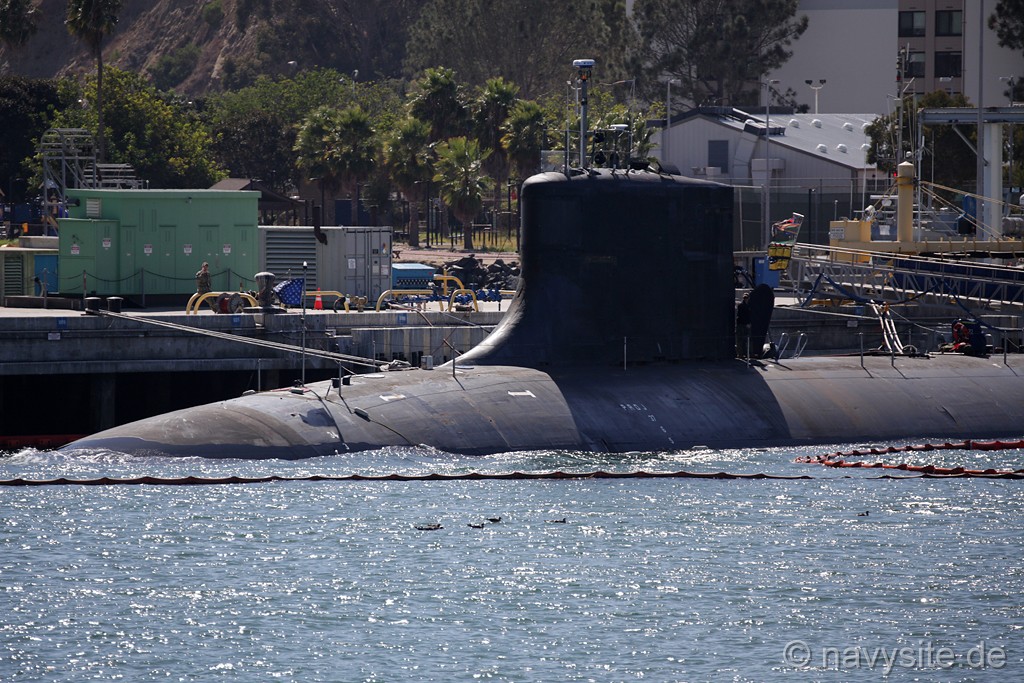
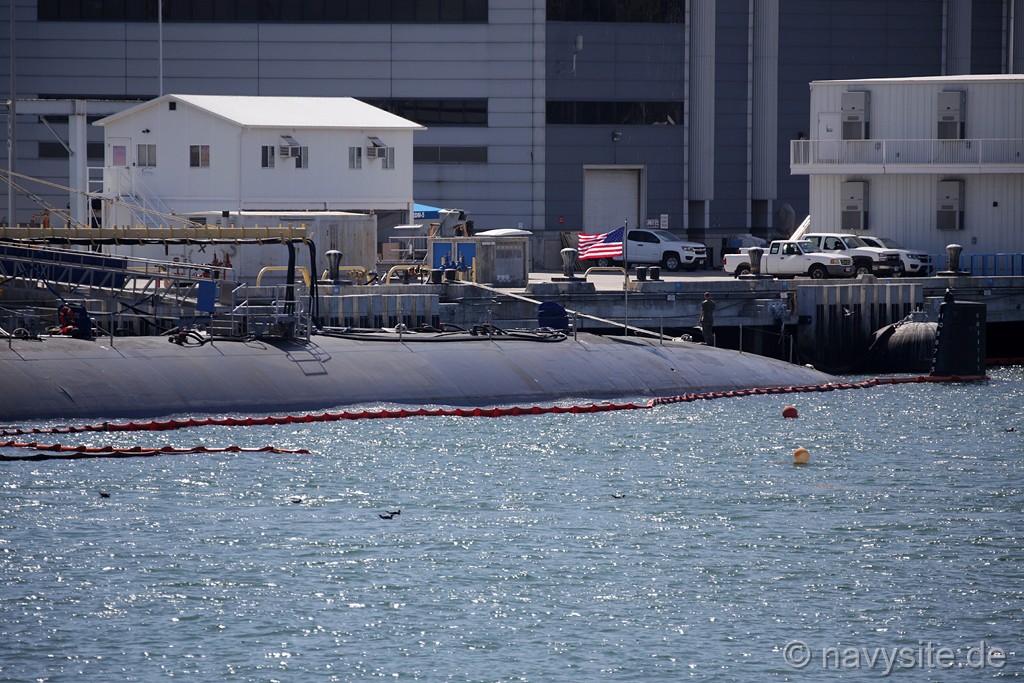
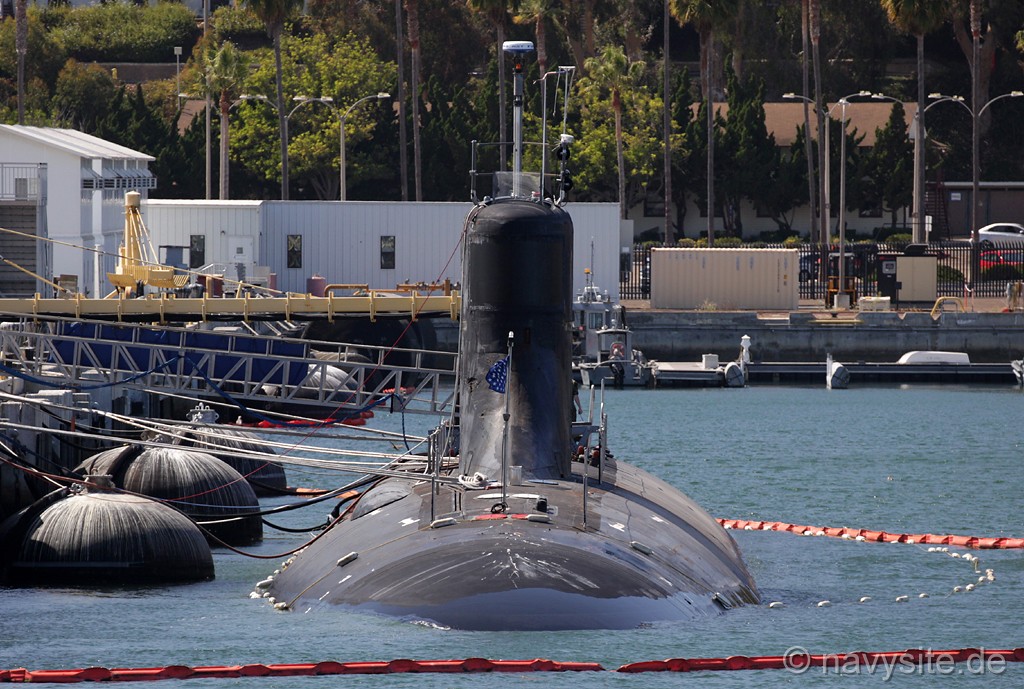
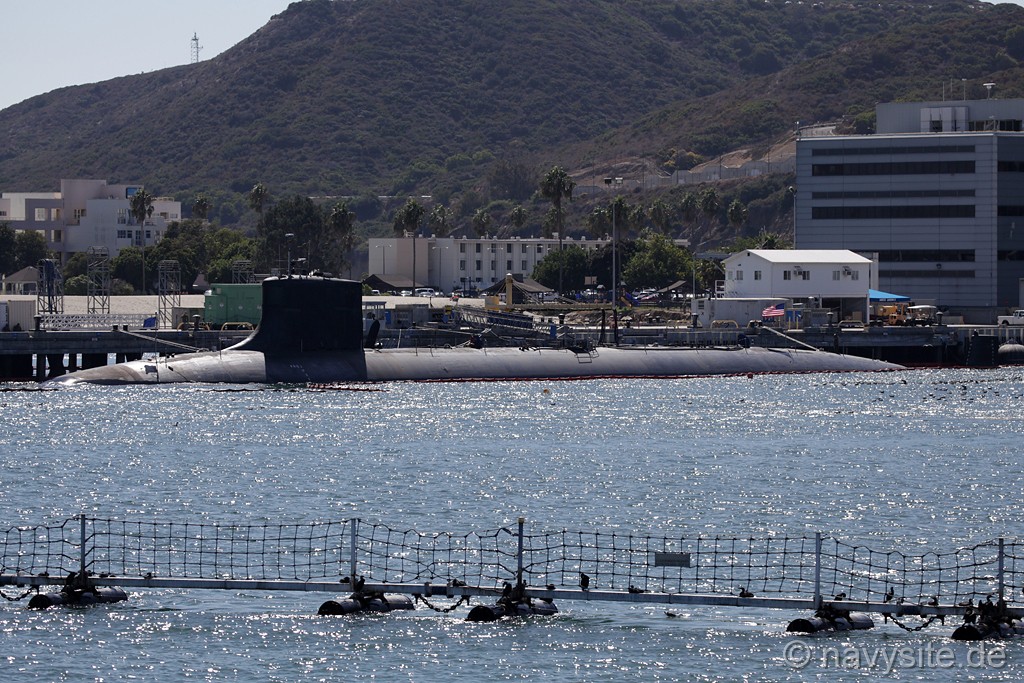
The photos below were taken by Michael Jenning and show the CONNECTICUT at Submarine Base Point Loma, Calif., on October 12, 2019. Note the damage on the front of the sail.


Back to topback to top


Back to Submarines list. Back to ships list. Back to selection page. Back to 1st page.