
Search the Site with

|
Search the Site with
|
 General Characteristics Crew List Memorabilia History Image Gallery to end of page
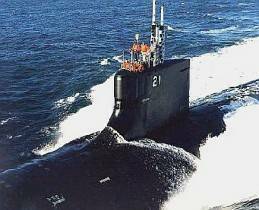 |  | 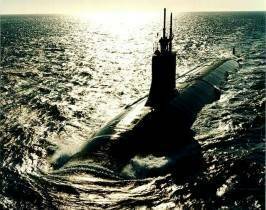 |
USS SEAWOLF is the first boat in a revolutionary new class of fast attack submarines and the fourth ship in the Navy named after the solitary fish with strong, prominent teeth and projecting tusks which give it a savage look.
| General Characteristics: | Awarded: January 9, 1989 |
| Launched and Christened: June 24, 1995 | |
| Commissioned: July 19, 1997 | |
| Builder: General Dynamics Electric Boat Division, Groton, Conn. | |
| Propulsion system: one nuclear reactor | |
| Propellers: one | |
| Length: 353 feet (107.6 meters) | |
| Beam: 40 feet (12.2 meters) | |
| Draft: 35 feet (10.67 meters) | |
| Displacement: Surfaced: approx. 7,460 tons Submerged: approx. 9,137 tons | |
| Speed: Surfaced: approx. 20 knots Submerged: approx. 35 knots | |
| Armament: | |
| Homeport: Bangor, Wash. | |
| Crew: 12 Officers, 121 Enlisted |
 back to top go to the end of the pageback to top go to the end of the page
Crew List:
This section contains the names of sailors who served aboard USS SEAWOLF. It is no official listing but contains the names of sailors who submitted their information.
back to top go to the end of the pageback to top go to the end of the page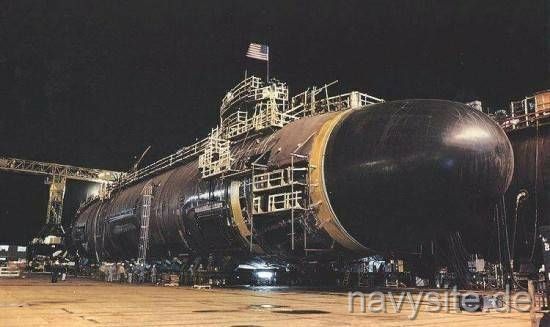 back to top go to the end of the page
 |  |  |
back to top go to the end of the pageUSS SEAWOLF History:
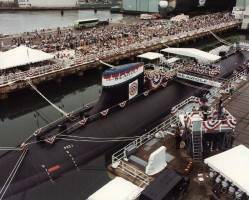
USS SEAWOLF is the lead ship of the SEAWOLF-class fast attack submarines and has spent her entire career operating at the very high end of U.S. undersea capability. Conceived during the final decade of the Cold War as a successor to the LOS ANGELES-class, she was built to be faster, quieter, more heavily armed, and more survivable than any previous American attack submarine. The contract to build SEAWOLF was awarded to General Dynamics Electric Boat in Groton, Connecticut, on January 9, 1989, and her keel was laid there on October 25, 1989. Construction proceeded through the early 1990s, but the program was complicated by the use of new materials and the ambitious acoustic design. SEAWOLF was launched and christened at Electric Boat on June 24, 1995, in a ceremony sponsored by Margaret Dalton, wife of Secretary of the Navy John H. Dalton.
Initial sea trials were delayed by concerns about titanium components in watertight integrity applications and by problems with the fairing of the wide aperture array (WAA) sonar. After those issues were partly resolved, SEAWOLF began her first at-sea trials and completed her initial sea trial on July 5, 1996, returning to Electric Boat after testing that included her first submerged operations, initial acoustic measurements, engineering inspections and crew training in basic ship control.
The ship was delivered to the Navy in mid-1997 and formally commissioned at Groton on July 19, 1997. The roughly seven-year, nine-month span from keel-laying to commissioning was the longest such interval for any U.S. submarine, reflecting both the complexity of the design and the budget turbulence that followed the end of the Cold War.
Following delivery, USS SEAWOLF entered an intensive period of post-construction trials. She conducted a series of acoustic trials, completed with her initial coatings in November 1997, and then continued with post-delivery shakedown operations. In August 1998, she entered a planned fourteen-month post-shakedown availability at Electric Boat in Groton, a yard period that ran into 1999 and was used to correct issues revealed during early trials and to incorporate design fixes into the combat and propulsion systems. As SEAWOLF emerged from this availability, the Navy's test community focused on bringing the AN/BSY-2 combat system and the ship's advanced machinery fully to maturity. Acoustic trials with her anechoic external coating installed were completed in December 1999, followed by hydrodynamic trials in March 2000, Weapons Systems Accuracy Trials that same month, and launcher trials in April 2000. The submarine also underwent dry-docking from August to September 2000 to inspect welds on high-pressure spherical air flasks, critical for the emergency main ballast tank blow system.
Operational evaluation (OPEVAL) for the SEAWOLF-class was organized into phases - cold-water operations, warm-water operations, strike warfare and minefield operations - with USS SEAWOLF and her sister ship USS CONNECTICUT (SSN 22) both participating. These events tested the platforms in the full range of their intended roles, from high-speed, deep-water anti-submarine warfare to strike operations with Tomahawk cruise missiles, though details of the scenarios and locations remain classified.
By 2001, after years of testing, additional modifications, and depot-level repairs, SEAWOLF was finally cleared for her first operational deployment. According to the Navy's own description of "MED 2001", she departed on that deployment in June 2001 with a relatively inexperienced crew - 11 of 14 officers and about 65 percent of enlisted sailors were on their first deployment - heading first into the North Atlantic for independently task-organized operations. There she used her array of sensors and weapons to train in undersea and surface warfare and intelligence collection, in line with the class’s original mission of dominating contested ocean areas. During this initial cruise, SEAWOLF made a port call to Her Majesty's Naval Base Clyde at Faslane, Scotland, where a scheduled maintenance and upkeep period was underway when the terrorist attacks of September 11, 2001 abruptly reshaped U.S. operational priorities. The submarine was ordered to get underway ahead of schedule, departing Faslane and initially heading back toward the U.S. East Coast to rendezvous in mid-Atlantic with the carrier battle group built around USS THEODORE ROOSEVELT (CVN 71). There she gained certification for Tomahawk strike operations, preparing to serve as a land-attack platform as well as an undersea asset.
Soon afterwards, evolving requirements for the emerging war in Afghanistan triggered new orders. Rather than remain tied to the carrier group, USS SEAWOLF was directed to proceed ahead into the Mediterranean Sea to augment the theater's inventory of Tomahawk launch platforms and weapons. During this period the submarine participated in the NATO exercise DESTINED GLORY 2001, a large multinational amphibious and maritime training evolution in which SEAWOLF tested her stealth and tracking abilities against diesel-electric submarines. In one reported scenario she closed to extremely short range against an opposing NATO diesel boat before revealing herself with active sonar to make the most of the training opportunity, demonstrating both quieting and tactical agility.
In the same deployment, SEAWOLF operated near Gibraltar in the narrow and heavily trafficked approaches to the Mediterranean, gaining valuable experience in contact management in dense multi-ship environments while dozens of warships transited the area. Later, she rendezvoused off La Maddalena, Italy, with the submarine tender USS EMORY S. LAND (AS 39), where she exchanged part of her torpedo inventory for additional Tomahawk cruise missiles, took on roughly two months of provisions, and conducted voyage repairs. Thereafter, she remained on call in support of the initial phases of Operation Enduring Freedom. Public sources indicate that much of the specific operational activity during this period remains classified, but the deployment clearly demonstrated SEAWOLF's ability to shift rapidly between independent intelligence-gathering tasks, integration with a carrier strike group, participation in major NATO exercises and readiness for land-attack missions in a single cruise.
After returning from the 2001 Mediterranean deployment, the submarine resumed stateside training and maintenance. On October 30, 2002, she returned to Electric Boat for a three-week repair period - the second time a Navy submarine had docked there under a then-new arrangement in which the Navy leased docking space from the yard while the work itself was managed by the Naval Submarine Support Facility at New London. This short availability was used for voyage repairs and minor upgrades without removing the ship from frontline service for an extended yard period.
In the summer of 2003, SEAWOLF shifted her focus northward, participating in the NATO anti-submarine warfare exercise ODIN-ONE in the North Sea. On August 27, 2003, U.S. Navy photography recorded her at sea in that exercise, which was structured as a high-end wartime ASW scenario in which U.S. active and reserve ASW forces hunted allied and NATO submarines acting as opposing forces. Norwegian participation is documented as including the ULA-class submarine KNM UTSTEIN and surface combatants such as HNOMS NARVIK and HNOMS BERGEN, giving SEAWOLF the opportunity to refine tactics against diesel-electric threats in congested northern waters while allied aircraft and surface ships honed their skills tracking a very quiet nuclear attack submarine.
Through the mid-2000s, SEAWOLF continued a pattern of training out of her then-homeport of Naval Submarine Base New London in Groton and periodic deployments. Award records show that she received the Battle Efficiency "E" in 2001 and again in 2004, reflecting sustained operational readiness and tactical performance, while continuing to operate largely in the classified realm.
In 2006, she shifted focus to the Pacific for a deployment under U.S. Pacific Fleet control. Open sources document the submarine in Apra Harbor, Guam, in October 2006. Local reports at the time highlighted the arrival of the advanced SEAWOLF-class submarine as a notable event for Guam and for U.S. undersea presence in the Western Pacific. The visit to Guam, on approximately October 19, 2006, took place against the backdrop of continued U.S. operations in the Western Pacific and Indian Ocean related to the global war on terrorism and ongoing regional security commitments.
In 2007, the Navy decided to concentrate its three SEAWOLF-class submarines in the Pacific Northwest. As part of that plan, USS SEAWOLF left Groton for the last time on June 15, 2007, photographed as she made her way down the Thames River past the U.S. Coast Guard Academy en route to a new Pacific homeport. On July 22, 2007, she arrived at Naval Base Kitsap's facilities in Bremerton, Washington, where a small ceremony on Delta Pier marked her official homeport change to the Pacific Northwest. Navy reporting at the time emphasized that her arrival expanded the fast-attack submarine presence in the region and added more than two hundred sailors and families to the local community.
For her performance in this period she earned additional recognition, including the Marjorie Sterrett Battleship Fund Award and another Battle "E" in 2007, underlining her standing as one of the most capable and well-run attack submarines in the fleet.
Operating from Bremerton, SEAWOLF settled into a cycle of Pacific deployments and advanced training. In early 2009, she deployed again to the Western Pacific and the U.S. 7th Fleet area of operations. In February 2009, she is documented participating in an intensive undersea warfare exercise with the carrier USS JOHN C. STENNIS (CVN 74), the Japan Maritime Self-Defense Force, and U.S. maritime patrol aircraft. Navy imagery from this period shows SEAWOLF operating alongside STENNIS and the JMSDF destroyer JS OONAMI while a U.S. P-3C ORION from Patrol Squadron 5 provided airborne anti-submarine support - an example of combined U.S.-Japanese training to counter advanced submarine threats.
Later that spring, SEAWOLF made a port visit to Fleet Activities Yokosuka, Japan, where Seventh Fleet and Submarine Group leadership visited the boat, and the crew demonstrated systems such as a low-pressure ballast tank blow for visitors on the pier. Stars and Stripes reporting during this deployment portrayed a demanding operational tempo and a long separation from home for the crew. The deployment as a whole, which remained largely unpublicized in operational detail, concluded later in 2009 and would be SEAWOLF's last deployment before a major modernization period.
Following her return, SEAWOLF entered a lengthy depot-level modernization and overhaul that kept her in a shipyard environment for about 30 months. Navy accounts describe this as a comprehensive depot modernization period in which the submarine was overhauled and upgraded after more than a decade of hard use. The work included extensive maintenance on propulsion and ship's systems, modernization of combat and navigation systems, and the incorporation of lessons learned from earlier operations and from the introduction of the VIRGINIA-class. Because of the scope and duration of this yard period, there was substantial crew turnover, and by the time the ship returned to full operational status she effectively combined a refreshed material condition with a largely renewed crew.
SEAWOLF returned to frontline operations with a six-month deployment that ended on January 21, 2014, when she arrived back at Naval Base Kitsap-Bremerton. This was her first deployment since 2009, and the first major test of the boat and crew after the long yard period. Navy reporting stresses that during this cruise the crew maintained about a 90 percent operational tempo and met all assigned tasking from the theater commander. The commanding officer at the time characterized the deployment as both challenging and successful, and senior submarine leaders highlighted it as evidence that SEAWOLF had re-emerged from modernization as a highly capable multi-mission platform. While specific operating areas and port visits were not publicly detailed, the deployment fit within the broader pattern of U.S. attack submarines providing forward presence, surveillance and warfighting capability in both the Pacific and, when required, other theaters.
In January 2015, SEAWOLF again departed Bremerton for an extended deployment. Photographic and open-source tracking place her at sea in the North Atlantic and Norwegian Sea in mid-2015 and operating in the Arctic Ocean by July 2015, as part of a six-month Arctic deployment conducted under the auspices of U.S. 6th Fleet and Arctic exercise frameworks. During this cruise, she demonstrated sustained under-ice and high-latitude capability, operating in the Norwegian Sea and further north before returning to Naval Base Kitsap in August 2015. Navy accounts indicate that this 2015 deployment lasted about six months and was specifically characterized as an Arctic deployment, underscoring the SEAWOLF class's design emphasis on deep, cold-water operations in challenging environments.
In the years that followed, SEAWOLF continued to alternate between maintenance, training, and forward deployments from the Pacific Northwest. Publicly available timelines compiled from Navy photography and independent tracking sites indicate that she completed at least one additional six-month deployment before the end of the 2010s, returning to Bremerton after extended operations but with the details of routes, operating areas and missions largely withheld as a matter of policy. Throughout this period she accumulated further awards, including additional Battle Efficiency "E" ribbons and departmental awards in 2014 and 2015, reflecting continued high performance in inspections, engineering readiness, weapons proficiency, navigation and supply management.
In 2020, SEAWOLF undertook one of her most visible modern deployments. In July 2020, she deployed from the Pacific into the Arctic area of responsibility and then into the U.S. 6th Fleet theater, during a period when the COVID-19 pandemic had sharply constrained global movements and port visits. According to U.S. Navy and later summarized sources, this deployment included special operations and a series of port calls in Europe: HMNB Clyde at Faslane in Scotland, the Norwegian port of Tromsø for a brief stop, and Gibraltar near the entrance to the Mediterranean. Navy imagery shows SEAWOLF operating in the Norwegian Sea in August 2020 and later at Gibraltar in December 2020, underscoring the breadth of the cruise. U.S. 6th Fleet characterized the deployment as the first U.S. Navy deployment to their area during the coronavirus pandemic, highlighting both the ship's endurance and the Navy's determination to maintain undersea presence even under restrictive public-health conditions.
After returning from that North Atlantic and European deployment, SEAWOLF resumed operations from Naval Base Kitsap. On June 9, 2021, she was photographed departing Naval Base Kitsap–Bremerton for another period of underway operations in the Pacific. Subsequent imagery depicted her in the Pacific Ocean during June 2021, but specific tasking and destinations were not publicly disclosed. During this timeframe leadership continuity was maintained through formal reliefs. On May 4, 2021, a change-of-command ceremony at the U.S. Naval Undersea Museum in Keyport, Washington, saw Commander Jeffrey Fassbender relieve Commander Jeremy Johnston as commanding officer.
The next major milestone in the ship's life came with a long deployment in 2022 that also entailed a change of homeport within the Pacific Northwest. In early 2022, SEAWOLF conducted ammunition loading at Naval Magazine Indian Island, Washington, and moored at Naval Base Kitsap-Bremerton during pre-deployment preparations. She departed her then-homeport of Bremerton on May 12, 2022, beginning a regularly scheduled deployment that would last more than seven months and cover over 55,000 nautical miles. During this cruise she operated in the U.S. 7th Fleet area of responsibility and conducted what Navy accounts describe as a "full spectrum of complex operations", including anti-submarine and anti-surface warfare tasks. Port calls on this 2022 deployment included multiple visits to Guam and at least one to Yokosuka, Japan. Photographic evidence shows SEAWOLF arriving at Naval Base Guam, Apra Harbor, in January 2022 and again sailing into Apra Harbor on August 25, 2022, described in maritime reporting as part of Guam's growing role as a forward logistics and operational hub for U.S. undersea forces. She also paid a visit to Fleet Activities Yokosuka, reinforcing ties with Japanese naval forces and underscoring the SEAWOLF-class presence in the Western Pacific. At the end of this deployment the submarine's administrative home shifted from Bremerton to the Bangor side of Naval Base Kitsap. On December 14, 2022, USS SEAWOLF arrived at her new homeport at Naval Base Kitsap-Bangor, mooring at the newly constructed Olympic Pier after more than seven months deployed. Navy and regional reports note that she was the first ship to use the pier, which had been built and extended specifically to accommodate the SEAWOLF-class submarines at Bangor.
This move aligned all three SEAWOLF-class submarines - SEAWOLF, CONNECTICUT and JIMMY CARTER (SSN 23) - in the same general area, simplifying maintenance and support arrangements for the small, unique class.
In the years immediately following, SEAWOLF continued in active service from Bangor. She returned from the 2022 deployment with a strong record of high operational tempo and complex mission accomplishment, as reflected not only in the official narrative of the deployment but also in her award record, which includes multiple unit-level commendations, expeditionary medals and an Arctic Service Ribbon associated with recent operations. On May 16, 2023, a change-of-command ceremony held at Naval Base Kitsap-Bangor saw Commander Douglas Hagenbuch relieve Commander Jeffrey Fassbender as commanding officer of USS SEAWOLF, marking another leadership transition as the boat continued operations from her new pier.
back to top go to the end of the pageUSS SEAWOLF Image Gallery:
 |  |  |  |  |
 |  |
back to top Back to Submarines list. Back to ships list. Back to selection page. Back to 1st page.