![]() |
Search the Site with
|
![]() | ![]() |
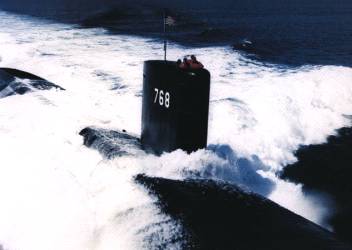
USS HARTFORD is the 57th submarine in the LOS ANGELES - class of fast attack submarines.
| General Characteristics: | Awarded: June 30, 1988 |
| Keel laid: February 22, 1992 | |
| Launched: December 4, 1993 | |
| Commissioned: December 10, 1994 | |
| Builder: Electric Boat Division of General Dynamics Corporation, Groton, Conn. | |
| Propulsion system: one nuclear reactor | |
| Propellers: one | |
| Length: 360 feet (109.73 meters) | |
| Beam: 33 feet (10 meters) | |
| Draft: 32,15 feet (9.8 meters) | |
| Displacement: Surfaced: approx. 6,000 tons Submerged: approx. 6,900 tons | |
| Speed: Surfaced: approx. 15 knots Submerged: approx. 32 knots | |
| Armament: | |
| Cost: approx. $900 million | |
| Homeport: Groton, CT | |
| Crew: 13 Officers, 116 Enlisted |
Crew List:
This section contains the names of sailors who served aboard USS HARTFORD. It is no official listing but contains the names of sailors who submitted their information.
Accidents aboard USS HARTFORD:
| Date | Where | Events |
|---|---|---|
| October 25, 2003 | off La Maddalena, Italy | USS HARTFORD runs aground causing limited damage to its rudders and scraping its bottom. No injuries or environmental damage are reported. After temporary repairs, the HARTFORD returned to the Norfolk Naval Shipyard for additional repairs. USS HARTFORD had just began a 6-month deployment one month before the grounding. Following an investigation of the grounding, HARTFORD's Commanding Officer, Cmdr. Christopher R. Van Metre, as well as one other officer and one enlisted crew member were relieved of their duties. Also relieved was the Commander of Submarine Squadron 22, Capt. Greg Parker. |
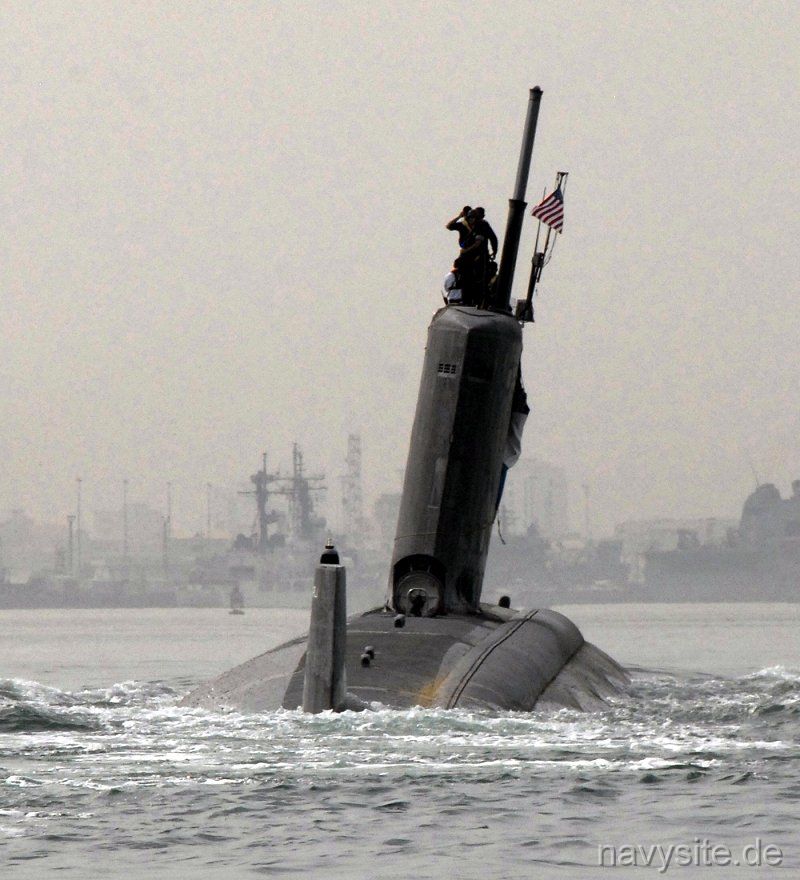
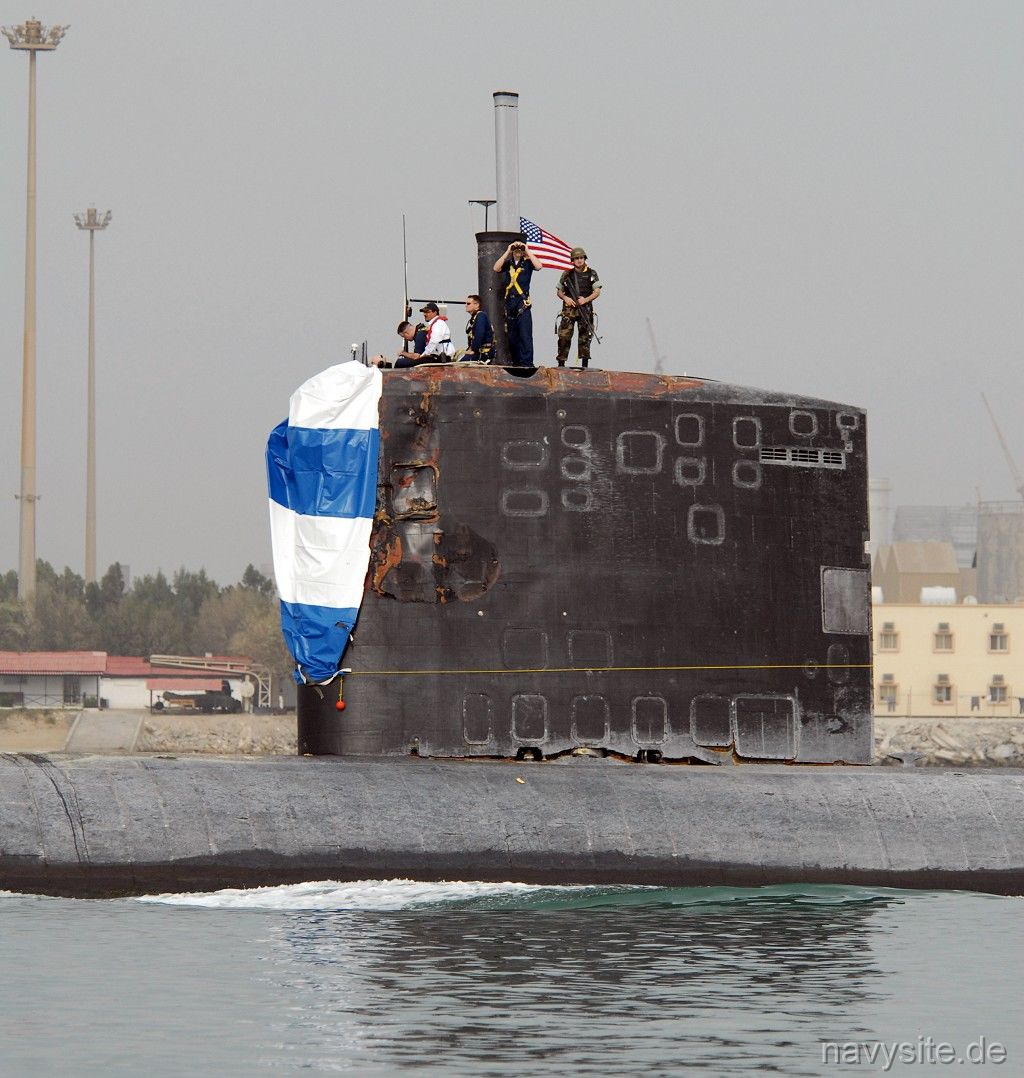
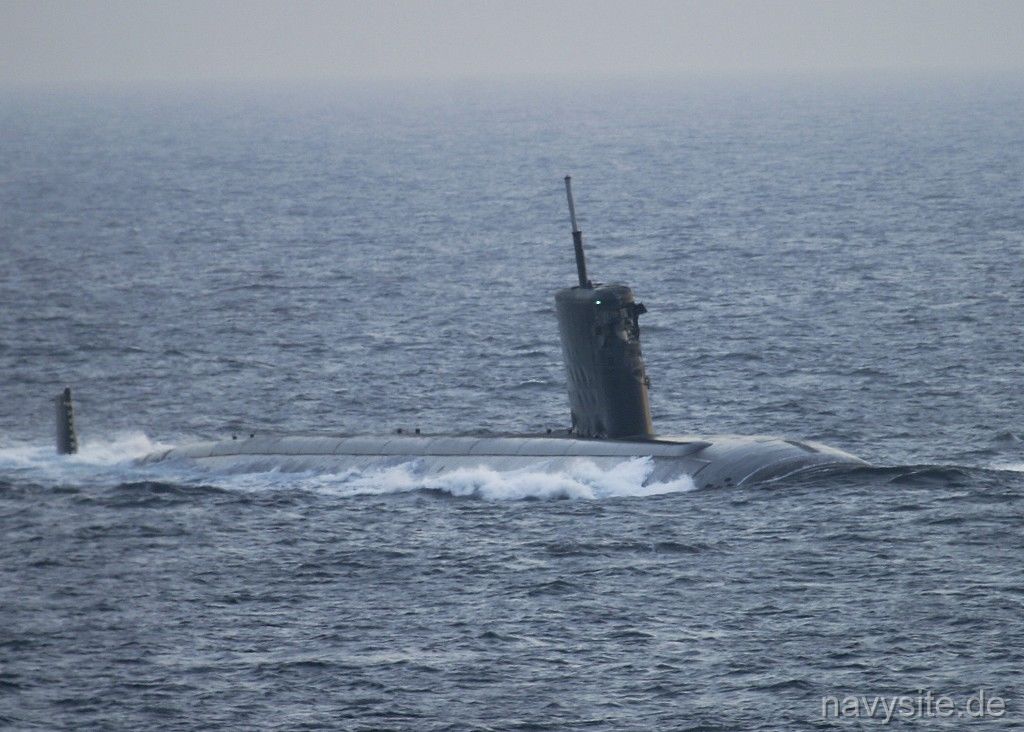
| March 20, 2009 | Strait of Hormuz | USS HARTFORD and the USS NEW ORLEANS (LPD 18) collide at approx. 1 a.m. local time. 15 HARTFORD sailors are slightly injured while no injuries are reported aboard the NEW ORLEANS. The submarine suffers damage to its sail but the propulsion plant was unaffected by the collision. NEW ORLEANS suffers a ruptured fuel tank, which resulted in an oil spill of approximately 25,000 gallons of diesel fuel marine. Both ships were able to continue operating under their own power. The photos below show the HARTFORD with her damaged sail underway in the Persian Gulf after the collision and arriving at Bahrain for damage assessment. ![]() |
USS HARTFORD History:
USS HARTFORD began her existence as part of the late-Cold War expansion of the U.S. attack-submarine force. The contract to build the boat was awarded to General Dynamics' Electric Boat Division at Groton, Connecticut, on June 30, 1988, at a time when the LOS ANGELES-class was being refined into its later "improved" flights with under-ice capability and vertical launch systems for TOMAHAWK cruise missiles. Her keel was laid at Groton on February 22, 1992, and the hull took shape as one of the later, under-ice-capable units, with retractable bow planes set on the hull rather than on the sail to facilitate surfacing through polar sea ice. The submarine was launched on December 4, 1993, sponsored by Laura O'Keefe, wife of then-future Secretary of the Navy Sean O'Keefe.
Following fitting-out and dockside tests, the Navy placed USS HARTFORD in commission on December 10, 1994, at Groton, Connecticut. Commander George Kasten took command as the first commanding officer, and the boat was assigned to the Atlantic Fleet with Naval Submarine Base New London - Groton, Connecticut - as her homeport, a relationship that has remained constant throughout her career.
In the first years after commissioning, from late 1994 through 1995, HARTFORD followed the typical pattern for a new submarine: post-delivery workups, tactical training, and certification of combat systems. She completed a post-shakedown availability (PSA) to correct construction-period issues and incorporate early improvements, then returned to sea for the full spectrum of trials and inspections that brought her up to the standard expected of an operational fast-attack submarine. While detailed day-by-day information remains in internal Navy records, open sources indicate that she conducted local and regional operations in the western Atlantic, building crew proficiency in anti-submarine warfare, strike warfare using TOMAHAWK missiles, and covert intelligence and surveillance tasking in support of the last years of the post-Cold-War "peace dividend" era.
By 1996, HARTFORD was settled into regular fleet routines. The command-history summary for that year notes local operations with the Canadian submarine HMCS OKANAGAN, reflecting the long-standing U.S.-Canadian cooperation in undersea warfare in the North Atlantic approaches. It also records "post-PSA Fire Control System Certification" and further operations, indicating that the boat completed formal certification of her fire-control system - vital for torpedo and missile employment - and then continued at-sea workups. In the wider strategic setting, the U.S. Navy was shifting from open-ocean Cold War patrols to power-projection and crisis-response missions, and HARTFORD's training at this stage was oriented toward supporting regional contingencies rather than tracking Soviet ballistic-missile submarines.
During the later 1990s, HARTFORD's pattern broadened beyond local waters. Command-history entries show periods of upkeep and combat-systems readiness reviews interspersed with sea time. For 1998, the formal chronology begins with an upkeep and Combat Systems Readiness Review from January 16 to March 9, followed by further preparations for deployment. In February 1999, after a four-week Fleet Maintenance Availability, HARTFORD left Groton on February 24 for sea trials in the Narragansett Bay operating area, a typical final check of systems and crew before more demanding operations.
As the new century opened, the submarine's operational profile reflected the pattern of U.S. maritime strategy after the 1991 Gulf War and the 1999 Kosovo campaign. According to open-source summaries based on Navy documents, HARTFORD deployed across the Atlantic in 2000, operating first in the broader Atlantic and then in the Mediterranean Sea under U.S. Sixth Fleet, where U.S. submarines supported surveillance and strike options in a region still shaped by Balkan instability and post-Kosovo peace enforcement. In 2001, she again crossed the Atlantic but this time continued onward into the Persian Gulf, operating in the U.S. Fifth Fleet area at a time when the United States enforced sanctions and no-fly/no-sail regimes against Iraq and maintained a strong naval presence in the Gulf. Command-history snippets for 2000 and 2001 show routine stand-downs, a Weapon System Readiness Review, and weapons-testing periods at the Atlantic Undersea Test and Evaluation Center (AUTEC) range in the Bahamas, where the boat fired exercise torpedoes and validated her fire-control solutions under controlled conditions before and between deployments.
After the September 11, 2001 attacks, the geopolitical environment for HARTFORD's deployments shifted sharply. Operations in the Persian Gulf now fell under the broader umbrella of the U.S. "Global War on Terror", and attack submarines such as HARTFORD provided covert surveillance, collection and, if required, strike capabilities against potential targets ashore, while also tracking surface and sub-surface traffic in the constrained waters around the Arabian Peninsula. Although the details of specific patrols remain classified, her presence in the region in the early 2000s placed the boat directly in this evolving strategic context.
In October 2003, HARTFORD began what was intended to be another six-month Mediterranean deployment. Navy historical summaries note that she left New London roughly a month before the accident that would abruptly reshape that cruise. On October 20, 2003, the submarine arrived at the U.S./NATO support facility at La Maddalena, Sardinia, mooring alongside the submarine tender USS EMORY S. LAND (AS 39), outboard of fellow LOS ANGELES-class submarine USS SPRINGFIELD (SSN 761), in the small harbor off the island of Santo Stefano.
HARTFORD was initially scheduled to leave on October 24, but problems with her sonar system delayed departure, and she remained in port while replacement parts were arranged. On October 25, 2003, shortly after noon, the boat finally got underway to clear the harbor and free the berth for another submarine. As she transited the narrow, rocky channel, the navigation team became overloaded; equipment issues and procedural errors allowed the submarine to stray out of the deep-water track. At about 12:40 p.m., HARTFORD struck the seabed at speed, suffering multiple groundings that damaged both rudders, the sonar dome, and external hull plating. No one was injured, and the hull's watertight integrity and nuclear propulsion plant remained uncompromised, but the damage was serious. Divers from EMORY S. LAND documented the state of the rudders and hull, and the incident, initially undisclosed, later drew criticism in Italy once it became public. Subsequent environmental sampling in nearby Corsica and Sardinia found no radioactive contamination, confirming that the reactor plant had not been breached.
After temporary repairs alongside EMORY S. LAND, HARTFORD departed La Maddalena on November 18 and headed back across the Atlantic. The U.S. Sixth Fleet reported that she sailed under her own power, with a damaged but functional rudder arrangement. Once back in U.S. waters, the submarine went to Norfolk Naval Shipyard for an extended repair period. The Navy relieved the commanding officer, Commander Christopher Van Metre, and the commodore of Submarine Squadron 22, Captain Greg Parker, along with other officers and sailors, following an investigation that highlighted navigational complacency and inadequate bridge-team coordination.
After several months in drydock and alongside for structural and systems repairs, HARTFORD returned to service, resuming Atlantic operations in the mid-2000s. During these years, LOS ANGELES-class boats remained the backbone of U.S. fast-attack forces, even as the newer VIRGINIA-class began to enter service. HARTFORD's workups during this period prepared her for both conventional deployments and participation in experimentation with new undersea technologies.
In October 2007, the submarine played a pioneering role in unmanned undersea systems. That month, she became the first submarine to successfully launch and recover an AN/BLQ-11 unmanned underwater vehicle (UUV) from one of her torpedo tubes. The recovery used a 60-foot robotic arm to re-capture the vehicle and bring it back aboard, demonstrating the feasibility of integrating tethered UUVs with attack-submarine operations. This work fit into a broader Navy effort to expand the use of unmanned systems for mine countermeasures, intelligence collection, and environmental sensing in contested waters.
Just over a year later, HARTFORD again entered the headlines. On March 20, 2009, while transiting the Strait of Hormuz at night at periscope depth, she collided with the amphibious transport dock USS NEW ORLEANS (LPD 18). The impact, at approximately 1 a.m. local time, rolled the submarine sharply and crumpled the upper part of her sail, injuring 15 sailors aboard HARTFORD with minor injuries. NEW ORLEANS suffered a large gash in a fuel tank, spilling an estimated 25,000 gallons of marine diesel into the strait. Despite the damage, both ships remained afloat and under their own power. HARTFORD proceeded on the surface through the Gulf with her sail visibly bent, eventually entering port in Bahrain for initial inspection and temporary repairs, as documented in Navy photographs.
The 2009 collision occurred against the background of heightened U.S.-Iran tensions, when the Strait of Hormuz was a focus of global concern over freedom of navigation and energy security. A Navy investigation again highlighted human-factors issues and watchstanding practices. After the initial assessment in Bahrain, the submarine returned to the United States and entered an extended repair and modernization period. In July 2009, the Navy awarded General Dynamics Electric Boat a contract to repair HARTFORD, bringing the boat to the Groton shipyard for major structural and systems work on her damaged sail and other affected components. Repairs and associated modernization took roughly two years. By mid-2011, local reporting from southeastern Connecticut described the boat as returning to sea trials and rejoining the operational fleet.
Once back in service, HARTFORD resumed regular deployments with the Atlantic submarine force. On May 15, 2012, she departed Groton for a deployment to the U.S. European Command (EUCOM) area of responsibility. Over the following months she operated primarily under U.S. Sixth Fleet in the North Atlantic and European waters, steaming more than 28,000 nautical miles. During this cruise she called at Haakonsvern, Norway; Faslane, Scotland; Lisbon, Portugal; and Portsmouth, England, reflecting a focus on NATO cooperation and North Atlantic and European maritime security. She returned to Naval Submarine Base New London on November 17, 2012. At that point, the strategic context revolved around reassuring European allies, monitoring Russian naval activity, and sustaining U.S. presence across the North Atlantic sea lines of communication.
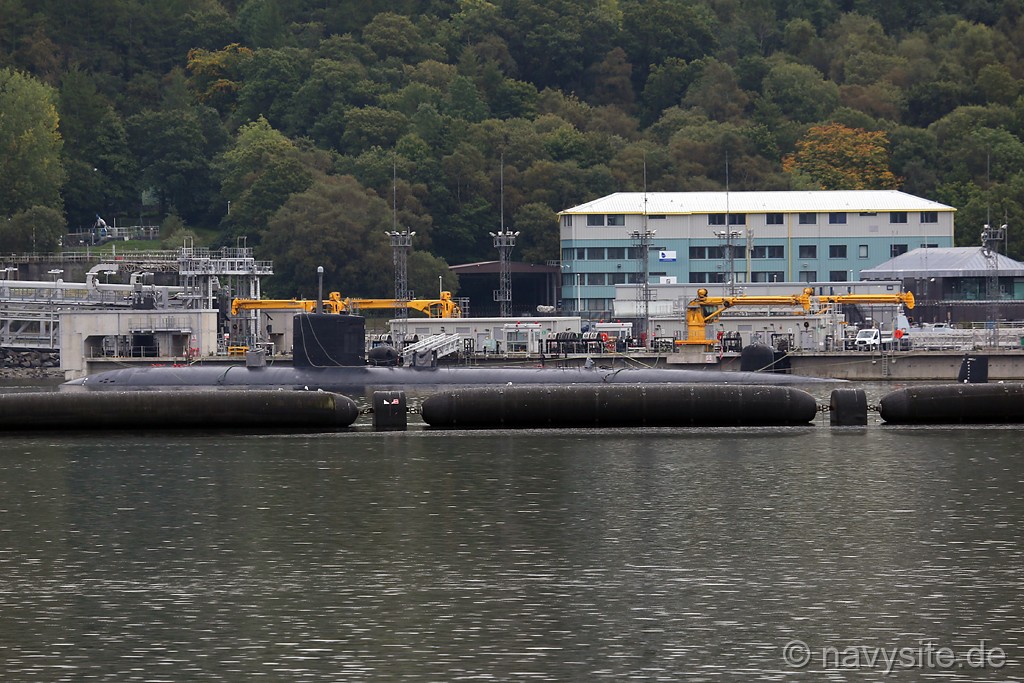
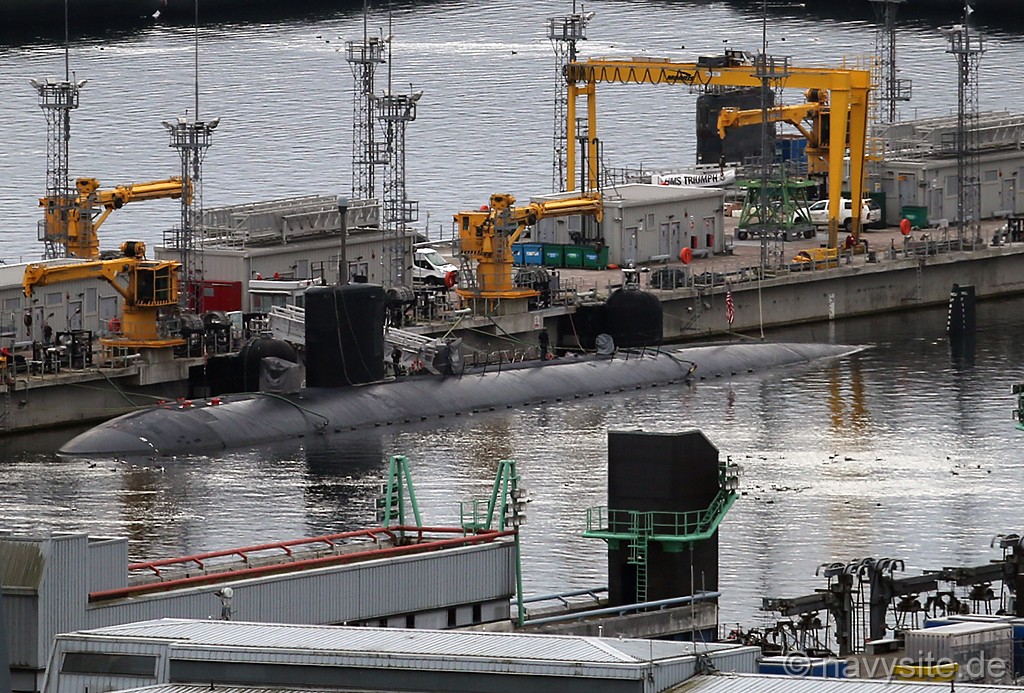
HARTFORD conducted another extended European deployment in 2015. During that year, she again deployed from Groton for roughly six months, once more operating under EUCOM and Sixth Fleet in the North Atlantic and adjacent seas. When she returned to submarine base New London on December 18, 2015, Navy and local media noted that she had made port calls in Faslane, Scotland, and Rota, Spain, among other stops, while conducting "security operations in the European Command area of responsibility". Photographs confirm HARTFORD moored at the Royal Navy base at Faslane on October 3, 2015, during that deployment. This cruise took place against the backdrop of renewed NATO attention to Russian submarine activity in the North Atlantic and High North after the 2014 annexation of Crimea.
In early 2016, HARTFORD shifted from temperate seas to the Arctic. As one of two submarines selected for Ice Exercise (ICEX) 2016, she deployed to the Arctic Ocean along with USS HAMPTON (SSN 767). Operating from a logistics hub at Prudhoe Bay, Alaska, and a temporary ice camp designated Camp Sargo, the submarines spent five weeks under the polar ice, practicing under-ice navigation, surfacing through ice, and conducting scientific data collection. On March 15, 2016, HARTFORD dramatically surfaced near Ice Camp Sargo, breaking through the ice sheet in a maneuver captured in widely published photographs and video. After the ice camp was closed and its personnel flown out at the end of March, HARTFORD and HAMPTON remained in the Arctic through early April to continue under-ice operations, reflecting the Navy's renewed emphasis on Arctic readiness amid climate-driven changes and increased Russian activity in the region.
The boat returned to Atlantic deployments soon afterward. In 2017, HARTFORD completed another major deployment to the EUCOM area. When she returned to Groton in August 2017, the Navy reported that she had steamed approximately 35,800 nautical miles - equivalent to roughly one and two-thirds circumnavigations of the globe - and made port visits to Haakonsvern, Norway; Faslane, Scotland; and Brest, France. This deployment, like those of 2012 and 2015, underscored the submarine's role in sustaining undersea presence in the increasingly contested North Atlantic and Norwegian Sea approaches, where NATO navies were once again tracking higher levels of Russian submarine activity.
In early 2018, HARTFORD again headed north, this time for ICEX 2018. The exercise brought together the LOS ANGELES-class USS HARTFORD from Groton, the SEAWOLF-class USS CONNECTICUT (SSN 22) from Bangor, Washington, and the Royal Navy's HMS TRENCHANT, a TRAFALGAR-class submarine, for several weeks of operations in the Arctic Ocean north of Alaska. The submarines conducted multiple under-ice transits, surfaced through the ice - including a joint surfacing of HARTFORD and CONNECTICUT in the Beaufort Sea on March 10 - and took part in scientific and tactical events from a temporary ice camp (Ice Camp Skate). Open-source deployment logs indicate that HARTFORD departed Groton on February 20, 2018, to participate in the exercise, arriving at Ice Camp Skate some 150 nautical miles north of Prudhoe Bay before conducting further Arctic operations, including a surfacing through the ice on March 21.
The submarine's sustained performance in demanding Arctic and Atlantic operations led to notable recognition. In October 2018, during a ceremony at Naval Submarine Base New London, USS HARTFORD and her crew were awarded the Battenberg Cup as the best ship in the Atlantic Fleet for performance in 2017. The award traditionally recognizes a surface combatant or aircraft carrier, and its presentation to a submarine highlighted the prominence of HARTFORD's operational record among Atlantic Fleet units.
HARTFORD completed yet another deployment to European waters in 2019. When she returned to Groton on July 24, 2019, after an extended cruise, Navy reports noted that she had executed the Chief of Naval Operations' maritime strategy by supporting national security interests and maritime security operations, steaming more than 30,000 nautical miles and making port visits in Europe, including stops at Faslane, Scotland, and Rota, Spain. The deployment fit into the broader NATO focus on undersea deterrence and interoperability across the North Atlantic and Norwegian Sea.
As the submarine aged into her third decade of service, the Navy moved to extend her life through a major Engineered Overhaul (EOH). In August 2020, Electric Boat in Groton received a $125.8-million cost-plus-fixed-fee contract for labor and material required to plan HARTFORD's EOH, covering advance planning, engineering, design, prefabrication, and yard-execution preparation. A 2019 strategic-planning document from Connecticut's Office of Military Affairs had already noted that the planned overhaul, set to begin around 2021, would help bridge a dip in workload at the Groton yard ahead of the surge in COLUMBIA-class ballistic-missile submarine construction.
According to subsequent industry reporting, USS HARTFORD entered the Groton shipyard in 2021 to begin the engineered overhaul, which combined reactor-plant refueling-related work (as appropriate to her class), structural refurbishment, and modernization of combat systems and shipboard equipment. On July 29, 2022, the Navy awarded General Dynamics Electric Boat a cost-plus-incentive-fee modification worth approximately $698 million to execute the maintenance, repair, and modernization associated with the overhaul. Work, to be performed in Groton, was scheduled to run through roughly October 2026. Electric Boat's own strategic plan for 2023-2027 lists the completion of HARTFORD's EOH and her return to the operational fleet as a key objective, illustrating the importance attached to keeping selected LOS ANGELES-class submarines in service well into the 2030s.
By 2024, further contract modifications had added funding to complete the overhaul, and open-source fleet-status lists described USS HARTFORD as undergoing a complete overhaul at Groton, with an expected return to operational status around the middle of the decade. This extended modernization reflects the Navy's need to sustain its attack-submarine numbers during a period of high demand and relatively slow new-construction throughput, especially as strategic competition with Russia and China drives requirements for undersea presence in the North Atlantic, Arctic, and Indo-Pacific.
USS HARTFORD Image Gallery:
![]() | ![]() |
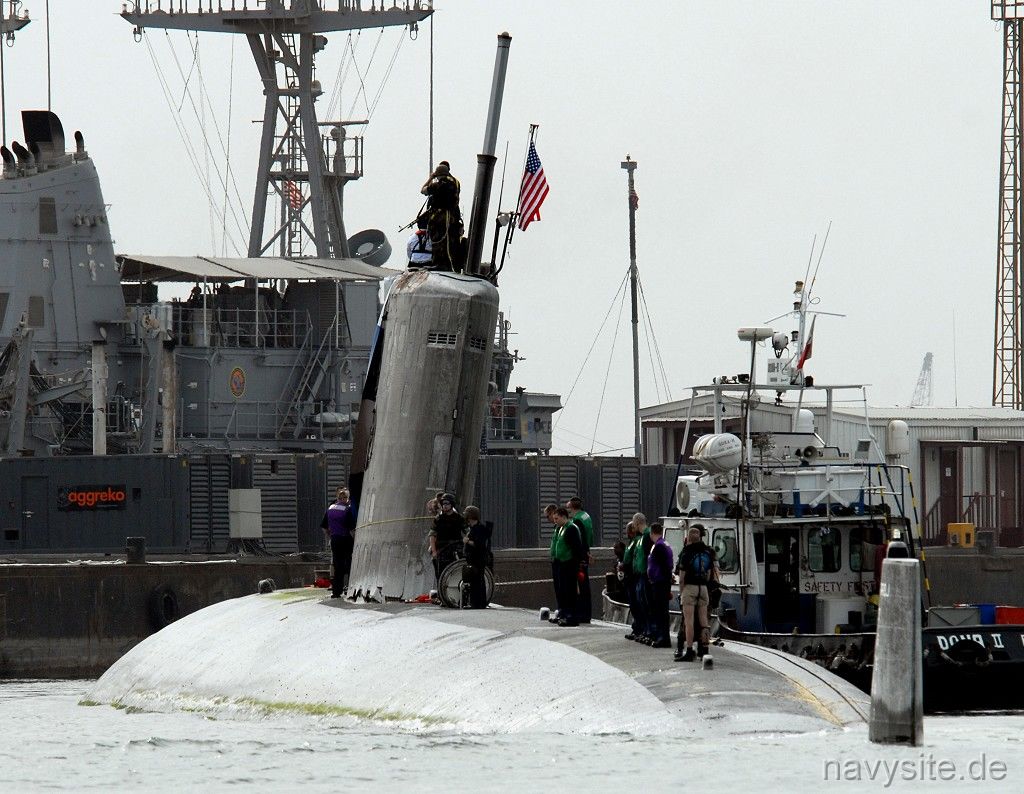
The photos below were taken by me and show the USS HARTFORD at Royal Navy Base Faslane in Scotland on October 3, 2015.
![]() | ![]() |
Back to Submarines list.
Back to ships list.
Back to selection page.
Back to 1st page.