Search the Site with 
General Characteristics Crew List Memorabilia History Image Gallery to end of page

USS Orion (AS 18)

- decommissioned -

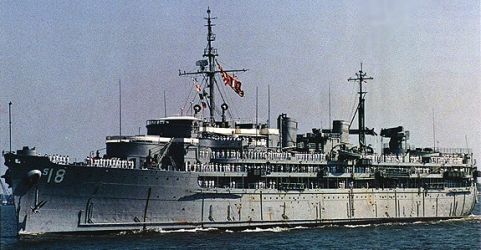
USS ORION was the sixth FULTON - class submarine tender and the second ship in the Navy to bear the name. After almost exactly 50 years of service, the ORION was both decommissioned and stricken from the Navy list on September 3, 1993. She spent the following years laid up in the National Defense Reserve Fleet, James River, Fort Eustis, Va., awaiting final disposal. She was sold for dismantling on July 27, 2006, to North American Ship Recycling at Baltimore, Maryland, under a contract that called for her to be towed to the company's yard and scrapped.

General Characteristics:Awarded: December 30, 1940
Keel laid: July 31, 1941
Launched: June 24, 1942
Commissioned: September 30, 1943
Decommissioned: September 3, 1993
Builder: Moore Dry Dock Co., Oakland, Calif.
Propulsion System: Diesel electric
Propellers: two
Length: 529.5 feet (161.4 meters)
Beam: 73 feet (22.3 meters)
Draft: 25.6 feet (7.8 meters)
Displacement: approx. 18,000 tons full load
Speed: 15 knots
Armament: four 20mm guns
Crew: approx. 1200


Back to topback to top  go to endgo to the end of the page


Back to topback to top  go to endgo to the end of the page

Crew List:

This section contains the names of sailors who served aboard USS ORION. It is no official listing but contains the names of sailors who submitted their information.


back to top  go to the end of the page



Back to topback to top  go to endgo to the end of the page

USS ORION History:

USS ORION was laid down 31 July 1941 at the Moore Dry Dock Co., Oakland, Calif.; launched 24 June 1942; sponsored by Mrs. Robert A. White; and commissioned 30 September 1943, Capt. C. S. Isgrig in command.

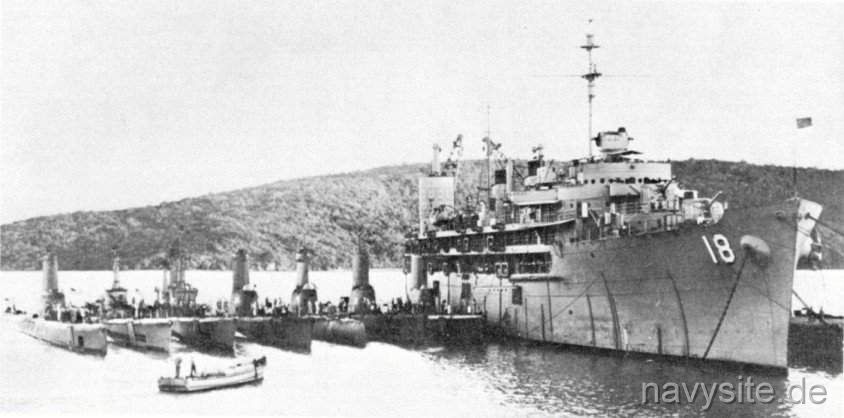
Following shakedown off southern California, ORION got underway for Pearl Harbor 23 November 1943. Arriving there on the 28th, she received her first submarine, GAR (SS 206) alongside for repairs two days later. On 10 December she steamed for Australia, arriving at Fremantle 5 January 1944 to begin her mission of maintaining the material readiness of, and an adequate stock of supplies for, submarines operating in the southwest Pacific. She remained in Western Australia until 6 August when she proceeded to Mios Woendi to establish Advanced Submarine Base Able. Arriving 26 August, she serviced 24 submarines, and 466 surface vessels, before being relieved, 9 December, by GRIFFIN (AS 13).

The next day ORION headed back to Hawaii for overhaul. On 8 April 1945 she sailed west again. At Saipan between 23 April and 1 September, she served as CTG 17.7 and as SOPA (Admin) for Tanapag Harbor in addition to her tender and repair activities which were performed for over 300 ships.

As the formal surrender documents were being signed in Tokyo Bay, ORION was en route to the United States. Assigned to the Atlantic Fleet, she operated off the east coast for four months, then sailed south to Balboa, C.Z. Taking up duties with SubRon 6, 24 January 1946, she remained in the Canal Zone, with one interruption for overhaul, until 11 May 1949. Then, with SubRon 6, she steamed to Norfolk, her new homeport.

After that change of homeport, ORION continued to service SubRon 6 at Norfolk and, during fleet exercises, in the Caribbean. A FRAM II overhaul and conversion to nuclear support, 6 September 1960 - 25 February 1961, was followed by refresher training off Cuba. In June; her first nuclear submarine job came alongside in the form of SHARK (SSN 591). Three years later she added foreign nuclear submarines to her long list of services performed after completing work on HMS DREADNOUGHT. Support of SubRon 6, however, has continued to be ORION’s primary mission. She services the conventional and nuclear powered ships of that squadron from the Destroyer/Submarine Piers at Norfolk into October 1970, when ORION changed homeport to Charleston, SC. This change of homeport also brought along her new assignment to SubRon 4.

Throughout 1971 and the early 1970s, USS ORION remained largely pierside at Charleston, functioning as the afloat maintenance and logistics hub for SUBRON 4. Her routine consisted of repair work in the tender's machine, electrical and weapons shops; hotel services such as power, water and steam; and administrative support for submarines cycling through upkeep after patrols or exercises. Crew recollections and photographic evidence place USS ORION firmly at Charleston during these years, with sailors joining and leaving the ship in 1971-1975 and describing life alongside the piers at the base. Open sources do not preserve detailed day-by-day movement records for these years, but they consistently depict a pattern of ORION serving as an almost permanently moored support platform, with only occasional short sorties for trials or local operations while the focus of her work remained in port.

Life on board during the Charleston years reflected both the steady tempo of Cold War submarine support and occasional high-level attention. A recollection from an officer assigned to SUBRON 4 staff in 1975 describes the squadron headquarters actually being embarked on USS ORION, underlining her role as the squadron's flagship as well as its workshop.

In the mid-1970s, Admiral Hyman G. Rickover, head of the U.S. Navy's nuclear propulsion program, chose to stay overnight in the captain's cabin on USS ORION during an inspection visit to Charleston Naval Shipyard. According to that account, the decks around the squadron spaces were cleared and the tender was kept exceptionally quiet to accommodate the admiral as he used the ship as his temporary quarters before proceeding ashore the next morning to inspect the yard's nuclear capabilities.

Crew anecdotes also recall that in the early 1970s, USS ORION took part in routine refresher training and liberty ports in the Caribbean, including periods at Guantanamo Bay and visits to Jamaica and Fort Lauderdale, consistent with the pattern of Atlantic Fleet tenders supporting submarines during training cycles, even though precise dates for those port calls are not captured in surviving official summaries.

By the late 1970s, USS ORION had already been extensively modernized once with a FRAM II overhaul and conversion to support nuclear submarines in 1960-1961, but after nearly two further decades of work she again required major yard time. From July 1979 through March 1980, the tender underwent an extended overhaul at Charleston Naval Shipyard specifically "in preparation for an overseas change of homeport". During these months, she remained in the yard, where her machinery and workshops were refurbished and her systems readied for continuous operation at a forward base far from major U.S. naval shipyards. This overhaul came against the backdrop of renewed East-West tension, including the Soviet invasion of Afghanistan and growing concern over Soviet naval activity in the Mediterranean; forward-deployed support for submarines in that theater became ever more important in U.S. planning.

USS ORION emerged from the Charleston overhaul early in 1980 and soon headed for Europe. Photographic records show her at the Italian port of Genoa on 22 January 1980, marking one of her first documented port calls after crossing the Atlantic. Over the following months, she moved into her new station at the U.S. Naval Support Activity on Santo Stefano, an island just off La Maddalena in northern Sardinia. On 1 June 1980, her homeport was formally changed to La Maddalena, Sardinia, making USS ORION the permanently forward-deployed submarine tender for the U.S. Sixth Fleet. This base, established earlier in the 1970s, had already hosted USS FULTON (AS 11) and USS HOWARD W. GILMORE (AS 16). USS ORION took over the role of supporting U.S. and allied submarines operating in the Mediterranean, while also symbolizing U.S. commitment to NATO's southern flank during the late Cold War.

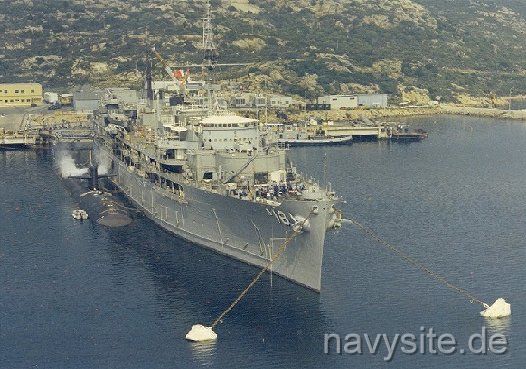
Through the early 1980s, USS ORION's days were dominated by the rhythm of arrivals and departures at La Maddalena. Submarines moored outboard the tender at Santo Stefano for repairs, maintenance and logistics while their crews went ashore to the small American community and the nearby Sardinian town of La Maddalena. Photographs from August 1983 show USS ORION berthed at Santo Stefano while servicing a LAFAYETTE-class ballistic-missile submarine, identified in contemporary captions as USS THOMAS JEFFERSON (SSN 618) after her conversion from SSBN status. The images underline ORION's capability to support both strategic and attack submarines.

On 1 September 1983, another official photograph records USS ORION anchored at Naval Support Activity La Maddalena, with the surrounding islands of the archipelago visible, capturing her as an established fixture of the base by that date. Later that same month, on 30 September 1983, USS ORION marked a major milestone: the 40th anniversary of her commissioning. The anniversary was celebrated at La Maddalena, where she had by then become a familiar part of the landscape. The celebration underscored the unusual longevity of a tender that had already served through the Second World War and the entire Cold War to that point, yet was still performing front-line support work. Her crew at the time included many sailors who had joined specifically for overseas duty in Italy, alongside long-serving specialists who had spent much of their careers aboard repair ships and tenders.

In 1985, one of the more distinctive episodes in USS ORION's Mediterranean service occurred when USS FULTON (AS 11), another veteran FULTON-class tender and at that moment the oldest active ship in the U.S. Navy, came to La Maddalena. Aerial photographs from March 1985 show USS FULTON and USS ORION moored side by side at La Maddalena. Contemporary captions explain that USS FULTON, then 43 years in service, temporarily relieved USS ORION for a period of 49 days so that ORION could receive needed maintenance and repairs while the tender mission at Santo Stefano continued uninterrupted.

During this period, the two sister ships represented a remarkable concentration of afloat repair capability in one small Mediterranean harbor and highlighted the U.S. Navy's practice of rotating tenders to maintain continuous support for deployed submarines.

Throughout the mid-1980s, USS ORION remained homeported at La Maddalena, a fact noted in contemporary analyses of U.S. naval operations: a 1986 review of U.S. naval activities in 1985 explicitly described her as homeported there, emphasizing her role supporting Sixth Fleet submarines in the central Mediterranean during a period of intense NATO exercises and frequent crises in the Middle East and North Africa.

Attack submarines making Mediterranean deployments routinely used La Maddalena as a maintenance and liberty port, mooring alongside USS ORION for Fleet Maintenance Availabilities (FMAVs) that typically lasted between one and two weeks. Command histories compiled later for LOS ANGELES-class submarines show this pattern clearly: boats such as USS MEMPHIS (SSN 691), USS CITY OF CORPUS CHRISTI (SSN 705), USS ALBUQUERQUE (SSN 706) and USS HYMAN G. RICKOVER (SSN 709) all recorded periods when they moored outboard USS ORION at Santo Stefano or La Maddalena for FMAVs or upkeep, although not all of those entries preserve the full year as well as the day and month. One such availability can be dated precisely. On 7 January 1988, USS MINNEAPOLIS-ST. PAUL (SSN 708) moored outboard USS ORION at La Maddalena for a six-day Fleet Maintenance Availability at the start of a Mediterranean deployment. Later in that same deployment, the submarine returned repeatedly to La Maddalena for additional upkeep periods in February and March, again relying on USS ORION's repair shops and support facilities. The pattern illustrates how the tender functioned as an extension of a homeport for submarines operating thousands of miles from the United States, allowing them to remain on station in the Mediterranean for months while still receiving depot-level maintenance and logistics support.

By 1990, the Cold War was entering its final phase, but operationally USS ORION's workload remained heavy. That year provides one of the clearest examples of her role thanks to detailed records for USS KEY WEST (SSN 722). On 23 March 1990, USS KEY WEST departed Norfolk for a scheduled Mediterranean deployment. On 8 April, she pulled into La Maddalena for a two-week port call specifically "to get tender support services from USS ORION", indicating that much of that fortnight was spent with the submarine moored alongside ORION for maintenance and repair work as well as crew liberty.

Later that same deployment, command history entries show a further "Port Visit La Maddalena, IT 30 June 1990 – 5 July 1990", again implying a week of upkeep in company with the tender. These visits took place just months after the fall of the Berlin Wall, at a time when U.S. submarines continued to monitor Soviet naval movements and support evolving NATO missions even as the broader political environment in Europe changed rapidly.

Even after the formal end of the Cold War, USS ORION remained active. Command history documentation for USS ALBUQUERQUE (SSN 706) in 1993 records "Upkeep La Maddalena, Italy alongside USS ORION" from 5 February to 15 February 1993, during a deployment in the early post-Cold War period. This entry shows that as late as the first months of 1993, ORION was still fully engaged in her traditional mission, supporting front-line submarines as they carried out new kinds of operations in a shifting strategic landscape. By early 1993, however, the end of the Cold War and the resulting restructuring of U.S. forces overseas were beginning to reshape ORION's fate. Sources compiled by veterans and naval historians note that in March 1993 USS ORION became, for a time, the oldest active ship in the U.S. Navy, a distinction she had temporarily ceded to USS FULTON during the mid-1980s but now held in her own right as other World War II-era auxiliaries left service.

The same accounts identify USS MIAMI (SSN 755) as the last submarine she tended while still based at La Maddalena, marking the end of an era in which nearly every major Atlantic Fleet submarine class had, at one time or another, come alongside USS ORION for support. In the spring of that year, as part of a broader drawdown and reorganization of overseas basing, she prepared to leave Italy after she was relieved by USS SIMON LAKE (AS 33). On 15 May 1993, USS ORION made what is described in contemporary captions as her last deployment to Norfolk, Virginia, where she arrived flying the historic "Don't Tread On Me" rattlesnake flag associated with the U.S. Navy's oldest active ship.

After returning to the United States, she was decommissioned on 3 September 1993, bringing an end to 50 years of commissioned service that had begun in the Second World War and extended through the entire Cold War and its immediate aftermath. Following decommissioning, she was placed in reserve and eventually transferred to the Maritime Administration for storage on 1 May 1999, laid up at facilities associated with Fort Eustis, Virginia.

The final chapter in USS ORION's story came in the 2000s. After several years in reserve, she was sold for dismantling on 27 July 2006 to North American Ship Recycling at Baltimore, Maryland, under a contract that called for her to be towed to the company's yard and scrapped. Her hull was gradually broken up, and the steel and other materials were recycled.


Back to topback to top  go to endgo to the end of the page


Back to topback to top


Back to Submarine Tenders list. Back to Ships list. Back to selection page. Back to 1st page.