![]() |
Search the Site with
|
![]() | ![]() | ![]() |
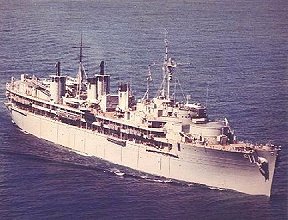
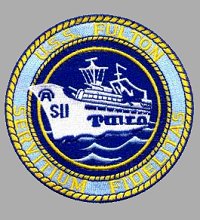
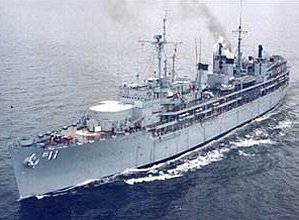
USS FULTON was the lead ship of the FULTON - class of submarine tenders and the fourth ship in the Navy named after Robert Fulton. Decommissioned on September 30, 1991, and stricken from the Navy list on December 20, 1991, the FULTON was sold for scrapping on November 17, 1995.
| General Characteristics: | Keel laid: July 1, 1939 |
| Launched: December 27, 1940 | |
| Commissioned: September 12, 1941 | |
| Decommissioned: September 30, 1991 | |
| Builder: Mare Island Naval Shipyard, Vallejo, Calif. | |
| Propulsion System: Diesel electric | |
| Propellers: two | |
| Length: 529.5 feet (161.4 meters) | |
| Beam: 73 feet (22.3 meters) | |
| Draft: 25.6 feet (7.8 meters) | |
| Displacement: approx. 18,000 tons full load | |
| Speed: 15 knots | |
| Armament: two Mk-30 5-inch / 38 caliber guns, four 20mm guns | |
| Crew: approx. 1200 |
Crew List:
This section contains the names of sailors who served aboard USS FULTON. It is no official listing but contains the names of sailors who submitted their information.
Accidents aboard USS FULTON:
| Date | Where | Events |
|---|---|---|
| July 24, 1958 | New London, Conn. | USS SKATE (SSN 578) suffers damage to her propeller when it collides with the USS FULTON while the tender is moored to a pier in New London, Conn. |
About the Ship's Name:
Robert Fulton, born in Little Britain, Pa., in 1765, had a distinguished career as a painter before patenting his first invention, a double inclined plane to replace locks in canals, in England in 1794. His numerous ingenious and influential inventions included a prototype submarine, NAUTILUS, amphibious boats, and the first commercially successful steamboat, CLERMONT. In 1814 and 1815, he built the first war steamer, known both as FULTON and DEMOLOGOS. He died in New York City 24 February 1815.
USS FULTON History:
USS FULTON was the lead ship of her class of submarine tenders and one of the longest-serving auxiliaries in the United States Navy, with a career that stretched from the months before America entered the Second World War into the final years of the Cold War. Her keel was laid at Mare Island Navy Yard on 19 July 1939, she was launched on 27 December 1940, and she was commissioned at Mare Island on 12 September 1941 under commander A. D. Douglas. Designed as a mobile base for submarines, she combined repair shops, supply facilities and extensive accommodation into a single hull, giving the Navy the ability to support submarines well forward of established bases.
During her shakedown out of San Diego in late 1941, the Japanese attack on Pearl Harbor on 7 December 1941 abruptly pulled USS FULTON into wartime operations. She was ordered at once to the Panama Canal area, arriving there on 9 December 1941. Over roughly the next month, she helped establish advanced seaplane bases in the Gulf of Fonseca off Nicaragua and in the Galapagos Islands, part of the rapid expansion of patrol aviation intended to guard the sea approaches to the canal against German U-boats and potential Japanese raiders. Once this work was complete, she returned to San Diego to prepare for extended deployment into the Pacific.
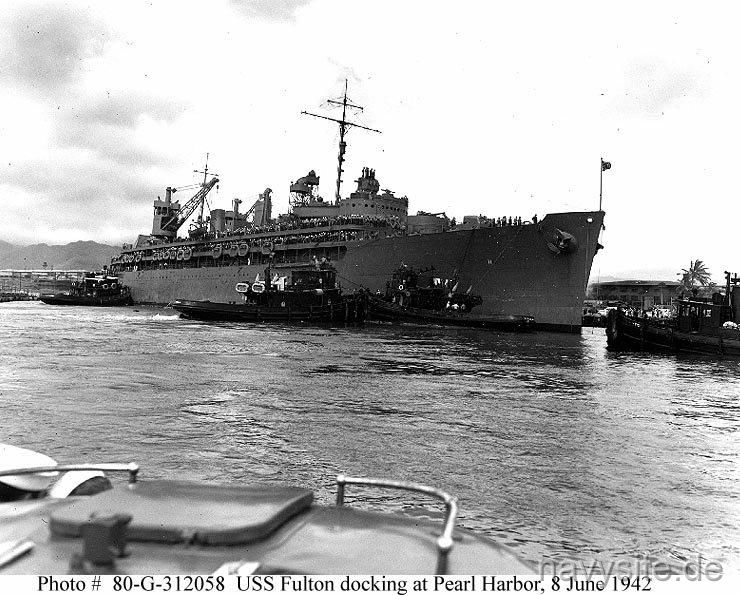
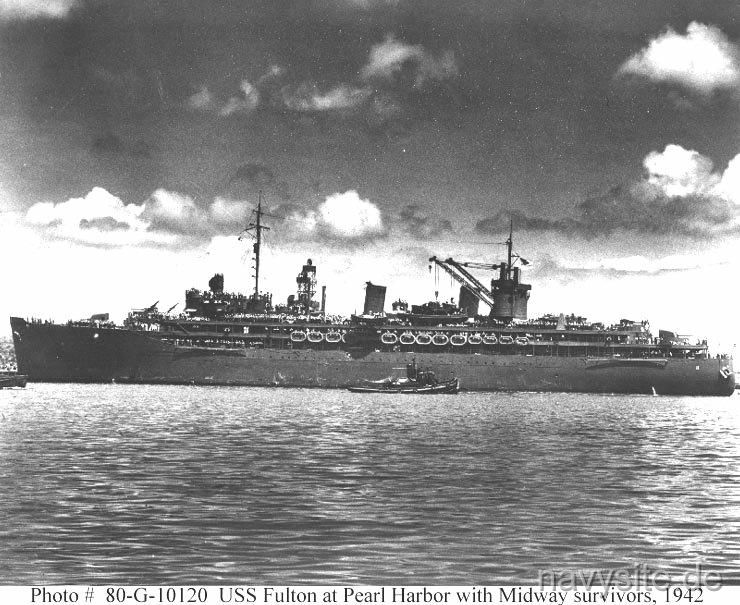
On 15 March 1942, USS FULTON arrived at Pearl Harbor and began tending submarines of the Pacific Fleet, which were already carrying the war across Japanese lines of communication. She remained there until 8 July 1942. During this period, she put to sea during the Battle of Midway in early June 1942, both to avoid being caught in any follow-on air attacks on Oahu and to be available as a repair and support ship if the fleet suffered damage. One of her most notable missions of the war followed the loss of the aircraft carrier USS YORKTOWN (CV 5). FULTON rendezvoused with the cruiser USS PORTLAND (CA 33) and the destroyer USS RUSSELL (DD 414) and received aboard 101 officers and 1,790 enlisted men who had survived YORKTOWN's sinking, transporting them safely back to Pearl Harbor. This operation, carried out in the immediate aftermath of Midway, underlined her role as a versatile support vessel rather than purely a submarine tender. For her participation in the Midway operation she would later receive a single battle star for World War II service.
Following her Pearl Harbor duty, USS FULTON shifted her advanced base westward. She was stationed at Midway Atoll until 17 October 1942, maintaining submarines that were now attacking Japanese shipping routes deeper into the Central Pacific. On 9 November 1942, she arrived at Brisbane, Australia, where she established a submarine base and rest camp. From Brisbane she refitted boats between war patrols, supported other small combatants, and provided the infrastructure that allowed American submarines to operate at increasing ranges into the western Pacific. She also supported experimental work in submarine mine-detection sonar, which contributed to the ability of American submarines to penetrate minefields defending critical Japanese waters such as the approaches to the Inland Sea.
On 29 October 1943, USS FULTON shifted still closer to the front, taking station at Milne Bay, New Guinea. There, she served until 17 March 1944, supporting submarines and other craft as Allied operations advanced along the New Guinea coast and toward the Philippines. Milne Bay had become an important Allied anchorage following the successful defense of the area against Japanese attempts to seize it in 1942. FULTON's presence there in 1943-1944 reflected the transition from defensive to offensive operations in the southwest Pacific. In March 1944, she sailed back to the United States West Coast for overhaul, returning to Pearl Harbor on 13 June 1944.
For the remaining year of the Pacific war FULTON moved repeatedly among forward bases. After a month at Pearl Harbor she again operated at Midway from 18 July to 8 September 1944, then proceeded to Saipan, which had only recently been secured in the Marianas campaign. At Saipan, she served as a tender from late 1944 into 1945, supporting submarines striking Japanese shipping in the western Pacific and contributing to the growing American presence in the newly captured Marianas. On 11 February 1945, she arrived at Subic Bay in the Philippines, which was being rebuilt as Naval Advance Unit No. 6 and a submarine and motor-torpedo-boat base. Contemporary accounts describe the area as still primitive and unhealthy so soon after liberation, underscoring the importance of a fully equipped tender like FULTON in re-establishing naval infrastructure there. Later in the spring, she returned to Saipan and continued work there until 25 April 1945. In early May, she briefly resumed service at Pearl Harbor, from 7 May to 9 June 1945, before sailing to Guam to refit submarines for some of the final patrols of the war against Japan.
After Japan's surrender, USS FULTON underwent a West Coast overhaul and then was assigned to post-war duties. From February through May 1946, she again served as a tender at Pearl Harbor, a hub for the reduced but still active Pacific Fleet submarine force. In mid-1946, she deployed to Bikini Atoll to participate in Operation Crossroads, the first post-war nuclear weapons tests. There, she supported six submarines assigned to the test program and also acted as repair ship for other vessels in the test task force, an indication of the Navy's reliance on her comprehensive repair and support facilities even in this experimental context. On 18 September 1946, she returned to Mare Island Navy Yard, and on 3 April 1947, she was decommissioned and placed in reserve. By the end of the war and her immediate post-war service, FULTON's record showed 332 vessels repaired or serviced, illustrating the scale of her contribution to submarine and fleet operations.
The outbreak of the Korean War and the rapid expansion of the post-war Navy brought USS FULTON back into service. She was recommissioned on 10 April 1951 and, about three weeks later, sailed for New London, Connecticut, which would remain her principal base for the next four decades. Assigned as tender to Submarine Squadron 10 at the Submarine Base across the Thames River in Groton, she now supported a submarine force transitioning from diesel-electric boats of the Second World War through GUPPY conversions toward the first generation of nuclear-powered submarines. She frequently operated from the State Pier at New London, occasionally relieving the submarine tender USS ORION (AS 18) at Norfolk, Virginia, and regularly conducting training and readiness cruises that took her from the cold waters around Newfoundland and Iceland to the warmer Caribbean, reflecting the spectrum of Atlantic Fleet submarine operations during the early Cold War.
In the autumn of 1957, FULTON crossed the Atlantic for Operation "Natoflex", a major NATO fleet exercise. During this deployment, she visited Rothesay in Scotland and Portland in England, supporting American submarines working with allied navies and demonstrating the capability to project tender support across the ocean. A further milestone came on 1 April 1958, when three nuclear submarines were formally assigned to Submarine Squadron 10, making FULTON the tender responsible for the care of a mixed conventional and nuclear squadron at a time when nuclear propulsion was still new. In August 1958, she steamed to New York City for celebrations marking the return of the nuclear submarine USS NAUTILUS (SSN 571) from her historic submerged passage under the North Pole, symbolizing her close association with the Navy's most advanced submarines.
Between August 1959 and January 1960, USS FULTON underwent a major modernization overhaul at Philadelphia Naval Shipyard. The work focused on equipping her to service both nuclear-powered and conventional submarines, including facilities to handle nuclear propulsion plant components, specialized radiological controls, and updated workshops. After completion she effectively became the world's first purpose-built nuclear support tender while retaining the ability to care for diesel-electric boats. Returning to New London, she resumed duties as flagship and primary tender for Submarine Squadron 10, which evolved into the Navy's first all-nuclear submarine squadron. Among the submarines she supported during the 1960s were NAUTILUS, USS SEAWOLF (SSN 575), USS SKATE (SSN 578), USS TRITON (SSN 586) and USS SKIPJACK (SSN 585), a group that represented much of the innovation in early nuclear submarine design.
From 1959 through 1971, FULTON's routine largely consisted of tending the boats of Submarine Squadron 10 at the State Pier in New London, punctuated by minor overhauls and periods of rest and recreation. Throughout these years successive commanding officers, including captains M. H. Rindskope, P. K. Schratz, C. K. Miller, M. C. Duncan, H. E. Rice and others, oversaw a steady tempo of refits, voyage repairs, weapons and sonar maintenance, and habitability work for a continually changing roster of submarines. Her support extended beyond routine servicing. She provided a base for crew training, squadron administration and logistics planning, making her central to Atlantic Fleet submarine operations in the North Atlantic and western Atlantic approaches.
In 1972, USS FULTON left her familiar New London environment for a deployment that foreshadowed a new phase in Mediterranean submarine support. From July to December 1972 she spent five months in the Mediterranean, based at La Maddalena, Sardinia. Her mission was to prepare that location for use as a full-time advanced refit site for nuclear-powered fast attack submarines of the United States Sixth Fleet. This deployment was notable as the first time since the Second World War that a World War II-era submarine tender had operated in the Mediterranean in this way. During the deployment, she provided repair and maintenance to deployed submarines, helped establish local supply and workshop routines, and demonstrated that a forward site like La Maddalena could sustain a high operational tempo for nuclear boats.
After returning to the United States and completing an overhaul in 1976, FULTON resumed her role at New London, continuing to support Atlantic Fleet submarines during an era of steady Cold War patrols in the North Atlantic and Norwegian Sea. In the early 1980s, she underwent a further major modernization to keep pace with newer classes of submarines. Between 1983 and 1984, she received an extensive overhaul at Electric Boat in Groton, Connecticut, and at the General Dynamics yard in Quincy, Massachusetts. Shortly before departing Quincy, a serious problem occurred in the after propulsion switchboard. When the panel was energized a fire broke out, spread rapidly through oil-soaked cork lagging on nearby bulkheads, and damaged cabling and equipment. The crew responded quickly and brought the fire under control, but the damage required several months of repair at the Fore River facility in Quincy. These repairs included replacement of wiring and switchgear and remedial work on affected spaces, after which FULTON returned to full operational status.
By late 1984, USS FULTON was again ready for extended deployment. She conducted refresher training at Guantanamo Bay, Cuba, and then, on 3 January 1985, departed for La Maddalena to relieve her sister tender USS ORION (AS 18). ORION needed a pier-side Selected Restricted Availability, and FULTON took over her maintenance responsibilities, ensuring that Sixth Fleet submarines continued to receive full tender support. During this four-month deployment, she not only operated from La Maddalena but also made port visits to Barcelona and Palma in Spain and Bergen in Norway, demonstrating the mobility of a modern tender. She returned to New London on 10 May 1985 after 128 days underway and more than 11,000 miles steamed without major incident. At La Maddalena, she and ORION were photographed moored side by side, with FULTON - then one of the oldest active ships in the fleet - temporarily carrying the forward-deployed tender mission.
From May 1985 through January 1988, FULTON again served as flagship of Commander Submarine Squadron 10 at New London, tending an all-nuclear squadron. She carried out shorter underway periods, including a deployment to Puerto Rico in connection with submarine rescue exercises. Other port visits in this period included St. John's in Newfoundland, Fort Lauderdale in Florida and Annapolis in Maryland, the latter coinciding with a graduation ceremony at the United States Naval Academy. These trips combined operational training, community relations and crew recreation while keeping the tender and her embarked squadron staff proficient in getting under way.
In early 1988, FULTON entered another Selected Restricted Availability at the Norshipco yard in Norfolk, Virginia. From 13 January to 12 March 1988, she was in drydock for hull work, sandblasting and painting below the waterline, extensive rehabilitation of berthing spaces and various machinery and systems repairs. On completion, she returned once more to New London to continue as flagship of Submarine Squadron 10, providing the same combination of repair shops, supply organization and administrative hub she had offered since the early 1950s, but now in support of fully modern LOS ANGELES-class and other nuclear attack submarines.
By 1991, USS FULTON was among the Navy's oldest commissioned ships. She held a deactivation ceremony at New London on 17 May 1991, marking the formal end of her active operational role even though administrative steps continued. She was officially decommissioned at New London on 30 September 1991. Shortly thereafter, she was turned over for final disposition and, under tow by the rescue and salvage ship USS GRAPPLE (ARS 53), arrived at Norfolk on 30 September 1991 for processing into the inactive fleet.
After decommissioning, USS FULTON was struck from the Naval Vessel Register on 20 December 1991 and laid up pending disposal. On 17 November 1995, she was sold for scrap, ending the physical existence of a ship that had served through nearly every phase of the modern submarine era. Over the course of her career, she earned one battle star for World War II, specifically for her role during the Battle of Midway, as well as two Navy Meritorious Unit Commendations, two awards of the Navy "E" Ribbon and a range of campaign and service medals including the American Defense Service Medal with "Fleet" clasp, the Asiatic-Pacific Campaign Medal and the National Defense Service Medal with two stars. Taken together, her wartime record in the Pacific, her contribution to Operation Crossroads, and four decades of continuous tender service to Atlantic Fleet submarines from the earliest nuclear boats to the closing years of the Cold War make USS FULTON a central auxiliary in the history of United States undersea warfare.
USS FULTON Image Gallery:
![]() | ![]() |
Back to Submarine Tenders list.
Back to Ships list.
Back to selection page.
Back to 1st page.