
Search the Site with

|
Search the Site with
|
 General Characteristics Crew List Memorabilia Cruise Books About the Ship's Name History Homeports of USS Hoel Image Gallery to end of page
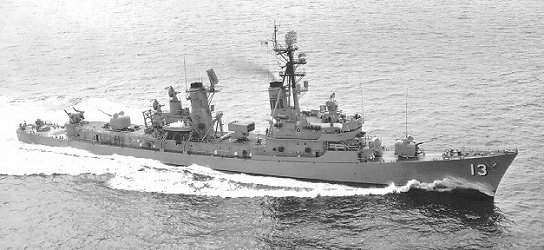 |  |
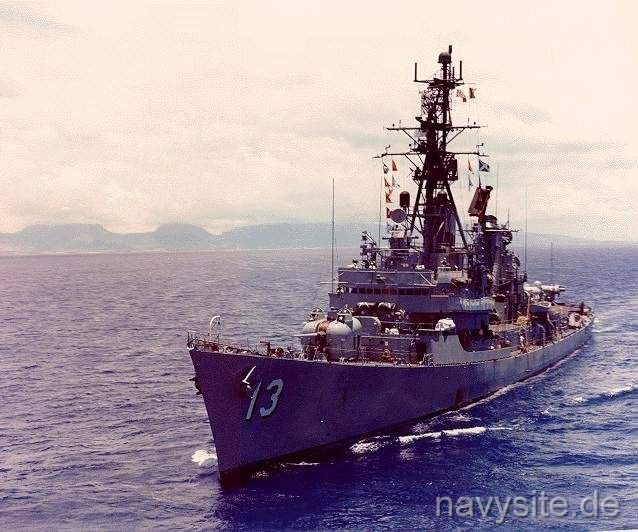
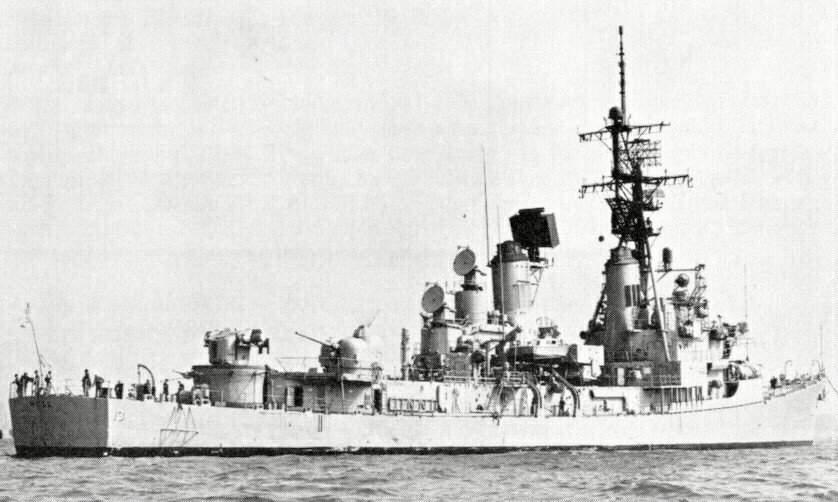
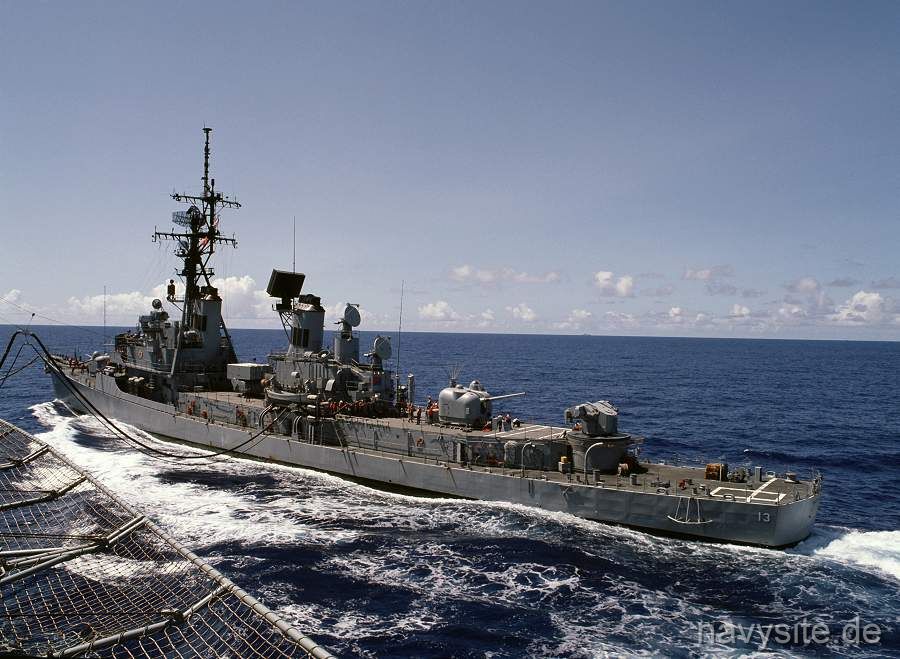
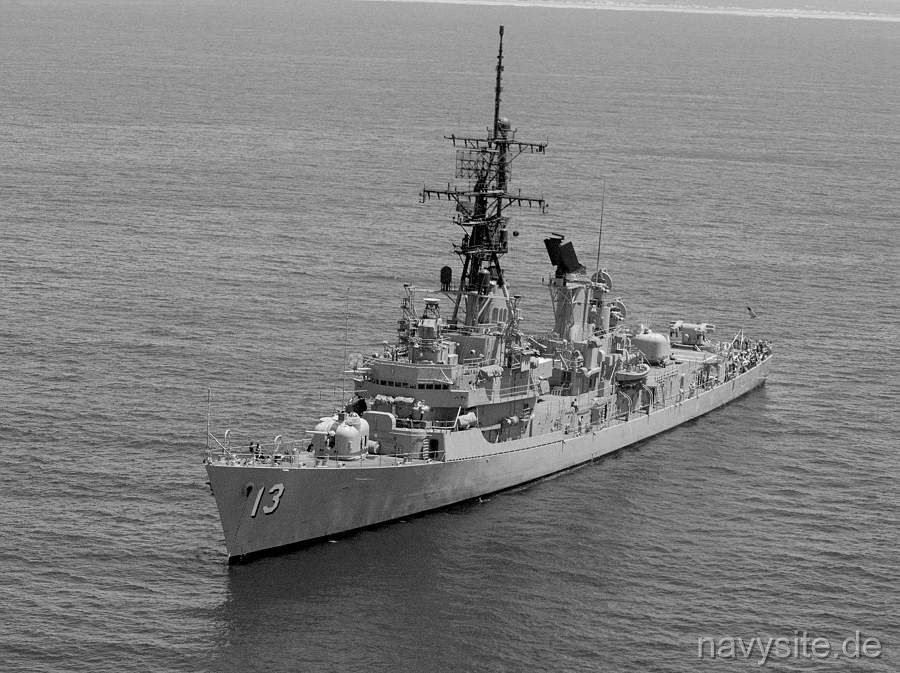
USS HOEL was the 12th ship in the CHARLES F. ADAMS - class of guided missile destroyers and the second ship in the Navy to bear the name. Another ship named "Hoel" was a destroyer cancelled during WWII.
USS HOEL was stricken from the Navy list on November 20, 1992, and was sold to Charleston Shipbuilders Inc. for conversion to a power barge on June 20, 1994. In 1997, the ship was towed to Manaus, Brazil, to provide the city with electricity. However, electricity output was too low and the project was stopped again. Today, the hulk of the HOEL is still located at Manaus.
| General Characteristics: | Awarded: January 17, 1958 |
| Keel laid: August 3, 1959 | |
| Launched: August 4, 1960 | |
| Commissioned: June 16, 1962 | |
| Decommissioned: October 1, 1990 | |
| Builder: Defoe Shipbuilding, Bay City, Michigan | |
| Propulsion system:4 - 1200 psi boilers; 2 geared turbines | |
| Propellers: two | |
| Length: 437 feet (133.2 meters) | |
| Beam: 47 feet (14.3 meters) | |
| Draft: 20 feet (6.1 meters) | |
| Displacement: approx. 4,500 tons | |
| Speed: 31+ knots | |
| Aircraft:none | |
| Armament: two Mk 42 5-inch/54 caliber guns, | |
| Crew: 24 officers and 330 enlisted |
 back to top go to the end of the pageback to top go to the end of the page
Crew List:
This section contains the names of sailors who served aboard USS HOEL. It is no official listing but contains the names of sailors who submitted their information.
back to top go to the end of the pageback to top go to the end of the pageUSS HOEL Cruise Books:
back to top go to the end of the pageAbout the Ship's Name:
 ( Click on the picture for a larger version of the photo )
William R. Hoel was born in Ohio on 7 March 1825. A steamboat pilot on the Mississippi River, he joined the Navy in October 1861 and played a very important role on the Western Rivers during the rest of the Civil War. Wounded in action on board the ironclad gunboat CINCINNATI during the battle of Fort Henry on 6 February 1862, he recovered in time to pilot USS CARONDELET past the Confederate fortress on Island Number Ten some two months later.
In May 1862, Acting Volunteer Lieutenant Hoel took command of the CINCINNATI while she was under salvage and repair. In October of that year he became Commanding Officer of sister gunboat PITTSBURG, taking her through operations in the vicinity of Vicksburg, Mississippi. On 29 April 1863, he courageously used his ship to protect the flagship BENTON when that vessel was endangered by enemy fire during the bombardment of Grand Gulf, Mississippi. In March-July 1865, Acting Volunteer Lieutenant Commander Hoel commanded the ram VINDICATOR. He left the Navy in December 1865.
back to top go to the end of the pageUSS HOEL History:
USS HOEL was commissioned at the Boston Naval Shipyard on 16 June 1962 under Commander Allen W. Slifer. After fitting out, she shifted to the Pacific, calling at Norfolk, Mayport and Fort Lauderdale, Guantanamo Bay, Cartagena, the Canal Zone, and Acapulco during her transit. En route between Cartagena and Panama she encountered the sailing yacht STARDRIFT becalmed and towed her a considerable distance to safety, a small episode that foreshadowed HOEL's long routine of watchstanding and assistance at sea. She reached her first home port, San Diego, on 11 September 1962 and spent the remainder of the year in Board of Inspection and Survey trials, qualifying her ASROC and TARTAR systems and joining the ready 1st Fleet soon thereafter.
Early 1963, brought a three-week cruise to Esquimalt, British Columbia, followed by special exercises at Pearl Harbor in April and May. On 6 June 1963, off San Diego, HOEL participated in the Pacific Fleet's Presidential Demonstration for President John F. Kennedy, a carefully staged review and live-fire display meant to showcase Navy readiness at a time when the administration was closely watching crises from Berlin to Southeast Asia. Through July to mid-September 1963 she underwent her post-shakedown availability at Long Beach Naval Shipyard, receiving improved fire-control radars and validating them with missile firings. On 17 October 1963, she departed Long Beach for her first Western Pacific (WestPac) deployment as flagship for Commander, Destroyer Division 12, beginning the pattern that would define her service: alternating WestPac periods with training and upkeep on the U.S. West Coast.
By mid-1960s deployments the strategic context had shifted decisively to Vietnam. HOEL's third WestPac began when she got underway from San Diego on 28 July 1966. In September she stood search-and-rescue stations off Da Nang, and on 8 December 1966, she shifted to naval gunfire support in I Corps. Across the final weeks of 1966 and into January 1967, she expended heavy ammunition in support of allied forces ashore. After a short respite in Hong Kong on 21 December, she returned to sea on 26 December to screen carriers at Yankee Station, including rescuing a downed A-4 pilot during flight operations - typical work for TARTAR-equipped ADAMS-class destroyers that alternated between plane guard, screen, and gunline duties as the air campaign and coastal operations ebbed and flowed. That WestPac ended on 3 February 1967.
HOEL's fourth WestPac ran from 28 December 1967 to 28 June 1968. During the Tet period, on 4 February 1968, while engaged in counter-battery work during a naval gunfire mission off the North Vietnamese coast, she came under shore fire. She sustained minor topside shrapnel damage (including to her launcher) but suffered no casualties and remained on station. Throughout the deployment she rotated between Yankee Station screening, search-and-rescue pickets, and gunfire missions, interspersed with brief port calls typical of Seventh Fleet cycles.
Her fifth WestPac began on 17 September 1969 and ended on 23 March 1970. On 28 September 1969, she crossed the equator en route to the South Pacific and, on 8-9 October 1969, represented the United States at Gisborne, New Zealand, for the bicentennial commemoration of Captain Cook's first landfall, a gesture of maritime diplomacy alongside allied warships. On 7 November 1969, she suffered an in-bore incident in mount MT-51 that forced a barrel change. Repairs were effected and the ship returned to operations. During the homeward leg she crossed the International Date Line on Friday 13 March 1970 - two "Friday the 13ths" in one passage by the calendar's quirks.
HOEL's sixth post-Vietnam rotation began 6 November 1970 and concluded 29 May 1971, a period of decreasing high-intensity gunline demand as Vietnamization advanced. She continued the destroyer's seamanship triad - plane guard, screen, and occasional naval gunfire support - while spending more time in exercises and upkeep than in previous years. After workups in 1971-72, HOEL deployed again on 13 June 1972 for her seventh WestPac amid the renewed fighting of the Easter Offensive. From July through December 1972, she spent 113 days on the gunline in the northern and central provinces, supporting Army of the Republic of Vietnam and U.S. advisors and interdicting logistics along the coast. She earned a Meritorious Unit Commendation for sustained operations from 10 July to 20 December 1972. On 19 December 1972, during night counter-battery exchanges, her consort USS GOLDSBOROUGH (DDG 20) was hit by shore fire. HOEL pressed on. The following evening, 20 December 1972, mount MT-52 suffered a barrel explosion during a mission conducted in company with USS COCHRANE (DDG 21) and USS FLOYD B. PARKS (DD 884). HOEL contained the casualty, shifted to her remaining mount, and completed the assignment. MT-51 fired 39 more rounds before ceasing fire at 05:04 a.m. on 21 December. Later that day, at 13:37 p.m. on 21 December 1972, she embarked Commander, Destroyer Squadron 21 from USS TOWERS (DDG 9) and proceeded toward Subic Bay in company with USS GRAY (DE 1054), USS SHELTON (DD 790), and USS JAMES E. KYES (DD 787). She returned to San Diego on 13 January 1973.
With U.S. combat operations in Vietnam ending, HOEL's eighth WestPac (1 February-1 August 1974) emphasized presence, readiness, and exercises rather than sustained gunfire. She spent extended periods around Subic Bay and in South China Sea evolutions as Seventh Fleet shifted from wartime tempo to post-ceasefire deterrence. After stateside training and upkeep, she sailed again for her ninth WestPac from 25 September 1976 to 15 May 1977, a Cold War deployment through the familiar arc of Pearl Harbor-Subic-Hong Kong-Japan with multi-ship antisubmarine and air defense drills and a "Tiger Cruise" during the homeward transit to reconnect crew families with shipboard life.
HOEL's tenth WestPac ran 26 September 1978 to 8 April 1979, again built around allied exercises and carrier screening duties during a comparatively calm interval in Northeast and Southeast Asian waters. She deployed for her eleventh long cruise on 1 April 1981 and returned 23 November 1981, a period marked by Indian Ocean contingencies and heightened fleet presence following the 1979-1981 Gulf and Southwest Asia crises. As part of carrier task group operations she logged extended blue-water days typical of the post-hostage-crisis U.S. posture.
In her twelfth deployment (1982-83), HOEL sailed for the South Pacific and Australia at a time when U.S.-Australian naval cooperation was expanding. She anchored at Melbourne on 10 March 1983, during the aftermath of the "Ash Wednesday" bushfires in Victoria and South Australia (16 February 1983), and crew volunteers assisted local communities ashore, a reminder of the humanitarian strand in Seventh Fleet port visits. The thirteenth WestPac followed from 24 July 1985 to 21 December 1985, featuring an equator crossing on 7 October and the usual suite of screening, gunnery, and readiness inspections as the Pacific Fleet focused on high-end air defense and antisubmarine training against increasingly capable adversaries.
The ship's fourteenth and most geopolitically charged deployment came in 1987-88 to the Persian Gulf and North Arabian Sea, where the "Tanker War" phase of the Iran-Iraq War had drawn U.S. naval forces into convoy protection and retaliatory strikes. On 19 October 1987, HOEL joined USS LEFTWICH (DD 984), USS KIDD (DDG 993), and USS JOHN YOUNG (DD 973) in the surface action group that executed Operation Nimble Archer, a limited reprisal against Iranian military-used oil platforms after a guided missile struck the reflagged tanker SEA ISLE CITY off Kuwait on 16 October. With air cover from the cruisers USS LONG BEACH (CGN 9) and USS WILLIAM H. STANDLEY (CG 32) and aircraft from USS RANGER (CV 61), the destroyers delivered naval gunfire to disable the platforms while U.S. special operations forces boarded one to collect documents before demolition. HOEL fired heavily and retired with the group at the operation's conclusion. She completed the remainder of the cruise in Gulf/Arabian Sea presence and escort duties before returning to San Diego in 1988.
Her fifteenth and final deployment ran 24 February to 24 August 1989, as a unit of RANGER's Battle Group "Echo", operating principally in the North Arabian Sea and Indian Ocean amid the cease-fire that ended the Iran-Iraq War the previous year. HOEL executed the full spectrum of blue-water tasks - plane guard, air defense picket, replenishment escort - and crossed the Line again during transits between the Arabian Sea and Diego Garcia. After returning home, she entered her last period of stateside operations and in-port preparation for retirement.
USS HOEL decommissioned at San Diego on 1 October 1990. She was towed to the Inactive Ship Maintenance Facility at Pearl Harbor by 1 June 1991 and stricken from the Naval Vessel Register on 20 November 1992. Sold on 20 June 1994, to a consortium intending to convert her to a floating power barge, she underwent modifications at Charleston in 1996, and was later towed to Brazil to support the power-hungry Free Trade Zone city of Manaus. The experiment proved only intermittently successful; by the late 1990s the contract was canceled and HOEL's long seagoing career had come to a quiet, utilitarian postscript far from the Pacific waters where she had spent nearly three decades screening carriers, standing picket, and firing in support of forces ashore.
back to top go to the end of the pageHomeports of USS HOEL:
| Period | Homeport |
|---|---|
| commissioned at Boston, Mass. | |
| 1962 - 1990 | San Diego, Calif. |
back to top go to the end of the pageUSS HOEL Image Gallery:
 |  |  | 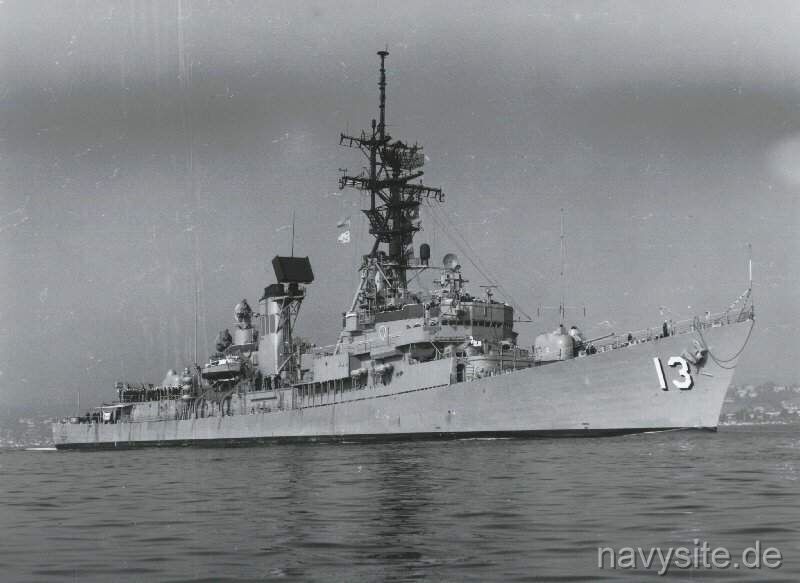 | 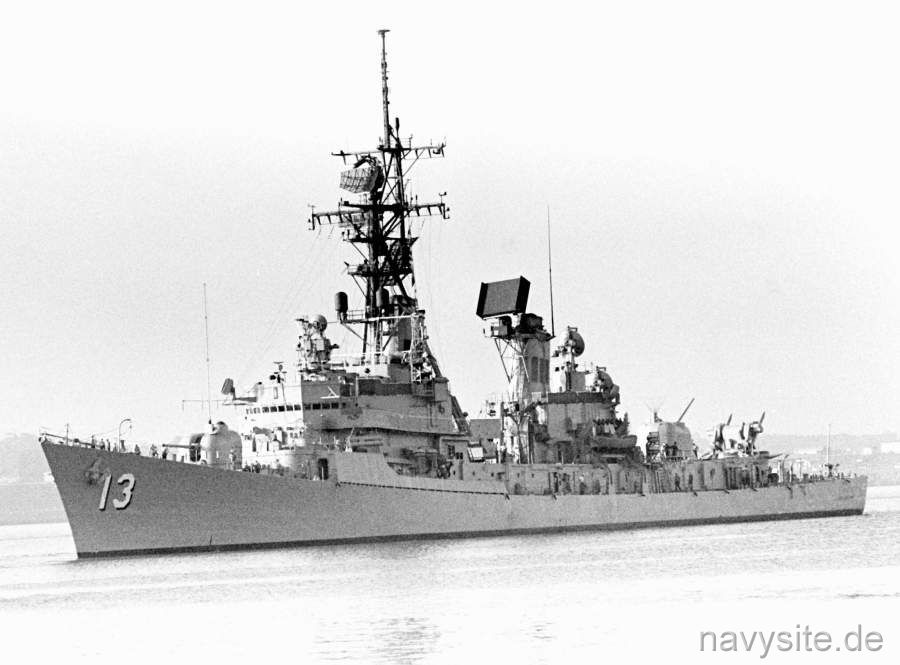 |
 |  |
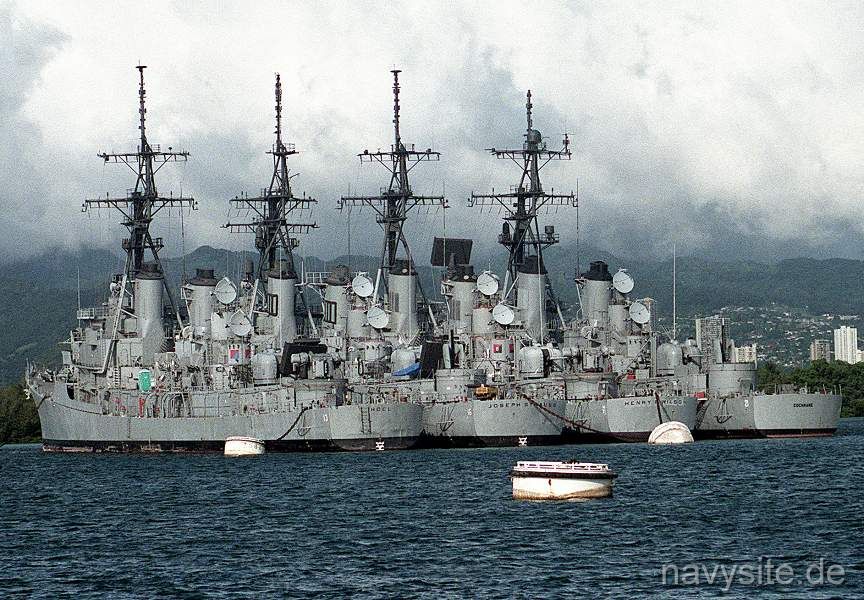
The photo below is an official US Navy photo taken on June 1, 1991. It shows four CHARLES F. ADAMS - class ships laid up at the Pearl Harbor Naval Inactive Ship Maintenance Facility. Visible are (from left to right): HOEL, JOSEPH STRAUSS (DDG 16), HENRY B. WILSON (DDG 7), and COCHRANE (DDG 21).
 |
back to top
 Back to Destroyer list. Back to ships list. Back to selection page. Back to 1st page.