Search the Site with

|
Search the Site with
|
 General Characteristics Crew List Memorabilia Cruise Books Accidents aboard the Ship About the Ship's Name History SINKEX Patch Gallery Image Gallery to end of page
 | 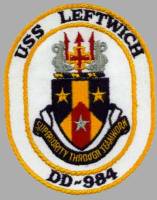 |
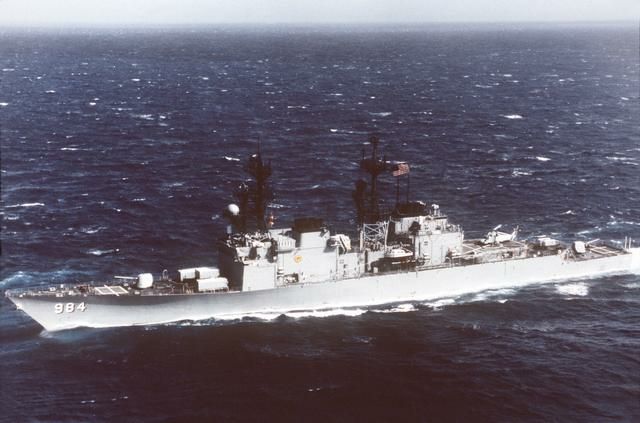
USS LEFTWICH was the 22nd SPRUANCE - class destroyer and the second ship in that class decommissioned. Stricken from the Navy list on March 27, 1998, the LEFTWICH was then berthed at the Naval Inactive Ship Maintenance Facility (NISMF), Pearl Harbor, HI, until she was sunk as a target on August 1, 2003, at 022° 48' 47.0" North, 160° 34' 00.0" West. The USS LEFTWICH was homeported in Pearl Harbor, HI., and was the first ship in the Navy named after Marine Corps Lieutenant Colonel William G. Leftwich, Jr.
| General Characteristics: | Keel Laid: November 12, 1976 |
| Launched: April 8, 1978 | |
| Commissioned: August 24, 1979 | |
| Decommissioned: March 27, 1998 | |
| Builder: Ingalls Shipbuilding, West Bank, Pascagoula, Miss. | |
| Propulsion system: four General Electric LM 2500 gas turbine engines | |
| Propellers: two | |
| Blades on each Propeller: five | |
| Length: 564,3 feet (172 meters) | |
| Beam: 55,1 feet (16.8 meters) | |
| Draft: 28,9 feet (8.8 meters) | |
| Displacement: approx. 9,200 tons full load | |
| Speed: 30+ knots | |
| Aircraft: two | |
| Armament: two | |
| Crew: approx. 340 |
 back to top go to the end of the pageback to top go to the end of the page
Crew List:
This section contains the names of sailors who served aboard USS LEFTWICH. It is no official listing but contains the names of sailors who submitted their information.
back to top go to the end of the pageback to top go to the end of the pageUSS LEFTWICH Cruise Books:
back to top go to the end of the page
Accidents aboard USS LEFTWICH:
| Date | Where | Events |
|---|---|---|
| November 29, 1982 | 40 miles east of Subic Bay, Philippines | USS THOMAS A. EDISON (SSBN 610) collides with USS LEFTWICH. The EDISON was at periscope depth preparing to surface; it damaged its sail and sail planes, but there was no flooding. Both ships remained operational after the accident. |
| 1983 | Pacific | In 1983, hull damage was repaired and the sonar dome rubber window was changed on the LEFTWICH. The damage was caused by heavy seas and the fact that the LEFTWICH was going too fast for the conditions. |
back to top go to the end of the page
About the Ship's Name:
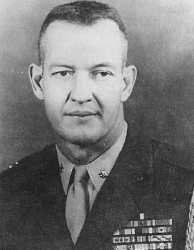 Lieutenant Colonel William G. Leftwich, Jr., was born on April 28, 1931 in Memphis, Tennessee, and graduated from Central High School in that city. He was commissioned a Marine Second Lieutenant on June 5, 1953 upon graduation from the United States Naval Academy. As brigade captain in his senior year at the Naval Academy, he was specially commended at graduation for exemplary officer-like qualities which contribute "to the development of naval spirit and loyalty within the Brigade."
Upon entering the Marine Corps, he completed the Basic School at Marine Corps Schools, Quantico, VA, in January 1954, and later served as a rifle platoon commander with the 2nd Marine Division at Camp Lejeune, NC. During 1955-56, he served with the 3rd Marine Division on Okinawa. On his return to the United States, he was stationed at Camp Pendleton, California, where he was promoted to Captain in July 1957. He then began a three-year assignment at the Naval Academy, serving as a company officer. An excellent athlete himself, he also voluntarily performed collateral duty as assistant varsity tennis coach and battalion football coach.
In 1960, he joined the 2nd Marine Division, serving as a company commander until 1962, when he was named aide-de-camp to the Commanding General. In June 1963, he was assigned as aide to the Commandant, Marine Corps Schools, Quantico. He was promoted to major in July 1964. He later completed a course of study in the Vietnamese Language prior to reporting for duty in Vietnam in January 1965 as Assistant Senior Advisor to the Vietnamese Marine Brigade.
Joining Task Force Alfa, he participated in 27 major operations against the Viet Cong in the central highlands of Vietnam, and spent more than 300 days in the field. He was wounded in the battle of Hoai An, March 9, 1965 and, besides the Purple Heart, was awarded the Navy Cross for extraordinary heroism. According to his citation, he "...played a major part in all phases of the successful relief of the village of Hoai An, which was under heavy enemy attack by two Viet Cong Battalions... . By his own personal example... he led the attack... . Despite injuries by enemy machine-gun bullets in the back, cheek, and nose, he went to the aid of a mortally wounded comrade... and delayed his own evacuation until he could call for additional air strikes and brief the task force commander of the situation."
He returned to the United States in January 1966, served as an instructor at the Basic School, then completed the Command and Staff College in June 1967 and was named to the School's Honor List. Assigned to Headquarters Marine Corps, he was promoted to Lieutenant Colonel in November 1967 while serving as a systems analyst with the Manpower Management Information Branch, G-1 Division. He later became head of the Systems Analysis Section.
In 1968, Lt. Col. Leftwich was selected by the Under Secretary of the Navy to be his Special Assistant and Marine Corps Aide. He served in this capacity under the Honorable Charles F. Baird, and Mr. Baird's successor as Under Secretary of the Navy, the Honorable John W. Wamer.
In April 1970, he began his second tour of duty in Vietnam, serving initially as an infantry battalion commander with the 2nd Battalion, First Marines. On June 30, he assumed duty as Commanding Officer of the 1st Reconnaissance Battalion, 1st Marine Division (Reinforced).
On November 18, 1970, Lt. Col. Leftwich was killed in a helicopter crash during an emergency extraction of one of his reconnaissance teams. In accordance with his practice of accompanying every emergency extraction called for by his reconnaissance teams, he was serving as senior "extract officer" for such a mission on the day of his death. The team had incurred casualties and requested an emergency extraction from enemy-infested territory in an area beginning to be enveloped by dense fog. The team was extracted under Lt. Col. Leftwich's personal supervision, then, as the helicopter began its ascent, it crashed into a mountainside in enemy territory, killing all aboard.
A partial list of his medals and awards includes: The Navy Cross, the Silver Star (posthumous), the Legion of Merit with Combat "V" and two gold stars, the Meritorious Service Medal, the Air Medal with one gold star, the Purple Heart with two gold stars, and various personal awards from the Republic of Vietnam.
Lt. Col. Leftwich is survived by his wife, the former Jane Ferrer, and two sons, William G. III, and Scott F. He was also survived by his mother, Mrs. Mattie H. Leftwich of Memphis. His father was deceased.
back to top go to the end of the pageUSS LEFTWICH History:
USS LEFTWICH was laid down at Ingalls Shipbuilding on 12 November 1976, launched on 8 April 1978, and commissioned at Pascagoula on 25 August 1979 with Chief of Naval Operations Admiral Thomas B. Hayward as the principal speaker. The next morning, 26 August 1979, she sailed for her first home port at Naval Station San Diego via the Panama Canal and began post-commissioning trials and workups for Western Pacific employment.
Early operating years in the eastern Pacific were followed by initial WestPac deployments at the turn of the 1980s, building the ship's team proficiency in anti-submarine and surface warfare in Seventh Fleet waters. A major setback came on 29 November 1982, when LEFTWICH collided with the fleet ballistic-missile submarine THOMAS A. EDISON (SSBN 610) during war games about 40 miles east of Subic Bay. Both ships returned to Subic. Reports noted damage to EDISON's sail and sonar dome and to LEFTWICH's bow sonar structure and forward fuel tanks. The destroyer subsequently underwent repairs in 1983 before resuming operations.
During WESTPAC 1984, LEFTWICH operated at high tempo in heavy seas. Contemporary accounts record hull and sonar-window damage from those conditions. On 18 August 1984, an embarked HSL detachment helicopter accident during takeoff in the Indian Ocean resulted in the loss of two aircrew, a solemn moment in the ship's operational record.
On 1 April 1985, LEFTWICH shifted home port to Pearl Harbor, aligning with Pacific Fleet tasking centered on Hawaii and the Western Pacific. From mid-1985 into mid-1986 she underwent an extended regular overhaul at Pearl Harbor Naval Shipyard, emerging to complete trials and refresher training to regain deployment readiness.
After return to full readiness, LEFTWICH resumed fleet operations and port visits around the Pacific Rim - including a documented call at Seattle on 1 August 1986 - then deployed again to the Western Pacific and Indian Ocean as tensions rose in the Persian Gulf during the "Tanker War" phase of the Iran-Iraq War. By mid-1987, she was operating with U.S. forces in and around the Gulf. On 19 October 1987, as part of the measured U.S. response to the Iranian Silkworm missile strike on the reflagged tanker SEA ISLE CITY, LEFTWICH joined three other U.S. destroyers - HOEL (DDG 13), JOHN YOUNG (DD 973), and KIDD (DDG 993) - in the surface action later dubbed Operation Nimble Archer. Following prior radio warnings issued from the frigate THACH (FFG 43), the four destroyers engaged and neutralized two militarized Iranian oil platforms used for command-and-control and small-boat attacks, with U.S. helicopters providing overwatch and U.S. special forces subsequently boarding and setting demolition charges. Cruiser and carrier-air support covered the action.
LEFTWICH continued an intensive Pacific and Indian Ocean operating rhythm into the end of the decade, including the 1989 WESTPAC documented in the ship's cruise book. In these deployments she alternated presence missions, multinational exercises, and readiness training from Northeast Asia to Southeast Asia and the Indian Ocean, reflecting the late-Cold War maritime posture of Seventh Fleet surface combatants.
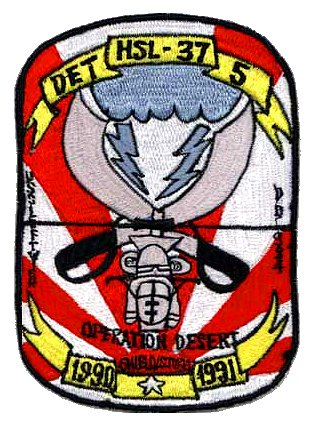
When Iraq invaded Kuwait in August 1990, LEFTWICH deployed to the region for Operations Desert Shield and Desert Storm under Commander Patrick Garrett, embarking Helicopter Anti-Submarine Squadron 37 Detachment 5. During the air campaign's opening phase the destroyer fired Tomahawk land-attack missiles and, notably, became the first combatant documented to conduct a wartime Tomahawk reload to sustain strike capacity. Throughout the maritime campaign she executed more than 200 merchant-vessel interceptions and one boarding in the northern Arabian Gulf while supporting mine countermeasures, carrier strike, and amphibious deception operations.
On 24 January 1991, LEFTWICH, in consort with CURTS (FFG 38) and NICHOLAS (FFG 47) and supported by coalition air strikes, took part in the action at Qaruh Island off the Kuwaiti coast. After U.S. aircraft destroyed Iraqi small combatants near the island, helicopters recovered survivors under fire. U.S. Navy SEALs then landed from the ships and secured the position, marking the first parcel of Kuwaiti territory reclaimed during Desert Storm. U.S. Navy chronologies and Marine Corps histories place LEFTWICH among the fire-support and lift ships backing these special operations and subsequent actions toward Umm al Maradim later in January alongside MOBILE BAY (CG 53) and other units.
With the cease-fire and drawdown underway, LEFTWICH completed post-hostilities duties and returned to Pearl Harbor in April 1991 with HSL-37 Det 5 still embarked, closing a high-intensity deployment that earned the ship a Navy Unit Commendation and Combat Action Ribbon for her crew.
LEFTWICH remained Hawaii-based through the early- and mid-1990s. A 1993 WESTPAC - covered in the ship's "LOG 7" cruise book - saw her once again in Seventh Fleet waters for combined exercises and forward presence, as the post-Cold War maritime focus shifted toward regional stability and coalition interoperability.
Her final deployment cycle began in late 1996. LEFTWICH departed Pearl Harbor in November 1996 for WestPac/Arabian Gulf operations and returned to Hawaii on 17 May 1997 after steaming more than 30,000 miles. During this cruise the ship conducted maritime interception operations enforcing United Nations sanctions on Iraq and made port calls including Hong Kong, Singapore, Bahrain, the United Arab Emirates, Australia, and Fiji, reflecting both operational commitments in the Gulf and engagement across the Indo-Pacific.
After nearly two decades of service, LEFTWICH was decommissioned and stricken at Pearl Harbor on 27 March 1998. Five years later, on 1 August 2003, the former destroyer was sunk as a target during training northwest of Kauai, Hawaii, at 22° 48' 47" N, 160° 34' 00" W.
back to top go to the end of the pageUSS LEFTWICH SINKEX:
The decommissioned LEFTWICH was sunk as a target on August 1, 2003, at 022° 48' 47.0" North, 160° 34' 00.0" West. The video below shows the sinking.
back to top go to the end of the pageUSS LEFTWICH Patch Gallery:
 |
back to top go to the end of the pageUSS LEFTWICH Image Gallery:
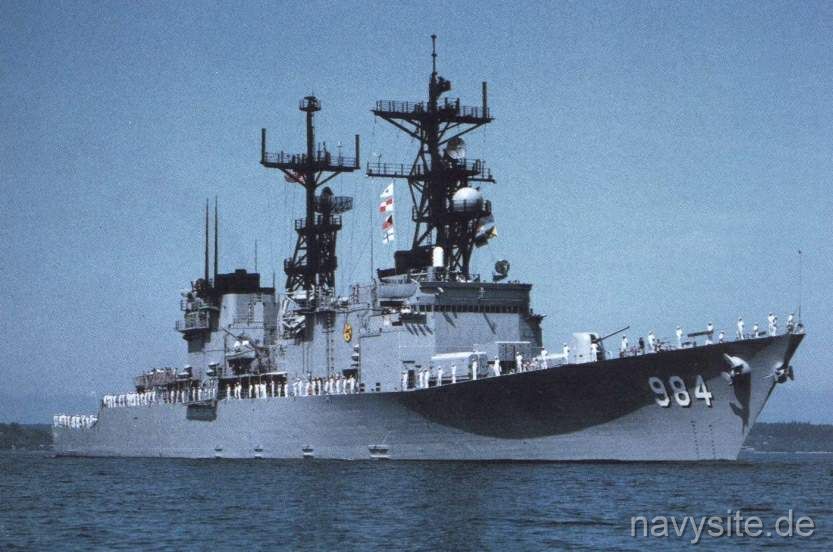 | 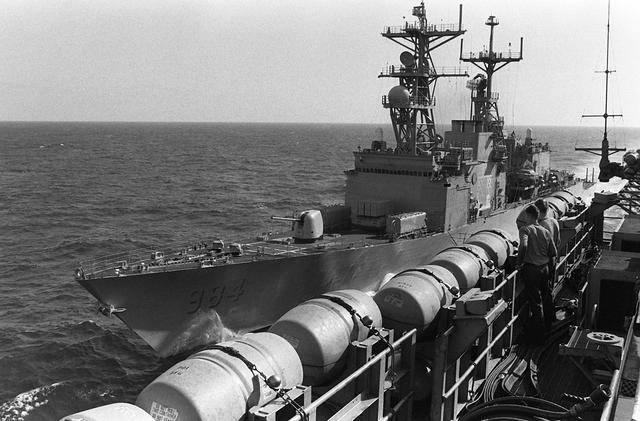 | 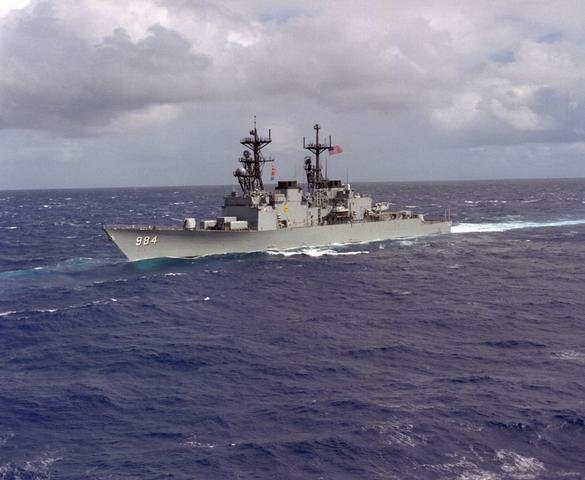 | 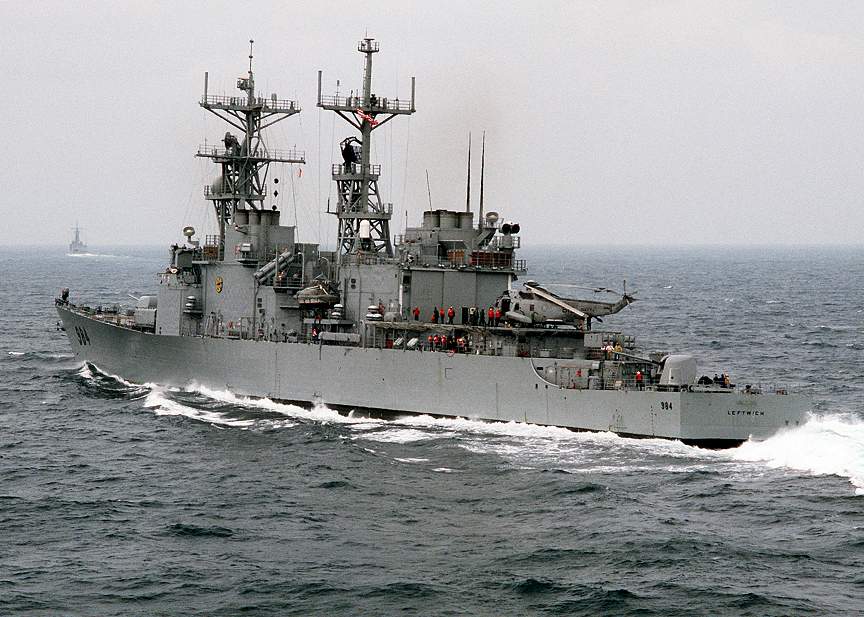 |  |
 |  |
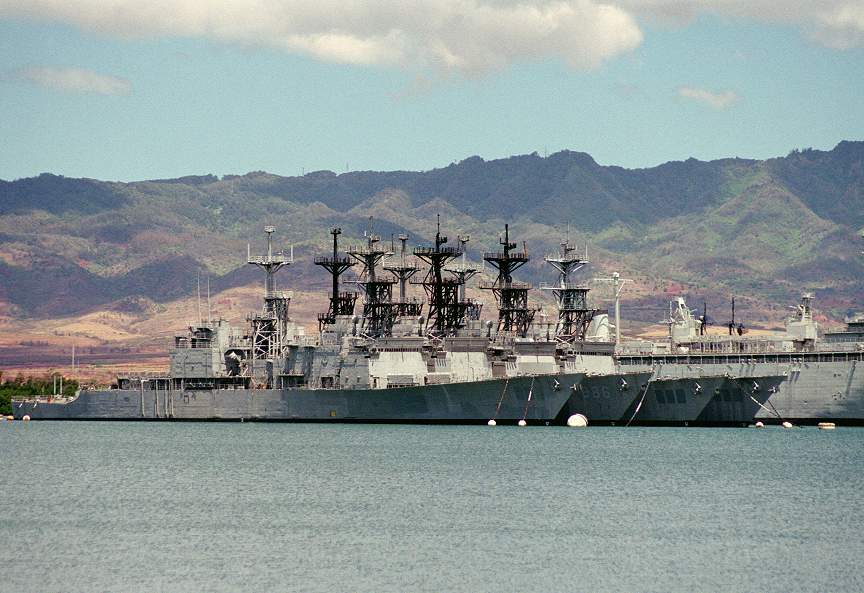
The photo below is an official US Navy photo taken on June 4, 2000. It shows (from left to right) the INGERSOLL (DD 990), HARRY W. HILL (DD 986), LEFTWICH, and MERRILL (DD 976) laid up at the Pearl Harbor Naval Inactive Ship Maintenance Facility. All four ships have since been sunk as targets off the north coast of Kauai, Hawaii.
 |
back to top
 Back to Destroyers list. Back to ships list. Back to selection page. Back to 1st page.