
Search the Site with

|
Search the Site with
|
 General Characteristics Crew List Memorabilia Cruise Books USS Mississippi History Image Gallery to end of page
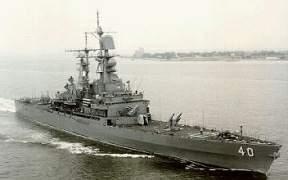 |  | 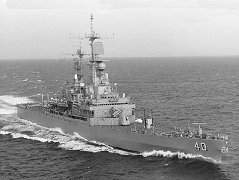 |
USS MISSISSIPPI was the third ship in the VIRGINIA - class of nuclear powered guided missile cruisers and the fourth ship in the Navy to bear the name. After decommissioning, the MISSISSIPPI was laid up at the Naval Inactive Ship Maintenance Facility (NISMF), Bremerton, WA., until she was disposed of by recycling. USS MISSISSIPPI was homeported in Norfolk, VA.
| General Characteristics: | Awarded: January 21, 1972 |
| Keel laid: February 22, 1975 | |
| Launched: July 31, 1976 | |
| Commissioned: August 5, 1978 | |
| Decommissioned: July 28, 1997 | |
| Builder: Newport News Shipbuilding Co., Newport News, Va. | |
| Propulsion system: two D2G General Electric nuclear reactors | |
| Propellers: two | |
| Length: 585 feet (178 meters) | |
| Beam: 63 feet (19.2 meters) | |
| Draft: 31,5 feet (9.6 meters) | |
| Displacement: approx. 11,300 tons full load | |
| Speed: 30+ knots | |
| Aircraft: none and no helicopter landing capability | |
| Armament: two Mk-26 missile launcher for Standard missiles (MR) and ASROC, two Mk-141 | |
| Crew: 39 Officers, 539 Enlisted |
 back to top go to the end of the pageback to top go to the end of the page
Crew List:
This section contains the names of sailors who served aboard USS MISSISSIPPI. It is no official listing but contains the names of sailors who submitted their information.
back to top go to the end of the pageback to top go to the end of the pageUSS MISSISSIPPI Cruise Books:
back to top go to the end of the pageHistory of USS MISSISSIPPI:
USS MISSISSIPPI, third ship of the four ship VIRGINIA Class nuclear-powered, guided missile cruisers, was commissioned on 5 August 1978 at Norfolk Naval Base, Norfolk, Virginia. Former President Jimmy Carter presided over the ceremonies.
Over the next three years, MISSISSIPPI performed tests and trials, which every new ship goes through. During this time, the ship also went through its first extended training period at Guantanamo Bay, Cuba.
In August of 1981, MISSISSIPPI made her first deployment. MISSISSIPPI was escorting USS NIMITZ (CVN 68) when F-14 fighters from that carrier shot down two Libyan fighter jets. MISSISSIPPI was also called upon during that deployment to patrol off the shore of Egypt after President Anwar Sadat was assassinated.
In 1982, Commander-in-Chief, U.S. Atlantic Fleet, awarded MISSISSIPPI the prestigious Battenberg Cup Award for being the best all-round ship in the Atlantic Fleet. The same year, MISSISSIPPI earned the "Battle Efficiency" Award.
In November 1982, the USS MISSISSIPPI departed Norfolk for her second Med Cruise. Thanksgiving that year was celebrated while underway to the Med. Once on station, the ship supported Libyan Freedom of Navigation operations several times, spent Christmas of 1982 on patrol off Beirut in support of the USMC element deployed to the Beirut Airport. The MISSISSIPPI was on the Gun Line off Beirut when the US Embassy to Lebanon was attacked with a terrorist's car bomb on April 18, 1983. The cruiser subsequently provided NGFS target identification and location support to the Marines stationed at the Beirut Airport, and became the only CGN ever to win the "Hook-Em" award for ASW excellence for tracking a JULIETTE Class soviet Submarine literally halfway across the Med. The crew of MISSISSIPPI maintained contact on the submarine for over 48 hours straight. The cruiser returned to Norfolk in late May of 1983.
Also in 1983, MISSISSIPPI received COMSIXTHFLT Battle Force "Top Hand" Award, a Meritorious Unit Commendation, her fourth consecutive excellent in the annual Operation Reactors Safeguards Examination, the Top Hammer Award for top performance in Atlantic Fleet exercise operations, the Old Crow Award for excellence and contributions in electronic warfare, and her second consecutive "Battle Efficiency" Award.
In 1985, MISSISSIPPI earned her third consecutive "Battle Efficiency" Award. This same year, she also received a second Meritorious Unit Commendation for Operation SNAP LOCK.
In 1986, MISSISSIPPI was awarded the Golden Anchor Award for Navy Personnel Retention.
In 1987, MISSISSIPPI received the Silver Star as the runner-up for the Golden Anchor Award.
In September 1987, MISSISSIPPI completed her first overhaul, which included the latest improvements in her Combat Systems Suite, which greatly improved the ship's ability to fight and win "war-at-sea."
Following exercises in the Caribbean in 1988, MISSISSIPPI deployed to the Mediterranean from May to November 1989. During the deployment, MISSISSIPPI provided support to Battle Force Sixth Fleet off the Coast of Lebanon in response to the killing of Marine Corps Colonel Higgins by terrorists. In December, MISSISSIPPI received her fourth "Battle Efficiency" Award.
During 1990, MISSISSIPPI completed three law enforcement operations in the Caribbean, and in August of 1990, deployed as flagship for Commander, Multi-National Maritime Interception Force (MIF) during Operations DESERT SHIELD and DESERT STORM. She completed the seven- month deployment on 31 March 1991, thus setting the record for the ship with the longest operating tempo in any given period. MISSISSIPPI provided Anti-Air Warfare (AAW) escort services for USS NITRO (AE 25) through the Straits of Bab-El-Mandeb to the Gulf of Aden. Upon completing her escort duties, MISSISSIPPI returned to the Red Sea to launch Tomahawk Cruise Missiles at designated strategic and military targets deep inside the country of Iraq.
From May 1991 until August 1992, MISSISSIPPI underwent a comprehensive extended availability at Norfolk Naval Shipyard, Portsmouth, Virginia. During this period, MISSISSIPPI received state-of-the-art New Threat Upgrade Combat Systems Suite, which tremendously enhances MISSISSIPPI's ability to perform a myriad of Anti-Air Warfare functions. MISSISSIPPI also received Tomahawk and Harpoon system improvements, which increased her strike and Anti-Surface Warfare capability.
From September 1992 - 1993, MISSISSIPPI participated in three Counter Narcotic Operations in the Caribbean Theater. She also was awarded her fifth "Battle Efficiency" Award. From October 1993 - November 1994, MISSISSIPPI served two deployments to the Haitian Theater in support of Operation SUPPORT DEMOCRACY.
In January of 1994, MISSISSIPPI was also awarded her second Golden Anchor Award for Navy Personnel Retention.
Beginning November of 1994, MISSISSIPPI began an intense training cycle in preparation for the March of 1995 Mediterranean deployment.
back to top go to the end of the pageUSS MISSISSIPPI Image Gallery:
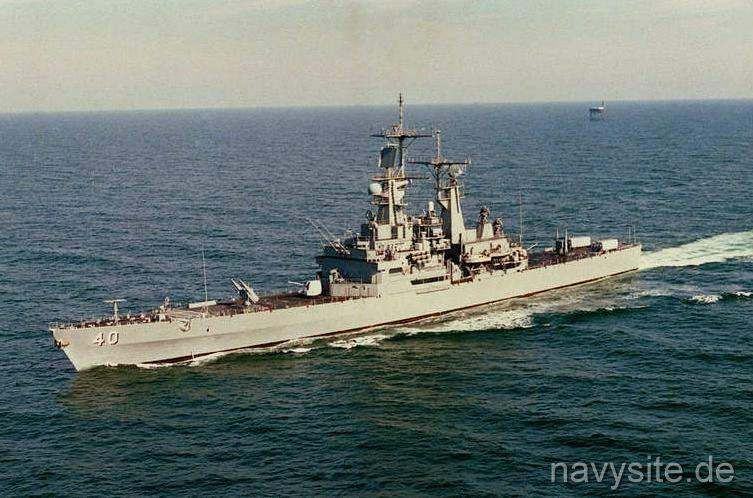 | 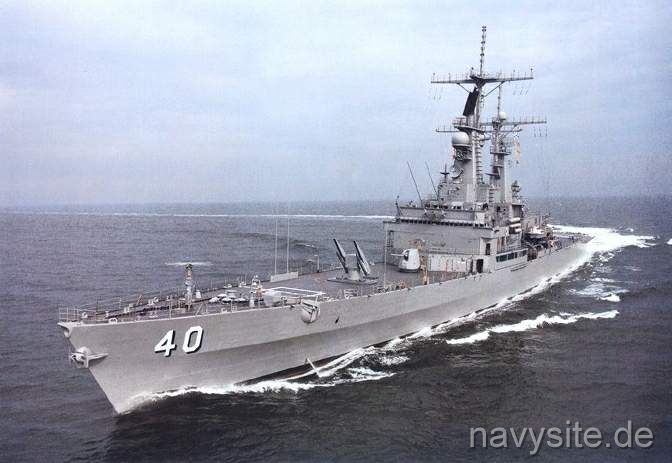 | 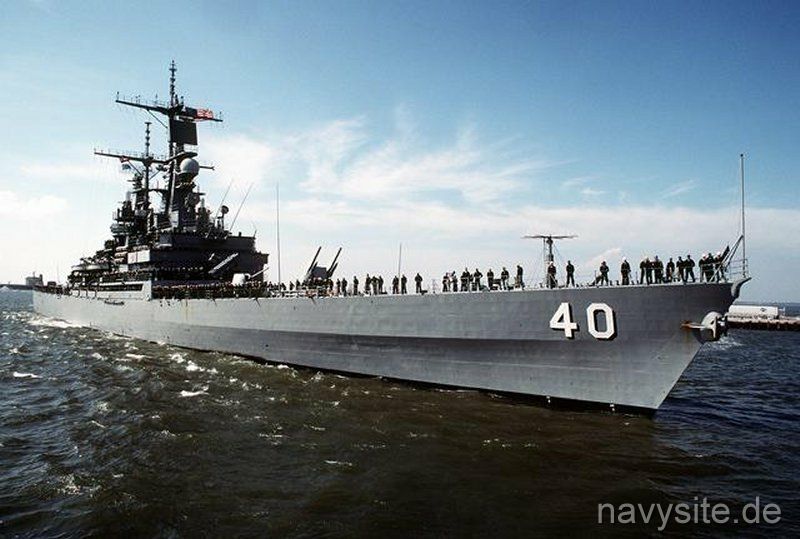 |
back to top
 Back to Cruisers list. Back to ships list. Back to selection page. Back to 1st page.