
Search the Site with

|
Search the Site with
|
 General Characteristics Crew List Memorabilia Accidents aboard the Ship History Patch Gallery to end of page
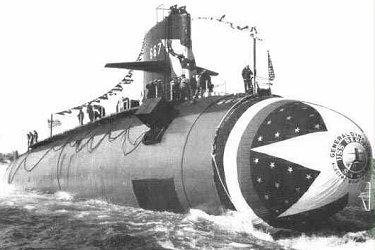 |  |
USS BERGALL was one of the STURGEON - class attack submarines and the second ship in the Navy to bear the name. Inactivated while still in commission on August 4, 1995, the BERGALL was formally decommissioned on June 6, 1996. Stricken from the Navy list on June 6, 1997, the BERGALL was disposed of through the Navy's Nuclear Powered Ship and Submarine Recycling Program at the Puget Sound Naval Shipyard at Bremerton, Wash. Recycling of the submarine was finished on September 29, 1997.
| General Characteristics: | Awarded: March 9, 1965 |
| Keel Laid: April 16, 1966 | |
| Launched: February 17, 1968 | |
| Commissioned: June 13, 1969 | |
| Decommissioned: June 6, 1996 | |
| Builder: Electric Boat Division of General Dynamics Corporation, Groton, CT. | |
| Propulsion system: one S5W2 nuclear reactor | |
| Propellers: one | |
| Length: 292 feet (89 meters) | |
| Beam: 31.7 feet (9.65 meters) | |
| Draft: 29.2 feet (8.9 meters) | |
| Displacement: Surfaced: approx. 4,250 tons | |
| Submerged: approx. 4,700 tons | |
| Speed: Surfaced: approx. 15 knots | |
| Submerged: approx. 30 knots | |
| Armament: four 533 mm torpedo tubes for | |
| Crew: 12 Officers, 95 Enlisted |
 back to top to end of the page
Crew List:
This section contains the names of sailors who served aboard USS BERGALL. It is no official listing but contains the names of sailors who submitted their information.
back to top go to the end of the pageback to top to end of the pageAccidents aboard USS BERGALL:
| Date | Where | Events |
|---|---|---|
| April 23, 1984 | Norfolk Naval Base, Va. |
back to top to end of the pageUSS BERGALL History:
USS BERGALL was the second United States Navy ship to bear the name Bergall, a name taken from a small North Atlantic fish also known as the cunner. The contract for USS BERGALL was awarded to the Electric Boat Division of General Dynamics at Groton, Connecticut, on March 9, 1965. Her keel was laid down on April 16, 1966. She was launched on February 17, 1968, sponsored by Mrs. Ray C. Needham, and she was commissioned on June 13, 1969, with Commander Billy F. Tally in command.
After commissioning, USS BERGALL was assigned to Submarine Development Group Two at Groton, Connecticut. This early assignment is important because it placed the submarine not merely in routine fleet service but also in the development and evaluation of submarine weapons and sonar systems. In her first years, she was associated with testing of the AN/BQS-13 sonar and with the introduction of the Mk 48 torpedo into the operational submarine force. In 1970, USS BERGALL became the first submarine converted for the Mk 48 torpedo, and in 1971 she became the first submarine to carry the Mk 48 in an operational warshot configuration. In 1972, a digital AN/BQQ-5 sonar installation was temporarily fitted in USS BERGALL for testing. Public award summaries connect her 1972 activity with a Navy Unit Commendation, but the detailed operational record behind that award is not publicly open. That absence is typical for Cold War attack-submarine work, especially when development, surveillance, and anti-submarine operations were involved.
Commander Billy F. Tally commanded USS BERGALL from commissioning until February 2, 1973, when Commander Raymond E. Wyatt relieved him. By the early and mid-1970s, USS BERGALL had moved from initial development work into the wider operating rhythm of an Atlantic Fleet nuclear attack submarine. Her missions during this period reflected the strategic conditions of the time: the Soviet Navy had become increasingly active in the Atlantic, the Norwegian Sea, and the Mediterranean, and the United States and its Nato allies were using submarines, surface forces, carrier groups, and maritime patrol aircraft to monitor and counter Soviet naval operations.
In late 1975, USS BERGALL completed an eleven-week Northern European deployment that included participation in Operation Ocean Safari, a major Nato maritime exercise in the eastern North Atlantic and the Norwegian Sea. Operation Ocean Safari was designed to test alliance readiness, sea-lane protection, anti-submarine warfare, carrier operations, and coordination among allied naval forces. The exercise occurred in a region central to Cold War maritime planning because Soviet submarines and surface units would have had to operate through northern and eastern Atlantic waters in any major crisis. USS BERGALL was one of the U.S. submarines participating on the Blue-force side, together with USS WILLIAM H. BATES (SSN 680) and USS STURGEON (SSN 637). U.S. surface ships associated with the exercise environment included USS INDEPENDENCE (CV 62), USS ALBANY (CG 10), USS JOSEPHUS DANIELS (CG 27), USS RICHMOND K. TURNER (CG 20), USS MITSCHER (DDG 35), USS FORREST SHERMAN (DD 931), USS BOWEN (FF 1079), USS PAUL (FF 1080), USS AINSWORTH (FF 1090), USS MacDONOUGH (DDG 39), USS CALOOSAHATCHEE (AO 98), and USS KALAMAZOO (AOR 6). Other U.S. units associated with opposing-force activity in the exercise included USS FARRAGUT (DDG 37), USS LAWRENCE (DDG 4), USS GATO (SSN 615), USS SILVERSIDES (SSN 679), and USS NAUTILUS (SSN 571). British carrier participation included HMS ARK ROYAL and HMS HERMES. Soviet attention to the exercise, including air, surface, and submarine surveillance, was a normal feature of such large Nato exercises and underlined the Cold War context in which USS BERGALL was operating.
USS BERGALL departed New London, Connecticut, for the Mediterranean on February 17, 1976. While still in the Atlantic and before reaching the Mediterranean, the deployment was interrupted by a medical emergency when Petty Officer Cardinale developed appendicitis near the Azores. He was transferred off the submarine for medical care, and USS BERGALL continued her deployment. The incident is also associated with contemporary television material from the BBC documentary series Sailor, which filmed a Sea King helicopter medical evacuation involving HMS ARK ROYAL; the public command letter confirms the appendicitis case and evacuation near the Azores, while the television record provides the broader visual context of the carrier-supported evacuation.
USS BERGALL then continued toward the Mediterranean. Her first port visit of the deployment was La Spezia, Italy, from March 5, 1976, to March 10, 1976. From there, the submarine moved to the La Maddalena and Santo Stefano area in Sardinia for upkeep alongside the submarine tender USS HOWARD S. GILMORE (AS 16). During that upkeep, crewmembers had access to La Maddalena and Palau, and some were able to take tours to Rome. The boat then left upkeep earlier than originally expected and resumed operations. By May 14, 1976, USS BERGALL was approaching Naples after roughly six weeks of continuous operations. Commander Wyatt described the deployment as having included independent operations and large Nato exercises in the Mediterranean and placed it within the Sixth Fleet environment, where U.S. ships operated amid Soviet naval presence and regional political instability. At that point, USS BERGALL had been away from home port for about three months and expected to return to New London in August 1976. On October 22, 1976, Commander Reid H. Smith relieved Commander Wyatt as commanding officer.
During 1977, USS BERGALL again deployed to the Mediterranean. Public records credit her with receiving the Commander Sixth Fleet "Hook 'Em" award during this deployment. The award was an anti-submarine-warfare recognition, and its presence in her record fits the submarine's repeated Sixth Fleet and Mediterranean employment. In the late 1970s, USS BERGALL remained part of the Atlantic Fleet's nuclear attack-submarine force. Her homeport history changed in September 1978, when her homeport shifted from Groton, Connecticut, to Norfolk, Virginia, in connection with a major availability. A crew account from 1978 places the boat at New London and Groton during that period and notes completion of the annual Operational Reactor Safeguards Examination in early May 1978, consistent with the nuclear-submarine inspection and readiness cycle before major shipyard work or further operations.
Commander Reid H. Smith remained in command into the early 1980s. USS BERGALL received Meritorious Unit Commendation recognition for several periods during this phase of her service. The documented award periods include September 12, 1980, to January 26, 1981; April 20, 1981, to May 11, 1981; July 24, 1982, to December 1, 1982; and January 1, 1992, to April 30, 1992. The award periods show that the submarine was engaged in significant operations. On February 6, 1981, Commander Stephen V. Mladineo relieved Commander Smith as commanding officer. Under Commander Mladineo, USS BERGALL continued the operational pattern already established in her career, combining Atlantic and Mediterranean service with anti-submarine-warfare tasks and fleet support. In 1982, USS BERGALL deployed to the Mediterranean and again received the Commander Sixth Fleet "Hook 'Em" award. This second Sixth Fleet anti-submarine-warfare recognition shows that she remained active in the Mediterranean undersea environment at a time when the Sixth Fleet was closely monitoring Soviet naval activity and regional tensions across the Mediterranean basin.
In 1983, USS BERGALL conducted a North Atlantic patrol lasting about three months. After returning to Norfolk and Submarine Squadron Six, she was quickly resupplied and sent back to sea for a second North Atlantic patrol because another submarine scheduled for the assignment could not leave the pier due to engineering problems.
On April 23, 1984, USS BERGALL was involved in a documented harbor accident at Naval Station Norfolk. While getting underway, the submarine rescue ship USS KITTIWAKE (ASR 13) backed down into USS BERGALL. The collision damaged USS BERGALL's sonar dome and USS KITTIWAKE's propeller. Public summaries attribute the mishap to reversed wiring or motor-control problems aboard USS KITTIWAKE, causing the rescue ship to move in the wrong direction. Because a sonar dome was central to an attack submarine's mission effectiveness, the incident was operationally significant. On October 25, 1984, Commander Dennis K. Gibbs relieved Commander Mladineo as commanding officer.
In January 1985, USS BERGALL deployed again. She first operated in the North Atlantic, then underwent refit at Holy Loch, Scotland. Holy Loch was an important U.S. submarine support site in the United Kingdom, particularly for ballistic-missile submarines, but it also served as a forward support location for other submarine activity. After this refit, USS BERGALL sailed to the Mediterranean and conducted patrols in support of the Sixth Fleet. In April 1985, she underwent another refit in Sardinia, Italy, and then returned to Sixth Fleet operations. In June 1985, after approximately six months away from homeport, she returned to Norfolk and Submarine Squadron Six.
Later in 1985, USS BERGALL began the largest shipyard period of her known career. She arrived at Mare Island Naval Shipyard in Vallejo, California, on October 30, 1985. On November 1, 1985, she began a 31-month refueling overhaul and depot modernization. This was a major interruption in her operating life and included nuclear refueling and extensive modernization and repair work. The availability continued until April 4, 1988. The fact that USS BERGALL crossed from the Atlantic operating force to Mare Island for this overhaul also reflects the scale and national distribution of U.S. nuclear-submarine maintenance infrastructure during the Cold War. On June 4, 1988, after completion of the overhaul period and return toward active service, Commander Michael E. Riordan relieved Commander Gibbs as commanding officer.
USS BERGALL returned to service in the final stage of the Cold War. The Berlin Wall fell on November 9, 1989, but the Soviet Navy still existed, and U.S. submarine operations did not immediately cease or lose their strategic importance. In January and February 1990, USS BERGALL conducted classified deployed operations. Later in 1990, she was drydocked in the floating dry dock USS RESOLUTE.
On March 30, 1991, Commander W. A. Hansen Jr. relieved Commander Riordan as commanding officer. USS BERGALL's early 1990s service unfolded during the transition from the Cold War to the post-Cold War Navy. The Soviet Union dissolved on December 26, 1991, but U.S. attack submarines continued to perform missions involving surveillance, regional presence, anti-submarine warfare, anti-surface warfare, special operations support, intelligence collection, and contingency support. USS BERGALL received a Meritorious Unit Commendation for the period January 1, 1992, to April 30, 1992.
On October 23, 1993, Commander George E. Manaskie became commanding officer of USS BERGALL. In 1994, the submarine conducted operations that resulted in Armed Forces Service Medal credit for two distinct periods: August 4, 1994, to August 22, 1994, and October 9, 1994, to October 27, 1994. By the mid-1990s, U.S. naval forces were increasingly engaged in post-Cold War regional operations, sanctions enforcement, crisis response, and presence missions.
USS BERGALL completed a final deployment to the Caribbean Sea in June 1995. This deployment came near the end of her active service and after more than two decades of Cold War and post-Cold War operations. Public biographical and association material connected with her executive officer, Lieutenant Commander Robert J. Brennan, also records a Caribbean deployment and an inter-fleet transfer during the May 1995 to May 1996 period. On August 4, 1995, USS BERGALL held her inactivation ceremony while still in commission. Commander Manaskie was commanding officer and Lieutenant Commander Brennan was executive officer. The ceremony marked the formal end of her active operating life: watches were secured, the commissioning pennant and colors were lowered in the ceremonial sense associated with inactivation, and the submarine entered the final administrative and material process leading to decommissioning.
USS BERGALL was formally decommissioned on June 6, 1996. She was stricken from the Naval Vessel Register on June 6, 1997. Her disposal was carried out through the Nuclear Powered Ship and Submarine Recycling Program at Puget Sound Naval Shipyard, Bremerton, Washington, the standard U.S. Navy process for dismantling retired nuclear-powered submarines, removing and disposing of reactor compartments, and recycling the remaining hull structure. Recycling was completed on September 29, 1997. From contract award on March 9, 1965, to completion of recycling on September 29, 1997, USS BERGALL's life covered more than thirty-two years.
back to top to end of the pageUSS BERGALL Patch Gallery:
 |
back to top Back to Submarines list. Back to ships list. Back to selection page. Back to 1st page.