
Search the Site with

|
Search the Site with
|
 General Characteristics Crew List Memorabilia Cruise Books Accidents aboard the Ship About the Ship's Name Ship's History Image Gallery to end of page
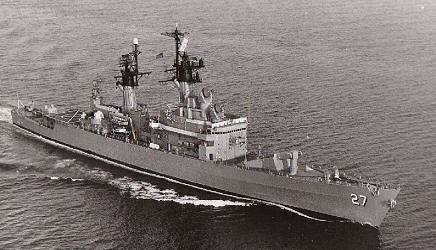 | 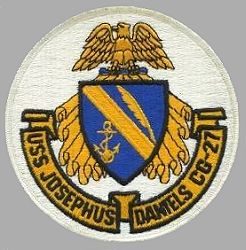 |
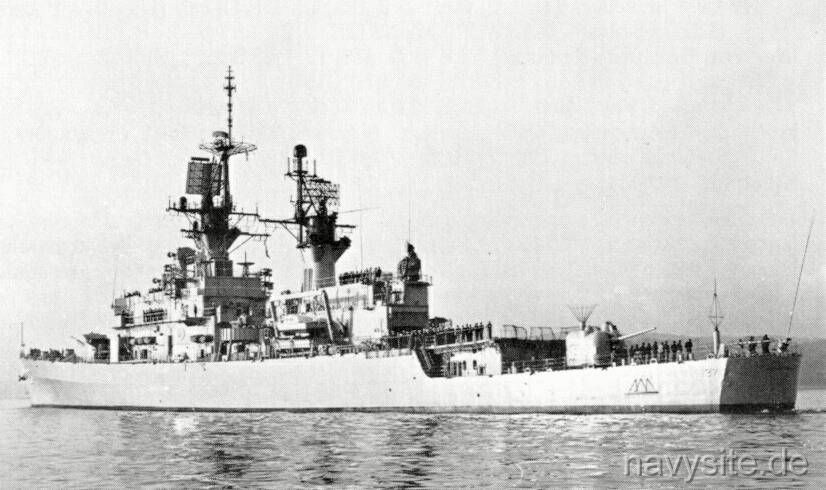
USS JOSEPHUS DANIELS was the second ship in the BELKNAP - class of guided missile cruisers and the first ship in the Navy to bear the name. Both decommissioned and stricken from the Navy list on January 21, 1994, the JOSEPHUS DANIELS was sold for scrapping on February 10, 1999. Throughout her service life, the JOSEPHUS DANIELS conducted a total of 18 major deployments.
| General Characteristics: | Awarded: May 18, 1961 |
| Keel laid: April 23, 1962 | |
| Launched: December 2, 1963 | |
| Commissioned: May 8, 1965 | |
| Decommissioned: January 21, 1994 | |
| Builder: Bath Iron Works, Bath, Maine. | |
| Propulsion system:4 - 1200 psi boilers; 2 General Electric geared turbines | |
| Propellers: two | |
| Length: 548 feet (167 meters) | |
| Beam: 55 feet (16.8 meters) | |
| Draft: 28,5 feet (8.7 meters) | |
| Displacement: approx. 8,100 tons | |
| Speed: 30+ knots | |
| Aircraft: one | |
| Armament: two Mk 141 | |
| Crew: 27 officers and 450 enlisted |
 back to top go to the end of the pageback to top go to the end of the page
Crew List:
This section contains the names of sailors who served aboard USS JOSEPHUS DANIELS. It is no official listing but contains the names of sailors who submitted their information.
back to top go to the end of the pageback to top go to the end of the pageUSS JOSEPHUS DANIELS Cruise Books:
back to top go to the end of the pageAccidents aboard USS JOSEPHUS DANIELS:
| Date | Where | Events |
|---|---|---|
| August 25, 1976 | western Mediterranean | USS CONYNGHAM (DDG 17) and the JOSEPHUS DANIELS are in a minor collision during National Week 21 exercises in the western Med. |
| January 5, 1982 | Atlantic | A SH-3 helicopter operating from the USS JOHN F. KENNEDY (CV 67) crashes aboard the JOSEPHUS DANIELS, slightly injuring some personnel. He helicopter was hovering above the JOSEPHUS DANIELS when the aircraft suddently lost power. The quick reaction of the ship's crew prevented the helo from falling overboard |
back to top go to the end of the pageAbout the Ship's Name:
Josephus Daniels was born 18 May 1862 in Washington, N.C. As editor and publisher of the Raleigh, N.C., News and Observer, he became a major editorial voice in the South. He was appointed Secretary of the Navy by President Wilson in 1 913. A number of his naval reforms included abolishing the officer's wine mess, the introduction of women into the service, and establishment of service schools on board ships and stations. He evinced great interest in the common man, favoring promotion from the ranks and inaugurating the practice of making 100 sailors from the fleet eligible for entrance into the Naval Academy annually. Under his leadership, the Navy expanded greatly and fought effectively in World War I. He resigned as head of the Navy Department in 1921, returning to his job as editor and publisher of the News and Observer until his appointment as Ambassador to Mexico from 1933 to 1942. After furthering President Roosevelt's "Good Neighbor" policy with Mexico, he devoted the remainder of his life to editing and the writing of a number of books, including Our Navy at War and Life of Woodrow Wilson. Josephus Daniels died at Raleigh 15 January 1948.
back to top go to the end of the pageUSS JOSEPHUS DANIELS History:
The Navy awarded the contract for USS JOSEPHUS DANIELS on May 18, 1961; keel laying followed at Bath, Maine, on April 23, 1962. She was launched on December 2, 1963 and commissioned on May 8, 1965, then based at Norfolk to complete trials, weapons qualifications (Terrier SAM, ASROC, and 5-inch battery), and refresher training. After a year of East Coast operations and type training, she departed the Virginia Capes for her first sustained overseas duty on December 9, 1966, joining the U.S. Sixth Fleet in the Mediterranean. That inaugural Sixth Fleet tour carried into early 1967 and set a pattern - air-defense screening for carrier groups, NATO exercises, and short logistics stops at ports such as Naples, Gaeta, Augusta Bay, Barcelona, Palma de Mallorca, Toulon, and Piraeus - repeated across multiple late-1960s deployments as the region rode waves of Arab-Israeli tension and unrest on Cyprus.
Beginning in July 1968 the ship shifted to the Southern Hemisphere for UNITAS IX, the annual circumnavigation of South America with partner navies. The itinerary combined anti-submarine and air-defense drills, gunnery, replenishment training, and a dense schedule of engagements. Port visits clustered along both coasts - typically including Rio de Janeiro and other Brazilian ports on the Atlantic leg, Montevideo and Buenos Aires in the Rio de la Plata, then through the Strait of Magellan to Valparaiso and Talcahuano in Chile, up the Pacific to Callao (Peru) and frequently Guayaquil (Ecuador) or Cartagena (Colombia) - before re-entering the Caribbean and returning to the East Coast. UNITAS cemented the ship's reputation for interoperability and showcased the BELKNAP - class as a flag-waving platform for hemispheric cooperation at the end of the 1960s.
In early 1970, JOSEPHUS DANIELS crossed the Pacific for a Western Pacific/Vietnam tour. She arrived on station in the Gulf of Tonkin by spring and anchored at Da Nang on April 8, 1970 during a logistics window. Her duties alternated between northern Gulf air-defense/picket stations for the carrier force, plane-guard and search-and-rescue coverage near the approaches to Da Nang, and periodic replenishment at Subic Bay and other forward hubs. The deployment - roughly eight months - ran against the backdrop of Vietnamization ashore and continued naval air operations at sea, after which the ship returned to the Atlantic Fleet.
Back in the Atlantic, JOSEPHUS DANIELS resumed a Mediterranean cycle of six-month cruises interleaved with East Coast training and upkeep. On June 30, 1975 the Navy reclassified all guided-missile frigates of her type as cruisers and DLG 27 became CG 27, reflecting the ship's primary mission as a guided-missile cruiser in carrier air-defense formations. A year later, during National Week 21 exercises in the western Mediterranean, she was involved in a minor collision with the destroyer USS CONYNGHAM (DDG 17) on August 25, 1976. Damage was contained and repairs were effected around the deployment schedule, and the cruiser remained with the Sixth Fleet through the exercise season.
Through the late 1970s and early 1980s, JOSEPHUS DANIELS alternated Sixth Fleet deployments with North Atlantic/Caribbean evolutions and periodic selected restricted availabilities. In 1981 she paired with the dock landing ship USS SPIEGEL GROVE (LSD 32) for a goodwill and presence cruise in the Caribbean basin, visiting ports such as Colon (Panama), Curacao, Venezuelan and Colombian ports, and several Eastern Caribbean islands - part of a broader U.S. effort to signal support for regional partners amid Central American instability. On January 5, 1982, while operating in the Atlantic, a visiting SH-3 Sea King suffered a power loss and crashed onto the cruiser's deck during hover operations. Crew response prevented the helicopter from going over the side and injuries were minor. Throughout the mid-1980s she cycled through major Second Fleet exercises, then deployed again to the Mediterranean as part of a carrier group in late 1986, dovetailing with routine Sixth Fleet presence missions and NATO events at a time when air and maritime surveillance near Libya, the Central Med, and the Aegean remained sensitive.
As with her BELKNAP - class sisters, the cruiser's combat systems evolved across the decade: replacement of the legacy Terrier with Standard ER missiles through the Mk 10 launcher, addition of Harpoon canisters for anti-surface strike, and installation of Phalanx CIWS for point defense. Electronics and communications upgrades refreshed the ship for high-tempo staff work and multinational coordination - capabilities she exercised during multi-carrier operations, ASW exercises, and periodic command-and-control support to Sixth Fleet events. Yard work to install and maintain these improvements fell into regular short availabilities at Norfolk and occasional pier-side periods in the Med (Naples/Augusta Bay) to limit time away from deployment cycles.
In mid-1990, JOSEPHUS DANIELS returned to South America for UNITAS XXXI, again serving as a key U.S. platform during the circumnavigation. On July 1, 1990, she transited the Strait of Magellan en route to Punta Arenas, Chile and acted as a senior-officer platform for combined training with nine South American navies. Port visits linked each exercise phase with public-outreach events and planning conferences along both coasts. The deployment coincided with the Cold War's final year and emphasized coalition maritime skills - undersea warfare, coordinated air defense, surface gunnery, replenishment, and maritime interdiction - rather than direct crisis response.
In the early 1990s the cruiser's operations centered on Atlantic and Mediterranean tasking. As U.N. sanctions and maritime embargo enforcement took hold around the Balkans, JOSEPHUS DANIELS supported Sixth Fleet planning cycles and presence patrols, with conference and logistics stops at usual hubs such as Naples, Gaeta, Souda Bay, and Augusta Bay. Stateside, she completed additional short maintenance periods to keep sensors, weapons, and communications current. With post-Cold War force structure shrinking and newer Aegis cruisers taking over long-range air-defense roles, JOSEPHUS DANIELS decommissioned on January 21, 1994. She was struck from the Navy list the same day and later scrapped.
back to top go to the end of the pageUSS JOSEPHUS DANIELS Image Gallery:
 |
back to top
 Back to Cruisers list. Back to ships list. Back to selection page. Back to 1st page.