
Search the Site with

|
Search the Site with
|
 General Characteristics Crew List History Image Gallery to end of page
 | 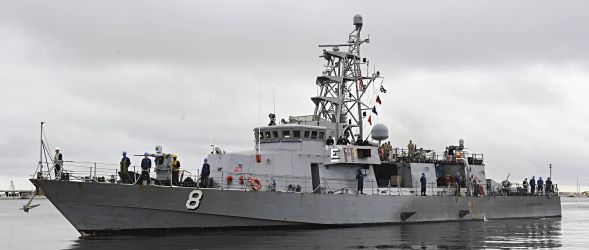 |
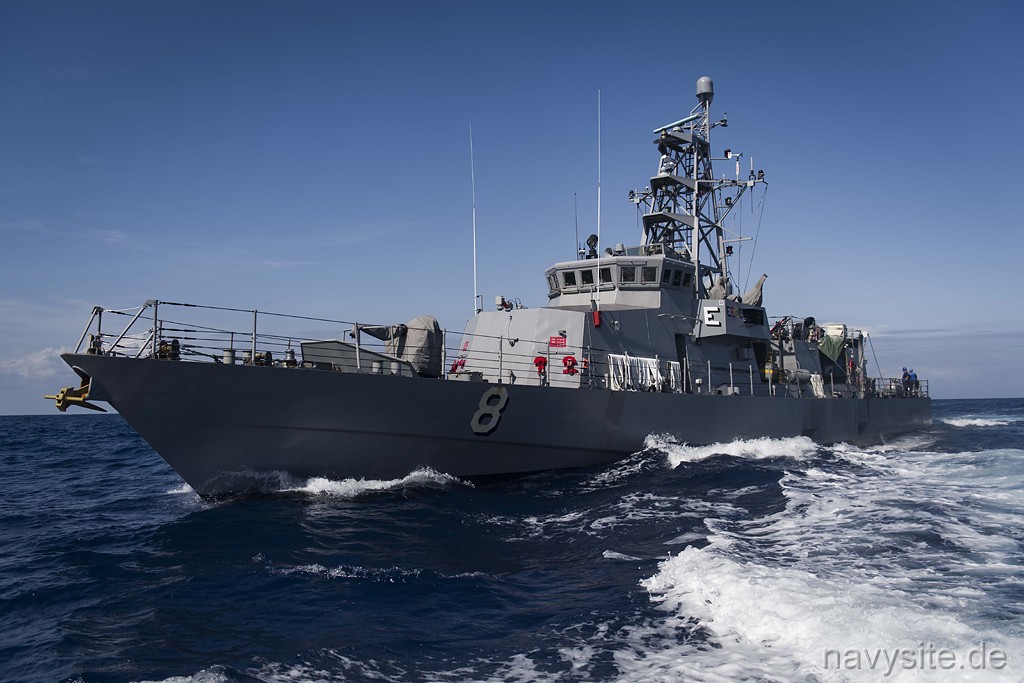
USS ZEPHYR was the 8th CYCLONE - class patrol coastal boat. From November 2001 on, the CYCLONE - class ships were temporarily operated under US Coast Guard control for homeland defense. On October 1, 2004, the ZEPHYR was decommissioned and officially transfered to the US Coast Guard where she was recommissioned as USCGC ZEPHYR (WPC 8). The ZEPHYR re-transfered to the Navy on September 30, 2011.
On February 17, 2021, USS ZEPHYR held a decommissioning ceremony at Naval Station Mayport, Fla. On February 27, the ZEPHYR was officially decommissioned and stricken from the Navy list. On March 23, 2026, the ship was sunk as an artificial reef off Okaloosa County, Florida, in the Gulf of Mexico.
| General Characteristics: | Awarded: August 3, 1990 |
| Keel laid: March 6, 1993 | |
| Launched: December 3, 1993 | |
| Commissioned: October 15, 1994 | |
| Decommissioned: October 1, 2004 | |
| Recommissioned: September 30, 2011 | |
| Decommissioned: February 27, 2021 | |
| Builder: Bollinger Machine Shop & Shipyard, Lockport, Louisiana | |
| Propulsion system:4 Paxman diesels | |
| Propellers: four | |
| Length: 170 feet (51.8 meters) | |
| Beam: 25 feet (7.6 meters) | |
| Draft: 7.5 feet (2.3 meters) | |
| Displacement: approx. 331 tons | |
| Speed: 35 knots | |
| Aircraft: none | |
| Armament: 2 25mm 2 Mk-19 automatic grenade launchers; 6 stinger missiles | |
| Crew: 4 officers, 24 enlisted and 8 Special Forces personnel |
 back to top go to the end of the pageback to top go to the end of the page
Crew List:
This section contains the names of sailors who served aboard USS ZEPHYR. It is no official listing but contains the names of sailors who submitted their information.
back to top go to the end of the pageUSS ZEPHYR History:
USS ZEPHYR, the eighth ship of the CYCLONE-class coastal patrol ships, was built as a small, fast, heavily armed platform for coastal patrol, interdiction, and support to naval special operations. Her keel was laid at Bollinger Machine Shop & Shipyard in Lockport, Louisiana, on March 6, 1993, and she was launched on December 3, 1993, with Mrs. Barbara A. Andrews, an aide to Senator Ted Stevens of Alaska, serving as sponsor. After fitting out and trials, the Navy accepted the ship on August 16, 1994, and she was commissioned as USS ZEPHYR (PC 8) at Corpus Christi, Texas, on October 15, 1994.
From commissioning, ZEPHYR was assigned to Naval Special Warfare Command and placed under the operational control of Special Boat Squadron ONE and Special Boat Unit TWELVE, operating from Naval Base San Diego and Naval Amphibious Base Coronado, California. In this role she joined a small group of CYCLONE-class ships tasked to support special operations forces, practicing high-speed approaches, launch and recovery of small boats, and close-shore operations along the U.S. west coast and in nearby Pacific waters. On May 13, 1997, for example, ZEPHYR was photographed in formation off the coast of San Diego with the patrol coastal ships HURRICANE (PC 3), SQUALL (PC 7), and MONSOON (PC 4), all marked as elements of Special Boat Squadron ONE and Special Boat Unit TWELVE at Naval Base San Diego.
By the mid-1990s, ZEPHYR was already participating in major fleet exercises. In 1996, she took part in Operation Northern Edge 96, a large U.S. joint exercise that brought together air, land, and maritime forces for integrated training. In this context, the small patrol coastal ship practiced coastal surveillance, fast attack profiles, and support to special operations forces within a larger joint environment, demonstrating the Navy's interest in littoral capabilities at a time when post-Cold War strategy was shifting toward regional contingencies and expeditionary operations.
In 1997, ZEPHYR was involved in several significant events that highlighted both her special warfare support and emerging counter-drug roles. Early in the year, she took part in "Socal Sinkex 97", a Southern California sinking exercise that provided live-fire training and the opportunity to operate with larger surface combatants during the controlled sinking of an obsolete target ship. Later in 1997, she deployed for roughly six months in support of UNITAS 38-97, a long-running series of multinational exercises with Latin American navies. ZEPHYR joined a U.S. group that included the destroyer COMTE DE GRASSE (DD 974) and the frigate DE WERT (FFG 45), which together conducted a circumnavigation of South America.
Over the course of this deployment, the ships carried out combined antisurface, antisubmarine, and maritime interdiction exercises with multiple partner navies and made numerous port visits around the continent. Within this force, ZEPHYR provided a high-speed coastal platform for close-in maneuvers, small-boat operations, and boarding exercises, giving regional partners exposure to U.S. concepts for littoral patrol and special operations support.
In 1998, ZEPHYR became the first CYCLONE-class patrol coastal ship to participate in the Rim of the Pacific (RIMPAC) exercise, RIMPAC '98, the large multinational maritime exercise held around the Hawaiian Islands. RIMPAC '98 brought together more than 50 ships, 250 aircraft, and tens of thousands of personnel from the United States and partner nations including Australia, Canada, Chile, Japan, and the Republic of Korea. Operating from Hawaiian waters in company with cruisers, destroyers, amphibious ships, and mine warfare units, ZEPHYR conducted coastal patrols, high-speed screening, and escort duties, showing how a small patrol coastal craft could contribute to a large, networked task force. Her participation in RIMPAC illustrated the Navy's experimentation with integrating littoral combatants into blue-water combined exercises.
Beginning in the late 1990s and into the early 2000s, ZEPHYR increasingly focused on counter-narcotics and maritime security operations in the Caribbean and Eastern Pacific. According to later official summaries, her deployments included a series of named operations: a "Caribbean Operation", Operation Blue Privateer, Operation Frontier Shield, an East Pacific counter-narcotics operation, and Joint Interagency Task Force (JIATF) East operations that included Exercise Fox Catcher.
In these missions, ZEPHYR typically embarked U.S. Coast Guard law enforcement detachments and operated as a fast interdiction platform, using her speed, maneuverability, and small-boat facilities to close and board suspect vessels. During Operation Blue Privateer, she took part in one of the most notable drug seizures of her career: boarding the freighter CASPER and confiscating approximately 4,000 pounds of cocaine and 200 pounds of marijuana, an interdiction that was cited at the time as the ninth-largest drug bust in U.S. history.
After the terrorist attacks of September 11, 2001, ZEPHYR's mission profile shifted strongly toward homeland defense and port security. She participated in Operation Chokehold 01-1 and deployed repeatedly in support of Operation Noble Eagle, the overarching homeland defense operation that followed the attacks. These missions saw ZEPHYR conducting harbor and coastal security patrols, escorting high-value units such as aircraft carriers and amphibious ships in and out of major U.S. ports, and working closely with Coast Guard, harbor police, and other security forces. She also supported "Pacific North West" operations that concentrated on maritime security in the approaches to key installations in the Puget Sound area, part of a layered defense around ballistic missile submarine bases and other strategic facilities.
In the same period, she joined operations Leviathan and Neptune Shield, which linked maritime homeland defense with larger joint and allied exercises, reinforcing the role of small patrol craft in close-in security and interdiction.
By 2004, ZEPHYR had become heavily engaged in high-value unit escort and maritime security patrols. Official evaluation later noted that she completed 30 high-value unit escorts in that year alone, reflecting the continuing demand for small, agile escorts to protect major combatants, merchant shipping, and critical infrastructure in U.S. coastal waters. At the same time, the Navy decided that several CYCLONE-class ships would be better employed by the U.S. Coast Guard for homeland security missions. As part of this shift, ZEPHYR was decommissioned from the Navy and transferred to the Coast Guard on October 1, 2004.
Recommissioned as USCGC ZEPHYR (WPC 8), she entered service as a medium endurance cutter equipped for coastal security, search and rescue, and counter-drug operations.
During her Coast Guard service from 2004 to 2011, ZEPHYR was based on the Gulf Coast and assigned to multi-mission duties that combined law enforcement, border security, and maritime safety. Congressional testimony and Coast Guard documentation from this period identify WPC 8 ZEPHYR as a Pascagoula, Mississippi-based cutter slated eventually to be returned to the Navy, highlighting her role in regional Coast Guard force structure. She conducted patrols in the Gulf of Mexico and Caribbean Sea, enforcing fisheries regulations, supporting migrant interdiction, and working alongside larger cutters and aircraft in counter-drug operations. She also maintained crew proficiency through training periods with Fleet Training Group San Diego. Records show her participating in such training in late 2006, integrating Coast Guard procedures with Navy ship-handling and engineering drills.
One of ZEPHYR's most prominent Coast Guard missions came in April 2010, following the explosion and fire aboard the mobile offshore drilling unit DEEPWATER HORIZON in the Gulf of Mexico on April 20, 2010. As Coast Guard and other federal assets converged on the scene for search and rescue operations and initial response to what would become a massive oil spill, USCGC ZEPHYR (WPC 8) arrived on scene early in the response and assumed duties as the on-scene coordinator for search and rescue activities around the stricken rig. Her role in directing small boats, coordinating rescue helicopters, and providing a command platform amid a complex and hazardous environment was later reflected in the award of a Humanitarian Service Medal to the ship for her participation in this response.
The loan of CYCLONE-class ships to the Coast Guard was always intended to be temporary, and by 2011 Coast Guard budget documents and planning guidance noted that WPC-class assets would be returned to the Navy as new Coast Guard patrol craft entered service. ZEPHYR's Coast Guard operations gradually wound down, and she was returned to Navy custody in 2011 for reactivation as a patrol coastal ship. After refit and preparation under Navy control, she was formally returned to full U.S. Navy service on September 30, 2011, once again carrying the designation USS ZEPHYR (PC 8) and operating out of Joint Expeditionary Base Little Creek, Virginia.
Following her return to the Navy, ZEPHYR shifted focus from homeland defense in U.S. coastal waters to forward-leaning counter-illicit-trafficking missions in the Caribbean and Eastern Pacific under U.S. 4th Fleet and U.S. Naval Forces Southern Command. In late 2013, she completed a homeport shift from Joint Expeditionary Base Little Creek to Naval Station Mayport, Florida, alongside the patrol coastal ship TORNADO (PC 14). From Mayport, she began a pattern of regular deployments into the 4th Fleet area of responsibility, typically embarking a Coast Guard law enforcement detachment and operating under Joint Interagency Task Force-South (JIATF-S) as part of Operation Martillo, the multinational effort to target illicit trafficking routes along the Central American coastline.
By 2016, ZEPHYR was firmly established in this role. That year, she completed a 45-day patrol in the 4th Fleet area, returning to Mayport after conducting counter-illicit-trafficking and maritime security operations in the Caribbean Sea and adjacent waters. During these deployments, she worked with partner coast guards and navies, as well as with U.S. destroyers and Coast Guard cutters, tracking suspected smuggling vessels, providing surface contact information to aircraft, and deploying her embarked boarding teams via rigid-hull inflatable boat to intercept and inspect small craft. Her relatively shallow draft and high speed made her well suited to chasing "go-fast" boats in constrained waters.
From November 2016 into early 2017, ZEPHYR and the patrol coastal ship SHAMAL (PC 13) conducted further counter-drug patrols in the 4th Fleet area of responsibility. On January 17, 2017, both ships returned to Naval Station Mayport after 64-day patrols. For ZEPHYR this marked the completion of her first deployment of fiscal year 2017 and included a significant interdiction in which she and her embarked Coast Guard law enforcement detachment seized approximately 900 kilograms of cocaine from a go-fast vessel and detained four suspected traffickers, all in support of Operation Martillo.
Barely months later, ZEPHYR deployed again from Mayport for another counter-drug patrol in the 4th Fleet area. That deployment lasted 56 days and ended with her return to homeport on May 10, 2017. During this patrol, she was involved in a widely reported interdiction in the Caribbean Sea in April 2017, when ZEPHYR and her embarked Coast Guard detachment, operating under JIATF-S and Operation Martillo, intercepted a smuggling vessel and seized cocaine valued at about $22.5 million in street value.
ZEPHYR continued this tempo into 2017 and beyond. In the late summer and autumn of 2017, she undertook a 76-day deployment in support of 4th Fleet operations, again under the umbrella of Operation Martillo. On November 10, 2017, she returned to Naval Station Mayport after this patrol, during which she worked with partner nations and U.S. Coast Guard personnel to interdict trafficking routes off Central America and seized approximately 726 kilograms of cocaine, adding to the cumulative impact of Martillo operations on transnational criminal organizations. Throughout these deployments, she also conducted training with regional navies, shiprider operations with partner country law-enforcement personnel, and presence patrols near key sea lanes, contributing to broader maritime security objectives in the Caribbean and Eastern Pacific.
During 2018 and 2019, ZEPHYR remained based at Mayport and continued to cycle through 4th Fleet patrols and maintenance periods. Official reporting emphasizes that she, along with other patrol coastal ships, deployed regularly to the 4th Fleet area to conduct counter-illicit-trafficking operations, maritime security patrols, and interoperability exercises under the operational control of U.S. Naval Forces Southern Command and JIATF-S. These deployments maintained pressure on smuggling networks attempting to move cocaine and other contraband from South America toward Central America and the Caribbean, and they provided ongoing opportunities for ZEPHYR's crew to exercise visit, board, search, and seizure procedures in real-world conditions. Between deployments the ship underwent routine maintenance availabilities to keep her aging hull and machinery in serviceable condition beyond the class's originally envisioned service life.
Even in the final years of her career, ZEPHYR remained active in counter-drug operations. A September 18, 2020, report on a large multi-ship offload of seized narcotics in Florida noted that ZEPHYR, operating in the Caribbean Sea with an embarked Coast Guard law enforcement detachment, recovered approximately 12 pounds of marijuana as part of a broader series of interdictions shared among several U.S. Navy and Coast Guard units and the British auxiliary RFA ARGUS (A 135).
By 2021, the CYCLONE-class patrol coastal ships had exceeded their design service lives, and the Navy moved to retire the remaining units. ZEPHYR's long operational record, stretching from special operations support in the 1990s through Coast Guard service and multiple tours in the Caribbean and Eastern Pacific, was recognized as she prepared to leave active duty. A decommissioning ceremony was held at Naval Station Mayport on February 17, 2021, marking her retirement from operational service in front of crew, former crew members, and guests. On February 27, 2021, USS ZEPHYR was formally decommissioned and stricken from the Naval Vessel Register.
Following her decommissioning and removal from the Naval Vessel Register, ex-ZEPHYR was transferred to the Navy's inactive ship facility in Philadelphia, Pennsylvania, where she remained laid up for several years. She was eventually selected for disposal as an artificial reef. On March 23, 2026, the ship was sunk off Okaloosa County, Florida, in the Gulf of Mexico. Ex-ZEPHYR now rests in approximately 157 feet of water at 30° 04.221' N, 86° 33.946' W, with about 47 feet of relief above the seafloor.
back to top go to the end of the pageUSS ZEPHYR Image Gallery:
 |  |
The photo below was taken by Michael Jenning and shows ex-ZEPHYR laid up at Philadelphia, Penn., on May 26, 2023 alongside her sisterships ex-TORNADO (PC 14) and ex-SHAMAL (PC 13).
 |
back to top
 Back to Patrol Coastal Boats list. Back to ships list. Back to selection page. Back to 1st page.