![]() |
Search the Site with
|
![]() | ![]() |
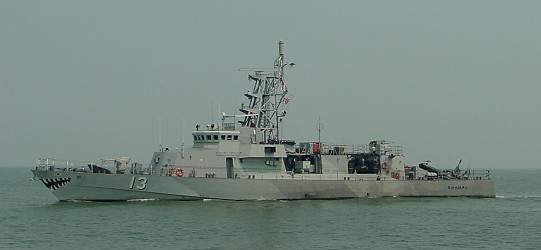
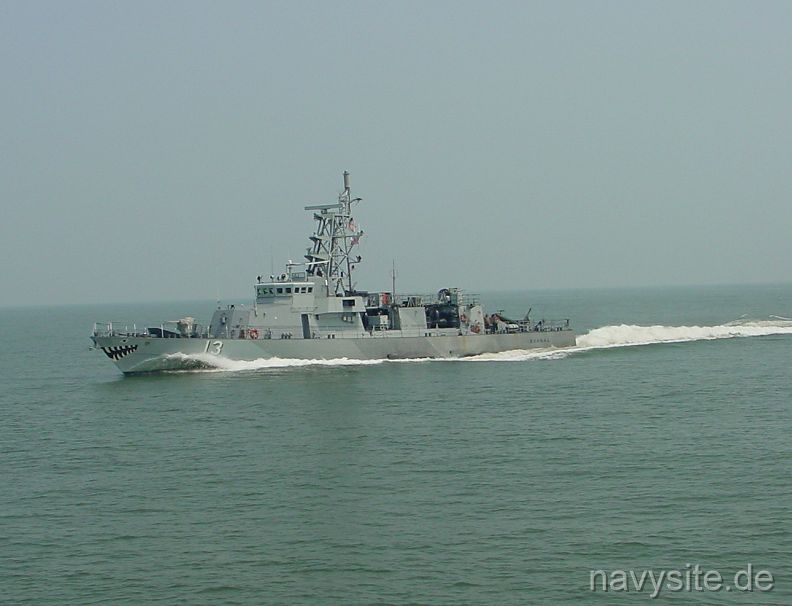
USS SHAMAL was the 13th CYCLONE - class patrol coastal boat. From November 2001 on, the CYCLONE - class ships were temporarily operated under US Coast Guard control for homeland defense. On December 6, 2004, the SHAMAL was decommissioned and officially transfered to the US Coast Guard where she was recommissioned as USCGC SHAMAL (WPC 13). The SHAMAL was re-transfered to the Navy on September 30, 2011.
On February 16, USS SHAMAL held a decommissioning ceremony at Naval Station Mayport, Fla. On February 26, the SHAMAL was officially decommissioned and stricken from the Navy list. She was subsequently scrapped.
| General Characteristics: | Awarded: July 19, 1991 |
| Keel laid: September 23, 1994 | |
| Launched: March 3, 1995 | |
| Commissioned: January 27, 1996 | |
| Decommissioned: December 6, 2004 | |
| Recommissioned: September 30, 2011 | |
| Decommissioned: February 26, 2021 | |
| Builder: Bollinger Machine Shop & Shipyard, Lockport, Louisiana | |
| Propulsion system:4 Paxman diesels | |
| Propellers: four | |
| Length: 170 feet (51.8 meters) | |
| Beam: 25 feet (7.6 meters) | |
| Draft: 7.5 feet (2.3 meters) | |
| Displacement: approx. 331 tons | |
| Speed: 35 knots | |
| Aircraft: none | |
| Armament: 2 25mm 2 Mk-19 automatic grenade launchers; 6 stinger missiles | |
| Crew: 4 officers, 24 enlisted and 8 Special Forces personnel |
Crew List:
This section contains the names of sailors who served aboard USS SHAMAL. It is no official listing but contains the names of sailors who submitted their information.
USS SHAMAL History:
USS SHAMAL was the thirteenth CYCLONE-class patrol coastal ship, built as a fast, shallow-draft platform for coastal patrol, special operations support and, later in her career, intensive counter-drug work in the Caribbean and eastern Pacific. Ordered on July 19, 1991, and constructed by Bollinger Shipyards at Lockport, Louisiana, she was laid down on September 23, 1994, and launched on March 3, 1995. After fitting-out and trials she was acquired by the Navy on October 31, 1995, and commissioned as USS SHAMAL (PC 13) on January 27, 1996.
From commissioning, she joined the group of CYCLONE-class patrol ships assigned to United States Naval Special Warfare Command. Like her sisters, she was intended to give SEALs and special boat units a high-speed, heavily armed platform for coastal surveillance, interdiction and insertion missions. These ships, including USS SHAMAL, operated under the administrative control of Special Boat Squadron TWO at Naval Amphibious Base Little Creek in Virginia, deploying with special operations forces for training, exercises and contingency missions along the U.S. East Coast and to overseas theaters.
The security environment for the ship changed rapidly after the attacks of September 11, 2001. In 2001, three CYCLONE-class patrol ships - SHAMAL, TEMPEST (PC 2) and TORNADO (PC 14) - were assigned to the U.S. Atlantic Fleet for maritime homeland security operations and homeported at Pascagoula, Mississippi, marking a shift from a primarily special-operations focus to coastal defense and port security missions in U.S. waters.
By 2004, SHAMAL combined routine coastal patrol work with high-visibility public engagements. During New York City's Fleet Week in late May 2004, she took part in the 17th annual event, with sailors from the ship participating in community-relations activities ashore. One official caption records a quartermaster from USS SHAMAL taking part in a lawn-bowling game in Central Park, underscoring the use of the small patrol craft as an ambassadorial presence alongside larger combatants in major port visits. That summer and early autumn, she continued coastal security patrols as the Navy and Coast Guard refined their division of labor in homeland defense.
A major transition came in the autumn of 2004. On September 29, 2004, SHAMAL was formally transferred from the Navy to the United States Coast Guard at Little Creek, Virginia, and placed in "commission special" status. She then underwent a two-month dockside availability at Integrated Support Command Portsmouth, Virginia, where she was adapted to Coast Guard service and prepared for a new operating pattern centered on law-enforcement missions. Following this work, she transited south to her new homeport of Pascagoula, Mississippi, and on December 6, 2004 was officially commissioned as USCGC SHAMAL (WPC 13). Coast Guard documentation from the time notes that her planned major missions would be alien-migrant interdiction and drug-interdiction operations within the Seventh and Eighth Coast Guard Districts, covering the Caribbean approaches, Florida Straits and much of the Gulf of Mexico.
In Coast Guard service through the second half of the 2000s, SHAMAL carried out those roles from Pascagoula, typically operating with a crew similar in size to her Navy complement and retaining the CYCLONE-class' mix of medium-caliber guns, grenade launchers and machine guns, now oriented toward law-enforcement rather than combat missions. She patrolled coastal and offshore waters for migrant-smuggling craft and drug-running "go-fast" boats, worked with Coast Guard aircraft and larger cutters, and took part in routine search-and-rescue responses in her assigned areas of responsibility. Her operations fit into a broader Coast Guard strategy that used former Navy CYCLONE-class ships as high-speed interdiction cutters while new SENTINEL-class fast response cutters were being introduced.
On September 30, 2011, after nearly seven years in the Department of Homeland Security, SHAMAL was decommissioned from Coast Guard service and transferred back to the Navy. Returned to the Navy as USS SHAMAL (PC 13), she rejoined the CYCLONE-class roster in late 2011 as part of an effort to bolster the small-ship force. U.S. Navy "year in review" reporting for 2011 highlighted the return of ZEPHYR (PC 8), SHAMAL and TORNADO from the Coast Guard and their recommissioning as adding to the patrol-coastal fleet. Initially, she again fell under the administrative control of Special Boat Squadron TWO at Little Creek, conducting local training, qualification and readiness operations as the Navy evaluated how best to employ the returning PCs.
During this period, the ship again shifted homeport. By late September 2013, local reporting from Florida recorded that USS SHAMAL had completed a homeport change from Joint Expeditionary Base Little Creek in Virginia Beach to Naval Station Mayport near Jacksonville, Florida. At Mayport, she joined a small group of CYCLONE-class ships - including ZEPHYR and TORNADO - based in the continental United States rather than forward-deployed to Bahrain. The Mayport-based PCs were earmarked both for training and for homeland security roles, but by the middle of the decade their primary employment shifted decisively toward counter-drug operations under U.S. Southern Command and U.S. Fourth Fleet.
Operation Martillo, a multinational counter-drug campaign targeting maritime trafficking routes off Central America, began in 2012. USS SHAMAL entered this operational pattern in late 2015. On December 9, 2015, she departed Mayport on her first 45-day patrol in the U.S. Fourth Fleet area of operations in support of Operation Martillo. After roughly six weeks conducting counter-illicit trafficking missions in the Western Caribbean and Eastern Pacific, she returned to port having participated in two joint interdictions that resulted in the seizure or jettison of 620 kilograms of cocaine and the detention of four suspected smugglers. The patrol refined the integration of her crew with embarked Coast Guard law-enforcement detachments and with Joint Interagency Task Force South, which coordinated intelligence and cueing across the region.
Barely weeks later, SHAMAL left again. On March 8, 2016, she got underway from Mayport for a second 45-day Operation Martillo patrol. Operating once more in the Fourth Fleet area - principally waters off Central America - she worked alongside U.S. Maritime Patrol Aircraft, the destroyer USS LASSEN (DDG 82) and U.S. Coast Guard cutters and aircraft. Over the course of this deployment, SHAMAL assisted in two further interdiction events that yielded or forced the jettison of a total of 1,400 kilograms of cocaine and produced one detainee, bringing her tally from the first two patrols to four events and more than two metric tons of narcotics removed from the flow northward. She returned to Naval Station Mayport on April 20, 2016, marking the completion of her second counter-drug patrol and her first pair of major deployments since returning from the Coast Guard.
These early Martillo deployments also showcased new equipment. SHAMAL, ZEPHYR and TORNADO were modified with a Coast Guard-style Over-the-Horizon rigid-hull inflatable boat and associated equipment, allowing embarked law-enforcement detachments to range farther from the ship and use their own radar and communications to pursue contacts. The combination of the PCs' speed and endurance with the OTH-RHIB and Coast Guard boarding teams made SHAMAL an asset well-suited to chasing small smuggling craft in coastal and open-ocean environments.
No sooner had she completed her second counter-drug patrol than SHAMAL was tasked with a ceremonial role. The April 2016, Navy release noted that "next on the horizon" for the ship was participation in Fleet Week New York. On May 25, 2016, she joined the amphibious assault ship USS BATAAN (LHD 5), the dock landing ship USS FORT McHENRY (LSD 43), Canadian patrol vessels and Coast Guard cutters in the Parade of Ships into New York Harbor for the 28th annual Fleet Week. During the week, her crew hosted public tours and took part in community-relations projects around the city, continuing a tradition that dated back to her appearance at Fleet Week 2004.
After Fleet Week she returned to deployment. On August 2, 2016, U.S. Naval Forces Southern Command reported that USS SHAMAL had just returned to Naval Station Mayport from a 62-day patrol in the Fourth Fleet area of responsibility - her third Operation Martillo deployment. During this two-month period, she assisted in five joint interdictions that seized or forced the jettison of approximately 1,483 kilograms of cocaine and resulted in six detainees. The release again emphasized the importance of the OTH-RHIB and embarked Coast Guard law-enforcement detachment in extending the ship's reach and responsiveness.
In late 2016, and into early 2017 SHAMAL continued this pattern. On January 17, 2017, she and USS ZEPHYR returned to Mayport from another 64-day counter-drug patrol in support of Operation Martillo, again operating in the Caribbean and eastern Pacific and contributing, together with partner forces, to the seizure of some 900 kilograms of cocaine and detention of four suspects during the deployment. By this time, the Mayport-based PCs were a routine presence in the region, rotating deployments and availing themselves of the network of partner-nation ports and logistical hubs that supported multinational counter-drug cooperation, although specific port calls during these patrols were not detailed in publicly available summaries.
From 2017 through 2019, USS SHAMAL remained based at Mayport and continued to deploy to the U.S. Southern Command area of responsibility. Naval and defense reporting in this period consistently described SHAMAL, ZEPHYR and TORNADO as the trio of CYCLONE-class patrol ships stationed in Mayport for training and homeland security duties while the rest of the class operated forward-deployed in the Persian Gulf. In practice, for SHAMAL this meant an alternating rhythm of Operation Martillo patrols focused on counter-narcotics work in the Caribbean and eastern Pacific, interspersed with maintenance periods, training, inspections and local operations from Mayport.
One of SHAMAL's most clearly documented late-career missions came in the summer of 2020. On July 4, 2020, while on routine patrol in the Caribbean Sea with an embarked Coast Guard law-enforcement detachment, USS SHAMAL detected a small "go-fast" smuggling vessel whose crew began jettisoning packages when they realized they had been spotted. SHAMAL launched her small boat and worked with the LEDET to pursue the contact and recover the discarded bales. By the end of the operation, the ship and boarding team had recovered 708 bales of suspected marijuana weighing more than 3,900 pounds, with an estimated wholesale value of 6.9 million dollars. U.S. Southern Command described the interdiction as part of enhanced counter-narcotics operations that began on April 1, 2020, tying SHAMAL's work to a theater-wide surge effort involving Navy, Coast Guard, and interagency assets against transnational criminal organizations.
Into 2020 and early 2021, SHAMAL continued to operate from Mayport as one of the last three CYCLONE-class ships based in the continental United States. In February 2021, the Navy began retiring the remaining PCs without direct replacement, judging that their roles could be covered by a mix of other surface combatants, littoral combat ships and Coast Guard cutters. USS SHAMAL was decommissioned at Naval Station Mayport on February 16, 2021, in a ceremony that also marked the start of the final drawdown of the class in U.S. service. She was formally stricken from the Naval Vessel Register on February 26, 2021.
USS SHAMAL Image Gallery:
![]() | ![]() | ![]() | ![]() | ![]() |
The photo below was taken by Michael Jenning and shows ex-SHAMAL laid up at Philadelphia, Penn., on May 26, 2023 alongside her sisterships ex-TORNADO (PC 14) and ex-ZEPHYR (PC 8).
![]() |
Back to Patrol Coastal Boats list.
Back to ships list.
Back to selection page.
Back to 1st page.