
Search the Site with

|
Search the Site with
|
 General Characteristics Crew List History Image Gallery to end of page
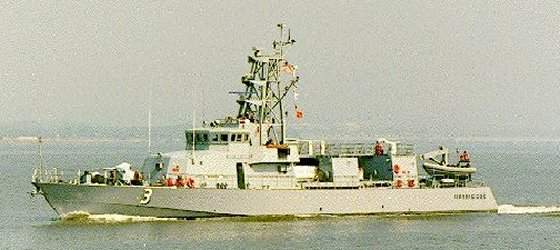 |  |
USS HURRICANE was the third CYCLONE - class patrol coastal boat. From November 2001 on, the CYCLONE - class ships were temporarily operated under US Coast Guard control for homeland defense. USS HURRICANE was decommissioned and stricken from the Naval Vessel Register on March 20, 2023, in a ceremony held in Alexandria, Egypt. On March 21, 2023, she was formally transferred to Egypt under the U.S. Excess Defense Articles program and commissioned into the Egyptian Navy as ENS KHALED BIN ELWALED (PC 720).
| General Characteristics: | Awarded: August 3, 1990 |
| Keel laid: November 20, 1991 | |
| Launched: June 6, 1992 | |
| Commissioned: October 15, 1993 | |
| Decommissioned: March 20, 2023 | |
| Builder: Bollinger Machine Shop & Shipyard, Lockport, Louisiana | |
| Propulsion system:4 Paxman diesels | |
| Propellers: four | |
| Length: 170 feet (51.8 meters) | |
| Beam: 25 feet (7.6 meters) | |
| Draft: 7.5 feet (2.3 meters) | |
| Displacement: approx. 331 tons | |
| Speed: 35 knots | |
| Aircraft: none | |
| Armament: 2 25mm 2 Mk-19 automatic grenade launchers; 6 stinger missiles | |
| Crew: 4 officers, 24 enlisted and 8 Special Forces personnel |
 back to top go to the end of the pageback to top go to the end of the page
Crew List:
This section contains the names of sailors who served aboard USS HURRICANE. It is no official listing but contains the names of sailors who submitted their information.
back to top go to the end of the pageUSS HURRICANE History:
The coastal patrol ship USS HURRICANE was ordered as part of the CYCLONE-class program to provide fast, shallow-draft platforms for coastal patrol, interdiction and direct support to Naval Special Warfare forces. She was built by Bollinger Machine Shop and Shipyard at Lockport, Louisiana, where her keel was laid on November 20, 1991 and she was launched on June 6, 1992. After fitting out and trials, she was delivered to the U.S. Navy on July 21, 1993, and commissioned on October 15, 1993, at Naval Air Station North Island in San Diego, California.
Assigned to Special Boat Squadron ONE under Naval Special Warfare Command and homeported at Naval Amphibious Base Coronado, she entered service at a time when the Navy was refining its approach to littoral warfare and joint special operations after the end of the Cold War and the 1991 Gulf War. In her first months of active duty, USS HURRICANE completed shakedown and work-up training off southern California, exercising her high-speed maneuvering, coastal navigation and boarding capabilities. The CYCLONE-class ships, with their small crews and high sprint speed, were intended to embark and support small special operations detachments, and HURRICANE's early operations focused on developing tactics for inserting and recovering special operations forces close to shore, as well as practicing visit, board, search and seizure procedures alongside other surface units. These activities took place primarily in the eastern Pacific operating areas off San Diego, under the tactical control of Naval Special Warfare and surface fleet commands, and established her routine pattern of short deployments and training periods between maintenance alongside at Coronado.
In 1994, the political crisis in Haiti drew USS HURRICANE into her first major operational deployment. Following the 1991 military coup that had overthrown President Jean-Bertrand Aristide, the United Nations and the United States moved to enforce sanctions and eventually restore the elected government. Under Operation Support Democracy and later Operation Uphold Democracy and Operation Restore Democracy, U.S. and multinational naval forces ringed the island to enforce an embargo and to support the insertion of ground forces. USS HURRICANE deployed from Coronado to the Caribbean and operated off the Haitian coast in company with larger amphibious and surface combatants, using her shallow draft and high speed to patrol close inshore, identify and query small craft, and provide a quickly maneuvering platform for boarding teams. Contemporary imagery shows her underway off Haiti operating with other U.S. ships explicitly in support of Operation Restore Democracy. Her role added a coastal interdiction and surveillance capability to the task force at a time when the main concern was the flow of arms and political figures into and out of Haiti by small vessels.
After the Haiti deployment, USS HURRICANE returned to southern California and resumed her pattern of Naval Special Warfare support. As part of Special Boat Squadron ONE she was one of the principal ships available for training West Coast special operations units, including exercises in high-speed approaches to rugged shorelines, night operations, and live-fire events on instrumented ranges. The ship's small crew and intensive operational tempo required frequent short maintenance availabilities in the San Diego area to keep her diesel propulsion and mission systems in good condition, while her operations remained focused on coastal patrol and the special warfare mission that had been central to the CYCLONE-class concept.
Through the later 1990s and early 2000s, USS HURRICANE continued as a Coronado-based patrol craft, participating in fleet exercises and joint training in the eastern Pacific and periodically embarking detachments of special operations personnel. Open sources do not provide a detailed month-by-month chronology for these years, but they consistently describe the class, and HURRICANE in particular, as providing long-range SEAL insertion and extraction capability and tactical swimmer operations in addition to routine coastal patrol duties under Naval Special Warfare Command.
A significant change came in the mid-2000s, as the Navy reassessed where the CYCLONE-class ships could best support emerging missions related to counter-terrorism and maritime security after the September 11, 2001 attacks. On November 1, 2005, USS HURRICANE began the process of shifting her homeport from Naval Amphibious Base Coronado to Naval Amphibious Base Little Creek in Virginia, a move that was completed by December 15, 2005. This relocation placed her under Atlantic Fleet operational control and closer to the U.S. East Coast, Caribbean and eventually the U.S. Fifth Fleet's Middle East operating areas, aligning with a broader plan to employ the CYCLONE-class in the Arabian Gulf for coastal security and protection of critical maritime infrastructure.
From 2006 onward, USS HURRICANE operated from Little Creek as one of the Atlantic-based patrol coastal ships, conducting training along the U.S. East Coast and in nearby waters while the Navy prepared to expand the CYCLONE-class presence in the Middle East. Exercises in these years focused on boarding tactics, escort procedures, and coordination with Coast Guard and allied units, reflecting the growing emphasis on maritime security, counter-smuggling and coastal surveillance. Although specific port visits in this period are not comprehensively documented in open sources, her operations fit the general pattern of short deployments and training phases typical for the class.
In 2012, USS HURRICANE took part in high-visibility commemorative operations connected to the bicentennial of the War of 1812. On July 20, 2012, she operated in company with the frigate USS DE WERT (FFG 45) and the Canadian frigate HMCS VILLE DE QUEBEC (FFH 332) at Halifax, Nova Scotia, during a reception hosted aboard the Canadian ship and associated public events marking the anniversary of the war. The trio of ships was engaged in a series of port visits in American and Canadian cities intended to highlight naval history and current cooperation. Later that summer, on September 20, 2012, USS HURRICANE visited Hamilton, Ontario, again together with HMCS VILLE DE QUEBEC, as part of the same bicentennial commemoration program on the Great Lakes. These visits showcased the ship to the public in waterfront cities far from her usual operating areas and underscored U.S.-Canadian naval ties.
Strategic priorities in the U.S. Central Command region soon led to a more permanent redeployment. In 2014, the Navy decided to concentrate nearly all of the CYCLONE-class ships in the Arabian Gulf to bolster maritime security forces there. USS HURRICANE was selected as one of the ships to move, and she departed the United States for the Middle East, eventually arriving at her new forward operating location at Manama, Bahrain. Once established in Bahrain, USS HURRICANE became one of ten patrol coastal ships assigned to Fifth Fleet, conducting continuous maritime security operations in the Arabian Gulf. Her missions involved patrolling busy sea lanes, escorting larger U.S. and allied surface combatants near the Strait of Hormuz and other chokepoints, and monitoring local traffic near vital offshore infrastructure. Fifth Fleet statements describe the class in this period as "small, but capable ships" whose role was to protect infrastructure, escort larger ships and build partnerships with regional navies by operating alongside them in exercises and routine patrols.
By 2018, images show USS HURRICANE operating routinely from Bahrain, alongside U.S. Coast Guard ISLAND-class patrol boats such as USCGC ADAK (WPB 1333), supporting maritime security patrols around Manama and within the wider Fifth Fleet area of responsibility. Her presence in these waters coincided with heightened tensions over Iranian activities and continued concerns about piracy, arms smuggling and attacks on merchant shipping, making the small patrol craft an important element of the layered security posture in the region.
In December 2019, USS HURRICANE played a prominent role in an annual test of the MK-60 Griffin guided-missile system held in the Arabian Gulf from December 10 to 14. During this Griffin Missile Exercise 2019, she launched a Griffin missile from her deck as part of a series of live-fire events designed to validate improvements to the system and sharpen tactics against small-boat threats. The exercise brought together multiple patrol coastal ships - USS SIROCCO (PC 6), USS TEMPEST (PC 2), USS SQUALL (PC 7), USS HURRICANE and USS WHIRLWIND (PC 11) - and ISLAND-class cutters USCGC ADAK, USCGC AQUIDNECK (WPB 1309) and USCGC BARANOF (WPB 1318). The participating ships also conducted live-fire drills with their 25-mm Mark 38 guns and other crew-served weapons. This event illustrated both the ships' evolving armament, as the Griffin missile was integrated to extend their reach, and the importance of combined Navy-Coast Guard operations in narrow and contested waters.
In 2020, USS HURRICANE underwent a major maintenance period in Bahrain. The Forward Deployed Regional Maintenance Center Detachment Bahrain completed a Docking Phased Maintenance Availability, a 203-day docking period at the Bahrain Ship Repair and Engineering Company that concluded before the Navy publicized the achievement on October 22, 2020. During this availability, the ship received extensive work, including replacement of all four stern tubes, replacement of one of her main engines and upgrades to her combat systems suite. The maintenance was conducted under the constraints of the COVID-19 pandemic, and Navy accounts emphasize that the project team had to adjust schedules and manage industrial challenges while keeping the availability on track. The completion of this DPMA restored USS HURRICANE to full operational status and was part of a recurring three-year maintenance cycle for the patrol coastal ships in Bahrain.
On April 7, 2021, USS HURRICANE took part in Exercise Neon Defender 21 in the Arabian Gulf, a bilateral maritime exercise between U.S. and Bahraini forces that focused on cooperative defense and maritime security. In formation that day were the Royal Bahrain Naval Force fast attack craft RBNS ABDUL RAHMAN AL-FADEL (P 22), Bahrain Coast Guard response boats HAWAR 5 and HAWAR 4, the guided-missile destroyer USS MAHAN (DDG 72), patrol coastal ships USS SQUALL and USS HURRICANE, the U.S. Coast Guard patrol boat USCGC ADAK, and two Mark VI patrol boats. Operating in formation, these units practiced coordinated maneuvering, communications and combined responses to simulated threats, reinforcing interoperability between U.S. and Bahraini maritime forces and demonstrating the flexibility of small patrol craft working alongside larger warships.
USS HURRICANE also appears in official accounts of a significant arms-interdiction operation in late 2022. On November 8, 2022, U.S. Fifth Fleet forces intercepted a fishing vessel in the Gulf of Oman that was smuggling a large quantity of explosive material from Iran to Yemen, in violation of United Nations Security Council Resolution 2216 and international law. The initial interdiction was carried out by the Coast Guard cutter USCGC JOHN SCHEUERMAN (WPC 1146) and the destroyer USS THE SULLIVANS (DDG 68), while USS HURRICANE and explosive ordnance disposal technicians from Task Force 56 assisted over the course of a week-long effort to fully search the vessel and analyze the cargo.
U.S. forces ultimately discovered more than 70 tons of ammonium perchlorate - enough oxidizer for numerous medium-range ballistic missiles - as well as over 100 tons of urea fertilizer, a potential explosive precursor. After determining that the vessel posed a hazard to navigation, they sank it on November 13, and its Yemeni crew was transferred for repatriation. USS HURRICANE's participation in this operation reflected the patrol coastal ships' role in countering illicit weapons trafficking that could fuel regional conflicts, in this case the ongoing war in Yemen.
By this time, the Navy had already decided to retire the CYCLONE-class ships as their hulls aged and as newer platforms and concepts emerged for littoral operations. Plans in the fiscal year 2023 budget called for inactivating the remaining patrol coastal ships forward-deployed to Bahrain. As part of this process, USS HURRICANE was decommissioned and stricken from the Naval Vessel Register on March 20, 2023, in a ceremony held in Alexandria, Egypt, after she had left Bahrain for the Mediterranean. On March 21, 2023, she was formally transferred to Egypt under the U.S. Excess Defense Articles program and commissioned into the Egyptian Navy as ENS KHALED BIN ELWALED (PC 720), alongside former USS SIROCCO (PC 6) and USS THUNDERBOLT (PC 12). This transfer extended the operational life of the ship in another navy while marking the end of nearly three decades of U.S. service.
back to top go to the end of the pageUSS HURRICANE Image Gallery:
 |  |  |
back to top
 Back to Patrol Coastal Boats list. Back to ships list. Back to selection page. Back to 1st page.