Search the Site with 
General Characteristics Crew List Memorabilia Accidents aboard the Ship About the Ship's Name History Image Gallery to end of page

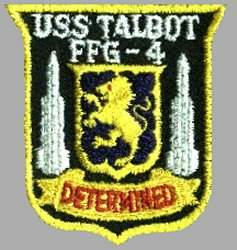
USS Talbot (FFG 4)

- formerly DEG 4 -
- decommissioned -


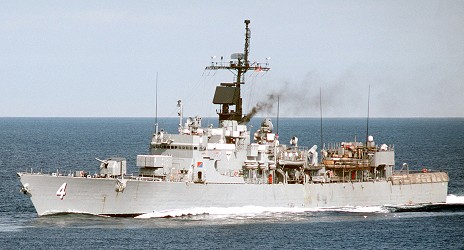
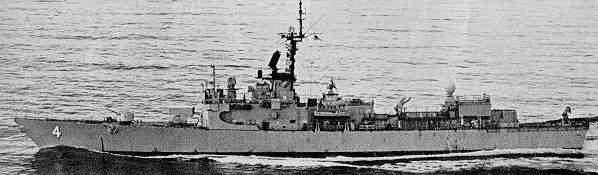
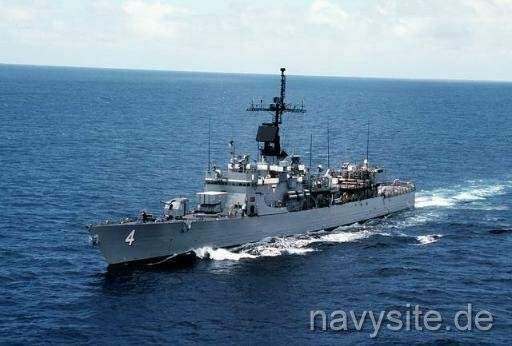
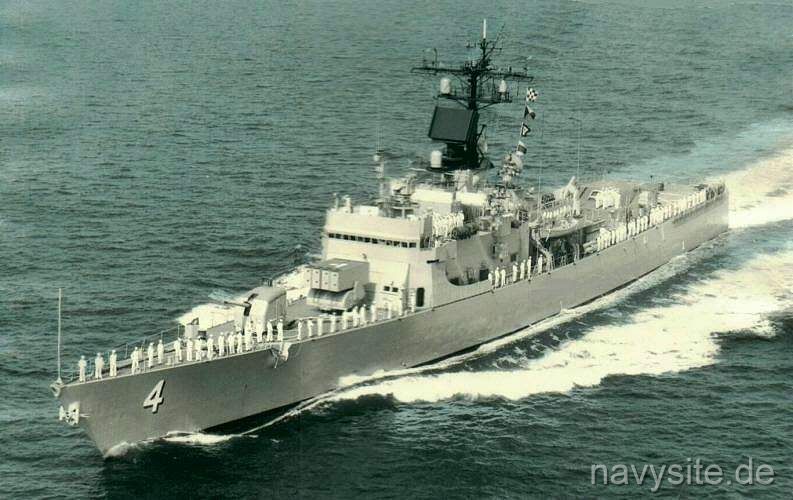
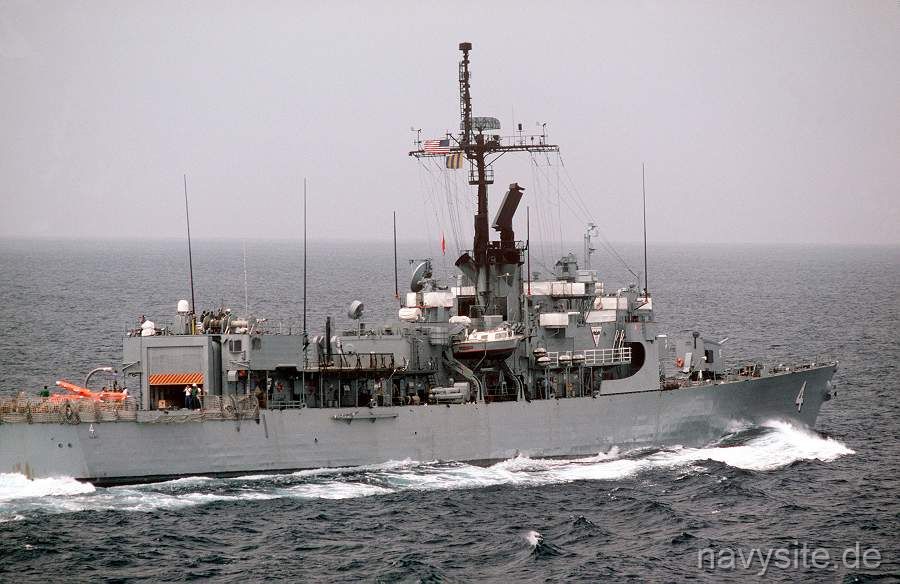
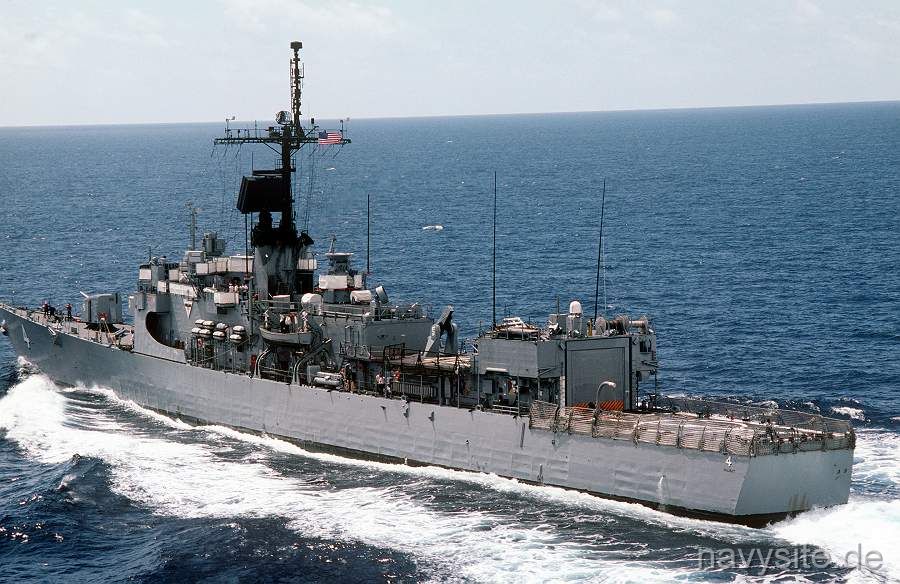
USS TALBOT was the 4th BROOKE - class guided missile frigate and the third ship in the Navy to bear the name. Decommissioned on September 30, 1988, TALBOT was given to Pakistan in April 1989 where the ship was renamed HUNIAN.

The ex-TALBOT was returned to the US Navy in Singapore on December 11, 1993 . There the ship stricken from the Navy list and sold for scrap on March 29, 1994.

General Characteristics:Awarded: May 24, 1963
Keel Laid: May 4, 1964
Launched: January 6, 1966
Commissioned: April 22, 1967
Decommissioned: September 30, 1988
Builder: Bath Iron Works, Bath, Maine
Propulsion system: 2 Foster Wheeler 1,200 psi boilers, 1 GE steam turbine, 1 shaft, 35,000 total horsepower
Propellers: one
Length: 414,4 feet (126.3 meters)
Beam: 45 feet (13.5 meters)
Draft: 26 feet (7.9 meters)
Displacement: 3,425 tons
Speed: 27 knots
Aircraft: one SH-2F (LAMPS 1)
Armament: one Mk 22 Mod. 0 guided missile launcher for 16 Standard SM-1 MR, one Mk 30 5-inch/12.7cm gun, MK 32 ASW torpedo tubes (two triple mounts), one Mk 16 ASROC missile launcher
Crew: 17 Officers, 219 Enlisted


Back to topback to top  go to endgo to the end of the page


Back to topback to top  go to endgo to the end of the page


Back to topback to top  go to endgo to the end of the page

Crew List:

This section contains the names of sailors who served aboard USS TALBOT. It is no official listing but contains the names of sailors who submitted their information.


back to top  go to the end of the page


Back to topback to top  go to endgo to the end of the page

Accidents aboard USS TALBOT:

DateWhereEvents
October 11, 1971western Atlantic
USS TALBOT suffers an engineering casualty and is towed to Newport, Rhode Island, by the USS SKYLARK (ASR 20).


Back to topback to top  go to endgo to the end of the page

About the Ship's Name:

Silas Talbot - born in Dighton, Mass. - was commissioned a captain in the Continental Army on 1 July 1776. After participating in the siege of Boston and aiding in the transportation of troops to New York, he obtained command of a fireship and attempted to use it to set fire to the British warship ASIA. The attempt failed, but the daring it displayed won him a promotion to major on 10 October 1777.

After suffering a severe wound while fighting to defend Philadelphia, Talbot returned to active service in the summer of 1778 and fought in Rhode Island. As commander of PIGOT and later of ARGO, both under the Army, he cruised against Loyalist vessels that were harassing American trade between Long Island and Nantucket and made prisoners of many of them. Because of his success fighting afloat for the Army, Congress made him a captain in the Continental Navy on 17 September 1779. However, since Congress had no suitable warship to entrust to him, Talbot put to sea in command of the privateer GENERAL WASHINGTON. In it he took one prize, but soon thereafter ran into the British fleet off New York. After a chase, he struck his colors to CULLODEN, a 74-gun ship-of-the-line and remained a prisoner until exchanged for a British offleer in December 1781.

After the war, Talbot settled in Fulton County, N.Y. He was a member of the New York Assembly in 1792 and 1793 and served in the federal House of Representatives from 1793 to 1795. On 5 June 1794, President Washington chose him third in a list of six captains of the newly established United States Navy. Before the end of his term in Congress, he was ordered to superintend the construction of the frigate PRESIDENT at New York. He commanded the Santo Domingo Station in 1799 and 1800 and was commended by the Seeretary of the Navy for protecting American commerce and for laying the foundation of a permanent trade with that country.

Captain Talbot resigned from the Navy on 23 September 1801 and died at New York City on 30 June 1813.


Back to topback to top  go to endgo to the end of the page

USS TALBOT History:

USS TALBOT was the fourth ship of the BROOKE-class guided missile destroyer escorts, a compact class developed during the early 1960s for Cold War escort duty, antisubmarine warfare, and guided missile air defense. USS TALBOT was ordered on May 24, 1963, from Bath Iron Works at Bath, Maine. Her keel was laid on May 4, 1964, and she was launched on January 6, 1966, sponsored by Miss Frances K. Talbot. The Navy commissioned her on April 22, 1967, as USS TALBOT (DEG 4). At commissioning, she entered the Atlantic Fleet as a steam-powered guided missile escort with one shaft, a 5-inch/38-caliber gun, a Mk 22 missile launcher for the Tartar and later Standard missile family, ASROC antisubmarine weapons, lightweight torpedo tubes, sonar, air-search and surface-search radar, and the combat systems needed for convoy, carrier, and surface-group escort work. Her designation changed on June 30, 1975, when the U.S. Navy reclassified the former DEG ships as guided missile frigates; from that date she served as USS TALBOT (FFG 4).

After commissioning, USS TALBOT entered the normal post-commissioning cycle of trials, shakedown, weapons checks, and correction of early defects. On July 8, 1967, she departed Hampton Roads, Virginia, for Puerto Rico to conduct shakedown training and missile-system trials in Caribbean waters. Those first weeks tested the new escort's engineering plant, guided missile battery, communications, sensors, damage control organization, and ability to operate at sea as a fleet unit. After the Caribbean work, she proceeded north and arrived at Newport, Rhode Island, on September 16, 1967, establishing the home port from which she began her first Atlantic Fleet operating period. From October 16 to November 18, 1967, USS TALBOT carried out special operations off the Virginia Capes. She then spent much of the period into the spring of 1968 in post-shakedown availability, the yard and maintenance phase that completed the transition from a newly commissioned ship to a deployable fleet escort.

In 1968, USS TALBOT continued local operations, weapons work, and antisubmarine training. Late in April she conducted firing exercises and antisubmarine operations, and in May 1968 she was assigned to the search for the missing nuclear-powered attack submarine USS SCORPION (SSN 589). USS SCORPION had failed to return from a Mediterranean deployment, and the search became one of the major U.S. Navy submarine-related operations of the Cold War. For USS TALBOT, still early in her own commissioned life, the assignment placed her in a serious Atlantic search effort that required careful navigation, communications discipline, sonar employment, and sustained operations with other fleet and specialized assets. After that duty, USS TALBOT spent the remainder of 1968 operating along the Atlantic coast and in the Caribbean.

On January 31, 1969, USS TALBOT departed Newport for her first Mediterranean deployment with the Sixth Fleet. The cruise placed her in the standing Cold War environment of the Mediterranean, where U.S. naval forces maintained a continuous presence among NATO allies, monitored Soviet naval activity, and supported American policy during a period shaped by the Arab-Israeli conflict, the confrontation between NATO and the Warsaw Pact, and repeated political tension around the eastern Mediterranean and North Africa. The deployment followed the standard Sixth Fleet pattern for an Atlantic Fleet escort: operations with carrier and surface forces, antisubmarine exercises, air-defense drills, communications training, and allied port visits. USS TALBOT completed the deployment and returned to Newport on July 11, 1969.

Following her return, USS TALBOT remained in Atlantic Fleet service and then entered the Boston Naval Shipyard for overhaul work. That overhaul was completed on April 1, 1970. She resumed local operations, and in May 1970 she returned to Puerto Rican waters for weapons tests. Refresher training followed, then several months of operations from Newport. On October 28, 1970, USS TALBOT began her second Mediterranean deployment. This cruise again placed her with the Sixth Fleet at a time when the U.S. Navy's Mediterranean presence was a routine part of NATO's southern-flank posture and a continuing response to Soviet naval operations in the region. Her work consisted of escort operations, fleet exercises, readiness training, and presence missions. USS TALBOT returned to Newport on May 2, 1971. During the remainder of the year she operated along the U.S. East Coast.

On October 11, 1971, while operating in the western Atlantic, USS TALBOT suffered an engineering casualty. The submarine rescue ship USS SKYLARK (ASR 20) took her in tow to Newport. The incident interrupted the ship's operating schedule. After repair and recovery, USS TALBOT returned to Atlantic Fleet work.

The first part of 1972 was devoted in part to Mk 48 torpedo testing in the Bahamas and off New England. On July 21, 1972, USS TALBOT departed Newport for Naval Station Roosevelt Roads, Puerto Rico, in company with USS FARRAGUT (DDG 37) and USS FORREST SHERMAN (DD 931). On July 26, 1972, USS REMORA (SS 487) joined the group. The ships then began UNITAS XIII, the annual U.S. Navy deployment and exercise series with South American navies. UNITAS was designed to improve tactical cooperation, communications, antisubmarine procedures, and professional familiarity between the United States and Latin American naval forces. For USS TALBOT, UNITAS XIII became one of the longest and most varied deployments of her career, taking her around South America and involving operations with seven South American navies. During the cruise, she made port calls in Venezuela, Brazil, Uruguay, Argentina, Chile, Peru, the Panama Canal Zone, and Colombia.

During the Chilean phase of UNITAS XIII, the U.S. force included USS FARRAGUT, USS FORREST SHERMAN, USS TALBOT, and USS REMORA. Chilean and U.S. forces met in Bahia de Linao on October 5, 1972, and the exercise phase began on October 6. The operations emphasized standard naval cooperation, particularly antisubmarine warfare, communications, and maneuvering. The schedule included activity around Talcahuano and concluded in the Bahia de Mejillones area on October 21, 1972. USS TALBOT's participation combined tactical training with naval diplomacy and required sustained operations over a long circuit of Atlantic, Pacific, Caribbean, and South American waters. She returned to Newport on December 3, 1972.

After UNITAS XIII, USS TALBOT entered another major maintenance phase. On February 15, 1973, she entered the Boston Naval Shipyard for an overhaul that lasted until December 14, 1973. The long yard period kept her out of normal fleet operations for most of the year but prepared her for the next phase of Atlantic Fleet service. On January 5, 1974, she departed Newport and proceeded to her new home port, Norfolk, Virginia. The shift from Newport to Norfolk placed her at one of the Atlantic Fleet's principal operating centers, close to the Virginia Capes training areas, major fleet commands, Norfolk Naval Shipyard, and the support structure for Atlantic and Mediterranean deployments.

From February 13 to April 29, 1974, USS TALBOT deployed for training exercises off Jacksonville, Florida; Guantanamo Bay, Cuba; and Vieques, Puerto Rico. These waters were standard Atlantic Fleet training areas for gunnery, missile firings, antisubmarine work, amphibious-related exercises, and refresher training. After a cruise to Newport in May, USS TALBOT entered Norfolk Naval Shipyard on June 17, 1974, for a significant experimental installation. The Navy removed her normal 5-inch/38-caliber gun mount and associated fire-control equipment and installed prototype equipment for the Oto Melara Mk 75 76 mm rapid-fire gun mount and the Mk 92 fire-control system. These systems were being evaluated for later use in new surface combatants, including the OLIVER HAZARD PERRY-class guided missile frigates and PEGASUS-class patrol hydrofoils, and USS TALBOT became an operating test platform for equipment that would become important in later U.S. Navy frigate design.

USS TALBOT stood out of Hampton Roads on October 21, 1974, to begin operational evaluation of the new gun and fire-control installation. From November 12 to December 19, 1974, she tested the systems at the Atlantic Fleet Weapons Range near Culebra, Puerto Rico. The evaluation continued into 1975, with USS TALBOT alternating three test periods at Culebra with local operations, fleet tactical exercises in the western Atlantic, and a tender availability alongside USS PUGET SOUND (AD 38) at Norfolk. This period gave USS TALBOT an unusual role: she remained a commissioned fleet escort, but she was also helping the Navy test weapons and fire-control arrangements intended for future ships. The evaluation ended when she returned to Norfolk on June 22, 1975. On June 30, 1975, USS TALBOT was reclassified from DEG 4 to FFG 4. After local operations and inspections, she entered Norfolk Naval Shipyard on September 15, 1975, for a three-month overhaul. During that period, the experimental Mk 92 fire-control system and 76 mm gun were removed, and her normal 5-inch/38-caliber gun and fire-control equipment were restored.

After overhaul and refresher training in the spring of 1976, USS TALBOT departed Norfolk on June 22, 1976, for another Mediterranean deployment. The six-month cruise included NATO exercises, Sixth Fleet operations, and port visits. During this deployment, USS TALBOT operated with HSL-34 Detachment 6 and an SH-2F LAMPS helicopter. The detachment's work tested small-deck helicopter operations aboard the ship and added an airborne antisubmarine and surveillance element to her escort capabilities. In the Mediterranean, USS TALBOT's duties again fit the Cold War pattern of the period: presence, allied training, surface-force operations, antisubmarine readiness, and support of the U.S. Navy's permanent Sixth Fleet posture. She returned to Norfolk on January 10, 1977.

During the first half of 1977, USS TALBOT conducted exercises off the East Coast. On June 9, 1977, she entered the Philadelphia Naval Shipyard for another overhaul. That yard period lasted into the following year and was completed on April 7, 1978. The remainder of 1978 was devoted to refresher training and fleet exercises off the East Coast and in the Caribbean. This sequence of overhaul, training, certification, and renewed readiness was typical for Atlantic Fleet escorts in the late 1970s. At the same time, events in Iran were beginning to draw increasing U.S. attention toward the Persian Gulf, the Strait of Hormuz, and the approaches to the Arabian Sea.

On December 6, 1978, USS TALBOT departed the United States for service with the Middle East Force in connection with the deteriorating political situation in Iran. The Iranian Revolution was then in progress, and the security of American citizens, other foreign nationals, oil facilities, shipping routes, and regional access became a major concern for the United States and other governments. The close of 1978 found USS TALBOT en route to the Persian Gulf. In February 1979, she was one of the U.S. Navy ships involved in the evacuation of Americans and other foreign nationals from the Iranian port cities of Bandar Abbas and Char Bahar. The operation removed about 440 people, including about 200 U.S. citizens. Ships associated with the sea evacuation included USS LA SALLE (AGF 3), USS KINKAID (DD 965), USS DECATUR (DDG 31), USS TALBOT, USS BLANDY (DD 943), and USS HOEL (DDG 13). This mission tied USS TALBOT directly to the wider international consequences of the Iranian Revolution, as foreign personnel were removed from Iran during the collapse of the old regime and the emergence of the new Islamic Republic.

After her Middle East Force service, USS TALBOT continued as a Norfolk-based Atlantic Fleet guided missile frigate with a mix of maintenance periods, local Atlantic operations, Caribbean training, Mediterranean or other overseas deployments, antisubmarine exercises, and operations with U.S. and allied naval forces. By this stage of her career, she was an experienced steam-powered escort with more than a decade of Atlantic, Mediterranean, Caribbean, South American, and Middle Eastern service behind her.

In 1984, USS TALBOT took part in UNITAS XXV, the twenty-fifth iteration of the annual U.S. Navy exercise series with Latin American navies. UNITAS XXV involved forces from Brazil, Chile, Colombia, Ecuador, Peru, the United States, Uruguay, and Venezuela. On June 14, 1984, during the first phase of the exercise, USS TALBOT was photographed at Naval Station Roosevelt Roads, Puerto Rico, moored near USS THORN (DD 988), the Peruvian submarine PISAGUA, and the patrol combatant hydrofoils USS HERCULES (PHM 2) and USS ARIES (PHM 5). Later photographic records from the exercise show USS TALBOT underway off the coast of Peru, launching a target drone from her stern during exercise activity, and refueling from the Chilean tanker ARAUCANO. These records place her squarely in the multinational training environment of UNITAS XXV, where surface ships, submarines, aircraft, and support vessels practiced communications, maneuvering, tracking, gunnery, and replenishment procedures across a large hemispheric operating area.

On June 4, 1986, USS TALBOT departed Mayport in company with USS AUBREY FITCH (FFG 34) to rendezvous with USS NICHOLSON (DD 982) and USS SEMMES (DDG 18). The group crossed the Atlantic, passed through the Mediterranean, transited the Suez Canal, continued down the Red Sea, rounded the Arabian Peninsula, and proceeded to the Strait of Hormuz. The ships reached Bahrain on July 8, 1986. The deployment took place during the Iran-Iraq War, when attacks on shipping and the wider "Tanker War" had made the Persian Gulf, the Gulf of Oman, and the northern Arabian Sea areas of sustained concern to the United States and its partners. The group spent the following months conducting patrols and merchant-ship escort duties in the Persian Gulf, the Gulf of Oman, and the northern Arabian Sea. On October 30, 1986, responsibilities in the area were turned over to USS SAMPSON (DDG 10). The returning ships retraced the route through the Red Sea, the Suez Canal, the Mediterranean, and the Atlantic. USS TALBOT returned to Mayport in early December 1986.

After the 1986 Middle East deployment, USS TALBOT entered the final phase of her U.S. Navy service. By the late 1980s, the BROOKE-class frigates were approaching the end of their American careers. They had been designed in the early 1960s as guided missile destroyer escorts, and although they remained useful as escorts, training platforms, and forward-deployed surface combatants, their steam plants, older missile systems, and compact Cold War hulls belonged to an earlier generation of surface-escort design. The Navy was increasingly relying on newer gas-turbine frigates, destroyers, and cruisers. USS TALBOT continued Atlantic Fleet work from Norfolk through 1987 and 1988. Her U.S. Navy career ended when she was decommissioned on September 30, 1988, after more than twenty-one years in commission.

USS TALBOT did not go directly to scrapping. In April 1989, she was transferred to Pakistan and entered Pakistani naval service as PNS HUNAIN, hull number D164. Pakistan used several former U.S. Navy frigates and destroyer escorts during this period to sustain a blue-water surface force, and the former USS TALBOT served in that role for several years after leaving the U.S. Navy. U.S. records list her as struck from the Naval Vessel Register on November 29, 1993. She was returned to U.S. custody at Singapore on December 11, 1993. On March 29, 1994, the former USS TALBOT was sold for scrapping.


Back to topback to top  go to endgo to the end of the page


provided by Paul Merwin

provided by Bill Kievit


Back to topback to top


Back to Frigates list. Back to ships list. Back to selection page. Back to 1st page.