Search the Site with

|
Search the Site with
|
 General Characteristics Crew List Memorabilia Cruise Books About the Ship's Coat of Arms About the Ship's Name Accidents aboard the Ship Image Gallery to end of page
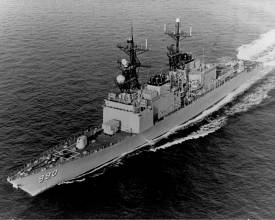 |  | 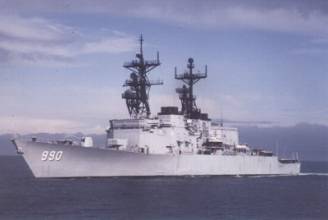 |
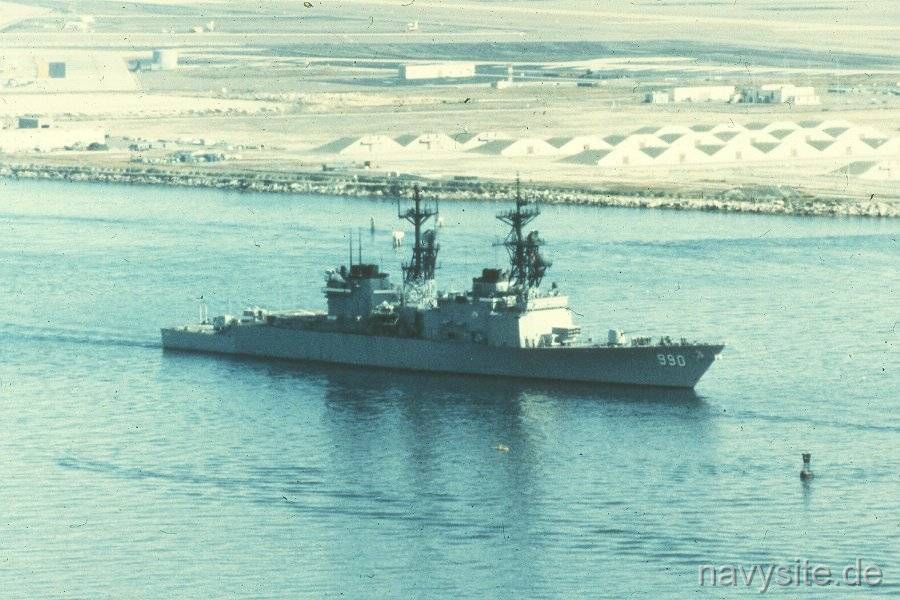
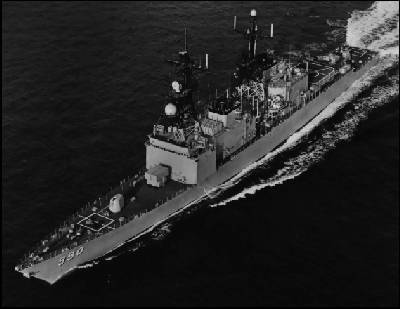
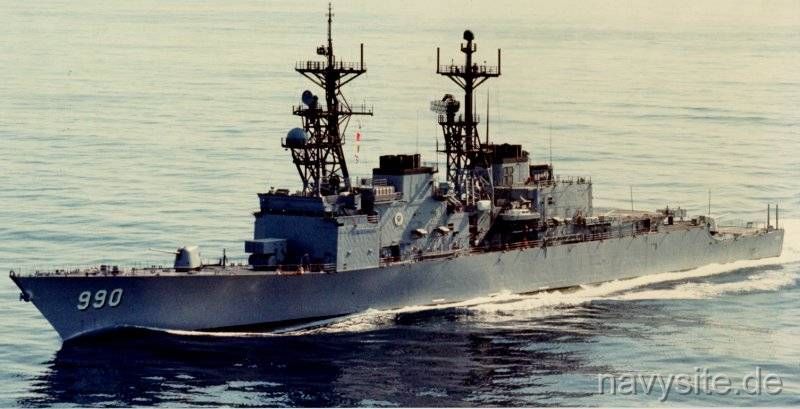
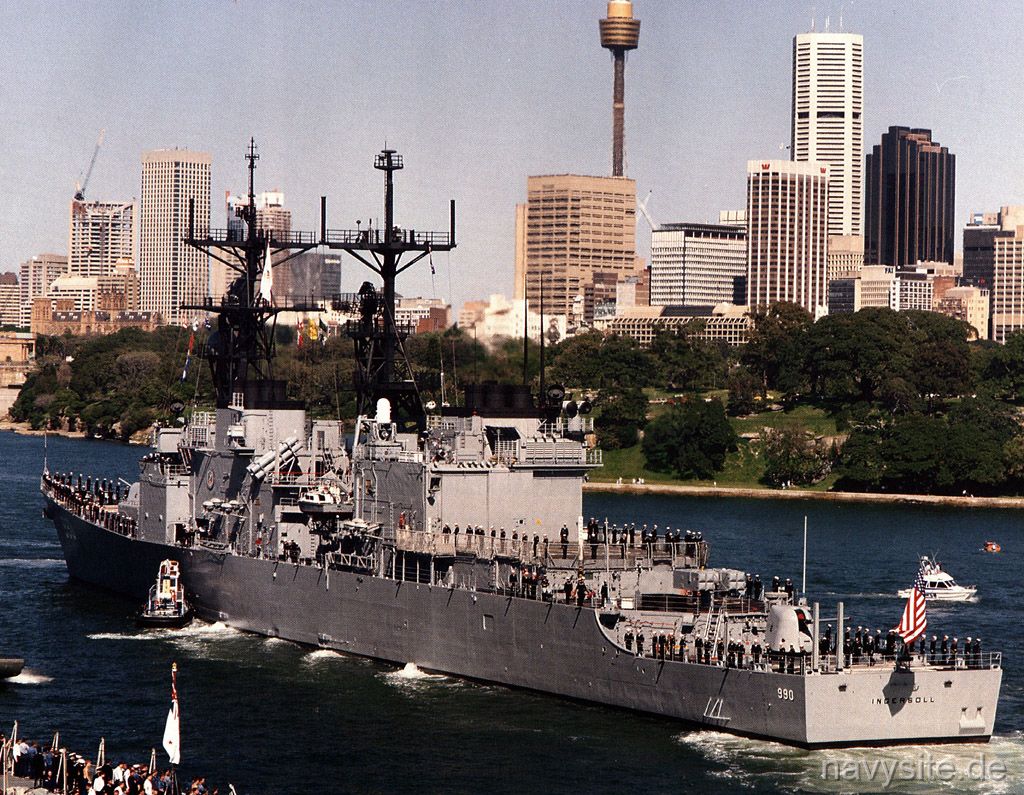
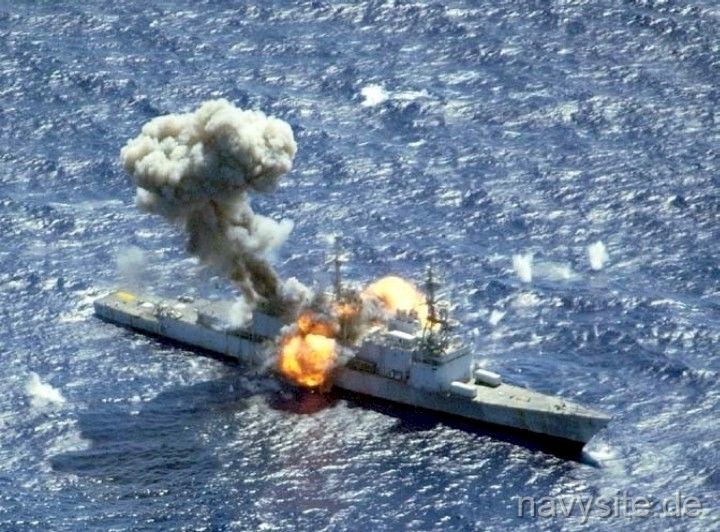
USS INGERSOLL was the 28th SPRUANCE class destroyer and the fifth ship in that class decommissioned. USS INGERSOLL was last homeported in Pearl Harbor, HI, and after decommissioning was berthed at the Naval Inactive Ship Maintenance Facility (NISMF), Pearl Harbor, HI. On July 29, 2003, the ship was finally disposed of as a target. The exact location of the SINKEX was 023° 02' 00.0" North, 160° 04' 00.0" West.
| General Characteristics: | Keel Laid: December 5, 1977 |
| Launched: March 10, 1979 | |
| Commissioned: April 12, 1980 | |
| Decommissioned: July 24, 1998 | |
| Builder: Ingalls Shipbuilding, West Bank, Pascagoula, Miss. | |
| Propulsion system: four General Electric LM 2500 gas turbine engines | |
| Propellers: two | |
| Blades on each Propeller: five | |
| Length: 564,3 feet (172 meters) | |
| Beam: 55,1 feet (16.8 meters) | |
| Draft: 28,9 feet (8.8 meters) | |
| Displacement: approx. 9,200 tons full load | |
| Speed: 30+ knots | |
| Aircraft: two | |
| Armament: two | |
| Crew: approx. 340 |
 back to top go to the end of the pageback to top go to the end of the page
Crew List:
This section contains the names of sailors who served aboard USS INGERSOLL. It is no official listing but contains the names of sailors who submitted their information.
back to top go to the end of the pageback to top go to the end of the pageUSS INGERSOLL Cruise Books:
back to top go to the end of the pageAbout the Ship's Coat of Arms:
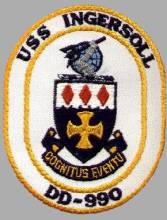
The official crest of lNGERSOLL was highly symbolic of the man whose name it bore. The upraised trident pointing in a westerly direction in front of a globe represented Admiral Royal Eason Ingersoll's responsibility for the defense of the Western Hemisphere during the early critical years of World War II. The shield symbolized Admiral Ingersoll's contributions as Commander-In Chief of the U.S. Atlantic Fleet during the Second World War. The determined antisubmarine measures he employed so successfully in dealing with the U-boat menace in the Battle of the Atlantic were represented by the invected line (a series of shallow "U"s). The three fusils simulated ships and alluded to the escort of convoys to the United Kingdom, the Mediterranean, and throughout the South Atlantic (including the Caribbean). The fusils further alluded numerically to the three generations of distinguished Naval Officers to bear the name of Ingersoll. The cross referred to the Navy Cross, one of the many decorations awarded to Admiral lngersoll during his long career. The motto COGNlTUS EVENTU translates from the Latin form as "Known By The Results". This embodied the spirit of Admiral Ingersoll, his commands, and the destroyer which bore his name.
back to top go to the end of the pageAbout the Ship's Name, about Admiral Royal Eason Ingersoll:
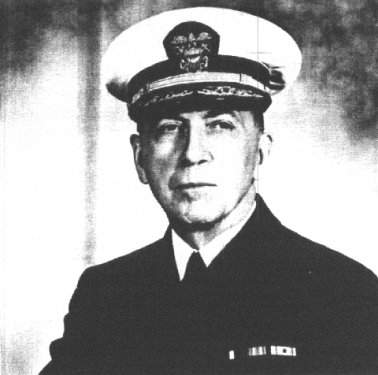 Royal Eason Ingersoll was born in Washington, D.C., on June 20, 1883. He was second in a line of three generations of distinguished Naval officers: his father, USNA Class of 1868, served in the Civil War, Spanish-American War, and World War I, and his son, Lieutenant Royal Rodney Ingersoll II, Class of 1934, was killed in action on June 4, 1942, in the Battle of Midway, aboard the USS HORNET.
Admiral Ingersoll graduated from the Naval Academy in 1905, and reported as a Passed Midshipman to the USS MISSOURI. In August of that year he was one of the young officers assigned special temporary duty to attend the Russian-Japanese Peace Conference, held at the Naval Yard, Portsmouth, New Hampshire. When detached from the MISSOURI in May 1906, he was assigned briefly to the USS MARIETTA, and later the USS HANCOCK, then assisted in fitting out the USS CONNECTICUT at the Navy Yard, New York. He served on board that battleship from her Commissioning on September 29, 1906, until October 1907.
Duty as an instructor of Seamanship and International Law, and later of English, at the Naval Academy between 1911 and 1913, preceded his assignment to Asiatic Station. There he joined the USS SARATOGA, Flagship of the Asiatic Fleet. He served briefly as her First Lieutenant, then became Aide and Flag Lieutenant on the Staff of the Commander-in-Chief.
He returned to the United States, and on June 1, 1916, reported as Assistant for Communications, and Communication Officer, in the Office of the Chief of Naval Operations, Navy Department. Concerning that assignment he subsequently wrote: "The work in this office began to pick up as the tension in the diplomatic relations with Germany increased, and overwhelmed us on February 2, 1917, when diplomatic relations with that country were broken...". For organizing the greatly expanded Naval Communications Office during World War I, he was awarded the Navy Cross and cited "For distinguished service in the line of his profession in organizing, developing and administering the Communication Office of the Navy Department."
After the Armistice in November 1918, he was ordered to join Admiral William S. Benson, USN, then Chief of Naval Operations, concerning the establishment of a communication office for that commission. In February 1919 he returned home in the USS GEORGE WASHINGTON with the Presidential party, handling messages for President Woodrow Wilson on the voyage across the Atlantic.
In March 1919 he again joined the USS CONNECTICUT, serving this time as her Executive Officer until September 1920, then transferring to the USS ARIZONA. In June 1921 he reported to the Navy Department for a tour of duty in the Office of Naval Intelligence, and on March 26, 1924, assumed command of the USS NOKOMIS. Under his command that gunboat was fitted out as a survey ship and cruised in the Cuban-Haitian area, making new charts of the north coast of Cuba.
Completing the Senior Course at the Naval War College, Newport, Rhode Island, in June 1927, he served the following year as a member of that Staff. In June 1928 he reported for duty as Assistant Chief of Staff to Commander Battle Fleet, in the USS CALIFORNIA, and continued similar duty on the Staff when Admiral Pratt became Commander in Chief, U.S. Fleet, his flag in the USS TEXAS. In August 1930 he was assigned to the Division of Fleet Training, Office of the Chief of Naval Operations, Navy Department, where he served until May 1933. He then reported as Commanding Officer of the USS AUGUSTA, and in November 1933 was transferred to the Navy Yard, Mare Island, California, to fit out the USS SAN FRANCISCO. He commanded that cruiser from her commissioning, February 10, 1934, until June 1935.
The following three years duty in the Office of the Chief of Naval Operations, as Director of the War Plans Division, included his assignment in June 1936 as Technical Assistant to the American Delegation at the London Naval Conference in 1935-1936. He again went to London in December 1937, concerned with requirements growing out of the London Treaty limiting naval armament.
On July 16, 1938, he took command of Cruiser Division Six of the Scouting Force, his flag in the cruiser MINNEAPOLIS. Two years later he returned to the Office of the Chief of Naval Operations as Assistant to the Chief, and on January 1, 1942, with the rank of Vice Admiral, he was designated Commander in Chief, U, S. Atlantic Fleet, hoisting his flag in the AUGUSTA.
He was advanced to the rank of Admiral the following July 1. Having organized the movements of the thousands of ships across the Atlantic in order to have men and supplies on hand at the precise hour for the North African landing in November 1942, to him fell the responsibility of planning the composition of the naval escort forces which insured the troop convoys safe arrival, and the old Navy tradition of "having never lost a troop ship" remained true.
Following the African invasion, the Atlantic Fleet was employed in running troops convoys, transporting stores, munitions and fuel of every character to the United Kingdom and the Mediterranean. As a side issue, it ran the convoys on the coast of Brazil, and continuously waged the antisubmarine war which had been a matter of primary concern since the outbreak of hostilities. Admiral Ingersoll is generally credited with whipping the U-boat menace and with solving the vast Atlantic logistics problems. In addition he had the responsibility of defense of the Western Hemisphere by our Naval forces, and of changes in the disposition of air and surface forces stationed at various points in North and South America. For his services in this tremendously important command, he was awarded the Distinguished Service Medal and cited as a "...forceful and resolute leader under the critical conditions existing throughout a period of approximately three years...against a determined and ruthless enemy intent on world domination...".
In November 1944 he was detached from command of the Atlantic Fleet and became Commander Western Sea Frontier, with Headquarters at San Francisco. In addition to commanding the naval forces engaged in protecting shipping in coastal waters, he managed the flow of supplies to the Pacific Fleet through West Coast ports, and in carrying out this assignment had the status of a Deputy Commander in Chief, U. S. Fleet, and Deputy Chief of Naval Operations After the reorganization of the Navy in October 1945, he continued to serve as Commander Western Sea Frontier until April 10, 1946, when he was relieved of all active duty pending his retirement on August 1, 1946.
In addition to the Navy Cross and the Distinguished Service Medal, Admiral Ingersoll was awarded the Victory Medal (World War I); the American Defense Service Medal; European-African-Middle Eastern Campaign Medal; and the World War II Victory Medal. He was also awarded the Chevalier of the Legion of Honor by the French Government and the Order of Naval Merit (Grand Cross) by the Government of Brazil.
Admiral Ingersoll was married in 1910 to Louise Van Harlingen of Atlanta, Georgia, and had two children. Mrs. Louise Ingersoll was the sponsor for DD 990; their daughter, Alice Jean Ingersoll Nagle, is acting as proxy sponsor. Their son, Royal Rodney was (with Admiral Ingersoll's father) the namesake of the first USS INGERSOLL (DD 652). Admiral Ingersoll died on May 20, 1976.
back to top go to the end of the pageAccidents aboard USS INGERSOLL:
| Date | Where | Events | |||
|---|---|---|---|---|---|
| February 5, 1985 | Indian Ocean | USS INGERSOLL suffers a casualty to the port oil distribution box, requiring the ship to leave its battle group in the Indian Ocean. | |||
| January 29, 1986 | Esquimalt, BC, Canada | USS INGERSOLL makes a heavy landing against the Canadian tug PROVIDER. Responsibility is charged to an inexperienced tug operator and to brisk winds. Damage to both ships is minimal. | |||
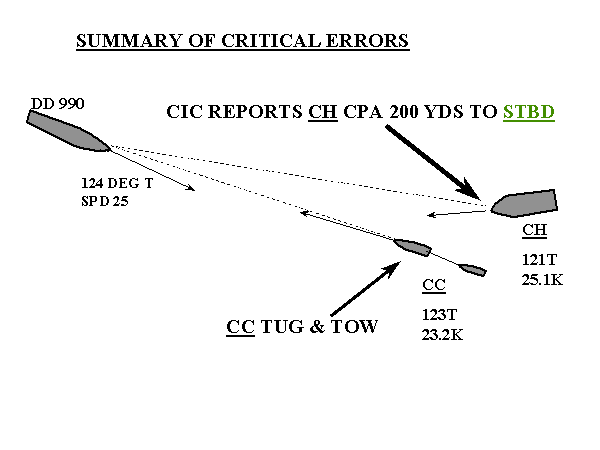
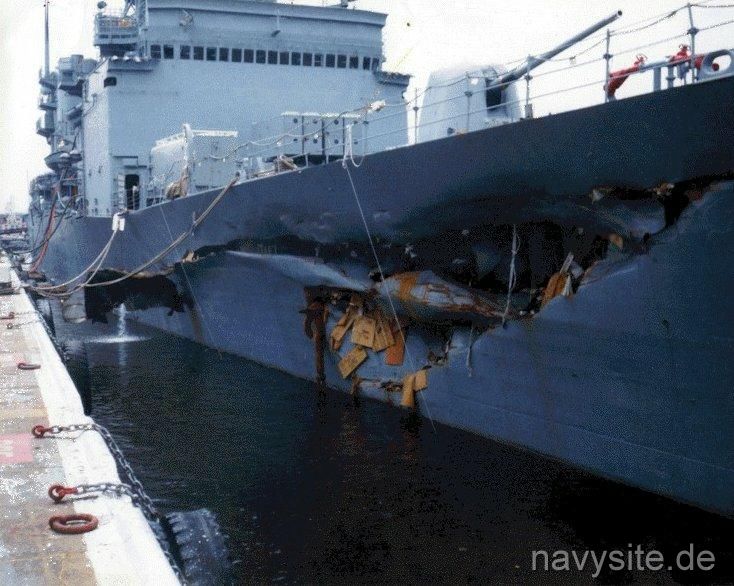
| June 20, 1992 | Straits of Malacca | USS INGERSOLL collided with oil tanker M/V MATSUMI MARU NR.7 after the destroyer's crew misread the oil tanker's running lights. The two charts below show the course of the collision.
|
back to top go to the end of the page
USS INGERSOLL Image Gallery:
 |  |  |  |  |
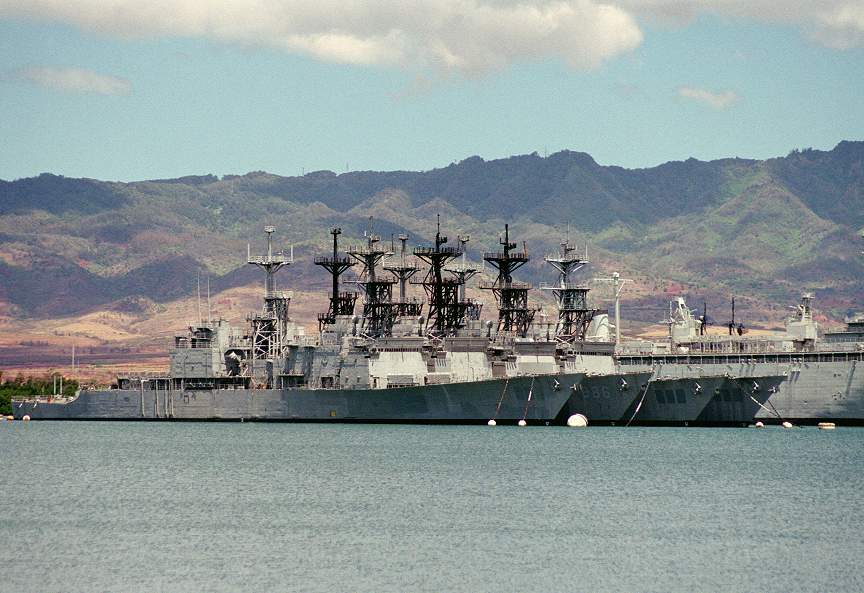
The photo below is an official US Navy photo taken on June 4, 2000. It shows (from left to right) the INGERSOLL, HARRY W. HILL (DD 986), LEFTWICH (DD 984), and MERRILL (DD 976) laid up at the Pearl Harbor Naval Inactive Ship Maintenance Facility. All four ships have since been sunk as targets off the north coast of Kauai, Hawaii.
 |
back to top
 Back to Destroyers list. Back to ships list. Back to selection page. Back to 1st page.