Search the Site with

|
Search the Site with
|
 General Characteristics Crew List Memorabilia Cruise Books About the Ship's Name Accidents aboard the Ship About the Ship's Coat of Arms Image Gallery to end of page
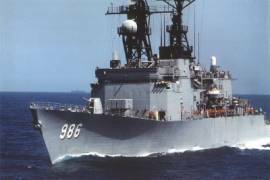 |  | 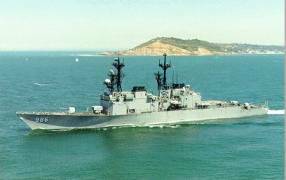 |
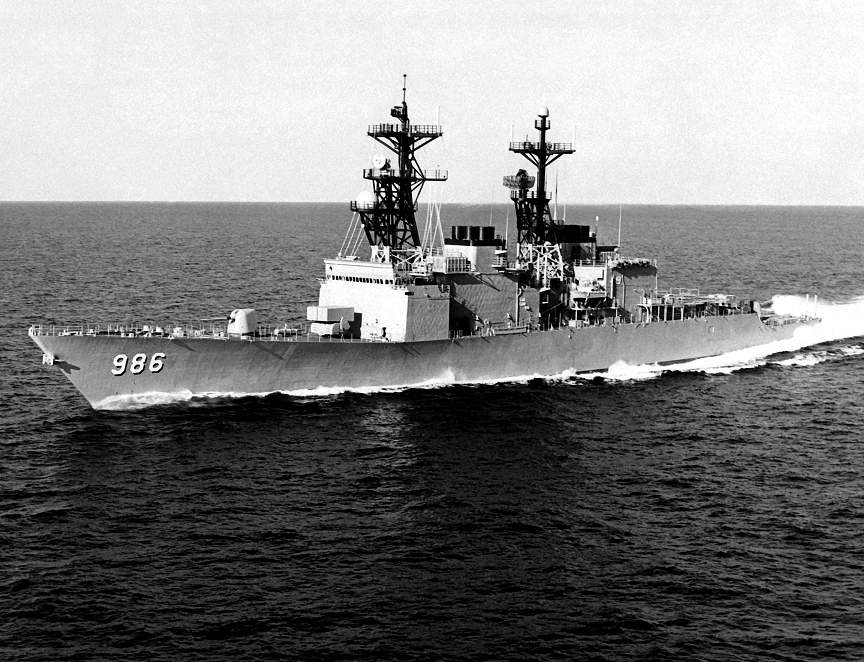
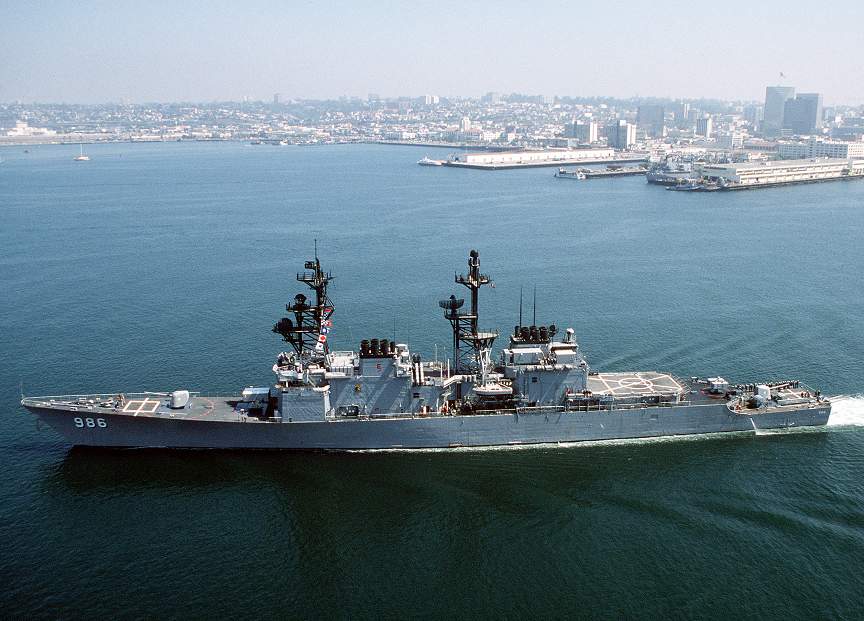
USS HARRY W. HILL was the 24th SPRUANCE - class destroyer and the third ship in that class decommissioned. The destroyer was last homeported in San Diego, Calif. Stricken from the Navy list on May 29, 1998, the HARRY W. HILL was sunk as a target during RIMPAC 2004 on July 15, 2004.
| General Characteristics: | Keel Laid: January 3, 1977 |
| Launched: August 10, 1978 | |
| Commissioned: November 17, 1979 | |
| Decommissioned: May 29, 1998 | |
| Builder: Ingalls Shipbuilding, West Bank, Pascagoula, Miss. | |
| Propulsion system: four General Electric LM 2500 gas turbine engines | |
| Propellers: two | |
| Blades on each Propeller: five | |
| Length: 564,3 feet (172 meters) | |
| Beam: 55,1 feet (16.8 meters) | |
| Draft: 28,9 feet (8.8 meters) | |
| Displacement: approx. 9,200 tons full load | |
| Speed: 30+ knots | |
| Aircraft: two | |
| Armament: two | |
| Crew: approx. 340 |
 back to top go to the end of the pageback to top go to the end of the page
Crew List:
This section contains the names of sailors who served aboard USS HARRY W. HILL. It is no official listing but contains the names of sailors who submitted their information.
back to top go to the end of the pageback to top go to the end of the pageUSS HARRY W. HILL Cruise Books:
back to top go to the end of the page
About the Ship’s Name, about Admiral Harry W. Hill
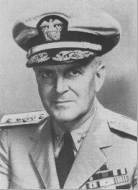 A graduate of the Naval Academy in 1911, Admiral Harry W. Hill served successively in USS MARYLAND (ARC 8), torpedo boat tender USS IRIS, USS PERRY (DD 11), and with the Pacific Flotilla as the Engineering Officer in USS ALBANY (CL 23). His follow-on assignments included service during World War I in USS TEXAS (BB 35) and as Navigator in USS WYOMING (BB 32) when both battleships were attached to the British Grand Fleet. Immediately after WW I, he served as Navigator in USS ARKANSAS (BB 33) until January 1919 when he was assigned duty as Aide and Flag Lieutenant to Admiral R. E. Coontz, Commander of the Atlantic Fleet's Division Seven. In July of the same year, he transferred to similar duty on the Staff of Commander Division Six, Pacific Fleet. Continuing as Aide to Admiral Coontz as Chief of Naval Operations from 1919 to 1923, Lieutenant Commander Hill then joined USS CONCORD (CL 10) as Gunnery Officer from 1923 to 1926. After serving the next three months as Aide to Commander in Chief, U.S. Fleet, he again had duty afloat as Gunnery Officer in USS MARYLAND (BB 46) from 1926 to 1931 and then served in the Executive Department at the Naval Academy.
Since a number of his ships won gunnery awards while under his direction, he served as Force Gunnery Officer on the Staff of Commander Battle Force, U.S. Fleet, in the Pacific from 1933 to 1934. As a Commander, he commissioned and commanded USS DEWEY (DD 349) from October 4, 1934 to June 17, 1935, when he was again assigned to the Office of the Chief of Naval Operations, Navy Department. In May 1938, Commander Hill completed the Senior Course at the Naval War College, and was promoted to Captain. He then served as War Plans Officer on the Staff of the Commander in Chief, U.S. Fleet, until February 1940, after which he had a third tour of duty in the Office of Naval Operations, where he was attached to the War Plans Division until January 1942.
Captain Hill took command of the heavy cruiser USS WICHITA (CA 45), which operated for several months on convoy duty with the British Home Fleet to the north Russian port of Murmansk. In September 1942, he was promoted to Rear Admiral and reported as Commander Battleship Division Four, Flag Ship USS MARYLAND (BB 46) serving a year in the South Pacific. He was also Commander of a task force which was the first ever to comprise both battleships and escort carriers.
In September 1943, he became Commander Amphibious Group Two, Fifth Amphibious Force, and in that capacity, participated in the capture of Tarawa, and later in operations against the Gilberts, Marshalls, Marianas, Iwo Jima, and Okinawa, where he commanded the amphibious and support operations of that force until the island was secured at the end of June. At the close of the war in August 1945, Admiral Hill commanded the Amphibious Force that landed the Sixth Army for the occupation of Japan. He later served as the first Commandant of the Naval War College, Chairman of the General Board of the Navy, and Superintendent of the U.S. Naval Academy.
Although he retired in the rank of Admiral in May 1952, he was not detached from his final assignment until the following August. Admiral Hill then reported as Governor of the Naval Home at Philadelphia, Pennsylvania where he continued to serve on active duty until May 1954. Admiral Harry Wilbur Hill passed away on July 19, 1971.
back to top go to the end of the page
Accidents aboard USS HARRY W. HILL:
| Date | Where | Events |
|---|---|---|
| January 14, 1991 | Gulf of Oman | USS HARRY W. HILL collides with the USS KANSAS CITY (AOR 3) during an underway replenishment at about 0630 local time. The HARRY W. HILL suffers a cracked sonar dome and various other damage and subsequently spends approx. 3 months at Naval Station Subic Bay, Philippines, for repairs. The KANSAS CITY suffers two underwater holes in fuel tanks, a crushed bulwark and various external topside damage from mid-ship to aft on the starboard side. For the following 3 weeks, the KANSAS CITY receices temporary repairs in Dubai, UAE. |
back to top go to the end of the page
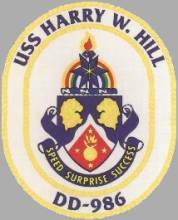
About the Ship’s Coat of Arms:The coat of arms for USS HARRY W. HILL commemorates some highlights of the Naval career of the ship's namesake, Admiral Harry W. Hill. His service as Gunnery Officer on several ships of the line, and especially while aboard the battleship MARYLAND when she won the Gunnery Trophy in 1929, is represented by the grenade symbol at the base. The three gold stars on the scarlet point signify as many awards of the Distinguished Service Medal for combat service in the South Pacific during World War II, with a total of four stars indicating his advancement upon retirement to the rank of Admiral, by reasons of combat citations. The white wavy chevron together with the red point in the base allude to Admiral Hill's outstanding service in protection of Russian bound convoys between Iceland and Northern Russian ports, for which the Soviet government awarded him the Order of Kutozov. The six waves of the chevron allude to six major amphibious operations commanded by Admiral Hill in the Pacific Theater during World War II. The two lion's heads represent the awards by Great Britain of the Companion of the Distinguished Service Order in tribute to his "Outstanding gallantry and leadership" in the Gilberts operations and the Companion of the Order of the Bath for his service on the U.S.-Canada Permanent Joint Board of Defense.
The flaming torch, adapted from the coat of arms of the U.S. Naval Academy, refers to Admiral Hill's military education. Following his graduation in 1911, he served aboard six vessels in succession through the end of World War I and the contribution of this experience to his leadership capability is symbolized by the six poiinted blue and gold star. Upon cessation of hostilities on November 11, 1918, Admiral Hill witnessed the surrender of the German High Seas Fleet while aboard USS WYOMING. This event is symbolized by the rainbow referring to the suspension ribbon of the World War I Victory Medal.
The ship's motto, "Speed, Surprise, Success", characterizes the traits common to the amphibious forces commanded by Admiral Hill in the South Pacific during World War II. This motto also depicts the effective manner in which this highly maneuverable and quiet shiip accomplished her primary mission of Undersea Warfare.
back to top go to the end of the page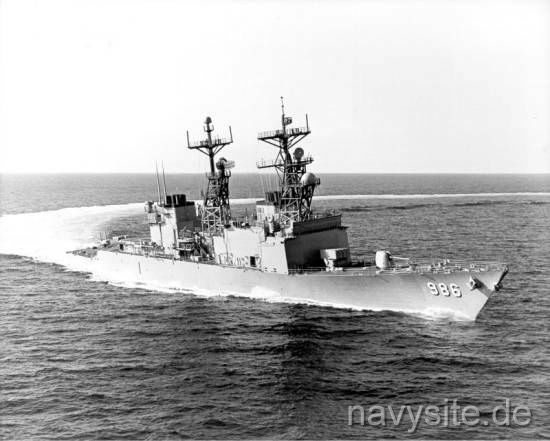 back to top go to the end of the page
USS HARRY W. HILL Image Gallery:
 |  | 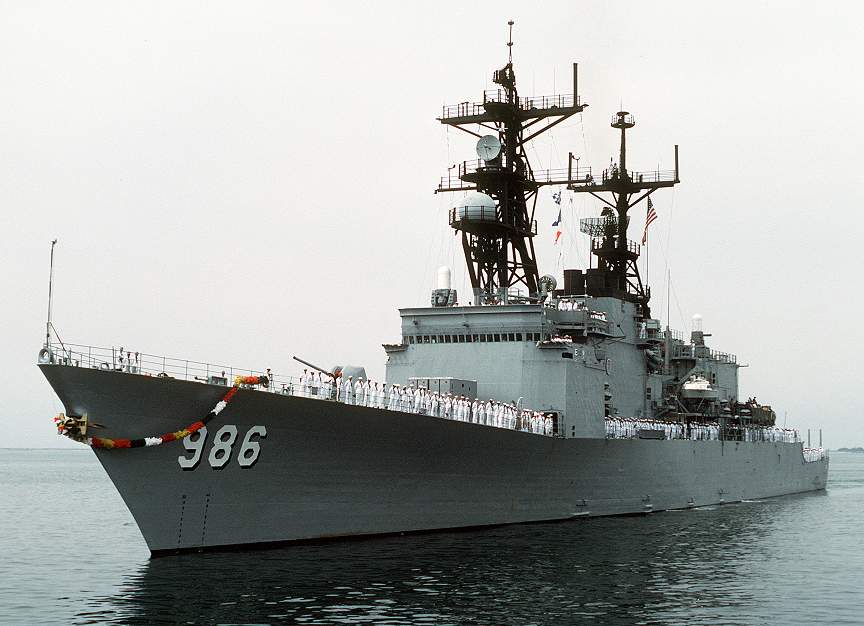 |
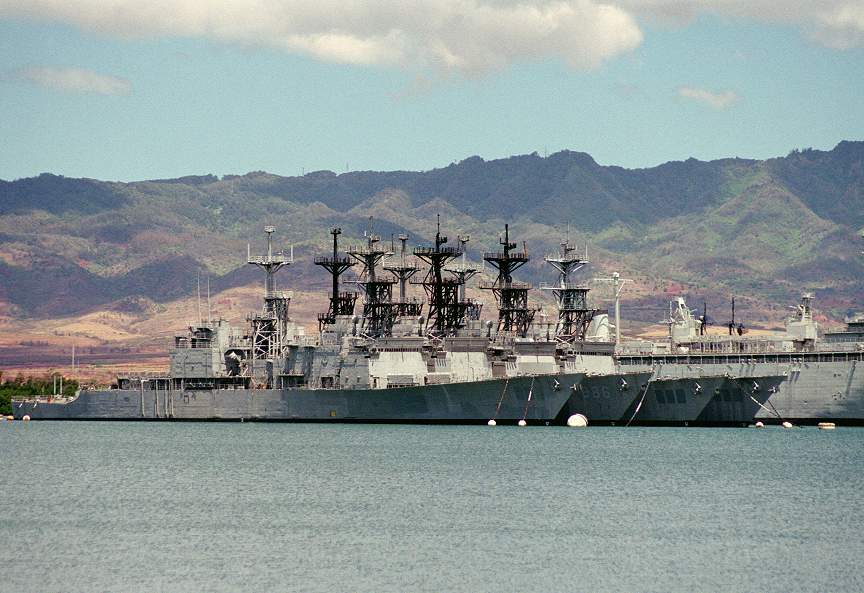
The photo below is an official US Navy photo taken on June 4, 2000. It shows (from left to right) the INGERSOLL (DD 990), HARRY W. HILL, LEFTWICH (DD 984), and MERRILL (DD 976) laid up at the Pearl Harbor Naval Inactive Ship Maintenance Facility. All four ships have since been sunk as targets off the north coast of Kauai, Hawaii.
 |
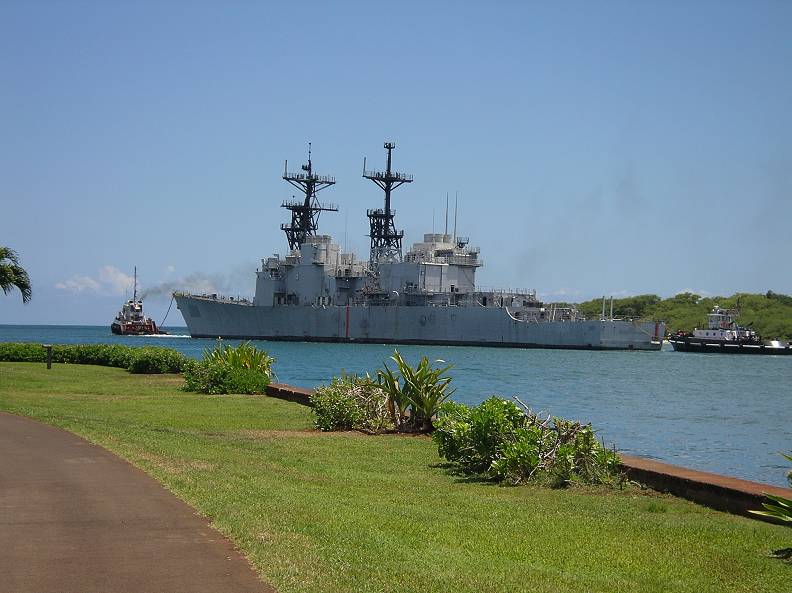
The photos below were taken by Mark Dubaz and show the HARRY W. HILL being towed out of Pearl Harbor in preparation for being sunk as a target during RIMPAC 2004. The photos were taken in July 2004.
 |  |  |
back to top
 Back to Destroyers list. Back to ships list. Back to selection page. Back to 1st page.