![]() |
Search the Site with
|
![]() | ![]() |
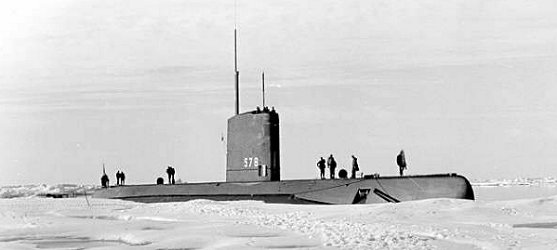
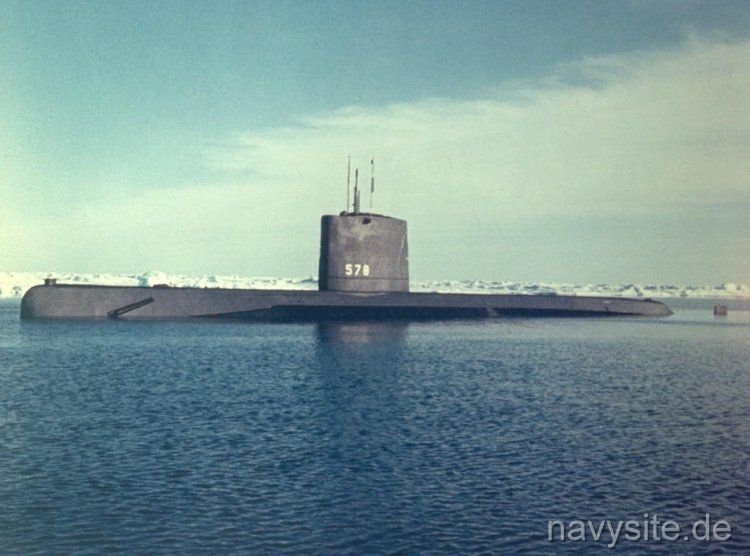
USS SKATE was the lead ship of a class of four nuclear-powered attack submarines and the second ship in the Navy named after the saltwater fish. Decommissioned on September 12, 1986, and stricken from the Navy list on October 30, 1986, the SKATE entered the Navy's Nuclear Powered Surface Ship and Submarine Recycling Program at the Puget Sound Naval Shipyard, Bremerton, Wash., on April 14, 1994. Recycling was finished on March 6, 1995.
| General Characteristics: | Awarded: July 18, 1955 |
| Keel laid: July 21, 1955 | |
| Launched: May 16, 1957 | |
| Commissioned: December 23, 1957 | |
| Decommissioned: September 12, 1986 | |
| Builder: Electric Boat Division of General Dynamics Corporation, Groton, CT. | |
| Propulsion system: one S3W nuclear reactor | |
| Propellers: two | |
| Length: 267.4 feet (81.5 meters) | |
| Beam: 25 feet (7.6 meters) | |
| Draft: 21 feet (6.4 meters) | |
| Displacement: Surfaced: approx. 2,570 tons Submerged: approx. 2,861 tons | |
| Speed: Surfaced: approx. 18 knots Submerged: approx. +20 knots | |
| Armament: eight 533 mm torpedo tubes | |
| Crew: 8 Officers, 75 Enlisted |
Crew List:
This section contains the names of sailors who served aboard USS SKATE. It is no official listing but contains the names of sailors who submitted their information.
Accidents aboard USS SKATE:
| Date | Where | Events |
|---|---|---|
| July 24, 1958 | New London, CT. | USS SKATE suffers damage to her propeller when she collides with the USS FULTON (AS 11) while the tender is moored to a pier in New London, CT. |
| January 28, 1959 | off the US east coast | The port propeller of USS SKATE is damaged in a collision with the USS CUBERA (SS 347). The accident occurs just after the CUBERA delivered mail to the SKATE and moved away. No injuries are reported. |
| February 13, 1960 | Electric Boat Division of General Dynamics Corporation, Groton, CT. | The SKATE suffers minor damage after colliding with a concrete pier at Electric Boat Division of General Dynamics Corporation, Groton, CT. |
| 1962 | Baffin Bay, Thule, Greenland | USS SKATE's engine room begins to flood after a seawater circulation line fails while the SKATE is submerged at 400 feet. Seawater sprays in and starts to flood the engine room. The SKATE does not lose power and surfaces safely. On the surface, with the water pressure greatly reduced, the flooding is stopped. |
USS SKATE History:
USS SKATE was the third U.S. Navy submarine to bear the name and the lead ship of the SKATE-class nuclear-powered attack submarines. She was also the third nuclear-powered submarine commissioned by the United States Navy, following USS NAUTILUS (SSN 571) and USS SEAWOLF (SSN 575). Unlike USS NAUTILUS and USS SEAWOLF, which were essentially pioneering single-ship designs, USS SKATE represented the first small class of U.S. nuclear attack submarines intended to move nuclear propulsion from experimental demonstration into repeatable fleet service. The contract for USS SKATE was awarded to the Electric Boat Division of General Dynamics Corporation at Groton, Connecticut, on July 18, 1955. Her keel was laid on July 21, 1955. She was launched on May 16, 1957, sponsored by Mrs. Lewis L. Strauss, wife of the chairman of the Atomic Energy Commission, and she was commissioned at New London, Connecticut, on December 23, 1957, with Commander James F. Calvert in command.
After commissioning, USS SKATE remained in the New London area for early trials and shakedown training. Until January 29, 1958, she conducted training out of New London, then moved to the Bermuda operating area and returned to her home port on February 8, 1958. Sixteen days later, on February 24, 1958, she set course for the Isle of Portland, England. That voyage gave the new submarine one of her first public distinctions: she made a completely submerged transatlantic crossing and included in the cruise a 31-day period of complete submergence, sealed off from the earth's atmosphere. Before returning to the United States, she visited northern European ports, including ports in France and the Netherlands. This early cruise took place only a few months after commissioning and showed how quickly nuclear propulsion was changing the operating meaning of a submarine deployment. A diesel-electric submarine could cross oceans, but it could not remain submerged in the same way for such a long continuous period without surfacing or snorkeling.
During the summer of 1958, USS SKATE entered the Arctic for the first time. On July 30, 1958, she headed north and began operations beneath the polar ice pack. For ten days, she worked under the ice, surfaced nine times through openings in the pack, and navigated more than 2,400 miles beneath the ice. Late on August 11, 1958, Eastern Daylight Time, a date sometimes recorded as August 12 because of time-zone convention, USS SKATE reached the North Pole area only days after USS NAUTILUS had passed beneath the Pole during Operation Sunshine. USS SKATE was the second ship to reach the North Pole, but ice conditions prevented her from surfacing at the exact pole position on that first Arctic cruise. The ice near the Pole was too heavy and too dangerous to risk forcing the submarine upward. She was nevertheless able to surface through openings elsewhere, to communicate, and to continue proving that nuclear submarines could operate beneath the polar ice rather than merely approach it from open water.
After the Arctic cruise, USS SKATE moved to Bergen, Norway, where she arrived on August 23, 1958. There, she was inspected by King Olav V of Norway, by U.S. Ambassador Frances E. Willis, and by Norwegian Minister of Defense Nils Handal. She then made additional northern European port calls in the Netherlands, Belgium, and France before returning to New London on September 25, 1958. The voyage gave the U.S. Navy a new Arctic operating record and gave NATO allies a close view of a nuclear submarine that had just demonstrated under-ice capabilities of direct Cold War significance. For her August 1958 polar work, USS SKATE received the Navy Unit Commendation for operating through the hazards of the polar ice pack.
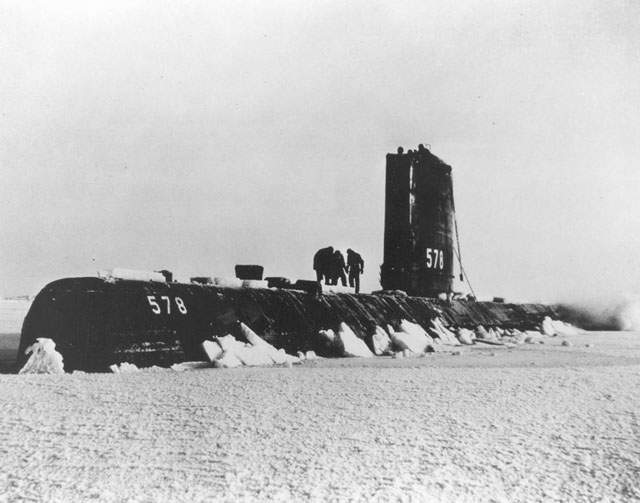
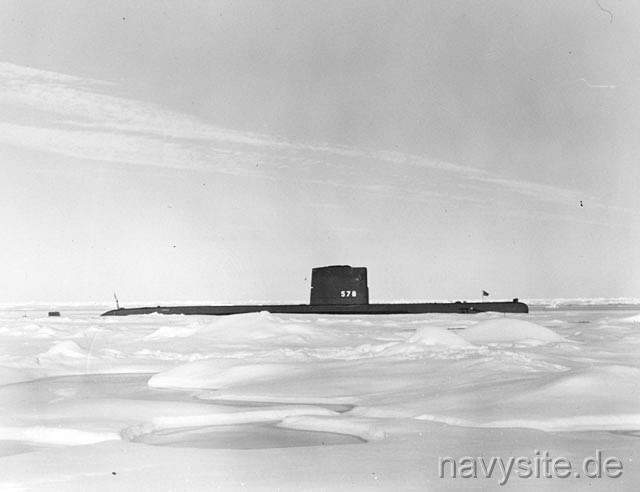
USS SKATE returned to the Arctic in March 1959, this time during the period of extreme cold and maximum ice thickness. The objective was no longer only to reach the high Arctic in summer conditions, but to determine whether a submarine could operate in and under the polar pack during the winter season. Over twelve days under the ice, USS SKATE forced her way upward through thinner ice to the surface ten times and steamed more than 3,000 miles under the pack. On March 17, 1959, she became the first submarine to surface at the North Pole. At the Pole, Commander Calvert and the crew raised an American flag, left a commemorative note in a waterproof container placed in an ice cairn, and conducted a memorial ceremony for Sir Hubert Wilkins, whose ashes were committed to the Arctic. Wilkins had been closely associated with earlier under-ice exploration efforts, including the 1931 expedition in the research submarine NAUTILUS, the former USS O-12. USS SKATE's return to the North Pole in winter therefore linked Cold War naval technology with the longer history of polar exploration.
When USS SKATE returned from the 1959 polar cruise, she received a bronze star in lieu of a second Navy Unit Commendation. The award recognized the first demonstration that submarines could operate in and under Arctic ice during the dead of winter. During the remainder of 1959 and into 1960, USS SKATE participated in exercises intended to strengthen American antisubmarine defenses. These exercises reflected the changing Cold War undersea environment. Nuclear submarines were no longer only experimental machines; they were becoming central to both submarine operations and antisubmarine planning. Every successful Arctic and open-ocean deployment by boats such as USS SKATE forced the Navy to reconsider how submarines could be detected, tracked, supported, and used in wartime.
From January to August 1961, USS SKATE underwent her first regular overhaul at the Electric Boat Division of General Dynamics at Groton. During that overhaul, her reactor was refueled for the first time after more than three years of operations. When she returned to sea, she spent the next several months conducting exercises to rebuild and improve crew readiness after the yard period. In this period, she continued to operate from New London as one of the Atlantic Fleet's small but increasingly important nuclear attack submarines. Her work included fleet exercises, local operations, and undersea testing connected with the development of new tactics and equipment.
On July 7, 1962, USS SKATE again set course from New London for the North Pole. Five days later, USS SEADRAGON (SSN 584) departed Pearl Harbor and headed north from the Pacific side. The two nuclear submarines rendezvoused in the Arctic on July 31, 1962. After meeting, USS SKATE and USS SEADRAGON operated together for more than a week in the polar region. On August 2, 1962, both submarines surfaced at the North Pole, and official greetings and insignia were exchanged between representatives of Submarine Force Atlantic Fleet and Submarine Force Pacific Fleet. The operation was important because it demonstrated not merely that one nuclear submarine could reach and surface at the Pole, but that two submarines from opposite ocean areas could coordinate, rendezvous, and operate together under the Arctic ice. In the strategic environment of the early 1960s, that capability had direct relevance to submarine mobility, navigation, communications, and wartime access to high-latitude routes.
After the 1962 polar operation, USS SKATE returned to New London and resumed local and fleet operations. Public records place her in Arctic-related and acoustic work during this period as well. In 1962, she operated in the Cabot Strait area with USS ENTEMEDOR (SS 340) and USS TUSK (SS 426). In 1963, she again appeared in Cabot Strait operations with USS BECUNA (SS 319) and USS TENCH (SS 417). These activities fit the broader pattern of undersea research and tactical development associated with nuclear submarines, oceanography, sonar, and high-latitude operations. During these years, the submarine force was also adapting to the rapid expansion of Soviet submarine capability and to the increasing importance of the North Atlantic and Arctic approaches in Cold War planning.
On April 28, 1965, USS SKATE entered Norfolk Naval Shipyard at Portsmouth, Virginia, for her second regular overhaul. She was the first nuclear submarine overhauled at that yard. The work included nuclear refueling and installation of the SUBSAFE package, the major submarine-safety program instituted after the loss of USS THRESHER (SSN 593) on April 10, 1963. The SUBSAFE program emphasized hull integrity, seawater-system reliability, emergency recovery capability, certification, and strict control of work affecting submarine survivability. USS SKATE's overhaul therefore belonged not only to her own maintenance cycle but also to the Navy-wide effort to improve submarine safety after the THRESHER disaster. The overhaul lasted until September 1967. When completed, USS SKATE had received her second nuclear refueling and had become the first submarine to complete this major SUBSAFE conversion program.
After sea trials and a shakedown cruise in the Caribbean, USS SKATE returned to New London and resumed work connected with new undersea tactics and equipment. In January 1968, she was assigned to Submarine Development Group Two. That assignment reflected her continued role as an experienced early nuclear submarine used not only for ordinary fleet operations but also for tactical development, equipment evaluation, and specialized submarine work. In October 1968, she deployed to the Mediterranean, where she participated in NATO exercises and operated with the Sixth Fleet for about two months. The deployment placed her in a region where U.S. naval forces maintained a constant Cold War presence among NATO allies and where Soviet naval activity had become an increasing concern. For USS SKATE, the cruise combined the normal work of a nuclear attack submarine with the broader NATO effort to maintain antisubmarine readiness in the Mediterranean.
In March and April 1969, USS SKATE returned to the Arctic for another under-ice operation, this time in company with USS PARGO (SSN 650) and USS WHALE (SSN 638). She departed New London in March for what was her fourth venture into Arctic waters. The three submarines conducted submerged operations under the polar ice pack and researched new concepts of submarine polar tactics. After the operation, USS SKATE visited Faslane, Scotland, and returned to New London on May 13, 1969. The deployment earned USS SKATE a Meritorious Unit Commendation for the period March 24 through April 15, 1969. The mission belonged to a broader phase of U.S. submarine development in which nuclear boats were learning to operate regularly in environments that had previously been treated as exceptional or experimental.
In October and November 1970, USS SKATE took part in the SQUEEZE PLAY exercises, and she again operated in the Arctic environment during the same general period of renewed under-ice work. Public Arctic-operation summaries place USS SKATE and USS HAMMERHEAD (SSN 663) together in the Arctic in late 1970. USS SKATE received another Meritorious Unit Commendation for the period October 12 through November 18, 1970. The 1970 work continued the Navy's effort to turn Arctic navigation, communications, sonar performance, and through-ice operating methods into repeatable submarine capabilities rather than rare demonstrations. For a boat commissioned in 1957, USS SKATE remained a useful platform because she had extensive Arctic experience and a crew structure familiar with the special risks of under-ice operations.
In February and March 1971, USS SKATE again operated in the Arctic Ocean, with Commander David A. Phoenix in command. This operation brought another Meritorious Unit Commendation, awarded for the period February 26 through March 9, 1971. In the public record, the exact route and detailed tactical work of this cruise are not fully available, but the deployment continued the same pattern of high-latitude nuclear-submarine operations that had defined much of USS SKATE's career since 1958. By this time, U.S. nuclear submarines had repeatedly proven that they could reach, navigate, and surface in the polar region; the continuing challenge was to refine navigation, sonar, communications, and tactical methods under ice.
In 1971, USS SKATE began her third major refueling overhaul at Norfolk Naval Shipyard. The overhaul began in 1971, extended into September 1973, and USS SKATE did not return to New London until November 17, 1973. This long yard period removed her from active operations for more than two years. It occurred at a time when the nuclear submarine force was changing rapidly. Newer classes offered higher speeds, improved quieting, more modern sensors, and more advanced weapons systems. USS SKATE remained valuable, but she was no longer a new boat. The overhaul kept her serviceable for continued Atlantic and later Pacific Fleet operations while also reflecting the heavy maintenance demands of first-generation nuclear submarines.
After returning to New London, USS SKATE was assigned to Submarine Squadron Two and resumed Atlantic Fleet work. The post-overhaul period involved the usual sequence of tests, training, local operations, inspections, and gradual restoration of full readiness. In August 1974, she operated as a unit of the Atlantic Fleet. Early in September 1974 she departed New London for a major NATO exercise in the North Atlantic. That exercise placed her in the central Cold War maritime theater where NATO was concerned with Soviet submarine activity, reinforcement routes across the Atlantic, convoy protection, and the ability of allied forces to operate together in demanding northern waters. After the North Atlantic phase, USS SKATE continued in October 1974 to the Mediterranean. She remained deployed through the autumn and early winter and returned to New London at the end of January 1975. This deployment linked the North Atlantic and Mediterranean operating areas in one extended post-overhaul cycle and showed that USS SKATE had returned to front-line fleet use after her long yard period.
During 1974 USS SKATE was also assigned to Commander, Second Fleet, for evaluation work connected with the Interim Sea Control Ship concept. The concept was part of a broader Navy effort to examine ways of providing sea control, antisubmarine warfare, and air support in situations where full-size aircraft carriers might be unavailable or excessive for the mission. For a nuclear submarine such as USS SKATE, participation in such evaluation work fit her long-standing role as a development and test platform. She was no longer only a fleet attack submarine; she was also an experienced nuclear platform used to explore tactics, exercises, and operational concepts relevant to Cold War maritime control.
In April and May 1975, USS SKATE participated in Exercise Solid Shield. During that exercise, she conducted SSN-swimmer operations, a form of work that required the submarine to support swimmer delivery, recovery, or special operations related procedures. Such activity reflected another part of the Navy's submarine mission set: covert or controlled operations involving trained personnel from the sea rather than only torpedo attack, surveillance, or antisubmarine work. After the exercise cycle, USS SKATE received the Submarine Squadron Two antisubmarine warfare "A" in July 1975, recognizing her performance in that mission area. By then, she had returned from a long overhaul, completed Atlantic and Mediterranean operations, participated in concept evaluation, and demonstrated continued value in submarine tactical work.
At the beginning of September 1975, USS SKATE departed New London for UNITAS XVI. UNITAS was the annual U.S. Navy exercise series conducted with South American navies, intended to improve hemispheric naval cooperation, antisubmarine tactics, communications, and interoperability. USS SKATE's participation was especially notable because she was the first nuclear-powered ship to take part in that annual UNITAS series. During the deployment, she visited ports in Argentina, Uruguay, Brazil, Trinidad, and Venezuela. Those port calls were part of the diplomatic and professional side of UNITAS: the exercise was not only tactical training, but also a recurring naval contact program with Latin American partners. USS SKATE returned to New London at the beginning of December 1975.
In April 1976, USS SKATE departed again for a Mediterranean deployment. The deployment returned her to the Sixth Fleet environment, where U.S. naval forces maintained a constant presence among NATO allies and monitored Soviet naval activity in a region affected by Middle Eastern tension, southern European politics, and Cold War naval competition. After returning from the Mediterranean, USS SKATE conducted exercises used to train SEAL Teams, Special Forces, and Marine Force Reconnaissance personnel. These operations continued the special-operations support pattern seen in Solid Shield and reflected the flexibility expected of an experienced nuclear attack submarine.
In 1977, USS SKATE completed her final months as an Atlantic Fleet submarine. Commander R. J. Asafaylo remained in command until September 1977, and the ship continued operations from New London while the Navy prepared to move her to the Pacific. On October 17, 1977, USS SKATE departed New London for transfer to the Pacific Fleet. She arrived at Pearl Harbor, Hawaii, on November 24, 1977, which became her new home port. There she joined the other three SKATE-class submarines as a member of Submarine Squadron Seven. The move shifted her career from the Atlantic, Mediterranean, and Arctic-centered pattern of her first two decades to the Pacific Fleet environment of her final years. Pearl Harbor placed her within a submarine force responsible for a vast operating area that included the central Pacific, western Pacific, northern Pacific, and access routes toward East Asia and the Indian Ocean.
In February 1978, USS SKATE began her fourth major overhaul at Pearl Harbor Naval Shipyard. The overhaul lasted until July 1979 and was the major maintenance event that prepared her for sustained Pacific Fleet operations. During this yard period, she was part of a first-generation nuclear-submarine class being maintained into a period when newer STURGEON-class and LOS ANGELES-class submarines were already becoming more important to the fleet. The overhaul kept USS SKATE operationally useful despite her age and enabled her to shift fully into the Pacific deployment cycle.
After the overhaul, USS SKATE began post-yard work in September 1979 with an eastern Pacific shakedown. She also participated in Fleet Exercise 2-79. This sequence was the Pacific Fleet equivalent of her earlier post-overhaul training cycles: sea trials, restoration of engineering and weapons readiness, crew certification, and renewed tactical integration. After shakedown and fleet exercise work, she participated in Rim of the Pacific 1980, conducted Chief of Naval Operations special-projects work, took part in antisubmarine exercises, and conducted mine-laying operations type training. Those assignments showed the range of tasks still given to an older nuclear attack submarine: major multinational exercise support, special-projects work, antisubmarine training, and preparation for offensive or controlled mining-related missions.
In July 1980, USS SKATE made her first Western Pacific deployment. During that deployment, she operated with units of the U.S. Seventh Fleet and allied navies. The deployment placed her in the central Cold War maritime environment of the Pacific, where U.S. submarine forces supported forward presence, surveillance, antisubmarine readiness, allied exercises, and the broader American security structure in East Asia. The Western Pacific operating area involved a wide range of tasks, from training with friendly forces to patrol and readiness work in waters affected by Soviet Pacific Fleet activity, regional tensions, and the continuing strategic importance of sea routes between Hawaii, Guam, Japan, the Philippines, and the western Pacific. USS SKATE returned to Pearl Harbor on December 23, 1980, exactly 23 years after her commissioning.
During 1981 USS SKATE continued Pacific Fleet operations from Pearl Harbor. After the first Western Pacific deployment, she returned to the standard cycle of maintenance, local operations, training, inspections, and readiness work that prepared her for another deployment. By this time, the Cold War was again intensifying. The Soviet invasion of Afghanistan, the continuing effects of the Iranian Revolution, and increasing U.S. concern over Soviet naval activity influenced American naval planning in both the Indian Ocean and the Pacific.
Commander Wayne J. Fernandez assumed command of USS SKATE in May 1982. In April 1982, shortly before or during that command transition period, USS SKATE began her second Western Pacific deployment. She again operated with Seventh Fleet and allied forces, continuing the late-career shift from Atlantic-Arctic development work to Pacific forward operations. She returned to Pearl Harbor in September 1982. The year was a strong one for the ship's internal readiness record. USS SKATE received the Battle Efficiency "E", the Engineering "E", the Damage Control "DC" award, the Communications "C", and the Deck Seamanship Award. These awards reflected performance across combat readiness, engineering reliability, ship survivability, communications, and seamanship during a period when the submarine was already one of the older nuclear-powered attack submarines in service.
In August 1983, USS SKATE departed on her third Western Pacific deployment. The deployment continued into the following year and ended with her return to Pearl Harbor in February 1984. The voyage took place during a tense period in the Pacific and northern Pacific strategic environment, following the 1983 shootdown of Korean Air Lines Flight 007 and amid continuing U.S.-Soviet naval competition.
After returning from the third Western Pacific deployment, USS SKATE continued local operations from Pearl Harbor. During the early and mid-1980s, public evidence for specific port visits and exercises becomes limited, but the ship remained an active member of the Pacific submarine force until the Navy began preparing her for retirement. USS SKATE was decommissioned on September 12, 1986. She was struck from the Naval Vessel Register on October 30, 1986. After decommissioning, she entered the Navy's nuclear-powered ship and submarine recycling process at Puget Sound Naval Shipyard, Bremerton, Washington. Recycling was completed on March 6, 1995. Her disposal closed a service life that had lasted almost 29 years from commissioning and almost 40 years from the beginning of the nuclear submarine program that had produced her.
USS SKATE's documented awards included two Navy Unit Commendations, three Meritorious Unit Commendations, the National Defense Service Medal, and later service ribbons and departmental awards associated with her operating record.
USS SKATE Image Gallery:
![]() | ![]() | ![]() | ![]() |
Back to Submarines list.
Back to ships list.
Back to selection page.
Back to 1st page.