![]() |
Search the Site with
|
![]() | ![]() |
USS SEAWOLF was the Navy's second nuclear-powered attack submarine and the first submarine to be equipped with a S2G sodium-cooled nuclear reactor. But due to the difficulties of running a sodium-cooled reactor, the Navy decided to replace SEAWOLF's sodium-cooled reactor with a water-cooled one and use only water-cooled designs in the future. The conversion of the reactor was conducted from December 12, 1958 thru September 30, 1960, at Electric Boat Division of General Dynamics Corporation, Groton, CT. Although fully armed, the SEAWOLF mainly served as a test and special mission platform. In 1968, the submarine was designated "second-line submarine" and continued its trials duty. USS SEAWOLF was for example used for suitability tests with small submarine rescue vehicles including the DSRV.
Decommissioned after 30 years of service on March 30, 1987, the SEAWOLF was stricken from the Navy list on July 10, 1987. The submarine spent the following years at the Puget Sound Naval Shipyard, Bremerton, Wash., until SEAWOLF entered the Navy's Nuclear Powered Surface Ship and Submarine Recycling Program there on October 1, 1996. Recycling was completed on September 30, 1997.
| General Characteristics: | Awarded: July 21, 1952 |
| Keel laid: September 7, 1953 | |
| Launched: July 21, 1955 | |
| Commissioned: March 30, 1957 | |
| Decommissioned: March 30, 1987 | |
| Builder: Electric Boat Division of General Dynamics Corporation, Groton, CT. | |
| Propulsion system: one S2Wa nuclear reactor | |
| Propellers: two | |
| Length: 337.6 feet (102.9 meters) | |
| Beam: 27.56 feet (8.4 meters) | |
| Draft: 22 feet (6.7 meters) | |
| Displacement: Surfaced: approx. 3,400 tons Submerged: approx. 4,280 tons | |
| Speed: Surfaced: approx. 19 knots Submerged: approx. +20 knots | |
| Armament: six 533 mm torpedo tubes | |
| Crew: 13 Officers, 92 Enlisted |
Crew List:
This section contains the names of sailors who served aboard USS SEAWOLF. It is no official listing but contains the names of sailors who submitted their information.
Accidents aboard USS SEAWOLF:
| Date | Where | Events |
|---|---|---|
| August 19, 1956 | Groton, Conn. | The experimental sodium-cooled nuclear reactor of USS SEAWOLF suffers a failure in the steam plant during a full power test run while the submarine is at Groton, Conn. A leak of sodium-pottasium alloy being used as the third fluid in the steam generator aggravates stress corrosion in the system, causing two cracks in steam piping and a leak in a superheater. Makeshift repairs allow the SEAWOLF to complete her initial sea trials on reduced power in February 1957. Due to the difficulties of running a sodium-cooled reactor, the Navy decides to replace SEAWOLF's sodium-cooled reactor with a water-cooled one and use only water-cooled designs in the future. |
| January 30, 1968 | approx. 65 miles east of Cape Cod, Mass. | USS SEAWOLF runs aground while submerged and damages her rudder. There are no injuries and the SEAWOLF returns to Groton, Conn., for repairs. |
| November 14, 1970 | south of Guantanamo Bay, Cuba | USS SEAWOLF suffers a breakdown in the engineroom main drain while en route to the Pacific. The SEAWOLF surfaces dead in the water and calls for assistance. The USS BLANDY (DD 943) gets underway to the SEAWOLF and tows the submarine. The next day the SEAWOLF is able to correct the problem herself and gets underway under her own power for Guantanamo Bay. |
USS SEAWOLF History:
USS SEAWOLF was the third U.S. Navy ship to bear the name and the second nuclear-powered submarine to enter U.S. Navy service. She was also one of the most unusual submarines of the first nuclear generation, because she was built with a liquid-metal, sodium-cooled reactor rather than the pressurized-water reactor that powered USS NAUTILUS (SSN 571) and later became the standard U.S. naval reactor type. The contract for USS SEAWOLF was awarded on July 21, 1952, while the Korean War was still being fought and while the United States was already moving quickly from wartime submarine experience toward nuclear propulsion. Her keel was laid down by the Electric Boat Division of General Dynamics at Groton, Connecticut, on September 7, 1953. She was launched on July 21, 1955, sponsored by Mrs. W. Sterling Cole, wife of Representative W. Sterling Cole of New York, who was closely associated with atomic-energy legislation. USS SEAWOLF was commissioned at New London, Connecticut, on March 30, 1957, with Commander Richard B. Laning in command.
USS SEAWOLF entered service as both an operational submarine and a developmental platform. She followed USS NAUTILUS into the fleet, but her propulsion plant represented a different technical route. Her original S2G reactor used liquid sodium as coolant, an arrangement intended to test whether higher operating temperatures and different thermal characteristics might offer advantages for submarine propulsion. The concept was technically ambitious, but the plant proved difficult to maintain and did not become the Navy's preferred path. USS SEAWOLF's early service therefore had importance beyond her own deployments: her experience helped confirm that pressurized-water reactor technology, rather than sodium-cooled propulsion, would become the practical standard for U.S. nuclear-powered warships.
Only three days after commissioning, on April 2, 1957, USS SEAWOLF departed New London for her shakedown cruise off Bermuda. She returned on May 8, 1957. Between May 16 and August 5, 1957, she made two voyages to Key West, Florida, and took part in intensive training exercises. This early work tested her engineering plant, diving characteristics, sonar, torpedo systems, nuclear operating procedures, communications, habitability, and crew endurance. In the late 1950s, every deployment by a nuclear submarine still had a developmental character. The Navy was learning how submarines could operate when they were no longer limited by battery endurance, snorkeling, or the need to surface frequently.
On September 3, 1957, USS SEAWOLF steamed across the North Atlantic to participate in NATO exercises. She surfaced off Newport, Rhode Island, on September 25, 1957, after a nonstop run of 6,331 nautical miles. On September 26, 1957, President Dwight D. Eisenhower embarked for a short cruise. That presidential visit gave the new submarine public and political visibility at a time when nuclear propulsion was both a military capability and a national technological symbol. USS SEAWOLF had shown that a submarine could remain submerged and underway across an oceanic distance in a manner that conventional submarines could not match.
In November 1957, USS SEAWOLF cruised to the Caribbean for exercises. In December she began an availability period that lasted until February 6, 1958. She then resumed operations along the U.S. East Coast until early August. On August 7, 1958, she submerged and did not surface again until October 6, 1958. During those 60 days she logged more than 13,700 nautical miles while remaining independent of the earth's atmosphere. The voyage demonstrated that a nuclear-powered submarine could remain submerged for the length of a normal war patrol, changing the practical meaning of submarine endurance. For this achievement USS SEAWOLF received the Navy Unit Commendation. The submerged endurance run showed that a submarine could remain hidden, mobile, and operational without the frequent surfacing or snorkeling cycles that had shaped diesel-electric operations.
The same year also brought the end of the sodium-cooled reactor experiment. On December 12, 1958, USS SEAWOLF returned to Electric Boat at Groton for conversion from the sodium-cooled S2G reactor plant to a pressurized-water S2Wa reactor plant. She was placed out of commission during the conversion and remained out of commission until September 30, 1960. This was not an ordinary repair period. The original reactor plant and associated systems had to be removed, and the submarine had to be rebuilt around a different nuclear propulsion plant. The change marked the practical end of the Navy's experiment with sodium-cooled submarine propulsion and aligned USS SEAWOLF with the pressurized-water technology used in the rest of the American nuclear-powered submarine force.
After recommissioning on September 30, 1960, USS SEAWOLF began a three-week period of independent operations on October 25, 1960, and returned to fleet operations in November and December. On January 9, 1961, she sailed to San Juan, Puerto Rico, for local operations. On January 25, 1961, she received orders to locate and track the Portuguese passenger liner SS SANTA MARIA, which had been seized two days earlier by opponents of the Portuguese regime. USS SEAWOLF made contact with the liner off Brazil on February 1, 1961. After SS SANTA MARIA surrendered at Recife, USS SEAWOLF returned to San Juan and continued East Coast operations. The episode placed a nuclear submarine into a politically sensitive maritime incident far from U.S. home waters and showed that the new submarine force could be used not only in fleet exercises but also in real-time crisis tracking.
On July 7, 1961, USS SEAWOLF began a two-month oceanographic voyage that took her across the Atlantic to Portsmouth, England. She returned to New London on September 19, 1961. The voyage reflected another important role of early nuclear submarines: gathering oceanographic, acoustic, and operational data needed for undersea navigation, sonar performance, antisubmarine warfare, and submarine tactics. During 1962, the public record places USS SEAWOLF mainly in local and fleet operations from New London and Atlantic Fleet operating areas.
In April 1963, USS SEAWOLF took part in the search for USS THRESHER (SSN 593), which was lost during deep-diving trials east of Cape Cod on April 10, 1963. The loss of USS THRESHER was one of the defining submarine disasters of the Cold War. The search involved surface ships, submarines, aircraft, and oceanographic vessels, and the accident led to major changes in U.S. submarine safety procedures through the SUBSAFE program. For USS SEAWOLF, participation in the search came only a few years after her own reactor conversion and placed her in an operation combining sonar search, navigation, deep-ocean investigation, and the Navy's urgent effort to understand the loss of a modern nuclear submarine.
USS SEAWOLF continued local and fleet operations until April 1964. On April 28, 1964, she departed New London for the Mediterranean and a deployment of about three and a half months with the Sixth Fleet. During this period, she operated with USS ENTERPRISE (CVAN 65), USS LONG BEACH (CGN 9), and USS BAINBRIDGE (DLGN 25) in early all-nuclear task-force operations. The combination of a nuclear-powered aircraft carrier, nuclear-powered surface combatants, and a nuclear-powered submarine had strategic and symbolic value during the Cold War. It demonstrated extended endurance, high-speed mobility, and the ability of nuclear-powered naval forces to operate together far from home ports. USS SEAWOLF's Mediterranean work therefore belonged both to normal Sixth Fleet activity and to the Navy's broader demonstration of nuclear-powered fleet capability. The deployment took place while the Mediterranean remained a major theater of NATO presence, Soviet naval interest, and continuing tension in the Middle East.
After returning from the Mediterranean, USS SEAWOLF conducted further East Coast exercises until May 5, 1965. On that date, she entered Portsmouth Naval Shipyard at Kittery, Maine, for refueling and extensive overhaul. The overhaul also brought her up to SUBSAFE standards instituted after the loss of USS THRESHER. The yard period lasted until September 1966. It was a major interruption in her operating career, but it reflected the Navy's post-THRESHER emphasis on hull integrity, seawater systems, emergency recovery, and rigorous submarine safety certification. During the rest of 1966 and into 1967, USS SEAWOLF completed post-overhaul work and prepared to return to regular operations.
On August 24, 1967, USS SEAWOLF sailed from Portsmouth, New Hampshire, for New London, Connecticut, which again became her home port. The following month she sailed to the Caribbean for refresher training and weapons trials. In early October, she required a propeller replacement at Charleston, South Carolina, and then conducted sea trials in the Bahama Islands for the remainder of that month. By the end of 1967 she was back at New London. This was the normal post-overhaul pattern for a nuclear submarine: return to home port, refresher training, weapons and sonar work, correction of mechanical defects, and trials in controlled operating areas before renewed fleet employment.
On January 30, 1968, while operating from New London, USS SEAWOLF grounded off the coast of Maine and badly damaged her stern. She was towed back to New London for repairs. The damage kept her out of seagoing operations for more than a year. She did not put to sea again until March 20, 1969, when she began sea trials. During June and July 1969 she operated in the Caribbean, conducting underwater sound and weapons system tests. From September 29 to December 21, 1969, she deployed with the Sixth Fleet during a period marked by Cold War naval competition, Arab-Israeli tension after the 1967 war, and increased Soviet naval presence in the region.
USS SEAWOLF operated along the U.S. East Coast through most of 1970. On November 9, 1970, her home port was changed to Vallejo, California, and she departed for the West Coast. On November 17, 1970, she transited the Panama Canal and shifted operational control to Submarine Force, Pacific Fleet. The move marked a major turning point in her career. Instead of continuing as an Atlantic Fleet nuclear attack submarine, USS SEAWOLF was about to become a heavily modified special-projects platform. Her new operating environment would be the Pacific, where U.S. submarine forces were increasingly involved in long-duration and highly sensitive Cold War undersea missions.
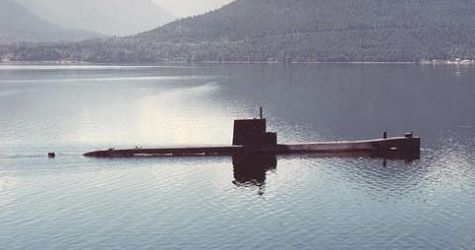
On January 8, 1971, USS SEAWOLF entered dry dock at Mare Island Naval Shipyard for overhaul and conversion to a special-projects platform. She remained in that conversion period until June 21, 1973. The details of many of her later missions remain partly classified, and the public record does not support a full mission-by-mission narrative. What can be said from open material is that the conversion substantially changed the boat. The hull was lengthened forward of the sail, and visible external and internal changes supported specialized undersea work. Public descriptions of the conversion refer to equipment for precise maneuvering, undersea retrieval or sensor work, diver support, and bottom-station operations. USS SEAWOLF's new role made use of her large hull, nuclear endurance, and ability to operate covertly for extended periods. The conversion placed her within the Navy's Cold War undersea special-projects community rather than the normal attack submarine deployment cycle.
After the conversion period at Mare Island, USS SEAWOLF moved up the coast to Bangor, Washington, on June 21, 1973. She returned to Mare Island on September 4, 1973. Through the remainder of 1973 and into 1974, she operated in testing and evaluation associated with her new configuration. This period was essential because the conversion had created a very different submarine from the one commissioned in 1957. She needed to prove not only her engineering reliability but also her ability to maneuver precisely, remain steady, and operate specialized equipment safely in demanding submerged conditions.
In 1974, USS SEAWOLF completed her post-conversion testing and evaluation period and conducted her first Pacific Fleet deployment. She operated independently for about three months. For that performance she received a second Navy Unit Commendation. The public record does not provide a detailed itinerary or a list of ports for this deployment, and that absence is consistent with the special-projects nature of her work. In 1975, USS SEAWOLF came under the exclusive direction of Submarine Development Group One. For outstanding performance during the 1974-1975 period she received a Battle Efficiency "E". Her association with Submarine Development Group One placed her among Navy units used for advanced undersea operations, special equipment employment, and highly controlled missions rather than routine fleet exercises.
In 1976, USS SEAWOLF received another Battle Efficiency "E" and the Engineering "E". During her second Pacific Fleet deployment, she conducted independent submerged operations for roughly three months and remained submerged for an exceptionally long continuous period. Public secondary accounts differ on whether the figure was 87 or 89 consecutive submerged days, setting a U.S. Navy endurance record for that operating period. For that deployment, USS SEAWOLF received another Navy Unit Commendation. The achievement showed that, although she was no longer a new submarine, her nuclear plant, crew, and modified systems could support missions of extraordinary length.
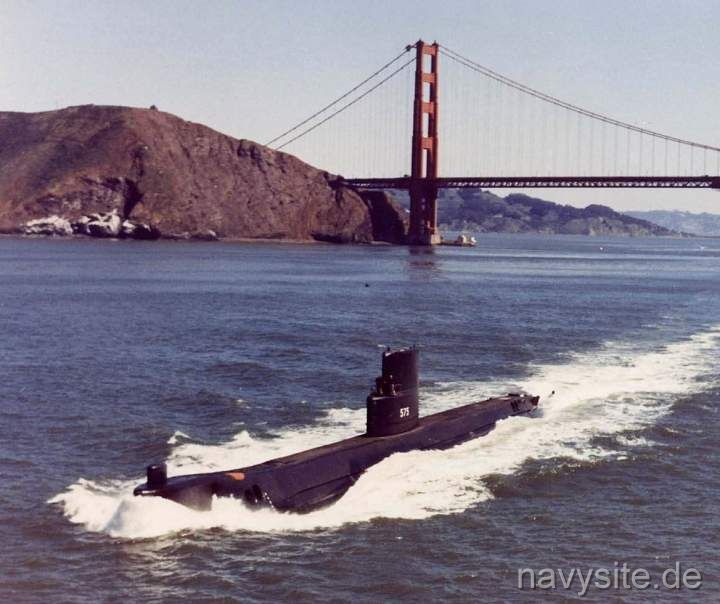
In 1977, USS SEAWOLF again received the Battle Efficiency "E" and Engineering "E" recognition. During her third Pacific Fleet deployment she conducted 79 consecutive days of independent submerged operations. She received another Navy Unit Commendation and the Navy Expeditionary Medal. A photograph from August 1977 shows USS SEAWOLF departing San Francisco Bay, a rare public visual record from a period when many details of her deployments were not openly released. In 1978, she conducted her fourth Pacific Fleet deployment.
During 1979 and 1980, USS SEAWOLF remained part of the same special-projects and Pacific Fleet operating pattern. Publicly available details are sparse. She was an aging early nuclear submarine by this time, but one with unique modifications and a mission set that kept her in demand. Public summaries describe a turbine-generator casualty during sea trials on February 29, 1980, which caused a major engine-room fire and returned the submarine to dry dock for further work. The broader context was a period of renewed Cold War tension: the Iranian Revolution, the hostage crisis in Tehran, the Soviet invasion of Afghanistan, and increasing U.S. concern about Soviet naval activity all heightened the value of undersea intelligence and surveillance. USS SEAWOLF's specific assignments are not fully public, so her role in this period is best described as continued special-projects service from the Pacific rather than as ordinary attack-submarine deployments.
In August 1981, USS SEAWOLF deployed on her fifth Pacific Fleet deployment. She returned to home port in October 1981 and received the Navy Expeditionary Medal. The available public record gives the deployment period and recognition rather than a detailed operational track. Later accounts of Cold War submarine special operations associate USS SEAWOLF with sensitive undersea missions in the northern and western Pacific operating areas. By this point, she had served for nearly a quarter century and had been substantially rebuilt more than once, yet she remained operationally valuable because of her unusual configuration and experienced special-projects role.
In 1983, USS SEAWOLF conducted her sixth Pacific Fleet deployment, lasting 76 days, and returned to Mare Island Naval Shipyard in May 1983. After this deployment she received another Navy Expeditionary Medal, additional Battle Efficiency "E" and Engineering recognition, a Supply "E", and a Damage Control "DC" award. These awards indicate that, despite age and complexity, the submarine's crew and departments continued to meet demanding operational and readiness standards.
In 1984, USS SEAWOLF conducted a 93-day deployment to the Western Pacific and returned in July. After that deployment she continued a high operating tempo with numerous local operations. She received her third consecutive Supply "E", a Communications "C", and the Deck Seamanship Award. The 1984 deployment took place during a period of heightened Cold War concern in the Pacific after the 1983 shootdown of Korean Air Lines Flight 007 and amid continuing U.S.-Soviet competition in the North Pacific.
The final phase of USS SEAWOLF's active career came in the mid-1980s. In April 1986, she conducted her last Western Pacific deployment and returned to Mare Island in June 1986 to prepare for decommissioning. By then, the Navy's submarine force had changed dramatically from the force into which USS SEAWOLF had been commissioned. Later nuclear attack submarines were in service in large numbers, ballistic-missile submarines had become central to strategic deterrence, and more modern special-mission submarines had taken over roles for which USS SEAWOLF had once been uniquely useful. Her steam plant, hull form, and early nuclear-era systems belonged to an earlier generation, even though her special-projects conversion had extended her usefulness far beyond that of most experimental ships.
USS SEAWOLF was decommissioned on March 30, 1987, exactly 30 years after she entered commissioned service. She was struck from the Naval Vessel Register on July 10, 1987. Her inactivation ended one of the most unusual careers in the U.S. nuclear submarine force: first as the only American submarine built with a sodium-cooled reactor, then as a converted pressurized-water nuclear attack submarine, and finally as a Pacific special-projects platform. The former USS SEAWOLF entered the Navy's nuclear-powered ship and submarine recycling program on October 1, 1996, and recycling was completed on September 30, 1997.
Across her career, USS SEAWOLF's documented awards included Navy Unit Commendations, a Meritorious Unit Commendation, Battle Efficiency and departmental awards, Navy Expeditionary Medals, and the National Defense Service Medal.
USS SEAWOLF Image Gallery:
![]() |
Back to Submarines list.
Back to ships list.
Back to selection page.
Back to 1st page.